1. Introduction
The process of transformation of a continuous-valued signal into a discrete-valued one is called ‘quantization’. It has broad applications in engineering and technology. We refer to [
1,
2,
3] for surveys on the subject and comprehensive lists of references to the literature; see also [
4,
5,
6,
7]. For mathematical treatment of quantization, one is referred to Graf–Luschgy’s book (see [
6]). For some other recent papers on quantization. one can see [
1,
2,
3,
6,
7,
8,
9,
10,
11,
12,
13,
14,
15,
16,
17,
18]. Recently, Pandey and Roychowdhury introduced the concepts of constrained quantization and the conditional quantization (for example, see [
19,
20,
21,
22]). This paper deals with conditional quantization.
Definition 1. Let P be a Borel probability measure on equipped with a Euclidean metric d induced by the Euclidean norm . Let be given with for some . Then, for with , the nth conditional quantization error for P with respect to the conditional set β is defined aswhere card represents the cardinality of the set A. We assume that
to make sure that the infimum in (
1) exists (see [
19]). For a finite set
and
, by
we denote the set of all elements in
that are nearest to
a among all the elements in
, i.e.,
is called the
Voronoi region in
generated by
.
Definition 2. A set , where for , for which the infimum in exists and contains no less than ℓ elements and no more than n elements is called a conditional optimal set of n-points for P with respect to the conditional set β.
Let
be a strictly decreasing sequence, and write
. Then, the number
if it exists, is called the
conditional quantization dimension of
P and is denoted by
. The conditional quantization dimension measures the speed at which the specified measure of the conditional quantization error converges as
n tends to infinity. For any
, the number
if it exists, is called the
κ-dimensional conditional quantization coefficient for
P.
In this paper, we investigate the conditional quantization for uniform distributions on the unit line segments and on regular m-sided polygons, where , inscribed in a unit circle.
1.1. Delineation
In this paper, there are three sections in addition to the section that contains the basic preliminaries. First, we have proved Proposition 1. In
Section 3, as a special case of Proposition 1, we explicitly determine the conditional optimal sets of
n-points and the
nth conditional quantization errors for a uniform distribution with two interior elements as the conditional set for all
on the interval
. In
Section 4, as an extension of Proposition 1, we calculate the conditional optimal sets of
n-points and the
nth conditional quantization errors for
uniformly distributed interior elements on the interval
. On the other hand,
Section 5 is an application of Proposition 1. It deals with a uniform distribution defined on the boundary of a regular
m-sided polygon. Let
P be a uniform distribution defined on the boundary of a regular
m-sided polygon inscribed in a unit circle. After the introduction of conditional quantization, we know that the quantization dimension and the quantization coefficient do not depend on the conditional set (see [
21]). Using this scenario, in
Section 5, we calculate the quantization coefficient for the uniform distribution
P defined on the boundary of the regular
m-sided polygon inscribed in the unit circle by calculating the conditional quantization coefficient for
P with respect to the conditional set
, which consists of all the vertices of the regular polygon. In addition, we also give an explicit formula to calculate the conditional optimal sets of
n-points and the
nth conditional quantization errors for the uniform distribution
P for all
, where
m is the number of vertices of the
m-sided polygon.
1.2. Motivation and Significance
Conditional quantization has recently been introduced by Pandey–Roychowdhury in [
21]. It has significant interdisciplinary applications: for example, in radiation therapy of cancer treatment to find the optimal locations of
n centers of radiation, where
k centers for some
of radiation are preselected, the conditional quantization technique can be used. There are many interesting open problems that can be investigated. The work in this paper is an advancement in this direction. In [
23], when there is no conditional set, Hansen et al., in a proposition, first determined the optimal sets of
n-means and the
nth quantization errors for the probability distribution
P defined on the boundary of a regular
m-sided polygon, when
n is of the form
for some
. Then, with the help of the proposition, they showed that the quantization coefficient for
P exists and equals
, i.e.,
In this paper, we have also calculated the quantization coefficient for the same uniform distribution
P, but the work in this paper is much simpler than the work to calculate the quantization coefficient done by Hansen et al. in [
23].
2. Preliminaries
For any two elements
and
in
, we write
which gives the squared Euclidean distance between the two elements
and
. Two elements
p and
q in an optimal set of
n-points are called
adjacent elements if they have a common boundary in their own Voronoi regions. Let
e be an element on the common boundary of the Voronoi regions of two adjacent elements
p and
q in an optimal set of
n-points. Since the common boundary of the Voronoi regions of any two elements is the perpendicular bisector of the line segment joining the elements, we have
We call such an equation a
canonical equation. Notice that any element
can be identified as an element
. Thus,
where
and
, defines a nonnegative real-valued function on
. On the other hand,
where
, defines a nonnegative real-valued function on
.
Let
P be a Borel probability measure on
that is uniform on its support the closed interval
. Then, the probability density function
f for
P is given by
Hence, we have
for any
, where
d stands for differential.
Notation 1. Let α be a discrete set. Then, for a Borel probability measure μ and a set A, by , it is meant the distortion error for μ with respect to the set α over the set A, i.e., The following proposition is a generalized version of Proposition 2.1, Proposition 2.2, and Proposition 2.3 that appear in [
21].
Proposition 1. Let P be a uniform distribution on the closed interval and be such that . For with , let be a conditional optimal set of n-points for P with respect to the conditional set such that contains k elements from the closed interval , ℓ elements from the closed interval and m elements from the closed interval for some with and . Then, ,with the conditional quantization error Proof. Notice that the element
c in the conditional set
is common to both the intervals
and
, the element
d in the conditional set
is common to both the intervals
and
, and so
c and
d are counted two times. Hence,
. We have
Let
be a conditional optimal set of
n-points such that
Then, we can write
such that
We now prove the following claim.
Claim.
Since there is no restriction on the locations of the elements
for
, they must be the conditional expectations in their own Voronoi regions. Hence, we have
By (
3), we have
Similarly, by (4) for
, we have
and by (5), we deduce
Combining all the expressions for
for
, we have
Thus, the claim is true. Now, by (
6), we have
Thus, we have
for
. The distortion error due to the elements
is given by
the minimum value of which is
and it occurs when
. Putting the values of
, we have
Since the closed interval
is a line segment and
P is a uniform distribution, proceeding in the similar way as the proof given in the above claim, we have
implying
Thus, we have
for
. The distortion error contributed by the
ℓ elements in the closed interval
is given by
Again, the closed interval
is a line segment and
P is a uniform distribution. Proceeding in the similar way as the proof given in the above claim, we have
implying
Thus, we have
for
. The distortion error contributed by the
m elements is given by
the minimum value of which is
and it occurs when
. Putting the values of
, we have
Since
for
,
for
, and
, and
the proposition is yielded. □
In the following sections, we give the main results of the paper.
3. Conditional Optimal Sets of n-Points and the Conditional Quantization Errors with Two Interior Elements in the Conditional Set for All on a Unit Line Segment
In this section, for the uniform distribution
P on the line segment
with respect to the conditional set
, we calculate the conditional optimal sets of
n-points and the
nth conditional quantization errors for all
with
. Let
be a conditional optimal set of
n-points with the
nth conditional quantization error
for all
. Let
,
, and
. Then,
, and
. By Proposition 1, we know that
Notice that
with the
nth conditional quantization error
Proposition 2. The optimal set of two points is the set with
Proof. By definition, the conditional optimal set of two points is the conditional set
itself, and the corresponding conditional quantization error is given by
Thus, the proposition is yielded. □
Proposition 3. The conditional optimal set of three points is the set with
Proof. By Equation (
8), we see that
Since
is minimum among all the above possible errors, we can deduce that
,
, and
. Hence, by (7), we obtain the conditional optimal set of three points as
with
□
Proposition 4. The conditional optimal set of four points is the set with
Proof. Considering all possible errors
we see that it is minimum when
and
. Hence, using (
7) and (
8), we deduce that
with
□
Proceeding in the similar way as the previous propositions, we can deduce the following two propositions:
Proposition 5. The conditional optimal set of five points is the set with
Proposition 6. The conditional optimal set of six points is the set with
Lemma 1. Let be such that for some . Let , , and . Then, .
Proof. Let
for some
, and
be the positive integers as defined in the hypothesis. Since
, by (
8), we have
which is minimum if
and
. Then,
. Thus, we see that
, which is the lemma. □
As a consequence of Lemma 1, we deduce the following corollary.
Corollary 1. Let be a conditional optimal set of n points with , , and . Then, for , we have , and .
Let us now give the following theorem, which is the main theorem in this section.
Theorem 1. For with , let be a conditional optimal set of n points for P. Let , , and . For some , if , then ; if , then ; if , then ; if , then .
Proof. By Lemma 1, it is known that if , then . Using a similar technique to that used in Lemma 1, we can show that if , then ; if , then ; if , then . Thus, the proof of the theorem is complete. □
Note 1. By Theorem 1, for any given , we can easily calculate the values of . Since the values of depend on n, writing , we have Notice that if for , then we haveimplying Conditional Optimal Sets of n Points and the nth Conditional Quantization Errors
Let
be a positive integer. To determine the optimal sets of
n points and the
nth conditional quantization errors, first using Theorem 1, we determine the corresponding values of
, and
m. Once
are known, by using (
7), we calculate the sets
,
, and
. Then,
is given by
and the
nth conditional quantization error is obtained by using the formula (
8). □
Example 1. Let , then, as , where , by Theorem 1, we have . Hence, by (7) and (8), we have the nth conditional optimal set of n points for aswith the nth conditional quantization error . Theorem 2. The conditional quantization dimension of the probability measure P exists, and .
Proof. For any
with
, there exists a positive integer
x depending on
n such that
. Then,
. By (
8), we see that
and
as
, and so, by the squeeze theorem,
as
, i.e.,
. We can take
n large enough so that
. Then,
yielding
Notice that
Hence,
, i.e., the conditional quantization dimension
of the probability measure
P exists and
. Thus, the proof of the theorem is complete. □
Theorem 3. The -dimensional quantization coefficient for P exists as a finite positive number and equals .
Proof. For any
with
, there exists a positive integer
x depending on
n such that
. Then,
and
. Since
by the squeeze theorem, we have
, which is the theorem. □
4. Conditional Optimal Sets of n Points and the nth Conditional Quantization Errors with (k − 1) Interior Elements and One Boundary Element in the Conditional Set for All n ≥ k on a Unit Line Segment
In this section, for the uniform distribution
P on the line segment
with respect to the conditional set
, we calculate the conditional optimal sets of
n points and the
nth conditional quantization errors for all
with
. Let
be a conditional optimal set of
n points with the
nth conditional quantization error
, where
with
. Write
Notice that
satisfies
,
for
. By Proposition 1, we know that
and
for
. Notice that
Proposition 7. The optimal set of k points is the set with
Proof. By definition, the conditional optimal set of
k points is the conditional set
itself, and the corresponding conditional quantization error is given by
Thus, the proposition is yielded. □
Lemma 2. Let be such . Let be the positive integers as defined by (9). Then, for , . Proof. Recall that for
,
. Let us first assume that
is an even number, i.e.,
for some
. Then,
By routine, we see that the above expression is a minimum if
. Similarly, if
for some
, then we see that the above expression is a minimum if
, or
. This yields the fact that, for
,
, which is the lemma. □
Lemma 3. Let be such . Let be the positive integers as defined by (9). Then, for , with . Proof. Recall that
and for
, we have
. Let us first assume that
is an even number, i.e.,
, i.e.,
for some
with
. Then,
By routine, we see that the above expression is a minimum if
. Similarly, if
for some
, then we see that the above expression is a minimum if
. Thus, for
, we have
with
, which is the lemma. □
Let us now give the following theorem, which is the main theorem is this section. This theorem helps us to determine the conditional optimal sets of n points and the nth conditional quantization errors for all with .
Theorem 4. For , let be a conditional optimal set of n points such that some and . Then,
- (i)
if , then ;
- (ii)
if , then and for , where is any subset of elements of the set .
Proof. The proof follows as a consequence of Lemmas 2 and 3. □
Remark 1. Notice that in of Theorem 4, we have ; on the other hand, in of Theorem 4, we have , i.e., in the sum an extra term occurs. This happens because, in the conditional optimal set of n points, elements from the conditional set are counted two times.
Conditional Optimal Sets of n Points and the nth Conditional Quantization Errors
Let
be a positive integer. To determine the optimal sets of
n points and the
nth conditional quantization errors, first using Theorem 4, we determine the values of
, where
. Once
are known by using the formulae given in (
10) and (
11), we calculate the sets
and the corresponding distortion errors
for all
. Then, using the expressions in (
12), we obtain the conditional optimal set
and the corresponding
nth conditional quantization error
. As an illustration, see Example 2 given below. □
Example 2. Let P be the uniform distribution on the closed interval . Choose , i.e., the conditional set is . Then, the optimal set of n points for any exists. Notice that, by Proposition 7, the conditional optimal set of five points is the conditional set β with the conditional quantization errorTo determine a conditional optimal set of n points, for some n, say, we proceed as follows: We have , i.e., we have and . Recall Theorem 4. Let for . Choose any . Let . Then, , yielding , , and . Then, using (10) and (11), we have
Hence, using the expressions in (12), we obtain 5. Conditional Quantization for Uniform Distributions on the Boundaries of Regular Polygons Inscribed in a Unit Circle
Let the equation of the unit circle be
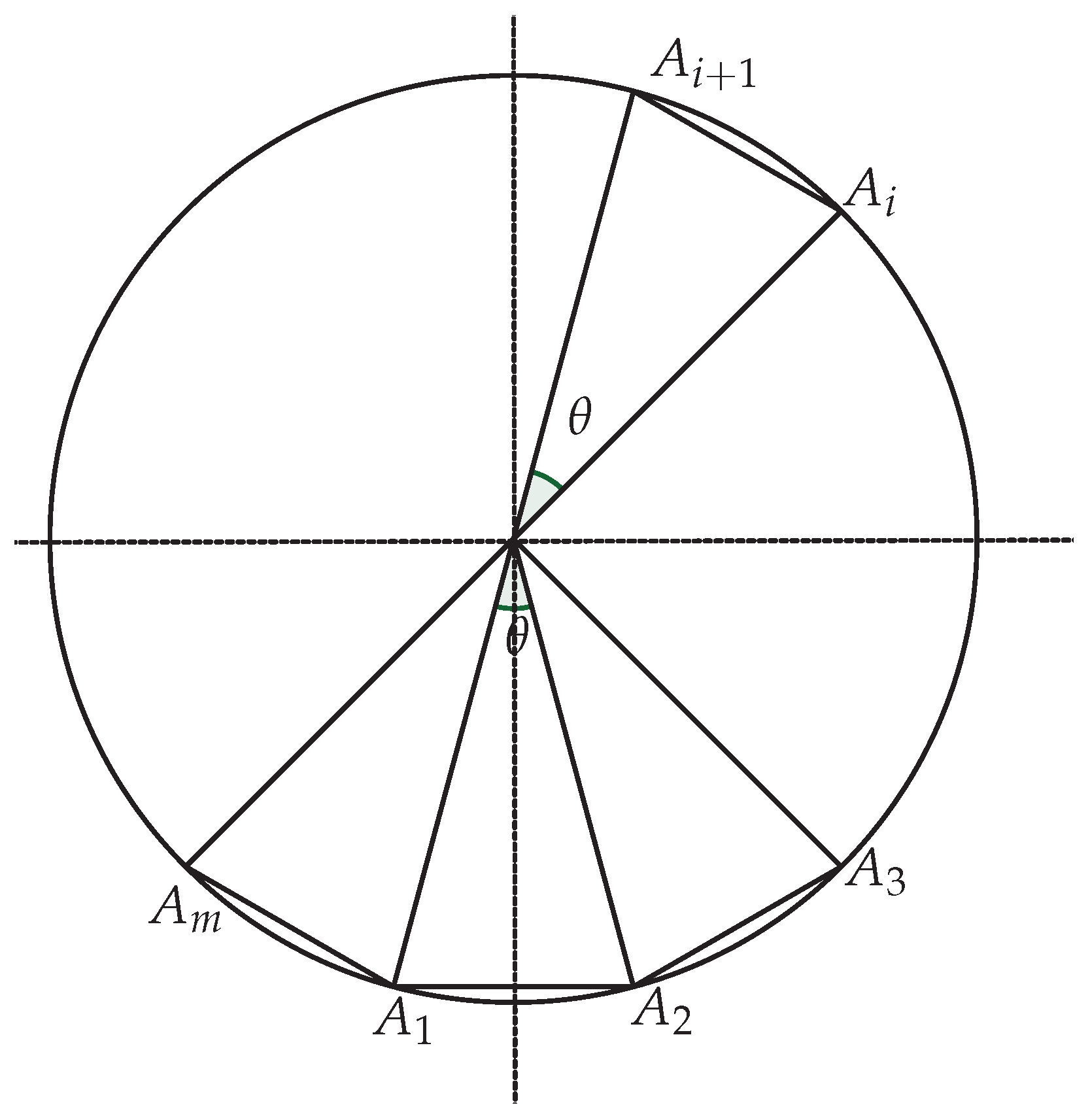
. Let
be a regular
m-sided polygon for some
inscribed in the circle, as shown in
Figure 1. Let
ℓ be the length of each side. Then, the length of the boundary of the polygon is given by
. Let
P be the uniform distribution defined on the boundary of the polygon. Then, the probability density function (pdf)
f for the uniform distribution
P is given by
for all
, and zero otherwise. Let
be the central angle subtended by each side of the polygon. Then, we know
. Let the polar angles of the vertices
of the polygon be given by
, where
. Without any loss of generality, due to rotational symmetry, we can always assume that the side
of the polygon is parallel to the
-axis, as shown in
Figure 1. Then, we have
Let
be the set of all vertices of the polygon, i.e.,
Notice that the Cartesian coordinates of the vertices
and
are given by, respectively,
and
. Hence,
Moreover, the length
ℓ of each side is given by
Let
be a conditional optimal set of
n points for
P with respect to the conditional set
, i.e.,
exists for all
. Let
Then, notice that
as each of the vertices are counted two times.
Proposition 8. Let P be the uniform distribution defined on the boundary of the regular m-sided polygon inscribed in the unit circle. Let . Then,with the corresponding distortion error Proof. Notice that the line segment
is parallel to the
-axis and lies on the line
. Hence, replacing
c by
and
d by
, by Proposition 1, we obtain
Recall
. Hence,
which yields the proposition. □
The following lemma, which is similar to Lemma 2, is also true here.
Lemma 4. Let be such . Let be the positive integers as defined by (13). Then, for , . Let
be an affine transformations such that, for all
, we have
where
Also, for any
, by
it is meant the composition mapping
If
, i.e., by
it is meant the identity mapping on
. Then, notice that
Let us now give the following theorem, which is the main theorem is this section. This theorem helps us to determine the conditional optimal sets of
n points and the
nth conditional quantization errors for all
with
.
Theorem 5. For , let be a conditional optimal set of n points such that for some and . Then, identifying by , we have
- (i)
if , then ;
- (ii)
if , then and for , where is any subset of ℓ elements of the set .
Proof. The proof follows as a consequence of Lemma 4. □
Conditional Optimal Sets of n Points and the nth Conditional Quantization Errors
Let
be a positive integer. To determine the conditional optimal sets of
n points and the
nth conditional quantization errors, first using Theorem 5, we determine the values of
, where
and
is identified as
. Recall Proposition 8. For each
, assume that
, and calculate
and
; denote them by
and
, respectively. Now, recall the affine transformation. Since the affine transformation considered in this section preserves the length, the distortion errors do not change under the affine transformation. Hence, for each
, we obtain
and
as follows:
Once
and
are obtained, we calculate the conditional optimal sets
and the
nth conditional quantization errors using the following formulae:
and
□
Remark 2. Since the conditional quantization dimension is same as the quantization dimension (see [21]), and it is well known that the quantization dimension of an absolutely continuous probability measure equals the Euclidean dimension of the underlying space, we can assume that the conditional quantization dimension of P is one, i.e., . Let us now give the following proposition.
Proposition 9. Let be an optimal set of n points for P such that , where . Then, Proof. Let
for some
. Let
be the positive integers as defined by (
13). Then, by Lemma 4, we can say that
Notice that each
equals
. It happens because
contains
m distinct elements from each side, but in each
, both the end points are counted. Hence, by (
15), we have
. Thus, the proof of the proposition is complete. □
Theorem 6. Let P be the uniform distribution on the boundary of a regular m-sided polygon inscribed in a unit circle. Then, the conditional quantization coefficient for P exists as a finite positive number and equals , i.e.,
Proof. Let
be such that
. Then, there exists a unique positive integer
such that
. Then,
Recall Proposition 9. By the squeeze theorem, we have
Moreover, we have
and
and hence, by (
16), using the squeeze theorem, we have
, i.e., the conditional quantization coefficient exists as a finite positive number that equals
. Thus, the proof of the theorem is complete. □
Remark 3. It is known that for an absolutely continuous probability measure, the quantization dimension equals the Euclidean dimension of the underlying space, and the quantization coefficient exists as a finite positive number (see [24]). Since the conditional quantization dimension is the same as the quantization dimension, and the conditional quantization coefficient is the same as the quantization coefficient (see [21]), by Theorem 6, we can conclude that the quantization coefficient for the uniform distribution defined on the boundary of a regular m-sided polygon inscribed in a unit circle is , which depends on m and is an increasing function of m. Thus, we can conclude that for absolutely continuous probability measures given in an Euclidean space, the quantization dimensions remain constant and is equal to the dimension of the underlying space, but the quantization coefficients can be different. Let us now conclude the paper with the following remark.
Remark 4. Although the conditional quantization in this paper is investigated for uniform distributions on line segments and regular polygons, by using a similar technique or by giving a major overhaul of the technique given in this paper, interested researchers can explore them for any probability distribution defined on the boundary of any geometrical shape.