


Abstract
The exact value of , which is the least positive number such that a convex body K can be covered by m translates of , is usually difficult to obtain. We present exact values of , , , , and , where is the unit ball of endowed with the taxicab norm.
MSC:
52C17; 52A15
1. Introduction
A compact convex set K whose interior is not empty is called a convex body. Denote by the set of extreme points of K, the closure of K, and the boundary of K. Let be the set of all convex bodies in . We denote by the smallest number of translates of needed to cover K. Concerning the least upper bound of for each , there is a long-standing conjecture:
Conjecture 1 (Hadwiger’s covering conjecture).
For each , we have
the equality holds if and only if K is a parallelotope.
This conjecture has been studied by many authors, and it is completely solved only in the two-dimensional case (cf. [1]). M. Lassak [2] proved that holds for each centrally symmetric convex body in . A. Prymak [3] showed that holds for each . More details and references about this conjecture can be found in [4,5,6]. For each and each , set
where . By standard compactness arguments, one can show that “inf” in the definition of can be replaced with “min”. The map is called the m-covering functional. A set C of m points satisfying is called an m-optimal configuration of K.
Estimating for special convex bodies plays an important role in Chuanming Zong’s quantitative program to attack Conjecture 1; see [7]. However, it is not easy to obtain m-optimal configurations even for convex bodies like the Euclidean unit disk and simplices (cf. Figure 6 in [8,9]). Several algorithms have been introduced to find near-optimal configurations for convex bodies; see [10,11,12]. In most cases, it is more difficult to show the optimality of a nice configuration. We will find several optimal configurations for crosspolytopes and prove the optimality theoretically. Since SageMath provides facilities to handle convex polytopes, many details in our proofs can be checked by computer programs.
A convex body is said to be an n-dimensional crosspolytope if there exist n linearly independent vectors such that . Each n-dimensional crosspolytope is affinely equivalent to
which is the closed unit ball of . In [13], Y. Lian showed that
and claimed that
We shall show that the correct value of is . For each , an m-optimal configuration for is presented. The exact value of is also determined. Our methods are different from the ones used in [14].
For each , denote by the i-th coordinate of x. Denote by the cardinality of a finite set A. Let be the canonical basis of . A nonempty subset A of is said to be ε-separated for some positive if the distance (with respect to the taxicab norm) between each pair of points in A is at least .
Our main results are the following:
Theorem 1.
.
Theorem 2.
.
It follows that . In fact, the corresponding equality holds.
Theorem 3.
.
2. Homothetic Covering of
2.1. Notations
We collect in this subsection several notations and basic results that will be used. Set
, , , and . Two orthants O and of are said to be adjacent (denoted by ) if the intersection of them is two-dimensional. The adjacency between orthants is collected in Table 1.

Table 1.
Adjacency of orthants.
For each , set , where . For example, we have , , , and . Let
Clearly,
and
For each and each , set
Let be the group generated by permutations of the standard basis vectors and reflections with respect to coordinate hyperplanes, and , , , and be the linear transforms in with matrices
respectively. It can be verified that, for each and each , we have
Thus, for each and each , we have
Let , , and . We will show that P is a 14-optimal configuration of . Set
By (1), we have
Similarly,
Let and be integers such that, for each , and differs from only in its i-th coordinate. Put
The following lemma can also be verified by a computer program based on SageMath; see [15].
Lemma 1.
For each , the closure of
is the simplex contained in .
Proof.
It suffices to show that .
Let . We have . For each , there exist such that and . Clearly,
Thus, . Therefore, .
Thus, . This completes the proof. □
For each , set
There exists such that and .
It can be verified that (see also [15])
Set and , where, for each , is the point in
and is the point in . See Table 2 for more details.
Table 2.
The set , , and , for each .
Lemma 2.
Suppose that , , and . If is given by
then
If contains another point , then
Proof.
Assume that . For each , we have and
If , then . By (10), we have
We end this subsection with the following result.
Lemma 3.
.
2.2. Auxiliary Lemmas
In the rest of Section 2, will always be a number in . Let . (, resp.) and ( , resp.) are said to be adjacent (denoted by or ) if they are contained in adjacent orthants. The following lemma is of fundamental importance for this section.
Lemma 4.
Suppose that are distinct, , and . If ; then, . In particular, a translate of intersects at most two members of , which are adjacent.
Proof.
Fix . Clearly, .
Since , there are two possible cases.
Case 1. . Then, for each , we have
Case 2. There exists a unique such that . Then, for each , we have
In both cases, by Lemma 1, we have .
To complete the proof, it is sufficient to note that among any three distinct orthants, there is a pair that are not adjacent. □
Lemma 5.
Let .
- (a)
- If there exists a such that , then .
- (b)
- If , then, for each , contains at most two points in .
- (c)
- For each , cannot be covered by a single translate of .
Proof.
We only need to show (a) and (b).
(a). Take . By Lemma 2, we have
Since a point is in if and only if its coordinates is a permutation of the coordinates of x, we have
It follows that
Thus,
Let and be adjacent, with the signs of their -th coordinates being opposite. Set
Clearly, and . Let and . We write if . Otherwise, we write and we have . Thus, if , then they cannot be covered by a single translate of .
Clearly, we have
Lemma 6.
Suppose that and B is a translate of .
- (a)
- and .
- (b)
- If , then there exist and such that , and and .
Lemma 7.
Let . Suppose that . If , then
- (a)
- ,
- (b)
- .
Proof.
(a). By applying a transformation in if necessary, we may assume that and . Suppose that the -th coordinates of and are with the opposite sign. Let . Then, one of the coordinates of x is 1 and . By Lemma 2, one coordinate of (see (9) for the definition) is and the other two are 1. It follows that . If , then, by (4), we have , which contradicts (10). Hence, .
(b). It follows from Lemma 4 and Lemma 7a. □
Suppose that . Lemma 7 shows that a translate of containing cannot contain any point in . Conversely, a translate of containing a point in cannot contain . Particularly, in the case of Lemma 6b, .
Lemma 8.
Let B be a translate of .
- (a)
- If , then .
- (b)
- If , then .
Proof.
By symmetry, we only need to prove (a). By Lemma 4, . Lemma 7 and the fact show that . The distance from to is 14. Thus, . □
Lemma 9.
Let .
- (a)
- If , then .
- (b)
- If , then .
- (c)
- If , then .
Proof.
(a). By the hypothesis and (4), we have
Adding these inequalities, we have
By and (4), .
(b). By the hypothesis and (4), we have
It follows that
By and (4), we have .
(c). By the hypothesis and (4), we have
Therefore,
By and (4), we have . □
Lemma 10.
Let . If , then
In the rest of this section, is a set satisfying ,
Let be distinct. Then, , which implies that . Set . By Lemma 10,
Set .
Recall that A 2-regular graph is a graph where each vertex is connected to exactly two other vertices.
Lemma 11.
Let and be two sets satisfying , be the bipartite graph with bipartitions and , where and are connected by an edge if and only if . If
- (a)
- ,
- (b)
- no member of can be covered by a single translate of ,
- (c)
- and is 2-regular,
then, for each pair of distinct members and of , no member of can contain two points in and two points in simultaneously.
Proof.
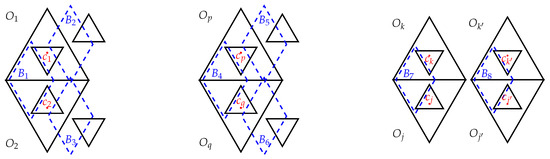
By the hypothesis, each member of is covered by exactly two members of , and each member of intersects exactly two members of .
Assume the contrary that there exist and distinct , such that contains two points in and two points in . By Lemma 4, . Without loss of generality, we may assume that . By Lemma 6, we may also assume (exchange the first two coordinates if necessary) that
Let and be members of such that and . See Figure 1. By Lemma 7,
Figure 1.
The covering configuration described in Lemma 11.
Note that . By (10), we have .
Then, and . It can be verified that (see also [15])
From Lemma 8, it follows that
By Lemma 7, contains at most eight points of . Clearly, . Since , there exists that contains two points in and two points in , where . Let and be two members of such that and . As above, we have . By (18), we have
By Lemma 7 again, can cover at most two points in
Therefore, at least points in remain uncovered, while the number of the remaining translates of is . Thus, .
If , then there exists a member of containing five points in E, which contradicts Lemma 6. If , then the remaining two members and of contain eight points of . By Lemma 7, contains no point in C, which is a contradiction. □
Lemma 12.
If , then there exist and such that .
Proof.
Let be the bipartite graph defined as in Lemma 11 with bipartitions and . By Lemma 4, the total number of edges is at most 16.
Assume the contrary that, for each and , . Then, for each , the degree of in is at least two. Thus, is 2-regular.
Let
Clearly, . By Lemmas 4 and 6, . By Lemmas 6 and 11, we only need to consider the case when . For each , we have
Then, for each , there exists a unique such that contains one point in and two points in , where .
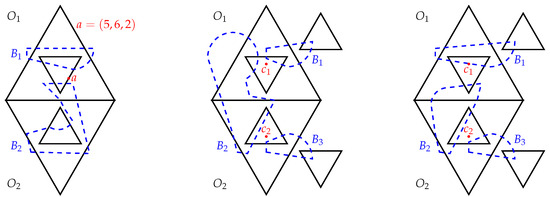
Let and be two members of such that . Without loss of generality, we may assume that
See Figure 2.
Figure 2.
The cases in Lemma 12, when .
We claim that . Otherwise, there exists in such that . By Lemma 4, . From (19), it follows that , which contradicts Lemma 4 since , and are pairwise nonadjacent.
There are two cases.
Case a. . Then, . It follows that . By Lemma 9a, . Thus,
By Lemma 9b, . Since , . Clearly, , which is a contradiction.
Case b. . Without loss of generality, we may assume (exchange the first two coordinates if necessary) that . By Lemma 6, . Then, either or is contained in .
If , then, by and Lemma 7, . By Lemma 7b and (19), there exists a member of containing that contains at most two points in E, which is a contradiction.
Now, assume that . We claim that . Otherwise, (20) holds, which yields a contradiction as in Case a. From Lemma 9c, it follows that , which contradicts Lemma 7b and (19). □
Corollary 1.
If , then there exist and distinct such that
Proof.
Set
Let
Assume the contrary that, for each and each satisfying , we have
Thus, .
Considering the bipartite graph G defined as in Lemma 11 with bipartitions and . Each member of has degree 1 in G and, by Lemma 4, each member of has degree at most 2. Thus, the total number L of edges of G satisfies
Each member of has degree at least 1 and each member of has degree at least 2. Therefore, we have . It follows that , and the subgraph of G with bipartitions and is 2-regular.
By Lemma 5, we have . By Lemma 12, there exist and such that . From Lemma 5b, it follows that . Then, there exists an such that . By Lemma 4, can only intersect with the three members of that are adjacent to . Note that these three members of are pairwise nonadjacent. From Lemma 5b and Lemma 4, it follows that contains at most two points in and .
Clearly, . By the pigeon hole principle and Lemma 6, there exist and such that contains two points in and two points in , which contradicts Lemma 11. □
2.3. The Proof of Theorem 1
Suppose the contrary that there exists a set with such that . By (17), we have , where .
By Corollary 1, without loss of generality, we may assume that there exists such that
Lemma 13.
.
Proof.
Take , then , which is equivalent to
By , we have
It follows that . Hence, .
By (4), we have
It can be verified that (see also [15])
Set
and . It can be verified that , and A is 14-separated. For each , there exists such that . Clearly, if are distinct, then and are distinct. By , we have . By Lemma 4, . Hence, and . Set
Put
where , , and . Since is a linear isometry on , is also 14-separated.
Clearly, if are distinct and , then by Lemma 4, .
Since is 14-separated, . From , it follows that . Thus,
On the one hand, neither nor is adjacent to any of and (see Table 1); thus, . On the other hand, since is 14-separated, . Thus, . Hence, either
or
Lemma 14.
.
Proof.
Table 4.
Possible k such that .
Suppose the contrary that one of the two points and is in . By
. By and , . Thus, . Since intersects both and , and .
Note that . By , . Since intersects both and , . Thus, .
By Table 4 and , we have .
By , , , and , we have .
Clearly, . By Lemma 13, . Moreover, , , and neither nor is adjacent to . By Lemma 4, . Thus, .
Since , , and , we have . By and , . By , intersects both and , we have , a contradiction. □
Corollary 2.
.
Proof.
Since , we have . From and , it follows that
Thus, is a configuration satisfying (22), where is replaced with . Let be the point in satisfying . Then, since
we have . Applying Lemma 14 on , we have . It follows that . □
By and Table 4, we have .
Lemma 15.
.
Proof.
By Table 1, we only need to show that .
By and , we have .
Next, we claim that . Otherwise, since , we would have . By , (25), and Corollary 2, we have .
By Table 1, is contained in . By
we have . Hence, intersects both and . By Lemma 4, , and therefore . Since , we have . In the current situation, intersects both and , and intersects both and . By Lemma 4 and Table 1, .
By Table 1, , and
we have .
By Table 1 and Lemma 13, for some . Since intersects , intersects , , and , we have, by Lemma 4, .
Clearly, . Since intersects both and , . By
. Hence, intersects , , and , which contradicts Lemma 4.
In the rest of this section, we show that . Otherwise, by
and , we have . Since intersects both and , we have . By
we have . By and Lemma 4, . Thus, . By Table 4 and
we have . Since intersects both and , . By Table 4,
we have . Since intersects and , and intersects and , . By Lemma 13, . Thus, .
Clearly, . Since intersects both and , . By
and Lemma 4, we have , contradicting the fact that intersects both and . □
Lemma 16.
If , then .
If , then .
Proof.
We prove the first statement and the other one can be obtained by arguments as in the proof of Corollary 2.
By Lemma 14, either or .
Case a . By (4), for each , we have
By (4) and , for each , we have
By (4) again, we have .
Case b . By (4), we have
From and (4), it follows that
By (4), we have . □
If , then by
we have . Thus,
If , then one can verify that
Lemma 17.
We have
Proof.
We show that . The inclusion can be proved by similar arguments as in the proof of Corollary 2.
By Lemma 16, we only need to show that . By Lemmas 4 and 13, . Thus, it suffices to show that, if is a subset of , then .
First, we show that . Otherwise, by
we have . By Corollary 2, we have . By Lemma 4 and the facts , , and , we have
which, together with and (27), shows that .
Similarly, by , , and (26), we have . It follows that intersects both and , which are not adjacent, which is a contradiction.
Next, we show that . Suppose that this is not true. From and Lemma 4, it follows that . Thus, . By
we have . By (26), we have , which is impossible since .
In the rest of this section, we show that . Otherwise, by
we have . By Table 1, . Since intersects both and and , we have . By
we have . By (26),
we have . Then, intersects both and , which are not adjacent, which is a contradiction. □
Corollary 3.
We have
Proof.
By Table 1 and Lemma 13, these two points are in . By Lemma 17 and , we have . □
Lemma 18.
We have .
Proof.
By Table 1 and Lemma 13, . We show that , and can be proved by similar arguments as in the proof of Corollary 2.
Otherwise, . By Lemma 4, may only intersect and . Since
we have . Since intersects both and , and
we have . Thus, intersects both and . By Lemma 4, .
Since intersects and , . By
we have and .
Since , we have . Thus, . By Lemma 13, . By (28) and , we have . By
we have .
Since intersects both and , . By and , we have . By (28) and
this is impossible. □
Lemma 19.
If , then .
Proof.
Taking the sum of (30) and (32), the sum of (31) and (33), and the sum of (30) and (31), and applying the triangle inequality, we obtain
Hence,
By (4), we have . □
Lemma 20.
Either or .
Proof.
Assume the contrary that and . By (4), we have
Similarly, we have
By Lemma 18, can only intersect and . Moreover, can only intersect and , and can only intersect and . It follows that
By and , . If , then, since , does not intersect . By (34), . Since , by (35), . Since , , and are not adjacent to , by Lemma 4, , which contradicts Lemma 5b. Thus, . Similarly, we have .
By Lemma 19, . By , (37), and Lemma 5b, this is impossible. □
Clearly, by (29) and Lemma 20, .
Lemma 21.
If , then . If , then .
Proof.
Suppose that . By ,
and Lemma 4, .
By , , and , we have .
Now, suppose that . As in the proof of Corollary 2, we have . By the first case, we have , where is defined as in Corollary 2. Then, either or . If , then and , which contradicts Lemma 4. Hence, . □
If , then . Hence, by Lemma 4, (23) holds. However, this is in contradiction to . If , then , which is in contradiction to . This completes the proof of Theorem 1.
3. A -Optimal Configuration of
In this section, we always assume . Let
For each and , set
If and , then, for each pair of points in , we have
which implies that .
Let S be a maximal subset of such that , . Then, for each , we have , and
Therefore, we obtain that .
Lemma 22.
If and , then .
Proof.
Set . Then, . Assume the contrary that . Then, by (38), . Clearly,
It follows that
Let and . Take . Without loss of generality, we may assume that
Let be the point satisfying
Then, and . Hence,
For each , we show by induction that
The case when follows from (39). Suppose that (41) holds for all , where . For each , by (39) and (40), we have
Hence, (41) holds for each . It follows that , , which is impossible. □
Lemma 23.
For , if and only if .
Proof.
We only need to show that , when . If , then, since , . Otherwise, there exists such that . Without loss of generality, we may assume that . Suppose that is given by
Then, and, since and , . □
Lemma 24.
If and , then .
Proof.
Let . Then, . Assume the contrary that . By (38), we have
Then, . Clearly, , . By Lemma 23, we have . Hence, . Thus, there exist such that . Moreover, since , , and , there exists a point .
Let and . There exists a unique integer such that . If , then . Thus, there is exactly one integer such that . Then, for each , we have . Thus, , which is impossible. Therefore, . In particular, we have
Since , . By , we have .
From , it follows that and . Suppose that . For each , we have
Thus, , which is a contradiction. □
Proof of Theorem 2.
Let
First, we show that . It is clear that , . Thus, it is suffices to show that . For each , let j be an integer in such that . Take such that . Since , we have . Then,
Hence,
Next, we show that . Otherwise, there exists and with such that . For each and each point , we have . Since is 2-separated and , is contained in at most two translates of . Hence, there exists a such that . By Lemma 22, this is a contradiction. □
Proof of Theorem 3.
Since , we only need to show that . Otherwise, there exists and such that . For each vertex v of and each point , we have . Then, we may assume, with loss of generality, that . By Lemma 24, , . Since , this is impossible. □
Author Contributions
Conceptualization, Y.L. and S.W.; methodology, Y.L. and F.C.; coding, Y.L.; validation, Y.L., F.C. and S.W.; writing—original draft preparation, Y.L.; writing—review and editing, S.W.; funding acquisition, S.W. All authors have read and agreed to the published version of the manuscript.
Funding
The authors are supported by the National Natural Science Foundation of China (grant numbers 12071444 and 12401125), and the Fundamental Research Program of Shanxi Province (grant numbers 20210302124657, 202103021224291, and 202303021221116).
Data Availability Statement
Data sharing is not applicable to this article as no datasets were generated or analyzed during the current study.
Conflicts of Interest
The authors declare no conflicts of interest.
References
- Levi, F.W. Überdeckung eines Eibereiches durch Parallelverschiebung seines offenen Kerns. Arch. Math. 1955, 6, 369–370. [Google Scholar] [CrossRef]
- Lassak, M. Solution of Hadwiger’s covering problem for centrally symmetric convex bodies in E3. J. Lond. Math. Soc. 1984, 30, 501–511. [Google Scholar] [CrossRef]
- Prymak, A.; Shepelska, V. On the Hadwiger covering problem in low dimensions. J. Geom. 2020, 111, 42. [Google Scholar] [CrossRef]
- Boltyanski, V.; Martini, H.; Soltan, P.S. Excursions into Combinatorial Geometry, Universitext; Springer: Berlin/Heidelberg, Germany, 1997. [Google Scholar]
- Brass, P.; Moser, W.; Pach, J. Research Problems in Discrete Geometry; Springer: New York, NY, USA, 2005. [Google Scholar]
- Martini, H.; Soltan, V. Combinatorial problems on the illumination of convex bodies. Aequationes Math. 1999, 57, 121–152. [Google Scholar] [CrossRef]
- Zong, C. A quantitative program for Hadwiger’s covering conjecture. Sci. China Math. 2010, 53, 2551–2560. [Google Scholar] [CrossRef]
- Bezdek, K.; Khan, M.A. The geometry of homothetic covering and illumination. In Discrete Geometry and Symmetry; Springer: Cham, Switzerland, 2018; Volume 234. [Google Scholar]
- Yu, M.; Gao, S.; He, C.; Wu, S. Estimations of covering functionals of simplices. Math. Inequalities Appl. 2023, 26, 793–809. [Google Scholar] [CrossRef]
- Han, X.; Wu, S.; Zhang, L. An algorithm based on compute unified device architecture for estimating covering functionals of convex bodies. Axioms 2024, 13, 132. [Google Scholar] [CrossRef]
- He, C.; Lv, Y.; Martini, H.; Wu, S. A branch-and-bound approach for estimating covering functionals of convex bodies. J. Optim. Theory Appl. 2023, 196, 1036–1055. [Google Scholar] [CrossRef]
- Yu, M.; Lv, Y.; Zhao, Y.; He, C.; Wu, S. Estimations of covering functionals of convex bodies based on relaxation algorithm. Mathematics 2023, 11, 2000. [Google Scholar] [CrossRef]
- Lian, Y.; Zhang, Y. Covering the crosspolytope with its smaller homothetic copies. arXiv 2021, arXiv:2103.10004. [Google Scholar]
- Joós, A. Covering the Crosspolytope with Crosspolytopes. arXiv 2023, arXiv:2305.00569. [Google Scholar]
- Lyu, Y. Computer-Assisted Proofs [Source Code]. Available online: https://github.com/lyuyunfang/Covering_functional_of_crosspolytopes (accessed on 12 January 2025).
Disclaimer/Publisher’s Note: The statements, opinions and data contained in all publications are solely those of the individual author(s) and contributor(s) and not of MDPI and/or the editor(s). MDPI and/or the editor(s) disclaim responsibility for any injury to people or property resulting from any ideas, methods, instructions or products referred to in the content. |
© 2025 by the authors. Licensee MDPI, Basel, Switzerland. This article is an open access article distributed under the terms and conditions of the Creative Commons Attribution (CC BY) license (https://creativecommons.org/licenses/by/4.0/).