


Abstract
For an undirected graph G, a zero-sum flow is an assignment of nonzero integer weights to the edges such that each vertex has a zero-sum, namely the sum of all incident edge weights with each vertex is zero. This concept is an undirected analog of nowhere-zero flows for directed graphs. We study a more general one, namely constant-sum -flows, which gives edge weights using nonzero elements of an additive Abelian group and requires each vertex to have a constant-sum instead. In particular, we focus on two special cases: , the finite cyclic group of integer congruence modulo k, and , the infinite cyclic group of integers. The constant sum under a constant-sum -flow is called an index of G for short, and the set of all possible constant sums (indices) of G is called the constant sum spectrum. It is denoted by and for and , respectively. The zero-sum flows and constant-sum group flows for regular graphs regarding cases and have been studied extensively in the literature over the years. In this article, we study the constant sum spectrum of nearly regular graphs such as wheel graphs and fan graphs in particular. We completely determine the constant-sum spectrum of fan graphs and wheel graphs concerning and , respectively. Some open problems will be mentioned in the concluding remarks.
Keywords:
Abelian group MSC:
05C21; 05C25; 05C78
1. Introduction and Background
Throughout this article, only finite undirected graphs are considered. All graph theoretical terminology not defined here can be referred to in [1]. A graph G has the edge set and vertex set . For any additive Abelian group , let be the set of all nonzero elements and 0 the additive identity of . Given a graph G, a mapping is also called an edge labeling of G. A graph G admits a constant-sum -flow or is said to be -magic if there is an edge labeling such that the induced vertex labeling defined by is a constant map. We call the constant a magic sum of G with respect to , or an index for short. We then denote the set of all constants r such that the graph G admits a constant-sum -flow with an index r by and call it the constant-sum spectrum, or the index spectrum, of G with respect to . Notice that, in this article, for convenience, we focus on two special cases: , the finite cyclic group of integer congruence modulo k, and , the infinite cyclic group of integers. Generally, a graph may have more than one edge labeling to admit a constant-sum -flow or to be -magic. No generally efficient algorithm is known for finding such magic labeling for general graphs. A. Kotzig and A. Rosa used the same term in [2], but their notion of magic labeling is different from what we consider here as edge labeling. Instead, A. Kotzig and A. Rosa discussed the total labeling over vertices and edges. They say a graph has a magic labeling if for each edge, the sum of the edge label and its two end vertex labels is constant. It is well known [3,4,5] that a graph G is -magic if and only if every edge of G is contained in a -factor and every pair of edges is separated by this -factor, where is the set of positive integers and a -factor is a regular spanning subgraph of degree one or two for each of its components. For a list of properties of -magic graphs, see [6,7,8]. Richard Stanley first studied -magic graphs in [9,10] and demonstrated that the study of magic labelings can be reduced to solving a system of linear Diophantine equations.
Note that one special case of magic sums of -magic graphs while with magic sum constant zero has been studied intensively, namely zero-sum flows, which was initially studied by S. Akbari et al. [11] in 2009. One may treat zero-sum flows as an undirected analog of nowhere-zero flows for directed graphs. A nowhere-zero flow in a directed graph is an assignment of nonzero integers to edges such that for every vertex, the sum of the incoming edge labels equals the sum of outgoing edge labels. A nowhere-zero k-flow is a nowhere-zero flow in which the assigned values are integers with absolute values less than k. A celebrated conjecture of Tutte in 1954 says that every bridgeless graph has a nowhere-zero 5-flow. There is a more general concept of a nowhere-zero flow that uses bidirected edges instead of directed ones, first systematically developed by Bouchet [12] in 1983. Bouchet raised the conjecture that every bidirected graph with a nowhere-zero integer flow has a nowhere-zero 6-flow, which is still unsettled. S. Akbari et al. raised a conjecture (called Zero-Sum 6-Flow Conjecture) in 2010 for zero-sum flows similar to Tutte’s 5-flow conjecture for nowhere-zero flows as follows: if G is a graph with a zero-sum flow, then G admits a zero-sum 6-flow. It was proved by Akbari et al. [13] that the above Zero-Sum 6-Flow Conjecture is equivalent to Bouchet’s 6-Flow Conjecture for bidirected graphs. The study of zero-sum flows was extended to constant-sum flows first by T.-M. Wang et al. [14] in 2011 and later studied by Akbari et al. [15,16,17,18] as 0-sum and 1-sum flows with related topics. Another extension of zero-sum flows to zero-sum flow numbers has also been initially studied by T.-M. and Wang et al. [19,20,21,22] over the years. More references can be seen in the survey article by Gallian [23].
The constant sum under a constant-sum -flow is called an index of G for short, and the set of all possible constant sums (indices) of G is called the constant-sum spectrum and denoted by . The constant-sum spectrum of various graph classes G was studied and calculated. We refer to and as the constant-sum spectrum with respect to and , respectively, in this paper. Note that the case of constant-sum -flows is not hard to calculate since every edge of a graph with -flows must be labeled with 1, and hence, the constant-sum spectrum is completely determined by the degree sequence of the graph. Therefore, the constant-sum spectrum is of interest for . In 2011 [14], T.-M. Wang et al. obtained the following result regarding the index sets of r-regular graphs (except the case ) of order n:
In 2023 [24], T.-M. Wang studied group constant-sum -flows while , particularly for regular and nearly regular graphs. We initiated the study of basic properties for the constant-sum -flows and extended to a more general situation constant-sum -flows for an Abelian group . Particularly in [24], we obtained that, for a regular graph G admitting a 1-factor, the constant-sum spectrum is full for all . As a consequence, it is characterized for all 3-regular graphs with a full constant-sum spectrum. We also give examples of regular graphs without a 1-factor whose constant-sum spectrum is not full for some k. Among other results, we completely determine the constant-sum spectrum concerning of complete bipartite graphs for as the additive cyclic subgroups of generated by , where . Moreover, we also completely determine the magic sum spectrum of regular graphs of even degrees.
Inspired by the above studies for complete bipartite graphs , which are nearly regular of possible two different degrees, two classes of nearly regular graphs such as wheels and fans admitting constant-sum -flows are studied for and , respectively. The fan graph is composed of a path on n vertices joined by another vertex, while the wheel graph is composed of a cycle on n vertices joined by another vertex. Among others, we completely determine the constant-sum spectrum of wheel graphs and fan graphs via a method of edge subdivision. In the concluding section, we mention more open problems that need to be explored further.
2. Basics for Constant-Sum -Flows
Recall that we have the following important necessary condition for a graph admitting constant-sum -flows with index r, which can be used to determine the magic sum spectrum.
Proposition 1.
For any constant-sum -flows f of a graph with index r, we have
By the above necessary condition in general, for a graph G with odd and for and with even k, it implies that r must be an even number, as a representative in the congruence class modulo k. Therefore, we have the following general upper bounds for the constant-sum spectrum:
Corollary 1.
For a graph G with odd vertices, we have that .
Corollary 2.
For a graph G with odd vertices and for even k, we have that .
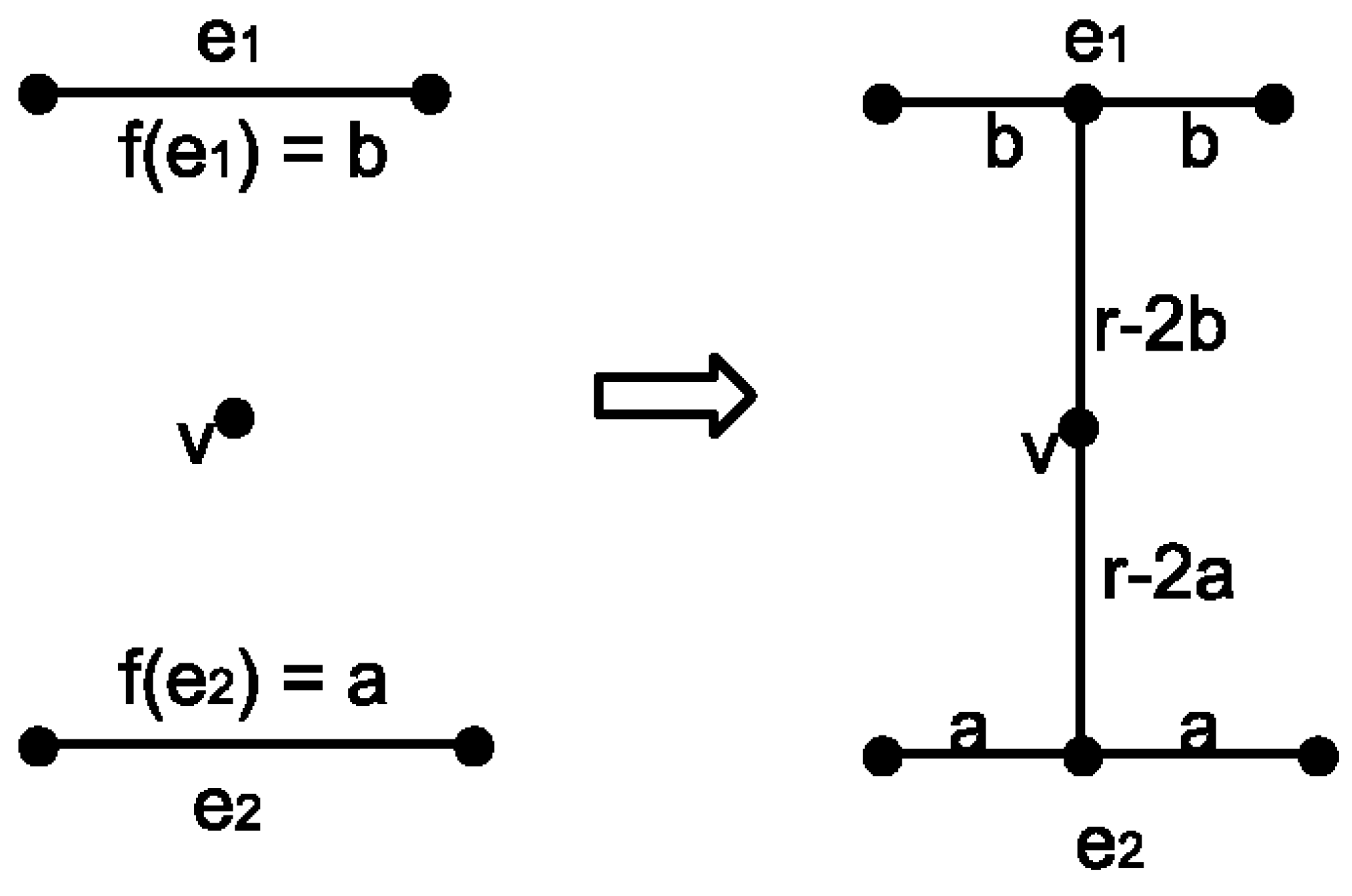
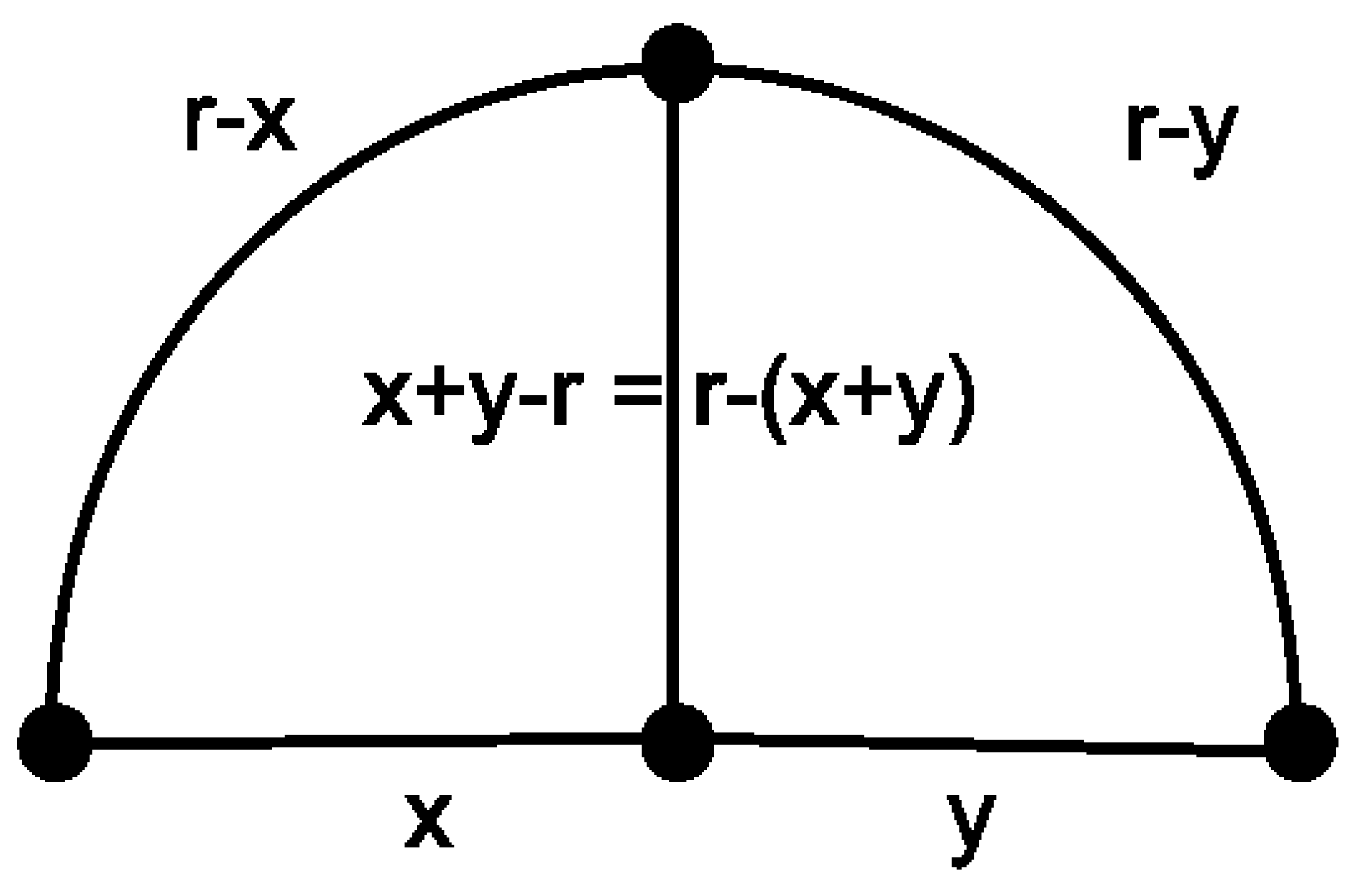
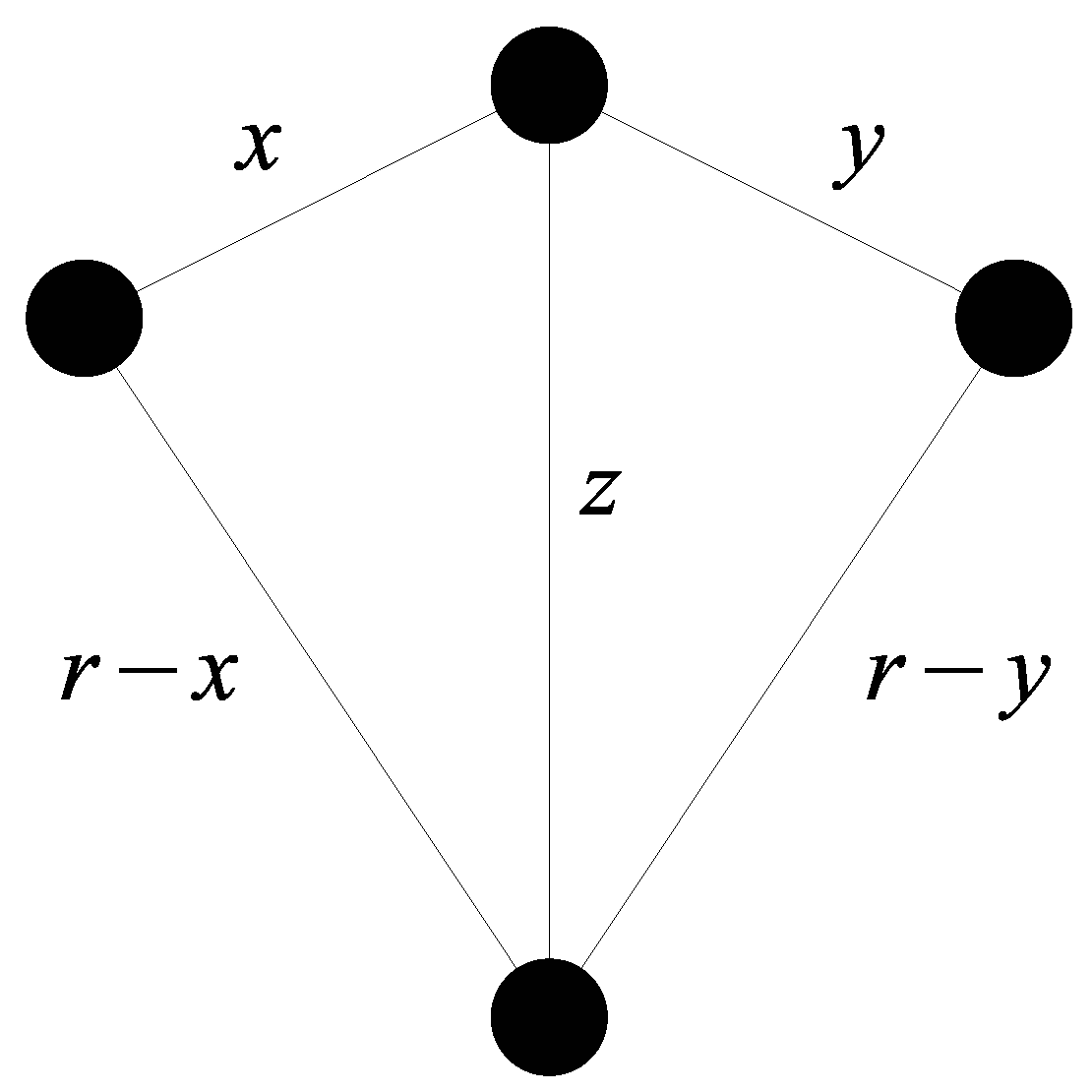
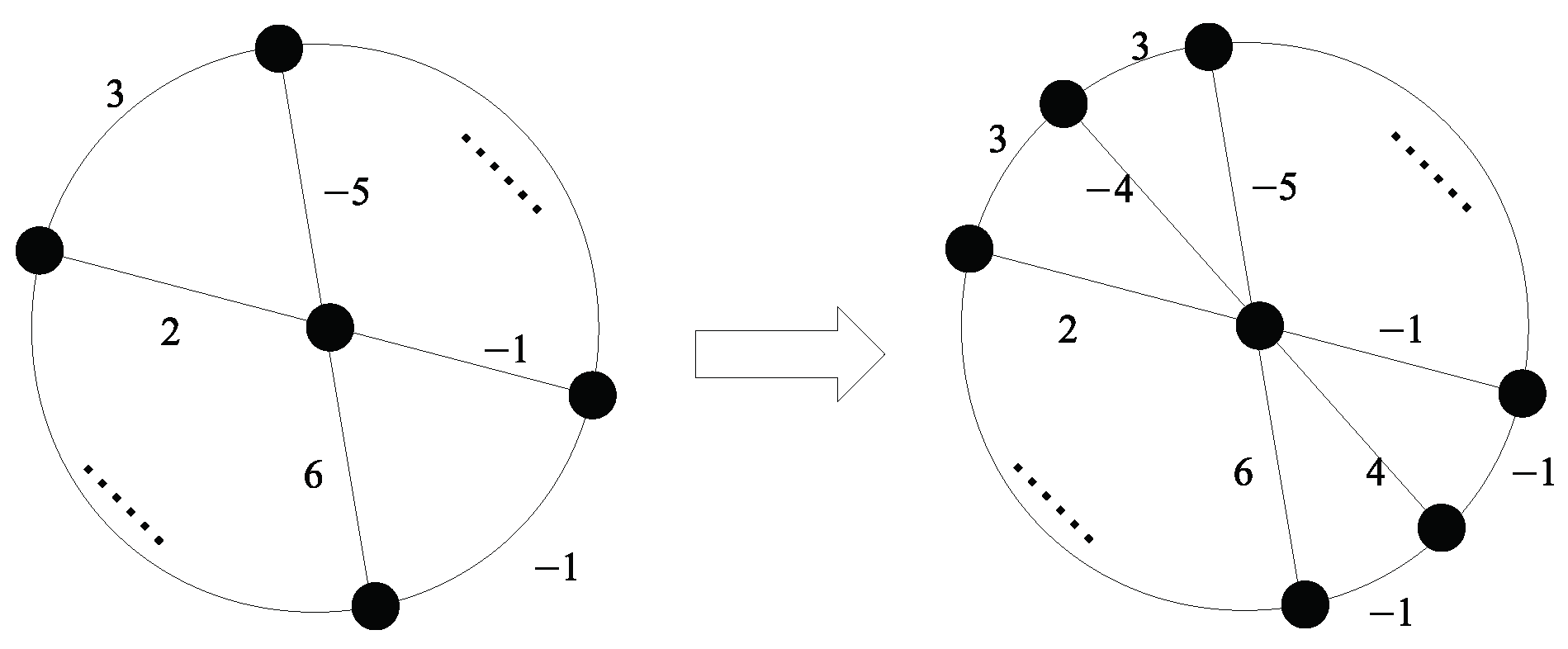
In order to obtain the whole constant-sum spectrum, we describe a subdivision method that is used in later sections for the construction of constant-sum -flow labeling with the same magic constant-sum index of an infinite family of graphs, in particular, fans and wheels. Let G be a graph with index r under a constant-sum -flow labeling f; using the subdivision method, we may obtain a new graph with a larger order, and a new constant-sum -flow on with the same index r, based upon G and f. We proceed by choosing in G a vertex v and edges with labels and , which are not incident with v. Then, we subdivide these two edges by inserting new vertices of degree 2, joining them to v, respectively (see Figure 1). We may then construct a new labeling on by keeping the labels on G unchanged and labeling and on two newly inserted edges, respectively. Note that if , , and , then the new labeling on is still constant-sum -flow with index r, and . Therefore, with this method, we can calculate the constant-sum spectrum of fans and wheels in the following sections.
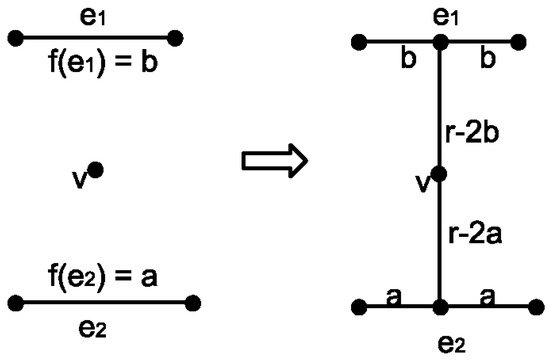
Figure 1.
General subdivision method.
3. Constant-Sum -Flows of Fans
We are in a position to calculate the constant-sum spectrum of fans in this section and start with a lemma for -magicness with zero sums. The constant-sum spectrum of 3-fan is special and different from other cases, as shown in the following.
Lemma 1.
For the 3-fan , we have the following facts:
- 1.
- is constant-sum -flow if and only if k is even and . Therefore, for k odd.
- 2.
- .
- 3.
- For , , for k even.
Proof.
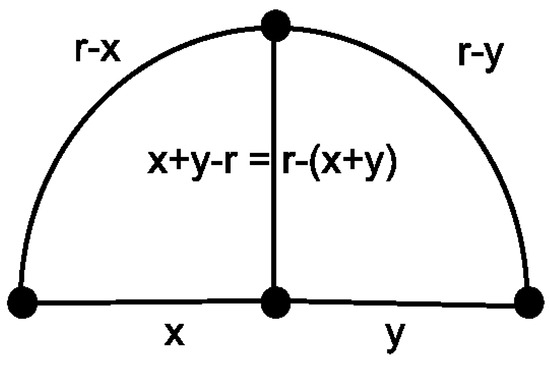
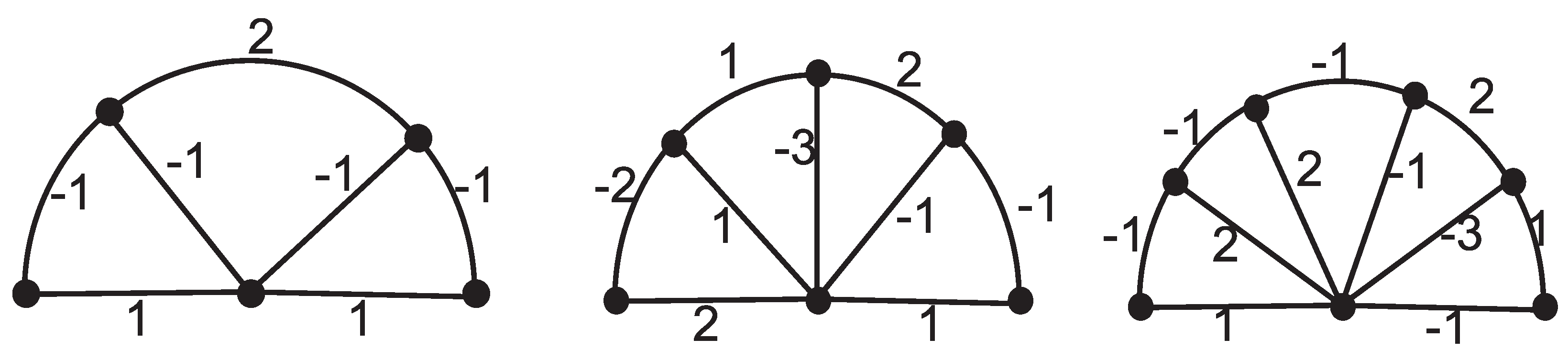
In , as in Figure 2, we have that if r is an index, then there exists nonzero elements x and y in such that and , , ; hence, k is even since is an element of order 2. Therefore, is constant-sum -flow if and only if k is even and .
Figure 2.
Constant-sum r of .
Suppose that , we have the labels on the path as , and the labels on the spokes are . Then, we have ; hence, , which is a contradiction to and . Therefore, .
For an even , in order to realize all indices in , we take for the index , and , for . □
Lemma 2.
For , , if and only if .
Proof.
Assume that . First, ensure that the edge labels on the path of the are all the same, either all 1’s or all ’s. If not, then there will be 0-edges over the spokes. Without loss of generality, suppose the edge labels on the path are all 1’s. Thus, the labels on the spokes are two ’s, and of them are 1’s. Then, by calculating the vertex sum of the center, we have . Conversely, it follows from the given labeling. □
Lemma 3.
, for and .
Proof.
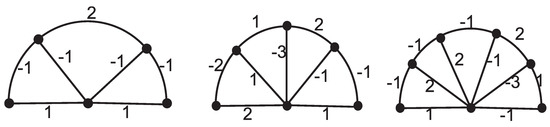
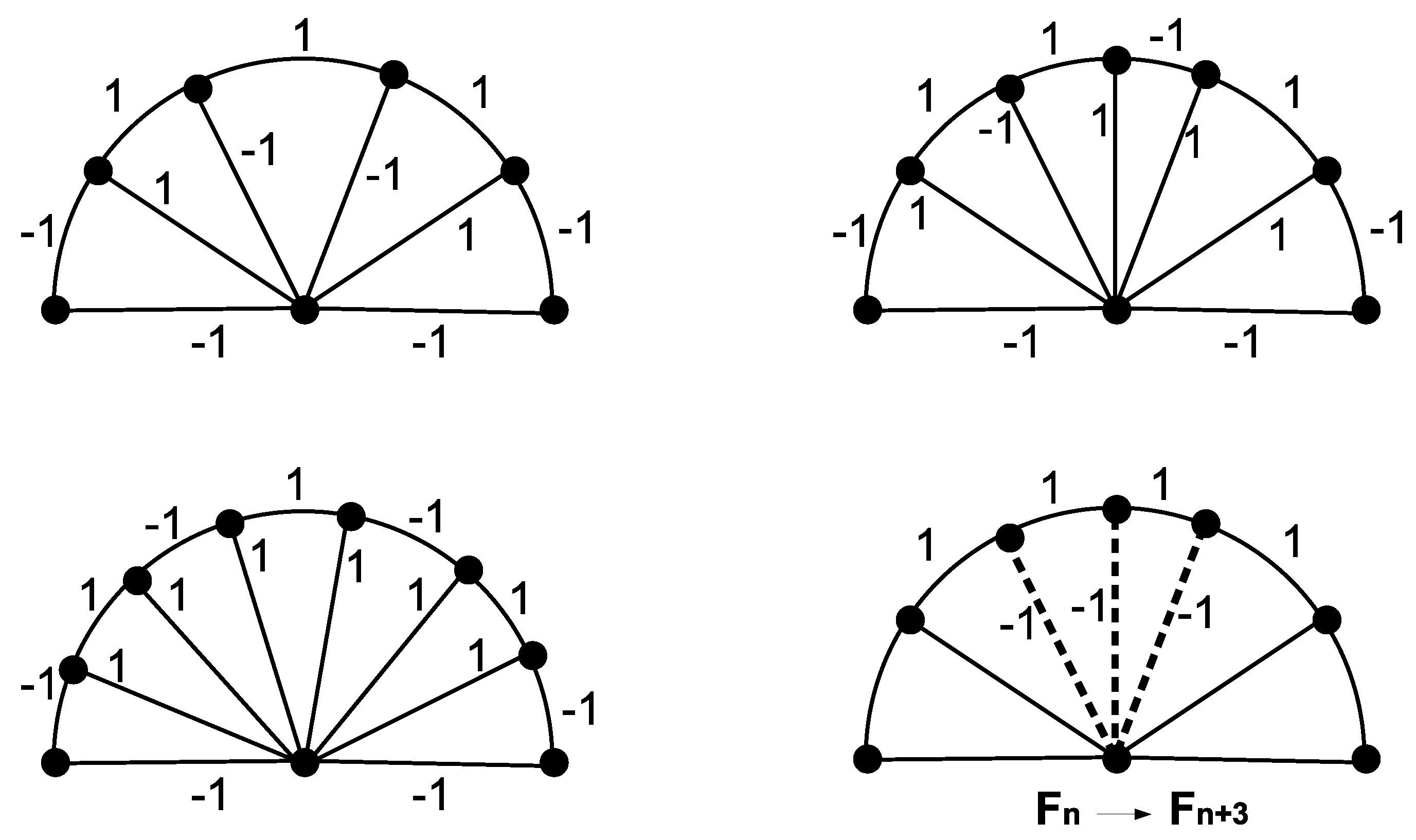
Please see Figure 3, where we have the labeling for such that the vertex sum is 0. Using the above subdivision method, we construct constant-sum -flow labeling from to by subdividing one pair of 1-edge and -edge in and , respectively. □
Figure 3.
-magic sum 0 of , .
For other cases of fans , see the following. We split the discussion into cases -magic, -magic, and -magic for .
Lemma 4.
if and only if .
Proof.
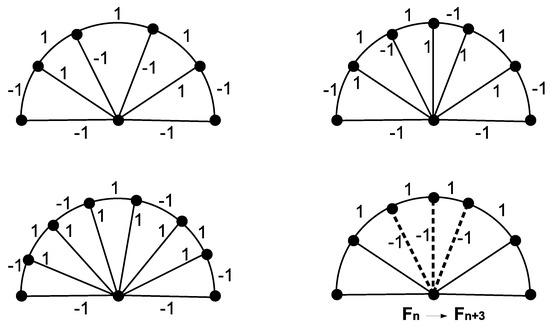
Without loss of generality, it suffices to consider the case of index 1. The labeling on the edges incident to vertices of degree 2 must be both . One may easily check that for , and we have -magic labeling with an index 1 of as in Figure 4.
Figure 4.
-magic sum 1 of , and construction from to for .
To obtain -magic labeling with index 1 from to for , we insert three vertices of degree two on some 1-edge on the path of , join them to the center, and label on the newly added spokes, as in Figure 4. Then, the resulting labeling will perform the task. □
Note that has an vertex, and thus, by the necessary condition Proposition 1, for n even. Therefore, we consider the following -magicness of .
Lemma 5.
for is odd.
Proof.
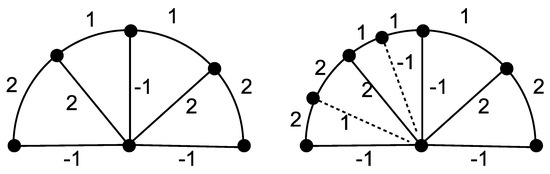
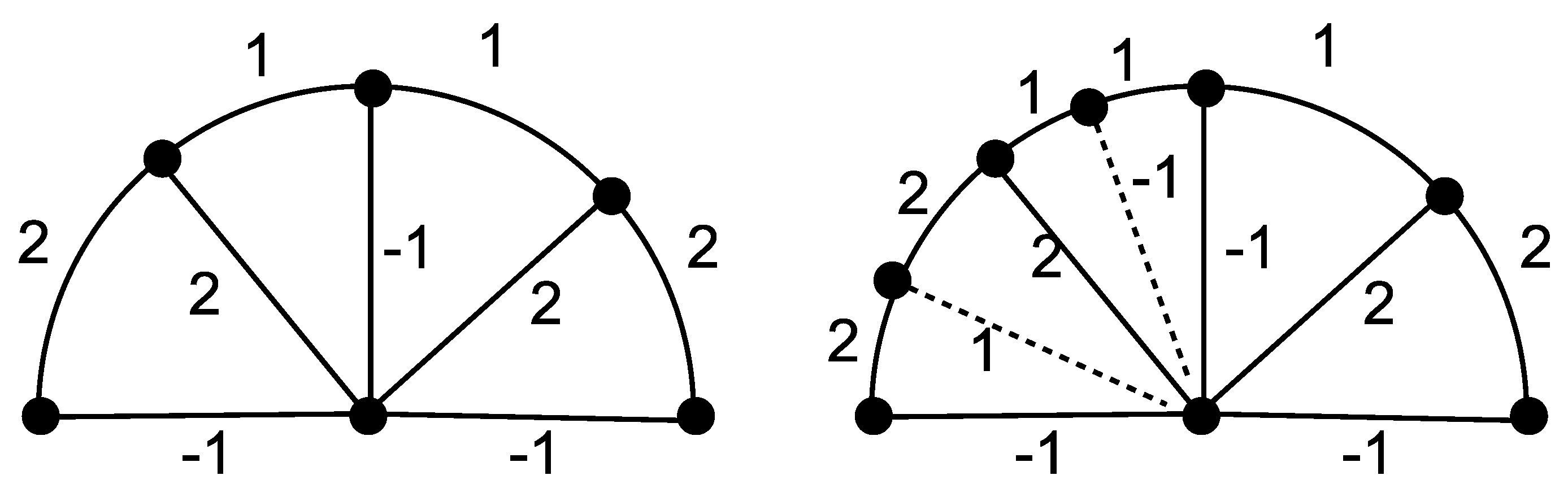
For is odd, we have as the labeling given in Figure 5.
Figure 5.
-magic with index for for odd.
Since there are edges labeled by 1 and 2 over the path of , respectively, the subdivision method mentioned above may be used by subdividing the 1-edge and 2-edge and connect the newly inserted degree 2 vertices to the center. Then, we may construct -magic labeling with index 1, and hence, for odd. □
Lemma 6.
for .
Proof.
As in Figure 6, first, we label alternatively on the path of . For n odd, in order to obtain the index 2, the labeling on spokes has to be one of 1, of 2, and one of . For n even, the labeling on spokes has to be two of 1 and of 2. In both cases, the vertex sums are constant 2 and we have completed our calculation.
□
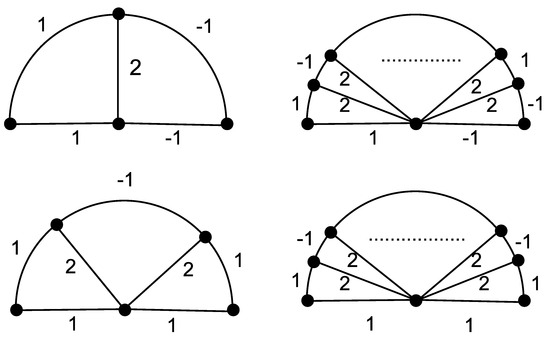
Figure 6.
-magic with index 2 for .
Figure 6.
-magic with index 2 for .
In the following, we deal with the constant-sum -flow case for . Again, by the necessary condition of being -magic with index r in Proposition 1, we have that , for n even. We will realize every nonzero index , where in the following lemma.
Lemma 7.
For all , we have , for all , , and n even.
Proof.
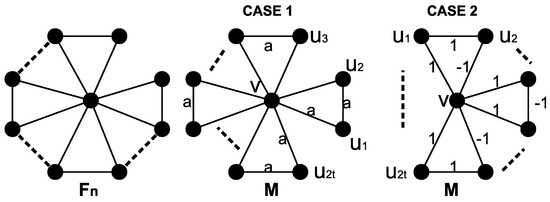
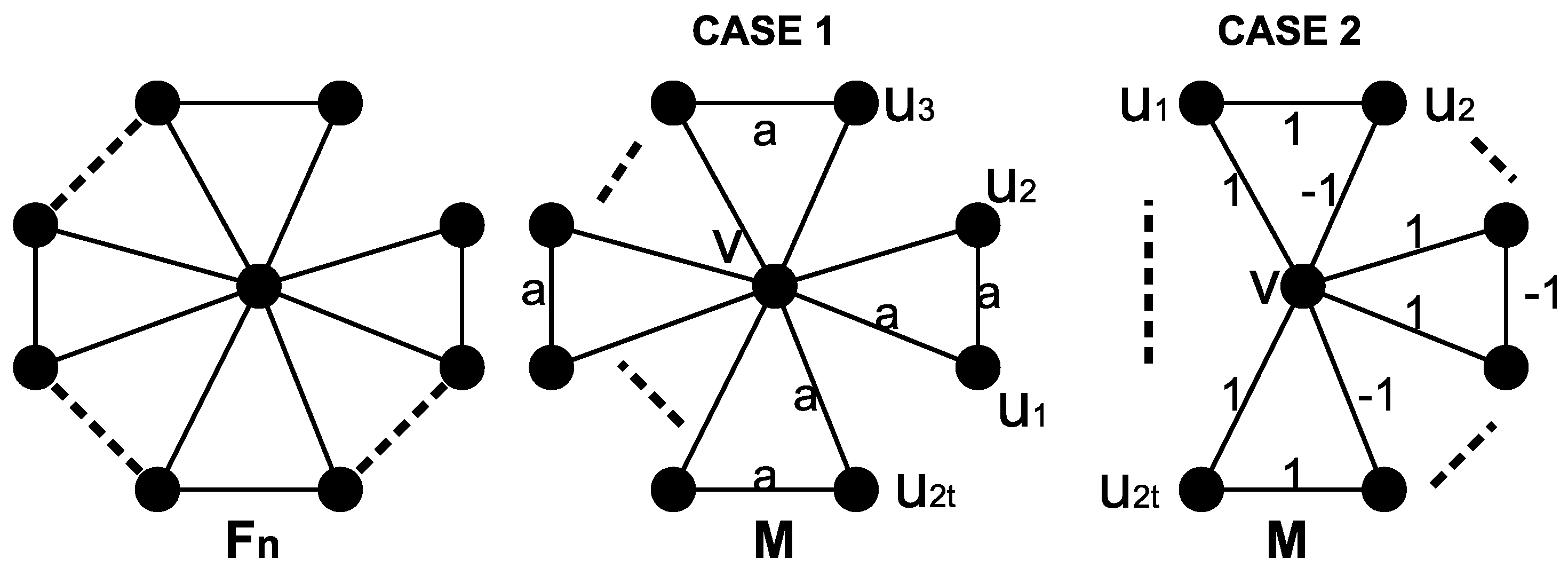
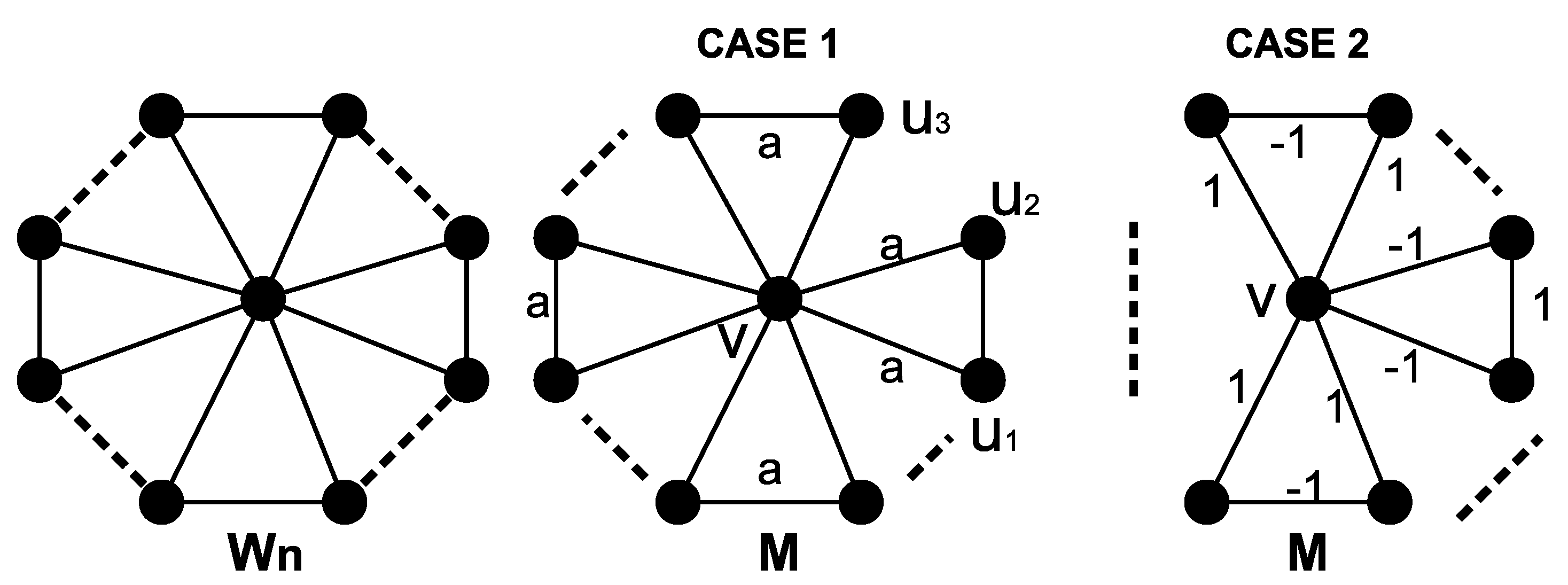
Let and ; we first delete the edges , alternatively, and obtain a windmill M, which is Eulerian since every vertex is of even degree, as in Figure 7.
Figure 7.
Constant-sum spectrum of fans , n even.
- Case 1: M contains an even number of triangles.
Hence, M is of even size, and we may label on one Eulerian tour of M such that vertex sum is 0 on each vertex. Add extra a to the labeling on the edges , , and , ; then, we have labels on M such that vertex sums on v, , and are , and are a on other vertices (see Figure 7). Now, return the edges , and label a on each of them; then, we have a labeling called on with such that each vertex sum is .
By a similar method as above, except labeling instead on the Eulerian tour of M, we then have another labeling on with such that each vertex sum is . Note that for and , if in , then we use the nonzero -labeling . If in , we use the nonzero -labeling . Thus, we have finished in this case.
- Case 2: M contains odd numbers (at least three) of triangles.
Take three triangles containing vertices and of M, and label them as in Figure 7 such that the partial vertex sums on v, , and are 2, respectively, and 0 on other vertices. Note that the other triangles form an Euler graph of even size, and we label on them such that the partial vertex sum is 0 for each vertex on one Eulerian tour, and remains 2 on the center. Put the edges back and label 2 on them; we then have labels on such that each vertex sum is 2. By multiplying all labels on each edge by a, we may have labels such that each vertex sum is . Then, we have finished in this case. □
Lemma 8.
, for all odd, and .
Proof.
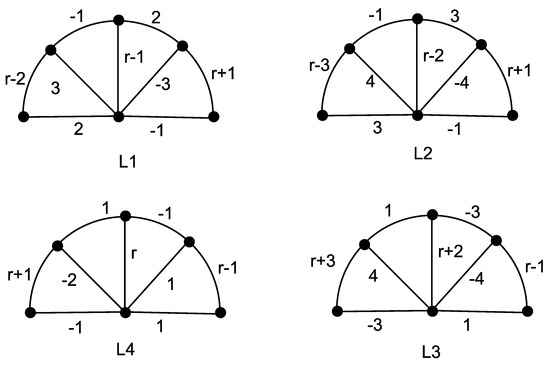
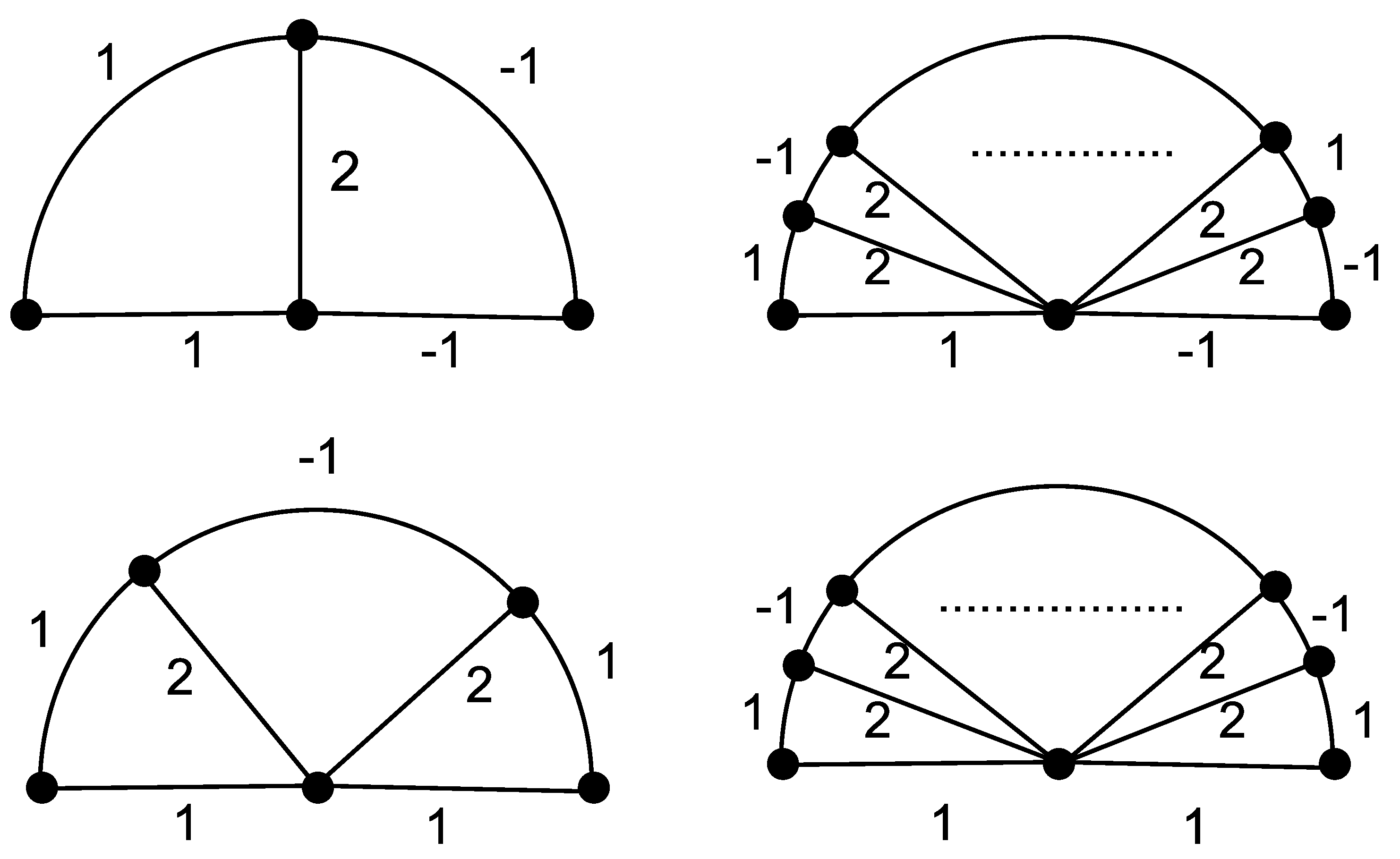
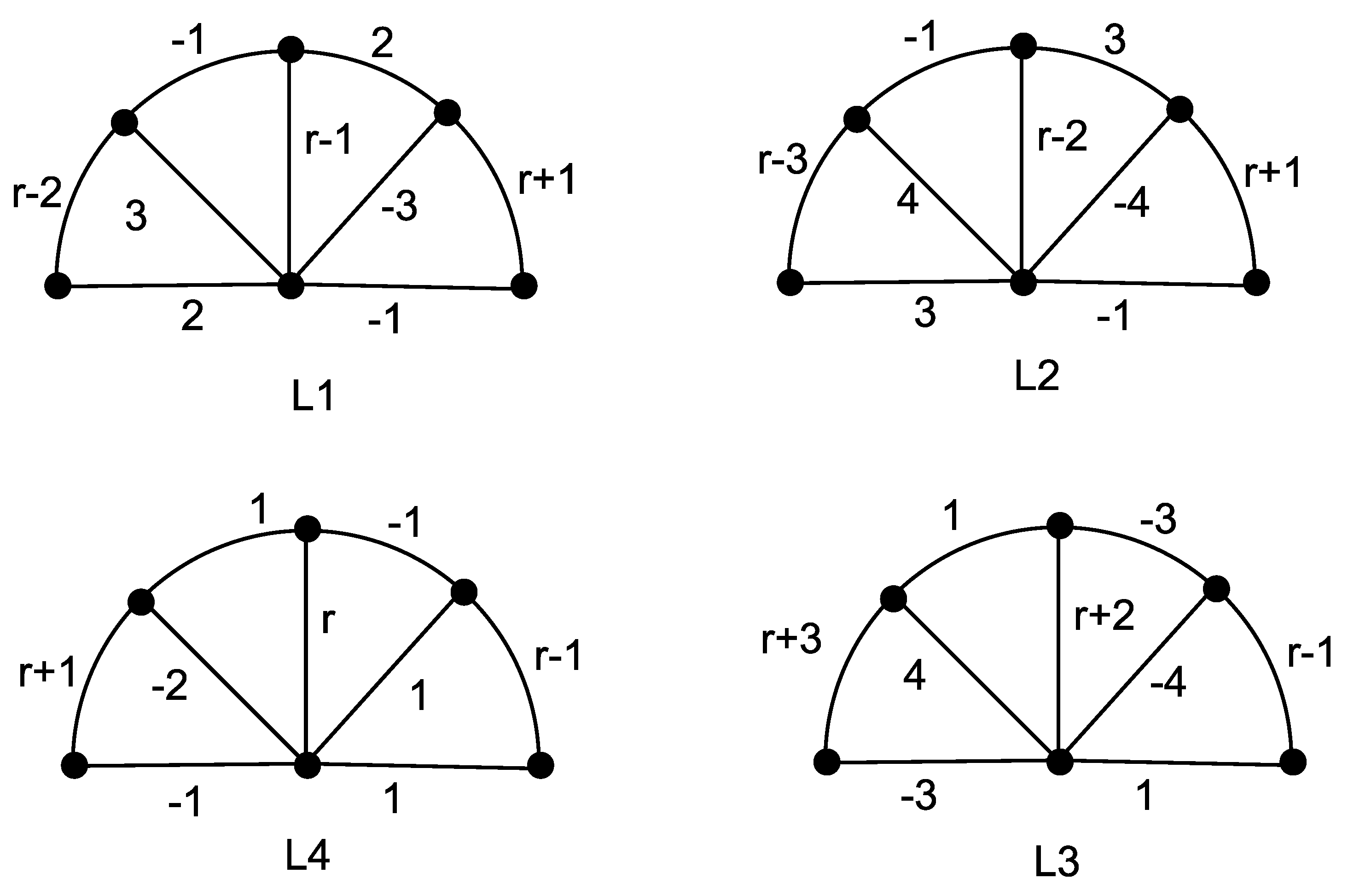
At first, we construct four types of labeling , , , and such that vertex sum is r for , as in Figure 8.
Figure 8.
, , , and .
We use the subdivision method in the following to extend , , , and to the labeling of , for and n odd. Note that via subdividing edges labeled by and on , , respectively, we have the following sets of possible labels and , respectively. Subdividing edges labeled by 1 and on and , respectively, we have the following sets of possible labels and , respectively. Subdividing edges labeled by and in again, we then have the sets of possible labels .
It remains to show that the above sets of possible labels contain no common zero elements in . It is not hard to see that contains zero elements only for , and then, instead, we may use the following labeling: for , for , for , and for . Hence, we have completed our calculations. □
To summarize from the above lemmas, we have the following.
Theorem 1.
The constant-sum spectrum of fans , , for are as follows:
When
When ,
When ,
Note that when k is odd, and when k is even.
4. Constant-Sum Spectrum of Wheels for
To obtain the constant-sum spectrum of the wheel graphs , , we look at the magic sum index 0. Note that the magic zero-sum was calculated in [25], and we include the proofs here for completeness. We consider the -magic case first.
Lemma 9.
For , if and only if (mod 3).
Proof.
Assume that . First, we observe that the edge labels on the cycle of the have to all be the same, either all 1’s or all ’s. If not, then there will be 0-edges over the spokes. By symmetry, suppose the edge labels on the cycle are all 1’s. Thus, the labels on the spokes are all ’s. Then, by calculating the vertex sum of the center, we have , and hence, . The converse follows from the given labeling. □
In the following, we calculate the constant-sum spectrum of the wheels for the remaining cases .
Lemma 10.
Let . Then for all .
Proof.
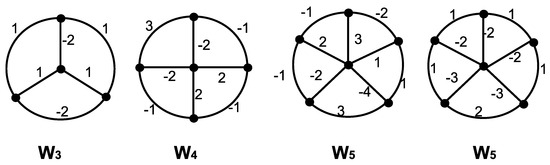
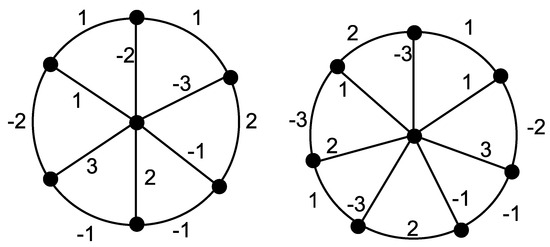
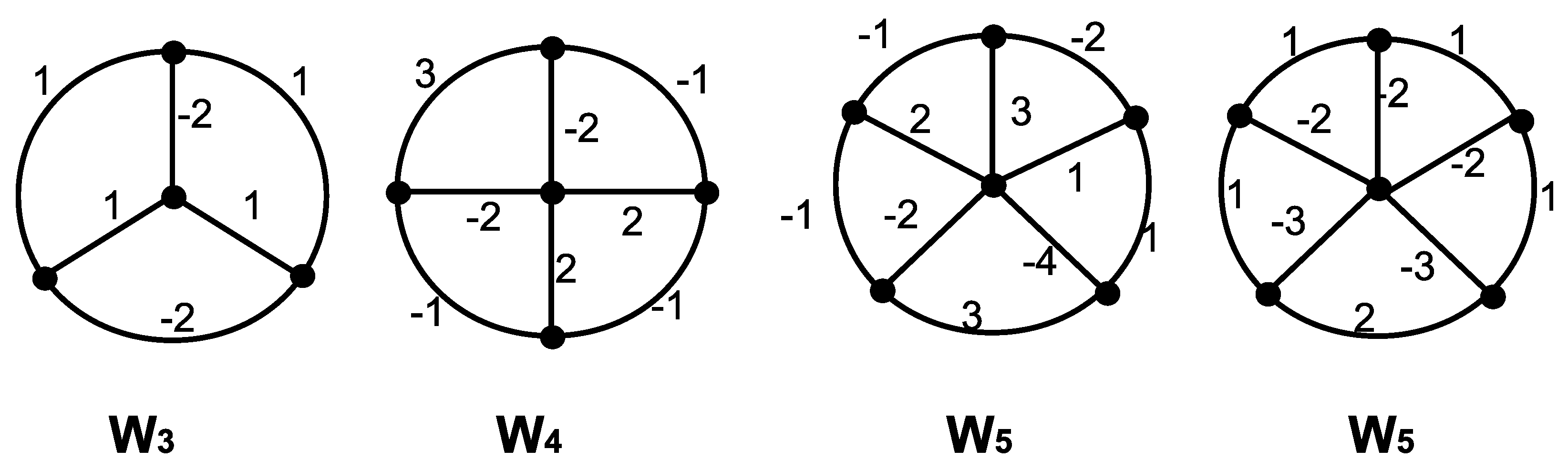
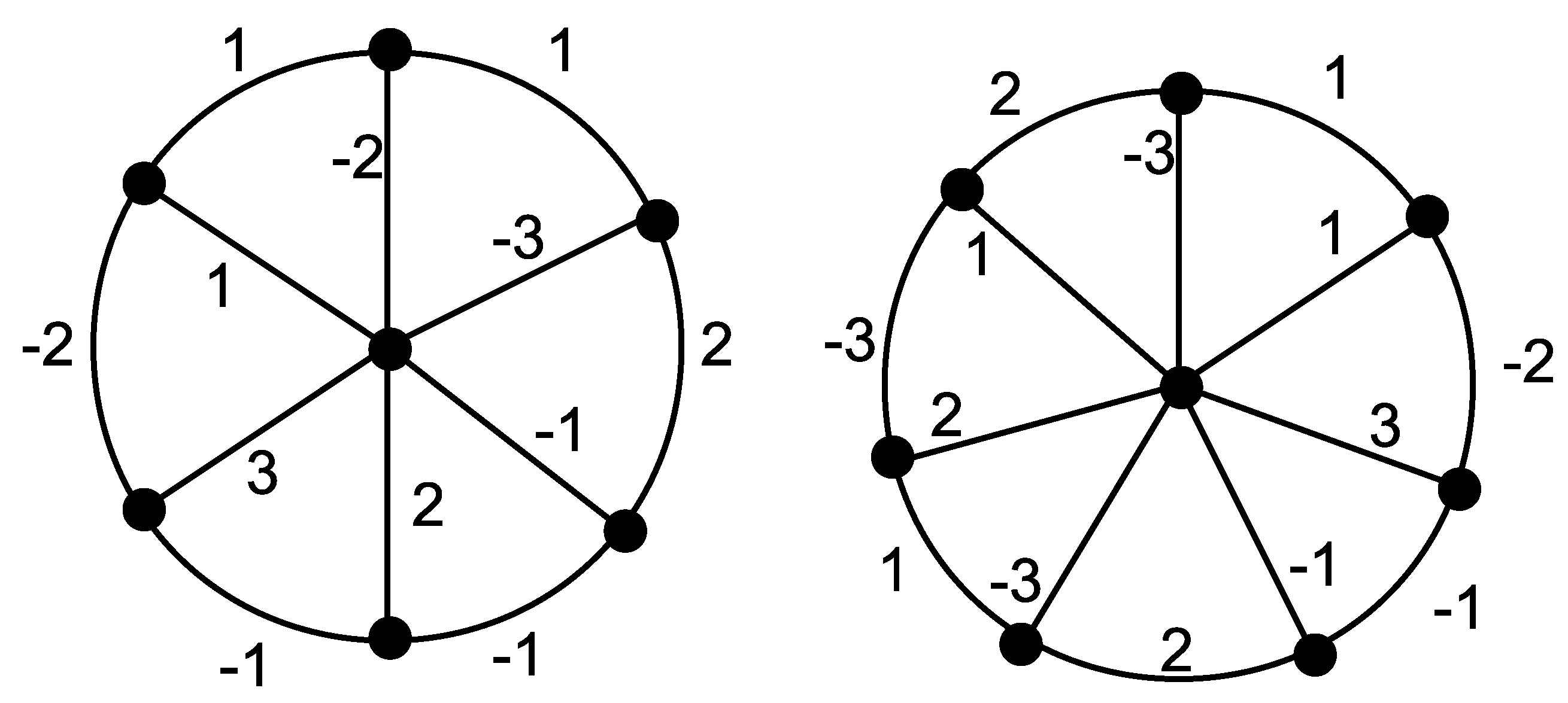
We deal with the problem by using induction on from n to , and for the cases for , we give the labeling in the figures. Note that is -magic with zero sum for (see Figure 9). In the case of , by Lemma 9 and see Figure 9, we see that for all . For the case , see Figure 9. The case on the left of Figure 9 is for -magicness with zero-sum for , for all , and the case on the right of Figure 9 is for -magicness with zero sum for .
Figure 9.
, , and .
The cases for and are presented in Figure 10. Combined with the Lemma 9, we see that for all and for all . Assume the result is true for . The induction step is the construction from to , for all , using the subdivision method mentioned above. Note that for the labeling given in Figure 10, and both have 1 and over the cycles of wheels, respectively. Therefore, we may complete the constant-sum spectrum of , for all , by subdividing the 1-edge and -edge. □
Figure 10.
and .
Lemma 11.
for .
Proof.
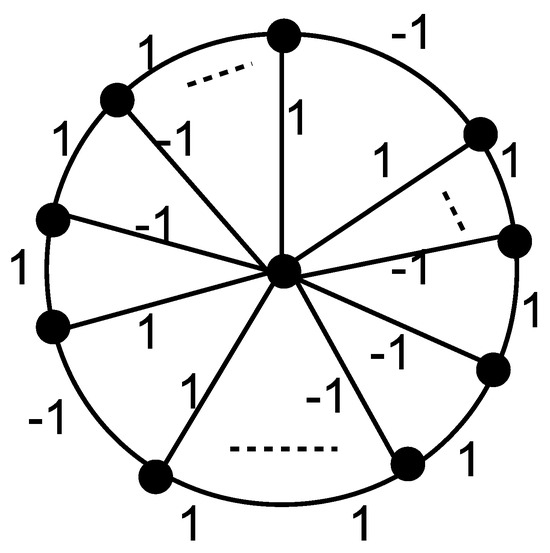
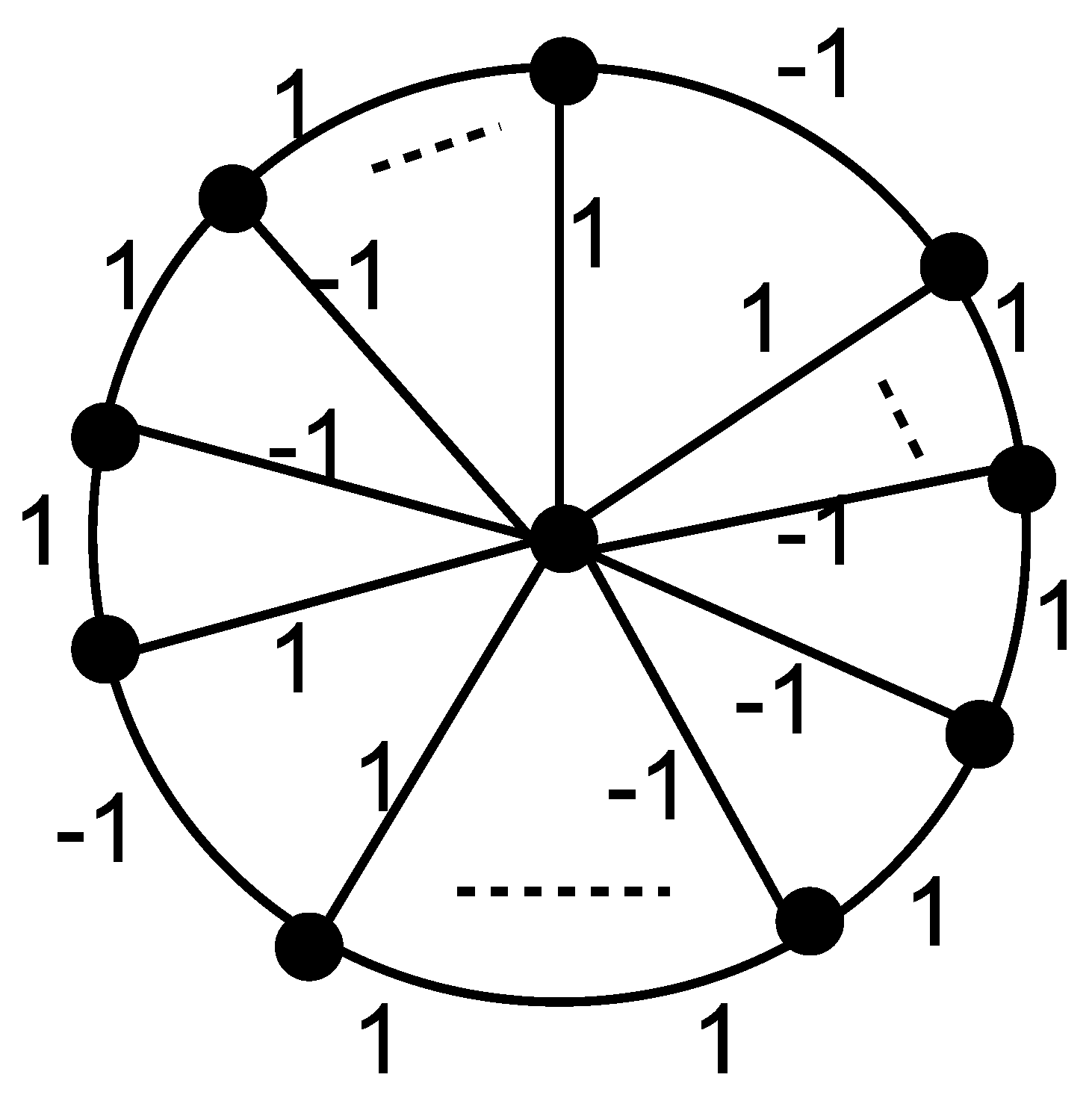
Suppose that mod 3, and , or 2. Label on r edges of the outer cycle of non-consecutively, and 1 on other edges. Please see Figure 11. To obtain index 1, label of 1’s and of ’s on the spokes, and hence, the vertex sum of the center is . □
Figure 11.
-magic sum of 1 of .
Lemma 12.
For n odd, .
Proof.
Let . In , each vertex is of odd degree, and it admits a perfect matching P such that is an Euler graph of even size. Label on such that each partial vertex sum is 0, and then label the nonzero element r on the matching P; we thus obtain all possible labeling of index . The case for zero index is thus complete. □
By Proposition 1, we have for n even. The following Lemma shows the constant-sum spectrum is the whole .
Lemma 13.
For n even, .
Proof.
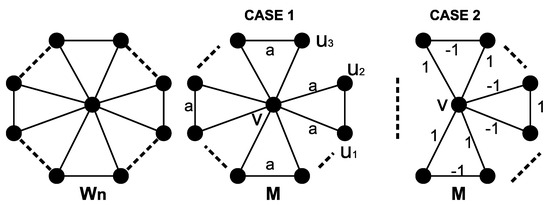
Let . Since the zero index case is completed, let in . Let ; we delete the edges and alternatively, and obtain a windmill M (see Figure 12).
Figure 12.
Constant-sum spectrum of wheels , n even.
- Case 1: M contains an even number of triangles.
Since M is of even size, we may label on one Eulerian tour of M such that the partial vertex sum is 0 on each vertex. Add value a to labels on edges , , then we have labels and on M such that partial vertex sums are on v, and a on other vertices. Now, put back the edges and , and then label a on them; we have labels on such that each vertex sum is .
To remedy the case when , similarly, we put labels on the Eulerian tour of M, and we then have labels and on such that each vertex sum is . Note that at least one of the two labeling on contains no zero element since and are under consideration.
- Case 2: M contains an odd number of triangles.
We have an Eulerian tour of odd size starting and ending at v and the edges are consecutively labeled . Then, we have label on M such that the partial vertex sum is 2 on v and is 0 on other vertices. Put the and back as in previous cases and label 2 on them; we then have the labels on such that each vertex sum is 2. Now adjust the labeling by multiplying the labels on each edge by a; we may have the labeling with such that each vertex sum is . We are thus finished in this case. □
To summarize the above Lemmas, we have the following:
Theorem 2.
The constant-sum spectrum of wheels , , for are as follows:
when ,
when ,
Again, note that when k is odd, and when k is even.
5. Constant-Sum -Flows of Fans and Wheels for
In order to obtain the constant-sum spectrum of fans and wheels for the case , we use the mathematical induction with a subdivision method by inserting new vertices and new edges to perform the task. We start with the fan graphs in the following.
5.1. Constant-Sum -Flows of Fans for
We calculate the constant-sum spectrum of fans , for in the following.
Lemma 14.
The constant-sum spectrum of is empty.
Proof.
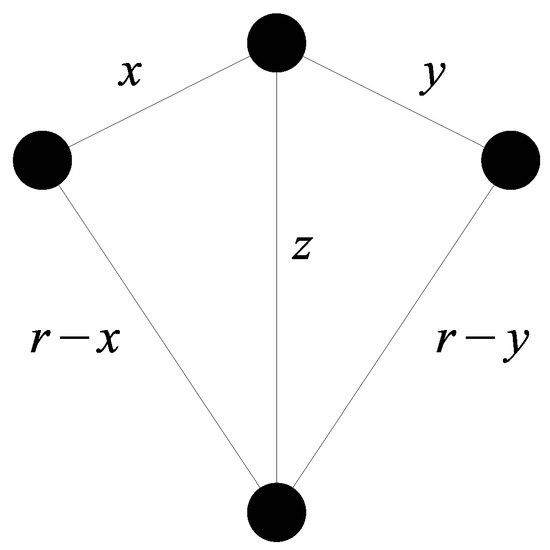
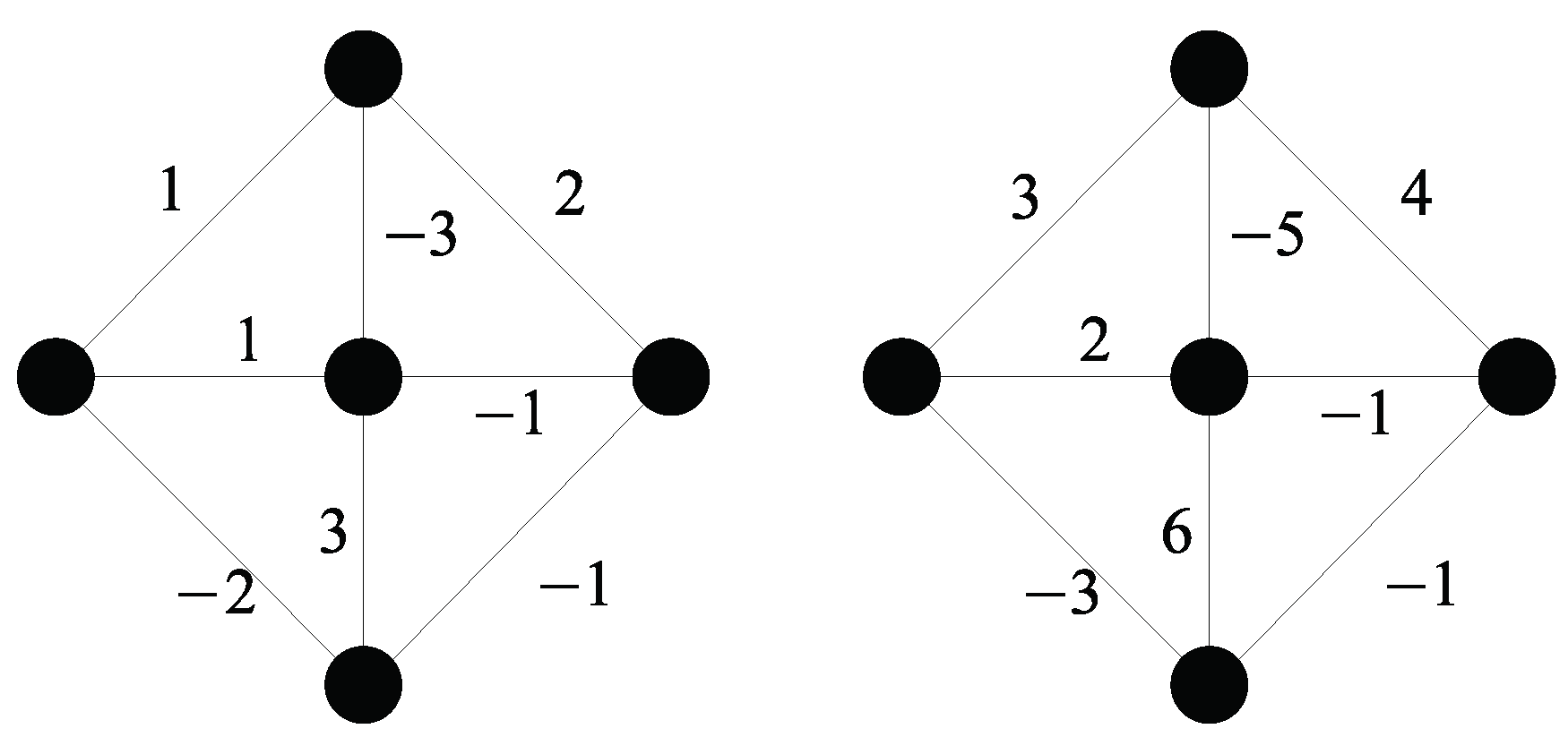
Suppose has some index , as in Figure 13. Note that one has and , which implies , a contradiction. □
Figure 13.
and the labels.
Lemma 15.
for all .
Proof.
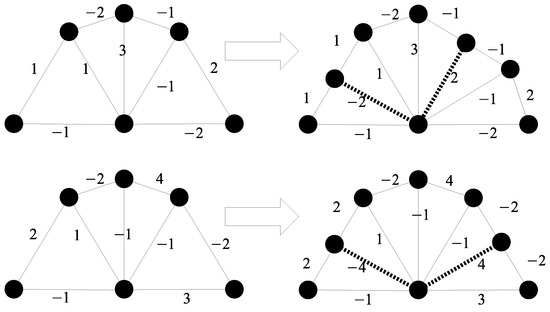
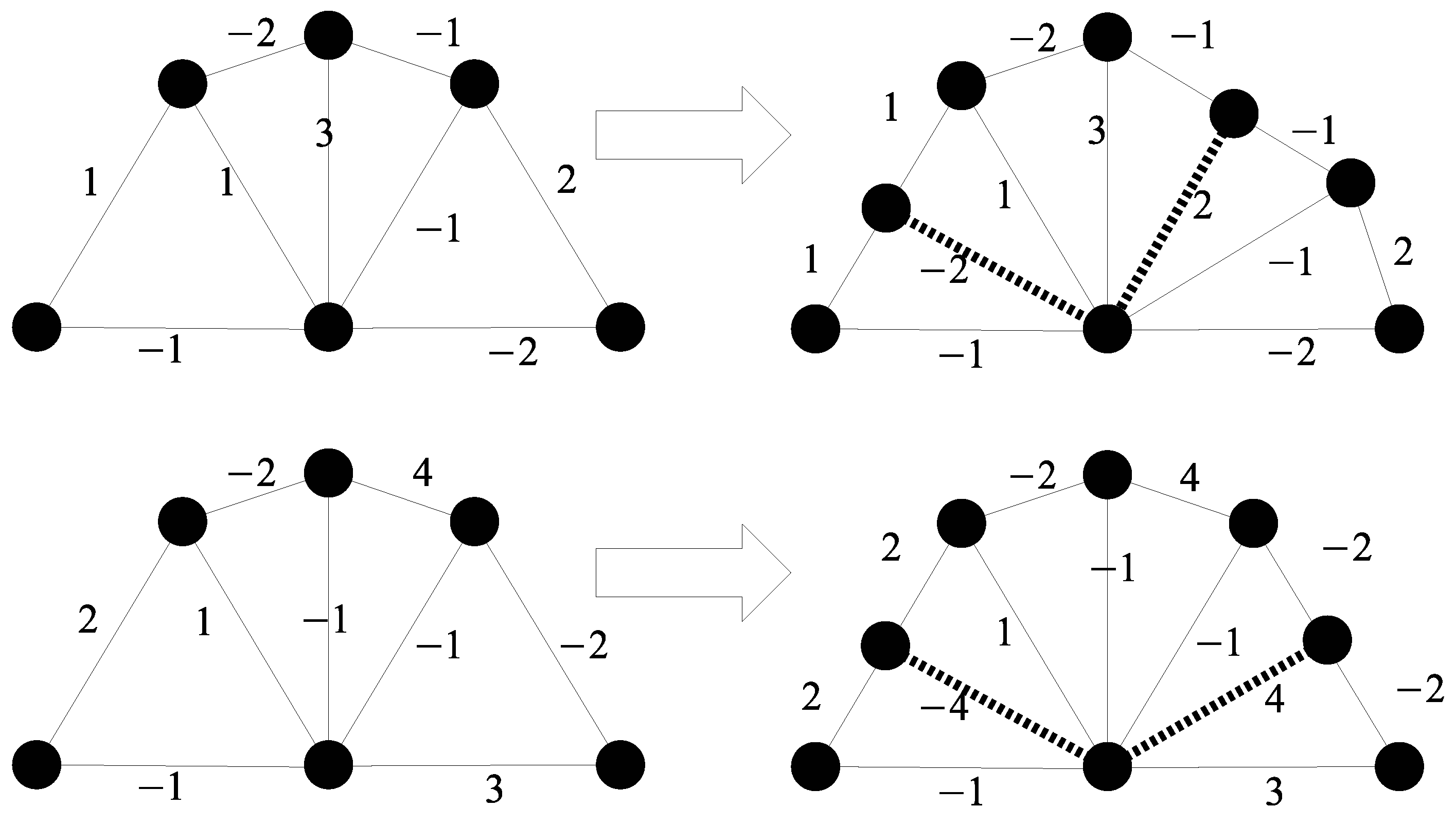
We use induction from to for . Figure 14 shows the edge insertion from to , which is also valid for general cases by induction. Therefore, for all . □
Figure 14.
0-sum 4-flow and 1-sum 5-flow from to .
Note that since is odd, by Corollary 1, the index of must be even. Therefore, for , we need to only consider even indices.
Lemma 16.
for all .
Proof.
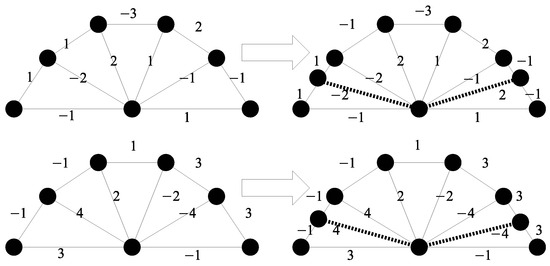
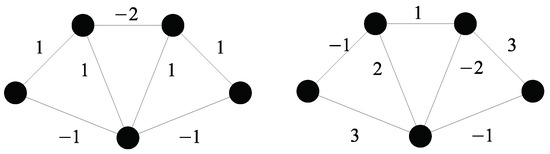
We use induction from to for . In the following, Figure 15 shows the edge insertion from to , which is also valid for general cases.
Figure 15.
0-sum 4-flow and 2-sum 5-flow from to .
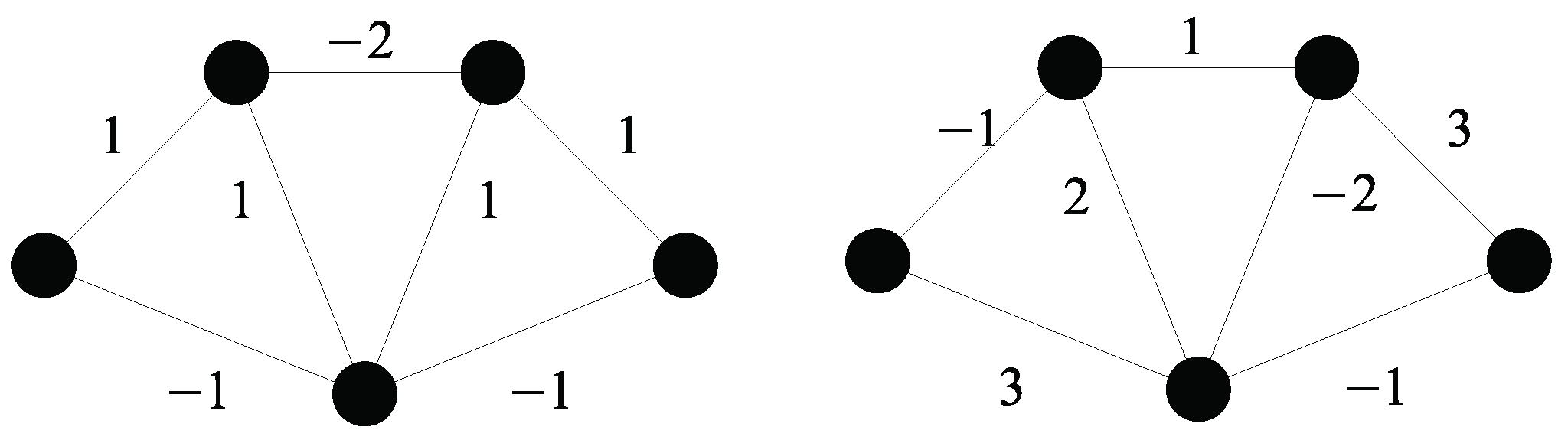
By this, we show that , for all . The only remaining case is . See the instances of 0-sum 3-flow and 2-sum 4-flow for , respectively, in Figure 16.
Figure 16.
0-sum 3-flow and 2-sum 4-flow for .
Therefore, we completed our calculations. □
5.2. Constant-Sum -Flows of Wheels for
We calculate the constant-sum spectrum of wheels for in the following.
Lemma 17.
for all .
Proof.
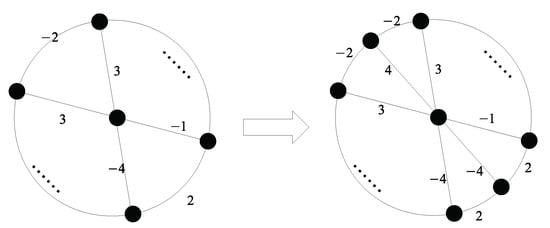
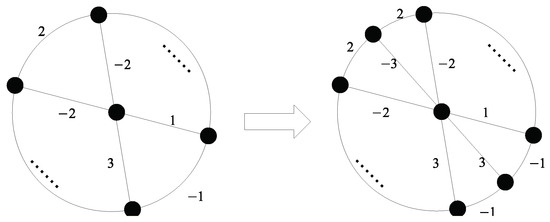
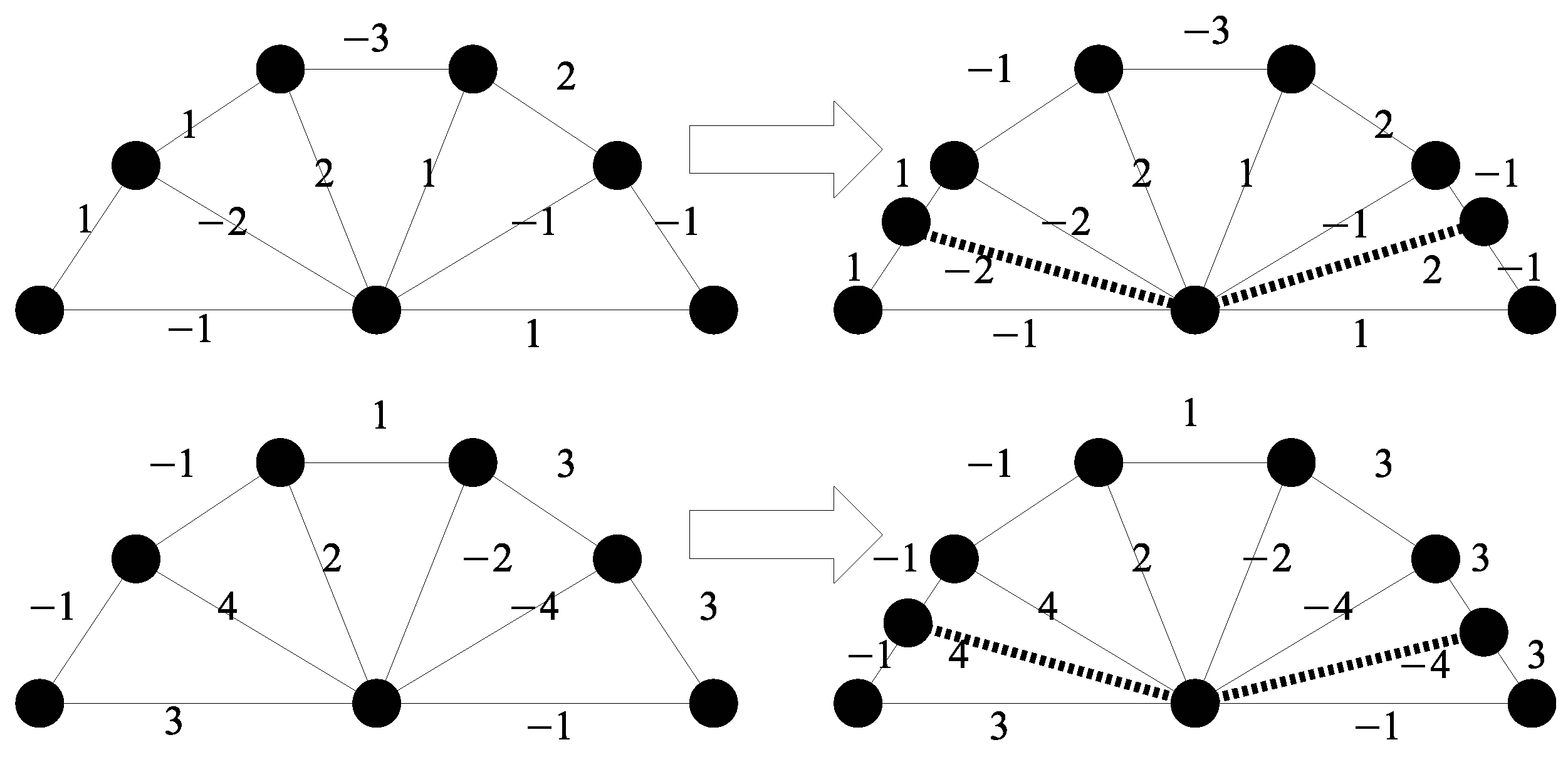
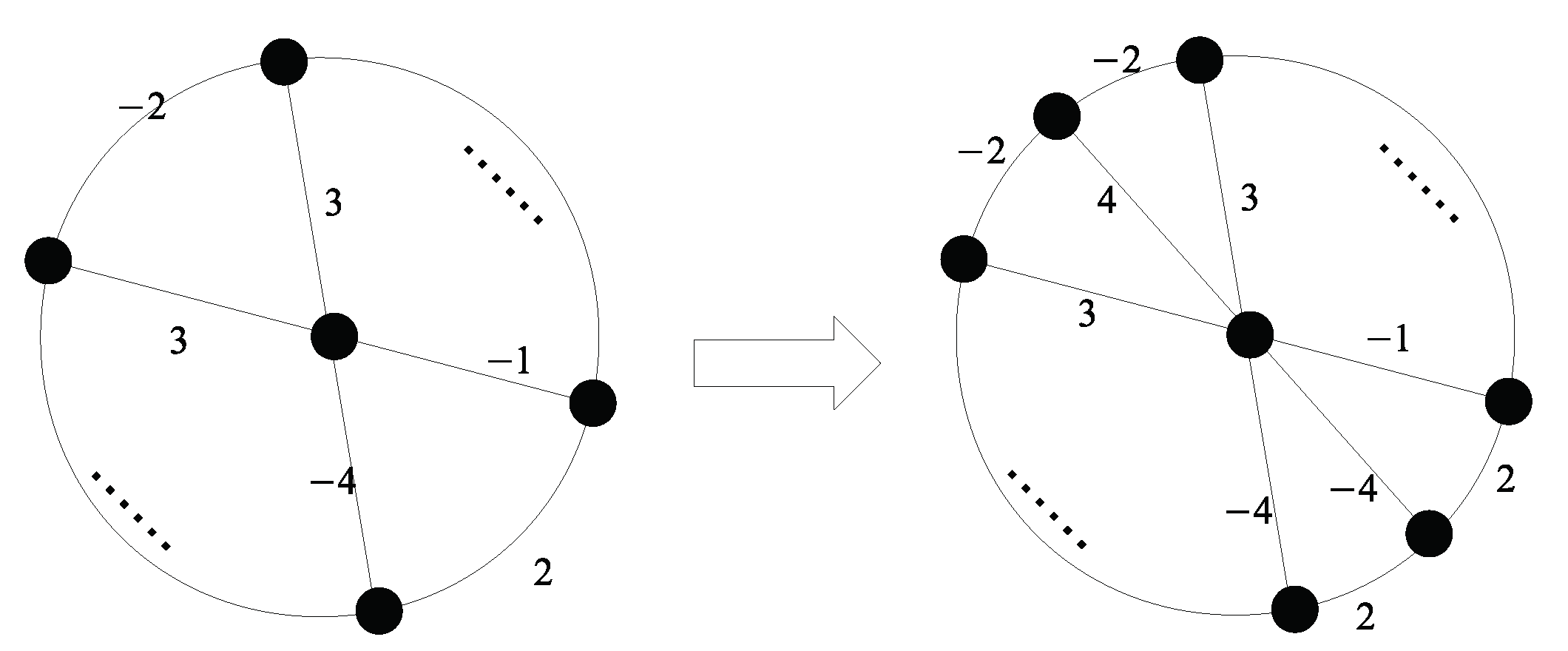
We use the edge insertion method from to inductively for 0-sums and 1-sums (as shown in Figure 17 and Figure 18, respectively) as follows.
Figure 17.
Wheels for index 0.
Figure 18.
Wheels for index 1.
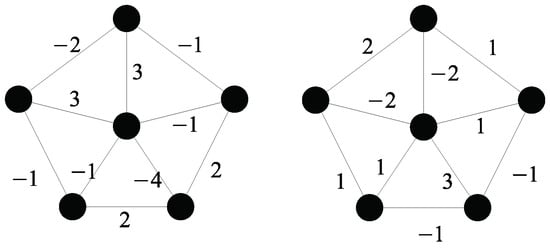
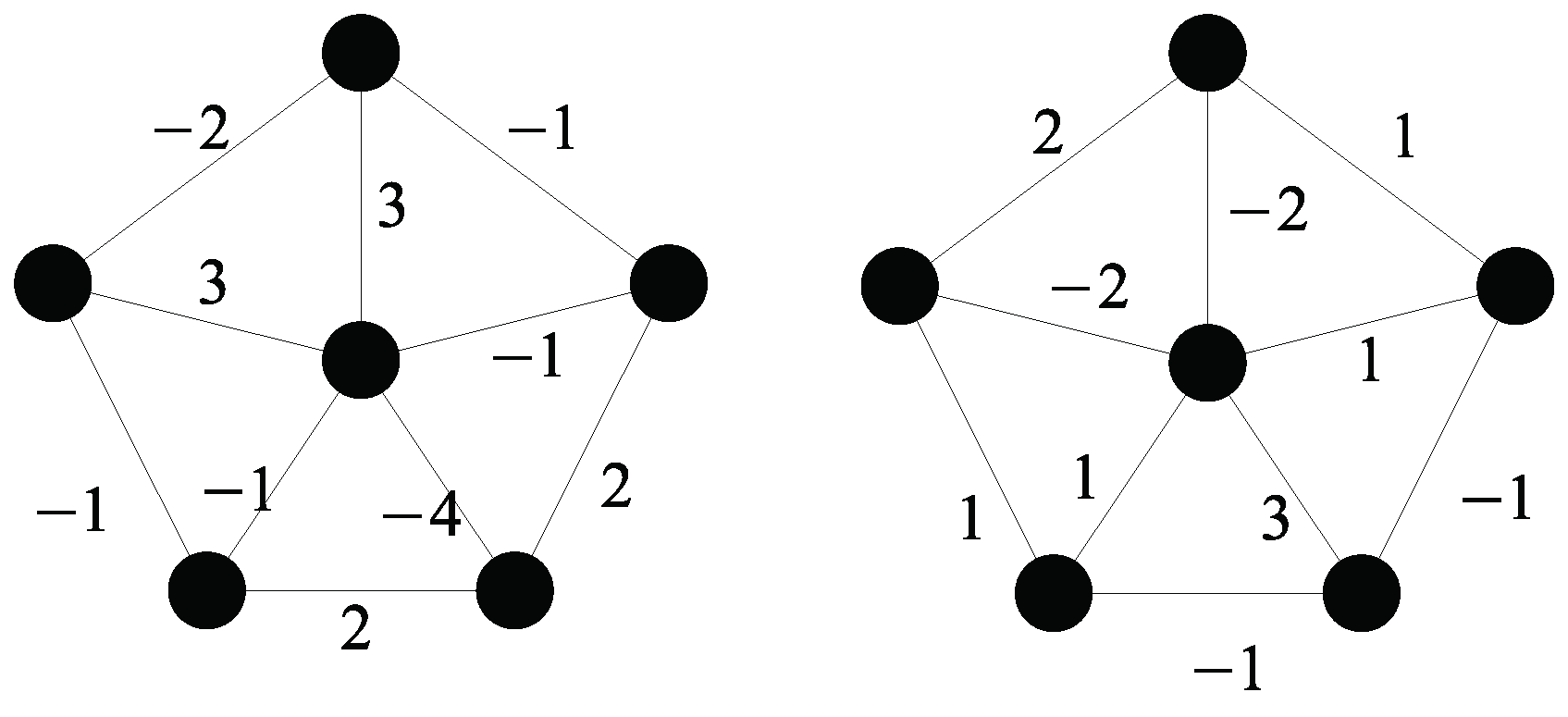
Note that in case , is 3-regular and was calculated in [24]. Instead, we start the induction from . See Figure 19 for instances of 0-sum 5-flow and 1-sum 4-flow for , respectively. Therefore, for all . □
Figure 19.
0-sum 5-flow and 1-sum 4-flow for .
Since is odd, by Corollary 1, the indices of must be even. We then have the following Lemma:
Lemma 18.
for all .
Proof.
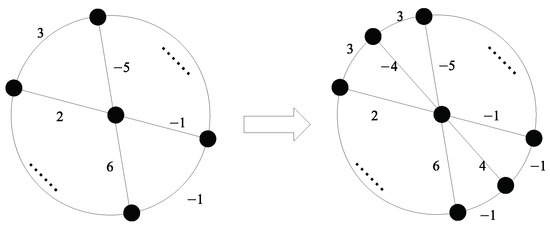
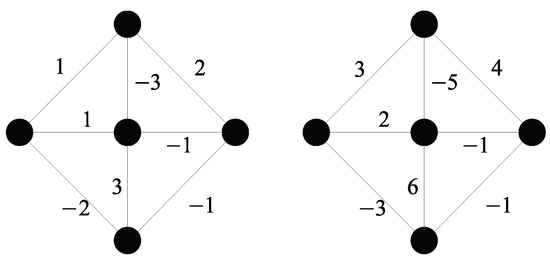
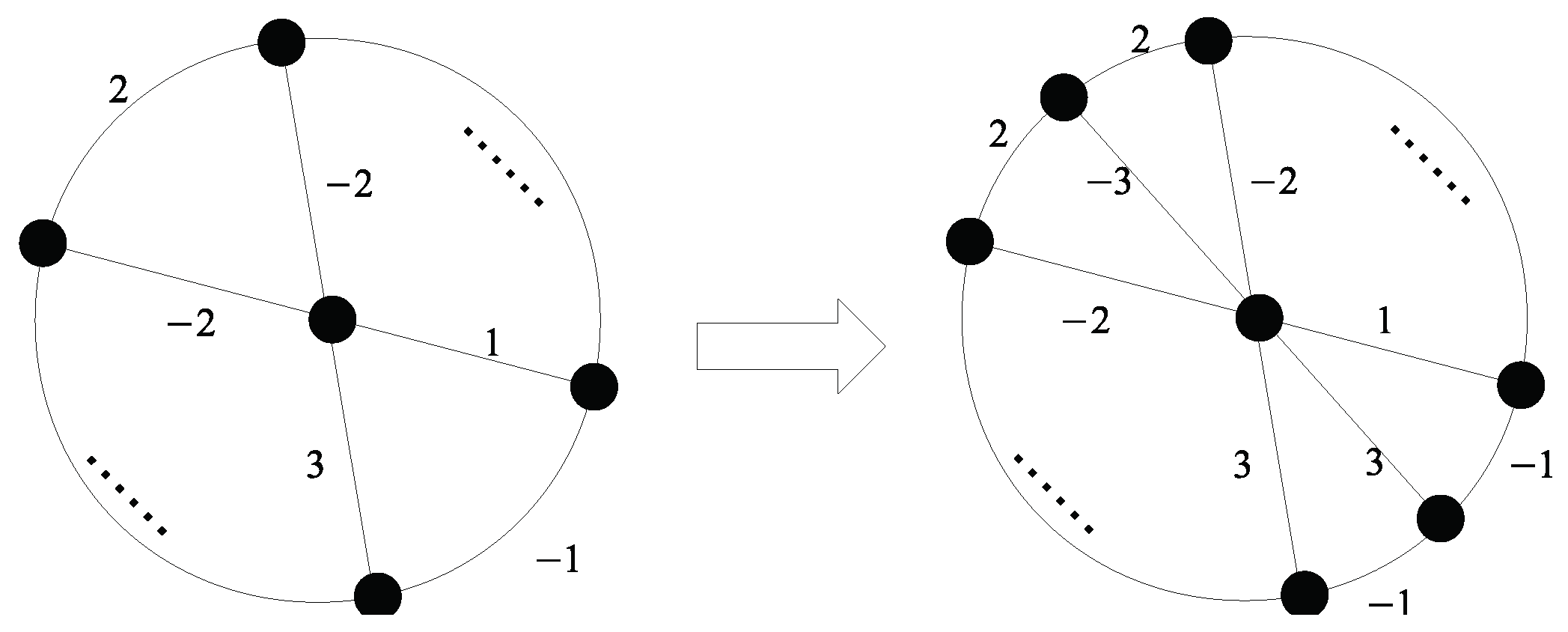
Similarly, we use the edge insertion method from to inductively for 0-sums and 2-sums (as shown in Figure 17 and Figure 20, respectively) as follows.
Figure 20.
Wheels for index 2.
We start the induction from , which is in Figure 21.
Figure 21.
0-sum 4-flow and 2-sum 7-flow for .
Therefore, for all odd . □
To summarize from the above Lemmas, we have obtained all constant-sum spectra of fans and wheels as follows.
Theorem 3.
The constant-sum spectrum of the fan graphs is as follows:
Theorem 4.
The constant-sum spectrum of wheel graphs is as follows:
6. Concluding Remarks and Future Work
In this article, we completely determine the constant-sum spectrum of two nearly regular graph classes, namely fans and wheels, for and , respectively. We list the following open problems along the directions of recent research to be explored further, inspired by our work:
- (1)
- To calculate the constant-sum spectra of regular graphs of odd degrees and the constant-sum spectra of nearly regular graph classes in general.
- (2)
- To determine the constant-sum spectra of various general graph products (e.g., Cartesian product, lexicographic product, strong product, and corona product) of (regular) graphs and other graphs that contain special cases of regular graphs or nearly regular graphs such as complete bipartite graphs , fan graphs , wheel graphs , etc.
- (3)
- Other than the complete bipartite graphs , to identify other classes of graphs whose constant-sum spectrum are the cyclic subgroups of . More generally identify classes of graphs whose constant-sum spectrum for an Abelian group as the subgroup of .
- (4)
- Extending the work in this paper to the general case of Abelian group based upon the special cases and .
- (5)
- For zero-sum flows, one has a more general parameter zero-sum flow number of a graph G, which is defined by the minimum k for G admitting a zero-sum k-flow. Similarly, one may study the parameter 1-sum flow number of a graph G, which is defined by the minimum k for G admitting a 1-sum k-flow.
Funding
This research was funded by National Science and Technology Council of Taiwan, under the grant number 113-2115-M-029-002-MY2.
Data Availability Statement
The original contributions presented in this study are included in the article. Further inquiries can be directed to the corresponding author.
Conflicts of Interest
The authors declare no conflicts of interest.
References
- Diestel, R. Graph Theory; Graduate Texts in Mathematics (GTM); Springer: Berlin/Heidelberg, Germany, 2005; Volume 173. [Google Scholar]
- Kotzig, A.; Rosa, A. Magic valuations of finite graphs. Canad. Math. Bull. 1970, 13, 451–461. [Google Scholar] [CrossRef]
- Jezny, S.; Trenkler, M. Characterization of magic graphs. Czecho-slovak Math. J. 1983, 33, 435–438. [Google Scholar] [CrossRef]
- Sadorovand, L.; Trenkler, M. On a generalization of magic graphs. In Combinatorics (Eger 1987); Colloquia Mathematica Societatis János Bolyai; 1988; pp. 447–452. [Google Scholar]
- Trenkler, M. Some results on magic graphs. In Proceedings of the Conference: Graphs and OtherCombinatorial Topics, Prague, Czech Republic, 24–27 August 1982; pp. 328–332. [Google Scholar]
- Jeurissen, R.H. Disconnected graphs with magic labelings. Discrete Math. 1983, 43, 47–53. [Google Scholar] [CrossRef]
- Stewart, B.M. Magic graphs. Canad. J. Math. 1966, 18, 1031–1059. [Google Scholar] [CrossRef]
- Stewart, B.M. Supermagic complete graphs. Canad. J. Math. 1967, 19, 427–438. [Google Scholar] [CrossRef]
- Stanley, R.P. Linear homogeneous diophantine equations and magic labelings of graphs. Duke Math. J. 1973, 40, 607–632. [Google Scholar] [CrossRef]
- Stanley, R.P. Magic labeling of graphs, symmetric magic squares, systems of parameters and Cohen-Macaulay rings. Duke Math. J. 1976, 43, 511–531. [Google Scholar] [CrossRef]
- Akbari, S.; Ghareghani, N.; Khosrovshahi, G.B.; Mahmoody, A. On zero-sum 6-flows of graphs. Linear Algebra Appl. 2009, 430, 3047–3052. [Google Scholar] [CrossRef]
- Bouchet, A. Nowhere-zero integral flows on a bidirected graph. J. Combin. Theory Ser. B 1983, 34, 279–292. [Google Scholar] [CrossRef]
- Akbari, S.; Daemi, A.; Hatami, O.; Javanmard, A.; Mehrabian, A. Zero-Sum Flows in Regular Graphs. Graphs Comb. 2010, 26, 603–615. [Google Scholar] [CrossRef]
- Wang, T.-M.; Hu, S.-W. Constant Sum Flows for Regular Graphs. In Frontiers in Algorithmics and Algorithmic Aspects in Information and Management, Proceedings of the Joint International Conference, FAW-AAIM 2011, Jinhua, China, 28–31 May 2011; Atallah, M., Li, X.-Y., Zhu, B., Eds.; Lecture Notes in Computer Science (LNCS); Springer: Berlin/Heidelberg, Germany, 2011; Volume 6681, pp. 168–175. [Google Scholar]
- Akbari, S.; Kano, M.; Zare, S. A generalization of 0-sum flows in graphs. Linear Algebra Its Appl. 2013, 438, 3629–3634. [Google Scholar] [CrossRef]
- Akbari, S.; Rahmati, F.; Zare, S. Zero-Sum Magic Labelings and Null Sets of Regular Graphs. Electron. J. Comb. 2014, 21, P2.17. [Google Scholar] [CrossRef] [PubMed]
- Akbari, S.; Friedland, S.; Markstrom, K.; Zare, S. On 1-sum flows in undirected graphs. Electron. J. Linear Algebra 2015, 31, 646–665. [Google Scholar] [CrossRef]
- Akbari, S.; Kano, M.; Zare, S. 0-Sum and 1-sum flows in regular graphs. Electron. J. Comb. 2016, 23, P2.37. [Google Scholar] [CrossRef] [PubMed]
- Wang, T.M.; Hu, S.W. Zero-Sum Flow Numbers of Regular Graphs. In Frontiers in Algorithmics and Algorithmic Aspects in Information and Management, Proceedings of the Joint International Conference, FAW-AAIM 2012, Beijing, China, 14–16 May 2012; Snoeyink, J., Lu, P., Su, K., Wang, L., Eds.; Lecture Notes in Computer Science; Springer: Berlin/Heidelberg, Germany, 2012; Volume 7285. [Google Scholar]
- Wang, T.M.; Zhang, G.H. Zero-Sum Flow Numbers of Hexagonal Grids. In Frontiers in Algorithmics and Algorithmic Aspects in Information and Management, Proceedings of the Joint International Conference, FAW-AAIM 2012, Beijing, China, 14–16 May 2012; Fellows, M., Tan, X., Zhu, B., Eds.; Lecture Notes in Computer Science; Springer: Berlin/Heidelberg, Germany, 2013; Volume 7924. [Google Scholar]
- Wang, T.M.; Hu, S.W.; Zhang, G.H. Zero-Sum Flow Numbers of Triangular Grids. In Frontiers in Algorithmics, Proceedings of the 8th International Workshop, FAW 2014, Zhangjiajie, China, 28–30 June 2014; Chen, J., Hopcroft, J.E., Wang, J., Eds.; Lecture Notes in Computer Science; Springer: Cham, Switzerland, 2014; Volume 8497. [Google Scholar]
- Wang, T.M.; Zhang, G.H. On Zero-Sum Flow Numbers of Triangular Tessellations. Indian J. Discret. Math. 2019, 5, 57–61. [Google Scholar]
- Gallian, J.A. A Dynamic Survey of Graph Labeling. Electron. J. Comb. 2022, #DS6. [Google Scholar]
- Wang, T.-M. Constant Sum Group Flows of Graphs. Mathematics 2023, 11, 4948. [Google Scholar] [CrossRef]
- Lin, C.-M.; Wang, T.-M. On Zero Magic Sums of Integer Magic Graphs. Ars Comb. 2015, 118, 119–134. [Google Scholar]
Disclaimer/Publisher’s Note: The statements, opinions and data contained in all publications are solely those of the individual author(s) and contributor(s) and not of MDPI and/or the editor(s). MDPI and/or the editor(s) disclaim responsibility for any injury to people or property resulting from any ideas, methods, instructions or products referred to in the content. |
© 2025 by the author. Licensee MDPI, Basel, Switzerland. This article is an open access article distributed under the terms and conditions of the Creative Commons Attribution (CC BY) license (https://creativecommons.org/licenses/by/4.0/).