


Abstract
An algorithmic method is proposed to generate all cubic polynomials with a critical orbit relation. We generate curves (polynomials of parameters) that correspond to those functions with critical orbit relations. The irreducibility of the polynomials obtained is left as an open problem. Our approach also works to generate critical orbit relations in all families of rational functions with active critical points.
MSC:
30D05; 37F45; 13P10; 13P15; 12Y05
1. Introduction and Statement of the Problem
In their influential paper, Baker and DeMarco [1] explored the distribution of postcritically finite (PCF) polynomials through the perspective of the Zariski topology in algebraic geometry. They defined special algebraic subvarieties as subvarieties within the space of degree-d polynomials that contain a Zariski-dense set of postcritically finite polynomials. They then posed the problem of classifying all such subvarieties.
Baker and DeMarco called an algebraic variety in the space of degree d polynomials (or rational maps) “special" if it contains infinitely many postcritically finite polynomials (rational maps) and asked to classify such special varieties [1]. Recently, this problem was solved for the cubic polynomials in [2] and for all degrees in [3] by Favre and Gauthier. They showed that the special curves can be characterized by the orbits of critical points in three cases: one of the critical points is persistently preperiodic, the two critical points have a persistent critical orbit relation, or there is a symmetry via , in which case the curve is , ([2] Theorem A). The special curves where the critical point is periodic were studied by Milnor [4]. The works of Milnor were generalized for rational maps with a preperiodic critical point by Buff, Epstein, and Koch and they showed that prefixed subvarieties are irreducible [5].
This research builds on significant advances in holomorphic dynamics, particularly the classification of special algebraic varieties containing postcritically finite polynomials, as established by Baker, DeMarco, Favre, and Gauthier [1,3]. By addressing critical orbit relations in cubic polynomials, our study extends the computational and theoretical techniques used to explore stability and bifurcation in parameter spaces. This work introduces an iterative framework for generating dynamical systems with specific critical orbit relations, offering new tools for understanding the structure and irreducibility of COR varieties. These contributions are pivotal for advancing computational approaches in dynamical systems and analyzing the parameter spaces of complex polynomials.
The approach is applicable for generating critical orbit relations in all families of rational functions with active critical points. We address the irreducibility of the polynomials in the space of cubic polynomials for some low-degree cases. In this regard, we would like to remark that experiments with other cases show that the irreducibility problem is very hard and for each case one needs to use different tools.
Every cubic polynomial has the Branner–Hubbard form , where are complex numbers [6]. The critical points are at . Cubic polynomials as a dynamical system and the parameter plane of cubic polynomials were studied intensively by many in [4,6,7,8,9]. Define the iterates of by letting and , for . In this paper, we solve the following problem.
Problem 1.
For each pair of , find all polynomials such that
Here, we also require that if and . In fact, we give an answer to this problem as an algebraic curve on complex variables , which is the Zariski closure of the set of points that solve the Problem 1. The irreducibility of the obtained curves is of great importance and is left as an open problem (see Proposition 2).
The orbit of a point z is A point is called a critical point of a polynomial p if . A polynomial p is called postcritically finite if the orbit of all critical points of p is finite as a set. A point is called a fixed point of a polynomial p if . The derivative at the fixed point is called its multiplier. Two polynomials p and q are called affine conjugate if and only if there exists an affine map with , (conjugacy) such that for all . Note that here plays the role of affine change of coordinates in z-plane and in planes at the same time. In the study of dynamical systems such a dynamical change in coordinates produces the same dynamics. By scaling (), we can make the leading coefficient of any polynomial 1. In general, a cubic polynomial has two critical points so by a change of coordinates (translation () we can put them at some and obtain the Branner–Hubbard form.
We also consider cubic polynomials written in the form
with a fixed point at the origin with the multiplier . The family in this form is denoted by Per1. Critical points of q solve the quadratic equation
Denote the critical points by and . If then it is not possible to label (mark) the critical points without taking the square root function in the complex plane.
Problem 2.
For each pair of , find all polynomials such that
These two problems are equivalent to each other but it is easy to work with the first one as the critical points are marked at . Indeed, let be any fixed point of ; by the change of coordinates we can put its fixed point to the origin to obtain a cubic polynomial of the form (2). Now we start with a cubic polynomial of the from (2) and let be the midpoint of the critical points and of (the midpoint of the line segment joining the two critical points). By the change in coordinates we can put its critical points to two points symmetric with respect to the origin. The resulting cubic polynomial is of the Branner–Hubbard form. Now for and , for convenience, denote the change in the coordinate by with and then and for all we obtain . Finally, we assume that p satisfies the Problem 1 for , i.e., Then, Applying to both sides of the latter we obtain or which solves Problem 2 with the same . Going backward, we can show that every solution to Problem 2 is also a solution to Problem 1.
One can also consider the following subproblem if we restrict to a slice and work in Per1.
Problem 3.
For each pair of , find all polynomials such that
The third problem has the same difficulty as the second one but both can be derived from the first.
Two distinct cubics and are affine conjugate if and only if and ; the conjugacy is . Indeed, for assume that there is an affine conjugacy: . Take the derivative from both sides and obtain It yields that the conjugacy sends the critical points of to the critical points of If we substitute we must have or . In both cases, we obtain . Then, we obtain and directly obtain . Thus, the conjugacy is the identity or it is . If then the conjugacy is . By collecting common terms we obtain and , which finishes the claim. The conjugacy interchanges the markings (labeling) of critical points . Thus, the moduli space, consisting of all affine conjugacy classes of cubics with marked critical points, can be identified with coordinates . It means that all four pairs correspond to the same equivalence class.
Definition 1.
For a polynomial p with critical points and acritical orbit relationis a quadruple (in short, a pair ) with nonnegative integers n and m such that
If then we require . If then the critical orbit relation is of the first type and for it is of the second type. In this paper, we only consider critical orbit relations of the second type.
We do not require such to be exact but only ask if (5) is true then and we call it a minimal relation. Every critical orbit relation of the form satisfies our requirement so it is minimal. As the Equation (5) is symmetric with respect to n and m, it suffices to consider only the cases of .
For a polynomial , a critical orbit relation is a pair with non-negative integers n and m such that for the critical points a and we have (1).
Let for be a holomorphic family ( is a complex manifold) of cubic polynomials and mark critical points of . A point belongs to the stability locus [10] if the Julia sets move holomorphically in a neighborhood of . Alternatively, a point belongs to the stability locus if the sequence
forms a normal family on some neighborhood of for both . A point belongs to the bifurcation locus if stability fails at . In complex dynamics, the bifurcation locus (also known as the activity locus [10,11]) of a parameterized family of one-variable holomorphic functions refers to the set of parameter points where small changes in the parameter cause significant changes in the dynamical behavior. This locus is often seen as a counterpart to the Julia set but in the context of parameter space. The most well-known example of a bifurcation locus is the boundary of the Mandelbrot set [10].
The following lemma motivates us to study functions with interacting distinct critical points. It is analogous to Lemma 2.3 in [11].
Lemma 1.
Assume that is not normal at for (the bifurcation locus is not empty) and persists throughout χ (or in every sufficiently small neighborhood of ). Then, there are infinitely many parameters such that and are in critical orbit relations. In particular, there are infinitely many parameters such that , where depends on t.
Proof.
Consider from the bifurcation locus. In a small neighborhood of let be two preimages of . An application of Montel’s theorem with the triple , which is persistent, finishes the proof. If there are no two preimages, then they must coincide, creating a critical point, which must be as there are only two critical points, so that the image of it is the critical point so that the relation is of the form . □
The Problem 1 may be reduced to computing the result of two polynomials and , with respect to variable z [12] (see Proposition 1). The result (denoted by ) is a polynomial on the parameters .
We propose a procedure for constructing a sequence of auxiliary polynomials (see Lemma 2) from which we directly arrive at the polynomial equation in the parameters , a zero set of which corresponds to a critical orbit relation (1) for each pair .
The zero set of the obtained polynomials can also be viewed as a family of a critical orbit relation, known as a COR variety (Critical orbit relations), in the parameter space of cubic maps, as described in [13]. These COR varieties are fundamental in the analysis of holomorphic and arithmetic dynamical systems, and they have been extensively studied [13,14,15,16]. With this paper, we proposed a new class of COR curves. The problem of the irreducibility of these new curves can be studied by the use of the techniques developed in [5,15,16,17,18].
The notion of poscritical minimality in families of rational functions was introduced in [19,20]. The condition on functions we consider in this paper is weaker than the condition for poscritical minimality. Moreover, the functions with a critical orbit relation are not necessarily postcritically finite. They can well be postcritically infinite. The above-mentioned result of Favre and Gauthier [2] shows that each variety defining the critical orbit relation contains infinite postcritically finite cubic polynomials. If we consider a slice in the cubic family consisting of polynomials with a persistent attracting or parabolic periodic point (e.g., Per1), all such maps will be postcritically infinite. But in these slices, there always exist those with a critical orbit relation. On the other hand, if the slice consists of entirely cubics with a persistent superattracting period point then all cubics with a critical orbit relation are necessarily postcritically finite.
2. From Critical Orbit Relations to Recurrence Relations
This section is a preliminary to a quantitative answer to the main Lemma 1, which is the main theme of the paper. Below we reduce the orbit of the critical point to a simple looking form with universal polynomials that are recursively obtained. In what follows, the powers in the polynomials p represent iterations while the powers of newly introduced polynomials and the variables or in the algebraic expressions represent the algebraic power.
Lemma 2.
There exist sequences and of polynomials of parameters such that for all the equality holds.
Proof.
As , set and . Recurrently define polynomials and such that for . It follows that the recurrence relation is the following.
The above formulas are obtained by substituting , for into the expansion of and combining the common terms. □
Denote by the degree of a two-variable polynomial with respect to a variable a and by the degree of a two-variable polynomial , which is the sum of degrees of variables a and b in the highest monomial of Q. For instance, and . It is easy to see from the recurrence relations that for , and for (to ease the notations in some places of this paper we drop the arguments in writing functions).
The following lemma gives even more structure to the introduced polynomials and . It also helps to reduce by half the degrees of the later obtained algebraic curves that represent each critical orbit relation.
Lemma 3.
There exist sequences and of polynomials such that for every one has and .
Proof.
We proceed by induction on n. For the statement is true as and , set and . Suppose that the statement holds for n:
By the inductive hypothesis,
Set
so that . Similarly,
Set
so that This finishes the proof. □
In fact, by the above we have
for all .
The recurrence formulas that define and allow us to easily construct a linear equation in z from a critical orbit relation. If the critical relation becomes a linear equation in z, and for the critical relation reduces to .
3. Main Technical Results
In this section, the critical orbit relations are reduced to polynomial relations. We consider them case by case.
Case of . By Lemma 2 we have
This implies that the critical orbit relation reduces to
If vanishes then . In this case, both critical points collide so the critical orbit relation is . This means that there is no cubic polynomial with an exact critical orbit relation . There is also a topological reason why the case is not realized in the cubic polynomial family.
This implies that, for , we can write the following
For , , where
If there is a minimal critical orbit relation , then .
Moreover, and for .
From (12) we obtain that if and the relation is minimal then it yields that . By definition
and
Moreover, and .
Case of for and . Note that if we have
and
We denote
then Recall that , and , . For we have that . By Lemma 3 set
Note that the critical orbit relation is minimal. An easy calculation shows that
For set
or by Lemma 3 we can write it as
then the above implies that
For set
then and . If there is a minimal critical orbit relation then . Moreover, and for .
Case of . By following Taylor’s formula for cubic polynomials
and since , , and we obtain After simplification it becomes
By substituting and instead of z and w, respectively, we obtain
Similarly,
Now, if we multiply the left-hand sides (which is as was defined in (14)) and the right-hand sides of the latter two identities (product of the first items is ) and substituting the iterates in the second items of the products on the right-hand sides by Lemma 2 correspondingly and denote by then
and we obtain the factorization
Let and set
then . We have and if there is a minimal critical orbit relation then .
By definition and .
Here is an application of the above computations. The problem of the exclusion of the variable z from the system and is equivalent to finding the resultant of the two polynomials, with respect to variable z [12]. We obtain the following as a direct corollary of the above computations.
Proposition 1.
For all pairs of , we have if then
and
4. Main Result and Its Proof
Our main result is the following:
Theorem 1.
Let us remark that if the critical orbit relation exists then any nearby point to the critical value must have four preimages but our polynomial is cubic so it is not realized for this family. The main result concludes that all other critical orbit relations are realized.
Proof of Theorem 1.
The first part of the theorem has been considered in the previous section for all three cases (, for and and , for ). For each case, the zero level of polynomials corresponds to minimal critical orbit relation. The degree counts show that all but critical orbit relations are realized so that there are infinitely many cubic polynomials for every minimal critical orbit relation . It finishes the proof and answers to Problems 1 and 2 as these two are the same. □
We would like to remark that for the minimal critical orbit relation the curves defined by contain points satisfying some other minimal critical orbit relation . So the required minimality is not equivalent to exactness. Our definition of minimality was introduced to factor those as much as possible. We conjecture that there are no further factorizations than those we found in this paper. If one needs to find the exact critical orbit relation it is necessary to study the intersection of these distinct algebraic curves defined by all pairs of and . Then, the exact critical orbit relations for particular are obtained from the curve by removing infinitely many discrete points that belong also to other such curves. It is clear that an algebraic curve defined by on complex variables is the Zariski closure of the set of points that solve the Problem 1 for the critical orbit relation .
If we consider a slice Per1, for a given , then if this slice does not contain postcritically finite maps. One can show that in this slice the above defined minimality is equivalent to exactness.
The moduli space can be described by the coordinates , let and then instead of we can work well with . We obtained the following.
Corollary 1.
In the moduli space of cubic polynomials of the form with coordinates and the minimal critical orbit relation corresponds to the set , where is defined by (13), (19), (20), (22), respectively. It is never empty, except for the relation . The degree of the curve is half of the degree of the polynomial .
Denote the affine algebraic curve in . It seems that each curve , except (which is an empty set), is irreducible. These curves are analogous to those defined by Milnor [4].
Denote Crit. In the parameter space except for all cases the algebraic curves Crit in have two components as which are the difference of two squares. But it seems that each factor of is irreducible over in this trivial factorization, which we leave as an open problem together with the irreducibility of . Moreover, the coefficients of each of are integers.
We end this section with the following.
Conjecture.
Every curve is irreducible in .
If this conjecture holds true, it implies that the structure of the parameter space remains consistent for points with critical orbit relations. If the curves were reducible, their reduced components would behave differently, causing the parameter space to split into non-uniform regions. However, visualizations and experimental results show no indication of such asymmetrical regions within the parameter space.
5. Examples of Special Curves in
Here are some examples of these special curves in .
and
Proposition 2.
The curves , , , , and are irreducible in .
Some examples of these curves are obtained in [22].
Proof.
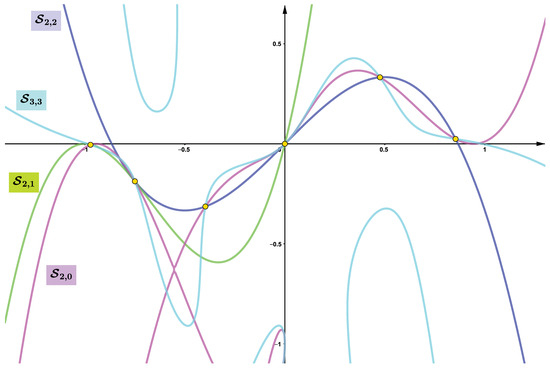
The curves , , , and are irreducible as they can be identified with the complex plain , graphs of polynomials (Figure 1). Let us show that the curve is irreducible. We need to show that the polynomial is irreducible in . Since its linear part does not vanish, it is irreducible in as well (see ([5] Lemma 5) or ([17] Theorem 4.6)). First, we show that the polynomial does not have a factor which is a polynomial of only x. On the contrary, assume . As and we obtain . Since we obtain, without loss of generality, that . Now divide by and obtain a nonzero reminder, which is a contradiction.
Figure 1.
The graphs of the curves .
Note that in we have now apply the Eisenstein criterion for prime number 2, which proves the claim. □
In Table 1 the degrees of for have been listed in a row.

Table 1.
The degree row of for .
6. Two Methods to Solve Problem 3
To solve Problem 3 one can try to use the method developed for Problem 1 by obtaining analogous results of Section 2 and Section 3. The factorizations of Section 3 for are no longer needed. We can still reduce each critical orbit relation into a polynomial equation. In this section by briefly go through the main parts of the former and also develop a new method for the latter. The main Lemma 2 will become the following.
Lemma 4.
Let be a cubic polynomial with critical points and that solve the equation . Then, for all the equality holds for and where polynomials and are recurrently defined as
with , .
Proof of this lemma goes alongside of the proof of Lemma 2 where in the expansion of we substitute and
Now we deal with the critical orbit relations and reduce them to polynomial relations. Since both critical points and are the roots of , Vieta’s formula yields that , which can be used to exclude the unknown from the critical orbit relations.
Case of . By Lemma 4 we have
If then the discriminate of vanishes: So that if then the critical orbit relation is . For all other values of the critical points and are distinct and the critical relation reduces to . Direct calculation yields so that does not produce a critical orbit relation, so this case is empty.
Denote From (23) we obtain
Set
This implies that for , we have the following factorization
Case of . For we have
Substituting , into (22) yields
Now the problem, the critical orbit relation, reduces to the following system of equations from which we need to exclude .
This system reduces to
For , using the identity
we obtain
If then the latter simplifies to
Now the problem, the critical orbit relation, reduces to the following system of equations from which we need to exclude .
This system reduces to
It remains to consider the case of . By (27) this case reduces to solve the following system.
By Lemma 4 and substituting into the first equation of the latter system we obtain the following.
To obtain the latter we substituted identities , , and .
Finally, this system reduces to
Instead of this, we propose an alternative method to solve Problem 3. In fact, it is not much alternative as it uses all the solutions of Problem 1 developed in Section 2 and Section 3. The idea is to work with a different parametrization of Per1 other than .
We start with the Branner–Hubbard form of a cubic polynomial and require that it has a multiple fixed point, not necessarily at the origin. It means that the fixed point equation has a multiple solution, which in turn, is equivalent to the vanishing of the discriminant of , which is . Now solve the latter for and substitute it in that is defined in Section 3 (by Formulas (10), (15), (16) and (21)) as these all are polynomials of and and thus obtain polynomials of only. For Problem 3 the corresponding result becomes stronger and, in particular, answers affirmatively on the infiniteness of cubic polynomials with critical orbit relations. Let us state it as a theorem without giving a proof.
Theorem 2.
The slice of defined by represents Per1and cubic polynomials with exact critical orbit relations corresponding to level sets , where are defined in Formulas (11), (15), (16), (21) with a substitution Moreover, the obtained critical orbit relations are all realized and are exact and there are infinitely many cubic polynomials with a critical orbit relation except the relation .
The idea of its proof is as follows. Let us note that every map has a parabolic fixed point at the origin and such a fixed point attracts the infinite orbit of a critical point [4]. If both critical points are in a relation then this relation is exact. By substituting and from Lemma 3 with (8), (9) and into (11) we obtain which is a polynomial of variable a. Similarly, we can show that after substitutions the polynomials defined in Formulas (15), (16), (21) are polynomials of variable a. Now introduce notations and then
By abusing the notation, (8) and (9) become the following after the substitutions.
Denote the leading term of a polynomial f by and the leading coefficient by . We obtain the following recurrence relations for the leading terms and coefficients.
with and .
with and . To solve the recurrence relation, introduce and divide the first equation by the second and obtain
with . This recurrence relation produces a constant sequence as is a fixed point of the rational function . Now it is easy to see that and Corresponding degrees are as follows:
with and . Solving these recurrence relations one obtains
and
Finally, and
Note that
and for
We have that
For the rest of the polynomials there are resonances. The term resonates with the term so that for and half of their degrees are dropped. For the polynomial the resonance happens for with resulting in a drop of the degree. But one can show that
and for we have that
Here are some examples: , , , , .
7. Summary and Further Discussions
This paper considered the problem of generating cubic polynomials with all possible critical orbit relations. We explicitly found that for polynomials, the level sets correspond to specific critical orbit relations. We also considered the sub-problems where we considered some slices in the parameter plane. The slices are cubic polynomials with fixed points with constant multipliers, Problem 2, and the multiplier 1, where the cubic polynomials have parabolic fixed points, and Problem 3. For the latter case, we gave two solutions to the problem. The statement of the main Lemma 2 is true for all other families of polynomials or rational functions as long as we have two interacting critical points that solve a quadratic equation of the parameters of the family. The idea is to reduce high powers in iterates of the critical point to a linear map (affine) of the critical point and then to reduce the critical relation into a linear equation and solve it explicitly. For some low degrees, the irreducibility is studied in Proposition 2. We propose a conjecture that all obtained polynomials in this paper are irreducible but this problem could be very hard to solve in full generality. To continue this line of research the other problems are as follows: One can also consider critical orbit relation for Blashke products. In this case, maps depend only on real analysis of the parameters so that the obtained equations will not be complex polynomials but polynomials involving parameters and their complex conjugates. The family considered in [23] is also a perfect example of the methods proposed in this paper.
One of the applications of the results in this paper is to study the number of stable components in the parameter plane of cubic polynomials as they contain unique centers where maps have critical orbit relations [19,20,24]. We can label them by the number of iterates for a critical orbit to reach the immediate basins of some fixed points. The difficulty one needs to overcome this problem is that the polynomials that we obtain do not determine the exact location of the critical point. The critical point could be in any Fatou component or both critical points could be at the same component and have a relation with each other. So the solution for this could be to use the Blaschke products that are mentioned above to exclude the latter case and obtain correct numbers on the number of stable components.
Another open problem is to study the interaction of more than two critical points. Now the critical points solve cubic equations or higher-order equations. In this case, we can modify the main Lemma 2 such that the iterates are now quadratic or one degree lower than the critical equation. The findings in this paper have significant implications for computational dynamics and related fields. By providing a systematic method for generating dynamical systems with specified orbit relations, our approach offers tools to study parameter spaces and the stability of holomorphic families. These insights can be utilized in modeling phenomena in physics, biology, and other sciences where dynamical systems are prevalent.
In computational dynamics, the iterative techniques described here can improve algorithms for detecting critical orbit relations, which are pivotal in visualizing fractals, such as the Mandelbrot set. Furthermore, understanding the structure and irreducibility of COR varieties aids in optimizing parameter exploration in high-dimensional spaces.
Future research could extend this framework to higher-degree polynomials or other families of rational functions. Additionally, exploring connections between critical orbit relations and arithmetic dynamics might yield new methods for solving Diophantine equations. The interdisciplinary nature of this work invites collaboration across mathematics, physics, and computer science to tackle complex systems and advance computational methods for analyzing their behavior.
Author Contributions
Conceptualization, K.M., F.Ç., M.R., G.I. and B.A.P.; methodology, K.M., F.Ç., M.R., G.I. and B.A.P.; validation, K.M., F.Ç., M.R., G.I. and B.A.P.; formal analysis, K.M., F.Ç., M.R., G.I. and B.A.P.; investigation, K.M., F.Ç., M.R., G.I. and B.A.P.; writing—original draft preparation, K.M., F.Ç., M.R., G.I. and B.A.P.; writing—review and editing, K.M., F.Ç., M.R., G.I. and B.A.P.; visualization, K.M., F.Ç., M.R., G.I. and B.A.P.; supervision, G.I. All authors have read and agreed to the published version of the manuscript.
Funding
This research received no external funding.
Data Availability Statement
Data are contained within the article.
Acknowledgments
Part of this research was carried out when the first author visited the Institute of Mathematics of Polish Academy of Sciences for Simons Semester 2023 and participated in Thematic Research Programme ‘Modern holomorphic dynamics and related fields’, Excellence Initiative—Research University program at the University of Warsaw. The first author thanks the organizers for the invitation and generous support. The authors also thank Farkhod Eshmatov, and Georgii Makeev for their valuable comments on the paper. The authors would like to thank the anonymous referees who provided useful and detailed comments on an earlier version of the manuscript.
Conflicts of Interest
The authors declare no conflicts of interest.
References
- Baker, M.; De Marco, L. Special curves and postcritically finite polynomials. Forum Math. 2013, 1, e3. [Google Scholar] [CrossRef]
- Favre, C.; Gauthier, F. Classification of Special Curves in the Space of Cubic Polynomials. Int. Math. Res. Not. 2016, 2018, 362–411. [Google Scholar] [CrossRef]
- Favre, C.; Gauthier, T. The Arithmetic of Polynomial Dynamical Pairs; Imj (AMS-214); Princeton University Press: Princeton, NJ, USA, 2022. [Google Scholar]
- Milnor, J. Cubic polynomial maps with periodic critical orbit, part I. In Complex Dynamics: Families and Friends; Schleicher, D., Ed.; CRC Press: Boca Raton, FL, USA, 2009; pp. 333–411. [Google Scholar]
- Buff, X.; Epstein, A.L.; Koch, S. Rational maps with a preperiodic critical point. arXiv 2018, arXiv:1806.11221. [Google Scholar]
- Branner, B.; Hubbard, J. The iteration of cubic polynomials Part I: The global topology of parameter space. Acta Math. 1988, 160, 143–206. [Google Scholar] [CrossRef]
- Dujardin, R. Cubic polynomials: A measurable view of parameter space. In Complex Dynamics: Families and Friends; Schleicher, D., Ed.; CRC Press: Boca Raton, FL, USA, 2009; pp. 451–489. [Google Scholar]
- Inou, H.; Mukherjee, S. On the support of the bifurcation measure of cubic polynomials. Math. Ann. 2019, 378, 1–12. [Google Scholar] [CrossRef]
- Milnor, J. Remarks on iterated cubic maps. Exp. Math. 1992, 1, 5–24. [Google Scholar]
- McMullen, C. The Mandelbrot Set is Universal. In The Mandelbrot Set, Theme and Variations; Lei, T., Ed.; Cambridge University Press: Cambridge, UK, 2000; pp. 1–18. [Google Scholar]
- Dujardin, R.; Favre, C. Distribution of Rational Maps with a Preperiodic Critical Point. Am. J. Math. 2008, 130, 979–1032. [Google Scholar] [CrossRef]
- Cox, D.A.; Little, J.; O’Shea, D. Ideals, Varieties, and Algorithms, An Introduction to Computational Algebraic Geometry and Commutative Algebra; Springer International Publishing: Cham, Switzerland, 2015. [Google Scholar]
- Ramadas, R.; Silversmith, R. Equations at Infinity for Critical-Orbit-Relation Families of Rational Maps. Exp. Math. 2022, 33, 379–399. [Google Scholar] [CrossRef]
- Ramadas, R. Moduli spaces of quadratic maps: Arithmetic and geometry. Int. Math. Res. Not. 2024, 15, 11364–11370. [Google Scholar] [CrossRef]
- Buff, X.; Epstein, A.L.; Koch, S. Prefixed curves in moduli space. Am. J. Math. 2022, 144, 1485–1509. [Google Scholar] [CrossRef]
- Buff, X.; Floyd, W.; Koch, S.; Parry, W. Factoring Gleason polynomials modulo 2. J. Théor. Des Nombres Bordx. 2022, 34, 787–812. [Google Scholar] [CrossRef]
- Patra, N. Irreducibility of preperiodic curves in the moduli space of cubic polynomials. arXiv 2023, arXiv:2305.19944. [Google Scholar]
- Patra, N. On irreducibility of preperiodic algebraic sets in moduli spaces of prime power degree polynomials. arXiv 2023, arXiv:2305.04778. [Google Scholar]
- Mamayusupov, K. Newton maps of complex exponential functions and parabolic surgery. Fundam. Math. 2018, 241, 265–290. [Google Scholar] [CrossRef]
- Mamayusupov, K. A characterization of postcritically minimal Newton maps of complex exponential functions. Ergod. Theory Dyn. Syst. 2019, 39, 2855–2880. [Google Scholar] [CrossRef]
- Prasolov, V.V. Polynomials, 1st ed.; Springer: Berlin/Heidelberg, Germany, 2009. [Google Scholar]
- Mamayusupov, K. Cubic polynomials with critical orbit relations. Uzb. Math. J. 2022, 66, 80–85. [Google Scholar]
- De Marco, L.; Xiaoguang, W.; Hexi, Y. Bifurcation measures and quadratic rational maps. Proc. Lond. Math. Soc. 2015, 111, 149–180. [Google Scholar] [CrossRef]
- Mamayusupov, K. On Postcritically Minimal Newton Maps. Ph.D. Thesis, IRC-Library, Information Resource Center der Jacobs University Bremen, Bremen, Germany, 2015. [Google Scholar]
Disclaimer/Publisher’s Note: The statements, opinions and data contained in all publications are solely those of the individual author(s) and contributor(s) and not of MDPI and/or the editor(s). MDPI and/or the editor(s) disclaim responsibility for any injury to people or property resulting from any ideas, methods, instructions or products referred to in the content. |
© 2025 by the authors. Licensee MDPI, Basel, Switzerland. This article is an open access article distributed under the terms and conditions of the Creative Commons Attribution (CC BY) license (https://creativecommons.org/licenses/by/4.0/).