1. Summatory Multiplicative Functions with Scaled Variable
Among summatory arithmetic functions
of various
, the most studied are the basic multiplicative functions
and their algebraic combinations. A study of different summatory functions and their asymptotics has a long history [
1,
2,
3]. Their list includes totient functions: the Euler
, Dedekind
and Jordan
, and nontotient functions: the Möbius
and the
n-order Möbius
, Liouville
, Piltz
, divisor
, prime divisor
, nonisomorphic Abelian group enumeration function
, exponentiation of additive functions
, and
, which give the numbers of distinct prime dividing
k and total prime factors of
k counted with multiplicities, respectively. The whole family of multiplicative arithmetic functions is much wider, e.g., the number
of representations of
k by sum of two integral
nth powers [
4], the number
of representations of
k by sum of
n integer squares [
3], the Legendre and Zsigmondy totient functions [
2] and the Nagell totient function [
5], the nonisomorphic solvable [
6] and nilpotent [
7] finite group enumeration functions, the Gauss [
3], Ramanujan [
3] and Kloosterman [
8] sums, the Ramanujan
function [
9], and other arithmetic functions studied in the last decade [
10,
11,
12,
13,
14,
15].
In this paper, we study a family of summatory multiplicative arithmetic functions with a scaled summation variable,
that, to the best of our knowledge, has not been discussed in the literature. For this reason, henceforth, we use the notation
for an unscaled summatory function. A description of asymptotics of
,
, assumes that we know two characteristics, its leading and error terms,
and
, respectively, i.e.,
A study of summatory functions
was motivated by an idea that came from the modern theory of critical phenomena (Kadanoff [
16], Wilson [
17]) and dealt with statistical sums for systems, characterized by different length scales. Instead of straightforward calculations, an approach was proposed that links the sums of two adjacent scales by a renormalization difference equation. In this paper, for the first time, we apply the ideas of renormalization from statistical physics to calculate asymptotically summatory multiplicative arithmetic functions.
This article is organized into six sections and concludes with concluding remarks. In
Section 1.1, we introduce universality classes
of arithmetic functions
such that different
have the same
and
. Inspecting a vast number of multiplicative functions
, we focus on wide classes,
,
, where
and
. In
Section 1.2, we derive a functional equation defined at different scales
,
where the characteristic functions
are satisfied by the recursive equations,
and
denotes the largest integer not exceeding
u. The functions
are calculated in (
17) and their behavior in
r is crucial for the convergence of numerical series. This is a subject of special discussion in the next section.
In
Section 2, we define the renormalization function
and its asymptotics,
The aim of this paper is to study the asymptotic renormalization function
in various aspects: (a) its existence as a convergent numerical series, (b) its multiplicativity property without specifying the function
, (c) formulas for
for corresponding Dirichlet series, (d) formulas for
for different arithmetic functions
, (e) formulas
for basic arithmetic function
. In short, we often omit the word ‘
asymptotic’ and refer to
as a renormalization function unless this would mislead the readers.
By imposing restrictions on
, in
Section 2.1, we prove two lemmas on the convergence of numerical series and calculate the asymptotics of renormalization functions. In
Section 2.2, by these constraints, we show that the error term
does not contribute to
. In
Section 2.3, we give a rational representation for
, which is much easier to implement in analytic calculations.
In
Section 3, we prove that the renormalization function has a multiplicative property in the following sense,
with
n distinct primes
(see Corollary 1). Using the renormalization approach, we also calculate the summatory functions
.
In
Section 4, we extend the renormalization approach on summatory
, where
,
, and the corresponding Dirichlet series
,
. We also study the renormalization of the summatory function
.
In
Section 5, we apply formulas, derived in
Section 2, to calculate
for basic multiplicative arithmetic functions
and their combinations. Almost all summatory functions are considered by Theorem 2 based on a simple calculation of
and avoiding the cumbersome calculation of characteristic functions
. The renormalization functions are given by algebraic and non-algebraic expressions as well, e.g., see
in (
131) and
in (
135), respectively. In this regard, the Ramanujan
– function is of particular interest: unlike many other functions
, its value for
is given by a complex formula (
151), while the characteristic functions
and
have been calculated in a simple form suitable for the explicit calculation of
and
. We have found a new identity (
157) for the Ramanujan
– function.
In
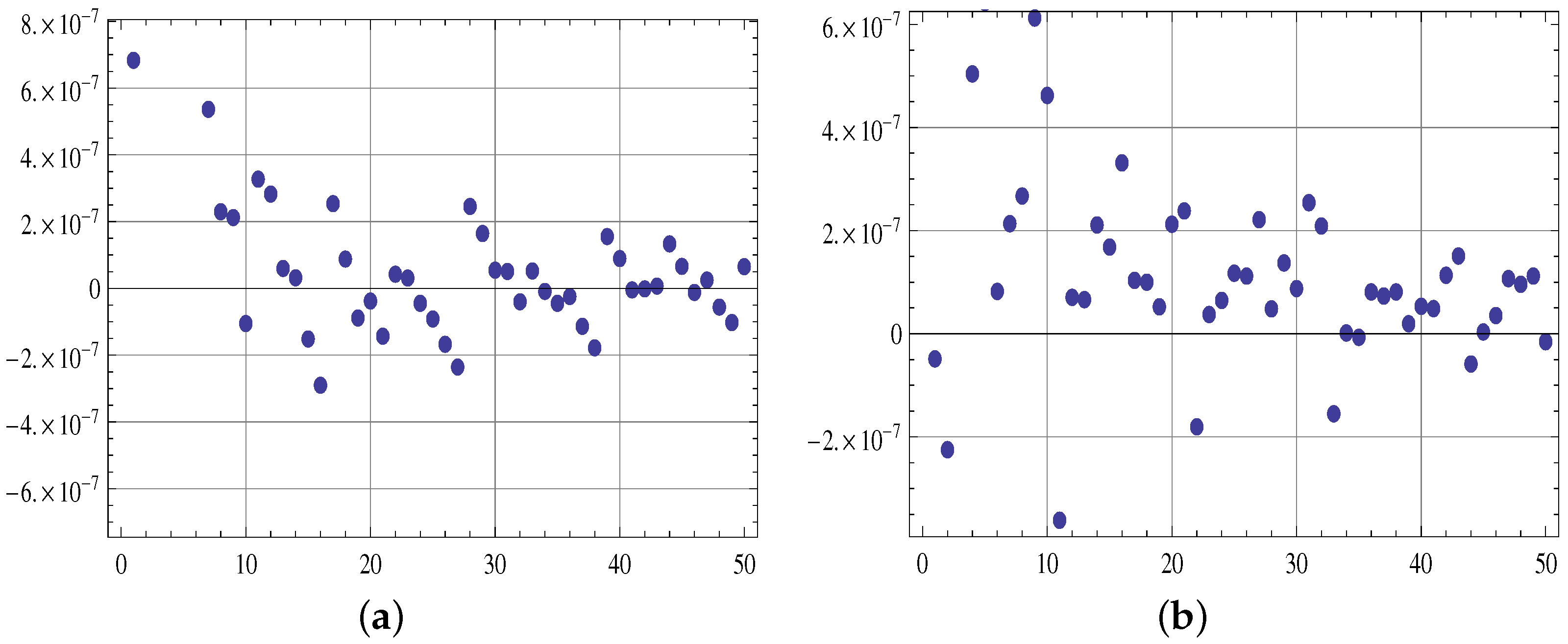
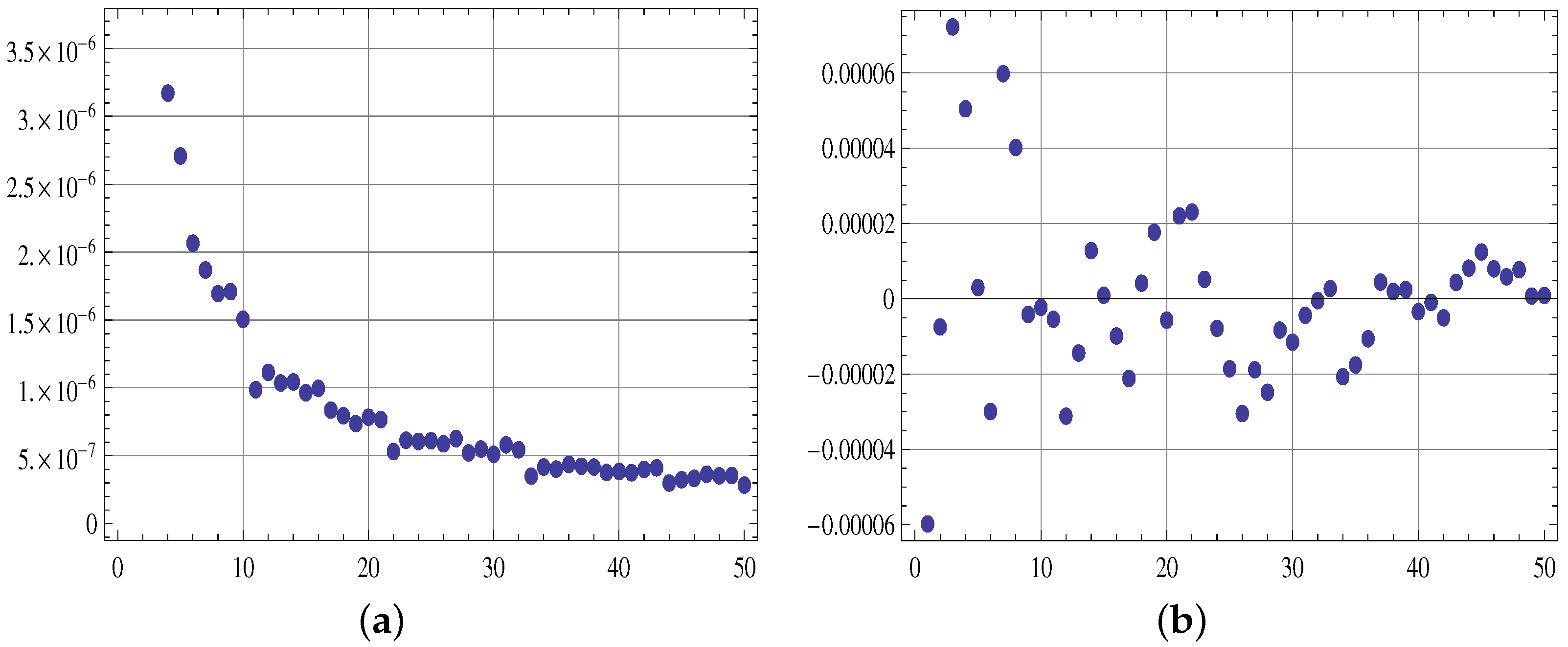
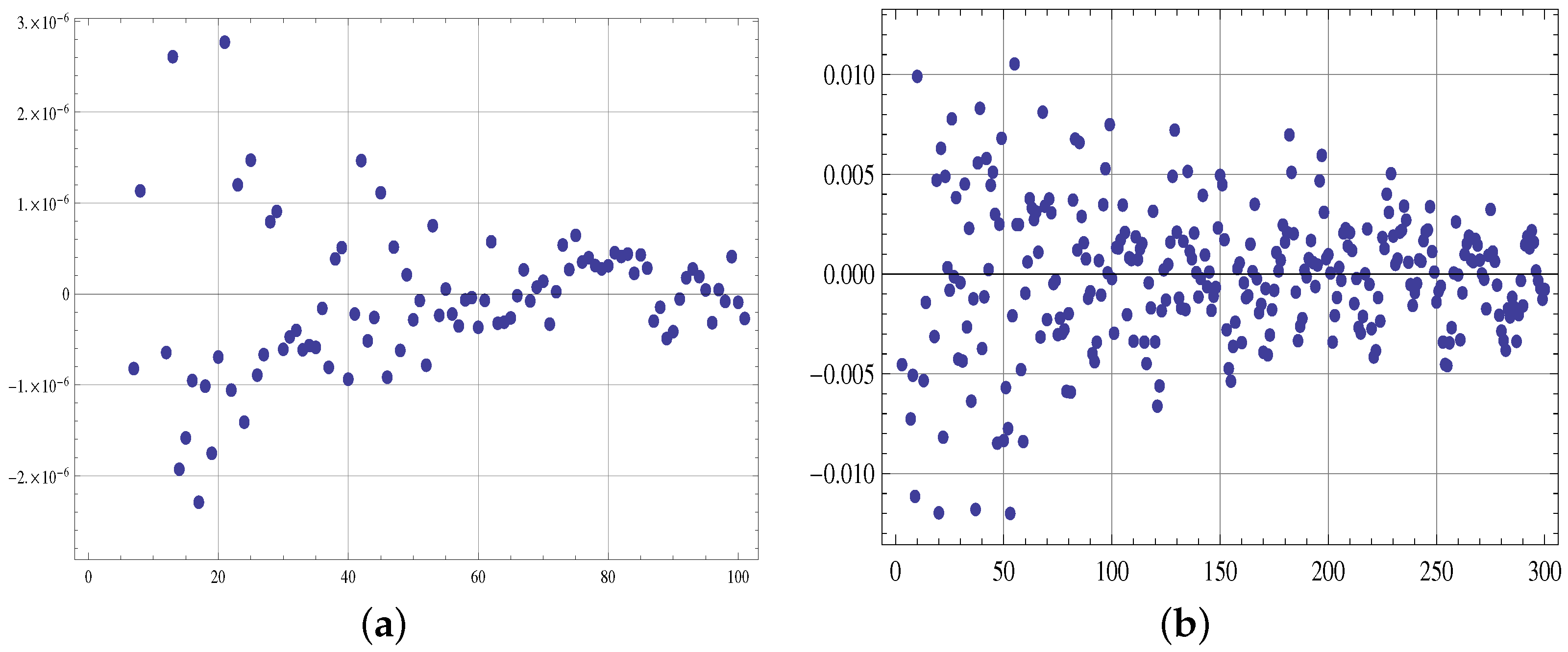
Section 6, we give a numerical verification of the renormalization approach developed in the article using numerical calculations and show its validity with high precision.
1.1. Asymptotic Growth of Summatory Functions
Consider the summatory multiplicative arithmetic function
and represent its asymptotics in
N, instead of (
2), by using one constant
and two positive definite functions
and
,
where “
” stands for the “big–O” Landau symbol.
The asymptotic growth of
is determined by its leading term and is given by the nondecreasing function
, that is, either increasing or equal to one, while the decreasing function
denotes the error term. The constant
is introduced to distinguish summatories with similar functions
and
, e.g., see
,
and
in
Table 1.
Different arithmetic functions
can have the same
and
; therefore, the entire set of
can be decomposed into different universality classes
as follows:
where
Below are examples of various multiplicative functions
belonging to different universality classes.
By the inspection of a vast number of multiplicative functions
with known asymptotics
and
(see
Table 1 and
Table 2), in this paper, we focus on their most wide class,
Remark 1. Table 1 and Table 2 do not present any example of multiplicative arithmetic functions of special universality classes such thatDespite an extensive search in the available literature, we have not found such functions there. In
Table 1 and
Table 2, we present a long list of multiplicative functions that belong to one of the universality classes
satisfying (
8).
We use the standard notation for the functions mentioned in
Section 1. Here,
stands for the Riemann zeta function, the explicit expressions for
,
,
,
,
,
, and the values for
are given in the corresponding references. The values of
,
,
were calculated by the author and marked by (⋆). The error terms for summatories of
,
,
and
are unknown to date.
The relation between the multiplicative properties of the arithmetic functions and the asymptotics of their summatory functions is not straightforward. In other words, the following correspondence:
is neither bijective nor injective. Indeed, the direction ‘⟵’ is not satisfied, since there exists a nonmultiplicative function
, which has the summatory function
[
37].
Regarding another direction ‘⟶’, there exist multiplicative arithmetic functions with summatory growth that differ from
and come by enumerating finite groups. Let
be a number of nilpotent groups of order
k, which is multiplicative, because each finite nilpotent group is a direct product of its Sylow subgroups [
7]. When
, for a prime
p, it is known [
45] that
, that is, of the order
.
Consider its summatory function
, which is the number of nilpotent groups of the order of most
N. For some
, we have
. Then, for
we get,
and therefore,
. Note that the number
, nilpotent groups of order
k, nilpotency class at most
n, generated by at most
m elements, belongs to the universality class defined in (
8), where
and
depend on
n and
m [
46].
Other examples of multiplicative functions with summatory growth
and error terms, which differ from
, are given in [
24],
They can also be encompassed within the universality classes by extending the latter on a much wider family of asymptotics, e.g.,
Keeping in mind this option, we continue to study summatory multiplicative functions with universality classes of asymptotics, given in (
8).
1.2. Scaling Equation for Summatory Functions
Represent
as a sum of two summatory functions
Making use of multiplicativity,
if
,
, we obtain
where
. The recursion (
13) holds for any
, i.e.,
Substituting (
14) into (
13), we obtain
Continuing this procedure recursively, we finally obtain,
The straightforward calculations of
give
such that for
or
, we obtain
and
,
.
By (
16) and (
17), the general formulas for
can be calculated by induction for simple arithmetic functions
and
such that
,
,
and
denotes a real constant, e.g.,
,
that gives
Another example of arithmetic functions that result in
,
, are those where
in (
18) or
, e.g.,
and
.
In general case of
, the formula for
for an arbitrary
may be difficult to recognize from its partial expressions, e.g., for
,
In
Section 5.2.1, Formula (
133), we show that
in (
19) come as coefficients in the series expansion of the function, involving logarithmic and hypergeometric functions.
Remark 2. Consider an integer N in the range where and write (15) as follows,where and is a finite number. We make use of the representation (
20) in
Section 2.1 when studying the asymptotics of renormalization functions for universality classes with
(Lemma 2) and
(Lemma 4).
2. Renormalization Function with Simple Scaling
Define the renormalization function as a ratio of two summatory functions
Substituting (
6) into (
21), we obtain its asymptotic behavior
where
and
are defined according to (
15) as follows:
If both numerical series
and
converge when
, then
What can be said about the convergence of
without knowing exactly the multiplicative function
? Formulas (
22) and (23) for
and
indicate that most of the information is hidden in the asymptotics
and
.
Substitute
into (
22) and obtain
Regarding
, which is responsible for the error term in
, note that according to the definition (
7), we obtain
. Applying this inequality to Formula (23),
and substituting
into the last expression, we obtain an estimate,
Section 2.1 and
Section 2.2 present a detailed analysis of the convergence of
and
for multiplicative functions
of several universality classes. We start with a certain class of
and, assuming only
, prove that the convergence of
implies the convergence of
to zero.
Proposition 1. Let be given in such a way that , and let be convergent. Then, , in each of the cases, Proof. Keeping in mind
and comparing (
25) and (
27), we conclude that if
is convergent when
and
, then
is also convergent when
and
. Substituting this into (
26), we obtain
which completes the proof if
. Indeed, if
is positive and
converges, then the r.h.s. in (
28) converges to zero as does
. Applying similar reasoning to the other two cases (2) and (3), we completely prove the proposition. □
Table 1 shows when the first item in Proposition 1 can be applied: this is the inverse Dedekind function:
,
and by (
18)
. However, neither the Euler totient function nor its inverse can be studied using Proposition 1, which is a rather weak statement.
The convergence of
implies a zero limit of
,
, over a much wider range of varying degrees
and
. Indeed, to ensure that
converges to zero, it is not necessary to require
to converge in (
26), but it is sufficient to allow
to grow at a rate less than
. However, this would require more assumptions about
. In the following
Section 2.1 and
Section 2.2, we study the convergence problem in more detail and prove the main result of this section in Theorem 1.
2.1. Convergence of
In this section, we study the convergence of
when
. The conditions imposed on
provide convergence of
. In this section and the next, we repeatedly make use of the squeeze (
) theorem [
47], which is also known as the pinching or sandwich theorems.
Lemma 1. Let a function , , , be given and let there exist two numbers and and an integer such that for all . Then, Proof. First, consider
given in (
25) when
,
, i.e.,
is a nonnegative integer. After binomial expansion in (
25), we obtain
Focus on the inner sum
and prove that the sum in (
31) is convergent absolutely.
To find an estimate for
, we must consider the last sum in the interval
where inequality
holds. However, due to a prefactor
,
, summation over the interval
does not contribute to the limit as
and does not change the convergence of the entire sum (
31). Then,
where
. Denote
and consider the sum in the r.h.s. of (
32),
where
and
are the polylogarithm and the Hurwitz–Lerch zeta function [
48], respectively,
Keeping in mind the asymptotics of
,
, for fixed
s and
z (Thm.1, [
49]),
, and combining it with (
31) and (
33), we get
Since the polylogarithm
,
, is a bounded rational function in
z when
, then for
, the function
is also bounded. Thus,
converges to zero and, by (
30) and (
31), the limit (
29) holds.
Extend this result on the entire set of nonnegative real numbers
. In order to do that, we make use of the
theorem and start with trivial inequalities,
which, due to (
25), implies the following relations:
From the proof of convergence of
with nonnegative integer degrees
and by (
37) and by the
theorem, it follows that
converges with real
. □
Lemma 1 can be applied to the totient functions
and their inverse
with functions
and
calculated in (
18).
Lemma 2. Let a function , , be given and let there exist two numbers and and an integer such that for all . Then, (29) holds. Proof. Consider
given in (
25) when
,
, i.e.,
is a negative integer. To avoid its divergence at
, we use representation (
20) in Remark 2,
where
and
were defined in (
20).
Estimate
when
,
and
. Note that the last term in (
38) does not contribute to the asymptotics of
when
and can therefore be omitted in what follows. We use an identity
and represent (
38) as follows:
Note that the following inequality holds:
Substitute (
42) into (
41) and keep in mind that due to the prefactor
in the r.h.s. of Equation (
41) the same convergence of
holds at intervals
and
(see discussion in the proof of Lemma 1). Then, we arrive at the following estimate:
The rest of the proof follows by applying the same arguments of asymptotics of the Hurwitz–Lerch zeta function, as it was performed in Lemma 1,
By comparing the r.h.s. in (
43) and (
35), we conclude that
is convergent to zero when
. Thus, by (
40) the limit (
29) holds for
.
We extend this result by the
theorem on all negative real
. This can be performed by inequality (
37) for another function
,
where
From the proof of the convergence of
with negative integer degrees
and by (
44) and by the
Theorem, it follows that
converges with real
. □
2.2. Convergence of
In this section, we consider the convergence of
,
, defined in (
22) and responsible for the contribution of the error term to
.
Lemma 3. Let a function , , be given and let there exist two numbers , and integer such that for all , then Proof. Denote
and make use of a simple inequality,
when
,
. Formula (
26) can be rewritten as follows:
where
. Keep in mind that due to the prefactor
in (
46), the same convergence of the r.h.s. in (
46) holds at intervals
and
(see discussion in proof of Lemma 1).
Further calculations depend on the sign of
. If
, then
If
, then
Finally, if
, then
Require now that all r.h.s. in (
47), (
48) and (
49) converge to zero when
. Regarding the first case (
47), this always holds because by (
8) if
, then
, and if
, then
, so the r.h.s. in (
47) is a decreasing function. So, this leads to the requirement,
. In two other cases, we have the following necessary conditions:
Summarizing the necessary conditions (
50), (51) and
, we conclude that the numerical series
is convergent to zero absolutely when
and irrespectively to the sign of
if
. This proves Formula (
45). □
Lemma 4. Let a function , be given and let there exist two numbers and and an integer such that for all , then (45) holds. Proof. Consider
given in (
27) and, according to Remark 2, rewrite it as follows:
where the upper bound in the sum is taken in order to avoid its divergence and
A is defined in (
38); for more details, see the proof of Lemma 2, formula (
38).
The last term in (
52) does not contribute to the asymptotics of
when
and can be skipped. Indeed, if
,
, it converges to zero when
; in the case
, according to (
8), we have
or
,
that again makes it irrelevant due to the prefactor
in formula (
26) for
. Apply an inequality (
42) in the range
,
and substitute it into (
52)
If
, we apply to (
53) the constraints on
and substitute the result into (
68),
By comparing (
54) with (
46) from Lemma 3, we obtain the following, according to (
47)–(
49):
Thus, by (
55)–(57) and inequalities
,
, the series
is convergent to zero when
, irrespective of the value of
.
Consider another case
and compare Formulas (
38) and (
52) for
and
, respectively. A difference in degrees,
and
, does not break the main result of Lemma 2: only the first leading term in (
40) is survived when
. When we apply it to (
52) and make use of constraint on
, we obtain
where
. Substituting the last estimate into (
68), we obtain
Recall that by (
8), the degrees of the error term satisfy: if
then
. Thus, by (
58), the series
converges to zero when
, which proves Lemma. □
Let us summarize the results of four Lemmas 1–4 on the convergence of the numerical series and .
Theorem 1. Let a function be given with and satisfying (8), and let there exist two numbers , and an integer such that for all . Then, Proof. By Lemmas 1 and 2, if there exist two numbers
and
and an integer
such that
for all
, then
converges to
in the whole range (
8) of varying parameters
and
. On the other hand, according to Lemmas 3 and 4 under the same sufficient conditions, the numerical series
converges to zero in the same range (
8) of varying parameters. Then, according to (
24), we arrive at (
59). □
There are a few questions about the convergence of and that have been left open beyond the scope of Theorem 1. First, this is a problem of necessary convergence conditions that requires further discussion. Another question arises in view of convergence to zero of : it can happen that for some , both renormalization functions and are convergent to nonzero values, while is satisfying less strong conditions than those given in Theorem 1. Thus, the following question has been left open.
Question 1. Does the error term contribute to the renormalization function , and which multiplicative arithmetic functions can give an affirmative answer?
2.3. Rational Representation of Renormalization Function
In
Section 2.1 and
Section 2.2, we find requirements sufficient to make
converge and
equal to zero. These conditions are presented through the characteristic functions
given recursively in (16). Their straightforward formula (
17) look cumbersome and lead in certain cases to rather complex expressions, e.g., (
19). That is why, in this section, we give another representation for
avoiding the use of
.
Substituting (16) into (
59), we obtain an infinite series for
,
Recasting the terms in the last expression, we obtain
Introduce two numerical series
and
and assume that they are convergent. Then, by a comparison of (
60) and (
59), we obtain
if the denominator in (
62) does not vanish. In short, this can be written as follows:
. However, we prefer to stay with (
62); otherwise, one can make a mistake in the calculations, e.g.,
,
, and
, but
.
Formula (
62) gives a rational representation of the renormalization function
that is free of intermediate calculations of
. What can be said about the convergence of
in terms of
?
Theorem 2. Let a function be given and let there exist two numbers and and an integer such that for all . Then, is convergent in accordance with (62) if . Proof. Constraints
,
and
, for all
imply the convergence of
and
, which follows by their absolute convergence.
Thus, if the denominator in (
62) does not vanish,
, then
is convergent in accordance with (
62). □
Table 3 presents different multiplicative functions and their corresponding parameters
,
,
, and
. All functions satisfy the constraints of Theorem 2 for
.
Regarding the convergence of
and
, defined in (
61), we present an example that shows that the renormalization function
can exist even when both
and
are divergent. Consider
, where
, and obtain
Here, the conditions of Theorem 1 are satisfied for all
, and only the first term is left non-zero in series (
59). Both
and
are divergent, e.g.,
, and, therefore, Theorem 2 cannot be applied. In other words, Theorem 1 has a much wider area of application than Theorem 2. In the following sections, we use both theorems.
3. Multiplicativity of Renormalization Function with Complex Scaling
In this section, we study the renormalization of a summatory function when the summation variable
k is scaled by a product
with
n distinct primes
. Consider
and find its governing functional Equation (
64).
First, write the relationship between two summatory functions with two different summands,
and
, where
. It is similar to that given in (
15) and follows from the latter by replacing
, i.e.,
Next, repeat this procedure to reduce the scale by
for the summatory function that appeared in the r.h.s. of (
63) and substitute it again into (
63),
Continue to reduce the scales in a consecutive way for the next summatories and obtain, finally,
Define new renormalization functions,
and find their representations through the characteristic functions
,
, and the degrees
and
of the leading asymptotics
and
, respectively. Following an approach developed in
Section 2, represent
as a sum
where
,
, are analogous to those given in (
22) and (23). We substitute
and
, given in (
8), and obtain formulas similar to those given in (
25)–(
27). Here they are,
where a base
c is chosen in such a way that
so that the upper summation bound
is correspondent to inequality,
. Regarding
, we have an upper bound
where
Keeping in mind
theorem and its usage in
Section 2.1 and
Section 2.2, we assume throughout this Section
. The extension to non-integers
and
is trivial and can be done using Lemmas 1 and 2, and therefore will be omitted. In the next sections, we prove several statements about
and
that are analogous to Lemmas 1–4 in
Section 2. In this regard, it is important to use the same sufficient conditions that were used in these lemmas.
3.1. Convergence of
Lemma 5. Let a function , , , be given and let there exist two numbers and and an integer such that for all . Then, Proof. Exponentiating the binomial in (
67), we obtain
where
Find an estimate for
,
where
. One more inequality reads
where
is defined in (
33). Combining the two last inequalities together, we obtain
Substituting the asymptotics (
35) of
into (
73), we obtain
Repeating the final remarks in proof of Lemma 1 on the asymptotics of the polylogarithm
, we conclude that
is convergent to zero when
. Then, keeping in mind the representation (
71) for
and running the upper bound of the summation to infinity, we conclude that the limit (
70) holds. □
Lemma 6. Let a function , , , be given and let there exist two numbers and and an integer such that for all . Then, (70) is satisfied. Proof. Here, we follow the keyline in the proof of Lemma 2 and, according to (
20) in Remark 2, start with representation of
, avoiding its divergence at
,
Making use of identity (
39), we obtain
where
and
Making use of inequality (
42) and constraint, imposed on
exponentiate the binomial
in (
77) and obtain
where
. Exponentiating the binomial
in the last expression, we obtain
The asymptotic behavior in
N of the last expression is completely determined by its inner sum in
with respect to its prefactor
. This behavior can be studied following the corresponding part in (
72) of the proof in Lemma 1,
Keeping in mind the prefactor
and the last asymptotics (
78), the upper bound for
can be performed in an infinitely small way, i.e., it is convergent to zero when
.
Using the representation (
76) for
and running the upper bound of summation to infinity, we conclude that the limit (
70) holds. □
3.2. Convergence of
Lemma 7. Let a function , , be given and let there exist two numbers and and an integer such that for all , then Proof. Denote
and make use of an inequality
when
,
. Substituting constraints on
into (
68), we obtain
and
. Focus on the sum
and estimate it in three cases,
,
and
.
Let
, i.e.,
, then
accounts for a number of integral points (vertices with integer coordinates) in the
n-dim simplex, or corner of the
n-dim cube, defined as follows:
The simplex
has one orthogonal corner and edge sizes
along the
ith axis. The number
is described by the Ehrhart polynomial [
50] and, when
, it has a leading term coinciding with simplex volume,
Substituting (
81) into (
80), we obtain
By (
82) and inequality
, we conclude that
is convergent to zero when
irrespectively to the value of
.
Consider the case
and estimate
and
,
By (
83), the term
is also convergent to zero when
.
Finally, consider the case
. According to (
80), we have
, and therefore,
Thus,
is convergent to zero due to (
84) and constraints (
8) on degrees
and
. Summarizing (
82)–(
84), we complete the proof of Lemma. □
In Lemmas 8 and 9, we consider two different cases, and , separately.
Lemma 8. Let a function , , be given and let there exist two numbers and and an integer such that for all . Then, the limit (79) is satisfied. Proof. According to (
20) in Remark 2, represent
avoiding its divergence at
,
and make use of inequality (
42) in the range
,
Substituting (
86) into (
85) for
, we obtain
Apply to (
87) the constraints on
and substitute the result into (
68),
By comparing (
88) with (
80) from Lemma 7, we obtain according to (
82), (
83), and (
84)
Thus, by (
89) and inequality
, a series
is convergent to zero when
irrespectively to the value of
. The same conclusion (
79) about the convergence of this series holds due to (90) when
. □
Lemma 9. Let a function , , be given and let there exist two numbers and and an integer such that for all . Then, the limit (79) is satisfied. Proof. This case has to be treated more precisely than that in Lemma 8. Rewrite (
85)
and compare it with expression (
75) when
. Changing the powers of
to
does not violate the main result of Lemma 6: Only the first leading term in (
76) is preserved as
. When we apply it to (
91) and make use of the constraint on
, we obtain
where
. Substituting the last estimate into (
68), we obtain
Recall that by (
8), the degrees of the error term satisfy the following condition: if
, then
. Thus, by (
92) the series
converges to zero when
, which proves the lemma. □
We combine Lemmas 5–9 on the convergence of
,
, and, according to (
66), arrive at an analog of Theorem 1 in the case of scaling by
.
Theorem 3. Let a function be given with and satisfying (8) and let there exist two numbers and and an integer such that for all . Then, Combining Theorems 1 and 3, we arrive at an important consequence that manifests the multiplicative property of the renormalization function.
Corollary 1. Under the conditions of Theorem 3, the following holds: 3.3. Asymptotics of Summatory Functions
In this section, we calculate the summatory function
and find its asymptotics by applying Corollary 1. According to the definition of a summatory function, we obtain
where indices
i,
j,
, and
account for all primes
such that
. Thus, according to the definition of the summatory function with scaled summation variable, we obtain
where
. Consider asymptotics (omitting the error terms) of three summatory functions when
,
Combining (
96) and the 2nd formula in (
95), we obtain
Calculation of
and
is a difficult numerical task. Consider a special case if
can be given in a closed form, namely if
, that is,
. Consider the third asymptotics in (
96) and, according to Corollary 1, find its limit when
,
Another special case comes when
is a completely multiplicative arithmetic function, i.e.,
. That leads to the following equalities:
and
. We illustrate this statement and formula (
98) in
Section 4.2.
7. Concluding Remarks
The importance of asymptotic summation of divergent series of arithmetic and non-arithmetic functions
with a scaled summation variable was recognized in statistical physics in the 1960s–1970s. The calculation of lattice partition functions determines critical phenomena in such models, e.g., the Ising, Potts, and XXY models. Just then, 50 years ago, a summation problem was resolved by elaborating [
16,
17] an approach that connects the sums of two adjacent scales by a renormalization equation.
In the present paper, we apply the renormalization ideas of statistical physics to calculate asymptotically summatory multiplicative arithmetic functions
with a scaled summation variable, that, to the best of our knowledge, have not been discussed in the literature. The main assertion of this paper is given in Formula (
5), where the impact of scaling with a prime power
of a summation variable
k in
is reduced to renormalization of the summatory function
without scaling. For the ratio
, we call the renormalization function
and study its asymptotics
when
.
We study the asymptotic renormalization function
in various aspects: (a) its existence as a convergent numerical series, (b) its multiplicativity property without specifying the function
, (c) formulas for
for corresponding Dirichlet series, (d) formulas for
for different arithmetic functions
, (e) the multiplicative property of the renormalization functions
with complex scaling
of a summation variable (see Corollary 1,
Section 3.2).
We calculate for basic multiplicative arithmetic functions, such as Euler , Dedekind , Jordan , Liouville , Piltz , divisor , prime divisor , Ramanujan , and many others. Many non-multiplicative arithmetic functions, such as the prime counting function , Chebyshev , Mangoldt , and the partition function , were left beyond the scope of this article. The study of their summation functions is a challenging task and may require further research.
In this regard, another issue worth mentioning is the possibility of applying asymptotic summation of divergent series by renormalization in models with a multiscale structure. Such structures can be found in various fields of science, such as fluid mechanics (an evolution of turbulence cascade), porous media and composites (microscopic scales at the level of pores and grains), computer science (machine learning, deep learning, and various fields of data analysis), and astrophysics (a scale-setting procedure for general relativity with renormalization group corrections).