1. Introduction
Spectral graph theory serves as a powerful interface between algebraic structures and combinatorial frameworks. In recent decades, significant attention has been devoted to studying graphs defined over algebraic objects such as rings, groups and semigroups. Within this direction, one of the most prominent constructions is the zero-divisor graph associated with a commutative ring, introduced to model the interaction between elements whose product is zero. A refinement of this concept, the weakly zero-divisor graph
, has recently gained traction for its ability to encode more nuanced ring-theoretic information through its adjacency relation based on nontrivial zero-product modulo
n [
1,
2].
Graph theory has numerous applications in diverse scientific and engineering domains, including communication networks, chemical graph theory, coding theory, cryptography and image processing. In particular, energy-based spectral measures have been applied in chemical informatics [
3,
4], materials science [
5], sustainable systems analysis [
6] and optical imaging [
7]. Such applications demonstrate the broader relevance of spectral techniques beyond pure mathematics.
In spectral analysis, various matrices such as the adjacency matrix, Laplacian matrix and signless Laplacian matrix play key roles in uncovering structural characteristics of graphs. Among these, the signless Laplacian matrix, defined as
for a graph
G, where
is the diagonal degree matrix and
is the adjacency matrix, captures important combinatorial properties such as graph energy, connectivity and bipartiteness [
8]. The foundational work of Gutman on graph energy [
3] and the comprehensive framework presented by Cvetković et al. [
9] laid the groundwork for further developments involving signless Laplacian and related spectral matrices. Subsequent efforts such as [
3,
4,
10] established the significance of energy-based and Randić-type spectra in both mathematical chemistry and combinatorics. More recently, related spectral approaches have also been employed in the analysis of advanced materials and mechanical systems [
11].
For graphs arising from rings, the signless Laplacian spectrum has proven particularly useful in analyzing algebraic complexity and symmetries. Several researchers have explored various types of spectra over graphs on
, including adjacency, Laplacian and normalized Laplacian spectra [
12,
13,
14]. In this context, the work in [
15] initiated a systematic study of the signless Laplacian spectrum of
, employing generalized join decompositions and symbolic eigenvalue extraction.
Building on that foundation, the present article undertakes a detailed spectral analysis of
for several algebraically meaningful classes of integers
n. The graph is decomposed using divisor-based partitions into induced subgraphs whose structure is either complete or null and then recombined via the generalized graph join
as introduced in [
16]. The spectral consequences of this construction are explored using weighted matrix techniques and symbolic expressions, such as Randić integral conditions over edge-regular graphs [
17], insights from the theory of matrix rank and structural constraints [
18] and studies on signless Laplacian energy which inform the energetic perspective of our spectra [
19].
We first consider the case , where p and q are distinct primes. In this scenario, the weakly zero-divisor graph admits a clear partition into three disjoint sets and the quotient graph formed by the divisors becomes a triangle, leading to a tractable and partially integral spectrum. The matrix representation arising from the quotient graph captures the nontrivial eigenvalues that are not directly obtained from the components.
Next, we study the case , introducing an additional prime factor to the structure. This adds a fourth component to the partition, thereby extending the quotient graph and complicating the matrix spectrum. Nevertheless, a block-matrix analysis still yields closed-form expressions for part of the spectrum and allows symbolic computation of the remaining eigenvalues.
The third case for generalizes the equal-power composite structure. This class is algebraically significant because it induces balanced component sizes in the partition. Here, integrality conditions for the spectrum are established and symbolic families are identified depending on the values of m.
The fourth case combines one square-power prime with two distinct primes, producing an asymmetric structural partition. The corresponding spectral matrix yields eigenvalues that are more varied and examples such as are used to illustrate the computational procedure.
Beyond symbolic derivations, this paper also addresses spectral properties, such as (i) identification of when the spectrum is fully integral, (ii) bounds on the smallest and largest eigenvalues, (iii) lower and upper estimates for signless Laplacian energy, (iv) detailed enumeration of eigenvalue multiplicities, (v) relationships between algebraic factorization of n and structural motifs in .
The article is structured as follows:
Section 2 presents necessary preliminaries, definitions and known results related to weakly zero-divisor graphs and spectral graph theory.
Section 3 develops the main symbolic spectral theorems for each composite structure.
Section 4 illustrates the results through worked examples and eigenvalue matrix construction, offers additional theorems on integrality and energy, and concludes with directions for future work, including extensions to Randić and normalized Laplacian spectra [
20,
21].
2. Preliminaries
We begin by introducing some fundamental concepts and known results that will be instrumental in deriving the main theorems of this work.
Definition 1 (Weakly Zero-Divisor Graph). Let be a commutative ring with unity. The weakly zero-divisor graph of , denoted , is the simple undirected graph whose vertex set consists of all nonzero zero-divisors of . Two distinct vertices and are adjacent if and only if there exist elements and such that . In this paper, we focus on the case , the ring of integers modulo n.
Definition 2 (Generalized Join of Graphs). Let be a graph of order m with vertex set . Suppose for are pairwise disjoint graphs, where each has order . The generalized join is defined as the graph obtained by replacing each vertex of G with the graph and connecting every vertex of to every vertex of whenever and are adjacent in G.
The construction
is commonly referred to as the
G-join operation, as introduced in [
16]. Specifically, when the base graph
G is the complete graph
, this reduces to the standard graph join. Throughout this article, we adopt the term
G-join for this operation and retain the notation
.
Let
denote the ring of integers modulo
n. The set of non-unit, nonzero elements in this ring has cardinality
, where
is Euler’s totient function. Let
be the proper divisors of
n. For each
, define the set
Since
uniquely determines the divisor class of
x, these sets are mutually disjoint, i.e.,
for
. Therefore, they partition the vertex set of the weakly zero-divisor graph
as follows:
Lemma 1 ([
8])
. , for . Lemma 2 ([
13])
. Let denote the set of all proper divisors of n and suppose n has the prime decomposition , where , and . If is one of the prime divisors for some , then the subgraph of induced by the set is an empty graph with vertices, i.e., . Corollary 1 ([
13])
. Let be a proper divisor of a positive integer n. Then,- (i)
The subgraph of induced by the vertex set is isomorphic either to the complete graph or to the empty graph .
- (ii)
If with , then each vertex in is either adjacent to every vertex in or to none of them in .
Corollary 1 indicates that the induced subgraphs within are either complete graphs or edgeless graphs. Building upon this observation, the next lemma shows that can be expressed as a composition of complete graphs and their complements. To formalize this construction, we define the auxiliary graph , which is the complete graph whose vertices correspond to the proper divisors of n, namely .
Lemma 3 ([
13])
. Consider the induced subgraph of formed by the vertices in , where . Then, Theorem 1 ([
22])
. Let G be a graph with vertex set and for each , let be an -regular graph on vertices. Then, the signless Laplacian spectrum of the G-join graph can be determined using the following formulation:whereand Suppose that
is a weighted graph with
assigned to the vertex
of
for
. Let
be defined by
The matrix is known as the vertex-weighted signless Laplacian matrix associated with . Since and have the same form, we make the following remark.
Remark 1. .
Proof. By definition, the
-entry of
is given by
On the other hand, the
-entry of
is
Since each adjacency in the quotient corresponds to all adjacencies between the components, the degree sum equals and in arises naturally from the symmetric weighting of the join edges. Therefore, the two matrices coincide entrywise and we have . □
3. Results
In this section, we present the main spectral results concerning the signless Laplacian spectrum of the weakly zero-divisor graph for various composite structures of n. By employing the structural decomposition discussed in the preceding sections, we derive symbolic expressions for the signless Laplacian spectra and verify them through concrete examples. Our approach primarily relies on the generalized join operation and block matrix techniques described in Theorem 1.
We now analyze the signless Laplacian spectrum of
for an arbitrary positive integer
n. Let
denote the proper divisors of
n. For each
, associate the weight
with the vertex
in the graph
. Define
the vertex-weighted signless Laplacian matrix
of
is given by
Theorem 2. Let be the proper divisors of a positive integer n. Then, the signless Laplacian spectrum of the graph iswhere each subgraph is -regular and the expressionmeans that is added to every element of the multiset after removing . Proof. From Lemma 3, the graph
can be expressed as the
G-join
Applying Theorem 1 and using the equality , the spectral formula follows. □
We begin with the case when n is the product of two distinct prime squares, i.e., with .
Theorem 3. Let with primes. Then the signless Laplacian spectrum of iswhere is the quotient on the seven divisor classes and is its vertex-weighted signless Laplacian. Proof. Let
with
and let
be the set of all proper divisors of
. By Lemma 3,
where
is the complete graph on the vertex set
. For each
, set
(by Lemma 1) and
where
is the order of
.
By Corollary 1, each induced graph
is either
(then it is
-regular) or
(then it is 0-regular). Hence, by Theorem 2,
where
is the regularity of
and
is the quotient on the seven classes.
Now: If
, then
, so after removing
and shifting by
, we contribute
if
, then
and
, hence, we contribute
For
, one checks (using the weakly zero-divisor adjacency) that the two mixed classes
yield complete induced blocks
and
, respectively, while the remaining five classes yield empty induced blocks. Therefore,
which is exactly the multiset stated in the theorem. The remaining seven eigenvalues are those of the vertex-weighted signless Laplacian
i.e.,
This completes the proof. □
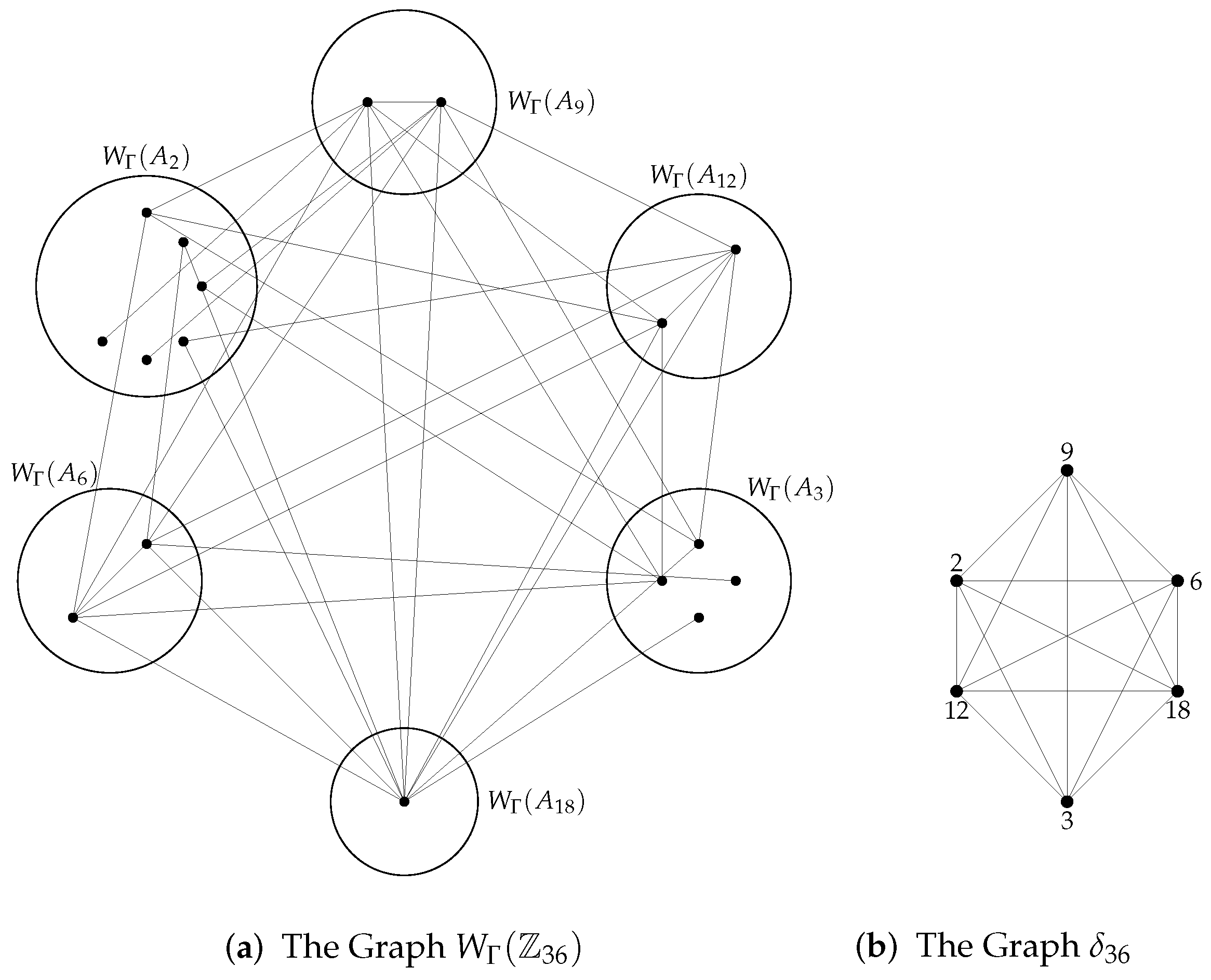
Example 1. The signless Laplacian spectrum of the weakly zero-divisor graph (see Figure 1a,b) By Lemma 3, we havefor , the sizes of the divisor classes areas in the case, the induced subgraphs areusing Theorem 2 (removing the largest value from each block), the internal part of the spectrum contributes only zeros:Hence, the block contribution is . It remains to add the eigenvalues of the vertex-weighted matrixwith the ordering , i.e.,its eigenvalues (numerically) are Theorem 4. Let , where are distinct primes. Then, the signless Laplacian spectrum of the weakly zero-divisor graph is given bywhere is the vertex-weighted signless Laplacian matrix of the complete divisor graph on S with vertex weights . Proof. Let
with
primes. The proper divisors that yield nonempty divisor classes are
By Lemma 1, for each
, we have
. In particular, set (in this fixed order)
By Corollary 1 (together with the structure described for
), the induced subgraph on
is edgeless,
while all the remaining induced subgraphs are complete:
By Lemma 3,
where
is the complete graph on the ten divisor classes
S. Write
Applying Theorem 2:
If
, then
, so
If
, then
and, removing one 0 as prescribed,
Therefore, the “block” contribution to the spectrum is the multiset
The remaining ten eigenvalues are the eigenvalues of the vertex-weighted signless Laplacian matrix
, which in our ordering of
S, has the form
Combining the block part
with
yields
where
for
and
. This completes the proof. □
Example 2. The signless Laplacian spectrum of the weakly zero-divisor graph .
The proper divisors of 60
that index the vertex classes arefor each , , we have , henceby Lemma 3 and Corollary 1, Let for the above ordering of divisors and setsince is -regular with Theorem 2 yields the multiset contribution The remaining 10
signless Laplacian eigenvalues are those of the vertex-weighted matrixthat is (using the above ’s), A numerical evaluation gives Theorem 5. Let , where are distinct primes and . Then, the signless Laplacian spectrum of the weakly zero-divisor graph is given bywhere denotes the vertex set of and is the set of eigenvalues of the vertex-weighted signless Laplacian matrix of the quotient graph . Proof. Let
with
. Write the set of proper divisors of
as
for each
let
; by Lemma 1,
. By Lemma 3, we have the generalized join decomposition
where
is the complete graph on vertex set
. For each
, the induced subgraph
is regular of order
and degree
(cf. Corollary 1); in particular,
Let
. For each
, the
–neighbor-sum (Theorem 2) equals
Therefore, by Theorem 2 together with Remark 1, the signless Laplacian spectrum of
is
We now group the contributions exactly as in Proposition 3.3 [
15] (the case
) but symmetrically in
p and
q.
for the chain
, one obtains the multiset
in which the term
appears with multiplicity
(coming from
), while the remaining
terms appear once each via their 0-eigenspaces.
analogously, for the chain we obtain the value with multiplicity and additional singleton values for .
for all mixed divisors
with
,
and
, each induced block contributes only its 0-eigenspace after the shift by
, so that their total contribution compresses to the single value
, counted once, together with the integer
which is the total multiplicity coming from these shifted 0-eigenspaces after removing the
terms (cf. the tally in the proof of Proposition 3.3 in [
15])
Collecting the above and writing the prime-power contributions explicitly yields exactly the four explicit eigenvalues listed in the statement,
and the remaining (unspecified) eigenvalues are the
eigenvalues of the vertex-weighted signless Laplacian matrix
(obtained from the complete graph on
by weighting the vertex
s with
), as required. Hence,
This completes the proof. □
Theorem 6. Let , where are distinct primes and . Denote by the vertex set of and put Then, the signless Laplacian spectrum of iswhere is the number of divisors of and is the vertex-weighted signless Laplacian of the complete quotient graph on the proper divisor classes with weights . Proof. List the proper divisors of
as
which are exactly
elements. By Lemma 3, the weakly zero-divisor graph is a generalized join
where
and
is the complete graph on these classes. For each class
we have
(Lemma 1). Moreover, by Lemma 2 and Corollary 1, the induced subgraphs are of two types:
while for every other proper divisor
, one has
Because the quotient graph
is complete, the neighbor-weight is
for every class
. Apply Theorem 2 (the
G-join signless Laplacian formula). If
(with
), then
and removing the largest eigenvalue
leaves
, which after shifting by
, gives the eigenvalue
for every
.
If
or
, then
with
or
. Removing the largest eigenvalue
and shifting by
(respectively
) yields
and similarly
with multiplicity
from the class
. Since the value
is the same for
q and
r, its total multiplicity is
Collecting the contributions from all classes
gives the family of eigenvalues
while the two prime classes
q and
r contribute the common value
with multiplicity
. In the compact two-row display used throughout this paper, these appear as the three entries shown in the theorem: the two values
and
with multiplicities
and
and a single column for
with multiplicity equal to the total number of shifted nonzero entries contributed by all the remaining classes, namely
By Theorem 2, the remaining signless Laplacian eigenvalues of are exactly the eigenvalues of the vertex-weighted signless Laplacian matrix of the complete quotient graph ; this matrix has diagonal entries and off-diagonal entries for the proper divisor indexing. This completes the proof. □
Theorem 7. Let be a positive integer for which is nonempty andwhere each is either a complete or an empty graph induced on the divisor class . Write and let be the regularity of (so for and for ). Defineand let denote the largest signless Laplacian eigenvalue of . Then,In particular, if is complete on the k classes, this simplifies to Proof. By Theorem 2, the signless Laplacian spectrum of
is the union of (i) the shifted spectra
and (ii) the spectrum of
since
is nonnegative and symmetric, Perron–Frobenius gives
every eigenvalue coming from the shifted blocks is at most
when
is complete and at most
when
is empty; in either case, it is ≤
, which is dominated by the corresponding row-sum bound above (since the extra sum of square-roots is nonnegative). Therefore, the largest eigenvalue of the whole graph is bounded by the stated maximum of row sums of
, proving the claim. □
Theorem 8. Let be a positive integer such thatwhere each is the induced (complete or empty) graph on of size , with internal regularity . LetLet be the smallest positive signless Laplacian eigenvalue of . Then, Proof. By Theorem 2, the spectrum of is the multiset union of the shifted block spectra and the spectrum of . Hence, the smallest positive eigenvalue of is at least the minimum of (i) the smallest elements among the nonzero numbers in those shifted block sets and (ii) the smallest eigenvalue of (if positive).
Since
is real symmetric and nonnegative, Gershgorin’s disk theorem gives
Moreover, all signless Laplacian eigenvalues are ≥0, so we can safely take the maximum with 0.
Finally, each shifted block contributes either nothing below its shift (empty graph case) or values (complete graph case, after removing the largest ), which are ≥0 and thus do not reduce the overall lower bound. Therefore, the stated bound holds for . □
Theorem 9. Let or , where are distinct primes and . Suppose that for every proper divisor of , the induced subgraph is either or with . If, in addition, the vertex-weighted signless Laplacian matrix has an integral spectrum (i.e., ), then the signless Laplacian spectrum of is entirely integral.
Proof. By Lemma 3, we may write
where each
is either
or
on
vertices. By Theorem 2,
where
is the internal regularity of
and
is the sum of the sizes of the neighboring classes.
For , one has and for , . In both cases, the multiset consists of integers. Adding the integer shift preserves integrality, so each block-contribution is integral. By the hypothesis that , the remaining k eigenvalues are also integers. Therefore, every eigenvalue in is an integer. □
Theorem 10. Let be the weakly zero-divisor graph over and let denote its complement. Then, the signless Laplacian energy of G and satisfies the Nordhaus–Gaddum-type inequality:where and are the signless Laplacian eigenvalues of G. Proof. Let
and let
and
be the signless Laplacian eigenvalues of
G and
, respectively. By definition,
and similarly for
.
By the Cauchy–Schwarz inequality,
since
, the term
is minimized when
G is regular, in which case
for all
v, giving
An identical computation holds for
, yielding
Applying the AM–GM inequality to these two bounds gives
□
Corollary 2. Let and be its complement. Then,where and . Numerically, Example 3. Consider the weakly zero-divisor graph , which has vertices. As computed earlier, ; hence, its complement satisfiesapplying the Nordhaus–Gaddum-type bound, we obtainHence, the combined signless Laplacian energy of the graph and its complement is at least approximately . Theorem 11. Let be the vertex-weighted signless Laplacian matrix corresponding to the quotient graph of , where has the divisor-induced partition Then, the signless Laplacian energy satisfieswhere are the eigenvalues of . Proof. By definition, the signless Laplacian energy is
applying the Cauchy–Schwarz inequality, we have
where
taking square roots yields
This proves the claim. □
Example 4. Let . From earlier computation, the eigenvalues of are The average eigenvalue isthus, the signless Laplacian energy is Moreover, by the Cauchy–Schwarz inequality, we have the upper bound Remark 2. For the case , the actual signless Laplacian energy is , while the Cauchy–Schwarz upper bound is . The relative gap between these values is thereforeThis indicates that, for this example, the bound is reasonably close to the actual value, capturing more than of the achievable maximum.