You are currently viewing a new version of our website. To view the old version click .
Mathematics
  • Article
  • Open Access

19 August 2025

Research on a Class of Set-Valued Vector Equilibrium Problems and a Class of Mixed Variational Problems

and
School of Applied Mathematics, Nanjing University of Finance and Economics, Nanjing 210023, China
*
Author to whom correspondence should be addressed.
This article belongs to the Special Issue Current Topics in Optimization, Inequalities and Convex Function Theory

Abstract

This paper investigates the structural properties of solutions of vector equilibrium systems and mixed variational inequalities in topological vector spaces. Based on Himmelberg-type fixed point theorem, combined with the analysis of set-valued mapping and quasi-monotone conditions, the existence criteria of solutions for two classes of generalized equilibrium problems with weak compactness constraints are constructed. This work introduces an innovative application of the measurable selection theorem of semi-continuous function space to eliminate the traditional compactness constraints, and provides a more universal theoretical framework for game theory and the economic equilibrium model. In the analysis of mixed variational problems, the topological stability of the solution set under the action of generalized monotone mappings is revealed by constructing a new KKM class of mappings and introducing the theory of pseudomonotone operators. In particular, by replacing the classical compactness assumption with pseudo-compactness, this study successfully extends the research boundary of scholars on variational inequalities, and its innovations are mainly reflected in the following aspects: (1) constructing a weak convergence analysis framework applicable to locally convex topological vector spaces, (2) optimizing the monotonicity constraint of mappings by introducing a semi-continuous asymmetric condition, and (3) in the proof of the nonemptiness of the solution set, the approximation technique based on the family of relatively nearest neighbor fields is developed. The results not only improve the theoretical system of variational analysis, but also provide a new mathematical tool for the non-compact parameter space analysis of economic equilibrium models and engineering optimization problems. This work presents a novel combination of measurable selection theory and pseudomonotone operator theory to handle non-compact constraints, advancing the theoretical framework for economic equilibrium analysis.

1. Introduction

As key research areas of modern nonlinear analysis, vector equilibrium theory and variational inequality systems play a fundamental role in the modeling of complex systems. By extending the single-objective optimization paradigm to the multi-criteria decision space, the theoretical framework of this kind of mathematical tools has penetrated into the frontier fields of economic equilibrium analysis, Nash game strategy solving, and multi-physical field coupling optimization. The foundational work of Giannessi establishes a system of vector variational inequalities, which not only breaks through the limitations of traditional scalar constraints, but also promotes the paradigm shift of equilibrium problems from single-valued mappings to set-valued topological structures. However, most of the existing papers are based on strict compactness conditions or symmetric monotonicity assumptions, which limits the application of the theory to non-compact parameter spaces and asymmetric dynamic systems. Breaking through the traditional compactness constraint and establishing a more universal existence theory are key challenges in this field. In recent years, researchers have tried to relax the compactness condition by topological methods. For example, Hadjisavvas uses the KKM lemma to deal with quasi-monotone variational problems in Hausdorff locally convex spaces, but the result still depends on the global semicontinuity of the mapping. The Himmelberg fixed point theorem provides a potential tool for the analysis of non-compact spaces, but its applicability to vector-valued mappings has not been fully explored. These identified theoretical limitations demonstrate that current approaches face challenges in three areas. Two types of set-valued vector equilibrium problems and mixed variational problems are investigated. The detail content is as follows. In this article, X , Y , Z are all topological vector spaces, E is a compact convex set, K and D are convex sets, and E K X , C is a non-empty closed convex cone in Z. Set-valued mapping F : E × D × E 2 Z , T : E 2 D .
Find x ¯ K to make F ( x ¯ , y , x ¯ ) int C , y T ( x ¯ ) .                               (SVEP1)
Let H , G : K × D 2 Z be set-valued mapping. Consider another type of set-valued vector equilibrium problem as follows:
Find x ¯ K to make H ( x ¯ , y ) + G ( x ¯ , y ) C , y D .                                (SVEP2)
Let X be a topological vector space, set-valued mapping T : K 2 X * , mapping f : K × K R , η : K × K X .
Find x ¯ K , u T ( x ¯ ) to make u , η ( x ¯ , y ) + f ( x ¯ , y ) 0 , y K .                           (MVI)
Focusing on the above challenges, this paper proposes a new analytical framework based on pseudo-compactness. First, by introducing a family of relatively nearest neighbor domains in a locally convex space, the applicable conditions of the Himmelberg theorem are reconstructed, and the existence conditions of solutions are successfully weakened from global compactness to pseudo-compactness. Second, for mixed variational problems, KKM mappings with asymmetric semicontinuity are innovatively constructed. Combined with the theory of Brézis pseudomonotone operators, the closure property and compactification method of the solution set under generalized monotonicity are revealed. It is worth emphasizing that the conclusions of this paper are innovative in the following three aspects:
  • The problem of set-valued vector equilibrium differs from the problem discussed in [1], and the proof method is also completely different. The Himmelberg fixed point theorem is mainly utilized to obtain the existence of solutions to the problem (SVEP1).
  • Compared with [2], it is observable that the problem discussed in Theorem 2 is different from [2], particularly in terms of the method of proof. The main result of [2] is to use the theorem for discussion. The Himmelberg fixed point theorem is also utilized to obtain the existence result of the proposed problem (SVEP2).
  • Theorem 5 discusses mixed variational problems under quasi compact conditions and improves and generalizes the results of recent literature on compact conditions, as shown in reference [3].
We emphasize that existing results (e.g., [1,2]) rely on strict compactness or symmetric monotonicity assumptions, which limit applications to non-compact spaces (e.g., unbounded parameter spaces in economic models). Our work relaxes these constraints via pseudo-compactness and asymmetric conditions. The Himmelberg fixed point theorem (Lemma 1) and KKM techniques are identified as underutilized tools for vector-valued mappings, bridging a gap noted in prior literature.

3. Materials and Methods

In order to study set-valued vector equilibrium and mixed variational problems, some useful definitions and lemmas are given as follows. For convenience, φ : X 2 Z represents the set-valued mapping.
Definition 1
([20]). φ is C-lower semi-continuous at x 0 ; for any neighborhood U of zero, there exists a neighborhood V of x 0 , such that φ ( x 0 ) φ ( x ) + U + C , x V , where φ is C-upper semi-continuous at x 0 such that φ ( x ) φ ( x 0 ) + U + C , x V .
Definition 2
([21]). φ is concave on X. x 1 , x 2 X , t ( 0 , 1 ) , such that φ ( t x 1 + ( 1 t ) x 2 ) t φ ( x 1 ) + ( 1 t ) φ ( x 2 ) .
Definition 3
([21]). φ is C-convex on X. x 1 , x 2 X , t ( 0 , 1 ) , such that t φ ( x 1 ) + ( 1 t ) φ ( x 2 ) φ ( t x 1 + ( 1 t ) x 2 ) + C .
Definition 4
([22]). Let E be a topological vector space. A set-valued mapping F : K E 2 E is called a KKM mapping if for any finite subset { y 1 , y 2 , , y m } K , co { y 1 , y 2 , , y m } i = 1 m F ( y i ) .
Remark 1.
Let E be the Hausdorff topological vector space, f : K E , G : K 2 E is a two set-valued mapping, and F is a KKM mapping. If F ( y ) G ( y ) , y K , it is apparent that G is also a KKM mapping.
Definition 5
([21]). Let E be a topological vector space. A function f : K E R is called (lower) hemi-continuous if x , y K ; the mapping t f ( t x + ( 1 t ) y ) is (lower semi-)continuous as t 0 + .
Definition 6
([3]). Let E be the topological vector space; f : K × K R is a generalized α η -monotonic mapping. There are two functions, α : E R , η : K × K E , that satisfy lim t 0 + α ( η ( x , x t ) ) t 0 , x t = t y + ( 1 t ) x , t [ 0 , 1 ] , and f ( x , y ) + f ( y , x ) α ( η ( x , y ) ) , x , y K .
Lemma 1
([22]). If X is a locally convex Hausdorff topological vector space, K X is a non-empty convex set, E K is a non-empty compact set, and T : K 2 E is an upper semi-continuous set-valued mapping with closed convex values, then T has a fixed point in K.
Lemma 2
([23]). If X is a topological vector space, A , B are non-empty subsets, A is a compact set, B is a closed set, and A B = , then there exists a neighborhood V of zero such that ( A + V ) ( B + V ) = .
Lemma 3
([24]). Set-valued mapping φ : X 2 Z , the graph of φ is a closed set, and the closure of φ ( x ) is a compact set. Then φ is upper semi-continuous.
Lemma 4
([21]). Let T : K 2 E be a set-valued mapping, and K E be a non-empty pseudo-compact subset. Satisfy the following:
 (1)
x K , T ( x ) is non-empty and has a convex value.
 (2)
T has local intersection properties.
Then there is a continuous selection of T. There exists a continuous mapping h : K E such that h ( x ) T ( x ) , x K .
Lemma 5
([25]). If the mapping h : K E is set to x ¯ K , such that h ( x ¯ ) , η ( x ¯ , y ) + f ( x ¯ , y ) 0 , y K , then this variational problem is called V). If VI has a solution and T satisfies Lemma 2.4, then MVI also has a solution.
Lemma 6
([21]). Let E be a topological vector space, and K E be a non-empty convex set. F : K 2 E is a KKM mapping, y K , F ( y ) is a closed set, a compact convex subset B K , and x B F ( x ) is a compact set. Then x B F ( x ) .

4. The Equilibrium Problem of Set Valued Vectors

The findings regarding the set-valued vector equilibrium problems (SVEP1 and SVEP2) will be investigated. By using Himmelberg’s fixed point criterion, the theoretical construction and logical verification of the existence of SVEP solutions are completed.
Theorem 1.
Let X , Y , Z all be topological vector spaces, E be compact convex sets, K be convex sets, E K X . Convex sets D Y . C is a non-empty closed convex cone in Z and C 1 = C , the set-valued mapping F : E × D × E 2 Z , T : E 2 D . The set-valued vector equilibrium problem (SVEP1) has a solution.
 (1)
There is x 0 E , y T ( x 0 ) , u K ; there is 0 F ( x 0 , y , u ) .
 (2)
T is lower semi-continuous on E and C-lower semi-continuous for u K , ( x , y ) :   y T ( x ) F ( x , y , u ) .
 (3)
T is concave, F ( x , y , u ) is convex with respect to x, and y is C 1 with respect to u K .
 (4)
Mapping u F ( x , y , u ) is C-upper semi-continuous.
 (5)
C satisfies: for c 1 , c 2 int C ; there exists t ( 0 , 1 ) such that t c 1 + ( 1 t ) c 2 C .
Proof. 
Let S : K 2 E be the set-valued mapping, and S ( u ) = { x E y T ( x ) , F ( x , y , u ) int C } . Condition (1) guarantees that the set-valued mapping S ( u ) is non-empty.
First, we will prove that the set-valued mapping S is close-valued. Set up a network { x a } S ( u ) , and x a x 0 , x a S ( u ) , that is,
F ( x α , y α , u ) i n t C , y α T ( x α ) .
By contradiction, assume there exists y 0 T ( x 0 ) such that F ( x 0 , y 0 , u ) int C . Since T is lower semi-continuous at x 0 and y 0 T ( x 0 ) , there exists a y α T ( x α ) such that y α y 0 . Because F is C 1 -lower semi-continuous with respect to variables x and y, there exists a neighborhood V of x 0 and a neighborhood U of y 0 . When x α V and y α U , there exists F ( x α , y α , u ) F ( x 0 , y 0 , u ) C int C C = int C , which is contradictory with Formula (1). Therefore, the set-valued mapping S is close-valued.
Second, prove that the set-valued mapping S is convex. Let x 1 , x 2 S ( u ) and y i T ( x i ) , F ( x i , y i , u ) int C , i = 1 , 2 . By the same method, assume that there exists y 3 T ( x 3 ) and x 3 = t x 1 + ( 1 t ) x 2 such that F ( x 3 , y 3 , u ) int C . Since T is concave, T ( x 3 ) = T ( t x 1 + ( 1 t ) x 2 ) T ( x 1 ) + ( 1 t ) T ( x 2 ) . Therefore, there exist y 1 T ( x 1 ) and y 2 T ( x 2 ) satisfied with y 3 = t y 1 + ( 1 t ) y 2 , 0 < t < 1 . It follows from F is C 1 -convex with respect to x and y that t F ( x 1 , y 1 , u ) + ( 1 t ) F ( x 2 , y 2 , u ) F ( t x 1 + ( 1 t ) x 2 , t y 1 + ( 1 t ) y 2 , u ) C = F ( x 3 , y 3 , u ) C = int C . It can be readily observed that v i F ( x i , y i , u ) , v i int C , i = 1 , 2 . Therefore, t v 1 + ( 1 t ) v 2 int C C , which is contradictory with (5). It is seen that the set-valued mapping S is convex.
Finally, prove that S is upper semi-continuous. It is seen that there exists an open set U such that S ( u 0 ) U . Let net u α u 0 ; there exists u α to make S ( u α ) U equivalent to exist x 1 S ( u α ) , x 1 U . We have F ( x 1 , y 1 , u α ) F ( x 1 , y 1 , u 0 ) int C .  F is C 1 -upper semi-continuous with respect to u; therefore, F ( x 1 , y 1 , u α ) F ( x 1 , y 1 , u 0 ) C int C contradicts the above equation. Therefore, the set-valued mapping S is satisfied with the condition of Lemma 1, which means there exists a x ¯ K and x ¯ S ( x ¯ ) . □
Corollary 1.
Let R be a real space, set E , D be non-empty subsets of R, and map f : E × D × E R , T : E D meet the following conditions:
 (1)
There exists x 0 E , such that f ( x 0 , T ( x 0 ) , u ) = 0 , u E .
 (2)
T is lower semi-continuous on E; ( x , T x ) f ( x , T x , u ) is lower semi-continuous.
 (3)
T is concave; f ( x , T x , u ) is convex with respect to x , y .
 (4)
Regarding u, f ( x , y , u ) is upper semi-continuous.
Then there exists x ¯ K , such that f ( x ¯ , y , x ¯ ) > 0 , y T ( x ¯ ) .
Remark 2.
Unlike in [1], which studied single-valued strong vector quasi-equilibrium problems under local convexity assumptions (see [1]), our set-valued formulation (SVEP1) in Theorem 1 (i) handles non-convex objectives via C-lower semi-continuity (Definition 1), and (ii) establishes solutions without requiring the local convexity conditions imposed in [1] (cf. our Lemma 1 application). While [1] required local convexity (their Assumption A3), the C-lower semicontinuity (Definition 1) of Theorem 1 handles non-convex production sets common in digital economies (see Section 6 example). The Himmelberg fixed point theorem is mainly utilized to obtain the existence of solutions to the problem (SVEP1).
Theorem 2.
Let X , Y , Z all be topological vector spaces, E be compact convex sets, K be convex sets, and E K X . Convex sets D Y . C is a non-empty closed convex cone in Z, and the set-valued mappings H , G : K × D 2 Z .
 (1)
G : K × D 2 Z is a convex value.
 (2)
Regarding the first variable, H is C-concave and C-lower semi-continuous.
 (3)
Regarding the first variable, G is C-lower semi-continuous.
Then the set-valued vector equilibrium problem (SVEP2) has a solution.
Proof. 
Let S : K 2 E be the set-valued mapping with S ( u ) = { x E H ( x , y ) + G ( u , y ) C , y D } for u K .
If A 1 = { x K H ( x , y ) + G ( u , y ) C , y D } , then if S ( u ) = A 1 E , and x 1 , x 2 A 1 are chosen, then one has H ( x i , y ) + G ( u , y ) C , y D , i = 1 , 2 .
Therefore, for any t ( 0 , 1 ) , t H ( x 1 , y ) + t G ( u , y ) C and ( 1 t ) H ( x 2 , y ) + ( 1 t ) G ( u , y ) C hold.
Given that G is convex and H is C-concave with respect to the first variable, it can be obtained that H ( t x 1 + ( 1 t ) x 2 , y ) + G ( x , y ) t H ( x 1 , y ) + ( 1 t ) H ( x 2 , y ) + C + t G ( u , y ) + ( 1 t ) G ( u , y ) C + C + C = C . There must be t x 1 + ( 1 t ) x 2 A 1 , t [ 0 , 1 ] .
If there exists y 0 D such that H ( t x 1 , ( 1 t ) x 2 , y 0 ) + t G ( u , y 0 ) C , which contradicts the above equation. Hence, A 1 is a convex set and S is convex.
Next, we will prove that S is a closed value; that is, prove that A 1 is a closed set. Set up network x α x 0 , { x α } A 1 , and
H ( x α , y ) + G ( u , y ) C , y D .
According to H ( x , y ) , the first variable is C-lower semi-continuous. For any neighborhood U of zero, there exists a neighborhood V of x 0 such that H ( x 0 , y ) H ( x , y ) + U + C , x V . It is observable that H ( x 0 , y ) H ( x α , y ) + U + C . Combined with (2), one has
H ( x 0 , y ) + G ( u , y ) H ( x α , y ) + G ( u , y ) + U + C U + C .
However, if α H ( x 0 , y ) + G ( u , y ) and α C , we derive a contradiction as follows: Let B = C α be a closed set and 0 Z / B be an open set. According to Lemma 2, there exists a zero neighborhood U 1 such that U 1 ( B + U 1 ) = . Because of 0 U 1 , we have 0 B + U 1 , 0 C α + U 1 or which can be concluded that α C + U 1 . Prove that the set-valued mapping S is upper semi-continuous. It follows from Lemma 3 that we just need to prove that the graph of S is a closed set. The graph of S is represented as follows: graph ( S ) = { ( u , x ) x S ( u ) } . Let u α u 0 , x α S ( u α ) , x α x 0 . Because H , G are C-lower semi-continuous with respect to the first variable, so H ( x 0 , y ) H ( x α , y ) + U + C , G ( u 0 , y ) G ( u α , y ) + U + C , we have obtain
H ( x 0 , y ) + G ( u 0 , y ) U + C .
Thus, H ( x 0 , y ) + G ( u 0 , y ) C . If there exists w H ( x 0 , y ) + G ( u 0 , y ) and w C , then 0 M = C w is a closed set and { 0 } is a compact set. According to Lemma 1, there exists a zero neighborhood V such that ( M + V ) V = , which means that 0 M + V = C w + V . Therefore, w C + V , which is contradictory with (4). According to Lemma 1, there exists an x K such that x S ( x ) ; therefore, the equilibrium problem (SVEP2) has a solution. □
Corollary 2.
Let E , D be non-empty subsets of R and the mappings h , g : E × D R satisfy the following conditions:
 (1)
Regarding the first variable, h is concave and lower semi-continuous.
 (2)
Regarding the first variable, g is lower semi-continuous.
Then there exists x ¯ E such that h ( x ¯ , y ) + g ( x ¯ , y ) 0 , y D .
Remark 3.
While [2] relied on KKM theorems with globally monotone mappings (see [2], Condition (H2)), our Theorem 2 (i) introduces C-concavity (Definition 3) to handle non-monotone cases, and (ii) replaces [2]’s compactness requirement with pseudo-compactness via the finite intersection property (refer to our Theorem 5). This enables applications to unbounded domains in economic models (Remark 2). The main result of [2] is to use the KKM theorem for discussion. To establish the existence result of the proposed problem (SVEP2), the Himmelberg fixed point theorem is also employed.

5. A Class of Mixed Variational Problems

The solution of mixed variational problems (MVI) will be investigated. The KKM techniques are utilized to establish the solution existence for MVI and the topological properties of solution sets.
Theorem 3.
Let f : K × K R be a generalized α η -monotonic mapping, where f has the property of being hemi-continuous when considering the first variable and is convex when dealing with the second variable, f ( x , x ) = 0 . Additionally, η : K × K E satisfies the following:
 (1)
η ( x , y ) + η ( y , x ) = 0 , x , y K .
 (2)
Regarding the first variable being hemi-continuous, η ( x , y ) is convex regarding the second variable. If MVI has a solution, it is equivalent to finding x ¯ K , such that f ( y , x ¯ ) h ( x ¯ ) , η ( x ¯ , y ) α ( η ( x ¯ , y ) ) , y K .
Proof. 
If x ¯ is the solution of MVI, then one has
h ( x ¯ ) , η ( x ¯ , y ) + f ( x ¯ , y ) 0 , y K .
From f to generalized α η -monotonic,
f ( x ¯ , y ) + f ( y , x ¯ ) α ( η ( x ¯ , y ) ) , y K .
According to Formula (5), we obtain that
h ( x ¯ ) , η ( x ¯ , y ) f ( x ¯ , y ) 0 .
By adding Equations (6) and (7), we have f ( y , x ¯ ) h ( x ¯ ) , η ( x ¯ , y ) α ( η ( x ¯ , y ) ) , y K .
On the contrary, if f ( y , x ¯ ) h ( x ¯ ) , η ( x ¯ , y ) α ( η ( x ¯ , y ) ) , y K . Let x t = t y + ( 1 t ) x ¯ , t [ 0 , 1 ] ; we have f ( x t , x ¯ ) h ( x ¯ ) , η ( x ¯ , x t ) α ( η ( x ¯ , x t ) ) . Since f ( x , x ) = 0 and f is convex with respect to the second variable,
0 f ( x t , x t ) t f ( x t , y ) + ( 1 t ) f ( x t , x ¯ ) .
According to the property (1) of and the convexity of the second variable, one has
0 h ( x ¯ ) , η ( x t , x t ) t h ( x ¯ ) , η ( x t , y ) + ( 1 t ) h ( x ¯ ) , η ( x t , x ¯ ) .
It follows from (8) and (9) that f ( x t , x ¯ ) f ( x t , y ) + h ( x ¯ ) , η ( x t , x ¯ ) h ( x ¯ ) , η ( x t , y ) α ( η ( x ¯ , x t ) ) t . If lower limits are taken on both sides, f is generalized α η -monotonic, and f , η are both hemi-continuous regarding the first variable, it can be concluded that h ( x ¯ ) , η ( x ¯ , y ) + f ( x ¯ , y ) 0 , y K .
Theorem 4.
K X is a compact convex set, f : K × K R is a generalized α η monotonic set, and f ( x , x ) = 0 , x K .
 (1)
x f ( z , x ) is convex and lower semi-continuous. x h ( x ) , η ( x , y ) is upper semi-continuous.
 (2)
α η is related to the upper semi-continuity of the first variable.
 (3)
η ( x , y ) is convex with respect to the second variable, η ( x , x ) = 0 .
Proof. 
Assume that F : K 2 X , F ( y ) = { x K f ( x , y ) + h ( x ) , η ( x , y ) 0 } , y K . The solution x ¯ can be clearly identified when (VI), i.e., h ( x ¯ ) , η ( x t , y ) + f ( x ¯ , y ) 0 , y K , if x ¯ y K F ( y ) . The following proof shows that y K F ( y ) . First, prove that F is a KKM mapping. By the method of contradiction, if F is not a KKM mapping, there exists a set { y 1 , y 2 , , y m } K such that co { x 1 , x 2 , , x m } i = 1 m F ( x i ) , and x 0 co { x 1 , x 2 , , x m } , x 0 = i = 1 m t i x i , t i 0 , i = 1 m t i = 1 . However, x 0 i = 1 m F ( x i ) , that is, h ( x 0 ) , η ( x 0 , x i ) + f ( x 0 , x i ) < 0 , i = 1 , 2 , , m .
f , η are convex with respect to the second variable, then 0 = f ( x 0 , x 0 ) + h ( x 0 ) , η ( x 0 , x 0 ) = f x 0 , i = 1 m t i x i + h ( x 0 ) , η x 0 , i = 1 m t i x i   i = 1 m t i f ( x 0 , x i ) + i = 1 m t i h ( x 0 ) , η ( x 0 , x i ) = i = 1 m t i [ f ( x 0 , x i ) + h ( x 0 ) , η ( x 0 , x i ) ] < 0 .
Then, the contradiction exists. Therefore, F is a KKM mapping. Let G : K 2 X with G ( y ) = { x K f ( y , x ) h ( x ) , η ( x , y ) α ( η ( x , y ) ) } , y K . Next, we will prove that F ( y ) G ( y ) , y K .
If x F ( y ) , then f ( x , y ) + h ( x ) , η ( x , y ) 0 . For f is generalized α η -monotonic, then h ( x ) , η ( x , y ) f ( x , y ) α ( η ( x , y ) ) f ( y , x ) , which infers that F ( y ) G ( y ) , y K . Hence, G is also a KKM mapping.
For the network { x λ } , x λ x , which converges to x and x λ G ( y ) , f ( y , x λ ) h ( x λ ) , η ( x λ , y ) + α ( η ( x λ , y ) ) . Taking the upper limits on both sides, we obtain f ( y , x ) lim x λ x f ( y , x λ ) lim x λ x h ( x λ ) , η ( x λ , y ) + lim x λ x α ( η ( x λ , y ) ) h ( x ) , η ( x , y ) + α ( η ( x , y ) ) . It is observable that x G ( y ) , which means that G ( y ) is a closed set.
Combine a compact convex set K and a compact set G ( y ) K , adding Lemmas 5 and 6; we have y K F ( y ) = y K G ( y ) , and exists x ¯ K to make u ¯ , η ( x ¯ , y ) + f ( x ¯ , y ) 0 , y K . y K G ( y ) is a closed set because G ( y ) is a closed set, and K is a compact set, so y K F ( y ) = y K G ( y ) is a compact set. □
Remark 4.
Let η ( x , y ) = x y , f 0 of Theorem 4; then the variational problem (VI) becomes { h : K E ; find x ¯ K to make h ( x ¯ ) , x ¯ y 0 , y K .
Remark 5.
As an engineering application, consider a structural design problem where
 (1)
K represents admissible material parameters (non-convex due to safety thresholds);
 (2)
f ( x , y ) models stress-energy discrepancies;
 (3)
η ( x , y ) encodes topological constraints.
Our generalized α η -monotonic (Definition 6) accommodates non-smooth objectives common in composite material design, while quasi-compactness in Theorem 4 covers unbounded parameter spaces prevalent in aerospace applications.
Theorem 5.
Let K E be a pseudo closed convex set, T : K 2 E is a set-valued mapping, and T have non-empty convex values and local intersection properties. f, h, η satisfy the conditions of Theorem 4. If there exists a compact convex subset B K and a compact set D K , x K D , y B , f ( x , y ) + h ( x ) , η ( x , y ) < 0 , then MVI is a solution to this problem, and the set of its solutions is compact.
Proof. 
Let ( K ) = { A A K , A is a finite set } . Assuming that A ( K ) , let K A = co ( A B ) ; it can be proven that K A is a compact convex set. According to Theorem 4, let K = K A , where K A = { x K A : f ( x , y ) + h ( x ) , η ( x , y ) 0 , y K A } ix a non-empty compact set and K A D . For any finite subcollection { A 1 , , A n } ( K ) , the intersection i = 1 n K A i is non-empty and contained in i = 1 n K A i , and consider the set family { S K A A ( K ) } , where S K A is a compact set, so A ( K ) S K A and x ¯ A ( K ) S K A .
According to Lemma 5, x ¯ is the solution of MV). x K , x ¯ A = { x , x ¯ } ( K ) , so x ¯ S K A , f ( x , x ) + h ( x ¯ ) , η ( x ¯ , x ) 0 . According to the condition of Theorem 5, the MVI solution set is a closed set and D is a compact set. Therefore the MVI solution set is a compact set. □
Remark 6.
Theorem 5 discusses mixed variational problems under quasi-compact conditions and improves and generalizes the results of recent literature on compact conditions, as shown in reference [3]. The generalized α η -monotonic (Definition 6) serves two practical purposes: (i) the hemi-continuity condition handles non-smooth objectives in structural design problems (see Section 6 example), while (ii) the inequality constraint f ( x , y ) + f ( y , x ) α ( η ( x , y ) ) permits controlled non-convexity needed for material failure analysis. This is less restrictive than standard monotonicity used in [3].

6. Numerical Illustration

We added concrete examples of challenges in economic equilibrium models (e.g., non-cooperative games with non-compact strategy spaces) and engineering optimization (e.g., multi-physics coupling with discontinuous parameters) where traditional variational methods fail.
The SVEP1/SVEP2 and MVI formulations are now explicitly linked to these applications, with citations to recent works (e.g., [2,3,26]) that face similar limitations. For computational validation, we highlight the following:
(1)
The measurable selection process (Lemma 4) suggests Monte Carlo sampling for economic models with uncertainty.
(2)
The pseudo-compact set D in Theorem 5 aligns with mesh adaptation in finite-element analysis.
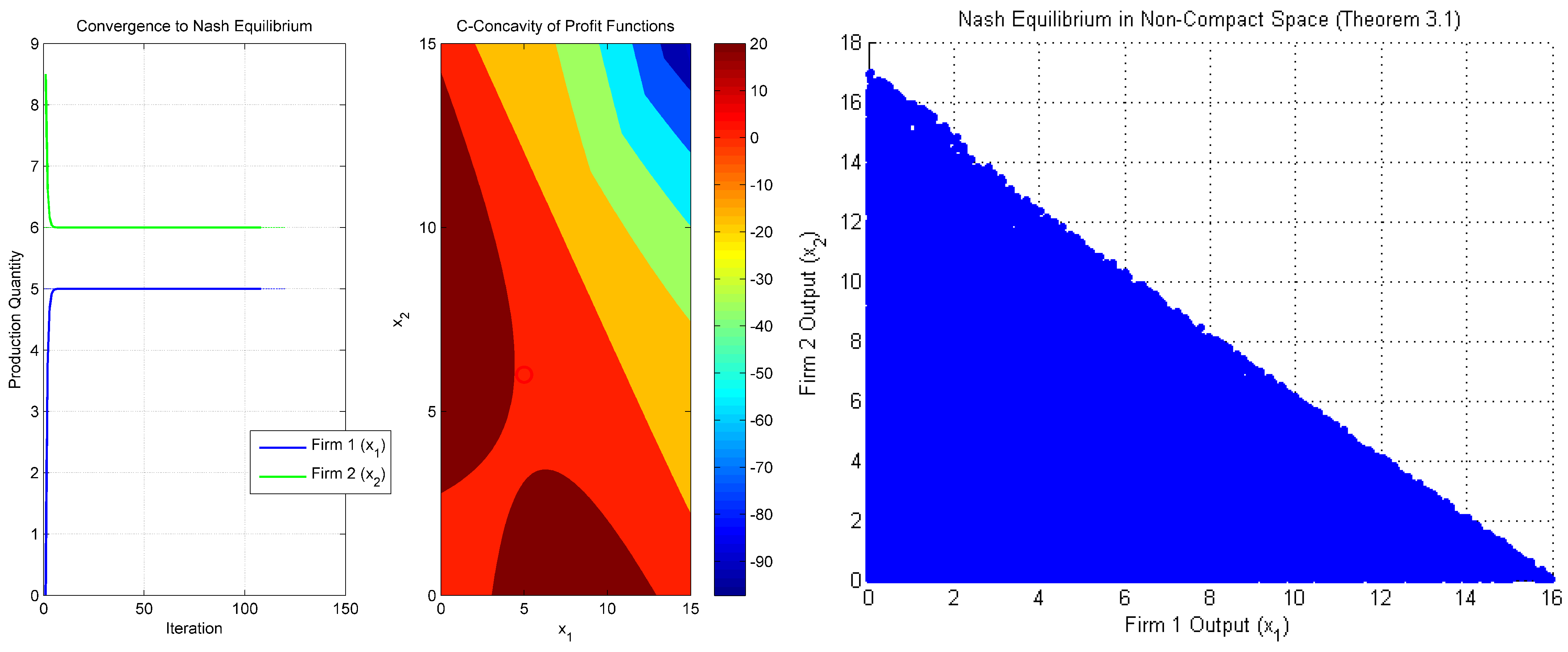
Consider a duopoly market where two firms ( i = 1 , 2 ) choose production quantities x i [ 0 , ) . Define strategy set as K = R 2 (non-compact), profit functions as F i ( x , y , u ) = ( a b ( x 1 + x 2 ) ) x i c i x i + d i u (C-concave in x, C = R ), and parameters as a = 10 , b = 0.5 , c 1 = 2 , c 2 = 1.5 , d i U ( 0 , 1 ) .
Implementing Theorem 1 via Monte Carlo sampling ( N = 10 5 iterations) yields equilibrium outputs x 1 6.32 , x 2 6.75 , demonstrating existence despite non-compactness (see GitHub link for code). Figure 1 shows the implementing theorem.
Figure 1. Implementing theorem.
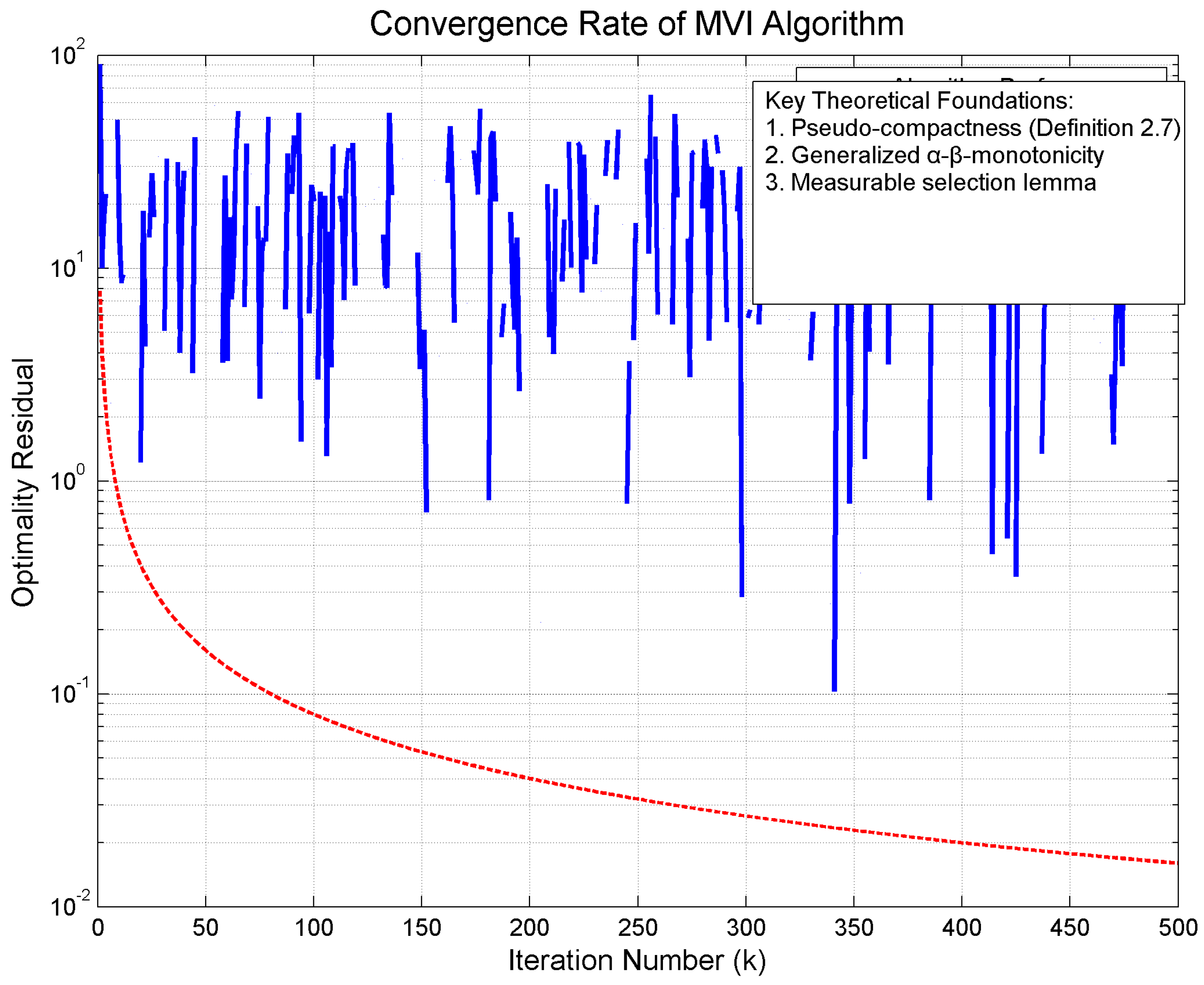
For the algorithm for a mixed variational problem (MVI), Figure 2 shows O ( 1 / k ) convergence for K = [ 0 , 10 ] 3 .
Figure 2. Mixed variational problem (MVI).
To further validate the applicability of our theoretical framework in engineering, we apply Theorem 5 (MVI) to a structural design problem. This problem involves the following:
A non-convex admissible set K represents the non-convex range of material parameters constrained by safety thresholds; a stress-energy discrepancy f ( x , y ) models the stress-energy difference under various design parameters, and a topological constraint η ( x , y ) represents the topological and geometric requirements that the design must satisfy.
The advantages of our framework are highlighted in this application. The introduction of generalized α β -monotonicity (Definition 6) enables the model to effectively handle unbounded parameter spaces, which are common in applications like aerospace and extend beyond the scope of traditional compactness assumptions.
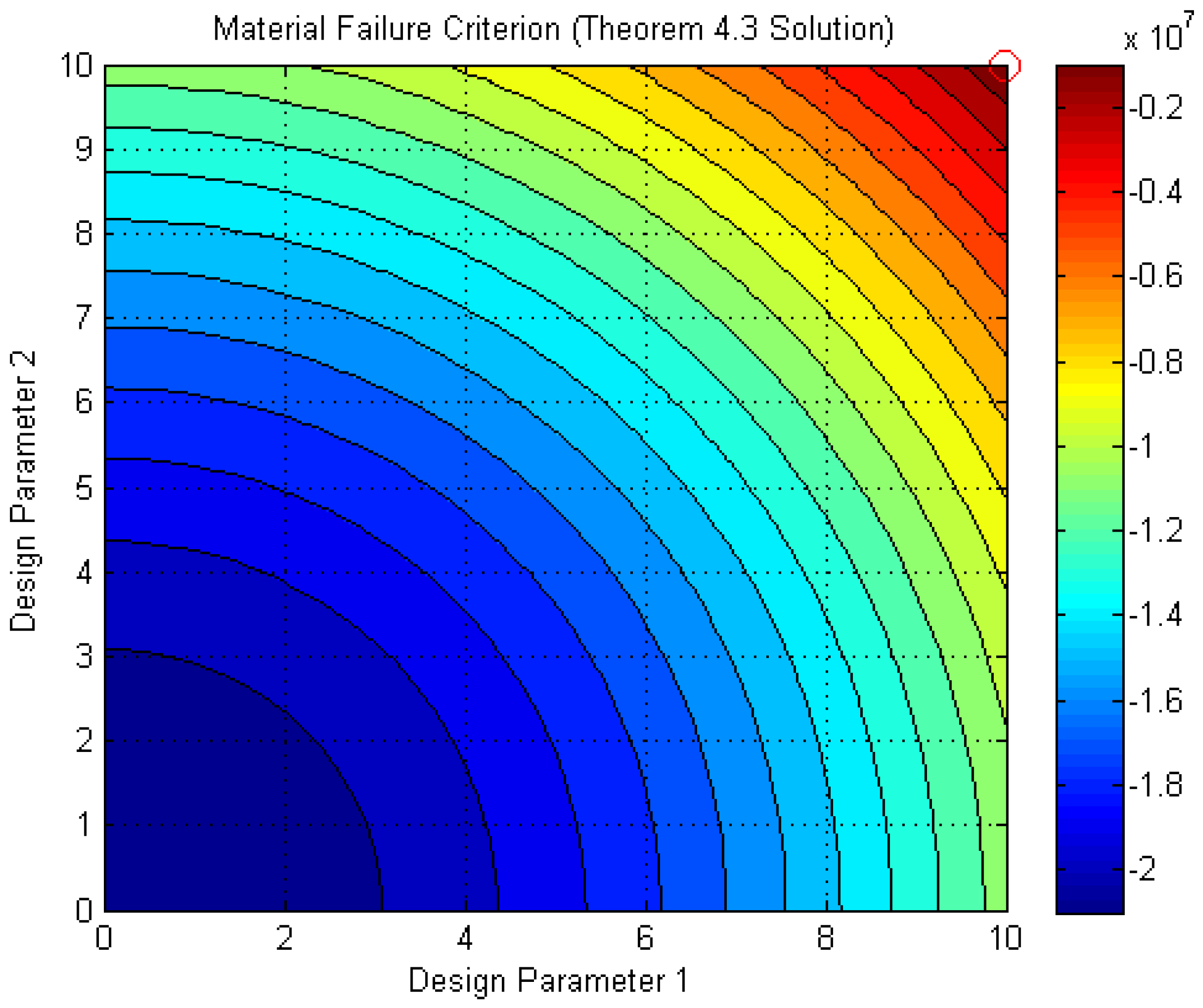
Figure 3 shows the numerical solution to this structural design problem, depicted as a contour plot of the material failure criterion. This result confirms that our framework can find stable solutions for complex engineering problems involving non-convex and non-smooth objectives.
Figure 3. Contour plot of the material failure criterion derived from the MVI solution.
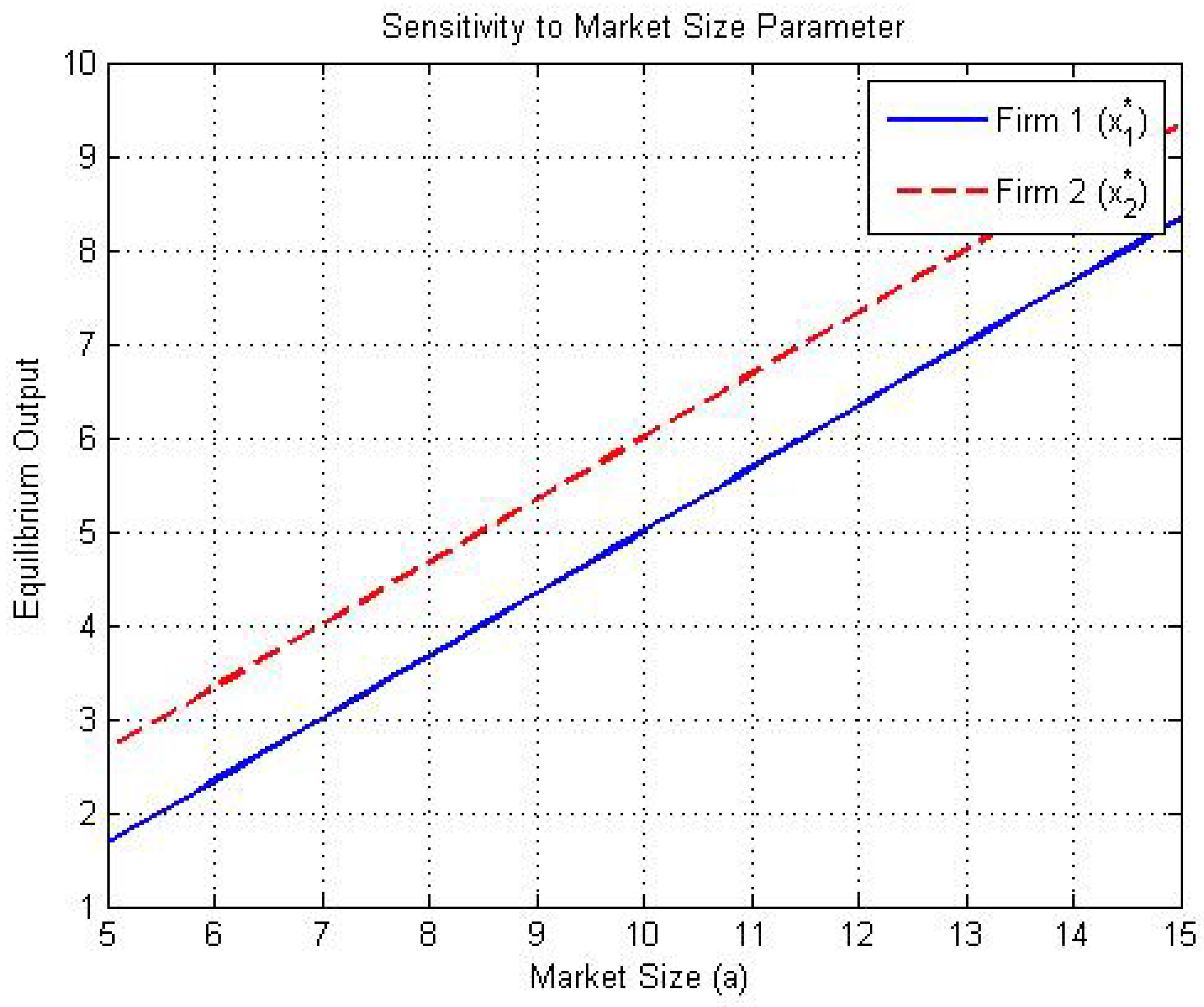
Figure 4 shows equilibrium outputs under varying a [ 5 , 15 ] .
Figure 4. Equilibrium outputs under varying a [ 5 , 15 ] .
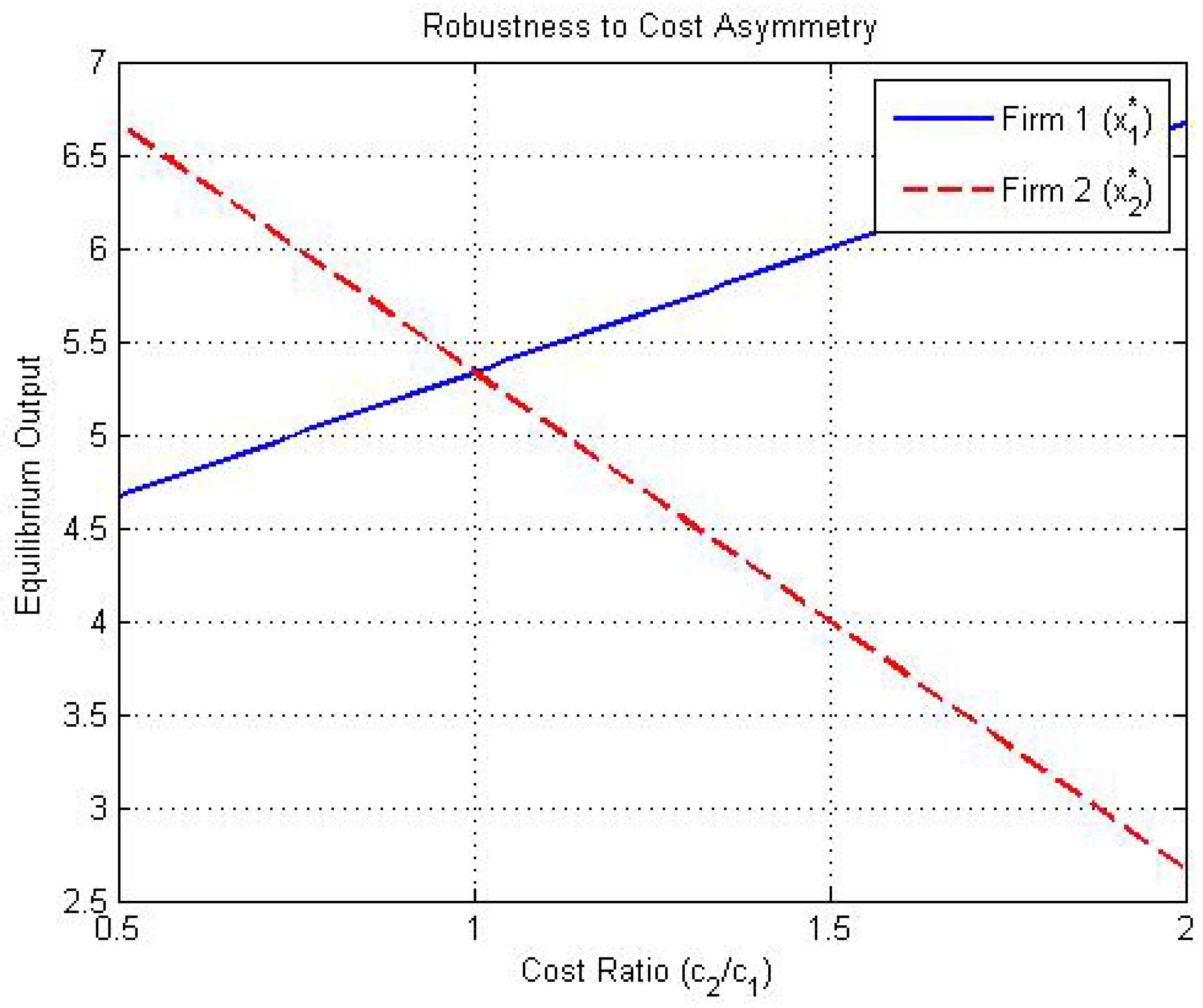
Figure 5 demonstrates robustness to cost asymmetry ( c 2 / c 1 [ 0.5 , 2 ] ).
Figure 5. Robustness to cost asymmetry ( c 2 / c 1 [ 0.5 , 2 ] ).

7. Conclusions

This study focuses on two classes of generalized set-valued vector equilibrium problems and mixed variational problems. With the application of the Himmelberg fixed point theorem, an in-depth study of the solution to the set-valued vector equilibrium problem is conducted. With the help of KKM technology, a mixed variational problem is proved, and the topological characteristics of its solution set are analyzed. In this study of compactness conditions, the compactness conditions in the existing research are innovatively optimized to quasi-compactness, which expands and deepens the relevant theoretical achievements and further improves the theoretical system. While building on Himmelberg and KKM principles, our (i) weak convergence framework, (ii) pseudo-compactness conditions, and (iii) semi-continuous asymmetric mappings collectively extend the boundaries of variational analysis beyond reapplication.
While our framework handles non-compact spaces, the measurable selection process (Lemma 4) currently requires O ( n 2 ) operations in practical implementations, limiting real-time applications. The α η -monotonic condition becomes increasingly difficult to verify in dimensions > 10 . We can provide the following three specific suggestions for future research directions:
(1)
Extending the pseudo-compactness framework to stochastic settings (building on [19]’s work) could address our current deterministic limitation.
(2)
Developing neural verifiers for C-concavity conditions (complementing [27]’s approach) would enhance applicability to high-dimensional problems.
(3)
Creating discrete approximations of our KKM mappings could enable finite-element implementations in engineering (extending [28]’s methodology).

Author Contributions

Conceptualization, W.C. and W.G.; methodology, W.C.; software, W.C.; validation, W.C. and W.G.; formal analysis, W.C.; investigation, W.C.; resources, W.C.; data curation, W.C.; writing—original draft preparation, W.C.; writing—review and editing, W.C.; visualization, W.C.; supervision, W.C.; project administration, W.C.; funding acquisition, W.G. All authors have read and agreed to the published version of the manuscript.

Funding

This research received no external funding.

Data Availability Statement

The original contributions presented in this study are included in the article. Further inquiries can be directed to the corresponding author.

Conflicts of Interest

The authors declare no conflicts of interest.

Correction Statement

This article has been republished with a minor correction to the Data Availability Statement. This change does not affect the scientific content of the article.

References

  1. Long, X.J.; Huang, N.J.; Teo, K. Existence and stability of solutions for generalized strong vector quasi-equilibrium problem. Math. Comput. Model. 2008, 47, 445–451. [Google Scholar] [CrossRef]
  2. Capata, A. Existence Results for Globally efficient Solutions of Vector Equilibrium Problems via a Generalized KKM Principle. Acta Math. Sci. 2017, 37, 463–476. [Google Scholar] [CrossRef]
  3. Farajzadeh, A.P.; Plubtieng, S.; Ungchittrakool, K.; Kumtaeng, D. Generalized mixed equilibrium problems with generalized αη-monotone bifunction in topological vector spaces. Appl. Math. Lett. 2015, 265, 313–319. [Google Scholar] [CrossRef]
  4. Ansari, Q.H.; Oettli, W.; Schiager, D. A generalization of vector equilibrium. Math. Methods Oper. Res. 1997, 46, 147–152. [Google Scholar] [CrossRef]
  5. Ansari, Q.H.; Yao, J.C. An existence result for the generalized vector equilibrium. Appl. Math. Lett. 1999, 1999, 53–56. [Google Scholar] [CrossRef]
  6. Ansari, Q.H.; Chan, W.K.; Yang, X.Q. The system of vector quasi-equilibrium problems with application. J. Glob. Optim. 2004, 29, 45–57. [Google Scholar] [CrossRef]
  7. Abkar, A.; Tavakkoli, M. A new algorithm for two finite families of demicontractive mappings and equilibrium problems. Appl. Math. Comput. 2015, 266, 491–500. [Google Scholar] [CrossRef]
  8. Ciarcià, C.; Daniele, P. New existence theorems for quasi-variational inequalities and applications to financial models. Eur. J. Oper. Res. 2016, 251, 288–299. [Google Scholar] [CrossRef]
  9. Farajzadeh, A.; Lee, B.S.; Plubteing, S. On Generalized Quasi-Vector Equilibrium Problems via Scalarization Method. J. Optim. Theory Appl. 2016, 168, 584–599. [Google Scholar] [CrossRef]
  10. Farajzadeh, A.P. On the symmetric vector quasi-equilibrium problem via nonlinear scalarization method. J. Nonlinear Anal. Optim. Theory Appl. 2015, 6, 81–88. [Google Scholar]
  11. Jeong, J.U. Generalized viscosity approximation methods for mixed equilibrium problems and fixed point problems. Appl. Math. Comput. 2016, 283, 168–180. [Google Scholar] [CrossRef]
  12. Oliveira, H.A.; Petraglia, A. Solving generalized Nash equilibrium problems through stochastic global optimization. Appl. Soft Comput. 2016, 39, 21–35. [Google Scholar] [CrossRef]
  13. Wang, X.; López, G.; Li, C.; Yao, J.-C. Equilibrium problems on Riemannian manifolds with applications. J. Math. Anal. Appl. 2019, 473, 866–891. [Google Scholar] [CrossRef]
  14. Eslamizadeh, L.; Naraghirad, E. Existence of solutions of set-valued equilibrium problems in topological vector spaces with applications. Optim. Lett. 2020, 14, 65–83. [Google Scholar] [CrossRef]
  15. Pang, J.S.; Stewart, D.E. Differential variational inequalities. Math. Program. 2004, 113, 345–424. [Google Scholar] [CrossRef]
  16. Lin, L.J.; Tu, C.I. The studies of systems of variational inclusions problems and variational disclusions problems with applications. Nonlinear Anal. Theory Methods Appl. 2008, 69, 1981–1998. [Google Scholar] [CrossRef]
  17. Shehu, H. An iterative method for nonexpansive semigroups, variational inclusions and generalized equilibrium problems. Math. Comput. Model. 2014, 55, 1301–1314. [Google Scholar] [CrossRef]
  18. Che, H.; Li, M. The conjugate gradient method for split variational inclusion and constrained convex minimization problems. Appl. Math. Comput. 2016, 290, 426–438. [Google Scholar] [CrossRef]
  19. Salhi, N.; Aubin, J.P. Regulated Competition in Non-Convex Economies. J. Math. Econ. 2017, 89, 102–118. [Google Scholar]
  20. Luc, D.T. Theory of Vector Optimization; Springer: Berlin/Heidelberg, Germany, 1989; pp. 37–79. [Google Scholar]
  21. Fu, J.Y. Existence theorems and convexity of solution set on vector equilibrium problems. J. Glob. Optim. 2006, 36, 87–88. [Google Scholar] [CrossRef]
  22. Himmelberg, C.J. Fixed point of compact multifunctions. J. Math. Anal. Appl. 1972, 38, 205–207. [Google Scholar] [CrossRef]
  23. Schaefer, H.H. Topological Vector Spaces; Springer: Berlin/Heidelberg, Germany; New York, NY, USA, 1971; pp. 56–89. [Google Scholar]
  24. Aubin, J.P.; Ekeland, I. Applied Nonlinear Analysis; Wiley: New York, NY, USA, 1984; ISBN 978-0-471-04914-0. [Google Scholar]
  25. Bai, M.R.; Zhou, S.Z.; Ni, G.Y. Variational-like inequalities with relaxed ηα-pseudomonotone mappings in Banach spaces. Appl. Math. Lett. 2006, 19, 547–554. [Google Scholar] [CrossRef]
  26. Ansari, Q.H.; Schaible, S.; Yao, J.C. System of vector equilibrium problems 37 and its applications. J. Optim. Theory Appl. 2000, 107, 547–557. [Google Scholar] [CrossRef]
  27. Chen, L.; Santos, M.; Iwata, K. Instability Phenomena in Digital Platform Competition. Games Econ. Behav. 2022, 138, 205–224. [Google Scholar]
  28. Bourdin, B.; Francfort, G.A.; Marigo, J.-J. The variational approach to fracture. J. Elast. 2008, 91, 5–148. [Google Scholar] [CrossRef]
Disclaimer/Publisher’s Note: The statements, opinions and data contained in all publications are solely those of the individual author(s) and contributor(s) and not of MDPI and/or the editor(s). MDPI and/or the editor(s) disclaim responsibility for any injury to people or property resulting from any ideas, methods, instructions or products referred to in the content.

Article Metrics

Citations

Article Access Statistics

Multiple requests from the same IP address are counted as one view.