


Abstract
We present an extension of the Dirichlet-type prime number theorem to weighted counting functions, the importance of which has recently been recognized for formulating Chebyshev’s bias. Moreover, we prove that their difference () changes its sign infinitely many times as x grows for any coprime with q, under the assumption that Dirichlet L-functions have no real nontrivial zeros. This result gives a justification of the theory of Aoki–Koyama that Chebyshev’s bias is formulated by the asymptotic behavior of at .
MSC:
11N05; 11M26
1. Introduction
We define the weighted counting function of primes in arithmetic progressions as
for . This is a generalization of the classical counting function . In 1837, Dirichlet proved that
for any a, b, which are coprime with q, where means that as .
On the other hand, in 1853, Chebyshev [1] found the phenomenon that there tend to be more primes p satisfying than those with . In fact, the inequality
holds for any x less than 26,861, which is the first prime number violating the inequality (1). However, both sides draw equal at the next prime 26,863, and gets ahead again until 616,841. It is computed that more than 97% of satisfy the inequality (1). This phenomenon is called Chebyshev’s bias and is one of the major unsolved mysteries in number theory.
Later, Littlewood [2,3] proved that the difference changes its sign infinitely many times. In 2023, Aoki and Koyama [4] suggested that Littlewood’s phenomenon no longer holds if we put the weight . They actually obtained the asymptotic under the assumption of the Deep Riemann Hypothesis that
The Deep Riemann Hypothesis (DRH) is a conjecture asserting the convergence of the Euler product of the corresponding L-function on the critical line. More precisely, in the case of Dirichlet L-functions, the DRH is stated as follows.
Conjecture 1
(Deep Riemann Hypothesis (DRH)). Let m be the order of the zero of a Dirichlet L-function at . Then, it holds that
Conjecture 1 was proposed by Kurokawa in his Japanese book [5] in 2012 and first appeared in English literature in [6] in 2014. It is known that the DRH implies the GRH.
When , we find that , and DRH asserts the convergence of the Euler product at . Then, the asymptotic (2) follows from the Taylor expansion of the logarithm of the Euler product.
For more general q, Aoki–Koyama [4] defined the Chebyshev bias towards (or against ) as the asymptotic
with a constant depending on q. Under DRH, it is also proved for any that
This was one of the reasons why Aoki–Koyama chose for formulating the bias.
The new formulation (3) concerns a different aspect from those dealt with by the definitions discovered by Rubinstein–Sarnak [7] and developed by Akbary–Ng–Shahabi [8], Devin [9], and so on. We find that (3) is an estimate of the size of the discrepancy caused by Chebyshev’s bias, which was ignored by the conventional definitions using the (logarithmic) length of the interval in terms of limiting distributions in the following sense.
For example, if, among the first 100 prime numbers, 50 of the first half are of the form and those of the latter half are of the form , the inequality always holds in this interval even if their total number of elements are equal, and the maximum difference becomes 50. On the other hand, in the case that primes of the form and appear alternately, the maximum difference may be 1 even if the same inequality holds incessantly. The conventional definition cannot distinguish these two extreme cases because they have the same length of the interval where the inequality holds.
From this discussion, it is effective to apply the structure that “regards smaller primes as heavier elements”, reflecting the magnitudes of the primes, in order to elucidate Chebyshev’s bias. This is the reason why the weighted counting function is effective and why the formulation (2) is convincing. But there still remains an open problem concerning their choice of . That is, the behavior of the left-hand side of (4) for was unknown.
In this paper, we will solve this problem by generalizing Littlewood’s theorem to . In what follows, we use the standard notation
and . Our first main theorem is as follows.
Theorem 1
(Weighted prime number theorem). Let be coprime with . For , it holds that
When , the first author [10] proved the weighted prime number theorem:
for , and Theorem 1 is a generalization of it.
We write if the following holds: There exists a constant such that for any , there exist such that and .
It is known by Stark [11] (Theorem 2) that for any coprime with q
under the assumption that the Dirichlet L-function has no zeros in the interval for any Dirichlet character modulo q. Actually, Stark obtained the estimate (5) for more general cases , but for our purpose, the case is sufficient.
Our second main theorem is a generalization of it.
Theorem 2.
Suppose that has no zeros in the interval for any Dirichlet character χ modulo q. For and any coprime with q, it holds that
In particular, changes its sign infinitely many times.
This is a generalization of the theorem of the first author [10] for the case of , where he proved that
changes its sign infinitely many times.
Theorem 1 together with the estimate (4) justifies the choice of for the formulation of Chebyshev’s bias.
2. Weighted Prime Number Theorem
The following lemma was proved in the previous paper [10].
Lemma 1.
Assume and are positive valued functions on . If and , it holds that
For q, with and , we denote
where the sum is taken over pairs , with m a positive integer and p a prime satisfying and .
Lemma 2.
Proof.
Putting , we have by partial summation that
From the classical prime number theorem , we compute
Here, the last integral is estimated by Lemma 1 as
Thus, we have
The proof is complete. □
For , we put
where the sum is taken over primes p satisfying and .
Lemma 3.
It holds that
Proof.
From the definitions, the right inequality is immediate. The left one is deduced as follows.
The proof is complete. □
Proof of Theorem 1.
From Lemmas 2 and 3, we have
Now we will establish the relation between and . Clearly, it holds that
Hence,
On the other hand, for , we have and
Therefore,
Since the last term is estimated as
we conclude that
Now, combining with (7), we reach
The proof is complete. □
3. Refinements
In this section, we prove Theorem 2. The following lemma plays the role for reducing the general weight w to the case of .
Lemma 4.
Proof.
Denote by the n-th smallest element in the set of primes p such that . Putting , we compute
Hence, for , we have
By substituting in the variable s, we obtain
The proof is complete. □
We will apply the theory of Tauberian theorems, which was developed by Ingham in the following theorem.
Theorem 3
([12] (Theorem 1)). Let
where is real valued and absolutely integrable on every interval , and the integral is absolutely convergent in some half plane .
Let be a real trigonometrical polynomial
and let
Suppose that is regular in the region , for some .
Then, it holds that
where
This theorem was reformulated by Stark for the purpose of refining the estimate of as follows:
Theorem 4
([11] (p. 314)). Put . Let
where is real valued and absolutely integrable on every interval , and the integral is absolutely convergent for . For any real sequence with and coefficients with , set
Suppose that for some , is continuous in the region , and analytic in the interior of this region. Then, for any ,
Theorem 4 follows from Theorem 3 applied to the derivative with respect to s of
The estimate (5) is an immediate consequence of Theorem 4 and the fact that the function
is analytic in ([11] (Lemmas 1 and 2)).
Proof of Theorem 2.
From Lemma 4 and the above discussion, the function
is analytic in . For , we replace (10) with the following function:
where . Then, for any ,
Consequently, it holds that
which is the desired result. □
4. Numerical Examples
Theorem 2 guarantees infinitely many sign changes of , and one may want to know an example of x where the sign change occurs. But the history tells us that it is very hard to figure it out. Even in the simplest case when and , the exact value giving a sign change of the difference (6) is not known. It was first proved by Skews in 1933 under the assumption of the Riemann Hypothesis that a sign change occurs at x less than , and many works were done for improvements of the smallest x giving a sign change. The current record is obtained by Bays and Hudson [13] that a sign change occurs at x less than . On the other hand, Kotnik [14] proved that there are no sign changes for .
Therefore, it would also be difficult to give concrete examples of x where sign changes of occur for . However, the second author investigated the behavior of
with the nontrivial Dirichlet character modulo 4 for and , and introduced the results in his Japanese book [15]. Here, we quote the figures and calculations from it.
We denote by the nontrivial character modulo 4. Figure 1 shows the value of the series
for (upper in brown) and (lower in blue).
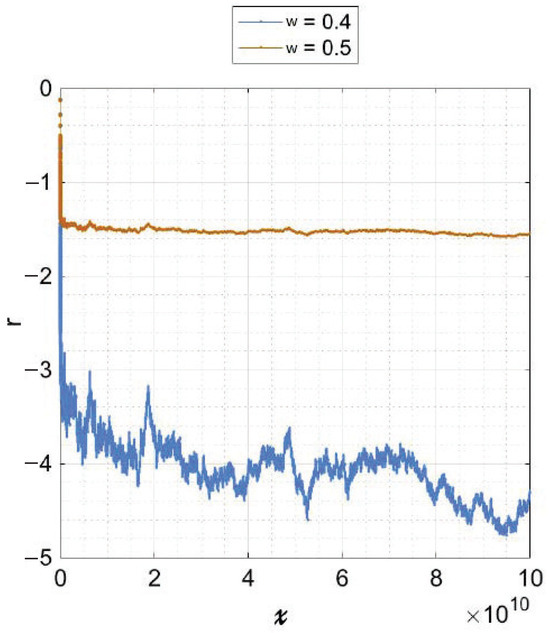
Figure 1.
with and .
We see that the two behaviors of are very different. Actually, for , as is implied by the DRH, the series is very stable. On the other hand, the difference (11) drastically changes when we choose .
5. Conclusions and Prospect
The main theorem obtained in this paper justifies our use of a weight in the formulation of the Chebyshev bias.
Aoki–Koyama’s paper [4] and subsequent research [16,17,18,19] have extended the Chebyshev bias to a wide range of cases. It is expected that similar theorems obtained in this paper will hold for all of them. The importance of weighted counting functions has only recently begun to be recognized for understanding the distribution of primes, and research extending classical results such as Littlewood’s work to weighted cases is likely to become increasingly important in the future.
Meanwhile, research is also being conducted to replace the Deep Riemann Hypothesis with other assumptions. Sheth [20] proved a weaker version of the Chebyshev bias by assuming only the Generalized Riemann Hypothesis instead of the Deep Riemann Hypothesis. His result yields an asymptotic formula similar to (3) as x runs through outside of an exceptional set with finite logarithmic measure. By relaxing the definition of the Chebyshev bias in this way, it may also be possible to demonstrate the Chebyshev bias assuming only the General Riemann Hypothesis.
Author Contributions
Formal analysis, K.S.; Investigation, K.S. and S.-y.K.; Writing—original draft, K.S.; Supervision, S.-y.K.; Project administration, S.-y.K. All authors have read and agreed to the published version of the manuscript.
Funding
The second author is partially supported by Toyo Univeristy: INOUE ENRYO Memorial Grant 2024.
Data Availability Statement
The original contributions presented in this study are included in the article. Further inquiries can be directed to the corresponding author.
Conflicts of Interest
The authors declare no conflicts of interest.
Correction Statement
This article has been republished with a minor correction to the Data Availability Statement. This change does not affect the scientific content of the article.
References
- Tchébychev, P.L. Lettre de M. le professeur Tchébychev à M. Fuss sur un nouveau théorème relatif aux nombres premiers contenus dans les formes 4n + 1 et 4n + 3. Bull. Classe Phys. Acad. Imp. Sci. 1853, 11, 208. [Google Scholar]
- Littlewood, J.E. Distribution des Nombres Premiers. Comptes Rendues 1914, 158, 1869–1872. [Google Scholar]
- Hardy, G.H.; Littlewood, J.E. Contributions to the theory of the Riemann zeta-function and the theory of the distribution of primes. Acta Math. 1918, 41, 119–196. [Google Scholar] [CrossRef]
- Aoki, M.; Koyama, S. Chebyshev’s bias against splitting and principal primes in global fields. J. Number Theory 2023, 245, 233–262. [Google Scholar] [CrossRef]
- Kurokawa, N. The Pursuit of the Riemann Hypothesis; Gijutsu Hyoron-sha: Tokyo, Japan, 2012. (In Japanese) [Google Scholar]
- Kimura, T.; Koyama, S.; Kurokawa, N. Euler products beyond the boundary. Lett. Math. Phys. 2014, 104, 1–19. [Google Scholar] [CrossRef]
- Rubinstein, M.; Sarnak, P. Chebyshev’s bias. Exp. Math. 1994, 3, 173–197. [Google Scholar] [CrossRef]
- Akbary, A.; Ng, N. Limiting distributions of the classical error terms of prime number theory. Q. J. Math. 2014, 65, 743–780. [Google Scholar] [CrossRef]
- Devin, L. Chebyshev’s bias for analytic L-functions. Math. Proc. Camb. Philos. Soc. 2020, 169, 103–140. [Google Scholar] [CrossRef]
- Shimada, K. Weighted prime number theorem with refinement. Preprint 2025. [Google Scholar]
- Stark, H. A problem in comparative prime number theory. Acta Arith. 1971, XVIII, 311–320. [Google Scholar] [CrossRef]
- Ingham, A.E. On two conjectures in the theory of numbers. Am. J. Math. 1942, 64, 313–319. [Google Scholar] [CrossRef]
- Bays, C.; Hudson, R.H. A new bound for the smallest x with π(x) > li(x). Math. Comp. 2000, 69, 1285–1296. [Google Scholar] [CrossRef]
- Kotnik, T. The prime-counting function and its analytic approximations: π(x) and its approximations. Adv. Comput. Math. 2008, 29, 55–70. [Google Scholar] [CrossRef]
- Koyama, S. The Power of Mathematics; Nikkei Science: Tokyo, Japan, 2020. (In Japanese) [Google Scholar]
- Koyama, S.; Kurokawa, N. Chebyshev’s Bias for Ramanujan’s τ-Function via the Deep Riemann Hypothesis. Proc. Japan Acad. Ser. A Math. Sci. 2022, 98, 35–39. [Google Scholar] [CrossRef]
- Kaneko, I.; Koyama, S. A new aspect of Chebyshev’s bias for elliptic curves over function fields. Proc. Am. Math. Soc. 2023, 151, 5059–5068. [Google Scholar] [CrossRef]
- Kaneko, I.; Koyama, S.; Kurokawa, N. Towards the Deep Riemann Hypothesis for GLn. arXiv 2022, arXiv:2206.02612. [Google Scholar]
- Okumura, Y. Chebyshev’s bias for Fermat curves of prime degree. Ramanujan J. 2024, 65, 725–742. [Google Scholar] [CrossRef]
- Sheth, A. Euler products at the centre and applications to Chebyshev’s bias. In Mathematical Proceedings of the Cambridge Philosophical Society; Cambridge University Press: Cambridge, UK, 2025. [Google Scholar]
Disclaimer/Publisher’s Note: The statements, opinions and data contained in all publications are solely those of the individual author(s) and contributor(s) and not of MDPI and/or the editor(s). MDPI and/or the editor(s) disclaim responsibility for any injury to people or property resulting from any ideas, methods, instructions or products referred to in the content. |
© 2025 by the authors. Licensee MDPI, Basel, Switzerland. This article is an open access article distributed under the terms and conditions of the Creative Commons Attribution (CC BY) license (https://creativecommons.org/licenses/by/4.0/).