


Abstract
Let be a connected graph. A bijection is called a local antimagic labeling if, for any two adjacent vertices x and y, , where , and is the set of edges incident to x. Thus, a local antimagic labeling induces a proper vertex coloring of G, where the vertex x is assigned the color . The local antimagic chromatic number is the minimum number of colors taken over all colorings induced by local antimagic labelings of G. In this paper, we present some families of bridge graphs with and give several ways to construct bridge graphs with .
MSC:
05C78; 05C69
1. Introduction
For a connected graph with order and size , a local antimagic labeling is a bijection such that whenever the vertices u and v are adjacent in G, where is the sum of the labels of the edges incident to u. Thus, a local antimagic edge labeling f of G induces a vertex labeling given by for any two adjacent vertices with distinct labels. This vertex labeling is called an induced vertex labeling, and the labels assigned to vertices are called induced colors under f (or colors, for short, if no ambiguity occurs). A connected graph G is said to be local antimagic if it admits a local antimagic edge labeling. Clearly, if G is local antimagic, then . The color number of a local antimagic labeling f is the number of distinct induced colors under f, denoted by , and f is also called a local antimagic -coloring. The local antimagic chromatic number of a graph G, denoted by , is the minimum over all local antimagic labelings f of G. Thus, .
The concept of local antimagic labeling was first introduced by Arumugam et al. [1] in 2017, marking the beginning of extensive research into local antimagic chromatic numbers of various graph classes. Building on this foundation, Nazula et al. [2] investigated unicyclic graphs in 2018, contributing to an early understanding of this parameter. Arumugam et al. [3] determined the local antimagic chromatic number of several families of trees. Subsequently, Lau et al. made significant advancements by determining the local antimagic chromatic numbers for several important graph families, including cycle-related join graphs [4], complete bipartite graphs [5], and spider graphs [6]. Further expanding the scope, Shaebani [7] constructed an infinite class of connected graphs with arbitrarily large local antimagic chromatic numbers. Recently, Lau et al. characterized s-bridge graphs with local antimagic chromatic number 2 in [8]. A bridge graph (or specifically, an s-bridge graph), denoted by , is a graph consisting of s edge-disjoint -paths of lengths , where . Up to isomorphic, we often assume , but not always. Figure 1 shows an s-bridge graph with a local antimagic 3-coloring.
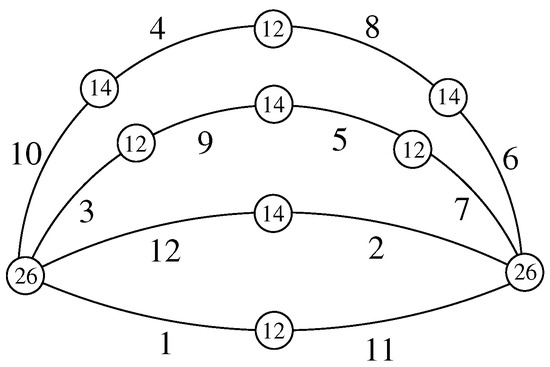
Figure 1.
with a local antimagic 3-coloring.
In this paper, we will further study s-bridge graphs and present some families of s-bridge graphs with local antimagic chromatic number 3.
Throughout this paper, we use to denote a sequence of length n in which all items are a, where . For integers , we let denote the set of integers from a to b. All notions and notation not defined in this paper are referred to in [9].
2. s-Bridge Graphs with Size 2s + 2
In this section, we will study a family of s-bridge graphs of size and show that their local antimagic chromatic number is 3.
Firstly, we recall some known results regarding s-bridge graphs of sizes greater than .
Theorem 1
([8], Theorem 2.3). For , if and only if either with even or is one of the following graphs of sizes greater than :
- (1)
- , where ;
- (2)
- , where ;
- (3)
- ; ; ;
- (4)
- , where ;
- (5)
- , where ;
- (6)
- , where and .
In the remainder of this section, we consider a family of s-bridge graphs that are bipartite and of size , where . Clearly, . In [8], it has been proved that . Next, we will show that .
Theorem 2.
For any , .
Before proving Theorem 2, we introduce some notation that will be used later. Let A be a matrix. We use and to denote the i-th row sum and the j-th column sum of A, respectively. And, denotes an matrix whose entries are 1.
Proof.
As , it is sufficient to show that holds for any . For any , let be the j-th -path in and be the s-th -path in . In each case below, we will define a matrix that corresponds to a local antimagic 3-coloring of , which implies that .
Case 1. s is odd, and .
In this case, we have the following two cases.
Case 1.1. (i.e., ).
We will define a matrix recurrently such that the set of its entries is for .
Let . It is clear that (i) the set of entries of is , (ii) , and (iii) . Suppose that is a matrix satisfying the following conditions: (i) the set of entries is ; (ii) for any , ; and (iii) , where .
Let
Consequently, we have a matrix satisfying the following conditions: (i) the set of entries is ; (ii) for any , (i.e., the sum of the entries in column 1 is the same as the sum of the entries in column 2); and (iii) .
Clearly, for any , and , where . Also, the last two columns of form a matrix .
Now, we are ready to label the edges of . Let f be an edge labeling of such that for any , the edges and are assigned the labels and , and the edges , , and are assigned the labels , , and , respectively. We have that for each , , and . Thus, f is a local antimagic 3-coloring of , which implies that .
Case 1.2. (i.e., ).
Similar to Case 1.1, we will define a matrix recurrently such that the set of its entries is for .
Let . It is obvious that for , , and . Suppose that is a matrix satisfying the following conditions: (i) the set of entries is ; (ii) for any , ; and (iii) , where .
Let
Clearly, is a matrix in which for each and , where and . Note that the last two columns of are a matrix .
Let f be an edge labeling of such that the edges and are labeled by and for each , and the edges , , and are labeled by , , and , respectively. Then, for each , , , and . Therefore, f is a local antimagic 3-coloring of , implying .
Case 2. s is even, and . There are also two subcases in this case.
Case 2.1. (i.e., ).
Let , where and . Note that the set of entries of is , and for each . Suppose that is defined so that the set of entries of is , and for each , where . Let , where and .
It is clear that the set of entries of is , and for each ,
Thus, is a matrix with the entry set , where , the sum of the elements in each row is , the sum of the elements in each column except the last column is , and the last column is .
Case 2.2. (i.e., ).
Let , where . Note that the set of entries of is , and for each . Suppose that is defined so that the set of entries of is , and for each , where . Let , where and .
It is obvious that the set of entries of is , and the sum of the elements in each row is
Therefore, is a matrix with the entry set , where , the sum of the elements in each row is , the sum of the elements in each column except the last column is , and the last column is .
Combining Case 2.1 and Case 2.2, when s is even and , we always obtain a matrix , in which the set of entries is , for each , and for each .
For any even integer , let f be an edge labeling of such that and for each , , , and . Then, we have that , , , and for each . Therefore, f is a local antimagic 3-coloring, implying that .
From Case 1 and Case 2, we have that for any . □
Remark 1.
In Case 1.1, we obtain a local antimagic 3-coloring f of such that . If we require , then there is only one case, which is . Following is the assignment of each -path in : , which induce the vertex labels and 48.
3. Bridge Graphs with an Even Number of Internal Paths of the Same Length
In this section, we will show that there is a family of bridge graphs with an even number of internal paths of the same length whose local antimagic chromatic number is 3.
Theorem 3.
For positive integers , , where .
Note that in Theorem 3 do not necessarily have to be distinct or in non-decreasing order. Before giving the proof of Theorem 3, we first introduce some notions and results that will be used later.
For positive integer s and integers , let be the arithmetic progression of length s with a first term i and a common difference d. Suppose that and are two ordered sequences of length n. Let be the ordered sequence of length generated by and such that the -st term is the i-th term of and the -th term is the i-th term of , where . When the length of is , we may similarly define as an ordered sequence of length .
The following result can be obtained easily.
Lemma 1.
For and , let and . Then,
- (1)
- The first and last terms of are a and ;
- (2)
- The sums of two consecutive terms of are q and , alternatingly;
- (3)
- The first and last terms of are b and ;
- (4)
- The sums of two consecutive terms of are and q, alternatingly.
From Lemma 1, we obtain the following result immediately.
Corollary 1.
The sum of the first term of and that of is , and the sum of the last term of and that of is also .
Similar to Lemma 1 and Corollary 1, we have the following.
Lemma 2.
For and , let and . Then,
- (1)
- The first and last terms of are a and ;
- (2)
- The sums of two consecutive terms of are q and , alternatively;
- (3)
- The first and last terms of are b and ;
- (4)
- The sums of two consecutive terms of are and q, alternatively;
- (5)
- The sum of the first term of and that of is , and the sum of the last term of and that of is also .
Suppose that q is fixed. If there is no ambiguity, we will write , , and instead of , , and , respectively. With some abuse of notation, we sometimes treat the ordered sequence as a set.
Now, we are ready to prove Theorem 3.
Proof of Theorem 3.
Let . Without loss of generality, we may assume that are even and are odd, . Note that if , then there is no even-length -path, and if , then there is no odd-length -path. For any , let be a -path of length in , and for any , let be a -path of length in . Then, the size of is . Without loss of generality, we assume and . Thus, by assumption, for .
Now, we label the edges of the -paths of according to the following eight steps:
- Step 1.
- If , then jump to Step 5.
- Step 2.
- Label the edges of -path by and the edges of -path by .
- Step 3.
- Suppose that for each , has been labeled. Let be the least unused label. Observe that, by definition, . Label the edges of -path by and the edges of -path by .
- Step 4.
- Repeat Step 3 until all are labeled.
- Step 5.
- If , then stop; otherwise, let be the least unused label. Observe that, by definition, . Empty summation is treated as 0.
- Step 6.
- Label the edges of -path by and the edges of -path by .
- Step 7.
- Suppose that has been labeled for each . Let be the least unused label. Observe that, by definition, . Label the edges of -path by and the edges of -path by .
- Step 8.
- Repeat Step 7 until every is labeled.
Note that . For , we have a set
where . Similarly, for , we have that
Since , all labels in are assigned. By Lemmas 1 and 2 and Corollary 1, we can check that the induced vertex labels are q, and . Thus, the above labeling is a local antimagic 3-coloring of , implying that . □
Combining Theorems 1 and 3, we easily obtain the following result.
Theorem 4.
For integers , , if is not in the list of Theorem 1, then .
Following are three examples of Theorem 4.
Example 1.
According to the notation used in the proof of Theorem 3, we have a local antimagic 3-coloring for , as shown in Figure 1.
Example 2.
Consider the graph . According to the notation used in the proof of Theorem 3, , , , , and . We label , , as follows:
Label by (we will omit the braces of the sequences in each example);
Label by ;
Label by ;
Label by ;
Label by ;
Label by ;
Label by ;
Label by ;
Label by ;
Label by .
One may see that the induced vertex labels are 56, 58 and 285. From Theorem 1, we know that . Thus, .
Example 3.
Consider the graph . According to the notation used in the proof of Theorem 3, , , , , , and . We label for and for as follows:
Label by ;
Label by ;
Label by ;
Label by ;
Label by ;
Label by ;
Label by ;
Label by ;
Label by ;
Label by .
One may see that the induced vertex labels are 50, 52 and 255. Since is not bipartite, .
4. Construct Some Bridge Graphs with Local Antimagic 3-Coloring
In the last section of this paper, we will give several ways to construct some bridge graphs such that their local antimagic chromatic number is 3.
4.1. From Bridge Graphs with Local Antimagic 2-Coloring
From Theorem 1(1), there is a local antimagic 2-coloring of , where (see the proof of Theorem 2.3 in [8] for more details). In what follows, we will give a local antimagic 3-coloring of based on the local antimagic 2-coloring of .
For a bridge graph , let be the -path of length , where , and be the -path of length , where . Let f be a local antimagic 2-coloring of obtained by the method described by [8] (Theorem 2.3). We see that the first three edge labels of starting from u are , where , , and q is the size of .
Now, we perform the following steps to create a local antimagic 3-coloring of :
- Delete the edge labeled by from for each (i.e., the second edge of );
- Merge two pendent vertices incident to the edges labeled by i and as a new vertex for each .
We now obtain the new graph , in which the induced vertex label of is , and the induced vertex labels of other vertices are the same as those in , which are and . As is not in the list of Theorem 1 (since every bridge graph in the list only has paths of even length), we have the following result.
Theorem 5.
For , .
Example 4.
We will give a local antimagic 3-coloring of the bridge graph in the following. Firstly, we consider the bridge graph . Let be the -paths of length 10 and be the -path of length 8, where . From the proof of Theorem 2.3 in [8]), we label as follows:
Label by 1, 84, 21, 64, 41, 44, 61, 24, 81, 4;
Label by 2, 83, 22, 63, 42, 43, 62, 23, 82, 3;
Label by 7, 78, 27, 58, 47, 28, 67, 18;
Label by 8, 77, 28, 57, 48, 37, 68, 17;
Label by 9, 76, 29, 56, 49, 36, 69, 16;
Label by 11, 74, 31, 54, 51, 34, 71, 14;
Label by 13, 72, 33, 52, 53, 32, 73, 12;
Label by 15, 70, 35, 50, 55, 30, 75, 10;
Label by 19, 66, 39, 46, 59, 26, 79, 6;
Label by 20, 65, 40, 45, 60, 25, 80, 5.
We obtain by deleting the edges labeled by 83 and 84 in , merging the pendent vertices incident to the edges labeled by 1 and 83 and merging the pendent vertices incident to the edges labeled by 2 and 84. Thus, the new paths of length 9 in are labeled by and . The labels of other paths of length 8 are the same as those in . It is clear that the induced colors are . Therefore, this is a local antimagic 3-coloring for .
4.2. From Some Special Sequences
In what follows, we will construct some bridge graphs of sizes and , where , from some special sequences and show that their local antimagic chromatic number is 3.
Let and be two arithmetic progressions, where . We break the sequence into three subsequences of lengths , and as follows:
where . Note that when . Let be the reverse of , i.e., . Observe that the set of elements in is , the set of elements in is , and the set of elements in is . Thus, all the elements in appear exactly once.
Clearly, the sum of two consecutive terms of for each is either or q. The sum of the first terms of , and is , and that of the last terms of , and is .
Now, we label the edges of three -paths of lengths , and by the sequences , and , respectively. Therefore, there is a local antimagic 3-coloring of for each . Since is not in the list of Theorem 1, we have the following result.
Theorem 6.
For , .
Suppose that we break the above sequence into the following three subsequences of lengths , 2 and , where :
We label the edges of five -paths of lengths , 2, , and by the sequences , , , and , respectively. Then, there is a local antimagic 3-coloring for when and . Also, as is not in the list of Theorem 1, we obtain the following result.
Theorem 7.
For and , .
Example 5.
Suppose and . We then have that
Thus, we label the -paths of lengths by , respectively. We then obtain a local antimagic 3-coloring of with induced colors , implying that .
Now, we break into , and . Then, the -paths of lengths are labeled by , respectively. Therefore, there is a local antimagic 3-coloring for with induced colors . Thus, .
In what follows, we will construct the bridge graph of size , where , from the sequences , , and . Let
Note that the sums of two consecutive terms of (or ) are and , alternatingly.
We break into subsequences with even lengths, i.e.,
Note that , which is the last term of . That is, for each ,
where by convention. The length of is for .
Similarly, we break into subsequences with even lengths; i.e., for each ,
where by convention. Note that , and the length of is for .
The sums of two consecutive terms of (or ) are still and , alternatingly. Now, we reverse the order of the sequence of each and keep the order of the sequence for . We also reverse the order of the sequence of each for and keep the order of the sequence for . The new sequences are denoted by and accordingly.
The sum of all first terms of is , and that of all last terms of is . Similarly, the sum of all first terms of is , and that of all last terms of is . Thus, the sum of all first terms of and is
and that of all last terms of and is
We label the edges of -paths of lengths , , ⋯, , , , ⋯, by the sequences , , ⋯, , , , ⋯, , respectively. Then, the following result is obtained.
Theorem 8.
Let , where . Then, if , where .
Proof.
Let . From the above discussion, .
If , then is one of the graphs listed in item or 4 of Theorem 1, since the number of internal paths is odd.
- (a)
- Suppose , where . The size of is .If is one of , then all are .If is one of , then all are .For each case, for some . Thus, . Let for some . Then, or , and there is no solution when .
- (b)
- Suppose , where and . Moreover, s is odd, say . The size of is . Then,for some and .Suppose (it is the same case when ). Then,Suppose and (it is the same case as when and ). Then,Suppose and (it is the same case as when and ). Then,where . Thus, and , which implies that , i.e., . Therefore, , which is excluded from the hypothesis.Suppose and (it is the same case as when and ). Then,where . Thus, and . There is no solution.
□
Example 6.
Suppose . Then,
If we choose , , , , , and , then we have
This is a local antimagic 3-coloring for with colors 24, 25, 66.
If we choose , , , , , , , and , then we have
This is a local antimagic 3-coloring for with colors 24, 25, 90.
4.3. From Spider Graphs
A spider graph with legs, denoted by , is a tree formed by identifying an end-vertex, called the core vertex, of each path of length for each , where . In [6], the authors obtained many sufficient conditions so that . Motivated by this, we will construct some s-bridge graphs from some so that their local antimagic chromatic number is 3.
Theorem 9
([6], Theorem 2.11). Let be positive even numbers, where . If , then .
When , the spider is a path. It is known [1] (Theorem 2.7) that the local antimagic chromatic number of a path of length at least 2 is 3. Actually, the condition of Theorem 9 does not hold when . So we only consider . From the proof of [6] (Theorem 2.11), the core vertex has the induced color q, and all vertices of degree 2 are labeled by q or , where q is the size of the spider graph. Now, we merge all pendant vertices. Then, we obtain an s-bridge graph and a local antimagic 3-coloring for the resulting graph. Therefore, we obtain the following result.
Corollary 2.
Let be positive even numbers, where . If , then .
Proof.
From the above discussion, . It suffices to check that all graphs listed in Theorem 1 do not satisfy the condition of Corollary 2.
From the condition of Corollary 2, we have that when ,
Also, all graphs listed in Theorem 1 are s-bridge graphs with . Next, we show that all graphs listed in Theorem 1 do not satisfy (1).
- (1)
- , where .Since , and , it is clear that it does not satisfy (1).
- (2a)
- , where .Since , and , it is clear that it does not satisfy (1).
- (2b)
- ; ; .Clearly, each graph does not satisfy (1).
- (3a)
- , where .Here, . Thus, , and . Then,implying that it does not satisfy (1).
- (3b)
- , where .Similar to , , and . When ,When , .Clearly, .
- (4)
- , where and .Obviously, and . When ,When , , where . Thus, .
This completes the proof. □
4.4. From One-Point Unions of Cycles
A one-point union of cycles, denoted by , is a graph obtained by identifying a vertex of each cycle of order . The vertex of degree is called the core vertex, and its incident edges are called the central edges. The authors completely determined the local antimagic chromatic number of . Motivated by this, we will construct some s-bridge graphs from some so that their local antimagic chromatic number is 3.
Note that if we choose a vertex of degree 2 in each cycle of and merge these r vertices into a vertex of degree such that the graph is still simple, then we obtain a -bridge graph. For example, from , we can obtain and .
Lemma 3.
Let G be a graph of size q. Suppose that there is a local antimagic labeling of G inducing a 2-coloring of G with colors x and y, where . Let X and Y be the sets of vertices colored x and y, respectively. Then, G is a bipartite graph with bipartition and . Moreover, .
Theorem 10.
For , if and only if , where , or , where r is odd. Otherwise, .
Remark 2.
For completeness, we will give the local antimagic 2-coloring f for the graphs , where , and , where r is odd. For , the edges of the i-th cycle, , has consecutive edges , with the central edges and incident to the core vertex u.
- (A)
- Consider for .For the i-th , we label the edges by and by , where . For , we label the edges by and by for . Then, the induced vertex labels are and alternately beginning at vertex u.
- (B)
- Consider when r is odd.For the i-th , where , we label the edges by and by for . For the k-th , where , we label the edges by and by , . Then, the induced vertex labels are and alternately beginning at vertex u.
Example 7.
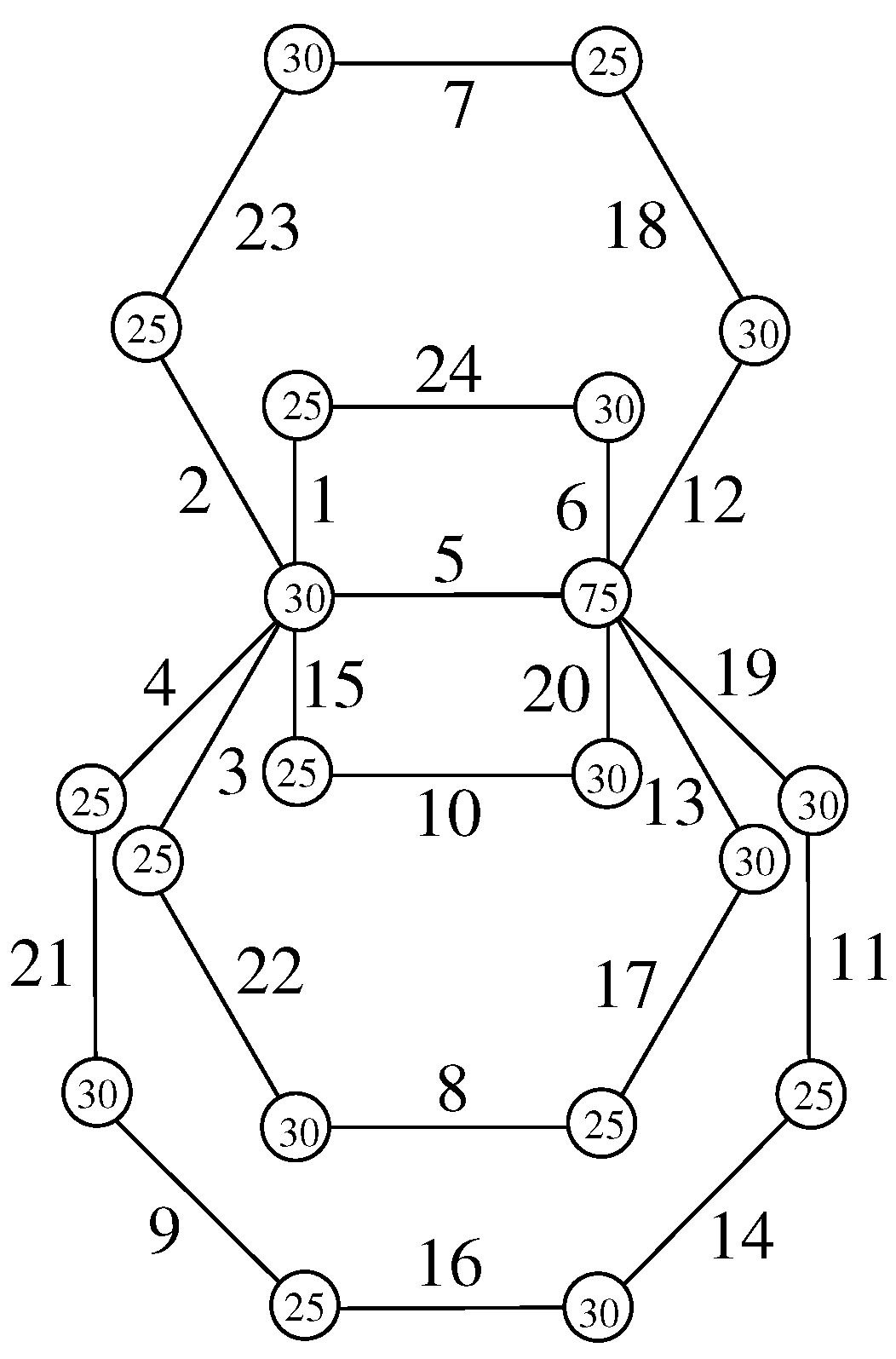
For , beginning and ending with central edges, the two 10-cycles have the consecutive labels 1, 24, 6, 19, 11, 14, 16, 9, 21, 4 and 2, 23, 7, 18, 12, 13, 17, 8, 22, 3, respectively, while the 4-cycle has the consecutive labels 5, 20, 10, 15, with and .
For , the two 10-cycles have the consecutive labels 1, 44, 11, 34, 21, 24, 31, 14, 41, 4 and 2, 43, 12, 33, 22, 23, 32, 13, 42, 3, respectively, while the three 8-cycles have the consecutive labels 5, 40, 15, 30, 25, 20, 35, 10; 6, 39, 16, 29, 26, 19, 36, 9 and 7, 38, 17, 28, 27, 18, 37, 8, respectively, with and .
Let , where , or , where r is odd. Let the core vertex u of G and all other vertices of even distance from u be black vertices, and let the remaining vertices be white vertices. For , we choose a white vertex of the i-th cycle of G, say , such that, at most, one of them is adjacent to u in G. We identify vertices to to obtain a new vertex v.
Observe that each obtained graph is
- (i)
- A -bridge graph with u and v as the only two vertices of degree ;
- (ii)
- Bipartite, with both partite sets of the same size, with (by Lemma 3).
Note that the new graph is either , where, at most, one of , , , is 1 and , or , where r is odd and, at most, one of , , , is 1, and . Clearly, these graphs are not in the list of Theorem 1.
Theorem 11.
For a simple graph or , .
Proof.
Consider graphs obtained by the transformation given above. If , , we immediately have a bipartite -bridge graph that induces a local antimagic 3-coloring with vertex labels and alternately beginning at vertex u, whereas vertex v has the label .
Similarly, if , and r is odd, we immediately have a bipartite -bridge graph that induces a local antimagic 3-coloring with vertex labels and alternately beginning at vertex u, whereas vertex v has the label . Thus, this labeling is a local antimagic 3-coloring. □
Example 8.
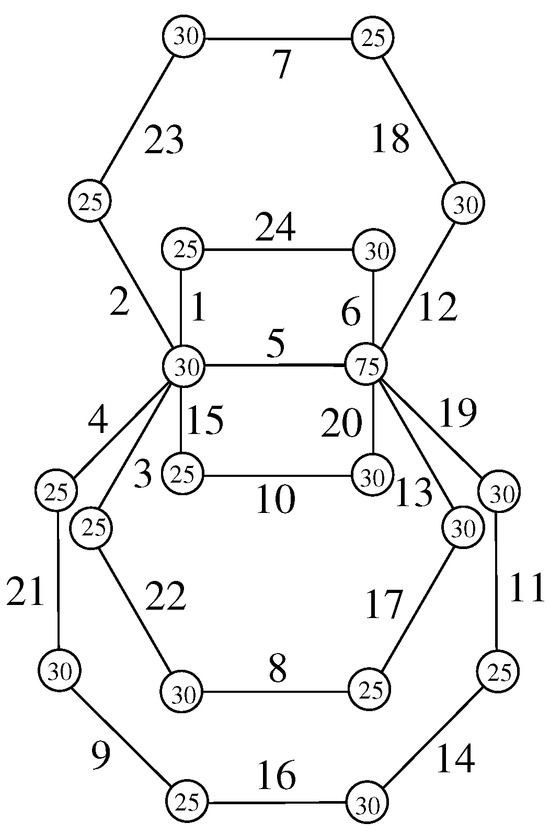
Suppose . Let , where , the distance between u and . We have . So, the bipartite 6-bridge graphs are , and , respectively. A local antimagic 3-coloring for with colors 25, 30, 75 is given in Figure 2.
Figure 2.
with a local antimagic 3-coloring.
Note that in transforming to -bridge graphs, if at least a black vertex and at least a white vertex are chosen, the -bridge graphs must be tripartite (in this paper, a tripartite graph means that the chromatic number of the graph is 3). Let the number of chosen black vertices be k, .
Theorem 12.
For even , there are infinitely many tripartite s-bridge graphs θ with .
Proof.
Consider the tripartite -bridge graphs obtained above. If , , we immediately have a tripartite -bridge graph that induces a local antimagic 3-coloring with vertex labels and alternately beginning at vertex u, whereas vertex v has the label . Similarly, if , and r is odd, we immediately have a tripartite -bridge graph that induces a local antimagic 3-coloring with the vertex labels and alternately beginning at vertex u, whereas vertex v has the label . Thus, . Since , the theorem holds. □
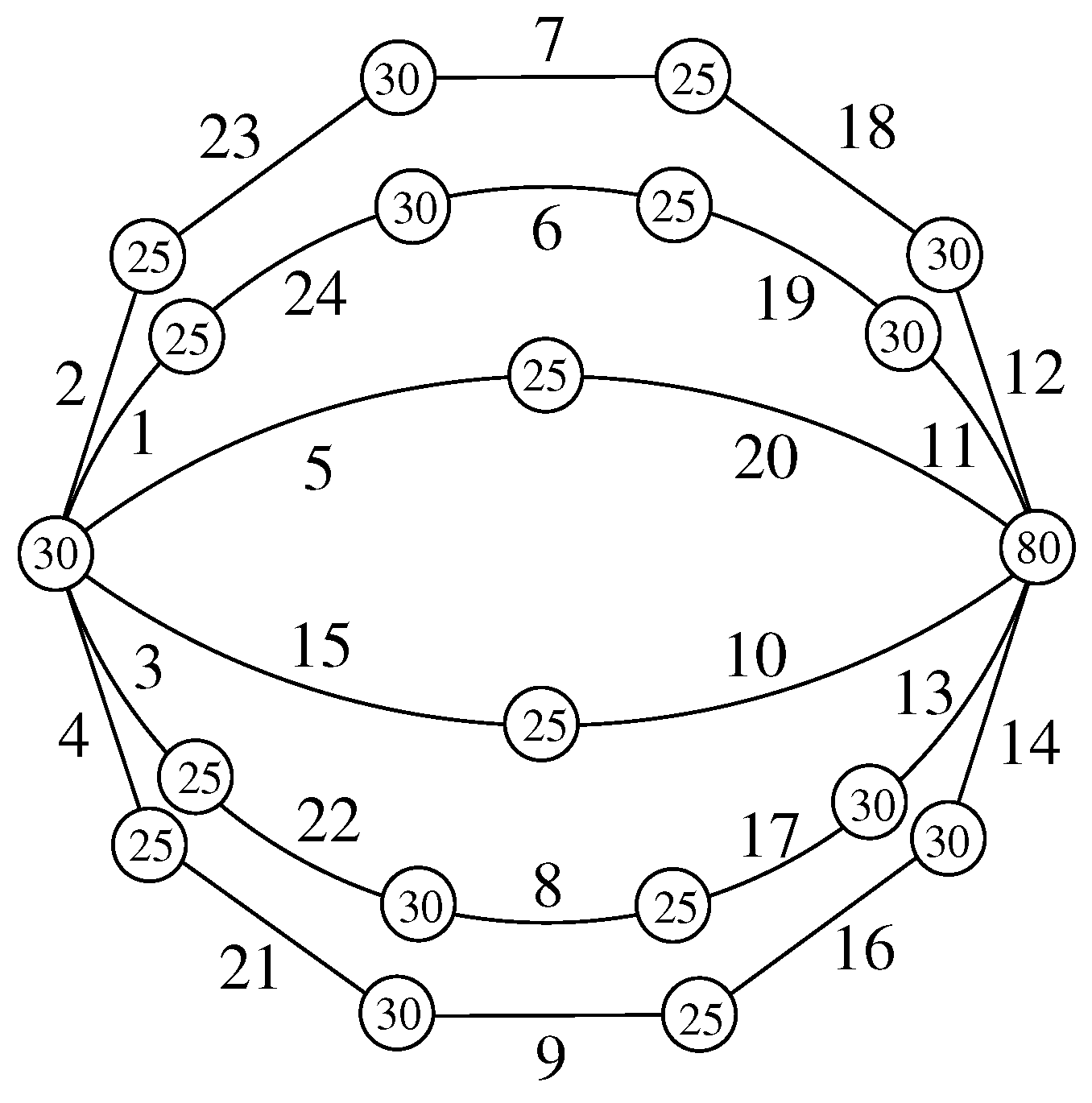
Example 9.
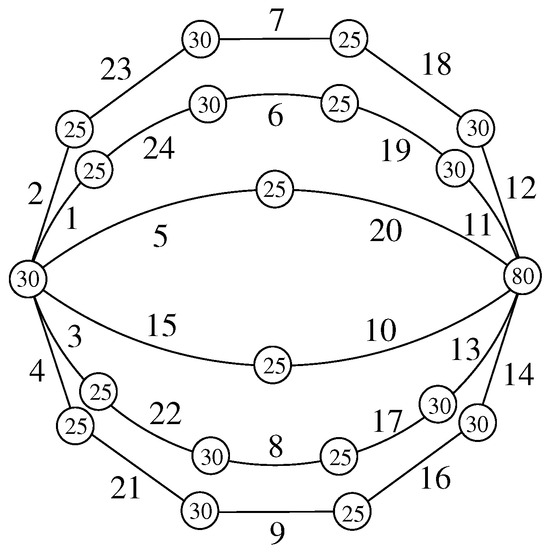
Suppose . Suppose that both , are odd, and is even, i.e., .
We must have . So, the tripartite 6-bridge graphs are , , , and , respectively. A local antimagic 3-coloring for with colors 25, 30, 80 is given in Figure 3.
Figure 3.
with a local antimagic 3-coloring.
5. Conclusions and Future Works
In this paper, we obtained many families of either bipartite or tripartite bridge graphs with local antimagic chromatic number 3. In [10], the authors proposed an application of local antimagic vertex coloring in optimizing factory workers’ work shift scheduling. A similar application using the idea of the local antimagic total labeling of a graph is given in [11]. With the development of science and technology, it is expected that local antimagic chromatic numbers can also have useful applications in the future.
Since no bridge graph with a local antimagic chromatic number greater than 3 is known, the following conjecture, which is partially supported by our results obtained herein, arises naturally.
Conjecture 1.
Every bridge graph not in Theorem 1 has local antimagic chromatic number 3.
Author Contributions
Conceptualization, W.-C.S., G.-C.L. and R.Z.; writing—original draft preparation, W.-C.S. and G.-C.L.; writing—review and editing, R.Z. All authors have read and agreed to the published version of the manuscript.
Funding
This research was funded by the National Natural Science Foundation of China (Grant Number 12101347) and Shandong Provincial Natural Science Foundation (Grant Number ZR2021QA085).
Data Availability Statement
The original contributions presented in the study are included in the article, further inquiries can be directed to the corresponding author/s.
Conflicts of Interest
The authors declare no conflicts of interest.
References
- Arumugam, S.; Premalatha, K.; Bača, M.; Semaničová-Feňovčíková, A. Local antimagic vertex coloring of a graph. Graphs Combin. 2017, 33, 275–285. [Google Scholar] [CrossRef]
- Nazula, N.H.; Slamin, S.; Dafik, D. Local antimagic vertex coloring of unicyclic graphs. Indonesian J. Combin. 2018, 2, 30–34. [Google Scholar] [CrossRef]
- Arumugam, S.; Lee, Y.C.; Premalatha, K.; Wang, T.M. Local antimagic chromatic number of trees-I. J. Disc. Math. Sci. Crypto. 2022, 25, 1591–1602. [Google Scholar]
- Lau, G.C.; Shiu, W.C.; Ng, H.K. On local antimagic chromatic number of cycle-related join graphs. Discuss. Math. Graph Theory 2021, 41, 133–152. [Google Scholar] [CrossRef]
- Lau, G.C.; Ng, H.K.; Shiu, W.C. Affirmative solutions on local antimagic chromatic number. Graphs Combin. 2020, 36, 1337–1354. [Google Scholar] [CrossRef]
- Lau, G.C.; Shiu, W.C.; Soo, C.X. On local antimagic chromatic number of spider graphs. J. Disc. Math. Sci. Crypto. 2022, 26, 303–339. [Google Scholar] [CrossRef]
- Shaebani, S. On local antimagic chromatic number of graphs. J. Algebr. Syst. 2020, 7, 245–256. [Google Scholar]
- Lau, G.C.; Shiu, W.C.; Zhang, R.; Premalatha, K.; Nalliah, M. Complete characterization of s-bridge graphs with local antimagic chromatic number 2. Vestn. Udmurt. Univ. 2024, 34, 375–396. [Google Scholar] [CrossRef]
- Bondy, J.A.; Murty, U.S.R. Graph Theory with Applications; MacMillan: New York, NY, USA, 1976. [Google Scholar]
- Muthumanickavel, G.; Nalliah, M. Optimizing factory workers work shifts scheduling using local antimagic vertex coloring. Contemp. Math. 2024, 5, 5621. [Google Scholar] [CrossRef]
- Utami, W.; Wijaya, K.; Slamin. Application of the local antimagic total labeling of graphs to optimise scheduling systerm for an expatriate assignment. J. Phys. Conf. Ser. 2020, 1538, 012013. [Google Scholar] [CrossRef]
Disclaimer/Publisher’s Note: The statements, opinions and data contained in all publications are solely those of the individual author(s) and contributor(s) and not of MDPI and/or the editor(s). MDPI and/or the editor(s) disclaim responsibility for any injury to people or property resulting from any ideas, methods, instructions or products referred to in the content. |
© 2024 by the authors. Licensee MDPI, Basel, Switzerland. This article is an open access article distributed under the terms and conditions of the Creative Commons Attribution (CC BY) license (https://creativecommons.org/licenses/by/4.0/).