

Abstract
New analytical formulas are derived for the rank and the local discrepancy of Farey fractions. The new rank formula is applicable to all Farey fractions and involves sums of a lower order compared to the searched one. This serves to establish a new unconditional estimate for the local discrepancy of Farey fractions that decrease with the order of the Farey sequence. This estimate improves the currently known estimates. A new recursive expression for the local discrepancy of Farey fractions is also given. A second new unconditional estimate of the local discrepancy of any Farey fraction is derived from a sum of the Mertens function, again, improving the currently known estimates.
MSC:
11B57
1. Introduction and Statement of Main Results
The Farey sequence of order is an ascending sequence of irreducible fractions between 0 and 1 whose denominators do not exceed n. These fractions are referred to as Farey fractions. An introduction and thorough reviews of the theory of Farey sequences can be found in [1,2,3,4], along with a few applications in [5,6]. Throughout this paper, we exclude the fraction from . For given and , is defined as the number of elements in within . We define as a subsequence of given by
and, therefore,
The local discrepancy of the Farey fraction in is defined as [7,8]
We also introduce the discrepancy , at the level of the Euler Totient function , such that the number of Farey fractions in lower than and with denominators equal to q is given by
and, therefore,
Note that is not necessarily an element of . The absolute discrepancy of the Farey sequence is generally defined as
It is important to recall an equivalent formulation of the Riemann Hypothesis (RH). The Franel–Landau formulation [9,10] is expressed as
This direct connection between local discrepancies and RH shows the importance of progressing in computing estimates of . The unconditional estimate of is not generally addressed in the literature, while has been evaluated to be in [7] and, therefore, using , we can write
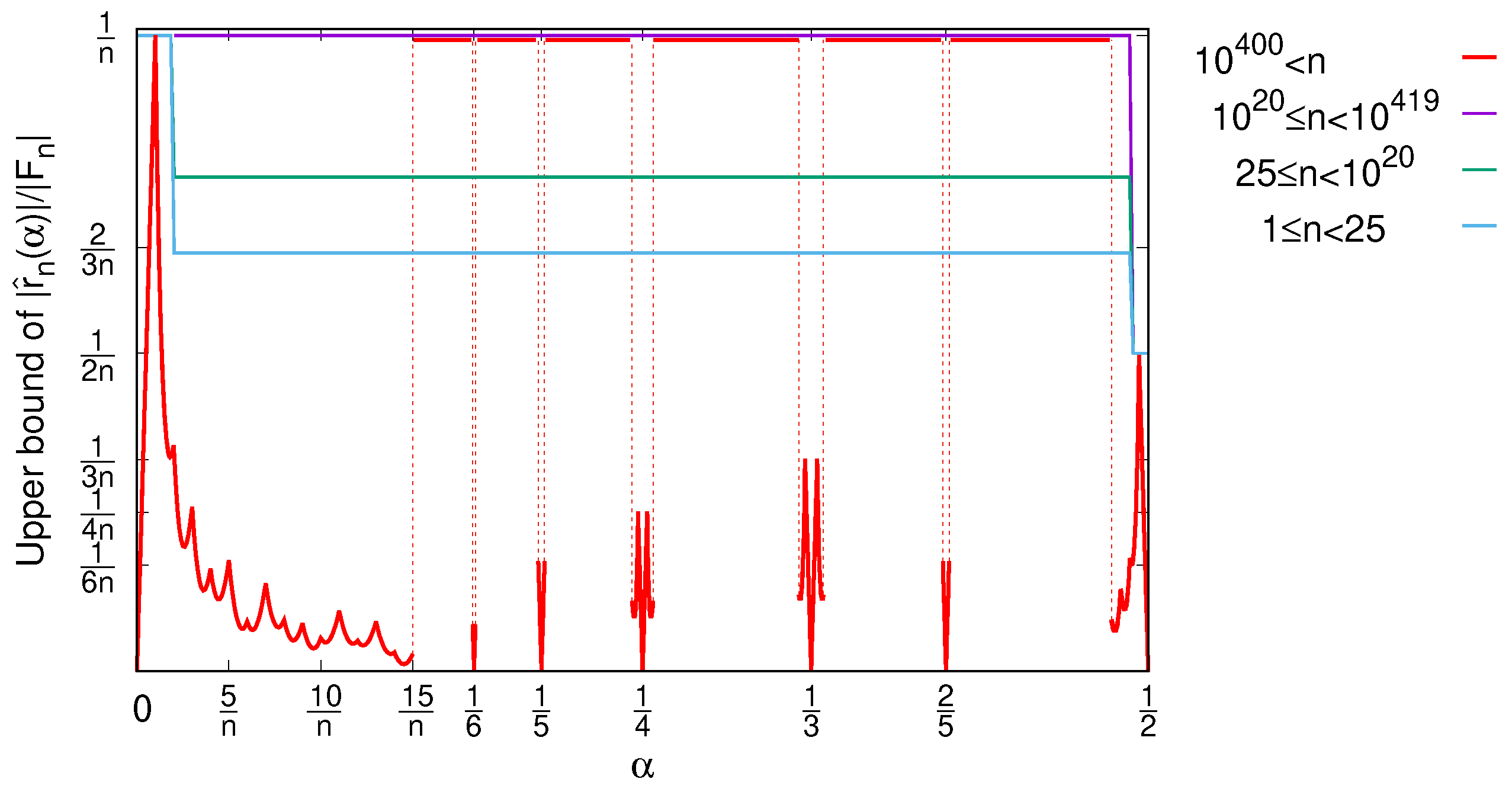
The absolute discrepancy of the Farey sequence was derived in [11] and found to be by finding an upper bound of an integral of the Mertens function. This result has been qualified as “most remarkable” in [12]. Figure 1 shows an illustration of the different bounds for the local discrepancies versus the corresponding Farey fraction for different ranges of n, as derived in [11].
Figure 1.
Illustration of the results in [11], showing the upper bounds of the local discrepancy of Farey fractions, , versus the Farey fractions in (without respecting the actual separation ratios in the horizontal axis). Note that the red curve for has been plotted using expression (2), while in [11] (page 361) tabulated values are given.
The following approximations are derived in [11] (page 361) for ,
where is the Totient summatory function and “” and “” are introduced in [11] to imply that the terms with relative influence below are neglected. Neither the validity range of these approximations for nor the estimates of the neglected terms are given in [11]. These approximations are only used for in [11] and, indeed, above this value of , the quantity in parenthesis in (2) can take negative values. For example, for , we would have , which does not hold.
Knowing the missing terms that complete the above approximations for any n and could lead to new bounds or estimates for the local discrepancies of Farey fractions. Partial developments in this direction are found in [13,14] for unit fractions. In Theorem 1 and Corollary 1, we develop new general expressions for and , obtaining, for ,
where is the Möbius funtion and represents the fractional part of x. This identity unexpectedly connects the discrepancy of in with the discrepancy of in . Furthermore, the new general identity (3) can be applied iteratively to for a finite number of steps, as is always a Farey fraction of a lower order than . This identity is used in Theorem 2 to derive a new unconditional estimate of for any , with , given by
where the function is a monotonic decreasing function defined as
This new unconditional estimate of improves the existing one, , from [7,11] for values that decrease with n.
In this work, we derive another unconditional estimate of . For later convenience, we define the local discrepancy with an offset as
In Theorem 3, we demonstrate that
with and , the fractional part with an offset defined as
Note that for being a Farey fraction and for any positive integers a and p, we have
Expression (4) can be used iteratively for an efficient calculation of as done, e.g., in [15], to compute . Applying the Möbius inversion formula to (4) and making further developments, the following two identities are also demonstrated in Theorem 3,
Theorem 4 establishes a second new unconditional estimate of the local discrepancy for a Farey fraction, , such that , with , as
It is important to note that this estimate includes the general case of being constant. Again, this unconditional estimate improves the existing one, , from [7,11] for Farey fractions with denominators that can grow sublinearly with the order of the Farey sequence and complements the estimate given in Theorem 2.
2. Results
Lemma 1.
The number of Farey fractions in with numerators equal to q for is given by
Proof.
Using Corollary 5 in [14], we determine the number of Farey fractions with numerators equal to q in as
To determine from , we need to compute the number of Farey fractions with numerators equal to q in . To this end, we define as
and a bijective map between and as
This implies that the number of Farey fractions with numerators equal to q in is the same as the number of Farey fractions with denominators equal to q in , that is . Furthermore, the image of under is given by
and the number of Farey fractions in with denominators equal to q and larger than is given by
Therefore,
□
Lemma 2.
The largest numerator among the Farey fractions in , with , is equal to or below .
Proof.
This is immediate from the fact that the largest denominator in is n and is the largest integer that fulfills . □
Theorem 1.
The rank of the Farey fraction in is given by
Proof.
Per Lemma 2, we obtain by adding for all ,
The desired result is achieved by using Lemma 1 in this relation. □
Corollary 1.
The local discrepancy of the Farey fraction in is given by
Proof.
This follows from the definition of the local discrepancy and Theorem 1. □
Theorem 2.
The unconditional estimate of the local discrepancy of the Farey fraction is given by
For , with , the estimate simplifies to the following expression,
Proof.
Recalling Theorem 1,
we proceed to provide estimates for the different terms in the right hand side of the above expression, assuming with and using known estimates from, e.g., [11,16,17] as follows:
with . Combining the above results we obtain the following relation,
For the sum with the Möbius function we establish the following estimate,
Combining the above estimates the desired result is obtained. For the case , we directly evaluate identity (8), obtaining
which is compatible with the formulation of the theorem and with the main result in [11]. □
Lemma 3.
For , h, and k integers fulfilling , and we have
Proof.
Subtracting we obtain
Since gcd, the fractional part takes different values for all and, therefore, we can establish the following bounds
□
Theorem 3.
with . Furthermore,
where is the Mertens function.
For , being a Farey fraction and b defined as , we have
and, by Möbius inversion, we also have
Proof.
represents the number of simple fractions of the form and below or equal with gcd. Therefore the sum over d,
gives the total number of fractions below or equal . This argument is commonly used, see, e.g., [15]. Developing the right hand side of the above of the Farey fractionn , we obtain
Inserting the following quantity,
in the above derivation gives
Since is defined as
we retrieve the desired result as follows:
Identity (11) is directly obtained by Möbius inversion and (12) is derived as follows,
with . Identity (12) is very similar to Formula (1) of [11] and to its further derivations within the proof of Lemma 4 in [11]. □
Corollary 2.
For any constant , we have
Proof.
By inspecting estimate (9) for the case with constant , we realize that the largest growing term, the sum with the Möbius function, must have the same asymptotic behavior as the second largest term, , so that their sum can result in the known estimate, , on the left hand side. □
Theorem 4.
The unconditional estimate of the local discrepancy of the Farey fraction is given by
for .
For the case , with , the second O term can be neglected and the estimate is given by
Proof.
Let us start from the expression (12) of the local discrepancy of the Farey fraction given in Theorem 3
Splitting the sum in (13) in two parts at for any such that gives
For any monotonically increasing function in the range , with , we have
for any . Since for , see [17], we establish the following estimate for the first sum in the right hand side of inequality (14) as
where we have used that
as demonstrated in Lemma 4.
The second sum in the r.h.s of (14) can be bounded as
where we have used the fact that for every there exists one such that
The set J is a subset of such that the map A
is bijective. The second sum in the r.h.s of Expression (15) includes the elements that cannot be paired when and accepts the following bound,
where we have used that , for all x.
Lemma 4.
For any , we have
Proof.
This is demonstrated using the following derivative,
and therefore,
The factor in the denominator inside the O term can be neglected for large x. □
3. Discussion
We have developed new exact formulas for the rank and discrepancy of Farey fractions using an interesting technique based on a bijection between Farey subsequences. These formulas complete an approximation presented in the classical paper [11]. It is remarkable that this formula, see Corollary 1, connects the local discrepancy of two different Farey fractions, namely and . As a curiosity, the largest solution of the equation is the fractional part of the Golden ratio, , which is not a Farey fraction. These new formulas are used to compute a new estimate of the local discrepancy in Theorem 2 that improves the currently known estimates.
The new notation introduced in this work, namely the discrepancy with an offset and the fractional part with the same offset , simplifies the known formula and has helped in the development of the new formulas for in Theorem 3. These are the basis for the development of the second new estimate of in Theorem 4. The new and previous estimates of , or equivalently , are put together in the following expression:
with , , and . The cases where or remain with the known estimate from [7]. For the cases or , the new unconditional estimates of are sublinear in n. Theorem 4 applies to being constant.
The Fanel–Landau formulation of the Riemann Hypothesis is expressed as
The known estimate , for all in , implies that
which is far from . For the RH to be true, would need to be for most of the Farey fractions in . The new sublinear estimates of in Theorems 2 and 4 go in the direction of the RH, but further developments would be needed for a significant improvement.
Funding
This research received no external funding.
Data Availability Statement
Data are contained within the article.
Conflicts of Interest
The author declares no conflicts of interest.
References
- Cobeli, C.; Zaharescu, A. The Haros-Farey sequence at two hundred years. A survey. Acta Univ. Apulensis. Math. Inform. 2003, 5, 1–38. [Google Scholar]
- Hardy, G.H.; Wright, E.M. An Introduction to the Theory of Numbers, 5th ed.; Oxford Science Publications: Docklands, Australia, 1996. [Google Scholar]
- Kanemitsu, S.; Yoshimoto, M. Farey series and the Riemann hypothesis. Acta Arith. 1996, 75, 351–374. [Google Scholar] [CrossRef]
- Matveev, A.O. Farey Sequences: Duality and Maps Between Subsequences, 1st ed.; De Gruyter: Berlin, Germany; Boston, MA, USA, 2017; ISBN 978-3110546620. [Google Scholar]
- Khoshnoudirad, D. Farey lines defining Farey dia-grams and application to some discrete structures. Appl. Anal. Discrete Math. 2015, 9, 73–84. [Google Scholar] [CrossRef]
- Tomás, R. From Farey sequences to resonance dia-grams. Phys. Rev. ST Accel. Beams 2014, 17, 014001. [Google Scholar] [CrossRef]
- Niederreiter, H. The Distribution of Farey Points. Math. Ann. 1973, 201, 341–345. [Google Scholar] [CrossRef]
- Codecà, P. Alcune Proprietà della Discrepanza Locale delle Sequenze di Farey; Atti della Accademia delle Scienze dell’Istituto di Bologna. Classe di Scienze Fisiche. Anno 269 rendiconti serie XIII, tomo VIII, 1980–1981, fasc.I/II; Tipografia Compositori: Bologna, Italy, 1980. [Google Scholar]
- Franel, J. Les suites de Farey et le problème des nom-bres premiers. Göttinger Nachrichten 1924, 1924, 198–201. [Google Scholar]
- Landau, E. Bemerkungen zu der vorstehenden Abhandlung von Herrn Franel. Göttinger Nachrichten 1924, 1924, 202–206. [Google Scholar]
- Dress, F. Discrépance des suites de Farey. J. Théorie Des Nr. Bordx. 1999, 11, 345–367. [Google Scholar] [CrossRef]
- Ledoan, A.H. The discrepancy of Farey series. Acta Math. Hung. 2018, 156, 465–480. [Google Scholar] [CrossRef]
- Tomás, R. Partial Franel Sums. J. Integer Seq. 2022, 25, 22.1.5. [Google Scholar]
- Tomás, R. Number of Farey fractions with equal numerators and the rank of unit fractions. Integers 2024, 26, 014001. [Google Scholar]
- Pawlewicz, J.; Pătraşcu, M. Order Statistics in the Farey Sequences in Sublinear Time and Counting Primitive Lattice Points in Polygons. Algorithmica 2009, 55, 271–282. [Google Scholar] [CrossRef][Green Version]
- Kanemitsu, S.; Kuzumaki, T.; Yoshimoto, M. Some sums involving Farey fractions II. J. Math. Soc. Jpn. 2000, 52, 125–142. [Google Scholar] [CrossRef]
- Walfisz, A. Weylsche Exponentialsummen in der Neueren Zahlentheorie, Mathematische Foschungsberichte; VEB Deutscher Verlag der Wissenschaften: Berlin, Germany, 1963; Volume 15, p. 191. [Google Scholar]
Disclaimer/Publisher’s Note: The statements, opinions and data contained in all publications are solely those of the individual author(s) and contributor(s) and not of MDPI and/or the editor(s). MDPI and/or the editor(s) disclaim responsibility for any injury to people or property resulting from any ideas, methods, instructions or products referred to in the content. |
© 2025 by the author. Licensee MDPI, Basel, Switzerland. This article is an open access article distributed under the terms and conditions of the Creative Commons Attribution (CC BY) license (https://creativecommons.org/licenses/by/4.0/).


