1. Introduction
A characteristic of a graph that is preserved under graph isomorphism is commonly referred to as a graph invariant [
1]. In chemical graph theory, graphical invariants that take numerical quantities are usually named topological invariants, or simply, topological indices. Zagreb indices, particularly the first and second Zagreb indices denoted by
and
, respectively, belong to well-examined categories of topological indices. Initially, they appeared in connection with the study molecules [
2,
3]. These indices can be defined as
where
is an edge between the vertices
u and
v, while
is the degree of the vertex
x. Some information about the chemical applications of
and
can be found in [
4,
5]. These indices have also been the subject of extensive research into their relationship, comparison, and other mathematical properties [
6,
7,
8,
9,
10,
11,
12,
13,
14]. Many existing facts of the Zagreb indices can be found in survey papers [
15,
16,
17,
18,
19].
In 2010, Todeschini et al. [
20] proposed to consider the multiplicative versions of topological indices. The multiplicative versions of
and
are defined [
21] as follows:
Bozovic et al. [
22] discussed extreme values of multiplicative Zagreb indices for chemical trees. Wang et al. [
23] examined the extremum multiplicative Zagreb indices of trees with a specific number of vertices and maximum degree. Further mathematical features of these two multiplicative indices can be found in [
21,
24,
25,
26,
27,
28,
29,
30,
31].
In 2012, Eliasi et al. [
25] introduced a modification of the multiplicative first Zagreb index known as the multiplicative sum Zagreb index [
32]. The mathematical formulation of the multiplicative sum Zagreb index is as follows:
In [
25], it was shown that the path has the least
-value across all connected graphs with the specified order. The trees achieving the second least
-value were also determined in [
25]. Xu and Das [
31] described the extremal trees, unicyclic graphs and bicyclic graphs of a specified order with respect to
. Azari and Iranmanesh [
33] established bounds on
for graph operations. Further mathematical features of
can be found in [
27,
34].
The focus of this work is strictly on the mathematical structure of chemical graphs. (Such graphs have found applications in chemistry; see, for example, the recent article [
35]). More precisely, in this study, graphs possessing the greatest
-values are determined from the class of chemical trees with a given order and fixed number of segments. The
-values of the obtained extremal trees are also obtained.
2. Preliminaries
In this section, some definitions as well as notations used in this paper are given. Undefined terminology from graph theory can be found in some standard books. The graphs under discussion here are simple, undirected, and finite. The degree of a vertex
v is represented by
. The distance between two vertices
u and
v is denoted by
. A tree of maximum degree at most four is called a chemical tree. The notion ∣
A∣ represents the cardinality of the set
A. Consider a non-trivial path
in a tree such that
and
. If
, then every vertex of
different from vertex
and
is called an internal vertex of
. The path
is referred to as an internal path if
provided that all internal vertices have degree 2 (if exist). Furthermore, the path
is an external path if one of the two numbers
is equal to 1 and the other has a value greater than 2 provided that all internal vertices have degree 2 (if exist). A branching vertex in a tree is a vertex with a degree greater than 2. If
S is an external path or an internal path in a tree
G, then
S is called a segment of the graph
G. We call the path graph
of order
n also a segment of
. Thus, a path graph has only one segment and there is no graph with exactly two segments. Let
denote the class of all chemical trees with exactly
n vertices and
s segments, where
. Let
be the degree sequence of a graph
G. Define
. For a chemical tree
G, we write (for the sake of simplicity) the degree sequence of
G as
For example, if a chemical tree has the degree sequence
then we write it as
. Let
be the set of neighbors of the vertex
. In a graph
G, let
(or simply
, when there is no confusion about
G) be the set of edges of
G with end vertices of degrees
i and
j. Certainly,
. For
, define
.
3. Main Results
Before proceeding to our main results, we give some crucial lemmas that provide some useful information on obtaining the greatest possible value of the multiplicative sum Zagreb index for trees belonging to the class .
Lemma 1. For a chemical tree with maximum multiplicative sum Zagreb index, the following statements are true:
- (a)
If then ,
- (b)
If then ,
- (c)
If there is an internal path of the form in of length 1, then there is no internal path of the form in , with , having length larger than 1.
- (d)
If a path , with , contains an internal vertex of degree four then .
- (e)
The graph does not possess an internal path having a length of 1 and an internal path having a length larger than 2 simultaneously.
- (f)
If has exactly two vertices of degree 3 then does not possess simultaneously the internal paths and both of length 1.
Proof. Throughout this proof, whenever the degree notion is used, it represents the degree of a vertex in the graph .
- (a)
If then there must be a vertex, say , of degree two laying on an external path of where , , and . Since , has another branching vertex, say (), which forms an internal path in the graph . Let be the neighbor of that lies on the path (the vertex may coincide with ).
Now, we consider a tree
that can be found in the class
and is obtained from
by the following operation:
There exists a positive real number
such that these two graphs satisfy the following:
Since
and
, Equation (
1) yields
, a contradiction.
- (b)
Assume that the hypothesis holds but the conclusion does not hold; that is, suppose that the inequality ∣
holds. Let
v denotes the only branching vertex in
(as
) with two distinct external paths
and
, each one having length of at least 2. Now, a new tree
is constructed from
using the following operation:
This operation emphasizes that
. There is
such that
Since
, Equation (
2) gives
, a contradiction.
- (c)
Assume contrarily that
possesses an internal path of the form
of length larger than 1, such that
. Suppose that
and
, where
and
. Then, a tree
is considered that is obtained using the following operation:
There is a number
, such that
The following possible cases are discussed next:
: .
In this case,
. Thus,
and consequently, Equation (
3) gives
a contradiction.
: Either and or and .
In this case,
. Thus,
and consequently, Equation (
3) gives
a contradiction again.
In both possible cases, we arrive at
a contradiction because of our contrary assumption that
possess an internal path of the form
of length larger than 1, such that
.
- (d)
Contrarily, assume that . Then, there exists , such that and . Let be a path with an internal vertex of degree 4, such that . Without loss of generality, suppose that is the only internal vertex on ; otherwise, we may consider a subpath of containing exactly one internal vertex of degree 4, such that . The following cases are to be discussed here:
:
If
, then we assume that
is a neighbor of
not lying on the path
; otherwise, we assume that
is a neighbor of
lying on the
path. Whether
z lies on
or not, in either of the two cases, we define a new graph as follows:
Note that the tree
belongs to the collection
. Whether
z lies on
or not, in either of the two cases, there exists a positive real number
, such that
which is a contradiction.
: .
In this case, we consider a tree
obtained using the operation described as follows:
Whether
z lies on
or not, in either of the two cases, there exists a positive real number
, such that
Note that there are the following three possibilities concerning the degrees of the vertices and :
- –
and ,
- –
and ,
- –
.
In every case, Equation (
4) gives
a contradiction.
- (e)
Although the proof of this part is slightly different from that of part (c), we provide its proof here for the sake of completeness. Assume contrarily that
simultaneously possesses an internal path
of length
and an internal path
of length 1, where
. Then, a tree
is considered that is obtained using the following operation:
There is a number
, such that
Since
and
, Equation (
5) provides
a contradiction.
- (f)
Assume contrarily that possesses simultaneously the internal paths and both of length 1. Let , such that , the distance is minimum, and . Note that y and u lie on the unique path. Let be the neighbor of y lying on the path. By part (c), the degree of is 4.
First, we discuss the case when
. Consider a tree
that is obtained using the following operation:
Then, we obtain , a contradiction.
Next, consider the case when
. Then,
has a neighbor, say
, of degree 2 lying on the
path. Let
be the neighbor of
lying on the
path. The vertices
and
u may be the same. By part (e),
. Now, consider a tree
that is obtained using the following operation:
Certainly,
. Now, define
Then, and , which yields a contradiction again.
□
If we consider the class for , then we note that consists of exactly one element for every . For with , we have the next result, which follows from Lemma 1(b).
Corollary 1. The graph constructed by attaching pendent vertices to a single pendent vertex of the path possesses uniquely the greatest multiplicative sum Zagreb index in for every with . The mentioned greatest value is .
Because of Corollary 1, in the rest of the current section, we focus on the case when for the class . To prove our next lemma, we need the following existing result:
Lemma 2 ([
36]).
For every graph , the following statements holds:- (a)
The equation holds if and only if , , , for some positive integer t.
- (b)
The equation holds if and only if , , , for some positive integer t.
- (c)
The equation holds if and only if , , for some positive integer t.
Lemma 3. Let be a chemical tree with maximum multiplicative sum Zagreb index and t be a positive integer. Then, Proof. Throughout this proof, whenever the degree notion
is used, it represents the degree of a vertex
in the graph
. First, we show that
. We suppose on the contrary that the inequality
holds. Take
, such that
. If all these three vertices are on one path, then (without loss of generality) suppose that
q lies on the unique
path in
. In either of the two cases, suppose that
is the set of neighbors of
r with the condition that
is located on
path (
may coincide with
q). Now, a chemical tree
is obtained in the collection
using the following operation:
For the case when all the three vertices
are on one path, see
Figure 1.
Note that there is a real number
, such that
Since
, inequality (
6) yields
a contradiction. Hence, the inequality
holds, which together with Lemma 2 gives the required result. □
We now define three subclasses of as follows when and for some integer :
.
consists of those members of that obey and and .
consists of those members of that obey and .
Three examples
,
, and
, one from each of the classes
,
, and
, respectively, are depicted in
Figure 2.
Theorem 1. Let be a chemical tree with maximum multiplicative sum Zagreb index such that and for some integer . Then .
Proof. By Lemma 3, it holds that . If then and we are done. If then Lemma 1(a) confirms that . Now, the conclusion is obtained from Lemma 1(e). □
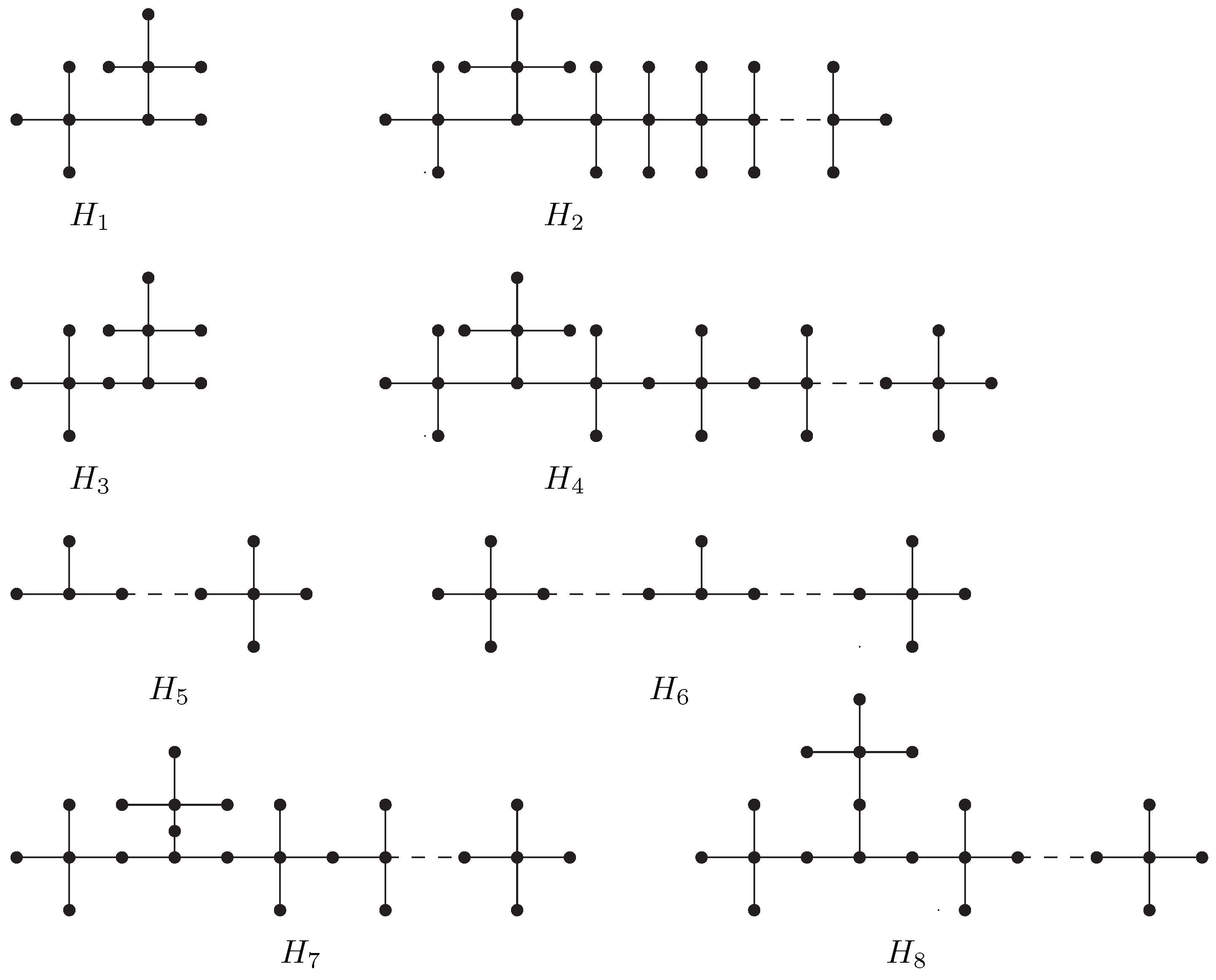
Next, we define five subclasses of as follows when and for some integer :
, where
is given
Figure 3.
, where
is shown
Figure 3.
. For example, the graphs
and
given in
Figure 3 belong to
.
. For example, the graph
given in
Figure 3 belongs to
.
,
. For example, the graph
given in
Figure 3 belongs to
.
Theorem 2. Let be a chemical tree with maximum multiplicative sum Zagreb index such that and for some integer . Then .
Proof. By Lemma 3, it holds that . If then Lemma 1(a) implies that . If , then by the parts (a), (d), and (e) of Lemma 1, we have . If (i) and , or (ii) and , or (iii) and , then by the parts (a), (c), (d), and (e) of Lemma 1, we conclude that , or , or , respectively. □
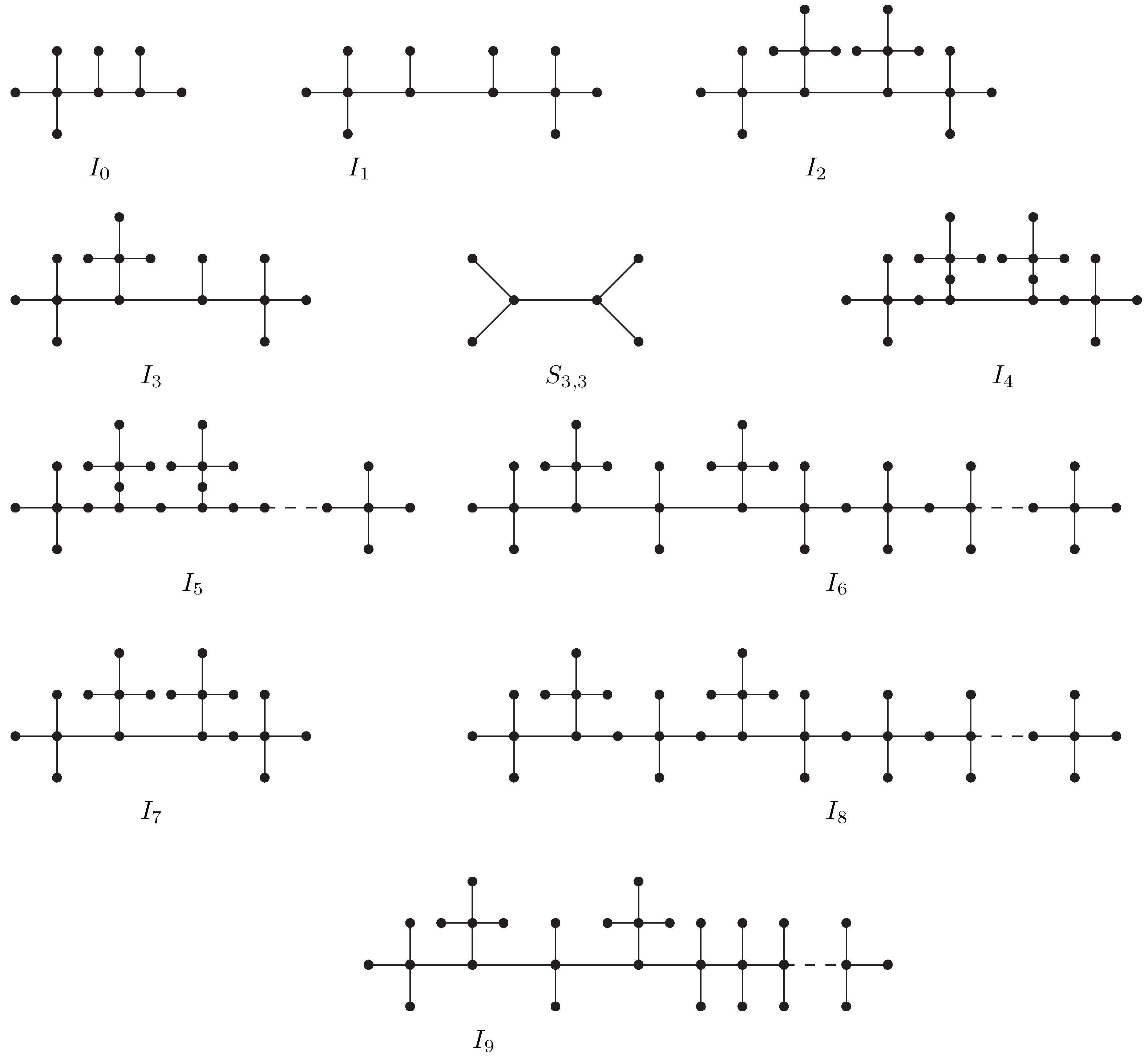
We next define six subclasses of as follows when and for some integer :
.
,
. For example, the graphs
and
given in
Figure 4 belong to
.
,
. For example, the graph
depicted in
Figure 4 belongs to
.
,
. For example, the graph
given in
Figure 4 belongs to
.
,
,
. For example, the graph
shown in
Figure 4 belongs to
.
, , .
Theorem 3. Let be a chemical tree with the greatest multiplicative sum Zagreb index such that and for some integer . Then .
Proof. By Lemma 3, it holds that . If then Lemma 1(a) implies that . If (i) and , or (ii) and , or (iii) and , or (iv) and , or (v) and , then by Lemma 3, we conclude that , or , or , or , or , respectively. □
Theorem 4. Let be a chemical tree with maximum multiplicative sum Zagreb index such that for some integer . Then, Proof. The following cases arise:
:
By using the above degree sequence of
, we have
. Thus, in this case,
consists of vertices of degree 4 and 1 only. Consequently, we have
and
. Hence,
: .
Note, in this case, that
. By keeping in mind Lemma 1, we obtain
: .
Note, in the present case, that
. Bearing in mind Lemma 1, we obtain
□
Theorem 5. Let be the chemical tree with maximum multiplicative sum Zagreb index such that for some integer . Then, Proof. : .
In the present case, it holds that . We discuss two possible subcases of the present case as follows:
: .
Note, in the present subcase, that
. Since
in the consider case, if
then Equation (
7) yields
and hence
. Thus,
is the graph constructed by attaching two new pendent vertices to a pendent vertex of the star
. Similarly, if
, then Equation (
7) gives
and hence
. Thus, by Lemma 1(e),
is the graph
depicted in
Figure 3. Hence, if
, then
Therefore,
: .
Note, in the present subcase, that
. Recall also that
in the present case. By Lemma 1(d), every neighbor of the unique vertex of degree 3 in
is of degree 4; for example, see
in
Figure 3. Hence,
Therefore,
: .
Observe, in the current case, that . In the following, we discuss two subcases according to whether or .
: .
Observe that
. If
, then
and hence by Equation (
7), we have
Thus, by Lemma 1,
is a particular case of
shown in
Figure 3. If
then
, and by Equation (
7), we have
If
then, by Lemma 1,
is the graph
depicted in
Figure 3. If
then, again by Lemma 1,
is the graph constructed from
by inserting a vertex of degree 2 on its unique internal path of length 1. Thus, all possible non-zero values of
are given as follows:
: .
Observe, in the current subcase, that and .
: and
Note that
that is,
. Hence, by Lemma 1, every internal path of the form
(in
) has length 2, and its unique vertex of degree 3 is adjacent to
vertex/vertices of degree 4; for example, consider a graph constructed from the graph
(shown in
Figure 3) by inserting a vertex of degree 2 on each of the
internal path(s) of the form
. Hence, the possible non-zero values of
of
are given as follows:
: and .
Observe, in the current subcase, that
. Note that
that is,
. Hence, by Lemma 1,
internal path(s) of the form
in
has/have length 2; for example, consider a graph constructed from the graph
(shown in
Figure 3) by inserting a vertex of degree 2 on each of the
internal path(s) of the form
. Hence, the possible non-zero values of
are given as follows:
: .
In the following, we discuss subcases for the current case.
: .
Observe, in the present subcase, that
. If
then
, and Equation (
7) yields
Thus, by Lemma 1,
is of the form
given in
Figure 3.
If
then
, and Equation (
7) gives
Thus, by Lemma 1,
is a graph constructed from
(given in
Figure 3) by inserting at least one vertex of degree 2 on each of two internal paths of length 1.
Hence, for
, the possible non-zero values of
are given as
: .
Since
, we have
Thus, by Lemma 1, every internal path of
has a length of at least 2; for example, consider a graph constructed from
(given in
Figure 3) by inserting at least one vertex of degree 2 on some internal path(s). Hence, all possible non-zero values of
are as follows:
Consequently, the proof is now completed. □
Theorem 6. Let be a chemical tree with maximum multiplicative sum Zagreb index such that for some integer . Then Proof. By Lemma 3, it holds that
: .
Certainly, in the current case, . The following subcases are further discussed:
: .
Here,
and hence
. Now, Equation (
8) gives
Because of Lemma 1,
is isomorphic to
,
,
,
, or
when
is equal to
,
,
,
, or
, respectively. Hence, all possible non-zero values of
are as follows:
: .
Clearly,
. By Lemma 1, all possible non-zero values of
in
(for example, see
shown in
Figure 4) are as follows:
: .
In this case, we have . The following subcases are further considered:
: .
Note, in the current subcase, that
. By Lemma 1, the graph
is constructed by inserting
vertices of degree 2 on the internal path of the graph
shown in
Figure 4. Hence, all possible non-zero values of
are mentioned below:
: and .
Note here that
and hence
belongs to the set
Now, Equation (
8) gives
Because of Lemma 1,
is isomorphic to a graph constructed from
,
,
, or
by inserting one vertex of degree 2 on each of the
internal path(s) of the form
. Hence, all possible non-zero values of
are as follows:
: and .
By Lemma 1,
is isomorphic to a graph constructed from
,
,
, or
by inserting at least one vertex of degree 2 on each its internal path(s). Hence, all possible non-zero values of
are as follows:
: and .
Note, in the current subcase, that
and
. (If
then we obtain
, a contradiction.) Also, note that
Thus, by Lemma 1, all possible non-zero values of
are as follows (for example,
may be a graph constructed from
(shown in
Figure 4) by inserting a vertex of degree 2 on each of its
internal path(s) of the form
):
: and .
In the current case, observe that
. Also, note that
that is,
. Thus, by Lemma 1, all possible non-zero values of
are as follows (for example,
may be a graph constructed from
(shown in
Figure 4) by inserting one vertex of degree 2 on each of its
internal path(s) of the form
):
: and .
Observe, in the current subcase, that
Thus, by Lemma 1, all possible non-zero values of
are as follows (for example,
may be a graph constructed from
(shown in
Figure 4) by inserting at least one vertex of degree 2 on each of its internal paths:
□