1. Introduction
In this paper, we only consider simple and undirected graphs. For a graph , we use and to represent the sets of vertices and edges of G, respectively. We use to represent the degree of a vertex , that is, the number of neighbors of v in G. If for any , then the graph G is called an r-regular graph. For a vertex , let and denote the open neighborhood and the closed neighborhood of v, respectively. The maximum degree and minimum degree of G are denoted by and , respectively. When no confusion can arise, , , , and are simplified by , , , and , respectively. A plane graph is a graph drawn in the plane such that its edges intersect only at their ends; a planar graph is a graph that can be drawn as a plane graph.
Let G be a graph. A (proper) k-coloring f of G is a mapping from to such that for any . Hence, a k-coloring can be regarded as a partition of , where denotes the set of vertices assigned color i, and is called a color class of f, where . If a graph G admits a k-coloring, the G is called k-colorable. The minimum number k such that G is k-colorable is called the chromatic number of G and is denoted by .
Let f be a k-coloring of a graph G. If a vertex has all colors in its closed neighborhood under f, namely , then the vertex v is called colorful with respect to f. Furthermore, the coloring f is called colorful whenever each of its color classes contains at least one colorful vertex. The maximum order of a colorful coloring of a graph G is called the b-chromatic number of G, and is denoted by . A fall k-coloring of a graph G is a k-coloring of G such that every vertex is colorful.
The problem of b-chromatic numbers was introduced by Irving and Manlove in 1999 [
1] and studied extensively in the literature (see the survey in [
2]), whereas fall coloring was introduced in [
3] and studied in [
4,
5,
6]. It follows from [
6] that fall coloring strongly chordal graphs is doable in polynomial time, even with an unbounded number of colors.
A
dominating set in a graph
G is a subset
such that each vertex in
is either in
S or has at least one neighbor in
S. If
S is a dominating set and independent, then
S is an independent dominating set (IDS) of
G. The independent domination number
is the minimum cardinality of an IDS of
G. A graph
G has a fall
k-coloring if and only if
can be partitioned into
k independent dominating sets [
7].
Note that a graph may have no fall coloring. For instance, the cycle
has a fall coloring only when
n is a multiple of three or is even [
3]. Hence, determining which graphs are fall-colorable is an interesting problem. In fact, in 1976 Cockayne and Hedetniemi [
7] first studied fall-colorable graphs but used another term,
indominable graphs. They found several families of graphs which have fall colorings.
In this paper, we further discuss fall-colorable graphs. First, the size of a k-colorable graph is determined, including the boundaries. Then, a sufficient condition of a graph to be k-colorable () is proposed and the tightness of this condition is discussed. Moreover, we give a simple proof for an NP-hard result of determining whether a graph is fall k-colorable, where . Finally, we show that there exist an infinite family of fall k-colorable planar graphs for and find some sufficient conditions for a maximal planar graph to be fall-colorable.
For other notations and terminologies in graph theory, we refer to [
8].
2. Some Properties of Fall-Colorable Graphs
In this section, we discuss some properties of fall
k-colorable graphs. The following, Lemmas 1 and 2, can be obtained straight from previous studies, such as [
3,
7].
Lemma 1 ([
3]).
Let G be a fall k-colorable graph and f a fall k-coloring. We have the following:(i) ;
(ii) The subgraph induced by the union of any r color classes under f is fall r-colorable, where .
Lemma 2 ([
7]).
A graph G is fall k-colorable if and only if G has a k-coloring such that the subgraph induced by the union of any two color classes has no isolated vertices. Theorem 1. Let G be a fall k-colorable graph of order n. Then,where and . Proof. Let
be a fall
k-coloring of
G and
, where
. Then,
. Without a loss of generality, we assume that
. For any two color classes
and
with
, by Theorem 2, we know that the subgraph
induced by
has no isolated vertices. Since
is a bipartite graph, we have
. Hence,
Now, we prove that if is the minimum then is an equitable partition of , namely , for any .
Suppose, to the contrary, that
is not an equitable partition of
. Then, there exists
such that
or
with
such that
. If the former occurs, let
,
, and
for any
. Then,
However, this contradicts the minimality of
.
If the latter occurs, let , , and for any . Similar to the former case, we can obtain , which is a contradiction. Therefore, if is a minimum then is an equitable partition of .
Let
, where
and
. Now, we consider the case of
as the minimum. Note that
. It therefore follows that
and
. Hence,
Together with Formulae (
1) and (
2), we have
□
Theorem 2. For any fall k-colorable graph G with order n, if G is -regular, then . Moveover, for any fall k-coloring f of G, each color class of f has exactly vertices.
Proof. Let be any color class of the fall k-coloring f of G. Then, for any two vertices u and v in ; we can obtain . Otherwise, if there exists a vertex , since G is -regular, we can deduce that x is adjacent to at most color classes, which implies that x is not a colorful vertex of f; this is a contradiction. Let . Then, is a t-partition of . Since for each , we have and so . Note that , we can discover that each color class of f has exactly vertices. □
3. A Sufficient Condition
In 2010, Balakrishnan and Kavaskar [
9] showed that any graph
G with
admits a fall coloring. In this section, we improve this result by relaxing the condition
to
for any
and prove that the condition of
is the best possible. First, we give a useful lemma obtained by Zarankiewicz [
10]:
Lemma 3 ([
10]).
Let G be a k-colorable graph with n vertices and , where . We have . Theorem 3. Let G be a k-colorable graph with n vertices and , where . Then, G is fall k-colorable.
Proof. If , then and G has no isolated vertices. Hence, G is fall 2-colorable.
Now, assume that
. Let
v be an arbitrary vertex of
G and
be the subgraph of
G induced by
. Then,
. Hence, for any vertex
x in
, we have
Note that G is k-colorable, so is -colorable. Hence, by Lemma 3, we can see that , which yields that for any k-coloring f of G. That is to say, v is a colorful vertex with respect to f. Since v is an arbitrary vertex of G, we can deduce that f is a fall k-coloring of G. Hence, the graph G is fall k-colorable. □
Now, we show that the condition in Theorem 3 is the best possible. We will construct a family of graphs that are not fall k-colorable, , with .
We use to denote the complete graph of order n and use to denote the complete r-partite graph with s vertices in each class, where . The join of two graphs G and H, denoted as , is the graph obtained from the disjointed union of G and H, and we add edges joining every vertex of G to every vertex of H.
For any
and
, let
,
,
, and
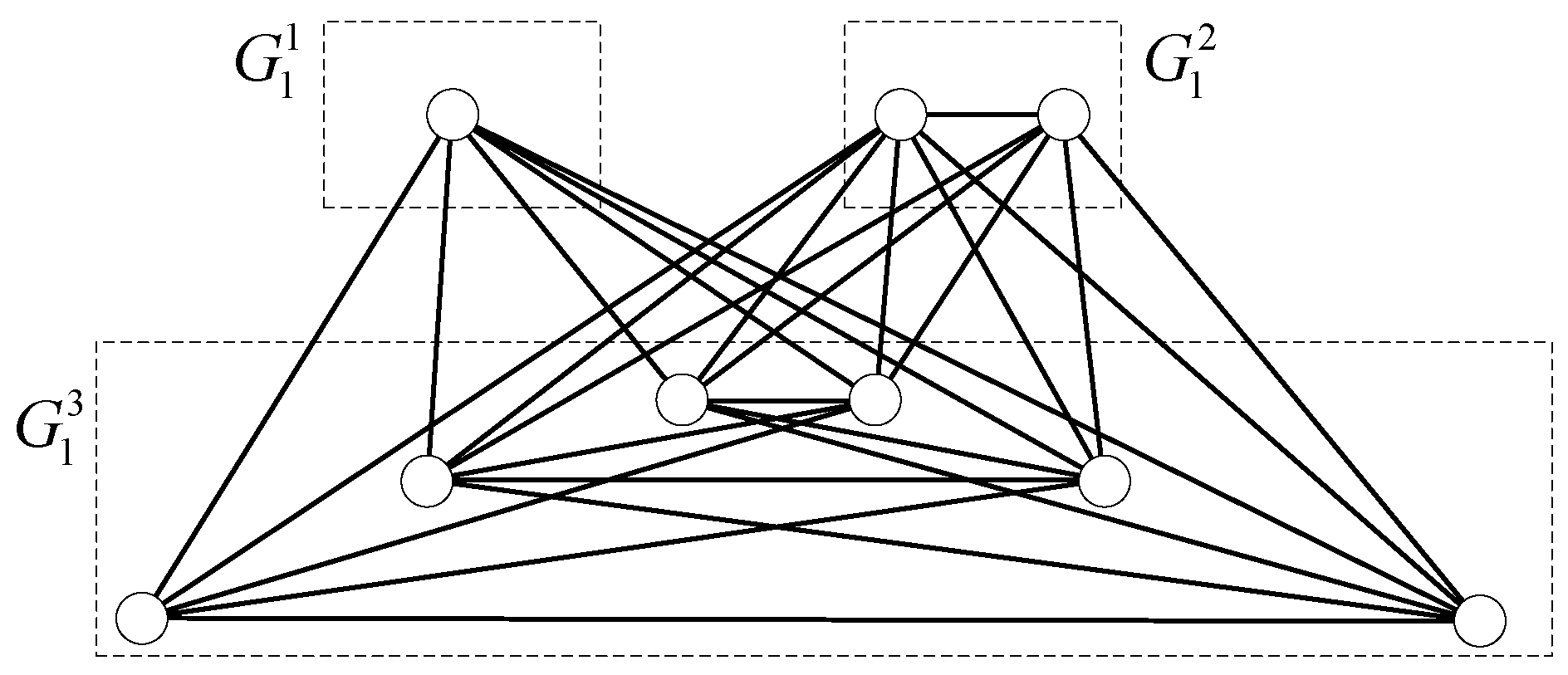
. For example, when
and
, the graph
is shown in
Figure 1.
Then,
For any , ; for any , ; for any , . Hence, .
Note that for any k-coloring of , . Hence, each vertex in is not a colorful vertex with respect to f. So, is not fall k-colorable.
4. Complexity
The problem of determining whether a graph is fall
k-colorable (
) has been shown to be NP-complete [
3,
11,
12,
13]. In this section, we give a simple proof for the NP-complete result of the FALL
k-COLORABLE problem, which is defined as follows:
FALL k-COLORABLE:
Instance: Given a graph and a positive integer k.
Question: Is G fall k-colorable?
k-COLORABLE:
Instance: Given a graph and a positive integer k.
Question: Is G k-colorable?
It is well known that the
k-COLORABLE problem is NP-hard for any
[
14]. We will prove that the fall
k-colorable problem is NP-hard by using a reduction from the
k-COLORABLE problem.
Theorem 4. FALL k-COLORABLE is NP-complete for any .
Proof. We show that the FALL k-COLORABLE problem is NP-complete by a reduction from k-COLORABLE. For any graph G of order n with the vertex set , we construct a graph as follows:
First, take n copies of the complete graph . Then, add these n copies of to G and identify and a vertex of into a single vertex, where .
We claim that G is k-colorable if and only if is fall k-colorable.
Let be fall k-colorable. Let be a fall k-coloring of . By this definition, is a proper k-coloring of . Then, the restriction of to is a k-coloring of G. So, G is k-colorable. Conversely, assume that G has a k-coloring f. By the construction of , f can be extended to a k-coloring of . Since every vertex of belongs to a subgraph of which is isomorphic to , we can see that is a fall k-coloring of . So, is fall k-colorable. □
Furthermore, the
k-COLORABLE problem remains NP-hard under several restrictions. Garey and Johnson [
15] proved the following:
Lemma 4 ([
15]).
Three-COLORABLE is NP-complete even when restricted to planar graphs with a maximum degree of four. By Lemma 4 and using a similar approach to that in the proof of Theorem 4, we can obtain the following result.
Corollary 1. FALL 3-COLORABLE is NP-complete even when restricted to planar graphs with a maximum degree of six.
5. Fall Colorings of Planar Graphs
In this section, we discuss the fall colorings of planar graphs. Since
for any planar graph
G, it follows from Lemma 1 (i) that
. In [
7], Cockayne and Hedetniemi found that each uniquely
k-colorable graph is fall
k-colorable. Note that for any integer
, there exist an infinite family of planar graphs that are uniquely
k-colorable [
16,
17,
18,
19,
20,
21], but uniquely five-colorable planar graphs do not exist [
18]. Hence, there exist an infinite family of planar fall
k-colorable graphs for any
. Now, we show that there also exist an infinite family of planar fall
k-colorable graphs for
.
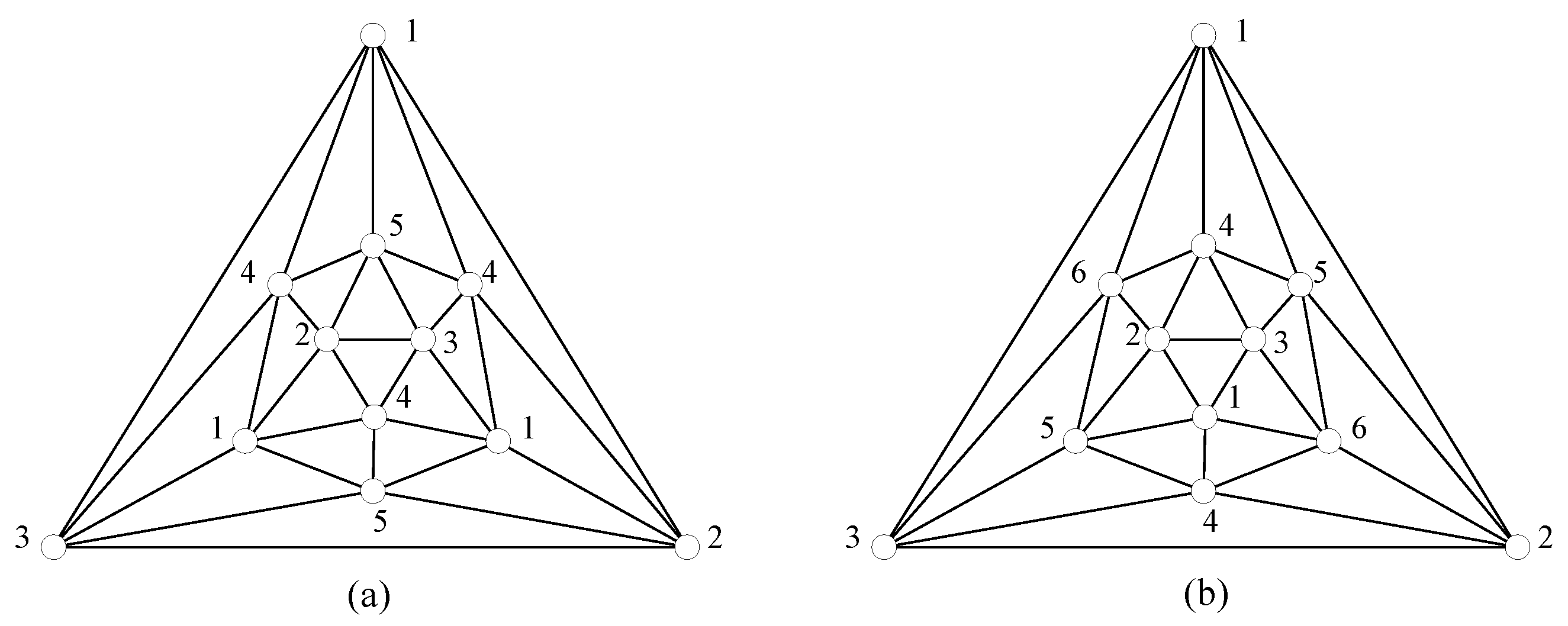
We can see that the icosahedron
in
Figure 2, which is a planar graph, has a fall five-coloring (
Figure 2a) and a fall six-coloring (
Figure 2b).
Theorem 5. There exist an infinite family of planar fall k-colorable graphs for .
Proof. From the icosahedron , we can construct a family of graphs as follows:
(1) ;
(2) For integer , can be obtained by embedding a copy of in some interior face of and identifying the boundaries of this face and the exterior face of .
It can be checked that
is a planar graph of order
. Note that every three-coloring of the exterior triangle of
can be extended to a fall five-coloring by
Figure 2a or a fall six-coloring by
Figure 2b of
. We can recursively obtain a fall five-coloring and a fall six-coloring of
. Hence, for any integer
i,
is a planar fall
k-colorable graph for
. □
Now, we discuss the fall colorings of maximal planar graphs. A planar graph
G is
maximal if
is not planar for any two nonadjacent vertices
u and
v of
G. For example, the icosahedron
in
Figure 2 is a maximal planar graph.
Theorem 6. ([
12]).
If a maximal planar graph G is three-colorable, then G is fall three-colorable. Since a maximal planar graph
G is three-colorable if and only if every vertex in
G has an even degree [
22,
23], we can obtain the following result:
Corollary 2. Let G be a maximal planar graph. If each vertex in G has an even degree, then G is fall three-colorable.
Theorem 7. Let G be a maximal planar graph. If each vertex in G has an odd degree, then G is fall four-colorable.
Proof. It follows from the Four Color Theorem [
24,
25] that
G is four-colorable. Let
f be a four-coloring of
G. Since
G is a maximal planar graph, we know that the neighbors of each vertex
v form a cycle
of order
. Note that
v has an odd degree in
G. Hence,
contains three colors under the coloring
f, that is,
v is colorful with respect to
f. So,
f is a fall four-coloring of
G. □
6. Conclusions and Open Problems
In this paper, we first show that for any fall k-colorable graph G with order n, where and , and this bound is tight. Then, we obtain that if G is k-colorable () and the minimum degree , then G is fall k-colorable and this condition of the minimum degree is the best possible. Moreover, we give a simple proof for an NP-hard result of determining whether a graph is fall k-colorable, where .
For a maximal planar graph G, if G has a fall k-coloring, then by Theorems 1, 5, 6, and 7 we can obtain that . This prompts us to propose the following problem:
Problem 1. For each , which maximal planar graphs G have fall k-colorings?
For any outerplane graph G, note that the minimum degree . If G has a fall k-coloring, then by Lemma 1 we have .