Abstract
The nonuniform sampling and reconstruction of bandlimited random signals in the SAFT domain is discussed in the paper, where the nonuniform samples are obtained by randomly disturbing the uniform sampling. First, we prove that the concerned nonuniform problem is equivalent to the process of uniform sampling after a prefilter in the statistic sense. Then, an approximate reconstruction method based on sinc interpolation is proposed for the randomized nonuniform sampling of SAFT-bandlimited random signals. Finally, we offer the mean square error estimate for the corresponding approximate recovery approach. The results generalize the conclusions of nonuniform sampling of bandlimited random signals in the FrFT and LCT domains to the SAFT domain.
Keywords:
special affine Fourier transform; randomized nonuniform sample; bandlimited random signals; mean square error estimate; approximate recovery MSC:
46E22; 94A20
1. Introduction
The special affine Fourier transform (SAFT) was first proposed in [1] to model optical systems. It offers a unified viewpoint of many known signal processing transforms, such as Fourier transform (FT), fractional Fourier transform (FrFT), linear canonical transform (LCT), Laplace transform (LT), and so on. It can also include some optical operations on light waves, such as rotation, magnification, hyperbolic transformation, free space propagation, Lens transformation, and so on. The SAFT is also called the offset linear canonical transform (OLCT) since it is defined by offsetting two extra parameters on the basis of the LCT [2]. It has been proven that the SAFT is a useful tool for signal processing, communications, quantum mechanics and optics [3,4,5,6]. Many classical results such as Zak transform, Poisson summation formula, uncertainty principles, and convolution theorems are established in the SAFT domain [7,8,9,10].
We let
be a matrix with six real parameters satisfying . The continuous-time SAFT associated with the parameter matrix A of signal is defined as in [1],
where kernel function is given by
We only restrict our attention to the case of because case is essentially a chirp multiplication. We suppose that x and k are position and wave numbers, respectively; then, it is shown in [1,7,11] that the SAFT can be understood as a general inhomogeneous lossless linear mapping in phase space as
which transforms any convex body into another convex body under any linear deformations, rotations, and translations in the phase space. Condition is used to guarantee that the area of the body is preserved by Transform (4). The definition in (2) is just the integral representation of the wave function transform associated with (4), which is derived by the authors in [1].
It can be verified that the inverse SAFT [12] is
where and
If matrix
the SAFT reduces to LCT and FT, respectively.
Sampling and reconstruction builds a connection between the continuous signals and the discrete digital signals, which is the theoretical basis of signal and processing. Beginning with the Shannon’s sampling theorem of bandlimited signals [13], various samplings such as nonuniform sampling, average sampling, dynamic sampling, random sampling, mobile sampling, timing sampling, and multi-channel sampling have been generally studied for signals bandlimited in the FT domain [14,15,16,17]. With the appearance and developments of the more general transforms, the corresponding sampling theories are extended to the signals bandlimited in the FrFT and LCT domains [3,5,18,19,20,21,22]. In particular, the sampling problems associated with the SAFT have generated wide research interests in recent years due to its extensiveness and flexibility [6,7,9,12,23,24,25], which can include more signal models. For example, it is easy to verify that signal
is bandlimited in the SAFT domain associated with matrix
However, is not bandlimited in the FT domain. Of course, we also must pay attention to the fact that a bandlimited signal space in the SAFT domain is not shift-invariant as
which is a different situation from the bandlimited space in the FT domain.
Signals in the real world often present random characteristics, and sampling for random signals bandlimited in the FT domain has been generally studied [16,26,27,28]. In recent years, there emerged a lot of research on the sampling of random signals bandlimited in the FrFT and LCT domains [29,30,31,32,33], including uniform sampling and nonuniform sampling. Nonuniform sampling is a more realistic sampling scheme due to the limitations of data acquisition and processing ability. Various nonuniform sampling schemes such as the periodic nonuniform model, the N-order recurrent nonuniform model, the migration of a finite number of uniform samples, and the general nonuniform mode have been considered for random signals bandlimited in the LCT domain [33], respectively. In particular, a randomized nonuniform sampling method with nonuniform samples being the random perturbations of uniform grids and a class of approximate recovery approaches by using sinc interpolation functions were studied in [30] for random signals bandlimited in the LCT domain, which extends the corresponding results in the FT and FrFT domains [22,34]. For random signals bandlimited in the SAFT domain, the multichannel uniform sampling theorems were established in [35], and the deterministic nonuniform sampling and reconstruction considered in [33] were studied in [12,36]. To the best of our knowledge, the randomized nonuniform sampling for random SAFT-bandlimited signals is still not seen. In the current paper, we study a kind of randomized nonuniform sampling method for SAFT-bandlimited random signals, which is a generalization of [22,30] from the reconstruction of random signals bandlimited in the FrFt and LCT domains to that of random signals bandlimited in the SAFT domain.
The paper is organized as follows. In Section 2, we offer the definition for the power spectral density in the SAFT domain. In Section 3, we study the nonuniform sampling scheme and propose an approximate recovery approach. In Section 4, the mean square error estimate for the proposed approximate recovery method is demonstrated.
2. Power Spectral Density in the SAFT Domain
Given probability space , is called to be a wide stationary stochastic process if it has zero mean and the auto-correlation function
is independent of , i.e., , where denotes mathematical expectation and superscript * stands for the complex conjugate. Two stochastic processes and are said to be jointly stationary if and are both stationary and their cross-correlation function
is independent of , i.e., .
The SAFT cross-correlation function, the SAFT auto-power spectral density, and the SAFT cross-power spectral density are defined as in [35]. For two random signals and , the SAFT auto-correlation function of is defined as
Similarly, the SAFT cross-correlation function of and is defined as
Remark 1.
If random signal is stationary, then is also stationary. In fact,
Moreover, one has
Therefore, must be independent of t. In such a case, we have
We define the SAFT auto-power spectral density of the random signal by
and the SAFT cross-power spectral density of the random signals and as
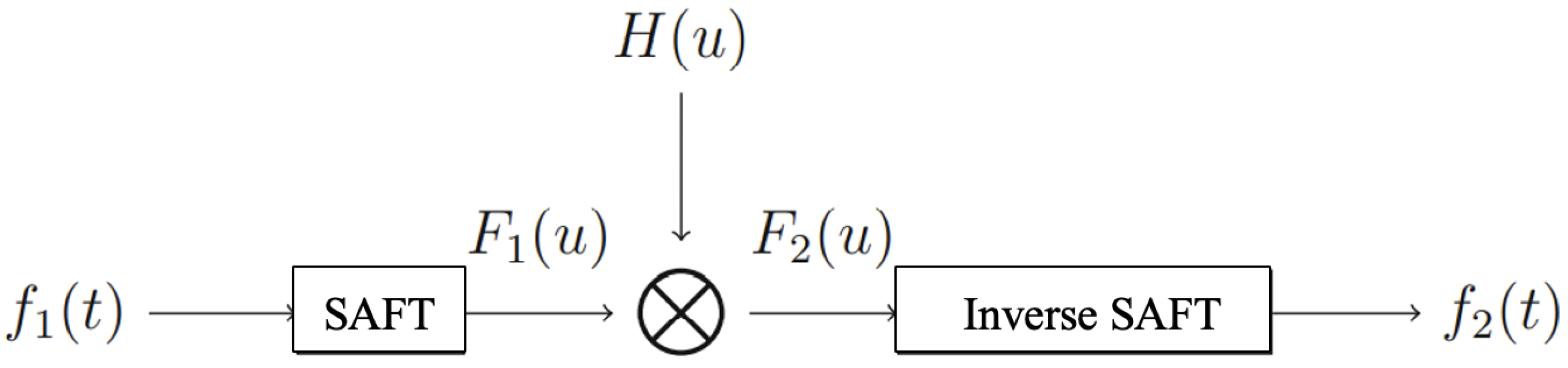
We let and . The multiplicative filtering in the SAFT domain which was introduced in [35] is demonstrated in Figure 1.
Figure 1.
Multiplicative filtering in the SAFT domain.
We define normalized convolution
for [5]. Then, we have the following conclusion:
Proposition 1.
Proof.
We only need to prove
It follows from the definition of the SAFT that □
Lemma 1
([35]). We suppose that and are the input and output random signals in Figure 1, respectively; then,
and
3. Nonuniform Sampling and Approximate Recovery
The sampling and reconstruction of random signals bandlimited in the SAFT domain based on nouniform samples with random characteristics are studied in this section.
Definition 1
([35]). We say that random signal is SAFT-bandlimited (or bandlimited in the SAFT domain) if its SAFT power spectral density satisfies
where is called the bandwidth.
Lemma 2.
We suppose that random signal is SAFT-bandlimited with bandwidth and is stationary. Then, is FT-bandlimited with bandwidth and the power spectral density satisfies supp.
Proof.
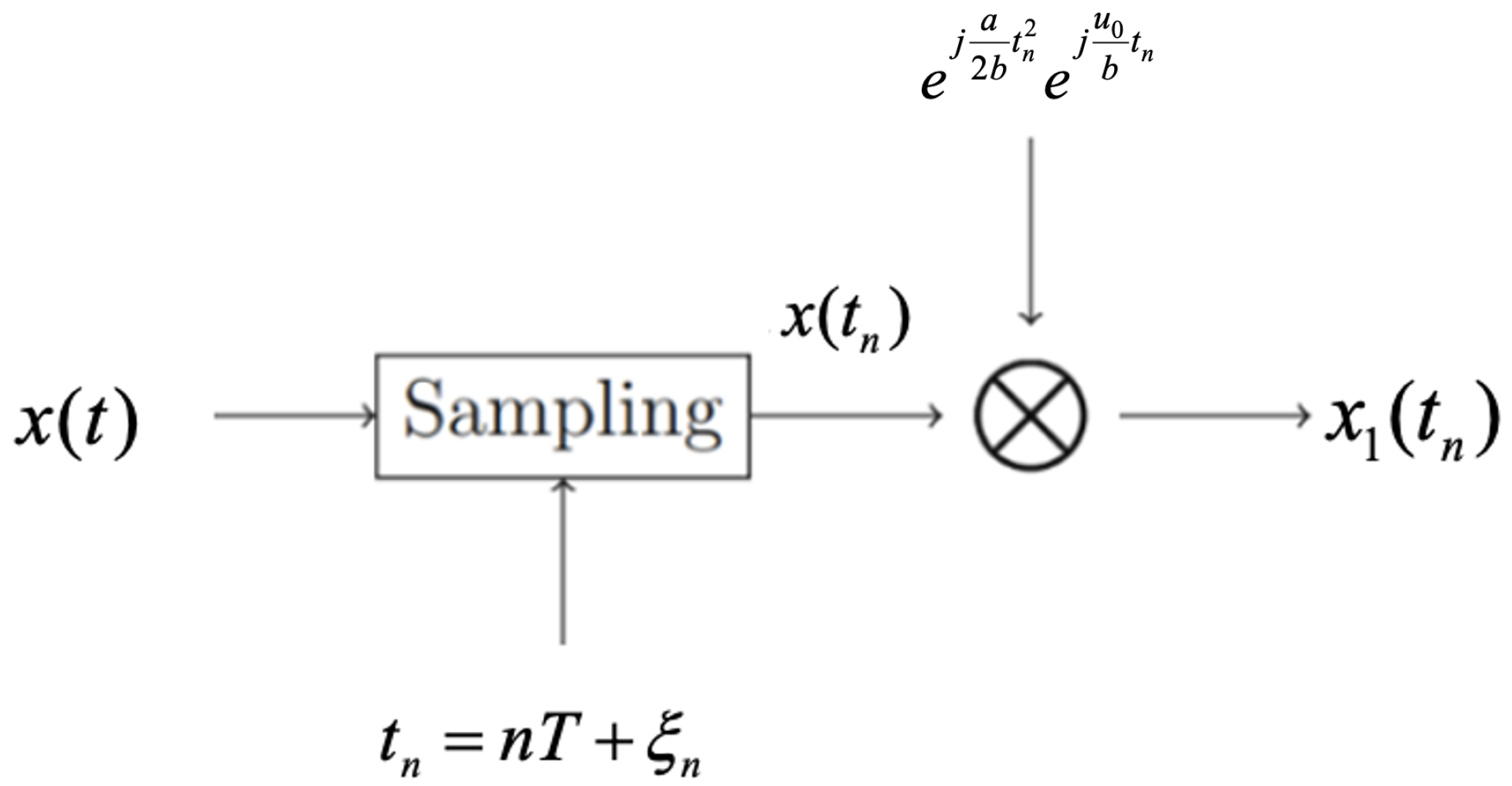
First, we show that the proposed nonuniform sampling is equivalent to the process of uniform sampling after a prefilter in the statistic sense.
Theorem 1.
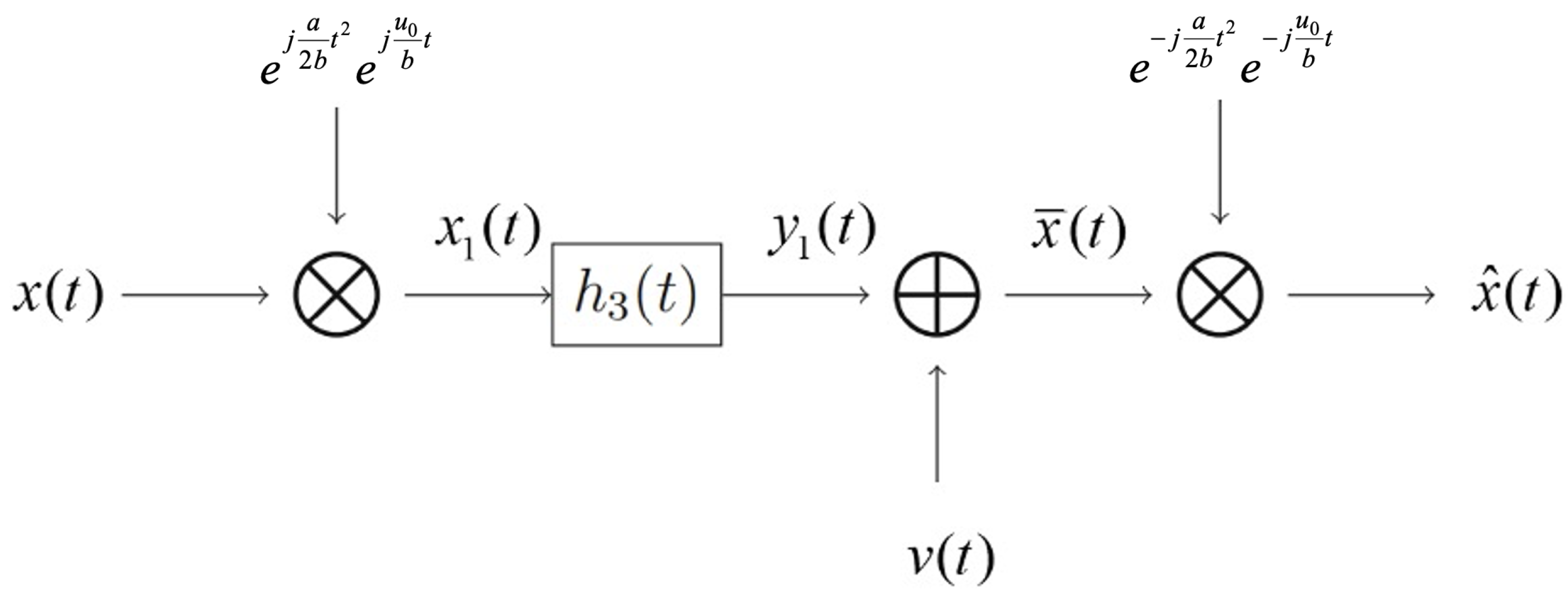
We suppose that random signal is SAFT-bandlimited with bandwidth and is stationary. Then, the nonuniform sampling of at sampling points (Figure 2) is identical to the uniform sampling after SAFT filter as in Figure 3 in the sense of second-order statistic characters, that is,
where , {} is a sequence of independent identically distributed random variables with zero mean in interval . Moreover,
and denotes the characteristic function of .
Figure 2.
The nonuniform sampling process.
Figure 3.
The equivalent system of the nonuniform sampling, where the filtering through filter means that .
Proof.
Note that . Then, it follows from Lemma 1 that
Moreover, one has
Hence, we have
which is independent of t and is stationary. It follows from (20) and (32) that
This together with (17) obtains
Combining (17) and (20), we have
We let and be its probability density function. We suppose that is the common probability density function of and , which are independent and have identical distributions; then,
where * denotes the convolution operator. Moreover, one has
where
Substituting (39) into (37) obtains
This together with and (36) proves the desired result. □
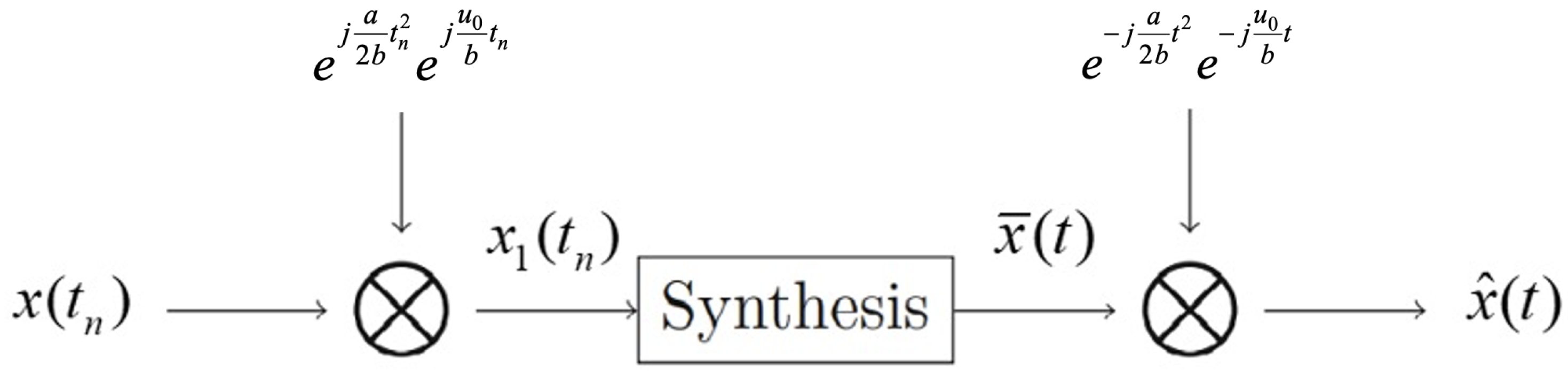
In the following, we offer an approximate recovery method for bandlimited signals in the SAFT domain based on randomized nonuniform samples.
Lemma 3
([34]). We suppose that random signal is bandlimited in the Fourier transform domain with bandwidth ; {} and {} are two sequences of independent identically distributed random variables with zero mean. Then, an approximate recovery formula of nonuniform sampling for random signal can be represented by
where , , , and .
Theorem 2.
We suppose that random signal is SAFT-bandlimited with bandwidth and is stationary. Then, can be approximated by
where and are as in Lemma 3.
Proof.
We let
Figure 4 shows the approximate recovery approach based on the sinc interpolation for a SAFT-bandlimited random signal.
Figure 4.
The approximate reconstruction of a SAFT-bandlimited random signal.
4. Error Estimate for Nonuniform Sampling
Since the reconstruction provided in Theorem 2 is an approximate method, we estimate the approximation error in this section.
Lemma 4.
We let and be the input and output random signals of the FT multiplicative filter as in Figure 5. Then,
where is the FT of , that is,
Figure 5.
A system equivalent to Figure 4.
Proof.
Note that Then,
which is independent of t. Moreover, one has
□
Theorem 3.
We suppose that random signal is SAFT-bandlimited with bandwidth and is stationary. We let be an additive stationary noise with zero mean and power spectral density
where is the joint characteristic function of random variables and . If is uncorrelated with and is the frequency response of filter , then the model described in Figure 5 is identical to the procedure represented in Figure 4 in the sense of second-order statistic characters. Moreover,
Proof.
It follows from Theorem 2 that
Then, one has
Moreover, it can be represented by two terms as
Note that and
These together with the fact that show that
Moreover, we have
It follows from Lemma 4 that the first term of in (63) is the FT power spectral density of in Figure 5. Furthermore, since and is uncorrelated with , then
Moreover, one has
which shows that the second term in (63) is just the power spectral density of , that is,
Therefore, the model described in Figure 5 is identical to the procedure represented in Figure 4 in the sense of second-order statistic characters.
Next, we estimate . Let . Combining (29) and (63), we obtain
Similarly, we can obtain
In fact, it is easy to see that
Moreover, it follows from (19) that
Hence, the SAFT auto-power spectral density of reconstruction error is
where we use the fact that is real due to (29). Note that
This completes the proof. □
Remark 2.
If and are equal to zero, then the sampling considered in the paper is just the classical uniform sampling. In such a case, . Then, we know from Theorem 3 that
Remark 3.
We provide a reconstruction method based on sinc interpolation for random signals bandlimited in the SAFT domain, which is theoretically similar to that for the classical bandlimited signals in the FT domain. However, the the numerical performance may show a different case, because the strong and rapid oscillations of the chirp-modulation multiplier in the SAFT background may cause instability against a minor jitter error. As we showed in (10), a bandlimited signal space in the SAFT domain is not shift-invariant, which may require an additional step to identify both the chirp and shift parameters from the data. However, although the support of the band-limitedness is changed and the bandwidth could increase, a modest amount of oversampling can make up the effects of missing the exact determination of the offset parameters to the reconstruction, because a small shift of the signal only leads to a slight disturbance to the support in the SAFT domain.
5. Conclusions
Since the six-parameter SAFT has more flexibility relative to the four-parameter LCT and can accommodate more signal models, we extend the sampling theory with samples being the randomized perturbation of the classical uniform scheme from the FrFT and LCT backgrounds to the SAFT-bandlimited random signals. We show that the proposed nonuniform model is equivalent to the uniform sampling after a pre-filter in the statistic sense. Moreover, an approximate recovery method based on the sinc functions and the corresponding error analysis in the sense of mean square convergence are given for random signals bandlimited in the SAFT domain.
Author Contributions
Investigation, Y.J. and H.L.; writing—original draft preparation, N.G. and H.L. All authors have read and agreed to the published version of the manuscript.
Funding
The project is partially supported by the National Natural Science Foundation of China (No. 12261025), the Guangxi Natural Science Foundation (No. 2019GXNSFFA245012), the Science and Technology Project of Guangxi (No. Guike AD23023002), Guangxi Colleges and Universities Key Laboratory of Data Analysis and Computation.
Data Availability Statement
Data are contained within the article.
Conflicts of Interest
The authors declare that they have no competing interests.
References
- Abe, S.; Sheridan, J.T. Optical operations on wave functions as the Abelian subgroups of the special affine Fourier transformation. Opt. Lett. 1994, 19, 1801–1803. [Google Scholar] [CrossRef] [PubMed]
- Healy, J.J.; Kutay, M.A.; Ozaktas, H.M.; Sheridan, J.T. Linear Canonical Transforms: Theory and Applications; Springer Series in Optical Sciences; Springer: New York, NY, USA, 2016. [Google Scholar]
- Liu, X.; Shi, J.; Xiang, W.; Zhang, Q.; Zhang, N. Sampling expansion for irregularly sampled signals in fractional Fourier transform domain. Digit. Signal Process. 2014, 34, 74–81. [Google Scholar] [CrossRef]
- Sharma, K.; Joshi, S. Signal separation using linear canonical and fractional Fourier transforms. Opt. Commun. 2006, 265, 454–460. [Google Scholar] [CrossRef]
- Zhao, H.; Wang, R.; Song, D.; Zhang, T.; Wu, D. Extrapolation of discrete bandlimited signals in linear canonical transform domain. Signal Process. 2014, 94, 212–218. [Google Scholar] [CrossRef]
- Xu, S.; Chai, Y.; Hu, Y. Spectral analysis of sampled band-limited signals in the offset linear canonical transform domain. Circuits Syst. Signal Process. 2015, 34, 3979–3997. [Google Scholar] [CrossRef]
- Bhandari, A.; Zayed, A.I. Shift-invariant and sampling spaces associated with the special affine Fourier transform. Appl. Comput. Harmon. Anal. 2019, 47, 30–52. [Google Scholar] [CrossRef]
- Huo, H.; Sun, W.; Xiao, L. Uncertainty principles associated with the offset linear canonical transform. Math. Methods Appl. Sci. 2019, 42, 466–474. [Google Scholar] [CrossRef]
- Xiang, Q.; Qin, K. Convolution, correlation, and sampling theorems for the offset linear canonical transform. Signal Image Video Process. 2014, 8, 433–442. [Google Scholar] [CrossRef]
- Zhi, X.; Wei, D.; Zhang, W. A generalized convolution theorem for the special affine Fourier transform and its application to filtering. Optik 2016, 127, 2613–2616. [Google Scholar] [CrossRef]
- Gao, N.; Jiang, Y. Sampling and reconstruction of multi-dimensional bandlimited signals in the special affine Fourier transform domain. Math. Meth. Appl. Sci. 2024. [Google Scholar] [CrossRef]
- Xu, S.; Huang, L.; Chai, Y.; He, Y. Nonuniform sampling theorems for bandlimited signals in the offset linear canonical transform. Circuits Syst. Signal Process. 2018, 37, 3227–3244. [Google Scholar]
- Shannon, C.E. Communication in the presence of noise. Proc. IRE 1949, 37, 10–12. [Google Scholar] [CrossRef]
- Adam, K.; Scholefield, A.; Vetterli, M. Sampling and reconstruction of bandlimited signals with multi-channel time encoding. IEEE Trans. Signal Process. 2020, 69, 1105–1119. [Google Scholar] [CrossRef]
- Aldroubi, A.; Davis, J.; Krishtal, I. Dynamic sampling: Time-space trade-off. Appl. Comput. Harmon. Anal. 2013, 34, 495–503. [Google Scholar] [CrossRef]
- Bass, R.F.; Gröchenig, K. Random sampling of bandlimited functions. Isral J. Math. 2010, 177, 1–28. [Google Scholar] [CrossRef]
- Gröchenig, K.; Romero, J.L.; Unnikrishnan, J.; Vetterli, M. On minimal trajectories for mobile sampling of bandlimited fields. Appl. Comput. Harmon. Anal. 2015, 39, 487–510. [Google Scholar] [CrossRef]
- Oktem, F.; Ozaktas, H. Exact relation between continuous and discrete linear canonical transforms. IEEE Signal Process. Lett. 2009, 16, 727–730. [Google Scholar] [CrossRef]
- Tao, R.; Li, B.; Wang, Y.; Aggrey, G. On sampling of band-limited signals associated with the linear canonical transform. IEEE Trans. Signal Process. 2008, 56, 5454–5464. [Google Scholar]
- Wei, D.; Ran, Q.; Li, Y. Multichannel sampling and reconstruction of bandlimited signals in the linear canonical transform domain. IET Signal Process. 2011, 5, 717–727. [Google Scholar] [CrossRef]
- Zhao, H.; Wang, R.; Song, D. Recovery of bandlimited signals in linear canonical transform domain from noisy samples. Circuits Syst. Signal Process. 2014, 33, 1997–2008. [Google Scholar] [CrossRef]
- Xu, L.; Zhang, F.; Tao, R. Randomized nonuniform sampling and reconstruction in fractional Fourier domain. Signal Process. 2016, 120, 311–322. [Google Scholar] [CrossRef]
- Stern, A. Sampling of compact signals in the offset linear canonical transform domains. Signal Image Video Process. 2007, 1, 359–367. [Google Scholar] [CrossRef]
- Xiang, Q.; Qin, K.; Huang, Q. Multichannel sampling of signals band-limited in offset linear canonical transform domains. Circuits Syst. Signal Process. 2013, 32, 2385–2406. [Google Scholar] [CrossRef]
- Xu, S.; Chai, Y.; Hu, Y.; Jiang, C.; Li, Y. Reconstruction of digital spectrum from periodic nonuniformly sampled signals in offset linear canonical transform domain. Opt. Commun. 2015, 348, 59–65. [Google Scholar] [CrossRef]
- Boche, H.; Mönich, U.J. Approximation of wide-sense stationary stochastic processes by Shannon sampling series. IEEE Trans. Inf. Theory 2010, 56, 6459–6469. [Google Scholar] [CrossRef]
- Gilles, F.; Sinuk, K. Average sampling of band-limited stochastic processes. Appl. Comput. Harmon. Anal. 2013, 35, 527–534. [Google Scholar]
- Song, Z.; Sun, W.; Zhou, X.; Hou, Z. An average sampling theorem for bandlimited stochastic processes. IEEE Trans. Inf. Theory 2007, 53, 4798–4800. [Google Scholar] [CrossRef]
- Huo, H.; Sun, W. Sampling theorems and error estimates for random signals in the linear canonical transform domain. Signal Process. 2015, 111, 31–38. [Google Scholar] [CrossRef]
- Huo, H.; Sun, W. Nonuniform sampling for random signals bandlimited in the linear canonical transform domain. Multidimens. Syst. Signal Process. 2020, 31, 927–950. [Google Scholar] [CrossRef]
- Tao, R.; Zhang, F.; Wang, Y. Sampling random signals in a fractional Fourier domain. Signal Process. 2011, 91, 1394–1400. [Google Scholar] [CrossRef]
- Xu, S.; Feng, L.; Chai, Y.; He, Y. Analysis of A-stationary random signals in the linear canonical transform domain. Signal Process. 2018, 146, 126–132. [Google Scholar] [CrossRef]
- Xu, S.; Jiang, C.; Chai, Y.; Hu, Y.; Huang, L. Nonuniform sampling theorems for random signals in the linear canonical transform domain. Int. J. Electron. 2018, 105, 1051–1062. [Google Scholar]
- Maymon, S.; Oppenheim, A.V. Sinc interpolation of nonuniform samples. IEEE Trans. Signal Process. 2011, 59, 4745–4758. [Google Scholar] [CrossRef]
- Xu, S.; Feng, L.; Chai, Y.; Hu, Y.; Huang, L. Sampling theorems for bandlimited random signals in the offset linear canonical transform domain. AEU Int. J. Electron. Commun. 2017, 81, 114–119. [Google Scholar] [CrossRef]
- Bao, Y.; Zhang, Y.; Song, Y.; Li, B.; Dang, P. Nonuniform sampling theorems for random signals in the offset linear canonical transform domain. In Proceedings of the APSIPA Annual Summit and Conference, Kuala Lumpur, Malaysia, 12–15 December 2017; pp. 94–99. [Google Scholar]
Disclaimer/Publisher’s Note: The statements, opinions and data contained in all publications are solely those of the individual author(s) and contributor(s) and not of MDPI and/or the editor(s). MDPI and/or the editor(s) disclaim responsibility for any injury to people or property resulting from any ideas, methods, instructions or products referred to in the content. |
© 2024 by the authors. Licensee MDPI, Basel, Switzerland. This article is an open access article distributed under the terms and conditions of the Creative Commons Attribution (CC BY) license (https://creativecommons.org/licenses/by/4.0/).