


Abstract
The present paper considers a fractional-order smoke epidemic model. We apply fuzzy systems and probability theory to make the best decision on the stability of the smoking epidemic model by using a new class of controllers powered by special functions to effectively generalize Ulam-type stability problems. Evaluation of optimal controllability and maximal stability is the new issue. This different concept of stability not only covers the old concepts but also investigates the optimization of the problem. Finally, we apply a new optimal method for the governing model with the Atangana–Baleanu–Caputo fractional derivative to obtain stability results in Banach spaces.
MSC:
46L05; 47B47; 47H10; 46L57; 39B62
1. Introduction
The idea of stability for a functional equation (FE) arises when we substitute the FE by an inequality which acts as a perturbation of the initial equation. Over the years, stability results of FEs have been developed for obtaining an approximate solution of the perturbed equation which is close to the exact solution (ES). This topic was introduced by Ulam and Hyers in 1940–1941, and this kind of stability is called HU stability [1,2]. In 1978, the improvement of HU stability provided by Rassias led to the development of what is now known as HUR stability [3]. In 1998, Ger and Alsina [4] established the HU stability of ODEs and many authors defined types of HUR–Mittag–Leffler stability of fractional PDEs to prove that every mapping from this type can be somehow approximated by an ES of the considered equation [5,6,7].
The recent interest in the Mittag–Leffler (ML) function and its various generalizations [8] is mainly due to their close relations to Fractional Calculus and especially to fractional problems that come from applications. The special functions, along with the ML function, including the functions of Wright type, the functions of hypergeometric type and others [9] which often appear in solutions of various types of equations with fractional operators, play a prominent role in the theory of the PDEs of fractional order that are applied in modeling of diverse phenomena [10,11,12].
As it is known, the major problem of procuring ES of such equations is very crucial, and the form of the ES (if it exists) is oftentimes so arduous that it is not suitable for numerical calculation [13,14,15]. In view of this, it is imperative to talk about an approximate solution and ask whether it lies close to the ES. Generally, we say that a fractional PDE is stable in the sense of Ulam if, for every solution of the fractional PDE, there exists an approximate solution of the perturbed equation that is near to it.
To clarify the issue, let us introduce the notion of Ulam-type stability of an operator equation [16,17]. We consider the Banach space and an operator for every We also consider the operator equation
and the inequality
Equation (1) is called HU stable if for every solution of Inequality (2), there is a solution v of operator Equation (1) such that
in which is a constant dependent on T.
Now, Equation (1) is called HUR stable if there is a continuous function , such that, for every and for every solution of the inequality
there is solution v of operator Equation (1) with such that
Equation (1) has HUR–Mittag–Leffler stability or HUR–Wright stability if the above statement is also true when we replace control function by the ML function or the Wright function, respectively.
In this paper, we consider a diagonal matrix of special functions as a controller to study a fresh concept of stability, namely multi-stability. The mentioned stability helps us to obtain different approximations depending on the diverse special functions that are initially selected and to evaluate maximal stability with minimal error which enables us to obtain the best approximate solution.
We let the matrix-valued controller be as follows:
in which denotes a special function in the the main diagonal of square matrix , and the natural number n represents the numbers of special functions that we intend to consider.
We consider normed linear spaces V and Mapping has the multi-stability property if we replace the controller of HUR stability with .
For the special case of multiple stability, i.e., Mittag–Leffler–Gauss-Hypergeometric–Bessel–Maitland–Fox stability, Mittag–Leffler–Supertrigonometric stability, Mittag–Leffler–Superhyperbolic stability and the others, we refer the reader to [18,19,20].
2. Preliminaries
2.1. Some Special Functions
2.1.1. Fox -Function and Related Functions
The function (sometimes called Fox’s -function) is a very generally defined special function due to Charles Fox (1928) (see [21]). We let be a proper contour of the Mellin–Barnes type in the complex S-plane. Therefore, the -function is given by
in which and
where and
We now present some special cases of the -function including the exponential function, the Wright function, the one-parameter Mittag–Leffler function, the Fox–Wright function, the Meijer –function, the Gauss Hypergeometric function, and the –function, respectively, as follows:
Note that for and we consider
2.1.2. Mittag–Leffler Function and Related Functions
We let
and
and The m-parameter Mittag–Leffler function is given by [21]
in which with for all and
Notice that is given by
2.2. Generalized Triangular Norms (GTNs)
We suppose
with the partial order relation below:
and Symbols and are given by
and
Definition 1
([18]). Operation , is called a GTN if for every we have
(1)
(2) ,
(3)
(4)
For sequences , converging to , if , ⨀ is continuous.
For example, we assume the continuous GTNs given as follows:
and
In this paper, we set
2.3. Matrix-Valued Fuzzy Normed Spaces
We consider vector space We assume to be a set of all matrix-valued fuzzy sets (MVF sets), including the increasing and continuous functions such that, for
In , for every and we assume if
A matrix-valued fuzzy normed space (MVFN space) [18] is a triple , such that, for all , and we obtain
(i) ,
(ii) ,
(iii) , iff
(iv)
For example, defines a fuzzy norm (see [18]) for all and
Note 1.
A matrix-valued fuzzy Banach space (MVFB space) is a complete MVFN space.
2.4. Matrix-Valued Random Normed Spaces
We suppose is a set of matrix-valued distribution functions (MVDFs) including the non-decreasing and left–continuous functions
such that we have
We let contain such that we obtain In for all we assume if
Note that the maximal element for is given by
For instance, the function
denotes an MVDF since and .
We assume vector space , DF and continuous GTN ⨀. A triple is a matrix-valued random normed space (MVRN space) [19] if for every and we obtain
- (i)
- (ii)
- iff
- (iii)
- ,
in which is the value of at a point
For instance, is a random norm [19] for all and .
2.5. Multi-Aggregations
We let
and An n-ary aggregation map [19] is a mapping,
such that we obtain
In addition, for all if then,
Here, we introduce some examples of aggregation maps,
defined as follows:
- Geometric mean functions,
- Arithmetric mean functions,
- Maximum functions,
- Minimum functions,
- Median of odd numbers,
- Median of even numbers,
- Sum functions,
- Product functions,
2.6. Generalized Alternative Fixed Point Theory
We first present vector-valued generalized metric spaces.
Note 2.
We suppose and . Thus, for every we have iff and also iff
Definition 2
([21]). Consider the set and A generalized metric d on is a map such that
for every , iff
for every , iff
for every ,
Theorem 1
([21]). Consider a complete generalized metric space , with , and a contractive mapping with Lipschitz constant . Hence, for all , either for any or there is an such that
;
The fixed point of Γ is a convergence point of the sequence and is unique in the set ;
for every .
3. Application of Multi-Stability for Smoke Transmission Model
In [22,23,24], the authors presented the following basic mathematical model which analyzes the spread of smoking in a population:
where and represent smokers, smokers who permanently quit smoking, potential smokers, smokers who temporarily quit smoking, and occasional smokers.
In [16], teh authors presented an extension of (7) to a two-age group model: 1-Group including people below 70 years old and 2-Group including people aged above 70 years. Every population consists of for the 1-Group and for the 2-Group. For each group, we have the following age-specific parameters:
- rate of supply,
- effective contact rate between and
- natural death rate,
- rate of quitting smoking,
- rate at which occasional smokers become regular smokers,
- the contact rate between smokers and temprorary quitters,
- fraction of smokers who temporary quit smoking.
Therefore, the i -age group transmission model () is given as follows:
Now, (8) under the ABC fractional derivative is given by [16]
with initial condition
where is the ABC fractional derivative given by
for any satisfies property and is the one-parameter Mittag–Leffler function given by
Notice that for any and the integral of ABC is given by
Reformulating the right side of (9), we obtain
in which
Now, we apply the concept of Z-numbers and we introduce a special matrix of the form (named the generalized Z-number) where is a fuzzy set, time-stamped, is the probability distribution function and is a degree of reliability of that is described as a value of (see [25]).
We let the Banach space be For every we define
and
Note that every special function given in the the main diagonal of square matrices and is defined as for example,
Definition 3.
The diagrams of are shown separately in Figure 1. As can be observed, (brown) and (yellow) include the highest and the lowest values, and , are placed between them. Therefore, we can infer that the proposes a better approximation for (11) than the others.
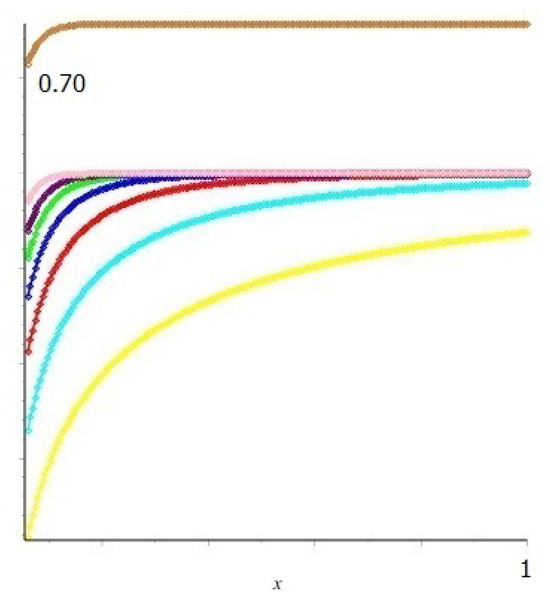
Figure 1.
The diagrams of on controller (14). and are shown in brown and yellow colors, and the rest are in between.
As above, we can conclude that proposes a better approximation for (11) than
Theorem 2.
For every , and we consider the Atangana–Baleanu–Caputo fractional smoke epidemic model (11) and the inequalities below:
and
We let there exist such that, for every , we have
and
We let Then, we can obtain a unique such that
and
where
Proof.
According to Lemma 2.4 in [16], the solution of (11) is defined as follows:
We consider mapping defined by
in which
Note that is a complete generalized metric space (see [19]).
For every and we show is a contraction mapping on as follows:
and in a similar way,
Thus, we deduce the contractive property of since .
We remark that (see [18]) function is a solution of (16)–(17) if there exists function (which depends on ) such that, for every and
(1) , and ; and
(2) we have
Now, the solution of (35) is given by
Making use of (26) and (30), we have
and in a similar way,
for every
By means of fixed point theory, we can obtain such that
(1) is a fixed point of ,
which is unique in the set
(2) as .
(3) We have
which infers
where
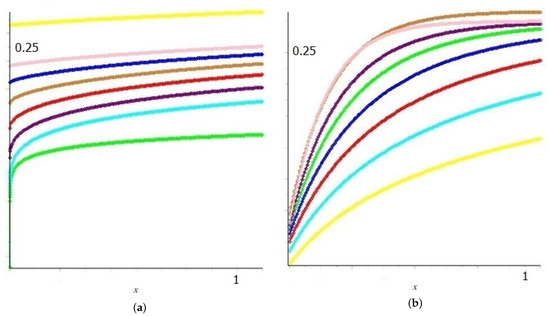
The plots of special functions given in the the main diagonal of square matrix are displayed in Figure 2a, where the diagrams of the Wright function and the Fox -function are displayed in green and yellow colors, and the rest are in between. Similarly, the plots of special functions given in the the main diagonal of square matrix are displayed in Figure 2b, where the diagrams of one-parameter Mittag–Leffler function and eight-parameter Mittag–Leffler function are displayed in brown and yellow colors, and the rest are in between.
Figure 2.
(a) displays the plots of special functions given in the the main diagonal of square matrix (14) where the diagrams of the Wright function and the Fox -function are displayed in green and yellow colors, and the rest are in between. Similarly, (b) displays the plots of special functions given in the the main diagonal of square matrix (15) where the diagrams of 1-parameter Mittag–Leffler function and 8-parameter Mittag–Leffler function are displayed in brown and yellow colors, and the rest are in between.
Thus, we have
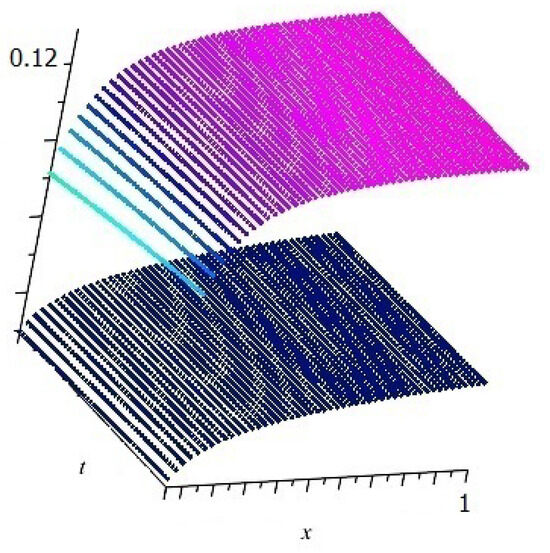
The plots of (the bottom chart) and (the above chart) are displayed in Figure 3. Now, we obtain
□
Figure 3.
The plots of (the bottom chart) and (the above chart).
4. A New Optimal Method for a Smoke Epidemic Model in Banach Spaces
In [16], the authors applied the Krasnoselskii-type fixed point theorem to study the existence, uniqueness, and UHR stability of (11) in Banach spaces. We study the existence, uniqueness, and UHR stability of the governing model using the Cadariu–Radu method derived from an alternative fixed point theorem. By comparing methods, we conclude that our method provides an optimal solution with the same error value obtained through the Krasnoselskii-type fixed point theorem.
We let the Banach space be and let
Now, we assume the following for :
- (ı)
- There is and such that
- (ıı)
- There is such that
We consider operator such that
4.1. The Krassnoselskii Fixed Point Theorem
Lemma 1
([16]). Consider Banach space with norm for any Assume is a closed convex subset of ⊤ and there are operators and with
- (1)
- (2)
- is compact and continuous and is a contraction operator.
Thus, there is solution such that
Theorem 3.
Proof.
First, we prove is a contraction. We assume and which is a closed convex set. Now, we have
Thus,
Therefore, is a contraction since
We now prove is compact and continuous for any then,
Thus, is bounded. We assume then, we have
As Thus, according to the Arzela–Ascoli theorem, is compact and equicontinuous. Therefore, based on Lemma 1, System (11) has at least one solution. □
Theorem 4.
Consider constant with Then, operator has a unique fixed point.
Proof.
We assume . Then,
Therefore, based on the contraction principle, the operator has a unique fixed point. □
Definition 4
Remark 1.
(1)
(2)
Lemma 2.
We consider the fractional-order system below,
Then, for we obtain
Proof.
Theorem 5.
4.2. The Cădariu–Radu Method
Here, we study the existence, uniqueness, and UHR stability of System (11) using the Cădariu–Radu method derived from an alternative fixed point Theorem 1 (see [26]).
Theorem 6.
Consider the following inequality:
where is a control function. Assume where Then, there exists a unique with
and
Proof.
We consider mapping defined by
Now, we define as
According to the previous subsection, we see that is contractive on i.e., for any we have
Then, we deduce the contraction property of , since
Again using the previous subsection, we obtain
Thus, the assumptions of Theorem 1 are satisfied, and we obtain
where is the unique solution in □
4.3. Discussion
The concept of fractional derivative is more than three thousand years old. The role of fractional calculus has been increasing due to its application zone in diverse domains like laser propagation, energy quantization, semiconductor industry, wave propagation, biology, optical communication, quantum chemistry, etc. The fractional derivative of ABC uses the Mittag–Leffler function to consider random fuzzy models with uncertain constraint conditions [27,28,29,30,31]. An analysis method is used to consider the best decision on the stability of the smoking epidemic model by using a new class of controllers powered by special functions. Under some special conditions, we compared the findings of our study with the obtained results in [16] and we concluded that our method provides an optimal solution with the same error value obtained through the Krasnoselskii-type fixed point theorem [16]. Our technique offers a constructive process to obtain our fixed points.
5. Conclusions
We applied fuzzy random systems, the probability theory, and the concept of Z-numbers to make the best decision on the Ulam stability of the smoking epidemic model by using a new class of controllers powered by special functions and aggregation maps. Effective generalization of Ulam-type stability problems and evaluation of optimal controllability and maximal stability are new issues. There exist different methods to the Ulam-type stability using diverse tools, for instance, Laplace transforms, invariant means, shadowing, sandwich ideas, and Fourier transforms [32,33,34,35]. In this paper, we used a fixed point argument to consider stability. We compared our results with the obtained results in [16] and we concluded that our method provides an optimal solution with the same error value obtained through the methods used in [16].
Author Contributions
Methodology, D.O.; Software, S.R.A.; Validation, R.S.; Writing—original draft, R.S.; Writing—review & editing, D.O. and S.R.A.; Supervision, R.S. All authors have read and agreed to the published version of the manuscript.
Funding
This research received no external funding.
Data Availability Statement
Data are not contained within the article.
Conflicts of Interest
The authors declare no conflict of interest.
References
- Brzdek, J.; Piszczek, M. On stability of the linear and polynomial functional equations in single variable. In Handbook of Functional Equations; Springer: New York, NY, USA, 2014; pp. 59–81. [Google Scholar]
- Benzarouala, C.; Brzdek, J.; El-hady, E.; Oubbi, L. On Ulam stability of the inhomogeneous version of the general linear functional equation. Results Math. 2023, 78, 76. [Google Scholar] [CrossRef]
- Rassias, T.M. On the stability of the linear mapping in Banach spaces. Proc. Amer. Math. Soc. 1978, 72, 297–300. [Google Scholar] [CrossRef]
- Alsina, C.; Ger, R. On some inequalities and stability results related to the exponential function. J. Inequal. Appl. 1998, 2, 373–380. [Google Scholar] [CrossRef]
- Wu, G.; Baleanu, D. Stability analysis of impulsive fractional difference equations. Fract. Calc. Appl. Anal. 2018, 21, 354–375. [Google Scholar] [CrossRef]
- Wu, G.; Baleanu, D.; Huang, L. Novel Mittag-Leffler stability of linear fractional delay difference equations with impluse. Appl. Math. Lett. 2018, 82, 71–78. [Google Scholar] [CrossRef]
- Wu, G.; Abdeljawad, T.; Liu, J.; Baleanu, D.; Wu, K. Mittag-Leffler stability analysis of fractional discrete-time neural networks via fixed point technique. Nonlinear Anal. Model. Control 2019, 24, 919–936. [Google Scholar] [CrossRef]
- Gorenflo, R.; Kilbas, A.A.; Mainardi, F.; Rogosin, S.V. Mittag-Leffler Functions, Related Topics and Applications; Springer: Berlin, Germany, 2020; p. 540. [Google Scholar]
- Yang, X.J. Theory and Applications of Special Functions for Scientists and Engineers; Springer: Singapore, 2021. [Google Scholar]
- Dousseh, P.Y.; Ainamon, C.; Miwadinou, C.H.; Monwanou, A.V.; Chabi-Orou, J.B. Chaos control and synchronization of a new chaotic financial system with integer and fractional order. J. Nonlinear Sci. Appl. 2021, 14, 372–389. [Google Scholar] [CrossRef]
- Kumar, B.; Malik, M. Existence, controllability and Hyers-Ulam stability of a hybrid neutral switched system with impulsive effects. Int. J. Syst. Sci. 2024, 55, 517–534. [Google Scholar] [CrossRef]
- AShakeri, S.; Ciric, L.J.B. Common fixed point theorem in partially ordered L-fuzzy metric spaces. Fixed Point Theory Appl. 2010, 2010, 125082. [Google Scholar] [CrossRef][Green Version]
- Mahdi, N.K.; Khudair, A.R. Linear fractional dynamic equations: Hyers–Ulam stability analysis on time scale. Results Control. Optim. 2024, 14, 100347. [Google Scholar] [CrossRef]
- Mihet, D. On the stability of the additive Cauchy functional equation in random normed spaces. Appl. Math. Lett. 2011, 24, 2005–2009. [Google Scholar] [CrossRef][Green Version]
- Demma, M.; Vetro, P. Fixed point results on b-metric space via Picard sequences and b-simulation functions. Iran. J. Math. Sci. Inform. 2016, 11, 123–136+156. [Google Scholar]
- Addai, E.; Zhang, L.; Asamoah, J.K.; Essel, J.F. A fractional order age-specific smoke epidemic model. Appl. Math. Model. 2023, 119, 99–118. [Google Scholar] [CrossRef]
- Petrusel, A.; Rus, I.A. Ulam Stability of Zero Point Equations. In Ulam Type Stability; Brzdek, J., Popa, D., Rassias, T.M., Eds.; Springer: Cham, Switzerland, 2019; pp. 345–364. [Google Scholar]
- Aderyani, S.R.; Saadati, R.; Abdeljawad, T.; Mlaiki, N. Multi-stability of non homogenous vector-valued fractional differential equations in matrix-valued Menger spaces. Alex. Eng. J. 2022, 61, 10913–10923. [Google Scholar] [CrossRef]
- Aderyani, S.R.; Saadati, R. Stability and controllability results by n-ary aggregation functions in matrix valued fuzzy n-normed spaces. Inf. Sci. 2023, 643, 119265. [Google Scholar] [CrossRef]
- Li, C.; Nonlaopon, K.; Hrytsenko, A.; Beaudin, J. On the analytic and approximate solutions for the fractional nonlinear Schrodinger equations. J. Nonlinear Sci. Appl. 2023, 16, 51–59. [Google Scholar] [CrossRef]
- O’Regan, D.; Aderyani, S.R.; Saadati, R.; Li, C. Stability Results and Parametric Delayed Mittag-Leffler Matrices in Symmetric Fuzzy-Random Spaces with Application. Symmetry 2023, 15, 1880. [Google Scholar] [CrossRef]
- Sharomi, O.; Gumel, A.B. Curtailing smoking dynamics: A mathematical modeling approach. Appl. Math. Comput. 2008, 195, 475–499. [Google Scholar] [CrossRef]
- Khan, S.A.; Shah, K.; Zaman, G.; Jarad, F. Existence theory and numerical solutions to smoking model under Caputo-Fabrizio fractional derivative. Chaos 2019, 29, 013128. [Google Scholar] [CrossRef] [PubMed]
- Ullah, R.; Khan, M.; Zaman, G.; Islam, S.; Khan, M.A.; Jan, S.; Gul, T. Dynamical features of a mathematical model on smoking. J. Appl. Environ. Biol. Sci. 2016, 6, 92–96. [Google Scholar]
- Aliev, R.A.; Guirimov, B.G.; Huseynov, O.H.; Aliyev, R.R. Z-relation equation-based decision making. Expert Syst. Appl. 2021, 184, 115387. [Google Scholar] [CrossRef]
- Onitsuka, M. Ulam Stability for Third-Order Linear Differential Equations with Variable Coefficients. Mediterr. J. Math. 2024, 21, 2. [Google Scholar] [CrossRef]
- Chen, Y.; Liu, F.; Yu, Q.; Li, T. Review of fractional epidemic models. Appl. Math. Model 2021, 97, 281–307. [Google Scholar] [CrossRef] [PubMed]
- Caputo, M.; Fabrizio, M. A new definition of fractional derivative without singular kernel. Progr. Fract. Differ. App. 2015, 1, 73–85. [Google Scholar]
- Alizadeh, S.; Baleanu, D.; Rezapour, S. Analyzing transient response of the parallel RCL circuit by using the caputo-fabrizio fractional derivative. Adv. Differ. Equ. 2020, 2020, 55. [Google Scholar] [CrossRef]
- Tilahuna, G.T.; Woldegerimab, W.A.; Mohammed, N. A fractional order model for the transmission dynamics of hepatitis B virus with two-age structure in the presence of vaccination. Arab J. Basic App. Sci. 2021, 28, 87–106. [Google Scholar] [CrossRef]
- Paavola, M.; Vartiainen, E.; Puska, P. Smoke cessation between teenage years and adulthood. Health Edu. Res. 2001, 16, 49–57. [Google Scholar] [CrossRef] [PubMed]
- Tölle, J.; Niemeyer, N.; Neugebauer, J. Accelerating Analytic-Continuation GW Calculations with a Laplace Transform and Natural Auxiliary Functions. J. Chem. Theory Comput. 2024, 20, 2022–2032. [Google Scholar] [CrossRef] [PubMed]
- Tomar, A.S.; Jayaswal, P. Rolling Element Bearing Fault Investigation Based on Translation Invariant Wavelet Means Denoising and Empirical Mode Decomposition (EMD). J. Inst. Eng. (India) Ser. C 2024, 105, 127–140. [Google Scholar] [CrossRef]
- Silviya, I.R.; Muthunagai, K. Differential and fuzzy differential sandwich theorems involving quantum calculus operators. J. Niger. Soc. Phys. Sci. 2024, 6, 1832. [Google Scholar] [CrossRef]
- Sun, K.; Elhajj, M.; Ochieng, W.Y. A GNSS Anti-Interference Method based on Fractional Fourier Transform. IEEE Trans. Aerosp. Electron. Syst. 2024, 1–29. [Google Scholar] [CrossRef]
Disclaimer/Publisher’s Note: The statements, opinions and data contained in all publications are solely those of the individual author(s) and contributor(s) and not of MDPI and/or the editor(s). MDPI and/or the editor(s) disclaim responsibility for any injury to people or property resulting from any ideas, methods, instructions or products referred to in the content. |
© 2024 by the authors. Licensee MDPI, Basel, Switzerland. This article is an open access article distributed under the terms and conditions of the Creative Commons Attribution (CC BY) license (https://creativecommons.org/licenses/by/4.0/).