Abstract
In this manuscript, we introduce a few new types of dominations in intuitionistic fuzzy directed graphs (IFDGs) based on different types of strong arcs (SAs). Our work is not only a direct extension of domination in directed fuzzy graphs (DFGs) but also fills the gap that exists in the literature regarding the dominations in different extended forms of fuzzy graphs (FGs). In the beginning, we introduce several types of strong arcs in IFDGs, like semi- strong arcs, semi- strong arcs, etc. Then, we introduce the concepts of domination in IFDGs based on these strong arcs and discuss its various useful characteristics. Moreover, the dominating set (DS), minimal dominating set (MDS), etc., are described with some fascinating results. We also introduce the concept of an independent set in IFDGs and investigate its relations with the DS, minimal independent set (MIS) and MDS. We also provide numerous important characterizations of domination in IFDGs based on minimal and maximal dominating sets. In this context, we discuss the lower and upper dominations of some IFDGs. In addition, we introduce the terms status and structurally equivalent and examine a few relationships with the dominations in IFDGs. Finally, we investigate the most expert (influential) person in the organization by utilizing the concepts of domination in IFGs.
Keywords:
IFDGs; strong arcs; domination in IFDG; independent set; minimal and maximal dominating sets MSC:
03E72; 05C72
1. Introduction
The term fuzzy sets (FSs) was first introduced by Zadeh [1] in 1965. The theory of FSs has become useful in different areas, such as management sciences, medical and life sciences, management sciences, social sciences, statistics, artificial intelligence, multiagent systems, expert systems, etc. In FSs, each element has some membership value allocated from the interval [0, 1]. Due to the flexibility of FSs, numerous generalizations of them has been introduced. The very first generalization of FSs, named interval-valued fuzzy sets (IVFSs), was introduced by Zadeh in [2]. In IVFSs, the membership value is a subinterval of [0, 1] instead of a fixed number. Since the concept of the non-membership value is not considered in FSs, it was also observed that in order to describe the particular type of information, one component (i.e., a membership value) is not sufficient. To explain such circumstances, Atanassov [3] introduced the concept of intuitionistic fuzzy sets (IFs), in which both the membership and non-membership values are considered, with the restriction that their sum is less than 1.
On the other hand, fuzzy logic becomes more beneficial and important in describing real-life problems with uncertainties. Recently, different types of networking have been dealt with through fuzzy logic. Consequently, fuzzy graph (FG) theory has become an important mathematical tool to address real-time issues more accurately. This new concept includes the fuzziness of the vertices and edges in fuzzy graphs (FGs). FGs were first introduced by Rosenfeld [4] and Kauffman [5]. They also introduced various graph theoretic tools, such as paths, cycles, bridges, trees, connectedness, etc., in their articles. As compared to classical graph theory, FGs are more effective because of their flexibility. In the literature, numerous applications of FGs have been investigated because of their flexibility. In the theory of FGs, many new terms were introduced by Bhattacharya [6]. In [7], some new operations were initiated and applied to FGs. The notion of Cayley IVFGs was described in [8]. In [9], the term complement of FGs was discussed. Poulik et al. [10] shifted the term average connectivity from classical graphs to FGs. Overall, FGs have become useful in several fields, like networking, modelling, social sciences, the recognition of different patterns, etc. Among the other types of FGs, fuzzy directed graphs (FDGs) or fuzzy digraphs have their own importance. Mordeson and Nair [11] introduced the notion of FDG. FDGs were further discussed in [12]. Numerous new terms related to FDGs, along with their applications, have been explored. Akram, Muhammad et al. [13] discussed the concept of bipolar FDGs in decision support systems. In continuation, a generalization of FGs, termed intuitionistic fuzzy graphs (IFGs), was introduced in [14]. Similarly, the notion of complex intuitionistic fuzzy graphs, along with their application to networking, was explored in [15]. Akram et al. [16,17,18] introduced many new terms, which included strong IFGs, IF hypergraphs, IF cycles, and IF trees. Afterwards, Akram et al. [19] introduced the concept of intuitionistic fuzzy digraphs (IFDGs) and their application in decision support systems. The application of IFGs in a water supply system was explored in [20]. Interval-valued intuitionistic fuzzy competition graphs were explored in [21]. IVIF-(s, t) graphs were discussed in [22,23]. The concepts of m-polar IFGs were introduced in [24]. Singh, Suneet et al. [25] discussed an interval-valued intuitionistic fuzzy directed graph with application towards transportation systems. Nithyanandham et al. [26] discussed an energy-based bipolar IFDG and presented its application in decision making theory. Some of the main components of picture fuzzy graphs (PFGs) were explored in [27].
In classical graph theory, the term domination has its own importance. Many researchers have presented several extended forms of domination in graphs, such as double Roman domination [28], triple Roman domination [29], broadcast domination [30], outer-convex domination [31], paired domination [32], etc. Kosari and Asgharsharghi introduced different domination numbers of graphs [33]. The notion of influence graphs has also been described in the literature to solve “influential problems” like the influence maximization problem for unknown social networks [34,35], etc. Alternatively, the term domination in FGs based on effective edges was introduced in [36]. The domination in FGs using strong arcs (SAs) was discussed by Nagoorgani et al. [37]. The notion of global domination in FGs based on SAs was discussed in [38]. Similarly, Shanmugam et al. [39] presented the idea of bridge domination in FGs. In [40], domination in FDGs was examined. Recently, in [41], the notions of broadcasts and dominating broadcasts were introduced, and they also provided applications of these concepts in a transportation model. The concept of domination in rough fuzzy digraphs was described by [42]. Similarly, domination in several types of vague graphs was discussed in [43,44,45,46]. Domination in IFGs was discussed by Parvathi [47], while double domination in IFGs was described by Nagoorgani [48]. The concept of domination in bipolar picture fuzzy graphs (BPPFGs) with application in social networks was introduced in [49].
In this study, we introduce various types of domination based on different strong arcs in intuitionistic fuzzy digraphs (IFDGs). Firstly, we describe various types of strong arcs in IFDGs. Then, based on these arcs, we introduce the concepts of domination in IFDGs. These concepts are direct generalizations of the dominations in FDGs. We also provide some important characteristics of dominations in IFDGs based on minimal and maximal dominating sets. In addition, we introduce the terms status, structurally equivalent, and the lower and upper domination number, etc., in the framework of IFDGs. At the end, we provide the application of domination in IFDGs towards an organization in order to identify the most influential person through domination in IFDGs.
Motivations and Novelty:
In an IFG, the membership and non-membership values extend the domain as compared to the other extensions of FGs and make the circumstances more flexible to express problems with uncertainties. The term domination in FGs, IFGs, and BPFGs has been established in the literature, which motivated us to extend these terms towards IFDGs, along with their application. Our study also fills the gaps existing in the literature. We can summarize the novelty of our work as in the following points.
- Firstly, we introduce different types of strong arcs in IFDGs, like semi- strong arcs, semi- strong arcs, etc. Then, we introduce the concepts of domination in IFDGs based on these strong arcs. Different characterizations of some special IFDGs are also explored.
- We also provide numerous important characterizations of domination in IFDGs based on minimal and maximal dominating sets. The lower and upper dominations of some IFDGs are also investigated.
- We introduce the terms status and structurally equivalent and find few relationships with the dominations in IFDGs.
- To demonstrate the usefulness of the terms that we have introduced, we offer their application in the context of influence graphs.
This article consists of five sections. In Section 2, we add some useful definitions and explanations related to FSs, FGs, FDGs, IFGs, etc. In Section 3, we introduce the concept of domination in an intuitionistic fuzzy digraph (IFDG) based on different types of SAs, which is a direct generalization of domination in FDGs. In the beginning, we introduce different types of SAs, like semi- strong arcs, semi- strong arcs, etc. Then, we provide some important characterizations of domination in IFDGs based on minimal and maximal dominating sets. We also introduce the terms status, structurally equivalent, and the lower and upper domination number, etc., in the framework of IFDGs. At the end, we provide the application of domination in IFDGs towards an organization in order to identify the most influential person through domination in IFDGs. In Section 5, we provide the conclusions, which also include the future prospects of our work.
2. Preliminaries
In this section, we provide some useful terms related to FSs and FGs and their extensions. For the basics of classical graph theory, one may consult [50].
Definition 1
([49]). An FS F described on a non-empty set Y is a pair F = {((s)): [0, 1]}, where σ(s) is the membership function from Y to [0, 1].
Definition 2
([51]). An intutionistic fuzzy set (IFS) N on a non-empty set Y is a pair , where is said to be the degree of membership and is the degree of non-membership satisfying the condition , for all .
Definition 3
([51]). A function is said to be an intutionistic fuzzy relation (IFR) on Y if , for all
Definition 4
([51]). Let and be IFSs on the set Y. If is an IFR on a set Y, then is called an IFR on , if and , for all An IFR N on Y is said to be symmetric if and , for all
Definition 5
([49]). A fuzzy graph (FG) on a set V is a pair = , where and , where [0, 1] and with , for all
Definition 6
([49]). Let = , where and , is the FG of a crisp graph G=. We say that s dominates t in the if , for . A subset of V is said to be a dominating set (DS) of the FG if, for each , there is such that s dominates t. A DS in an FG is a minimal dominating set (MDS) if has no proper dominating subset. A DS in FG having the minimum (fuzzy) cardinality is known as the domination number (DN) of FG
Definition 7
([49]). Let be an FG without an isolated vertex. Then, the DS is known as the total dominating set (TDS) if a vertex in dominates all vertices of V. The minimum (fuzzy) cardinality of the TDS is known as the total domination number (TDN).
Definition 8
([49]). Two vertices s and t are called neighbors (Ns) in an FG if . The set of all Ns of s is denoted by .
Definition 9
([49]). A vertex s is known as a strong neighbor (SN) if the arc is strong. The collection of all strong neighbors (SNs) of s is said to be a strong neighborhood (SNbhd) of s and is represented by .
Definition 10.
The closed strong neighborhood (CSNbhd) is defined as .
Definition 11
([51]). An IFG with underlying set V is described as , where and , where
- (i)
- the function represents the degree of membership of any element and represents the degree of non-membership of any element such that , for all
- (ii)
- the function is the degree of membership of any element , while is the degree of non-membership of any element satisfying and such that , for all
Definition 12
([51]). If are any two vertices of the IFG = , where and , then the -strength of connectedness between s and t is , where
and the -strength of connectedness between s and t is
If y and z are connected by means of paths of length k, then
and
Definition 13
([51]). If deleting any vertex s of connected IFG decreases the strength of connectedness between several pairs of vertices (nodes), then such a vertex s is called a cut vertex.
Definition 14
([51]). Let = be an IFG. Then, is known as the vertex cardinality of N, is the edge cardinality of M, and is the cardinality of IFG .
Definition 15
([40]). A directed simple graph is represented by , where is a non-empty finite set of vertices and is a set of directed edges. A pair is called a fuzzy digraph (FDG), where and are the mappings and , such that , for all and . We call a digraph a hidden directed graph of a fuzzy directed graph .
Definition 16
([40]). The sequence of strong arcs such that the end vertex of every arc is the same as the starting vertex of the next arc in a sequence is called a fuzzy dipath (FDP) P.
Definition 17
([40]). A dipath (DP) that begins and ends with the same vertex is called a fuzzy dicycle (FDC) C.
Definition 18
([19]). An intuitionistic fuzzy digraph (IFDG) of a digraph is a pair = , where N = represents an IFS in and M = represents an IF relation on such that
and , for all . We note that M may not be a symmetric relation.
3. Domination in Intutionistic Fuzzy Digraphs
In this section, firstly, we introduce the concepts of strong arcs and their types in IFDGs. Based on these strong arcs, we present the concepts of domination in IFDGs. Moreover, the dominating set (DS), minimal dominating set (MDS), etc., are also described with some interesting results. Then, we also introduce the concept of an independent set in an IFDG and its relations with the DS, minimal independent set (MIS) and MDS. At the end of this section, we present the terms status and structurally equivalent and explore some relations among these terms and the domination in IFDGs.
We begin our discussion with the definition of the degree of a vertex in an IFDG.
Definition 19.
Let be a hidden digraph of an IFDG . Then, the order q of is defined as
Example 1.
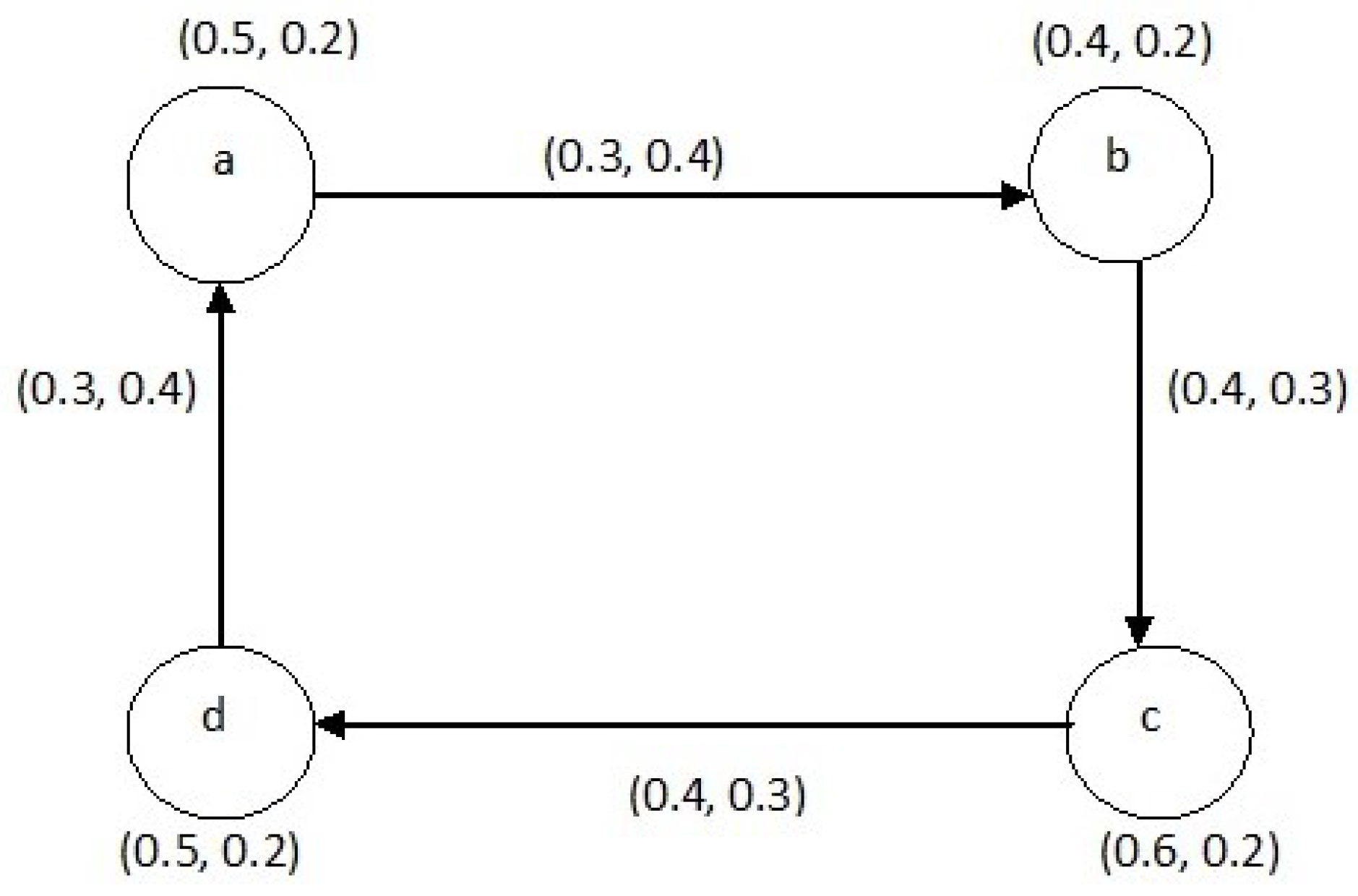
In the IFDG shown in Figure 1, we have
Figure 1.
Intuitionistic fuzzy digraph.
Now, we present the definition of the size of an IFDG.
Definition 20.
Let be a hidden digraph of . The size p of is defined as
for all
Example 2.
Referring to the IFDG shown in Figure 1, we have
Here, we present the definition of a strong arc in an IFDG, which plays a crucial role in the rest of this paper.
Definition 21.
An arc of an IFDG is said to be a strong arc if and ; otherwise, the arc is non-strong.
Afterwards, we present different types of strong arcs in IFDGs, such as semi -strong arcs, semi -strong arcs, etc.
Definition 22.
An arc of an IFDG is a semi β-strong arc if and
Definition 23.
An arc of an IFDG is a semi δ-strong arc if and
In Example 3, we analyze the strong arcs among those depicted in the IFDG given in Figure 1.
Example 3.
We determine which arcs in the IFDG shown in Figure 1 are considered strong arcs and which ones are not.
- Case Consider the arc ; = 0.3 and = 0.4. Now, = sup = 0.3 and = sup = 0.4. Therefore, = 0.3 and = 0.3. Hence, the arc is a strong arc.
- Case Let us consider an arc ; = 0.4 and = 0.3. Now, = sup = 0.4 and = inf = 0.3. Therefore, = 0.4 and = 0.3. Hence, the arc is a strong arc.
- Case Let us consider the arc ; = 0.4 and = 0.3. Now, = sup = 0.4 and = inf =0.3. Therefore, = 0.4 and = 0.3. Hence, the arc is a strong arc.
- Case Let us consider the arc ; = 0.3 and = 0.4. Now, = sup = 0.3 and = inf = 0.4. Therefore, = 0.3 and = 0.4. Hence, the arc is a strong arc.
- Case Consider the arc ; = 0.2 and = 0.2. Now, = sup = sup{0.3,0.4} = 0.4 and = inf = inf{0.4, 0.3} = 0.3. Therefore, and = 0.3. Hence, the arc is not a strong arc.
In Definition 24, we introduce the terms strong neighborhood (SNbhd) and closed neighborhood (CNbhd) along with their types and cardinalities.
Definition 24.
Let be a hidden digraph of an IFDG . Then,
- (i)
- = {: is strong arc} is the SNbhd of . Similarly, the CNbhd of s is = .
- (ii)
- = {: arc is semi β-strong arc} is known as the semi β-SNbhd of and CNbhd of s is .
- (iii)
- = {: is semi δ-strong arc} is known as the semi δ-SNbhd of and CNbhd of s is.
- (iv)
- = is the minimum cardinality of the SNbhd.
- (v)
- = is the maximum cardinality of the SNbhd.
Theorem 1.
If two nodes of an IFDG are linked by one dipath, then every arc of is a strong arc.
Proof.
Let be a connected IFDG with n nodes. If we take , then s and t must be adjacent by one arc (because is a connected IFDG). Clearly, and . Hence, an arc is a strong arc. Let . In any IF dipath, and for any arc in the dipath , as they are connected through the same dipath. Thus, it is proven that and for any number of arcs in a given dipath. Hence, all the arcs are strong. □
Corollary 1.
In an IF dipath, each arc is a strong arc.
Theorem 2.
In a non-trivial connected IFDG with n nodes such that , has at least one strong arc.
Proof.
Let be a connected IFDG with vertices . Assume that s and t are the two nodes of .
- When : Because is a connected IFDG, s and t are two nodes such that is an arc. From Theorem 1, only one strongest dipath between s and t exists such that and . Hence, is a strong arc.
- When : Assume that has at least one strong arc. Because is connected with , there exists more than one dipath between s and t such that at least one strong dipath exists. Thus, and (from Theorem 1). If this does not hold, there is no dipath between s and t. Hence, is a disconnected digraph, which contradicts our hypothesis that is connected. Therefore, if , then non-trivial connected IFDG has at least one strong arc. □
Theorem 3.
Let be the arc of IFDG . Then, the following conditions are equivalent.
In , an arc is a strong arc.
An arc must be semi β-strong and semi δ-strong.
The membership degree and non-membership degree of arc must be in between the closed interval , where the smallest value of the membership degree of the IFDG is , and the largest value of the non-membership degree of the IFDG is
Definition 25.
Let be an IFDG and s, t be any two vertices of . Then, s dominates t, if the arc is a strong arc.
Example 4.
Referring to the IFDG given in Figure 1, the arcs are strong arcs but the arc is a non-strong arc. Thus, l dominates m, m dominates n and n dominates k, but m does not dominate k.
Definition 26.
A DS of IFDG is a subset N1 of if, for each N1, there exists N1 such that s dominates t. A DS is an MDS if there is no proper subset of that is a DS. The minimum cardinality from all MDSs is a lower DN of and it is abbreviated as . The maximum cardinality from all MDSs is an upper DN of and is abbreviated as The minimum fuzzy cardinality from all DSs of an IFDG is known as the strong arc DN and is symbolically written as . The corresponding DS is known as the minimum strong arc DS and the number of elements in the minimum strong arc DS is known as .
Example 5.
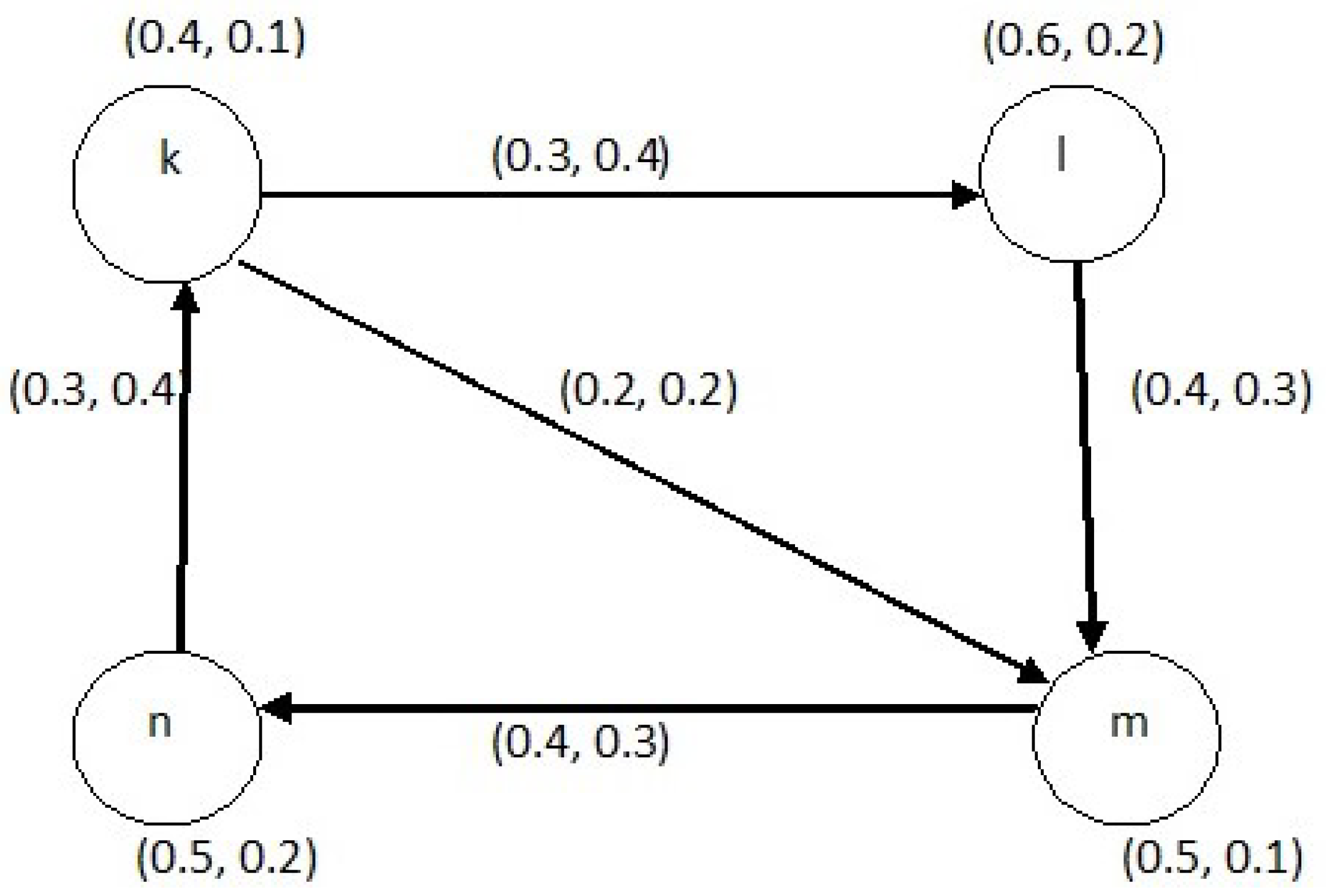
Consider a set of vertices in an IFDG, as shown in Figure 2. Let N1 = be the DS lying in N. Let be the set of vertices other than N1, such that each of its vertices dominates at least one vertex in N, which implies that N1 is a DS. Again, consider that N2 = is the DS lying in N. Let be the set other than N2 such that each of its vertices dominates at least one vertex in N, which implies that N2 is a DS. Thus, the DSs are and , while is the MDS of minimum cardinality 1.25 and is the MDS of maximum cardinality 1.35.
Figure 2.
Intuitionistic fuzzy digraph.
Definition 27.
The open Nbhd of s in an IFDG is represented as and is defined as . The vertex t is known as the SN of s if an arc is a strong arc, and the set of all SNs of s is known as the SNbhd of s and is abbreviated as . Similarly, is the CSNbhd of
Example 6.
Referring to the IFDG given in Figure 1, one can easily deduce that the arcs are strong arcs, while the arc is a non-strong arc. The SN of k is l. Thus, is the CSNbhd of
Definition 28.
Let be an IFDG and be any two vertices of Then,
- (i)
- s semi β- dominates t, if the arc is a semi β-strong arc;
- (ii)
- s semi δ- dominates t, if an arc is a semi δ-strong arc.
Remark 1.
Semi β- strong arc DN is . The number of elements in the minimum semi β- strong arc DS is symbolically written as
- (ii)
- Semi δ - strong arc DN is described as . The number of elements in the minimum semi δ - strong arc DS is represented as
Definition 29.
Two vertices s and t of an IFDG are called isolated vertices if and . Secondly, = ∅, which implies that there does not exist any Nbhd of s. Thus, an isolated vertex cannot dominate any other vertex of .
Theorem 4.
In an IFDG , a DS is an MDS if, for each , one of the following conditions holds.
- (i)
- s is not an SN of any vertex in
- (ii)
- there exists a vertex such that
Proof.
Assume that is an MDS of . For each vertex , is not a DS. Then, exists and is not dominated by any vertex in . If , then t is not an SN of any vertex in . If , t is not dominated by , but it is dominated by , and there is a vertex t that is the only SN of s in . Hence,
Conversely, consider that is a DS. For every vertex , one of the two given conditions holds true. Assume that is not an MDS. Thus, there exists a vertex , that is a DS. Hence, s is an SN to one of the vertices in , so condition (i) does not hold true. If is a DS, then each vertex of is an SN to one of the vertices in , and condition (ii) also does not hold true. This is a contradiction of our hypothesis that one of the two conditions holds true. Thus, is an MDS. □
Theorem 5.
Let = be an IFDG with no isolated vertex. Let be an MDS. Then, is a DS of .
Proof.
Assume that is an MDS. Consider that t is a vertex of . As does not have isolated vertices and there exists a vertex , t is dominated by one of the vertices in , i.e., is a DS. From Theorem 4, . Thus, each vertex in is dominated by one of the vertices in and is a DS. □
Corollary 2.
If there is no isolated vertex in an IFDG , then .
Proof.
Let be an IFDG with no isolated vertex. Then, it has two disjoint DSs, i.e., . □
Definition 30.
Two vertices s and t of an IFDG are called independent if there is no strong edge between these two vertices. A subset of N is known as an independent set (IS) of an IFDG if the following conditions hold:
for all
Definition 31.
An IS in an IFDG is called a maximal independent set (MIS) if the set is not independent for every . The minimum cardinality between the MISs is called the lower independent number of an IFDG , represented by . The maximum cardinality between the MISs is called the upper independent number of an IFDG , represented as
Theorem 6.
An IS is an MIS in an IFDG if and only if it is an IS and DS.
Proof.
Let be an MIS of IFDG . Then, for each vertex , the set is not independent. Moreover, for each vertex , there exists a vertex such that t is an SN of s. Hence, is a DS. Thus, is both a DS and IS.
Conversely, let be an IS and DS. If is not an MIS, there is a vertex such that the set is independent. If is independent, then there is no vertex in that is an SN of s. Hence, is not a DS, which contradicts our assumption. Thus, is an MIS. □
Theorem 7.
Every MIS in an IFDG is an MDS.
Proof.
Let be an MIS of an IFDG. By assumption, is a DS but not an MDS. Then, there exists at least one vertex such that is a DS. If dominates , then there is at least one vertex in that is necessarily an SN of t, which contradicts our assumption. Hence, is an MDS. □
Definition 32.
In IFDG , a subset of vertex set N is known as status S if each vertex obeys the property that the vertex g dominates the vertices in and is equal to the set of vertices in that is dominated by h.
Remark 2.
Each vertex in status S dominates the same set of vertices outside the status. It can be seen that the status must contain at least two vertices.
Theorem 8.
If a status S of a connected non-trivial IFDG is an MDS, then S is an independent DS with cardinality 2.
Proof.
Let S be a status that is an MDS. As is connected with no isolated vertex, then there exists at least one vertex . As S is an MDS, g is adjoint at least in the S, and since S is the status, each node of S is adjoint to the g. Additionally, every vertex of S is adjoint to the each vertex in . Thus, , because S is the status. Now, consider and assume that h belongs to S and g belongs to . Since S is the status, it implies that h is adjoint to each vertex of and g is adjoint to every other vertex of S. Hence, the DS is , which contradicts our assumption that S is the minimal set. Thus, . However, if h is adjoint to the g, then the DS of is g, which is again a contradiction that S is the minimal set. Consequently, is an IS. □
Definition 33.
Let g and h be any two vertices of an IFDG. Then, these two vertices are called structurally equivalent if either or . A set S is called structurally equivalent if each of the two vertices in S is structurally equivalent.
Corollary 3.
Let be a connected IFDG. Let S be an MDS that is structurally equivalent. Then, the set S has two independent vertices such that each vertex has a degree
4. Application of Domination in IFDGs towards Social Networks
Graphs have various applications in many areas of science, such as chemistry, physics, biology, mathematics, computer science and others. In the organization model, it has been noted that, in a group, there is a connection between two workers. It is also necessary to conclude that, in a graph, one worker is more dominant or influential. Using the graph, we can draw this scenario. In a specific group, we can draw a graph in which each vertex represents each worker. In the graph, the directed edges show the relationship between two workers from one particular vertex (worker) to another. Multiple edges or loops are not needed in these types of graphs. In classical graph theory, every vertex has equal importance. It is not possible to draw such types of graphs in an organization model accurately. Additionally, in classical graph theory, every organization in a social unit (individual or organization) should have equal importance, but the situation is different in real life. Similarly, in classical graph theory, every directed edge has equal strength. Thus, the influence of the worker has fuzzy directed boundaries. It is useful to represent these situations in fuzzy directed graphs. Every vertex represents a worker and the strength of his influence in the organization model, and it is represented by the membership value in the fuzzy directed influential graph. Since the developed form of FS is the IFS, domination in IFDGs provides better results as compared to fuzzy directed graphs.
4.1. Fuzzy Influence Digraph
Let us consider an organization with workers and their designations. Let S = {BOD, CEO, CTO, DM, DPD, DHR, Stt } be the set of workers for this organization, as shown in Table 1. By conducting research on the organization, we conclude the following.
Table 1.
Designations of workers in an organization and abbreviations used for their designations.
- (i)
- The CEO has worked with the DM for about 8 years, and, on strategic initiatives, he gives importance to his input.
- (ii)
- The BOD has been chaired for about 8 years and is associated with the DM. Similarly to the CEO, the BOD also values the DM.
- (iii)
- In reorganization, the whole marketing scheme is vital but the DHR is more vital.
- (iv)
- There is a history of disputes between the CTO and DHR.
- (v)
- The CTO has more influence on the DPD.
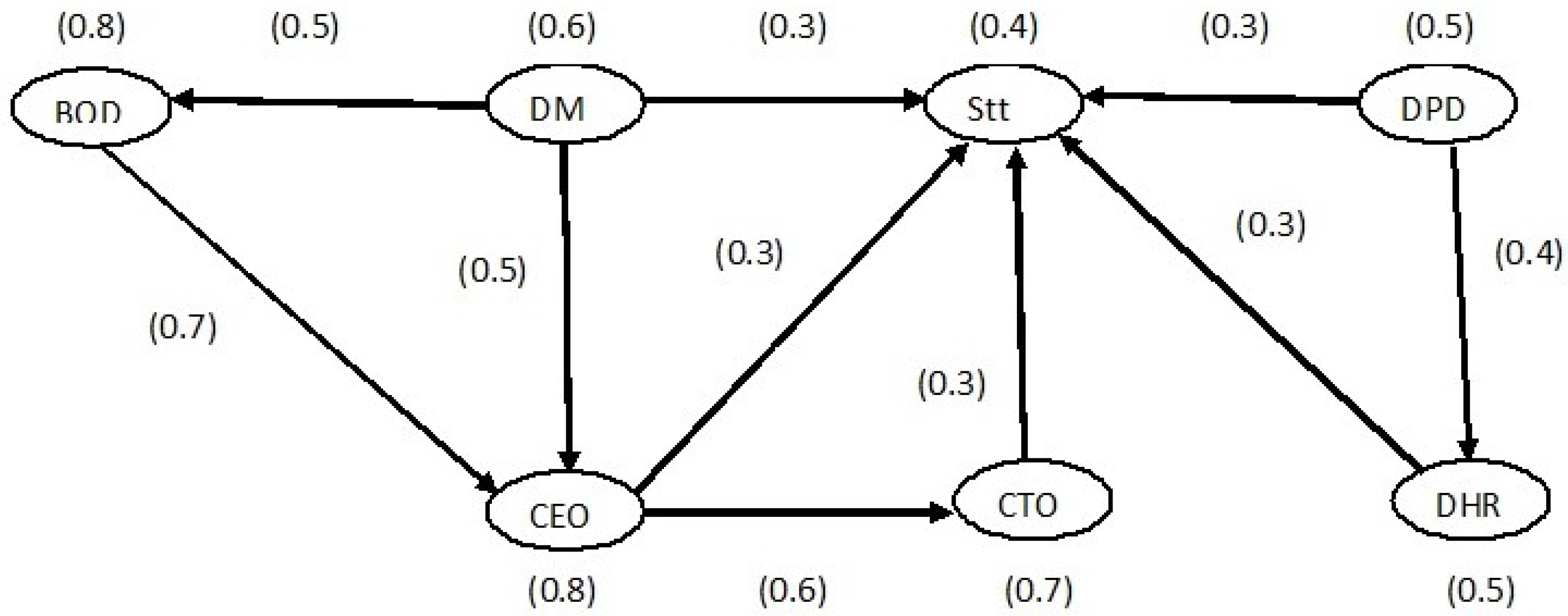
An influence digraph can be drawn by observing the above-mentioned points, but this type of digraph does not show the power of the workers in an organization and also the degree of influence of workers on one another. It is important to show them in fuzzy sets as their influence and power have no definite limits. The influence of workers on one another can be represented through a fuzzy digraph, but there exists hesitation in evaluating their influence. We consider a fuzzy directed influential graph of this organization, shown in Figure 3. The organization is represented by the nodes and its membership value represents the degree of influence. The degree of membership represents how influential the worker is? in the organization. The BOD has an level of influence. In the digraph, the directed edges show the influence level of one worker on the other workers within the organization. The membership degree of the directed edges is considered as a positive percentage of influence, e.g., the DM has a influence on both the BOD and CEO. Thus, the DM dominates both the BOD and CEO, which is why it is busier and more influential than the others.
Figure 3.
Fuzzy directed influence graph.
While dealing with the above circumstances through FDGs, we have only the degree of acceptance and there is no information about the degree of non-acceptance of the lower staff members. Hence, there is a lack of information that can be properly manipulated through the IFDGs.
4.2. Intuitionistic Fuzzy Influence Digraph
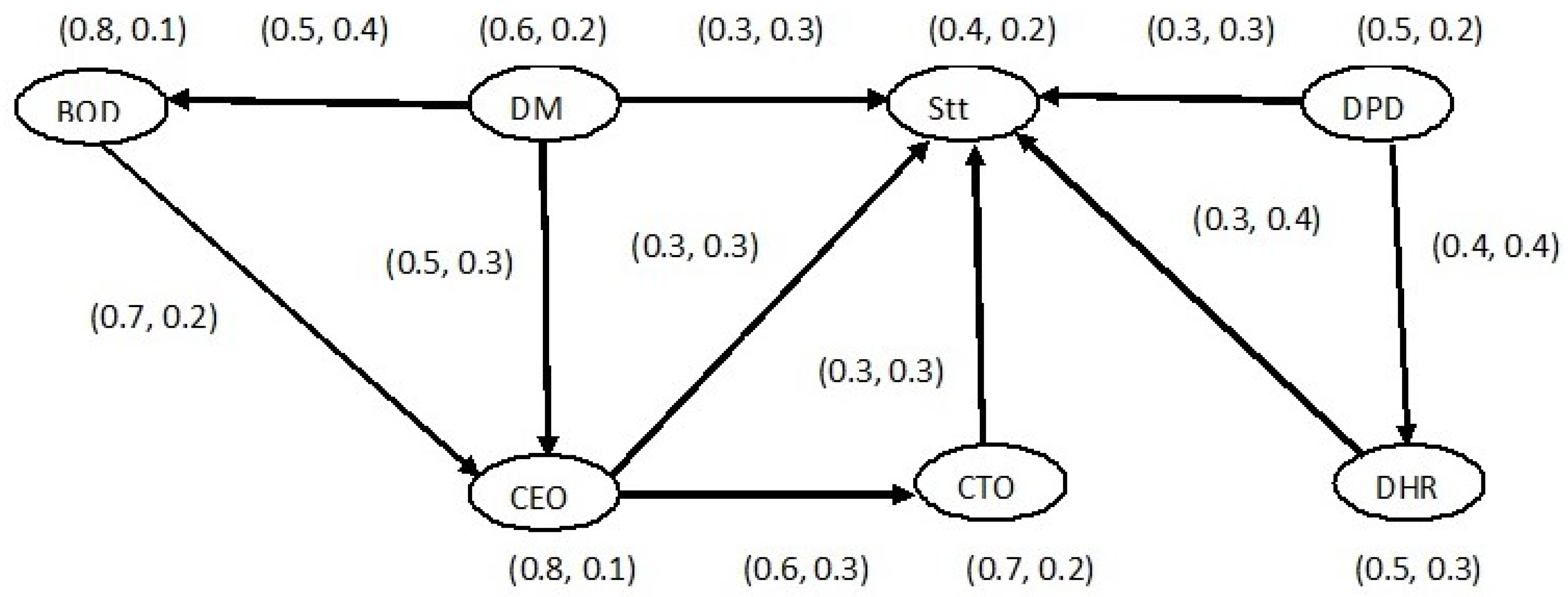
Since the power and influence of workers cannot be properly described in fuzzy digraphs, we use an IFDG, which gives better results as compared to FGs. In an IFDG, the directed edges are used to show the influence. The resulting IFDG is shown in Figure 4, and Table 2 shows the allocated membership and non-membership values. In the IFDG, the vertices also represent the workers along with their power in terms of membership and non-membership degrees, which are described by percentages. For instance, the CEO has power in the organization. Likewise, in the IFDG, the directed edges show the influence of one worker on another. The membership and non-membership degrees can also be referred to as a positive influence and negative influence, respectively. For instance, the BOD has a influence on the DM’s opinion but he does not follow his opinion of the time. In Figure 4, it can be seen that the DM has an influence on both the BOD and CEO. As the membership degrees in both cases are , which is , his influence on both of them is the same. In the case of the CEO, the hesitation degree is , which is , but it is in the case of the BOD, which is , which shows that the CEO has more hesitation than the BOD. It is clear that the most influential worker within the organization is the DM. He has a great influence on both the BOD and CEO; each has power. Clearly, all the arcs are strong but the DM dominates the BOD, CEO and Stt. Hence, the most influential worker in the organization is the DM.
Figure 4.
Intuitionistic fuzzy directed influence graph.
Table 2.
Power of workers allocated in terms of membership and non-membership degrees.
5. Conclusions
In this article, we have introduced the notion of domination in IFDGs based on SAs, along with several fundamental properties and applications. We have extended the concepts of domination in FDGs. Since dominations in picture fuzzy graphs and bipolar picture fuzzy graphs were introduced in the literature, but the concept of domination in IFDGs was missing, we have also filled this gap the literature related to domination. At the beginning of our study, we introduced several types of strong arcs in IFDGs, like semi- strong arcs, semi- strong arcs, etc. Then, we introduced the concept of domination in IFDGs based on these strong arcs and discussed its various useful characteristics. Moreover, the dominating set (DS), minimal dominating set (MDS), etc., were described with some fascinating results. We have also introduced the concept of an independent set in an IFDG and investigated its relations with the DS, minimal independent set (MIS) and MDS. We have also provided numerous important characterizations of domination in IFDGs based on the minimal and maximal dominating sets. In this context, we have discussed the lower and upper dominations of some IFDGs. In addition, we have introduced the terms status and structurally equivalent and explored a few relationships with the dominations in IFDGs. Finally, we have investigated the most expert (influential) person in the organization by using the concepts of domination in IFGs. One could extend these concepts towards other extended forms of FGs, like spherical picture fuzzy graphs.
Author Contributions
Conceptualization, H.G., W.A.K., A.F., K.A., J.S. and A.K.; methodology, H.G., W.A.K., A.F., K.A., J.S. and A.K.; validation, H.G., W.A.K. and A.F.; formal analysis, H.G., W.A.K., A.F., K.A., J.S. and A.K.; investigation, W.A.K., A.F. and K.A.; writing—original draft preparation, H.G., W.A.K., A.F., K.A., J.S. and A.K.; writing—review and editing, J.S. and A.K.; supervision, H.G. and W.A.K. All authors have read and agreed to the published version of the manuscript.
Funding
This research received no external funding.
Data Availability Statement
Data are contained within the article.
Conflicts of Interest
The authors declare no conflicts of interest.
References
- Zadeh, L.A. Fuzzy sets. Inform. Control. 1965, 8, 338–353. [Google Scholar] [CrossRef]
- Zadeh, L.A. The concept of a linguistic variable and its application to approximate reasoning-I. Inform. Sci. 1975, 8, 199–249. [Google Scholar] [CrossRef]
- Atanassov, K.T.; Stoeva, S. Intuitionistic fuzzy sets. Fuzzy Sets Syst. 1986, 20, 87–96. [Google Scholar] [CrossRef]
- Rosenfield, A. Fuzzy Graphs, Fuzzy Sets and Their Applications to Cognitive and Decision Processes; Academic Press: New York, NY, USA, 1975; pp. 77–95. [Google Scholar]
- Kauffman, A. Introduction a 1a Theories des Sous-Emsembles Flous; Masson et cie: Paris, France, 1973; p. 1. [Google Scholar]
- Bhattacharya, P. Some remarks on fuzzy graphs. Pattern Recognit. Lett. 1987, 6, 297–302. [Google Scholar] [CrossRef]
- Mordeson, J.N.; Peng, C.S. Operations on fuzzy graphs. Inform. Sci. 1994, 79, 159–170. [Google Scholar] [CrossRef]
- Borzooei, R.A.; Rashmanlou, H. Cayley interval-valued fuzzy graphs. Upb Sci. Bull. Ser. Appl. Math. Phys. 2016, 78, 83–94. [Google Scholar]
- Sunitha, M.S.; Vijayakumar, A. Complement of a fuzzy graphs. Indian J. Pure Appl. Math. 2002, 33, 1451–1464. [Google Scholar]
- Poulik, S.; Ghorial, G. Estimation of most effected cycles and busiest network route based on complexity function of graph in fuzzy environment. Artif. Intell. Rev. 2022, 55, 4557–4574. [Google Scholar] [CrossRef]
- Mordeson, J.; Nair, P. Successor and source of (fuzzy) finite state machines and (fuzzy) directed graphs. Inf. Sci. 1996, 95, 113–124. [Google Scholar] [CrossRef]
- Kumar, P.K.K.; Lavanya, S. On fuzzy digraphs. Int. J. Pure Appl. Math. 2017, 115, 599–606. [Google Scholar] [CrossRef]
- Akram, M.; Alshehri, N.; Davvaz, B.; Ashraf, A. Bipolar Fuzzy Digraphs in Decision Support Systems. J. Mult. Valued Log. Soft Comput. 2016, 27, 553–572. [Google Scholar]
- Shannon, A.; Atanassov, K.T. A first step to a theory of the intuitionistic fuzzy graphs. In Proceedings of the FUBEST, Sofia, Bulgaria, 28–30 September 1994; Lakov, D., Ed.; Sofia: Paris, France, 1994; pp. 59–61. [Google Scholar]
- Yaqoob, N.; Gulistan, M.; Kadry, S.; Wahab, H.A. Complex Intuitionistic Fuzzy Graphs with Application in Cellular Network Provider Companies. Mathematics 2019, 7, 35. [Google Scholar] [CrossRef]
- Akram, M.; Davvaz, B. Strong intuitionistic fuzzy graphs. Filomat 2012, 26, 177–195. [Google Scholar] [CrossRef]
- Akram, M.; Dudek, W.A. Intuitionistic fuzzy hypergraphs with applications. Inform. Sci. 2013, 218, 182–193. [Google Scholar] [CrossRef]
- Akram, M.; Al-Shehrie, N.O. Intuitionistic fuzzy cycles and intuitionistic fuzzy trees. Sci. World J. 2014, 2014, 305836. [Google Scholar] [CrossRef] [PubMed]
- Akram, M.; Ashraf, A.; Sarwar, M. Novel applications of intuitionistic fuzzy digraphs in decision support systems. Sci. World J. 2014, 2014, 904606. [Google Scholar] [CrossRef] [PubMed]
- Shao, Z.; Kosari, S.; Rashmanlou, H.; Shoaib, M. New concepts in intuitionistic fuzzy graph with application in water supplier systems. Mathematics 2020, 8, 1241. [Google Scholar] [CrossRef]
- Talebi, A.A.; Rashmanlou, H.; Sadati, S.H. Interval-valued Intuitionistic Fuzzy Competition Graph. J. Mult. Valued Log. Soft Comput. 2020, 34, 335. [Google Scholar]
- Rashmanlou, H.; Borzooei, R.A.; Samanta, S.; Pal, M. Properties of interval valued intuitionistic (s, t)–fuzzy graphs. Pac. Sci. Rev. Nat. Sci. Eng. 2016, 18, 30–37. [Google Scholar] [CrossRef]
- Rashmanlou, H.; Borzooei, R.A. New concepts of interval-valued intuitionistic (S, T)-fuzzy graphs. J. Intell. Fuzzy Syst. 2016, 30, 1893–1901. [Google Scholar] [CrossRef]
- Talebi, A.A.; Rashmanlou, H.; Sadati, S.H. New concepts on m-polar interval-valued intuitionistic fuzzy graph. TWMS J. Appl. Eng. Math. 2020, 10, 806–818. [Google Scholar]
- Singh, S.; Barve, A.; Muduli, K.; Kumar, A.; Luthra, S. Evaluating roadblocks to implementing a green freight transportation system an interval valued intuitionistic fuzzy digraph matrix approach. IEEE Trans. Eng. Manag. 2022, 71, 2758–2771. [Google Scholar] [CrossRef]
- Nithyanandham, D.; Augustin, F.; Micheal, D.R.; Pillai, N.D. Energy based bipolar intuitionistic fuzzy digraph decision-making system in selecting COVID-19 vaccines. Appl. Soft Comput. 2023, 147, 110793. [Google Scholar] [CrossRef]
- Shi, X.; Kosari, S.; Talebi, A.A.; Sadati, S.H.; Rashmanlou, H. Investigation of the main energies of picture fuzzy graph and its applications. Int. J. Comput. Intell. Syst. 2022, 15, 31. [Google Scholar] [CrossRef]
- Yue, J.; Wei, M.; Li, M.; Liu, G. On the double Roman domination of graphs. Appl. Math. Comput. 2018, 338, 669–675. [Google Scholar] [CrossRef]
- Ahangar, H.A.; Álvarez, M.; Chellali, M.; Sheikholeslami, S.; Valenzuela-Tripodoro, J. Triple Roman domination in graphs. Appl. Math. Comput. 2021, 391, 125444. [Google Scholar]
- Henning, M.A.; MacGillivray, G.; Yang, F. Broadcast domination in graphs. In Structures of Domination in Graphs; Haynes, T.W., Hedetniemi, S.T., Henning, M.A., Eds.; Springer International Publishing: Cham, Switzerland, 2021; pp. 15–46. [Google Scholar]
- Dayap, J.A.; Enriquez, E.L. Outer-convex domination in graphs. Discret. Math. Algorithms Appl. 2019, 12, 2050008. [Google Scholar] [CrossRef]
- Desormeaux, W.J.; Haynes, T.W.; Henning, M.A. Paired Domination in Graphs. In Topics in Domination in Graphs; Springer International Publishing: Cham, Switzerland, 2020; pp. 31–77. [Google Scholar]
- Kosari, S.; Asgharsharghi, L. The l-distance k-rainbow domination numbers of graphs. Asian-Eur. J. Math. 2023, 16, 2350040. [Google Scholar] [CrossRef]
- Mihara, S.; Tsugawa, S.; Ohsaki, H. Influence maximization problem for unknown social networks. In Proceedings of the 2015 IEEE/ACM International Conference on Advances in Social Networks Analysis and Mining 2015, Paris, France, 25–28 August 2015; pp. 1539–1546. [Google Scholar]
- Chen, W.; Wang, Y.; Yang, S. Efficient influence maximization in social networks. In Proceedings of the 15th ACM SIGKDD International Conference on Knowledge Discovery and Data Mining, Paris, France, 28 June–1 July 2009; pp. 199–208. [Google Scholar]
- Somasundaram, A.; Somasundaram, S. Domination in fuzzy graphs-I. Pattern Recognit. Lett. 1998, 19, 787–791. [Google Scholar] [CrossRef]
- Nagoorgani, A.; Chandrasekaran, V.T. Domination in Fuzzy graph. Adv. Fuzzy Syst. 2006, 1, 17–26. [Google Scholar]
- Manjusha, O.T. Global domination in Fuzzy graphs using Strong arcs. J. Fuzzy Ext. Appl. 2023, 4, 8–17. [Google Scholar]
- Shanmugam, S.; Aishwarya, T.P.; Shreya, N. Bridge domination in fuzzy graphs. J. Fuzzy Ext. Appl. 2023, 4, 148–154. [Google Scholar]
- Enriquez, E.; Estrada, G.; Loquias, C.; Bacalso, R.J.; Ocampo, L. Domination in fuzzy directed graphs. Mathematics 2021, 9, 2143. [Google Scholar] [CrossRef]
- Noppakaew, P.; Hengthonglert, K.; Sakuntasathien, S. Dominating broadcasts in fuzzy graphs. Mathematics 2022, 10, 281. [Google Scholar] [CrossRef]
- Ahmad, U.; Batool, T. Domination in rough fuzzy digraphs with application. Soft Comput. 2023, 27, 2425–2442. [Google Scholar] [CrossRef]
- Qiang, X.; Akhoundi, M.; Kou, Z.; Liu, X.; Kosari, S. Novel concepts of domination in vague graphs with application in medicine. Math. Probl. Eng. 2021, 2021, 6121454. [Google Scholar] [CrossRef]
- Shi, X.; Kosari, S. Certain properties of domination in product vague graphs with an application in medicine. Front. Phys. 2021, 9, 680634. [Google Scholar] [CrossRef]
- Kosari, S.; Shao, Z.; Rao, Y.; Liu, X.; Cai, R.; Rashmanlou, H. Some Types of Domination in Vague Graphs with Application in Medicine. J. Mult. Valued Log. Soft Comput. 2023, 41, 203. [Google Scholar]
- Shao, Z.; Kosari, S.; Rao, Y.; Rashmanlou, H.; Mofidnakhaei, F. New Kind of Vague Graphs With Novel Application. J. Mult. Valued Log. Soft Comput. 2023, 40, 323. [Google Scholar]
- Parvathi, R.; Thamizhendhi, G. Domination in intuitionistic fuzzy graphs. Notes Intuitionistic Fuzzy Sets 2010, 16, 39–49. [Google Scholar]
- Nagoorgani, A.; Akram, M.; Anupriya, S. Double domination on intuitionistic fuzzy graphs. J. Appl. Math. Comput. 2016, 52, 515–528. [Google Scholar] [CrossRef]
- Khan, W.A.; Taouti, A. Dominations in bipolar picture fuzzy graphs and social networks. Results Nonlinear Anal. 2023, 6, 60–74. [Google Scholar]
- Diestel, R. Graph Theory; Springer: New York, NY, USA, 2000. [Google Scholar]
- Senthilkumar, V. Types of domination in intuitionistic fuzzy graph by strong arc and effective arc. Bull. Pure Appl. Sci. Math. Stat. 2018, 37, 490–498. [Google Scholar] [CrossRef]
Disclaimer/Publisher’s Note: The statements, opinions and data contained in all publications are solely those of the individual author(s) and contributor(s) and not of MDPI and/or the editor(s). MDPI and/or the editor(s) disclaim responsibility for any injury to people or property resulting from any ideas, methods, instructions or products referred to in the content. |
© 2024 by the authors. Licensee MDPI, Basel, Switzerland. This article is an open access article distributed under the terms and conditions of the Creative Commons Attribution (CC BY) license (https://creativecommons.org/licenses/by/4.0/).