


Abstract
Any triangle in an isotropic plane has a circumcircle u and incircle i. It turns out that there are infinitely many triangles with the same circumcircle u and incircle i. This one-parameter family of triangles is called a poristic system of triangles. We study the trace of the centroid, the Feuerbach point, the symmedian point, the Gergonne point, the Steiner point and the Brocard points for such a system of triangles. We also study the traces of some further points associated with the triangles of the poristic family, and we prove that the vertices of the contact triangle, tangential triangle and anticomplementary triangle move on circles while the initial triangle traverses the poristic family.
Keywords:
isotropic plane; Poncelet porism; centroid; Feuerbach point; symmedian point; Gergonne point; Steiner point; Brocard points MSC:
51N25
1. Introduction
A porism is a theorem about a closure property of a geometric figure or construction, as explained in [1] (pp. 412–417). A well-known example comes from the elementary triangle geometry. Any triangle in the Euclidean plane has a circumcircle u and incircle i. It turns out that there are infinitely many triangles with the same circumcircle u and incircle i. In other words, if we pick a point on u and draw a tangent from to i, then intersects u in points and . Now, we draw a tangent from to i that intersects u in and . Finally, we draw a tangent from to i that intersects u in and . It turns out that . The one-parameter family of triangles with a common incircle and a common circumcircle is usually called a porisitic system of triangles. In the Euclidean plane, the poristic family of triangles interscribed in between the incircle and the circumcircle is called Chapple’s porism. The fact that such families exist even in some non-Euclidean planes is due to the projective nature of the problem. Hence, it is not necessary to prove the existence of a closed triangular path between two isotropic circles (Euclidean parabolas with parallel axes). Nevertheless, in Section 3.1, in order to obtain a parametrization of the poristic family, we offer the proof that the described property is also valid in an isotropic plane.
In [2], the author showed that many triangle centers move on circles while the triangle traces the poristic family. Some centers move on conics, and some centers move on curves of a higher degree. In this paper, in Section 3.2, we study the loci of some triangle centers in the isotropic plane. A further investigation of the loci of triangle centers in the Euclidean plane is given in [3], where the authors studied a poristic family defined by two confocal ellipses.
In Section 3.3, we study the traces of the vertices of the contact triangle, tangential triangle and anticomplementary triangle associated with the triangle of the poristic family in the isotropic plane.
2. Methods
An isotropic plane is a projective plane with a distinct line f and a distinct point . Lines incident with the absolute point F are called isotropic lines, and points incident with the absolute line f are called isotropic points. Two lines are said to be parallel if their intersection point is an isotropic point, while two points are said to be parallel if they are joined by an isotropic line.
The basic facts about the isotropic plane can be found in [4]. Here, we highlight the ones that are important for our study.
The standard affine model of the isotropic plane, where the coordinates of points are given by and , is obtained by setting and . In this model, the isotropic lines have equations of the form with . The isotropic distance of a pair of two non-parallel points and is defined by , while two non-parallel lines p and q, given by the equations and , respectively, form the isotropic angle defined by . The midpoint of points P and Q is defined in a natural way as the point with coordinates , while the bisector of lines p and q is the line with the equation .
According to their position with respect to the absolute figure, conics are ellipses, hyperbolas, special hyperbolas, parabolas and circles, as explained in [4]. The most interesting conics for us are circles, conics that touch f at F.Therefore, a circle has an equation of the form with .
A curve in the isotropic plane is said to be circular if it passes through the absolute point F. If the curve intersects f only at F, then it is entirely circular, as explained in [5]. Thus, circles are entirely circular conics.
It was shown in [6] that any allowable triangle (triangle whose sides are non-isotropic lines) in the isotropic plane can be set in the so-called standard position by choosing an appropriate affine coordinate system and having the circumcircle u with the equation
and vertices
with .
Let , and be elementary symmetric functions in three variables a, b and c; in other words, let
The centroid, the symmedian point, the Gergonne point, the Feuerbach point and the Steiner point of the triangle are labeled , , , and , respectively, according to Kimberling’s encyclopedia [7].
The coordinates of the centroid of the triangle are
It was shown in [8] that the incircle i
and the Euler circle
touch each other externally at the Feuerbach point
The symmedians are the reflections of medians in the bisectors. According to [9], they intersect at the symmedian point of the triangle having the coordinates
The Gergonne point of the triangle is the intersection point of three lines , and , where , and are the contact points of the triangle and its incircle i. In [10], the coordinates of the Gergonne point of the standard triangle were determined as follows:
The Steiner point of the triangle is defined as the fourth (in addition to A, B and C) common point of the circumscribed circle u and circumscribed Steiner ellipse of that triangle, as explained in [11]. In the case of the standard triangle , this point has the coordinate vector
For every triangle in the isotropic plane, there is the first and the second Brocard point, and they are unique. The first Brocard point is defined as the point such that its connections with the vertices A, B and C form equal angles with the sides , and , respectively. Analogously, the second Brocard point is defined as the point such that its connection lines with the vertices A, B and C form equal angles with the sides , and , respectively. According to [12], the Brocard points and of the standard triangle are given by
where
In Section 3.2, we will show that in the isotropic plane, all triangles in a poristic system share the centroid and the Feuerbach point. The symmedian point and the Gergonne point of all triangles move on straight lines. The Steiner point traces a circle, while Brocard points trace a quartic curve.
3. Results
3.1. Poncelet’s Porism
In order to obtain an explicit parametrization of the poristic family, we assume that we are given a triangle with the vertices in Equation (2), a circumcircle u with Equation (1) and an incircle i with Equation (5). Let be a point on the circle u. The polar line p of with respect to i is
The intersections and of p and i are the points of contact of the tangents from to the incircle i:
where . Lines and intersect the circumcircle u at points and , respectively:
The connection line has the equation
and touches i at the point
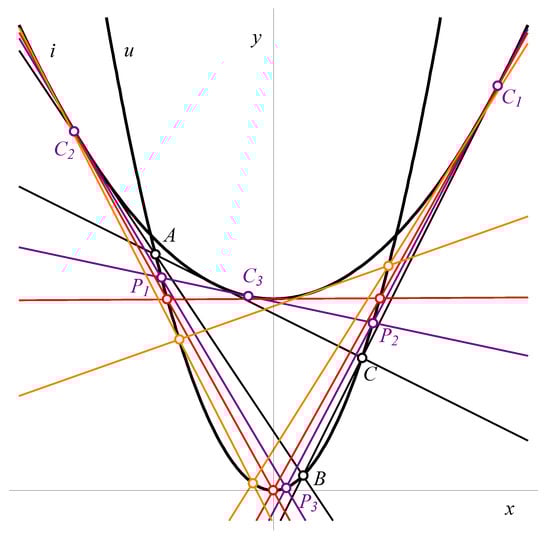
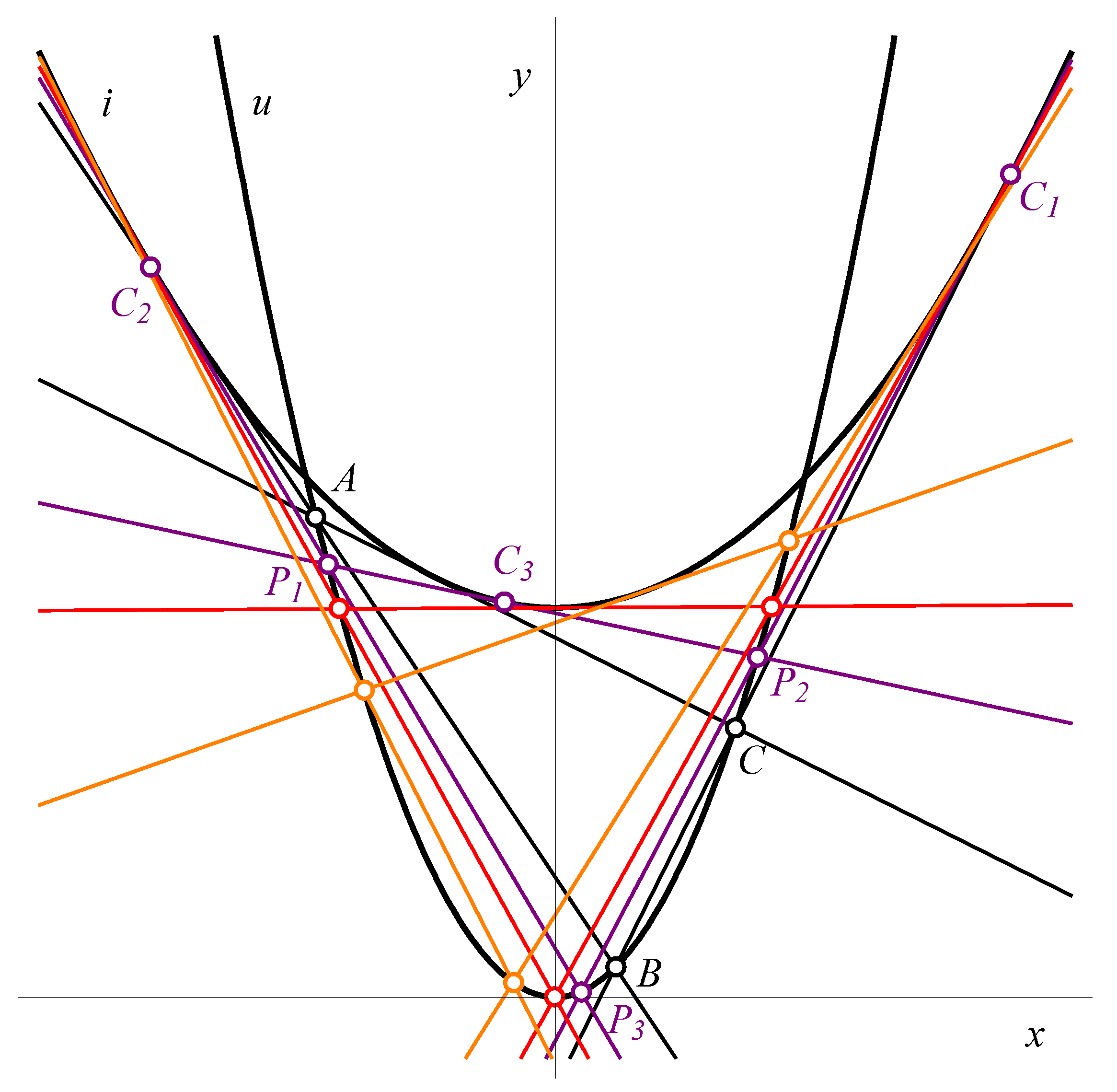
Thus, for any choice of the initial vertix , the triangle closes (see Figure 1).
Figure 1.
A porisitic system of triangles in the isotropic plane.
The triangles and share the centroid that has the coordinates
It follows from Equation (13) that all triangles in the poristic system are in the standard position, and therefore, Equations (3)–(12) for can be applied to . The points and values related to will be marked with a ★.
We should notice that all sides of the triangle will be real lines only if we chose the vertex as an outer of i, which is precisely the case when , and hence .
3.2. Loci of Centers in the Poristic System of Triangles
Let be a triangle from the poristic system with vertices
where .
The elementary symmetric functions related to are
Theorem 1.
The centroid and the Feuerbach point of triangle are fixed while the triangle traces its poristic family.
Proof.
We have already shown that Similarly, □
Theorem 2.
The Gergonne point of triangle moves on a line while the triangle traverses the poristic family.
Proof.
The Gergonne point of triangle has the coordinates . Thus, the Gergonne points of all triangles from the poristic family lie on the line g with the equation
the connection line of the intersections of the incircle i and circumcircle u. □
Theorem 3.
The symmedian point of triangle moves on a line if the triangle traverses the poristic family.
Proof.
The symmedian point of triangle has the coordinates . Thus, the symmedian point of all triangles from the poristic family moves on the line k with the equation
the connection line of the intersections of the circumcircle u and common Euler circle e given by Equation (6). □
Remark 1.
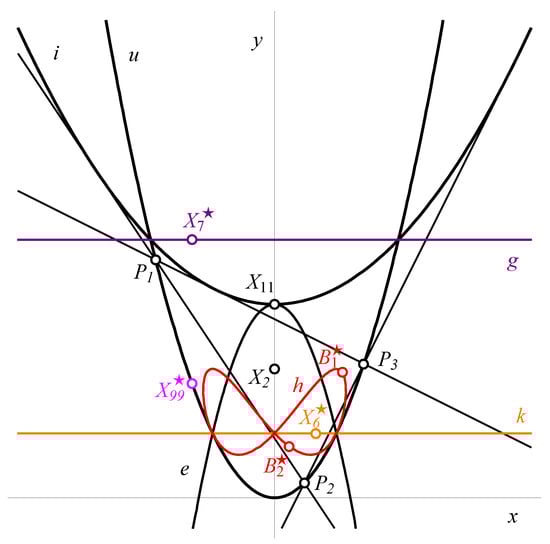
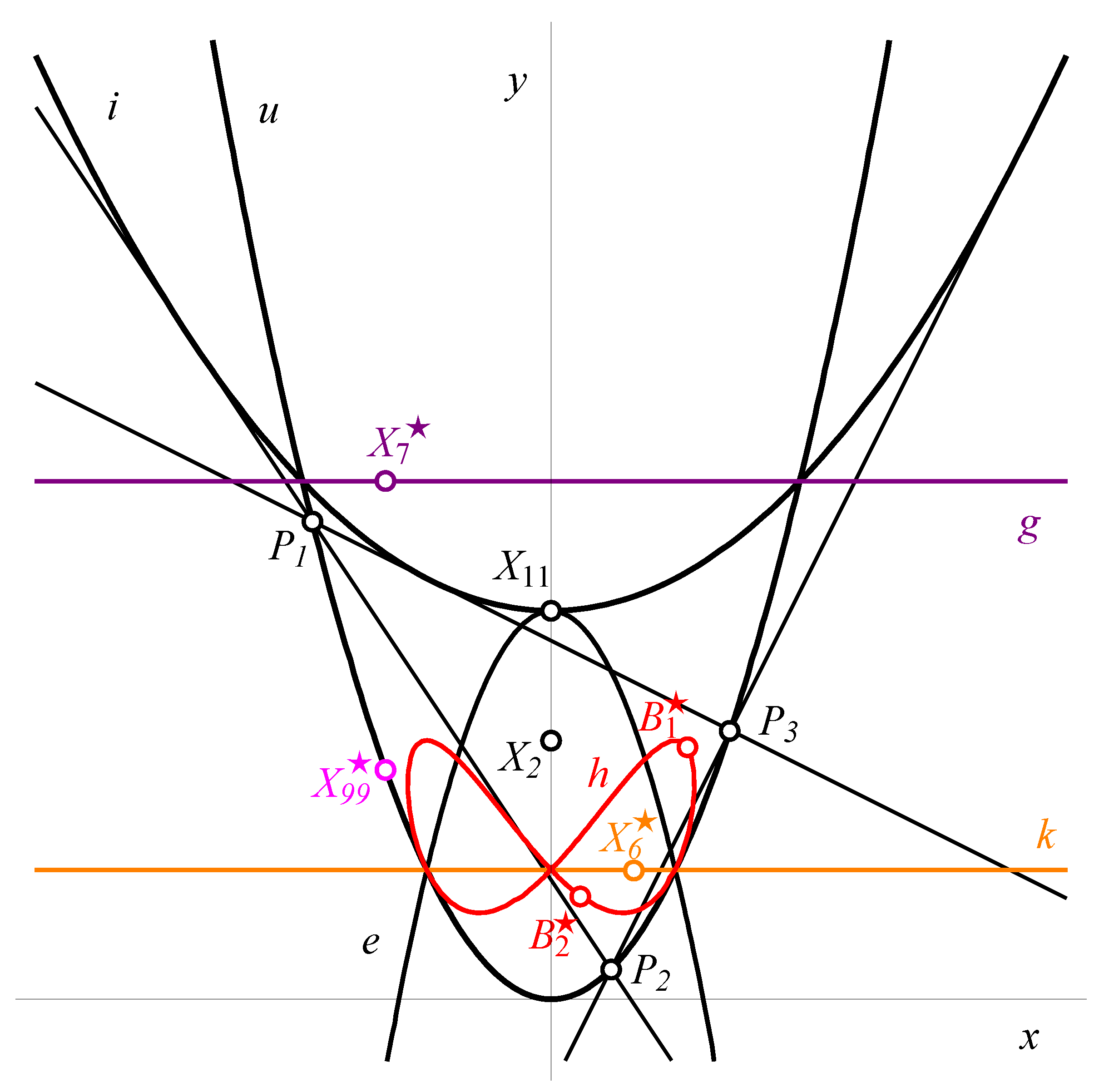
The locus of the Gergonne point and the locus of the symmedian point are parallel lines (see Figure 2).
Figure 2.
The loci of the symmedian point, the Gergonne point and the Brocard points for a porisitic system of triangles in the isotropic plane. The centroid and the Feuerbach point are fixed points.
Theorem 4.
The Steiner point of triangle moves on a circle when the triangle traverses the poristic family.
Proof.
The statement follows trivially from the fact that the Steiner point of a triangle is the intersection point of the circumcircle and the Steiner ellipse of the triangle. The Steiner point of triangle obviously lies on the circle with the equation (i.e., the circumcircle u). □
Theorem 5.
The Brocard points of triangle move on a quartic curve when the triangle traverses the poristic family.
Proof.
Let be the first Brocard point of triangle . Then, we have
where
and
The coordinates of are therefore given by
After inserting and eliminating the parameter t from the above equations, we obtain the equation of a quartic curve h:
In other words, we have
The same quartic curve h is obtained as the locus of the second Brocard points:
□
It follows from Equations (1) and (17) that the locus h of Brocard points touches the circumcircle u at two points: the intersections of the circumcircle u and the Euler circle e.
Homogenizing Equation (16) of h and setting yields the intersection with the absolute line f as . Thus, the absolute point F is the intersection point with an intersection multiplicity of four, and therefore, h is an entirely circular quartic.
3.3. Traces of Some Points
In [2], the author also studied the traces of some further points associated with triangles of the poristic family in the Eucildean plane. He showed that the trace of the midpoint of any side of a triangle traversing a poristic family is a Limaçon of Pascal and that the vertices of the tangential triangle of a triangle move on an ellipse. We will show that in the isotropic plane, both curves are isotropic circles.
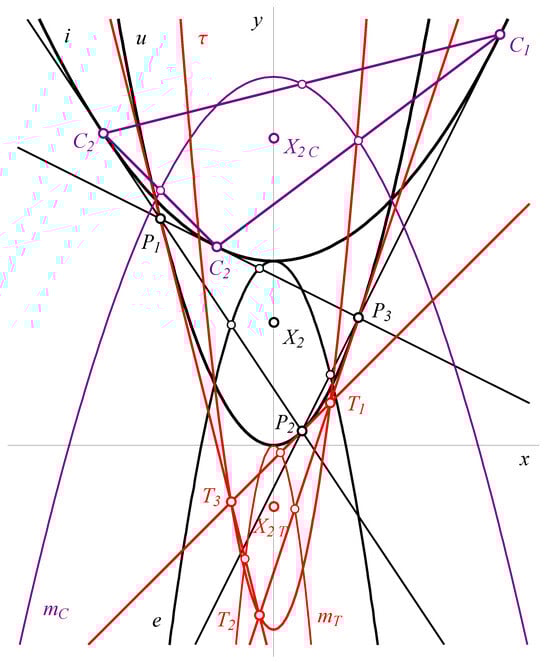
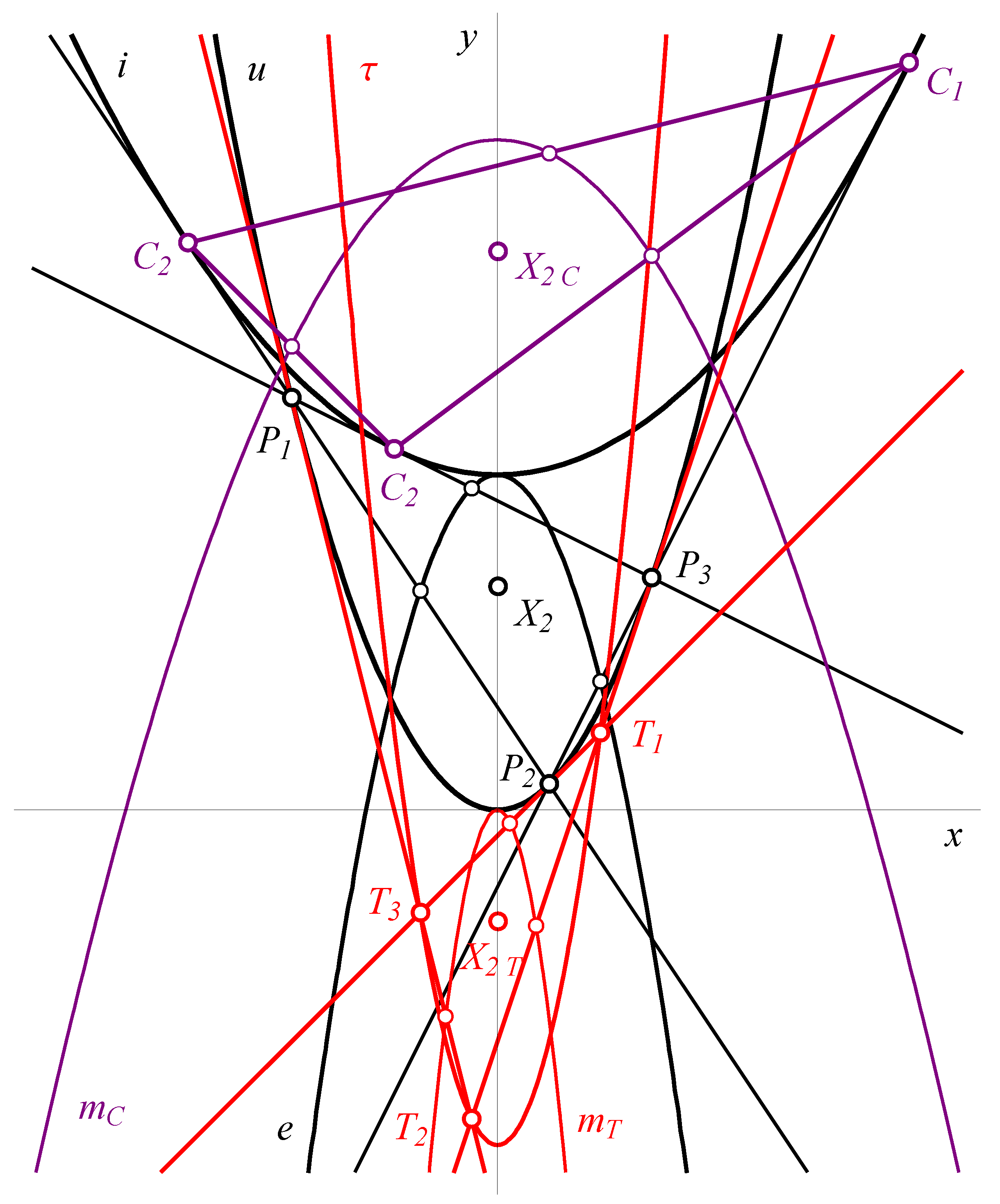
We have already seen that while triangle traverses the poristic family, the midpoints of its sides trace the common Euler circle e, and the centroid is fixed. Now, we focus on the contact triangles and tangential triangles of the triangles from the poristic family (see Figure 3).
Figure 3.
When triangle traverses the poristic family, the midpoints of its sides traverse a circle e (black). The midpoints of the sides of its contact triangle traverse a circle , and the centroid is fixed (purple). The vertices of the tangential triangle traverse a circle , the midpoints of traverse a circle , and the centroid is fixed (red).
Theorem 6.
The vertices of the contact triangle of triangle move on a circle while traverses the poristic family. The trace of the midpoint of any side of the contact triangle is a circle, and the centroid of the contact triangle is fixed.
Proof.
The vertices , and of the contact triangle of are in Section 3.1 and are determined as follows:
The midpoints of its sides are
The point obviously traces the circle
and it can be easily checked that and lie on the same circle.
The centroid of triangle is . □
Theorem 7.
The vertices of the tangential triangle of triangle move on a circle while traverses the poristic family. The trace of the midpoint of any side of the tangential triangle is a circle, and the centroid of the tangential triangle is fixed.
Proof.
The polar line of the point with respect to the circle has the equation . Therefore, the tangents to u at vertices , and are given by the respective equations
The vertices , and of the tangential triangle are
The point traces the circle
since . and lie on the same circle. The midpoints of the sides of given by the coordinates
trace the circle
The centroid of triangle is the point . □
Remark 2.
The centroid of triangle , centroid of the contact triangle and centroid of the tangential triangle are parallel points.
Remark 3.
The circle τ is polar to circle i with respect to circle u. Therefore, there is also a poristic family with u as the incircle and τ as the circumcircle.
Theorem 8.
The vertices of the anticomplementary triangle of triangle move on a circle while traverses the poristic family. The centroid of the anticomplementary triangle is fixed.
Proof.
The anticomplementary triangle is the triangle which has triangle as its medial triangle (i.e., it is formed by the lines through the vertices of parallel to its sides). It is in perspective with at centroid , as explained in [6]. The vertices of the anticomplementary triangle are
and they lie on the circle given by Equation (18). The triangle and its anticomplementary triangle share the centroid . □
4. Discussion
Any triangle in the isotropic plane has a circumcircle u and incircle i. We showed that there are infinitely many triangles with the same circumcircle u and incircle i. We also proved that all triangles in a poristic system share a centroid and Feuerbach point. The symmedian point and the Gergonne point trace straight lines, the Steiner point traces a circle, and the Brocard points trace a quartic curve.
To make this study simpler, we put the initial triangle in the so-called standard position by choosing its vertices to be , and , with . Assuming that , we would obtain the same results, but the calculations would be much more complicated, and the formulas and equations would be much longer.
Funding
This research received no external funding.
Data Availability Statement
No new data were created or analyzed in this study. Data sharing is not applicable to this article.
Acknowledgments
The author would like to thank Boris Odehnal for useful discussions.
Conflicts of Interest
The author declares no conflict of interest.
References
- Glaeser, G.; Stachel, H.; Odehnal, B. The Universe of Conics: From the Ancient Greeks to 21st Century Developments, 3rd ed.; Springer: Berlin/Heidelberg, Germany, 2016; pp. 412–434. [Google Scholar]
- Odehnal, B. Poristic loci of triangle centers. J. Geom. Graph. 2008, 15, 45–67. [Google Scholar]
- Reznik, D.S.; Garcia, R.; Koiller, J. The Ballet of Triangle Centers on the Elliptic Billiard. J. Geom. Graph. 2020, 24, 79–101. [Google Scholar]
- Sachs, H. Ebene Isotrope Geometrie, 3rd ed.; Wieweg: Braunschweig/Wiesbaden, Germany, 1987. [Google Scholar]
- Jurkin, E. Circular quartics in the isotropic plane generated by projectuvely linked pencils of coniocs. Acta Math. Hung. 2011, 130, 35–49. [Google Scholar] [CrossRef] [Scilit]
- Kolar-Šuper, R.; Kolar-Begović, Z.; Volenec, V.; Beban-Brkić, J. Metrical relationships in a standard triangle in an isotropic plane. Math. Comm. 2005, 10, 149–157. [Google Scholar]
- Kimberling, C. Encyclopedia of Triangle Centers and Central Triangles. Available online: https://faculty.evansville.edu/ck6/encyclopedia/ETC.html (accessed on 18 January 2024).
- Beban-Brkić, J.; Kolar-Šuper, R.; Kolar-Begović, Z.; Volenec, V. On Feuerbach’s theorem and a pencil of circles in I2. J. Geom. Graph. 2006, 10, 125–132. [Google Scholar]
- Kolar-Begović, Z.; Kolar-Šuper, R.; Beban-Brkić, J.; Volenec, V. Symmedians and the symmedian center of the triangle in an isotropic plane. Math. Pann. 2006, 17, 287–301. [Google Scholar]
- Beban-Brkić, J.; Volenec, V.; Kolar-Begović, Z.; Kolar-Šuper, R. On Gergonne point of the triangle in isotropic plane. Rad Hrvat. Akad. Znan. Umjet. Mat. Znan. 2013, 17, 95–106. [Google Scholar]
- Kolar-Šuper, R.; Kolar-Begović, Z.; Volenec, V. Steiner point of a triangle in an isotropic plane. Rad Hrvat. Akad. Znan. Umjet. Mat. Znan. 2016, 20, 83–95. [Google Scholar]
- Volenec, V.; Kolar-Begović, Z.; Kolar-Šuper, R. Crelle-Brocard Points of the triangle in an isotropic plane. Math. Pann. 2013, 24, 167–181. [Google Scholar]
Disclaimer/Publisher’s Note: The statements, opinions and data contained in all publications are solely those of the individual author(s) and contributor(s) and not of MDPI and/or the editor(s). MDPI and/or the editor(s) disclaim responsibility for any injury to people or property resulting from any ideas, methods, instructions or products referred to in the content. |
© 2024 by the author. Licensee MDPI, Basel, Switzerland. This article is an open access article distributed under the terms and conditions of the Creative Commons Attribution (CC BY) license (https://creativecommons.org/licenses/by/4.0/).