1. Introduction
The Irish mathematician W.R. Hamilton pioneered research on the concept of quaternions in 1843 [
1]. There has been a rapid development in quaternions during recent years. There exist various kinds of related work about quaternions that achieve valuable results [
2,
3]. Most recently, researchers have focused on the theories for solving quaternion matrix equations, i.e., general and special solutions of quaternion matrix equations [
4]. Quaternions and quaternion matrices have been comprehensively applied to multiple areas including algebra, analysis, topology, and physics. In particular, they are crucial in several fields, such as signal processing [
5], image processing [
6], and quantum physics [
7].
In 1849, building upon Hamilton’s work, James Cockle further introduced “split quaternions” [
8]. The set of split quaternions is denoted as follows:
where
As a derivative version of quaternions, its form is similar to the original definition of quaternions, but they are indeed two different algebras. The definition proposed by James Cockle has a more complex algebraic structure. Split quaternions play a significant role in various fields, e.g., physics, quantum mechanics, signal processing, and deep learning. Split quaternions have been applied to denote Lorentz rotations, and Lorentz transformations can be represented as
unitary matrices of split quaternions, which reveals the geometric and physical importance of split quaternions [
9,
10,
11,
12,
13,
14,
15].
Clifford [
16] later proposed dual numbers and dual quaternions in 1873, and they have already become the basis for handling some typical engineering problems [
17]. Dual split quaternions, like dual quaternions, expand the idea of dual numbers to include split quaternions. Building on the principles of split quaternions, dual split quaternions have been applied to diverse disciplines including algebra, geometry, and physics [
18,
19,
20,
21].
Below is a typical matrix equation system, which we will mainly focus on. There exists some related work providing solutions to it, but we will explore this equation system as defined in the domain of dual split quaternion tensors.
Due to its wide applications in fields such as biology, inverse problems in vibration theory, and linear programming, system (
1) has been extensively studied. Rao and Mitra [
22] established the criteria for the solvability of system (
1) and also presented their general solutions. Khatri and Mitra [
23] examined their Hermitian solutions within the complex field. Wang [
24] derived conditions for solvability and provided solutions for bi-symmetric cases of system (
1) in the quaternion skew field. Li and others [
25] examined generalized reflexive solutions for complex system (
1). Yuan [
26] used spectral decomposition to investigate least squares solutions for system (
1). Xie [
27] applied the M-P inverse, as well as the rank of quaternion matrices, to determine the equivalent conditions when there existed solutions, and then proposed the general solution. Si and others [
15] used real representations to establish various solutions of system (
1) and their equivalent conditions over split quaternion field.
Tensors are useful in engineering and science, and there are some papers focusing on the solutions of tensor equations [
28,
29,
30,
31,
32,
33]. With dual split quaternions that can represent rotations and translations commonly used in artificial intelligence [
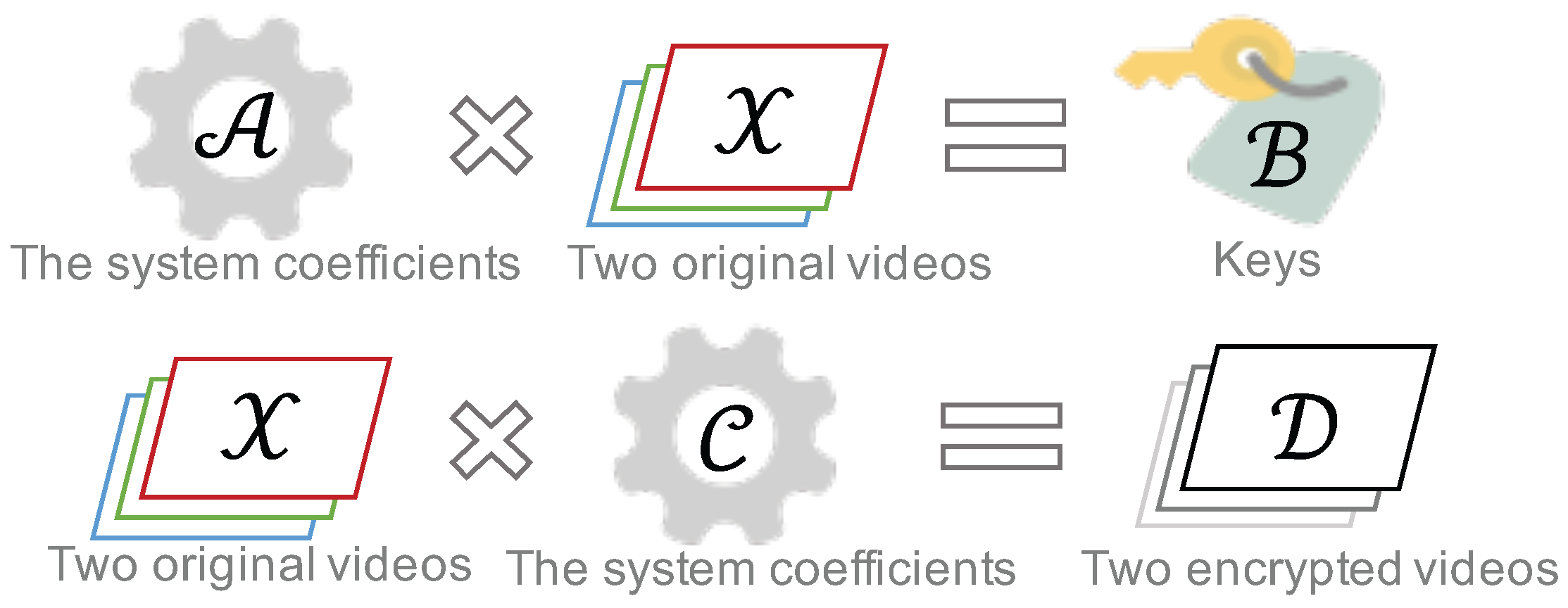
18], tensors over dual split quaternions can be further applied to more scenarios. For instance, using dual split quaternion tensors allows for the simultaneous encryption of two videos, enhancing the efficiency of encryption and decryption. Moreover, due to the complexity of the mathematical structure of dual split quaternions, videos encrypted with dual split quaternion tensors are not easily decrypted. Considering these advantages, tensors over dual split quaternions should be explored both in theory and in reality for better applications.
In this paper, we focus on solving system (
1), defined in the space of dual split quaternion tensors. To the best of our knowledge, it is the first exploration of the above system within the dual split quaternion tensor algebra. Specifically, it aims to solve the following system of dual split quaternion tensor equations:
This paper is designed with the following structure:
Section 2 describes essential definitions and corollaries that are essential to our subsequent analysis.
Section 3 investigates the conditions that are equivalent for system (
2) when there exist solutions. In this section, we further demonstrate its general solution in cases where solutions are attainable. Furthermore, we present the sufficient and necessary criteria when system (
2) have
-Hermitian solutions. Based on these results, we introduce the equivalent condition for the Hermitian solution, along with the general expressions of solutions for two specific dual split quaternion tensor equations. Ultimately, we present a specific numerical example and an encryption and decryption algorithm as an application.
In this paper, the dual number field, quaternion field, split quaternion field, dual quaternion field, and dual split quaternion field are represented by , , , , and , respectively. All tensors over are represented using .
2. Preliminary
In this section, there are three parts that provide fundamental knowledge for the subsequent demonstration of this paper. In the first part, we will give the definition of dual split quaternion tensors. The second part will cover some definitions and propositions about tensors. Lastly, we will present various real representations of split quaternion tensors.
2.1. Dual Split Quaternion Tensors
is a multidimensional array tensor with entries. Let , , and , respectively, represent the sets of the order M tensors with dimensions over the real field , real quaternion algebra , and real split quaternion algebra .
For , . When , is referred to as the transpose of and is denoted by . When , is the conjugate transpose of , represented as . A diagonal tensor has all zero entries, except for the elements . When all diagonal elements of are equal to 1, is referred to as a unit tensor, expressed as . Specifically, if , it is expressed as . denotes the zero tensor whose elements are all zero.
Definition 1 ([
16,
34]).
The field of dual numbers is expressed as follows:where ϵ is the infinitesimal unit. By extending quaternions and split quaternions to include dual numbers, we derive the definitions of dual quaternions and dual split quaternions as follows:
The sets of dual quaternion tensors and dual split quaternion tensors [
18,
34] are represented as follows:
For , means that and , and vice versa. is called the conjugate transpose of . are called the -conjugate transposes of , where .
For
,
is uniquely identified as
, where
, and
. The conjugate transpose of
satisfies
. Additionally, for
, the
-conjugates and
-conjugate transposes [
35] of
have the following forms:
and
Definition 2. Let . Provided that fulfills the following criteria:we refer to as a η-Hermitian tensor. For ; then, we can derive that and . Furthermore, means that and , and vice versa.
2.2. Basic Theory with Einstein Product
Definition 3 ([
36]).
Let and . Then, we can define the Einstein product of tensors and through the operation as follows: Proposition 1. Let and . Then, the following are true:
- 1.
;
- 2.
and .
Definition 4 ([
33,
37]).
Let and . is referred to as the Moore–Penrose inverse of , expressed as , if the following conditions are all fulfilled:- 1.
;
- 2.
;
- 3.
;
- 4.
.
Furthermore, projectors and have the following forms: Similar to block matrices, reference [
37] provides the definition of block tensors and reference [
38] provides the definition of block tensors when their sizes are the same. Next, we extend the definitions from references [
37,
38] to split quaternion tensors to give the definition of block tensors with the same size.
Definition 5. Let and . Then, the following are true:
- 1.
The ’row block tensor’ formed by and is , andwhere . - 2.
The ’column block tensor’ formed by and is , andwhere .
In particular, let
,
,
and
. Then, the following is true:
Remark 1. is the tensor located at row i, column in the aforementioned block tensor, and it will be used in the following statement.
Lemma 1 ([
37]).
Let , , , and , . Then, the following are true: Next, we will introduce the definition of the transformation
t between a tensor and a matrix within split quaternion algebra [
33,
39]. Under this definition, we can simplify the tensor into a matrix.
Definition 6. The transformation with is defined as follows:where and . Lemma 2 ([
33]).
Let and . Then, t satisfies the following properties:- 1.
The map t is bijective and its inverse map exists as follows: - 2.
t satisfies: and .
Example 1. Let be defined by the following: Consequently, there is a one-to-one correspondence between the elements of the split quaternion matrix and the split quaternion tensor. Thus, we can make use of the above definition to transform the tensor into a matrix for further calculations.
2.3. Real Representations of Split Quaternion Tensors
In this section, we will provide various real representations using the definition of block tensors in the above section.
Let
, where
,
. We will define three kinds of real representations of
based on the real representation in [
11], as follows:
Definition 7 ([
15,
35]).
Let , where , , , , . Then, we define the following:where , and . As shown in the next proposition, we present the relevant characteristics of real representations discussed previously. These properties will play a crucial role in subsequent sections and can be easily obtained through simple calculations. Let the following be true:
Proposition 2. For , let , and . Then, the following is true:
- 1.
;
- 2.
- 3.
;
- 4.
(a) ;
(b) ;
(c) ;
- 5.
;
- 6.
(a) ;
(b) ;
(c) ;
- 7.
.
3. The General Solution to System (2)
Using the definitions and lemmas outlined above, this part will examine the solutions to system (
2). At the beginning of this section, we present two lemmas. Utilizing Definition 6, we can transform tensors into matrices. Consequently, the subsequent lemmas can be readily proven using matrix proof techniques found in references [
27,
40], so this paper will not delve into the details. Building on these lemmas, split quaternion tensors’ real representations are used for obtaining the necessary and sufficient criteria when system (
2) has solutions, as well as the general solution expression.
Lemma 3 ([
40]).
Let , , and . Set the following:Then,is consistent if and only if the following is true: Building on this, the general solution for system (
3)
is stated in the following form:where are arbitrary tensors of appropriate size defined on . Lemma 4 ([
27]).
Suppose that , , , and . Set the following:Then, the following descriptions are equivalent:
Based on these, the general solution for system (
2)
is represented as , where the following is true:and are random tensors with suitable dimensions. Remark 2. Note that the set of real tensors is included within the set of quaternion tensors, since real numbers are special cases of quaternions with all imaginary parts set to 0. Thus, the conclusions above also hold in the field of real tensors.
Theorem 1. Suppose that , , , and . Set the following: Then, the following descriptions are equivalent:
- 1.
The system of dual split quaternion tensor Equation (
2)
is solvable. - 2.
The system of real tensor equations, namelyis consistent. - 3.
Based on these circumstances, the general solution of system (
2)
can be represented as , whereand are random tensors with proper dimensions. Proof. (1) ⇔ (2)
If condition (1) holds, it indicates that system (
2) possesses a solution. Thus, we can express the solution for system (
2) as
, where
. By substituting
into system (
2), we obtain the following split quaternion tensor equations:
Let
and
. Apply the real representation to the system, and, using (2) and (3) of Proposition 2, we then obtain the following:
i.e.,
Thus,
is a pair of solutions to system (
4).
On the other hand, let
be the solutions for system (
4). Using 4a of Proposition 2, we obtain the following:
i.e.,
Thus,
represent solutions to the system of real tensor equations. Likewise,
and
are also solutions to the system. Then, we define the following:
Using direct computation, we obtain the following:
and
where
and
Then, we let the following be true:
and
where
and
.
Due to 6a of Proposition 2,
and
. Thus, the following is true:
Due to the above, we can obtain
as the solution of system (
5). Furthermore, it is clear that system (
2) and system (
5) are equivalent. Therefore, when system (
2) has solutions, system (
4) also has solutions, and vice versa. In addition, we can deduce the general solution of system of dual split quaternion tensor equations using Lemma 4 as
, where the following is true:
and
are random tensors with suitable size.
Additionally, (2) and (3) are equivalent to each other, which can be easily proven using Lemmas 3 and 4. We will not elaborate further on these points here. □
In the following section, we will propose equivalent conditions required when system (
2) has
-Hermitian solutions.
Theorem 2. Suppose that , , , and .
Then, system (
2)
has η-Hermitian solutions , and this means that system (
4)
possesses a pair of solutions that satisfies and , and vice versa. Proof. It is only necessary to demonstrate the situation for
; the other situations are identical to it, so we omit them. Let us assume that
, which is a
j-Hermitian solution of system (
2), where
. Then, we obtain the following:
By substituting
into system (
2), system (
2) then corresponds to the subsequent system as follows:
Let
. Apply the real representation to the system, and, using 2 and 3 of Proposition 2, we then obtain the following:
i.e.,
According to 7 of Proposition 2 and the definition of real representation, we obtain the following:
Thus, the above system can be expressed as follows:
i.e.,
Using 5 in Proposition 2, we obtain the following:
On the other hand, if system (
4) has a pair of solutions
that satisfies
and
, then the system (
4) can be denoted as follows:
and
As indicated by 4b in Proposition 2,
are also solutions to the system. Next, we define the following:
Using direct computation, we obtain the following:
and
where
and
Then, we let the following be true:
and
where
and
.
Due to 6b of Proposition 2,
and
. Thus, the following is true:
That is,
is a pair of solutions of system (
4). Then, the following is true:
According to 7 of Proposition 2 and Definition 7, we obtain the following:
i.e.,
and
It is obvious that system (
19) and system (
2) are equivalent. Consequently,
is a
j-Hermitian solution of system (
2). □
Based on the above theorems and lemmas, we will next present the equivalent condition when system (
2) possesses a Hermitian solution. Additionally, we will put forward the equivalent criteria when two specific equations,
and
, have solutions, along with their general solution expressions.
Corollary 1. Let , , , and . Set the following: Then, system (
2)
has a Hermitian solution, , and it means that the following system of real tensor equations has a pair of symmetric solutions , and vice versa: Corollary 2. Let and , where . Set the following: Then, the subsequent descriptions correspond to each other as follows:
- 1.
Dual split quaternion tensor equation is solvable.
- 2.
The following system of real tensor equations is consistent: - 3.
.
Based on these circumstances, the general solution of tensor equation is represented as , where the following is true:whereand and are arbitrary real tensors with appropriate dimensions. Corollary 3. Suppose that and . Let the following be true: Then, the descriptions below correspond to each other:
- 1.
The dual split quaternion tensor equation is solvable.
- 2.
The following system of real tensor equations is consistent: - 3.
.
Based on these situations, the general solution of tensor equation can be expressed as , where the following is true:whereand and denote random tensors over with suitable dimensions.