Abstract
The overlap function, a continuous aggregation function, is widely used in classification, decision-making, image processing, etc. Compared to applications, overlap functions have also achieved fruitful results in theory, such as studies on the fundamental properties of overlap functions, various generalizations of the concept of overlap functions, and the construction of additive and multiplicative generators based on overlap functions. However, most of the research studies on the overlap functions mentioned above contain commutativity and continuity, which can limit their practical applications. In this paper, we remove the symmetry and continuity from overlap functions and define discrete pseudo-quasi overlap functions on finite chains. Meanwhile, we also discuss their related properties. Then, we introduce pseudo-quasi overlap functions on sub-chains and construct discrete pseudo-quasi overlap functions on finite chains using pseudo-quasi overlap functions on these sub-chain functions. Unlike quasi-overlap functions on finite chains generated by the ordinal sum, discrete pseudo-quasi overlap functions on finite chains constructed through pseudo-quasi overlap functions on different sub-chains are dissimilar. Eventually, we remove the continuity from pseudo-automorphisms and propose the concept of pseudo-quasi-automorphisms. Based on this, we utilize pseudo-overlap functions, pseudo-quasi-automorphisms, and integral functions to obtain discrete pseudo-quasi overlap functions on finite chains, moreover, we apply them to fuzzy multi-attribute group decision-making. The results indicate that compared to overlap functions and pseudo-overlap functions, discrete pseudo-quasi overlap functions on finite chains have stronger flexibility and a wider range of practical applications.
Keywords:
fuzzy logic; information fusion; overlap function; fuzzy multi-attribute group decision-making MSC:
03B52; 03E72
1. Introduction
To establish a mathematical model of fuzzy objects, Zadeh proposed the concept of fuzzy sets [1] in 1965. Many scholars have conducted extensive research on the fuzzy set theory and applied it in pattern recognition, medical diagnosis, and fuzzy control [2,3,4,5]. In 1973, Zadeh proposed the famous CRI algorithm [6], which was a very effective tool for describing and dealing with the fuzziness of things and the uncertainty of systems, as well as for simulating human intelligence and decision-making. Fuzzy reasoning has been applied with great success in industrial control and manufacturing household appliances. However, compared with its application, the theoretical foundation of fuzzy reasoning is not flawless. In 1993, Elkan presented a report titled “The Seemingly Right Success of Fuzzy Logic” at the 11th Annual Conference on Artificial Intelligence [7], which caused a huge uproar. Many scholars have commented on this. Wu discussed this debate in [8]. Ying [9] pointed out that “although many of Erkan’s views are incorrect, and Wu has made some clarifications, we must also recognize that the lack of systematic and in-depth theoretical research in fuzzy logic is an undeniable fact.” Of course, there was no consensus on this debate. In fact, this debate has never been resolved. Meanwhile, it is precisely for this reason that fuzzy logic has become an active area of research, with many scholars achieving significant results in the field. In recent years, research on fuzzy sets has garnered widespread attention. Therefore, we delve into both the theoretical foundations and practical applications related to fuzzy sets.
In 2010, Bustine et al. proposed the definition of overlap functions [10]. As a special binary aggregation function, the overlap function has been widely used in decision-making, image processing, classification, and other fields [11,12,13]. Moreover, many academics have achieved significant outcomes in the theoretical research of overlap functions, specifically manifested in the following aspects: (1) research on basic properties of overlap functions, such as migrativity, homogeneity, Lipschitzianity, Archimedes, idempotence, etc. [14,15,16]; (2) extensions of various concepts related to overlap functions, including quasi-overlap functions [17], pseudo-overlap functions [18], semi-overlap functions [19], and so on [20,21,22]; (3) study of inducing various types of implication operators from overlap functions and group functions [23,24,25]; (4) construction of additive and multiplicative generators for overlap functions and various generalized overlap functions [26,27,28,29].
Aggregation is an important concept in decision theory, information fusion, and fuzzy inference systems. It involves converting several numerical values into a representative value; this process is called aggregation, and the function that executes this process is called an aggregation function. As powerful tools for processing information fusion, aggregation functions have been widely used in classification [30], fuzzy systems and control [31], hierarchical information fusion [32], and so on [33,34,35]. In order to better handle information fusion problems, many scholars have degenerated the aggregation functions (including t-norms, uninorms, t-operators, etc.) in [0, 1] to finite chains, and achieved relevant results [36,37,38]. Qiao transformed the overlap function and quasi-overlap function on [0, 1] into finite chains [39,40], and studied their related properties.
A fuzzy multi-attribute group decision-making problem can be described as a given set of possible alternative solutions, and each solution needs to be comprehensively evaluated from several attributes. Our goal is to find the optimal solution from this set of alternative solutions or to comprehensively rank this set of alternative solutions; the ranking results can reflect the decision-maker’s intention. The presence of uncertainty in fuzzy multi-attribute group decision-making processes can be represented by fuzzy sets. Therefore, fuzzy logic plays an important role in the field of fuzzy multi-attribute group decision-making. Fuzzy multi-attribute decision-making represents a non-classical approach to multi-attribute decision-making, extending and developing classical multi-attribute decision-making theories. Bass and Kwakernaak [41] proposed a method for addressing fuzzy multi-attribute group decision-making under uncertainty. Following their work, various scholars have proposed numerous types of fuzzy multi-attribute decision-making methods. Kichert, Zimmermann, and Chen et al. [42,43,44] summarized the above fuzzy multi-attribute decision-making methods. A few academics have also studied the application of overlap functions and certain generalized overlap functions in fuzzy multi-attribute group decision-making [45,46]. Mao et al. [47] proposed a fuzzy multi-attribute decision-making method based on the Sugeno integral semantics of overlap functions using fuzzy quantifiers, and verified the feasibility of this method through specific examples. Wen [48] combined overlap functions with rough sets to propose a new class of models, and then extended this model to multi-granularity, thereby establishing a solution method for fuzzy multi-attribute decision-making problems. Silva et al. [49] introduced a weighted average operator generated by n-dimensional overlap and aggregation functions, which they applied to fuzzy multi-attribute group decision-making problems. On this basis, Zhang et al. [18] extended the aforementioned weighted average operator and explored the use of pseudo-overlap functions in fuzzy multi-attribute group decision-making.
With the background information mentioned above and the current status of studying nationally as well as globally, the research motivations and innovation points of this paper are as follows:
(1) At present, most concepts of overlap functions and generalized overlap functions include symmetry and continuity, which can limit their practical applications. Thus, we remove the symmetry and continuity from overlap functions and introduce the concept of discrete pseudo-quasi overlap functions on finite chains. In addition, we have also studied their related properties.
(2) Currently, there is little research on constructing aggregate functions based on ordinal sums. Qiao [40] used ordinal sums to construct quasi-overlap functions on finite chains. This method constructs quasi-overlap functions on finite chains through quasi-overlap functions on sub-chains; each sub-chain is called an addend. Therefore, we naturally attempt to generalize the method of constructing quasi-overlap functions on the finite chains mentioned above and use a new method to construct discrete pseudo-quasi overlap functions on finite chains.
(3) In most literature (such as [18,47,49]), the aggregation functions used in the application of fuzzy multi-attribute group decision-making are all continuous. However, in the practical application of fuzzy multi-attribute group decision-making, the data objects involved are usually discrete. On the other hand, the discrete aggregation function has better flexibility and a wider range of applications in fuzzy multi-attribute group applications. Therefore, we apply discrete pseudo-quasi overlap functions on finite chains to fuzzy multi-attribute group decision-making. This approach not only promotes the development of fuzzy multi-attribute decision-making but also provides valuable reference and guidance for the theoretical development and practical application of overlap functions.
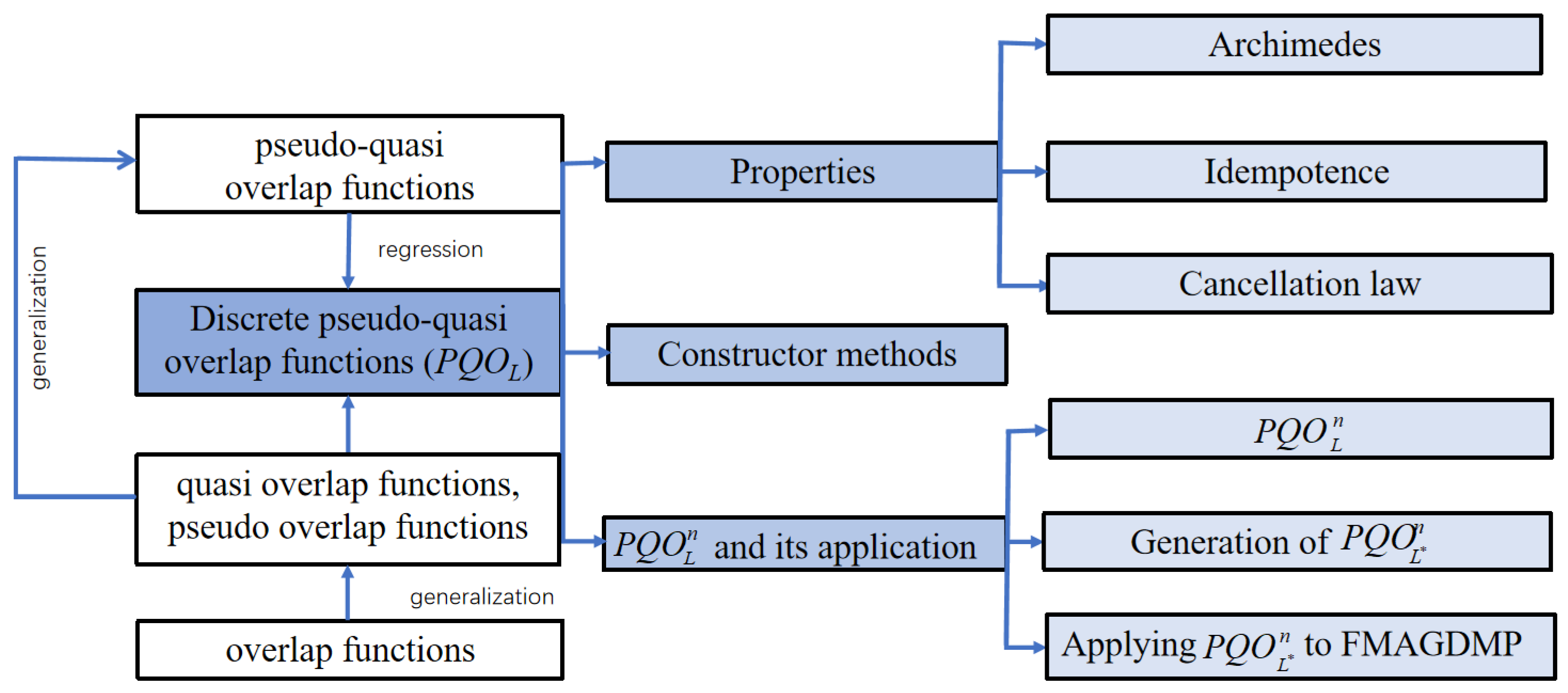
The main contents of this paper could be summarized as follows: In Section 2, we mainly present some basic knowledge on the topic. In Section 3, we introduce the concept of discrete pseudo-quasi overlap functions on finite chains and study their related properties. In Section 4, we offer pseudo-quasi overlap functions on sub-chains and construct discrete pseudo-quasi overlap functions on finite chains through pseudo-quasi overlap functions on sub-chains. Moreover, compared to quasi-overlap functions on finite chains generated by the ordinal sum, the discrete pseudo-quasi overlap functions on finite chains created by pseudo-quasi overlap functions on various sub-chains are different. In Section 5, we present the idea of pseudo-quasi-automorphism by removing the continuity from pseudo-automorphisms. Based on this, we use pseudo-overlap functions, pseudo-quasi-automorphisms, and integer functions to construct discrete pseudo-quasi overlap functions on finite chains and apply them to fuzzy multi-attribute group decision-making. The findings show that discrete pseudo-quasi overlap functions have better flexibility and adaptability than overlap functions and pseudo-overlap functions in applications. The research contents of this paper are shown in Figure 1.
Figure 1.
Framework diagram of the paper.
2. Preliminaries
In this portion, we mainly provide some preliminary knowledge that is used in later sections.
Definition 1
([10]). A binary function is known as an overlap function if it meets ,
- O is symmetric;
- or ;
- and ;
- O is non-decreasing;
- O is continuous.
Definition 2
([17]). A binary function is known as a quasi-overlap function if it satisfies .
Definition 3
([18]). A binary function is referred to as a pseudo-overlap function if it satisfies .
Definition 4
([20]). An n-ary function is known as an n-ary overlap function if it meets ,
- is symmetry;
- for , such as ;
- for , such as ;
- is non-decreasing;
- is continuous.
Definition 5
([18]). An n-ary function is known as an n-ary pseudo-overlap function if it satisfies .
3. Discrete Pseudo-Quasi Overlap Functions
In this part, we delete the symmetry of quasi-overlap functions and introduce the notion of discrete pseudo-quasi overlap functions on finite chains. In addition, we discuss some of the associated properties, like Archimedean, idempotence, and cancellation law.
We define a finite chain as follows:
Let be a set, . is called a finite chain when it satisfies ,
- ;
- is the minimum element, and is the maximum element of .
Definition 6.
A binary function is called a discrete pseudo-quasi overlap function on if it fulfills ,
- or ;
- and ;
- is non-decreasing.
A discrete pseudo-quasi overlap function is called an -section left deflation on when it satisfies ,
- .
- Correspondingly, a discrete pseudo-quasi overlap function is called an -section right deflation on when it satisfies ,
- .
Assuming is a finite chain, we extend the L to [0, 1], then is a pseudo-quasi overlap function given in [21]. On the other hand, a discrete pseudo-quasi overlap function that satisfies symmetry is a quasi-overlap function on L, as mentioned in [40]. Moreover, the above and correspond to item (5) from Definition 2.1 in [40].
In the following sections, we use L to indicate the finite chain .
Below, we provide some examples of discrete pseudo-quasi overlap functions on .
Example 1.
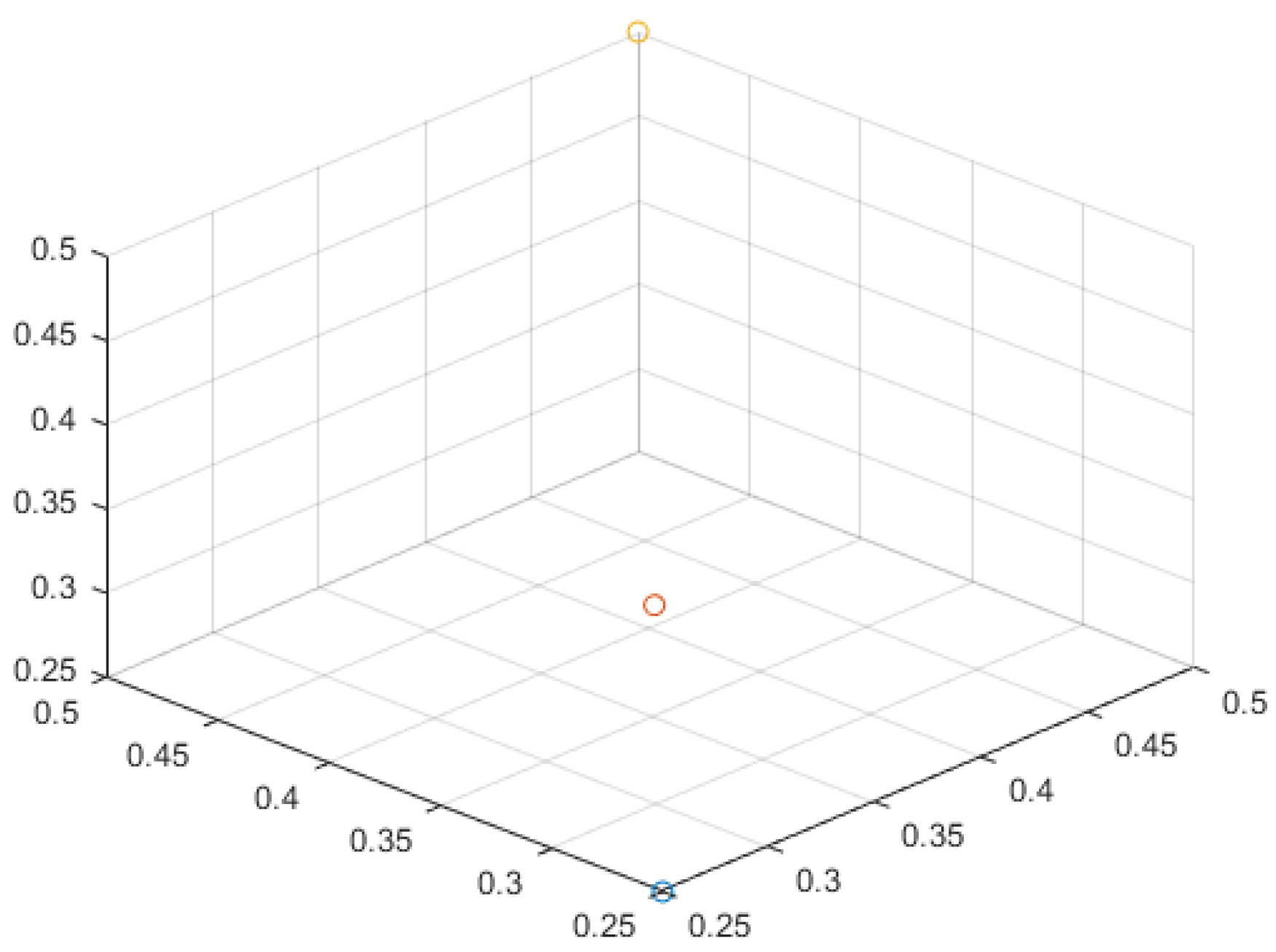
(1) Let be a finite chain. Then, for , any discrete pseudo-quasi overlap function is a quasi-overlap function on .
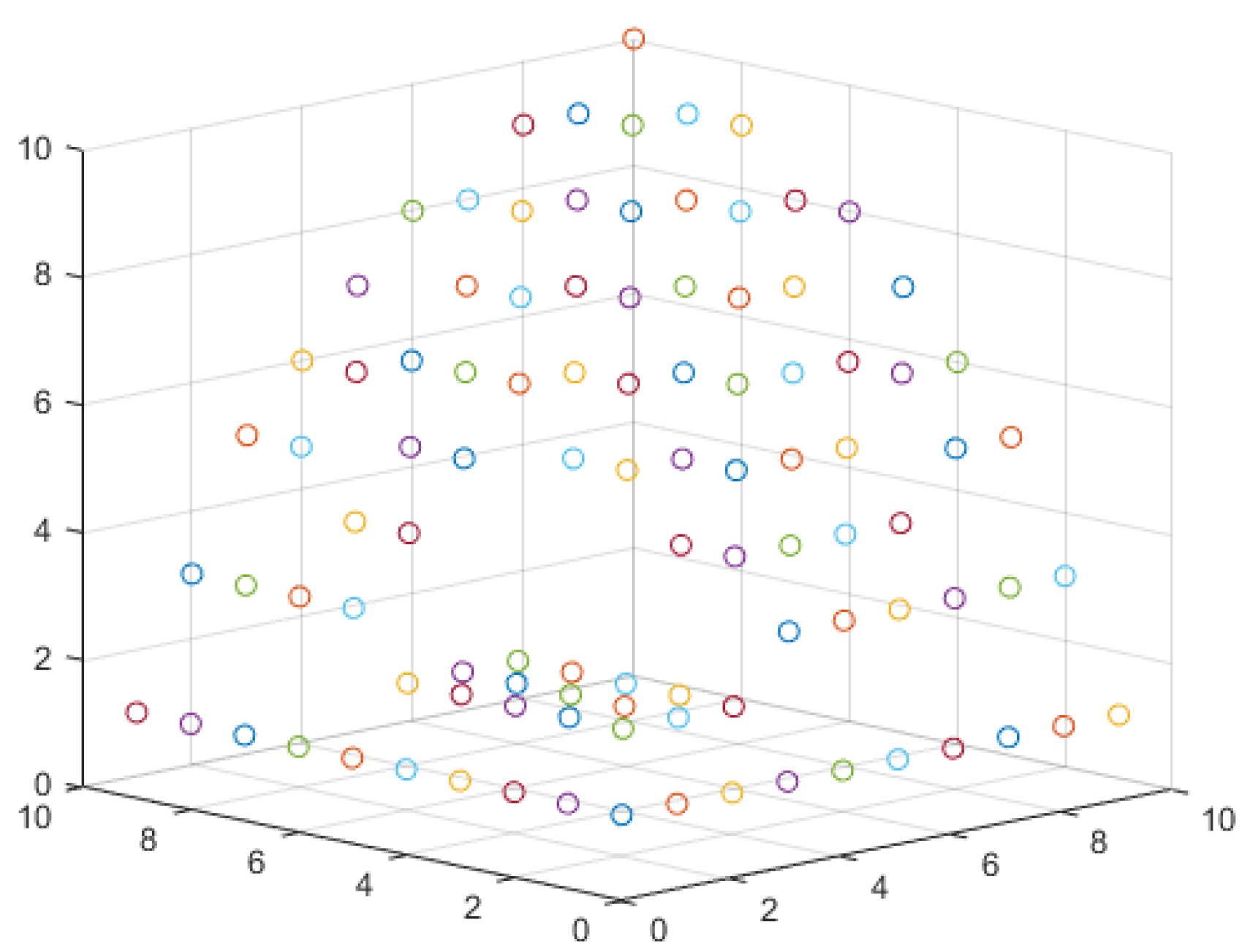
Taking . A graph of the is shown in Figure 2.
Figure 2.
A discrete pseudo-quasi overlap function .
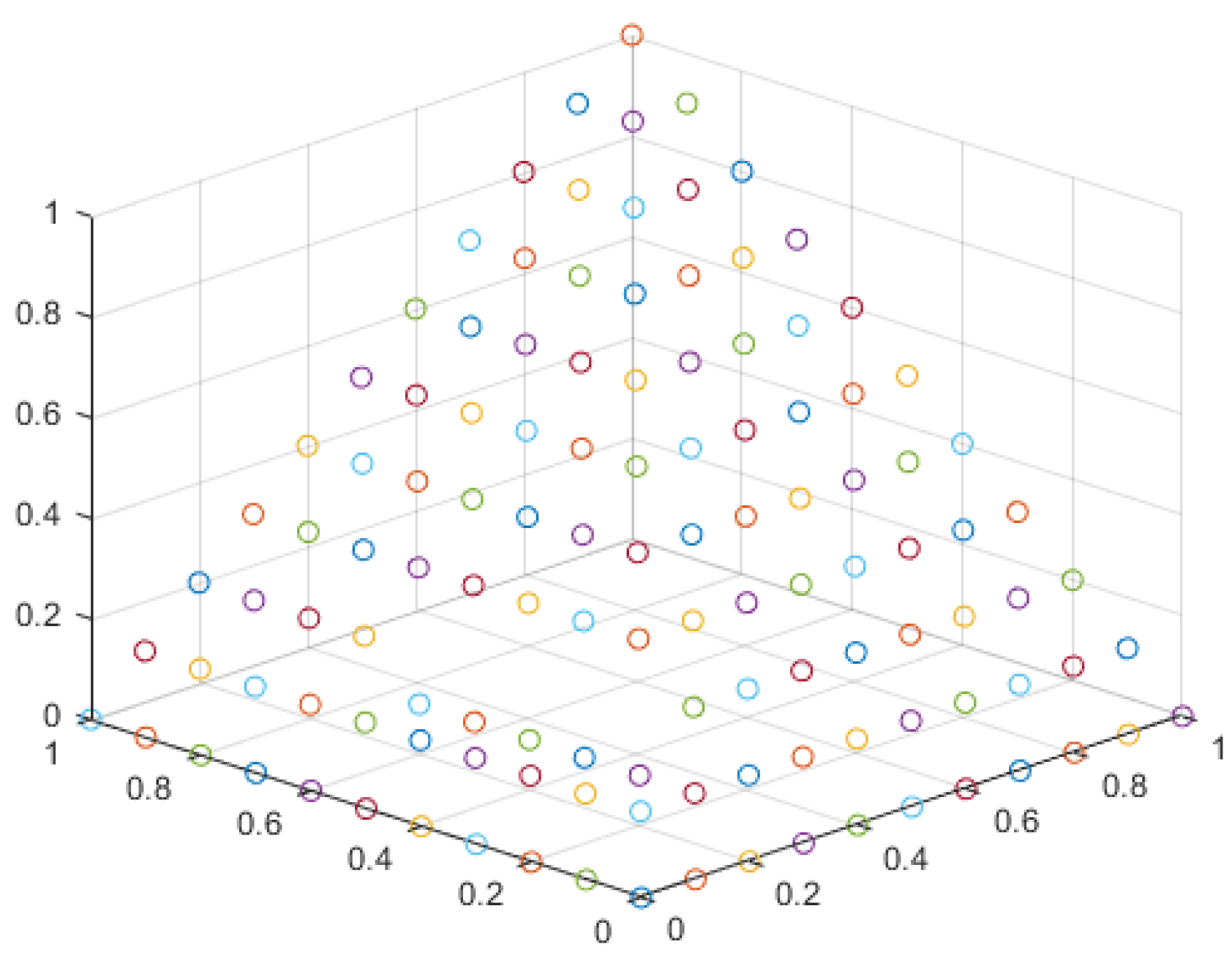
(2) Let be a finite chain, , . Then, , the function , defined as follows:
Taking . A graph of the is shown in Figure 3.
Figure 3.
A discrete pseudo-quasi overlap function .
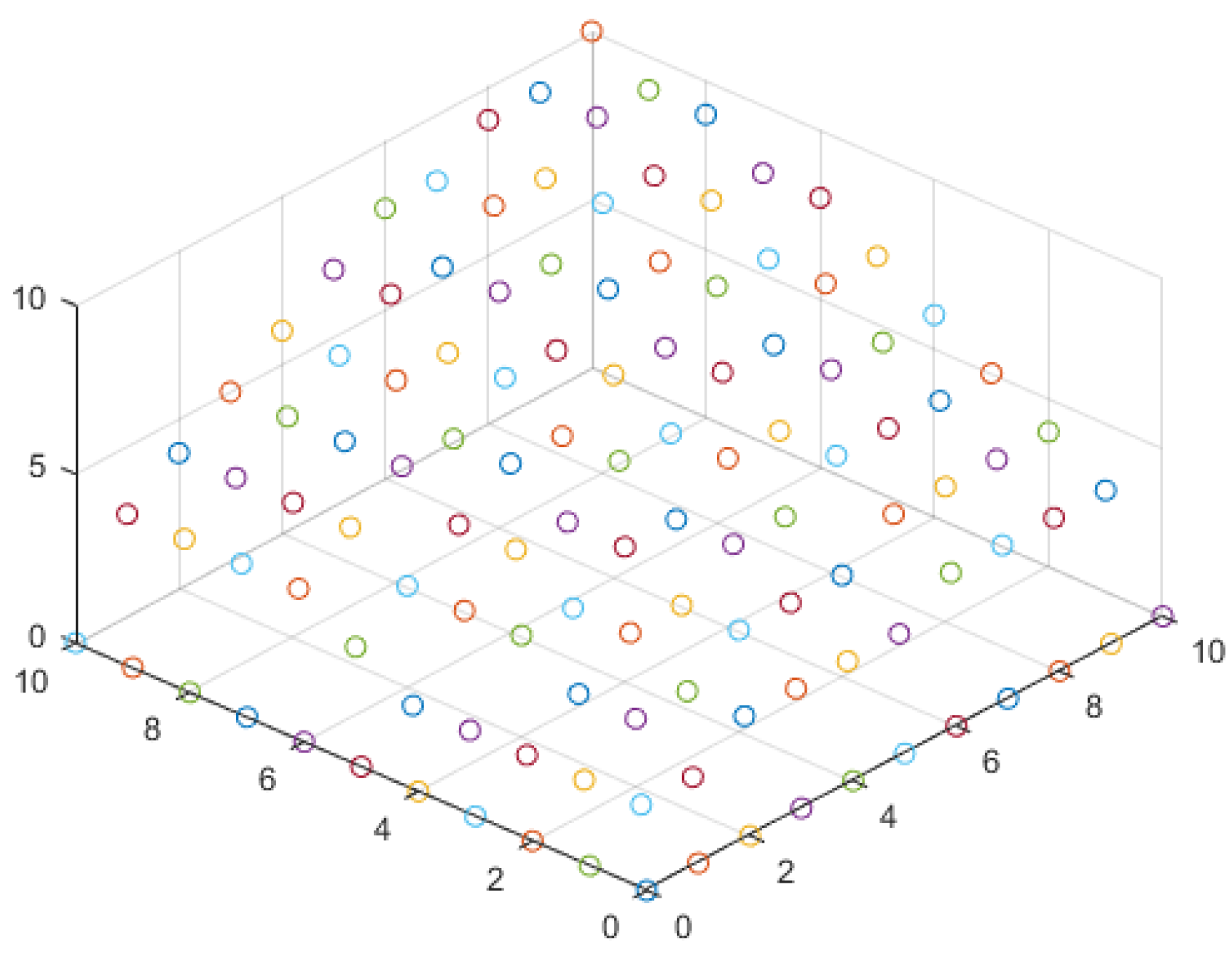
(3) Let be a finite chain with natural numbers, , . Then, , the function , defined as follows:
Taking . An image of the is shown in Figure 4.
Figure 4.
A discrete pseudo-quasi overlap function .
Let be a finite chain with positive integers, , . Then, , the function , defined as follows:
Taking . An image of the is shown in Figure 5.
Figure 5.
A discrete pseudo-quasi overlap function .
We observe that “” in Example 1 is an integral function; more precisely, it is a round function to the nearest integer x. Furthermore, regarding other types of integral functions, such as floor, ceil, and fix, their methods of constructing discrete pseudo-quasi overlap functions on are similar to that of the round function.
Next, we investigate the relevant properties of discrete pseudo-quasi overlap functions on finite chains L.
3.1. Archimedes of Discrete-Pseudo-Quasi Overlap Functions
First, we discuss the Archimedes of discrete pseudo-quasi overlap functions on L.
Definition 7.
Let be a discrete pseudo-quasi overlap function on L. is called Archimedean when it satisfies , and is given by the following:
Proposition 1.
Let be a discrete pseudo-quasi overlap function on L. Then, is not strictly increasing.
Proof.
We take , and . Then, . So, , , and is not strictly increasing. On the other hand, , , we need to verify that is strictly increasing. For , and , there are three different cases, as follows:
- (1)
- ;
- (2)
- ;
- (3)
- . Suppose that is not strictly increasing. According to , we know that . Obviously, this is contradictory to . Thus, , is strictly increasing. Finally, for the scenario where , and is not strictly increasing, the proof method is similar to [34]. To summarize, is not strictly increasing. □
From Proposition 1, we can immediately deduce that is also not strictly increasing.
Proposition 2.
Let be Archimedean. If is a discrete pseudo-quasi overlap function on L, then .
Proof.
The following can directly be obtained through Definition 7, Proposition 1, and mathematical methods of induction: For , that is, . For . According to and Proposition 1, we have the following:
Thus, . Assume that , . For , we have the following:
Therefore, , . □
Proposition 3.
Let be a discrete pseudo-quasi overlap function on L. Then, is not Archimedean.
Proof.
Suppose that is Archimedean. Owing to Proposition 2, we know the following:
Thus, for , conflicting with for Definition 7. Therefore, is not Archimedean. □
Now, we will discuss the idempotence of discrete pseudo-quasi overlap functions on L.
3.2. Idempotence of Discrete Pseudo-Quasi Overlap Functions
Definition 8.
Let be a discrete pseudo-quasi overlap function on L. An element is called idempotent when it satisfies . A discrete pseudo-quasi overlap function is called idempotent when it satisfies that is an idempotent element.
Obviously, 0 and 1 are idempotent elements of a discrete pseudo-quasi overlap function on L. Moreover, only the discrete pseudo-quasi overlap function on generated by Case (1) in Example 1 is idempotent.
Proposition 4.
Let be a discrete pseudo-quasi overlap function on L. Then, there exists , such that .
Proof.
The proof is analogous to [16]. □
Proposition 5.
Let be a discrete pseudo-quasi overlap function on L.
- (1)
- If satisfies , then there exists , such that .
- (2)
- If satisfies , then there exists , such that .
Proof.
(1) Suppose that is a discrete pseudo-quasi overlap function on L. If satisfies then , . Moreover, according to Proposition 4 and , we known that there exists , such that we have the following:
So, . The proofs of (2) are similar to (1). □
Proposition 6.
Let be a discrete pseudo-quasi overlap function on L. If is Archimedean, then has no idempotent element, except for .
Proof.
Suppose that there exists , which is an idempotent element of the discrete pseudo-quasi overlap function on L. As is Archimedean, then , and . Assume that we have the following:
So, for . Thus, for , which conflicts with in Definition 7. Thus, has no idempotent element, except for . □
In the end, we discuss the cancellation law of discrete pseudo-quasi overlap functions on L.
3.3. Cancellation Law of Discrete Pseudo-Quasi Overlap Functions
Definition 9.
Let be a discrete pseudo-quasi overlap function on L. , is said to fulfill the left-cancellation law if we have the following:
Similarly, is said to fulfill the right-cancellation law if we have the following:
Lemma 1.
A discrete pseudo-quasi overlap function on L fulfills the cancellation law if satisfy the following conditions:
- (1)
- or ;
- (2)
- or .
Proposition 7.
Let be a discrete pseudo-quasi overlap function on L.
- (1)
- fulfills the left-cancellation law ⇔ for , and is strictly increasing.
- (2)
- fulfills the right-cancellation law ⇔ for , and is strictly increasing.
Proof.
The proofs of (1) and (2) are similar. Next, we only prove (2). (2) (Necessity) Suppose that fulfills the right-cancellation law, . Since is monotonically increasing, . We consider . Since fulfills the right-cancellation law, or . Obviously, this contradicts with . Thus, . (Sufficiency) Suppose that is strictly increasing. So, , and . We assume that does not fulfill the right-cancellation law. Then, if , it means that and . So, or or . We consider . Because is strictly increasing, . This contradicts with . Thus, the scenario where does not exist. Similarly, the scenario where is also not valid. Finally, we consider . Apparently, this contradicts the premise that is strictly increasing. Therefore, fulfills the right-cancellation law. □
Proposition 8.
Let be a discrete pseudo-quasi overlap function on L. Then, does not fulfill the cancellation law.
Proof.
The proof is analogous to [17]. □
According to Propositions 4 and 8, we know that both discrete pseudo-quasi overlap functions and quasi-overlap functions on L can obtain similar conclusions. That is to say, symmetry does not significantly affect the conclusions of Propositions 4 and 8.
4. The Construction of Discrete Pseudo-Quasi Overlap Functions
In [40], Qiao proposed a method for constructing quasi-overlap functions on finite chains based on the ordinal sum. This method mainly utilizes quasi-overlap functions on sub-chains to create quasi-functions on finite chains, where these sub-chains are additive. Therefore, we extend this approach and devise a new method to construct discrete pseudo-quasi overlap functions. First, we define discrete pseudo-quasi overlap functions on a sub-chain. We then construct a discrete pseudo-quasi overlap function on finite chains by leveraging pseudo-quasi overlap functions on these sub-chains.
Definition 10.
Let L be a finite chain, and be a sub-chain of L. A binary function is called a discrete pseudo-quasi overlap function on when it satisfies
- or ;
- and ;
- is non-decreasing.
Theorem 1.
Let L be a finite chain, be a sub-chain of L, and be a discrete pseudo-quasi overlap function on . Then, , the function , is defined as follows:
is a discrete pseudo-quasi overlap function on L, among these, with different values of k, the functions and have different forms, as follows:
where .
where .
for , , such as . and are in one-to-one correspondence. The details are as follows:
Proof.
and are similar. Next, we only prove . Without loss of generality, we take . (Necessity) If , then , i.e., or . According to , we know that . So, . On the other hand, . So, . Thus, or . (Sufficiency) If or . Without loss of generality, we take . Since , we obtain . So, we have the following:
On the other hand, if , and , we also obtain . So, . Thus, we have the following:
Therefore, satisfies .
(Necessity) If , then , that is, and . For , we know that , and . So, , and . (Sufficiency) If and . Since , , we gain , and . So, , and . Thus, we have the following:
Therefore, satisfies .
, we have several situations, specifically as follows:
(1) . Since that is a discrete pseudo-quasi overlap function on . So, .
(2) at the same time.
(2.1) , without loss of generality, we take . Then, , and . Since , we have the following:
According to , we know that .
(2.2) , without loss of generality, we take . Then, , and we have the following:
Thus, .
(2.3) . Then, we have the following:
and . So, .
(2.4) , without loss of generality, we take , . Then, , and we have the following:
So, .
(2.5) , without loss of generality, we take . Then, , and we have the following:
So, .
(2.6) , without loss of generality, we take , . Then, , and we have the following:
So, .
(2.7) , without loss of generality, we take . Then, , and . So, .
(2.8) , without loss of generality, we take . Then, , and . So, .
Therefore, satisfies . In summary, , is a discrete pseudo-quasi overlap function on L. □
Below, we provide some examples of discrete pseudo-quasi overlap functions on L in Theorem 1. Taking .
Note that the bolded parts in Table 1, Table 2 and Table 3 represent the values corresponding to and in Theorem 1.
Table 1.
A discrete pseudo-quasi overlap function on L constructed by the scenario (i) of Theorem 1. ().
Table 2.
A discrete pseudo-quasi overlap function on L constructed by the scenario () of Theorem 1. ().
Table 3.
A discrete pseudo-quasi overlap function on L constructed by the scenario () of Theorem 1. ).
Of course, the construction method of the scenario () in Theorem 1 also applies to . The specific details are similar to the scenario () of Theorem 1.
Based on the scenario () of Theorem 1, we obtain the following conclusion:
Proposition 9.
Let L be a finite chain, be a sub-chain of L, and be a discrete pseudo-quasi overlap function on . Then, , the function is defined as follows:
is a discrete pseudo-quasi overlap function on L, among them, and , we have the following two different construction forms:
where , such as .
where , such as .
Proof.
The proof is analogous to Theorem 1. □
Below, we provide some examples of discrete pseudo-quasi overlap functions on L in Proposition 9. Taking
Note that the bolded parts in Table 4 and Table 5 represent the values corresponding to and in Proposition 9.
Table 4.
A discrete pseudo-quasi overlap function on L constructed by the scenario (i) of Proposition 9. ().
Table 5.
A discrete pseudo-quasi overlap function on L constructed by the scenario () of Proposition 9. ().
Likewise, the construction method of Proposition 9 also applies to . The specific details are similar to Proposition 9.
In summary, the biggest difference between the method of constructing discrete pseudo-quasi overlap functions on finite chains described above and the method of creating quasi-overlap functions on finite chains through ordinal sum in [40] lies in the uniformity of the outcomes. Quasi-overlap functions on finite chains constructed from different sub-chains are the same, whereas the discrete pseudo-quasi overlap functions on finite chains constructed from pseudo-quasi overlap functions on different sub-chains are different.
5. The Application of Discrete Pseudo-Quasi Overlap Functions in Fuzzy Multi-Attribute Group Decision-Making
In this section, we extend the binary discrete pseudo-quasi overlap function on L in Definition 6 to an n-ary discrete pseudo-quasi overlap function on L. Then, we construct an n-dimensional discrete pseudo-quasi overlap function using pseudo-overlap functions, pseudo-quasi-isomorphisms, and integral functions. Furthermore, we apply the n-ary discrete pseudo-quasi overlap function on L to fuzzy multi-attribute group decision-making.
5.1. N-Ary Discrete Pseudo-Quasi Overlap Functions
To start with, we present the concept of n-ary discrete pseudo-quasi overlap functions on L.
Definition 11.
Let be a finite chain. A function is called an n-ary discrete pseudo-quasi overlap function on L when it satisfies ,
- for , such as ;
- for , such as ;
- is non-decreasing.
Note that we extend the finite chain L in Definition 11 to [0, 1], then is an n-ary pseudo-quasi overlap function. Moreover, we can readily provide the definition of n-ary pseudo-quasi overlap functions , along with its corresponding properties , and . The definition of n-ary pseudo-quasi overlap functions is similar to Definition 11, so it is omitted here.
Additionally, we assume that in Definition 11. In this section, we use to represent the finite chain .
Example 2.
Let be a finite chain.
, the function ,
where is an integral function, is an n-ary discrete pseudo-quasi overlap function on .
, the function ,
is an n-ary discrete pseudo-quasi overlap function on .
5.2. Generation of N-Ary Discrete Pseudo-Quasi Overlap Functions
As stated in reference [18], the generation of pseudo-overlap functions comes from n-dimensional overlap functions and a set of weights. Therefore, we construct an n-dimensional discrete pseudo-quasi overlap function based on the pseudo-overlap functions mentioned above, pseudo-quasi-isomorphisms, and integral functions. Below, we introduce the concept of pseudo-quasi-isomorphisms:
Definition 12.
A unary function is called a pseudo-quasi-automorphism when it satisfies ,
- H is non-decreasing;
- when and only when ;
- when and only when .
Obviously, each pseudo-automorphism is a pseudo-quasi-automorphism given in [26]. Conversely, a continuous pseudo-quasi-automorphism is a pseudo-automorphism.
Theorem 2.
Let be a finite chain, be a pseudo-quasi-automorphism, and be an n-ary pseudo-overlap function. Then, , the function is defined as follows:
where is an integral function, i.e., , and is an n-ary pseudo-quasi overlap function.
Proof.
Suppose that is an n-ary pseudo-overlap function. (Necessity) If we have the following:
then , i.e., . So, for , such as . (Sufficiency) If , , then , that is, we have the following:
Thus, satisfies .(Necessity) If , then , that is, , So, for , such as . (Sufficiency) If , , then , that is, we have the following:
Thus, satisfies . Since F is increasing, H is increasing, and is increasing, we clearly know that is increasing. Thus, satisfies . Therefore, is an n-ary pseudo-quasi overlap function. □
Below, we transform the pseudo-quasi overlap function on in Theorem 2 into a discrete pseudo-quasi overlap function on . According to the description of function restrictions in [50] and Theorem 2, we obtain the following conclusion:
Lemma 2.
Let be a finite chain, ,
and be an n-ary pseudo-quasi overlap function, and let be a subset of . Then, , the n-ary function is an n-ary discrete pseudo-quasi overlap function on . Specifically, we use to represent an n-ary discrete pseudo-quasi overlap function on .
Based on Theorem 2, Lemma 2, and Examples 6 and 7 of [18], we can obtain the following example:
Example 3.
Let be a finite chain, and be a positive weighted vector; the following are ternary discrete pseudo-quasi overlap functions on generated by .
, the function ,
is a discrete pseudo-quasi overlap function on .
, the function ,
is a discrete pseudo-quasi overlap function on .
, the function ,
is a discrete pseudo-quasi overlap function on .
, the function ,
where is a permutation of , and it fulfills , is a discrete pseudo-quasi overlap function on .
, the function ,
where is a permutation of , and it fulfills , is a discrete pseudo-quasi overlap function on .
Example 4.
Let be a finite chain, and be a positive weighted vector. The following are six-variable discrete pseudo-quasi overlap functions on generated by .
, the function ,
is a discrete pseudo-quasi overlap function on .
, the function ,
is a discrete pseudo-quasi overlap function on .
, the function ,
is a discrete discrete pseudo-quasi overlap function on .
, the function ,
where is a permutation of , and it fulfills , is a discrete pseudo-quasi overlap function on .
, the function ,
where is a permutation of , and it fulfills , is a discrete pseudo-quasi overlap function on .
Next, we apply the discrete pseudo-quasi overlap functions on proposed above to fuzzy multi-attribute group decision-making.
5.3. An Application of Discrete Pseudo-Quasi Overlap Functions in Fuzzy Multi-Attribute Group Decision-Making
At present, the aggregation functions used in most applications of fuzzy multi-attribute group decision-making are continuous, such as the Sugeno integral based on overlap functions in [47], the overlap function in [49], and the pseudo-overlap function in [18]. However, in practical applications of fuzzy multi-attribute group decision-making, the data objects involved are generally discrete. Therefore, we apply the n-ary discrete pseudo-quasi overlap function constructed above to fuzzy multi-attribute group decision-making. Firstly, we briefly introduce the concept of fuzzy multi-attribute group decision-making.
A solution to the fuzzy multi-attribute group decision-making problem (FMAGDMP) involves selecting the most favorable options from a list of alternatives, taking into account various attributes of the alternatives as well as the perspectives of the specialist group.
Generally, in a FMAGDMP, let be a discrete finite set of feasible alternatives, be a set of attributes, be a set of decision makers, and be a positive weighted vector. Each decision maker creates a decision matrix , with the columns denoting the attributes and the rows indicating the feasible alternatives. In traditional decision-making, if the feasible alternative has the attribute , then the decision makers believe that the position of has the value of 1, and if not, the position of has the value of 0. However, under certain circumstances, some features are usually vague, such as “reasonable price”, “market depression”, and “currency inflation”, which are essentially ambiguous. Therefore, we need to treat them as fuzzy sets. In this instance, the value at position represents the membership degree, that is, a value in [0, 1], of the alternative to the fuzzy set connected to the attribute . Generally speaking, profit and expenses are two important attributes. For instance, while “risk of investment” is an expense attribute, “quality of construction project” is a profit attribute. In addition, we assume that is an index set of the profit attributes.
We provide the solution to FMAGDMP as follows:
- Step 1. Use the following Formula to convert each decision matrix into a standard decision matrix ;
- Step 2. Generate a congregate decision matrix by aggregating the standard decision matrix according to an n-dimensional discrete pseudo-quasi overlap function on , where the aggregation method is shown in Formula below;
- Step 3. Determine the total preference vector for each alternative by aggregating the membership degrees to each attribute using on ; Formula (5) below shows the aggregating approach:
- Step 4. Sort the alternatives based on the overall preference values in descending order and select the alternative with the highest value.
Next, we demonstrate the application of the above method through the example given in [43]. We assume that investors plan to contribute a portion of their funds to an enterprise. Making use of a market analysis, investors narrow down the range of potential enterprises to six:
a chemical enterprise;
a food firm;
a computer corporation;
an automobile firm;
a furniture corporation;
a pharmaceutical enterprise.
Three specialists or decision makers with corresponding weight vectors assist the investor.
Six attributes are established by the specialist panel to assess the investments.
The profit attributes include the following:
profits in the immediate term;
profits in the medium term;
profits over the long haul.
The expense attributes include the following:
investing in danger;
investment challenge;
additional detrimental aspects of investment.
The assessments provided by the specialists regarding the degree to which the investments align with the attributes are shown in Table 6, Table 7 and Table 8, forming the decision matrix for each specialist.
Table 6.
Evaluation of specialist .
Table 7.
Evaluation of specialist .
Table 8.
Evaluation of specialist .
After applying Formula (3) from step 1 to the decision matrices and mentioned above, we obtain the standard decision matrices , and , which are shown in Table 9, Table 10 and Table 11 in that order.
Table 9.
Standardization of specialist decision matrix.
Table 10.
Standardization of specialist decision matrix.
Table 11.
Standardization of specialist decision matrix.
The congregate decision matrix Q of Table 12 is produced by applying of Example 3 to the standard decision matrices , and above.
Table 12.
Congregate decision matrix.
Afterward, the total preference vector is determined by taking into account of Example 4. Table 13 presents the final result. (Specifically, in and only represents the rounding function. For other types of integral functions, such as floor, ceil, and fix, the results obtained are similar to those of the round function.)
Table 13.
Total preference vector.
Eventually, we obtain the descending order of the alternative by utilizing Table 13:
We are aware that the weighted discrete pseudo-quasi overlap functions used in steps 2 and 3 of the FMAGDMP solution are different, and the final ranking of the alternative is dissimilar. In Table 14, we obtain different rankings by utilizing and from Examples 3 and 4 and other aggregation functions in [48,50]. Moreover, the above rankings are generated by different aggregation functions under the same FMAGDMP solution.
Table 14.
Ranks obtained by different weighted discrete pseudo-quasi functions and other aggregation functions in [49,51].
From Table 14, we notice that the eleven aggregation methods generated by and of Examples 3 and 4 resulted in seven different sorts. In addition, among these seven different sorts, all sorts indicate that is the best, while most sorts (five sorts) show that is the worst.
By analyzing Table 14, we can see that the rankings generated by different aggregation functions under the same FMAGDMP solution are slightly different, and compared to other aggregation functions, the rankings obtained using discrete pseudo-quasi overlap functions are more reasonable.
As mentioned above, we use weighted discrete pseudo-quasi overlap functions to fuse information. However, in practical applications, there may be situations without weight vectors. Therefore, we choose other types of discrete pseudo-quasi overlap functions as aggregation functions to solve FMAGDMP. Of course, this type of discrete pseudo-quasi overlap function is significantly different from Examples 3 and 4. It implies the importance of various expert decisions or attributes in the function formula itself. Below, we apply this type of discrete pseudo-quasi overlap function to the previous approach for solving FMAGDMP.
Based on Theorem 2, Lemma 2, and [18], we obtain the following example:
Example 5.
Let be a finite chain; the following are ternary discrete pseudo-quasi overlap functions on .
, the function is defined as follows:
and is a discrete pseudo-quasi overlap function on .
, the function is defined as follows:
and is a discrete pseudo-quasi overlap function on .
, the function is defined as follows:
and is a discrete pseudo-quasi overlap function on .
Example 6.
Let be a finite chain; the following are six-variable discrete pseudo-quasi overlap functions on .
, the function ,
is a discrete pseudo-quasi overlap function on .
, the function ,
is a discrete pseudo-quasi overlap function on .
, the function ,
is a discrete pseudo-quasi overlap function on .
Similar to the previous approach to solving FMAGDMP, we obtain different rankings by means of in Examples 5 and 6, as shown in Table 15 below.
Table 15.
Ranks obtained by different discrete pseudo-quasi overlap functions.
From Table 15, it can clearly be seen that the nine different aggregation methods created by from Examples 5 and 6 bring seven different sorts, and among these sorts, the great majority of sorts (five sorts) consider to be the best, while all sorts consider to be the worst. Moreover, the rankings in Table 14 and Table 15 can be integrated, and further analysis shows that discrete pseudo-quasi overlap functions may be more flexible in fuzzy multi-attribute applications compared to other aggregate functions.
In summary, the discrete pseudo-quasi overlap function applied to fuzzy multi-attribute group decision-making not only aggregates multiple pieces of information but also reflects the significance of different factors, such as the importance of attributes and specialists. More importantly, under the same fuzzy multi-attribute decision-making solution, according to Table 14 and Table 15, and references [18,49,51], we can see that compared to the overlap functions and pseudo-overlap functions, which contain continuity and symmetry and have limitations, the discrete pseudo-quasi overlap function proposed in this paper offers a wider range of applications and greater flexibility.

6. Conclusions
In this paper, we first introduce the concept of discrete pseudo-quasi overlap functions on finite chains and discuss their associated properties. Then, we present pseudo-quasi overlap functions on sub-chains; based on this, we construct discrete pseudo-quasi overlap functions on finite chains through pseudo-quasi overlap functions on sub-chains. Compared to quasi-overlap functions on finite chains constructed using ordinal sums, the discrete pseudo-quasi overlap functions on finite chains derived from pseudo-quasi overlap functions on different sub-chains are not the same. Finally, we present the concept of pseudo-quasi-automorphisms by removing the continuity assumption from pseudo-automorphisms, and we use pseudo-overlap functions, pseudo-quasi-isomorphisms, and integral functions to create discrete pseudo-quasi overlap functions expressed as fractions on finite chains. More importantly, we apply the discrete pseudo-quasi overlap function constructed above to fuzzy multi-attribute group decision-making. The results demonstrate that, compared to overlap functions, pseudo-overlap functions, and other aggregation functions, the proposed approach is both more practical and more flexible.
The results of this paper not only enrich the theoretical research on overlap functions but also provide practical guidance for their application. In future research, we will continue to study the theoretical knowledge and practical applications related to pseudo-quasi overlap functions, which can be divided into the following aspects:
(1) Deriving residual-type implication operators using pseudo-quasi overlap functions and combining them with various inference algorithms;
(2) Extending the pseudo-quasi overlap function to a more general form and studying its related properties;
(3) Exploring the application of the pseudo-quasi overlap function as a relatively broad aggregation function; this can be applied in other fields such as attribute reduction, fuzzy mathematical morphology, and image processing.
Author Contributions
Writing—original draft preparation, M.J.; writing—review and editing, J.W., X.Z. and M.W. All authors have read and agreed to the published version of the manuscript.
Funding
This study was funded by the National Natural Science Foundation of China (nos. 12271319, 12201373).
Data Availability Statement
The original contributions presented in the study are included in reference [51], further inquiries can be directed to the corresponding author of reference [51].
Conflicts of Interest
No conflicts of interest exist in the submission of this manuscript, and all authors approve the manuscript for publication. This work is original research that has not been published previously and is not under consideration for publication elsewhere, in whole or in part. All the authors listed have approved the enclosed manuscript.
References
- Zadeh, L. Fuzzy sets. Inf. Control 1965, 8, 338–353. [Google Scholar] [CrossRef]
- Antoniou, G.; Williams, M.A. Nonmonotonic Reasoning; MIT Press: Cambridge, MA, USA, 1997. [Google Scholar]
- Wang, J.; Zhang, X. Intuitionistic fuzzy granular matrix: Novel calculation approaches for intuitionistic fuzzy covering-based rough sets. Axioms 2024, 13, 411. [Google Scholar] [CrossRef]
- Mamdani, E.H.; Gaines, R.B. Fuzzy Reasoning and Its Applications; Academic Press: Orlando, FL, USA, 1981. [Google Scholar]
- Wang, L. A Course in Fuzzy Systems and Control; Prentice Hall PTR: Upper Saddle River, NJ, USA, 1997. [Google Scholar]
- Zadeh, L. Outline of a new approach to the analysis of complex systems and decision processes. Trans. Fuzzy Syst. 1973, 3, 28–44. [Google Scholar] [CrossRef]
- Elkan, C. The paradoxical success of fuzzy logic. IEEE Expert 1994, 9, 38. [Google Scholar] [CrossRef]
- Wu, W. An argument over the fuzzy logic. Fuzzy Syst. Math. 1995, 9, 1–10. [Google Scholar]
- Ying, M. The compactness of fuzzy logic. Sci. Notif. 1998, 43, 379–383. [Google Scholar] [CrossRef]
- Bustince, H.; Fernández, J.; Mesiar, R. Overlap functions. Nonlinear Anal. 2010, 72, 1488–1499. [Google Scholar] [CrossRef]
- Bustince, H.; Barrenechea, E.; Pagola, M. Image thresholding using restricted equivalence functions and maximizing the measures of similarity. Fuzzy Sets Syst. 2007, 158, 496–516. [Google Scholar] [CrossRef]
- Elkano, M.; Galar, M.; Sanz, J.; Fernández, A.; Barrenechea, E.; Herrera, F.; Bustince, H. Enhancing multi-class classification in FARC-HD fuzzy classifier: On the synergy between n-dimensional overlap functions and decomposition strategies. Trans. Fuzzy Syst. 2015, 23, 1562–1580. [Google Scholar] [CrossRef]
- Sanz, J.A.; Fernandez, A.; Bustince, H.; Herrera, F. Improving the performance of fuzzy rule-based classification systems with interval-valued fuzzy sets and genetic amplitude tuning. Inf. Sci. 2010, 180, 3674–3685. [Google Scholar] [CrossRef]
- Wang, Y.; Liu, H. The modularity condition for overlap and grouping functions. Fuzzy Sets Syst. 2019, 372, 97–110. [Google Scholar] [CrossRef]
- Zhou, H.; Yan, X. Migrativity properties of overlap functions over uninorms. Fuzzy Sets Syst. 2021, 403, 10–37. [Google Scholar] [CrossRef]
- Bustince, H.; Pagola, M.; Mesiar, R.; Hüllermeier, E.; Herrera, F. Grouping, overlaps, and generalized bientropic functions for fuzzy modeling of pairwise comparisons. IEEE Trans. Fuzzy Syst. 2012, 20, 405–415. [Google Scholar] [CrossRef]
- Paiva, R.; Santiago, R.; Bedregal, B.; Palmeira, E. Lattice-valued overlap and quasi-overlap functions. Inf. Sci. 2021, 562, 180–199. [Google Scholar] [CrossRef]
- Zhang, X.; Liang, R.; Bustince, H. Pseudo overlap functions, fuzzy implications and pseudo grouping functions with applications. Axioms 2022, 11, 593. [Google Scholar] [CrossRef]
- Zhang, X.; Wang, M. Semi-overlap functions and novel fuzzy reasoning algorithms. Inf. Sci. 2020, 527, 27–50. [Google Scholar] [CrossRef]
- Gómez, D.; Rodríguez, J.T.; Montero, J.; Bustince, H.; Barrenechea, E. N-dimensional overlap functions. Fuzzy Sets Syst. 2016, 287, 57–75. [Google Scholar] [CrossRef]
- Miguel, L.D.; Gómez, D.; Rodríguez, J.T. General overlap functions. Fuzzy Sets Syst. 2019, 372, 81–96. [Google Scholar] [CrossRef]
- Jing, M.; Zhang, X. Pseudo-Quasi Overlap Functions and Related Fuzzy Inference Methods. Axioms 2023, 12, 217. [Google Scholar] [CrossRef]
- Dimuro, G.P.; Bedregal, B. On residual implications derived from overlap functions. Inf. Sci. 2015, 312, 78–88. [Google Scholar]
- Dimuro, G.P.; Bedregal, B.; Santiago, R.H.N. On (G, N)-implications derived from group functions. Inf. Sci. 2014, 279, 1–17. [Google Scholar] [CrossRef]
- Cao, M.; Hu, B.; Qiao, J. On interval (G, N)-implications and (O, G, N)-implications derived from interval overlap and group functions. Int. J. Approx. Reason. 2018, 100, 135–160. [Google Scholar] [CrossRef]
- Dimuro, G.P.; Bedregal, B.; Bustince, H.; Asiáin, M.J.; Mesiar, R. On additive generators of overlap functions. Fuzzy Sets Syst. 2016, 287, 76–96. [Google Scholar] [CrossRef]
- Qiao, J.; Hu, B. On multiplicative generators of overlap and grouping functions. Fuzzy Sets Syst. 2018, 332, 1–24. [Google Scholar] [CrossRef]
- Zhang, X.; Wang, M. Constructing general overlap and grouping functions multiplicative generators. Fuzzy Sets Syst. 2022, 150, 297–310. [Google Scholar]
- Qiao, J.; Hu, B. On interval additive generators of interval overlap functions and interval grouping functions. Fuzzy Sets Syst. 2017, 323, 19–55. [Google Scholar] [CrossRef]
- Dimuro, G.P.; Fernández, J.; Bedregal, B. The state-of-art of the generalizations of the Choquet integral: From aggregation and pre-aggregation to ordered directionally monotone functions. Inf. Fusion 2020, 57, 27–43. [Google Scholar] [CrossRef]
- Masoudi, S.; Soltanpour, M.R.; Abdollahi, H. Adaptive fuzzy control method for a linear switched reluctance motor. IET Electr. Power Appl. 2018, 12, 1328–1336. [Google Scholar] [CrossRef]
- Campomanes-Alvarez, C.; Ibáñez, Ó.; Cordón, O.; Wilkinson, C. Hierarchical information fusion for decision making in craniofacial superimposition. Inf. Fusion 2018, 39, 25–40. [Google Scholar] [CrossRef]
- Zhang, Q.; Yang, L.T.; Chen, Z. A survey on deep learning for big data. Inf. Fusion 2018, 42, 146–157. [Google Scholar] [CrossRef]
- Su, Y.; Liu, H. Discrete aggregation operators with annihilator. Fuzzy Sets Syst. 2017, 308, 72–84. [Google Scholar] [CrossRef]
- Li, T.B.; Qiao, J.; Ding, W.P. Three-way conflict analysis and resolution based on q-rung orthopair fuzzy information. Inf. Sci. 2023, 638, 118959. [Google Scholar] [CrossRef]
- De Baets, B.; Mesiar, R. Discrete triangular norms. In Topological and Algebraic Structures in Fuzzy Sets: A Handbook of Recent Developments in the Mathematics of Fuzzy Sets; Springer: Dordrecht, The Netherlands, 2003; pp. 389–400. [Google Scholar]
- Mas, M.; Monserrat, M.; Torrens, J. On left and right uninorms on a finite chain. Fuzzy Sets Syst. 2004, 146, 3–17. [Google Scholar] [CrossRef]
- Mas, M.; Monserrat, M.; Torrens, J. t-operators and uninorms on a finite totally ordered set. Int. J. Intell. Syst. 1999, 14, 909–922. [Google Scholar] [CrossRef]
- Qiao, J. Discrete overlap functions: Basic properties and constructions. Int. J. Approx. Reason. 2022, 149, 161–177. [Google Scholar] [CrossRef]
- Qiao, J. On discrete quasi-overlap functions. Inf. Sci. 2022, 584, 603–617. [Google Scholar] [CrossRef]
- Bass, S.M.; Kwakernaak, H. Rating and ranking of multiple aspect alternative using fuzzy sets. Automatic 1997, 13, 47–58. [Google Scholar] [CrossRef]
- Kichert, W.J.M. Fuzzy Theories on Decision Making: A Critical Review; Martinus Nijhoff: London, UK, 1978. [Google Scholar]
- Zimmermamm, H.J. Fuzzy mathematical programming. In Fuzzy Sets, Decision Making, and Expert Systems; Springer: Dordrecht, The Netherlands, 1987; pp. 71–124. [Google Scholar]
- Chen, S.J.; Hwang, C.L. Fuzzy multiple attribute decision making methods. In Fuzzy Multiple Attribute Decision Making: Methods and Applications; Springer: Berlin/Heidelberg, Germany, 1992; pp. 289–486. [Google Scholar]
- Qi, G.; Li, J.; Kang, B.; Yang, B. The aggregation of Z-numbers based on overlap functions and group functions and its application on group decision-making. Inf. Sci. 2023, 623, 857–899. [Google Scholar] [CrossRef]
- Wang, J.; Zhang, X.; Shen, Q. Choquet-like integrals with rough attribute fuzzy measures for data-driven decision-making. IEEE Trans. Fuzzy Syst. 2024, 32, 2825–2836. [Google Scholar] [CrossRef]
- Mao, X.; Temuer, C.; Zhou, H. Sugeno Integral Based on Overlap Function and Its Application to Fuzzy Quantifiers and Multi-Attribute Decision-Making. Axioms 2023, 12, 734. [Google Scholar] [CrossRef]
- Wen, X.; Zhang, X. Overlap functions based (multi-granulation) fuzzy rough sets and their applications in MCDM. Symmetry 2021, 13, 1779. [Google Scholar] [CrossRef]
- Da Silva, I.A.; Bedregal, B.; Bustince, H. Weighted average operators generated by n-dimensional overlaps and an application in decision. In Proceedings of the 2015 Conference of the International Fuzzy Systems Association and the European Society for Fuzzy Logic and Technology (IFSA-EUSFLAT-15), Gijón, Spain, 30 June–3 July 2015; pp. 1473–1478. [Google Scholar]
- Cockett, J.; Robin, B.; Lack, S. Restriction categories I: Categories of partial maps. Theor. Comput. Sci. 2002, 270, 223–259. [Google Scholar] [CrossRef]
- Merigo, J.M.; Casanovas, M. Decision-Making with distance measures and induced aggregation operators. Comput. Ind. Eng. 2011, 60, 66–76. [Google Scholar] [CrossRef]
Disclaimer/Publisher’s Note: The statements, opinions and data contained in all publications are solely those of the individual author(s) and contributor(s) and not of MDPI and/or the editor(s). MDPI and/or the editor(s) disclaim responsibility for any injury to people or property resulting from any ideas, methods, instructions or products referred to in the content. |
© 2024 by the authors. Licensee MDPI, Basel, Switzerland. This article is an open access article distributed under the terms and conditions of the Creative Commons Attribution (CC BY) license (https://creativecommons.org/licenses/by/4.0/).