Abstract
The topological Dehn twists have several applications in mathematical sciences as well as in physical sciences. The interplay between homotopy theory and Dehn twists exposes a rich set of properties. This paper generalizes the Dehn twists by proposing the notion of pre-twisted space, orientations of twists and the formation of pointed based space under a homeomorphic continuous function. It is shown that the Dehn twisted homotopy under non-retraction admits a left lifting property (LLP) through the local homeomorphism. The LLP extends the principles of Hurewicz fibration by avoiding pullback. Moreover, this paper illustrates that the Dehn twisted homotopy up to a base point in a based space can be formed by considering retraction. As a result, two disjoint continuous functions become point-wise continuous at the base point under retracted homotopy twists. Interestingly, the oriented Dehn twists of a pre-twisted space under homotopy retraction mutually commute in a contractible space.
MSC:
54E15; 55P05; 55P15
1. Introduction
In general, the mathematical concepts of twisting have applications in physical systems and in mathematics, which have interplays with topology as well as the topological dynamics of the respective systems [1,2,3,4]. Interestingly, algebraic operator-based twisting can be formulated by employing the homotopy theory of Donovan–Karoubi, and it leads to the notion of symmetric spectra of a topological space under retraction as well as the twist , where is the total space, is the retracted topological space and represents a Cartesian product of monoids [5,6]. A Dehn twist is a special class of twisted structure, which can be formulated by employing the algebraic operators (named after mathematician Max Dehn). Interestingly, if we consider that the topological surface is a Klein bottle, then the Dehn twist and the corresponding homeomorphism are essentially the varieties of automorphisms [1]. Dehn twists have several applications in analyzing physical systems [1,2,3]. It is known that the topologically ordered state of matter is stable if it is in a topologically trivial state preventing degeneracy [2]. However, under degeneracy, Dehn twists can be applied to form braid structures, and corresponding nontrivial operations are obtained. Moreover, from the application point of view, it is shown that Dehn twists encode the topological spins of parity-symmetric anyons (i.e., the exchanges of such anyons) in a physical system [1,2]. In addition to applications in physical systems, a Dehn twist has interplays with homotopy and associated algebraic structures, exposing a rich set of interesting mathematical properties. First, we present the concept of a Dehn twist, in brief (Section 1.1). Next, we present the motivation and contributions made in this paper in Section 1.2 and Section 1.3, respectively. In this paper, the unit interval in real values is denoted by ; the index set is denoted by ; and the sets of real numbers and integers are denoted by , respectively. If and are homeomorphic, then it is denoted as .
1.1. General Dehn Twist
Let us consider an oriented (arbitrary) surface of genus , represented as , containing a simple closed curve . Suppose is a regular neighborhood of the curve and there exists an orientation-preserving homeomorphism given by . If the function is a directed twist such that , then we can define a standard Dehn twist as follows [7,8]:
Definition 1.
If the continuous function is a homeomorphism on , then it is a Dehn twist about if it preserves the following properties:
Remark 1.
Note that a Dehn twist can have directions, such as a right twist or left twist, as indicated by the corresponding signs. Moreover, if we consider two simple closed (disjoint) curves and in an isotopy class, then the Dehn twist admits the commutative algebraic property, which is given as .
The fundamental property of a Dehn twist is its uniqueness, as presented in the following Lemma [7]:
Lemma 1.
If we consider two Dehn twists and about the respective disjoint and simple closed curves, then we can conclude that and .
It is interesting to note that a Dehn twist can be formulated considering a fundamental group on a surface without requiring any additional modifications of the concept [8].
1.2. Motivation
Homotopy analysis methods have wide arrays of applications. For example, homotopy analysis methods are applied for solving integrodifferential equations by admitting the convergence criteria of the associated series [9]. Note that in such applications, the homotopy is employed as an operator. Interestingly, the metrizable topological space of Grothendieck manifold admits the coarse sheaf cohomology as well as cohomology groups [10]. In this case, the coarse cohomologies are homotopy invariant [10]. There are interplays between the homotopy of algebraic topology, Dehn twists and the lifting with a rich set of properties. For example, suppose is a flat torus and there exists the area-preserving homeomorphism , where is homotopic to the identity of the respective flat torus. If is a lifting of , then there is a rotation set , which is a generalization of the rotational number of circle homeomorphisms preserving the orientations [11]. Moreover, let us consider a (area-preserving) homeomorphism , where denotes a set of homotopic Dehn twists of the respective flat torus. If is lifting with a zero vertical rotational number, then all points have uniformly bounded motion under the corresponding lifting [12,13]. This has applications in dynamical systems and in fixed point theory [13]. Note that the aforesaid topological properties are restricted to the flat torus under Dehn twists while preserving the area.
It is known that homotopy and retraction are two inter-related concepts in algebraic topology, where Dehn twists play an interesting role. Thus, the relevant motivating question is as follows: can we further generalize or extend a Dehn twist in relation to its application in homotopy and retraction? More specifically, interesting questions are (1) what are the topological properties of interactions between extended Dehn twists and non-contractible spaces under homotopy; (2) what are the interplays between the homotopic retraction of a topological space and Dehn twists? Furthermore, the question is as follows: is there any lifting of such twisted homotopy and what is its relationship with Hurewicz fibration? This paper addresses these questions in relative detail from the viewpoint of algebraic topology.
1.3. Contributions
First, we note the following fundamental observation presented as Theorem 1 [14]. We present our proof (formulated by the author of this paper) of the corresponding theorem (Theorem 1).
Theorem 1.
If is a simple closed curve on a compact oriented surface of genus , then the generalized Dehn twists about generate automorphism of fundamental group . Moreover, it forms the corresponding homotopy class on under the Dehn twists.
Proof.
Let be a compact oriented surface of genus . Suppose is a connected based subspace such that is a simple closed curve with the base point . Thus, it forms a fundamental group on . If is a base point preserving a Dehn twist about , then admits the conditions given by (1) , (2) and (3) , where . Thus, it results in the formation of homotopy class , where and the fundamental group admits automorphism under a finite number of Dehn twists. □
The important constraint on is that it should result in a set of simple closed curves in the homotopy class within the based space.
Theorem 1 and our proof illustrate that a based topological space plays an interesting role in generating fundamental groups under Dehn twists. This paper introduces the notion of pre-twisted space and the formation of an space under homeomorphism, such that the space essentially becomes a based topological space. The formulation of a generalized as well as an extended Dehn twist of a pre-twisted space is presented in this paper, where a Dehn twist has a specific orientation and the Dehn twists with opposite orientations mutually commute. We show that a non-contractible space can be subjected to the extended Dehn twists under homotopy and the resulting twisted homotopy with non-retraction can be lifted (LLP) by employing the local homeomorphism. Thus, the proposed formulation extends the principles of Hurewicz fibration by avoiding pullback. Furthermore, the topological properties of twisted homotopy up to an point with retraction under a Dehn twist are presented in this paper. As a result, two disjoint continuous functions become continuous at the point under the Dehn-twisted homotopy with retraction. We show that the commutative relation between the homotopic retraction and Dehn twists is preserved.
The rest of the paper is organized as follows: Section 2 presents preliminary concepts. The definitions of pre-twisted space, extended Dehn twists and twisted homotopy are presented in Section 3. The topological properties of the varieties of twisted homotopies are presented in Section 4. Finally, Section 5 concludes the paper.
2. Preliminaries
We present the preliminary concepts in two parts. First, we present the results related to Dehn twists in Section 2.1. Next, we present the discussions about the Dehn twists, isotopy and fibration in Section 2.2.
2.1. Curves and Dehn Twists
Suppose we consider an oriented surface of genus represented as and let be a simple closed curve. The curve is called trivial if and it maintains the condition given by , where represents an open disk. Note that every trivial curve admits a Dehn twist, which is equivalent to the corresponding diffeomorphism [15]. There is an inter-relationship between the closed curve, the Dehn twist about the curve and the respective automorphic homeomorphism of a closed surface, which is presented as follows [15,16]:
Lemma 2.
Let denote a closed surface of genus and the two-sided closed curve on be given as . Suppose is a Dehn twist about and is an automorphic homeomorphism preserving . If the Dehn twist reverses the orientations of neighborhoods of , then the following properties are preserved:
The corresponding commutator under homeomorphism can be denoted as . Note that in this case, the closed two-sided curve is not bounding any disk. The concept of a compression body and the associated Dehn twist on a manifold with a boundary are defined as follows [17]:
Definition 2.
A compression body is a connected three-manifold generated from a compact surface with no components such that the property is preserved, where is the attached one-handle.
It is important to note that a compression body is irreducible.
Definition 3.
Let be a three-manifold with a boundary and the continuous function be a homeomorphism. The function restricted to boundary is a Dehn twist if it is isotopic to the identity of the subspace and it is complement to a set of closed as well as simple curves , such that .
Remark 2.
Note that the Dehn twist on a closed surface about a closed two-sided curve does not bound any disk. However, in the case of manifold with a boundary, the Dehn twist (restricted to the boundary) about a set of disjoint closed and simple curves essentially bounds a set of disks generated by .
This leads to the following theorem involving the Dehn twist of a compression body [17]:
Theorem 2.
Let be a compression body and be a homeomorphism. The Dehn twist about the function is a composition of a set of Dehn twists about the simple, closed and disjoint curves , which are isotopic, and each of bounds a disk such that the condition is maintained.
There are interplays between the Dehn twists and the intersection numbers of multiple simple closed curves generated by and on the surface with genus . Let us denote the intersection number as . This results in the commutative invariance theorem of Dehn twists of if the condition is maintained on the surface [18].
Theorem 3.
If and are two-sided curves on the surface such that and conditions are maintained, then such that the following implication is admitted: .
The proof of the commutative invariance under multiple Dehn twists about the non-intersecting curves is detailed in [18]. A similar result can be extended to Lagrangian n-sphere embedded within the symplectic m-manifold for admitting Milnor fibration, where the twist is a standard Dehn twist [19]. Moreover, in such a case, the standard Dehn twist commutes considering two disjoint Lagrangian for . Interestingly, there may not be any inter-relationship between two Dehn twists, even if the intersection number is non-zero, which is presented in the Ishida theorem as follows [19]:
Theorem 4.
Let a surface of genus and the puncture be given as . Suppose two simple closed curves are and such that . In this case, there is no inter-relationship between the Dehn twists .
Note that the value of is considered to be minimum in this case. A detailed discussion is given in [19,20].
2.2. Dehn Twists, Isotopy and Fibration
The topological properties of Dehn twists vary depending on the dimensions of the spaces. The Dehn twist around a non-trivial loop on a surface with a non-zero genus generates a one-dimensional Teichmüller disk [21]. A Teichmüller disk is completely geodesic with respect to the Teichmüller metric. If we consider a two-manifold representing a surface, then there is an isotopy without fixing such that it is homotopic up to a periodic and irreducible variety [22]. If is a homeomorphism fixing , then the fractional Dehn twist coefficient of represents the winding number of the arc , where is a base point [22].
Interestingly, there is an inter-relationship between the fundamental group and Hurewicz arc system on a two-disk (represented as ). Let us consider a Lefschetz fibration , where is a compact four-manifold. Let us choose a base point and a finite set of points . If we consider a set of arcs such that , then is a Hurewicz arc system admitting a right-handed Dehn twist generating , which is called the Hurewicz generator system [23].
It is known that the Dehn twists of various four-manifolds may not always preserve the smooth isotopy with respect to the identity function along the twist. For example, Kronheimer and Mrowka have shown that if we consider a manifold , then the Dehn twist along the submanifold within the respective manifold does not admit smooth isotopy with respect to the identity function [24,25]. In order to avoid non-smooth isotopy, the sequences of stabilizations are often necessary. Interestingly, the Dehn twist along within cannot be made smooth after a single stabilization [24].
3. Homotopy Under Dehn Twists: Definitions
Let a topological space be given as such that and . We denote a real plane of dimension as , and a planar convex open m-disk is denoted as . If we consider a topological subspace , then the corresponding homotopy can be formulated through by following the conventions of algebraic topology. Let us denote a homotopic subspace of as . Moreover, if is a continuous function such that , then we represent the position of the point as , where is a clock-wise angular displacement with respect to a fixed reference point on . Let us consider the low-dimensional topological space such that , for simplicity. First, we present the definition of pre-twist of a Dehn variety as follows:
Definition 4.
Let be a topological space and such that the condition is preserved. If and are two disjoint continuous functions, where maintains the property, then is the pre-twist of a Dehn variety if the following conditions are maintained:
It is important to note that is considered as extremely small, such that in general, where and . It is important to note that in the remaining sections of this paper, we are algebraically denoting the position and the corresponding point together as to avoid representational complexities (i.e., for simplicity).
Definition 5.
Let be a simply connected topological space such that and let be a continuous function. The ordered pair is defined as an forming a fixed based space if . The point is called an point in .
Note that the admits homeomorphism such that if is a homeomorphism, then .
Remark 3.
There exists an , which is a null-homotopy up to an point in a fixed-based space such that . Note that in this case, is also a simply connected space. Moreover, if is a retraction and is continuous, then such that . Furthermore, it can be observed that , indicating that in this case, is a null-homotopic retraction up to the point .
Definition 6.
Let a continuous function be given as , where and . The function is an extended Dehn twist if ; the function induces twist as , such that and .
The extended Dehn twist generalizes the standard Dehn twist by admitting a variable factor or weight of the twist, while covering a finite order of the twist. Note that the extended Dehn twist introduces the notion of the direction of a twist within a homotopy space.
Remark 4.
If we consider that , then the extended twist is transformed into a standard Dehn twist of order . If we consider a positively (clock-wise) oriented twist , then the corresponding inverse is given by . It is important to note that, in general, the directed as well as extended Dehn twists are mutually commutative such that they admit the condition given as , where is an identity function.
4. Topological Properties
In this section, we present the topological properties of extended Dehn twists on two varieties of homotopy spaces. First, we present the topological analysis of the application of an extended Dehn twist on a homotopy space, which is not contractible and not null-homotopic. Next, we consider a null-homotopic topological space and we apply the extended Dehn twist on the respective homotopy space.
4.1. Extended Dehn Twist in Non-Contractible Space
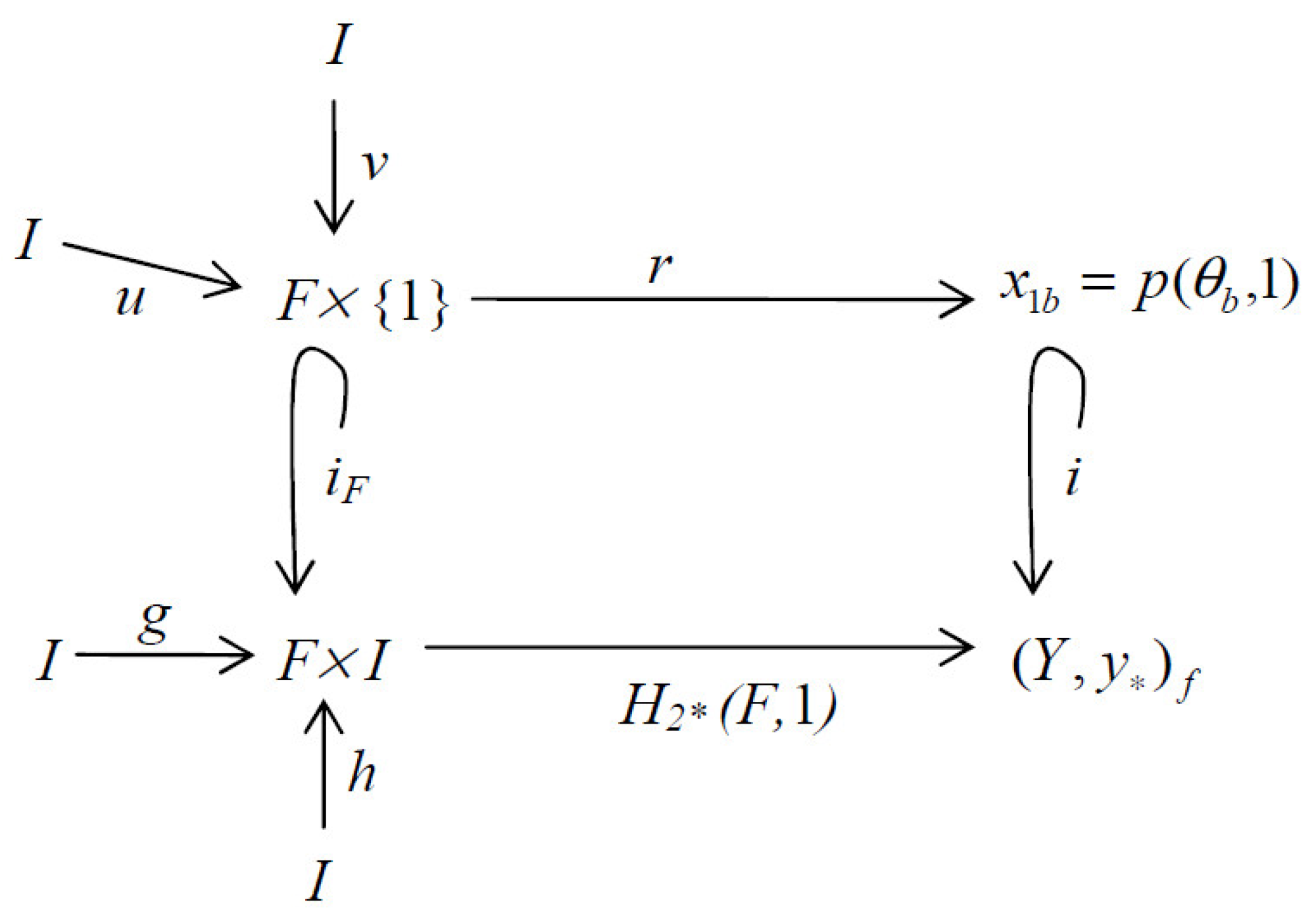
Let us consider a continuous function such that the property is maintained. Suppose we consider that and . Suppose a homotopy is given by and a covering map is given by . We define a homotopy under the extended Dehn twist, which is given by , such that the following algebraic properties are preserved:
Note that, in this particular case, we can consider that with respect to and the corresponding twisted homotopy can be formulated as . As a result, we obtain , where . It results in the following commutative diagram as illustrated in Figure 1, where is a homotopy lifting under the extended Dehn twist and is a local homeomorphism in :
Figure 1.
Twisted homotopy lifting and fibration with no retraction.
Interestingly, the homotopy lifting under the extended Dehn twist with no retraction have resemblances to the Hurewicz fibration with necessary modifications.
Remark 5.
It is important to note that the covering map of a homotopic extended Dehn twist has a left lifting property (LLP) because it admits the condition given by . Furthermore, the lifting is a twisted homotopy lifting because it preserves the property.
Theorem 5.
If is a twisted homotopy with , then it admits the following two properties: (a) and (b) .
Proof.
Let us consider a twisted homotopy . Note that in this case, for all . Let us consider an identity function given as . As a result, the extended Dehn twist results in the following properties:
Hence, we can conclude that and because and . □
4.2. Homotopic Retraction Under Extended Dehn Twist
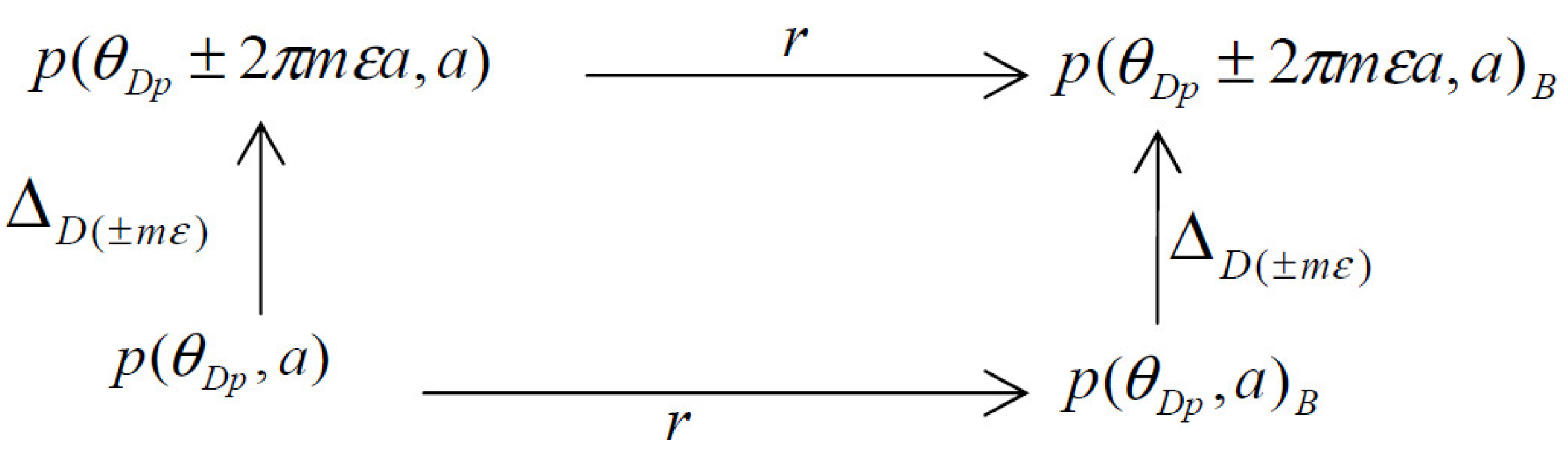
In this section, we consider that the three-space can be topologically retracted and it is null-homotopic. If we first apply the extended Dehn twist to as , and next, we apply retraction under , then we obtain the following equations:
If we apply the extended Dehn twist and retraction in the reverse order, then it results in the following equations:
It leads to the following commutative diagram illustrated in Figure 2.
Figure 2.
Commutative diagram for retraction and extended Dehn twist.
It is relatively easy to observe that the aforesaid commutative property is admitted for all points in the null-homotopic space. This results in the following theorem:
Theorem 6.
Let be a null-homotopic retraction up to in , where it preserves the property. If and are two disjoint continuous functions, then it results in in .
Proof.
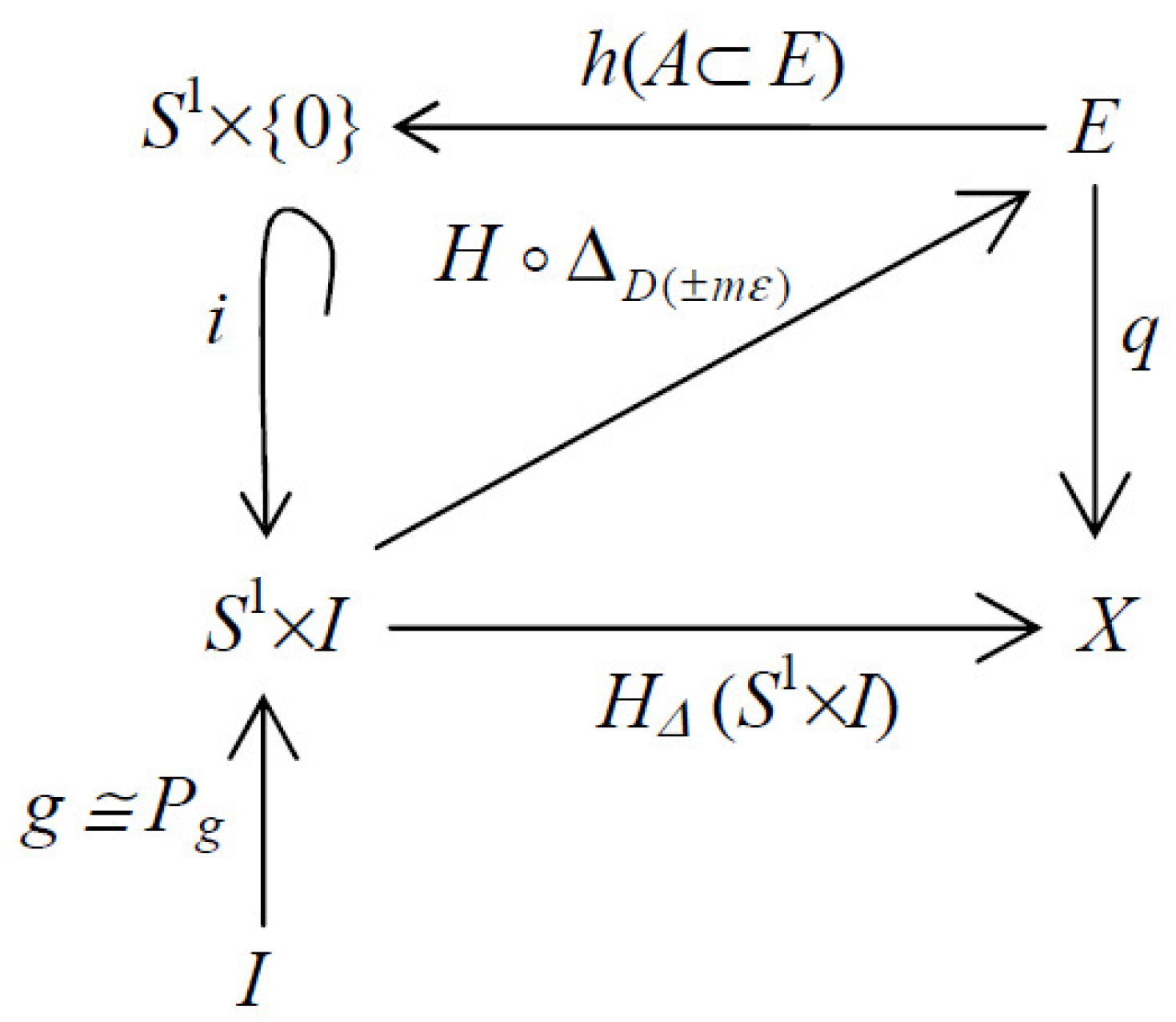
Let be a topological space such that the property is maintained and is the corresponding homotopy. Let us consider that is a null-homotopy up to an point in such that . This implies that there is a retraction with embedding such that , where is a retraction with and is the respective (injective) embedding with . Thus, the homotopy is a null-homotopic retraction variety. Let us consider that and are two disjoint continuous functions such that and . As is a null-homotopic retraction, we can infer that . Hence, we conclude that in . It results in the following commutative diagram as illustrated in Figure 3, where and are two constant (continuous) functions such that and within the topological space. □
Figure 3.
Commutative diagram representing Theorem 6.
This immediately leads to the following corollary:
Corollary 1.
There exist two injective embeddings under homotopy and the restrictions in , which are given as and such that .
We can view this as the admission of the base-point preservation principle within a based topological space.
Remark 6.
Finally, this is to note that the proposed concepts and formulations (excluding our proof of Theorem 1) in this paper are employing the elements of algebraic topology without resorting to the algebraic operator theory of twisted structures. Moreover, the proposed formulations generalize the Dehn twist under retraction in terms of algebraic topology. It would be interesting to investigate the relationships between the proposed concepts and the twisted (algebraic) K-theoretical structures in future.
5. Conclusions
The general form of Dehn twists can be extended involving the pre-twisted topological based spaces and the orientations of twists, where the based space is formed through the continuous function retaining homeomorphism. Extended Dehn twists can be applied to homotopy under two conditions: (1) the non-retraction of a space and (2) under the retraction of the topological space. The resulting twisted homotopies behave differently. The Dehn twisted homotopy with non-retraction can admit a left lifting property (LLP) by following the modified form of Hurewicz fibration, avoiding pullback. However, the Dehn twisted homotopy under retraction up to the base point within a based space admits the point-wise continuity of two disjoint continuous functions at the base point. In a contractible space, the extended Dehn twists and retractions mutually commute.
Funding
This research (article processing charge) is partly funded by Gyeongsang National University, Jinju, Republic of Korea (ROK).
Data Availability Statement
The original contributions presented in the study are included in the article.
Acknowledgments
The author would like to thank the reviewers and editors for their valuable comments and suggestions during the peer-review process.
Conflicts of Interest
The author declares no conflicts of interest.
References
- Chan, A.P.O.; Teo, J.C.Y.; Ryu, S. Topological phases on non-orientable surfaces: Twisting by parity Symmetry. New J. Phys. 2016, 18, 035005. [Google Scholar] [CrossRef]
- Zhu, G.; Lavasani, A.; Barkeshli, M. Instantaneous braids and Dehn twists in topologically ordered states. Phys. Rev. B. 2020, 102, 075105. [Google Scholar] [CrossRef]
- Heusler, S.; Schlummer, P.; Ubben, M.S. The topological origin of quantum randomness. Symmetry 2021, 13, 581. [Google Scholar] [CrossRef]
- Ludkowski, S.V. Topologies on smashed twisted wreath products of metagroups. Axioms 2023, 12, 240. [Google Scholar] [CrossRef]
- Donovan, P.; Karoubi, M. Graded Brauer groups and K-theory with local coefficients. Inst. Hautes Études Sci. Publ. Math. 1970, 38, 5–25. [Google Scholar] [CrossRef]
- Hebestreit, F.; Sagave, S. Homotopical and operator algebraic twisted K-theory. Math. Ann. 2020, 378, 1021–1059. [Google Scholar] [CrossRef]
- Farb, B.; Margalit, D. A Primer on Mapping Class Groups (PMS-49); Princeton University Press: Princeton, NJ, USA, 2012; Chapter 3; pp. 64–88. [Google Scholar] [CrossRef]
- Yusuke, K.; Massuyeau, G.; Tsuji, S. Generalized Dehn Twists in Low-Dimensional Topology; Topology & Geometry; EMS Press: Berlin, Germany, 2019; pp. 357–398. [Google Scholar] [CrossRef]
- Słota, D.; Hetmaniok, E.; Wituła, R.; Gromysz, K.; Trawiński, T. Homotopy Approach for Integrodifferential Equations. Mathematics 2019, 7, 904. [Google Scholar] [CrossRef]
- Hartmann, E. Coarse Sheaf Cohomology. Mathematics 2023, 11, 3121. [Google Scholar] [CrossRef]
- Koropecki, A.; Tal, F.A. Area-preserving irrotational diffeomorphisms of the torus with sublinear diffusions. Proc. Am. Math. Soc. 2014, 142, 3483–3490. [Google Scholar] [CrossRef]
- Addas-Zanata, S.; Tal, F.A.; Garcia, B.A. Dynamics of homeomorphisms of the torus homotopic to Dehn twists. Ergod. Theory Dyn. Syst. 2014, 34, 409–422. [Google Scholar] [CrossRef]
- Doeff, H.E. Rotation measures for homeomorphisms of the torus homotopic to a Dehn twist. Ergod. Theory Dyn. Syst. 1997, 17, 575–591. [Google Scholar] [CrossRef]
- Kuno, Y.; Massuyeau, G. Generalized Dehn twists on surfaces and homology cylinders. Algebr. Geom. Topol. 2021, 21, 697–754. [Google Scholar] [CrossRef]
- Korkmaz, M. Stable commutator length of a Dehn twist. Mich. Math. J. 2004, 52, 23–31. [Google Scholar] [CrossRef]
- Szepietowski, B. On the commutator length of a Dehn twist. C. R. Math. 2010, 348, 923–926. [Google Scholar] [CrossRef]
- MCCullough, D. Homeomorphisms which are Dehn twists on the boundary. Algebr. Geom. Topol. 2006, 6, 1331–1340. [Google Scholar] [CrossRef][Green Version]
- Stukow, M. Dehn twists on nonorientable surfaces. Fundam. Math. 2006, 189, 117–147. [Google Scholar] [CrossRef]
- Keating, A.M. Dehn twists and free subgroups of symplectic mapping class groups. J. Topol. 2014, 7, 436–474. [Google Scholar] [CrossRef]
- Ishida, A. The structure of subgroup of mapping class groups generated by two Dehn twists. Proc. Jpn. Acad. Ser. A Math. Sci. 1996, 72, 240–241. [Google Scholar] [CrossRef]
- Marden, A.; Masur, H. A foliation of Teichmüller space by twist invariant disks. Math. Scand. 1975, 36, 211–228. [Google Scholar] [CrossRef][Green Version]
- Hedden, M.; Mark, T.E. Floer homology and fractional Dehn twist. Adv. Math. 2018, 324, 1–39. [Google Scholar] [CrossRef]
- Baykur, R.I.; Kamada, S. Classification of broken Lefschetz fibrations with small fiber genera. Math. Soc. Jpn. 2015, 67, 877–901. [Google Scholar] [CrossRef]
- Lin, J. Isotopy of the Dehn twist on K3#K3 after a single stabilization. Geom. Topol. 2023, 27, 1987–2012. [Google Scholar]
- Kronheimer, P.B.; Mrowka, T.S. The Dehn twist on a sum of two K3 surfaces. Math. Res. Lett. 2020, 27, 1767–1783. [Google Scholar] [CrossRef]
Disclaimer/Publisher’s Note: The statements, opinions and data contained in all publications are solely those of the individual author(s) and contributor(s) and not of MDPI and/or the editor(s). MDPI and/or the editor(s) disclaim responsibility for any injury to people or property resulting from any ideas, methods, instructions or products referred to in the content. |
© 2024 by the author. Licensee MDPI, Basel, Switzerland. This article is an open access article distributed under the terms and conditions of the Creative Commons Attribution (CC BY) license (https://creativecommons.org/licenses/by/4.0/).