


Abstract
Russian Roulette is a well-known cruel gambling game and its concepts and methods have been exploited in a lot of research fields for decades. However, abundant useful information contained in the process of Russian Roulette is seldom studied with a mathematical model with interpretability. To this end, we define the formal context to model Russian Roulette and carry out 3-valued concept analysis for formal contexts to mine useful information. At first, the uniqueness of formal contexts is discussed from a formal concept analysis viewpoint. And then we propose 3-valued concepts and discuss their properties and the connections with the basic concepts. Experimental analysis demonstrates that 3-valued concept lattices can show many more different details compared with basic concept lattices. Finally, a case study about a Chinese herbal medicine is introduced to demonstrate the feasibility of the proposed model.
MSC:
06B05; 68T30
1. Introduction
Russian Roulette is a cruel gambling game. In Russian Roulette, players usually choose to put into a gun no bullets, or one or two bullets, rather than three or more. In other words, participants only have three options: no bullets, one bullet, or two bullets, i.e., three choices. The concepts and methods derived from Russian Roulette have been used in various types of scientific studies for decades. In the 1970s, the proposal of smoke-control legislation created a lot of crucial challenges for United States copper producers. White [1] reviewed the efforts of individual United States copper producers to reduce the emission of sulfur dioxide and found that copper smelters in the U.S. fell into a scenario of industrial Russian Roulette. In 1995, Murata et al. [2] conducted shielding analysis based on a three-dimensional Monte Carlo model. Two decades ago, Ghassoun and Jehouani [3] sampled energy parameters based on a Russian Roulette technique. Frackiewicz and Schmidt [4] generalized the concept of quantum Russian Roulette and gave a suitable quantum description for any finite number of players. In 2019, oriented for big data, Tokuyoshi and Harada [5] raised a hierarchical acceleration strategy for vertex connections.
It is obvious that there are abundant useful data embodied in Russian Roulette processes. However, those valuable data are seldom effectively investigated based on a mathematical model with interpretability. In this study, we deeply explore this issue with respect to the following aspects.
- Firstly, we define a mathematical model for Russian Roulette, the formal context, which differs from the 3-valued formal context and the ordinary set-valued formal context in many aspects.
- In addition, we investigate the formal context from multiple perspectives to show the uniqueness of 2R formal contexts.
- What is more, we define a novel type of concept for the formal context, i.e., 3-valued 2R concepts and we manifest their effectiveness by systematic experiments and illustrative examples.
Nowadays, most of the studies based on machine learning exhibit a strict dichotomy between accuracy and interpretability. Conceptual knowledge-based data-mining techniques are powerful tools for explainable artificial intelligence. Formal concept analysis, which models a domain with a cognitive viewpoint, has become a wonderful theory for knowledge-based applications [6].
To cater for different cases, many scholars have proposed various types of concepts as well as concept-learning methods. Li et al. [7] described a way to acquire formal concepts from a pseudo-concept by using the granular computing technique. Xu and Li [8] built a two-way concept-acquisition system from several types of information granules. Zhi and Li [9] proposed updating strategies of concept lattices and implication rules with the arrival of new objects. Lately, Lang and Yao [10] provided a new perspective on conflict analysis by modeling and analyzing cliques with a set of formal concepts. Bazin et al. [11] described a method to discover causal relations based on an adaptation of classical formal concept analysis. Belohlavek and Mikula [12] formally explained typicality as an important psychological property of human concepts. Jǎkel and Schmidt [13] designed an abstract framework based on formal concepts to solve optimization problems.
However, formal concepts do not explicitly exhibit the not-possessed features. As a successful solution, Qi et al. [14,15] proposed three-way concept analysis (3WCA) by thinking in threes [16,17]. Since the proposal of 3WCA, many researchers have devoted their efforts to this novel concept model [18,19,20,21,22,23,24]. Zhi et al. [24] defined three-way dual formal concepts by introducing the operations of possibility analysis. Hu et al. [18] adopted interval sets to extend three-way concepts for a specific case in medical diagnosis. Mouliswaran et al. [19] proposed an effective access control method by analyzing the roles of visitors by 3WCA. Yan and Li [22] constructed three-way network concepts to mine topological information in dynamic social networks.
From a possibility theoretic view, more meaningful types of concepts, such as object-oriented and property-oriented concepts, can be defined [25,26,27,28,29,30]. There have been several theoretical studies in this field. For instance, Ma et al. [31] proposed a hierarchical concept-mining approach to acquire object-oriented concepts. In addition, Ma et al. [32] carried out attribute reduction of lattices aided by the topological structures of attributes. She et al. [33] surveyed the properties of multi-scale contexts based on necessary and possible attributes. Wei and Wan [34] discussed the transformation between three types of concepts based on equivalence relations. Recently, Zhi et al. [35] provided new semantics to property-oriented concepts, based on which they further proposed a feasible strategy to discover close contacts in disease-transmission networks. Analogously, object-oriented concepts, property-oriented concepts and dual formal concepts can be combined with three-way decisions. As a consequence, we can accordingly obtain three kinds of three-way concepts [24]. Qian et al. [36] explored the fast computation of three-way concepts by dividing and merging formal contexts.
In addition, all the above-mentioned types of concepts can be adjusted for fuzzy contexts. For example, He et al. [37] defined three-way L-fuzzy concepts to improve the precision of uncertainty reasoning. Chen et al. [38] combined fuzzy concept lattices and three-way decisions to mine useful patterns in unlabelled texts. Zhi et al. [39] adopted the fuzzy concept lattice to realize multi-level conflict analysis and proposed a way to obtain the most appropriate analysis level to make fast decisions. Xu et al. [40] described a two-way concept-acquisition method, which can derive fuzzy concepts from a given clue.
Motivated by the above-mentioned problems, i.e., how to model the obtained record of Russian Roulette, how to define new concepts to mine useful patterns from Russian Roulette and how to obtain these concepts, we put forward 3-valued concept analysis for formal contexts. In the rest of the paper, Section 2 briefly reviews some basic notions related to this study. Section 3 proposes 3-valued concept analysis for formal contexts. In Section 4, experiments and case studies are presented to show the effectiveness of the 3-valued concept lattice model. Finally, conclusions are provided in the last section.
2. Preliminaries of Formal Concept Analysis
A formal context describes a set of related objects Q by a set of attributes T via a binary relation between Q and T. Concretely, we use (respectively, ) to express that the object q possesses (respectively, does not possess) the attribute t.
represents the attributes that are possessed by the object and denotes the set of objects which have the attribute ; these are defined as follows:
For and , we define two operations as follows:
gives the common attributes shared by every object in E and returns the set of objects that possess all the attributes in P. If and , then we call a formal concept of .
In addition, and can be defined as follows:
is the attributes that are not commonly shared by every object in E and returns the set of objects that do not possess all the attributes in P. If , and , then we call an object-induced three-way concept of [15].
What is more, other types of operations, , and , can also be defined to investigate the other aspects of granules [25,26,27,28,29,30]. Formally, for , we have
, and .
Dually, for , we have:
, and .
Then, we can define property-oriented concepts, object-oriented concepts and dual formal concepts by using the above-defined operations [27,28,29,30,41].
Concretely, if and , then we call a property-oriented concept of . If and , then we call an object-oriented concept of . If and , then we call a dual formal concept of .
3. The Unique Properties of 2R Formal Contexts: A Formal Concept Analysis Viewpoint
In this section, we propose four types of concepts of formal contexts and describe the unique properties of formal contexts.
3.1. Formal Concepts of 2R Formal Contexts
In Russian Roulette, a gambler will trigger one or two bullets. In other words, a gambler will definitely trigger one bullet and definitely does not trigger all three bullets. To conform with the existing studies, we use ‘+’, ‘−’ and ‘0’ to denote three bullets, i.e., three kinds of choices.
It is clear that there are six kinds of possible actions taken by the gamblers of a Russian Roulette game, i.e., , , , , and . In the subsequent discussion, we collectively denote these six sets as . Put formally, we have .
Definition 1.
A formal context for Russian Roulette is a quadruple , where Q and T are two non-empty finite sets and .
For simplicity, we call the above-defined formal context a Russian Roulette formal context, and a formal context for short. Here, the first R represents Russian and the second R indicates roulette.
A formal context is essentially a six-valued formal context and its complement is defined as follows.
Definition 2.
Let . For and , the negation of is defined as
Moreover, is called the complement context of K.
It is easy to show that the complement context of a formal context is also a formal context.
Example 1.

Table 1.
The formal context K of Example 1.
Table 2.
The complement context of Example 1.
Qi et al. [42] presented a 3-valued formal context. As an example, Table 3 shows a 3-valued formal context, which can be seen as a special case of a formal context in essence. However, it is clear that the complement cannot be derived in the settings of 3-valued formal contexts.
Table 3.
A 3-valued formal context.
Definition 3.
Let . For and , two associated operators and are defined as
where .
At first glance, ‘’ has been defined by Qi [42] in another format denoted by ‘#’. Actually, they are totally different from each other. Semantically, if an object q possesses an attribute t with a value ?, then the attribute t may be involved in the common features of E, i.e., . In other words, is not necessarily equal to ?. Alternatively, containing the element ? is sufficient.
For example, considering the formal context in Table 1, we have . However, if we follow the idea of 3-way concept analysis [42], it turns out to be as .
Proposition 1.
If E, , and P, , , then the following properties hold.
(i) ; .
(ii) ; .
(iii) ; .
(iv) .
(v) ; .
(vi) ; .
Definition 4.
Let , and . If and ; then is called a concept.
Moreover, we use to denote the set of concepts and define a binary relation between concepts as
Theorem 1.
is a complete lattice and for , ; it follows that
Hereinafter, we call a concept lattice of K. For the sake of a clear discussion, if ? of concept-forming operator is set to +, then we call the derived concepts positive concepts. Analogously, negative concepts and zero concepts can be obtained. As a consequence, for a formal context K, we have positive concept lattice, negative concept lattice and zero concept lattice and denote them as , and , respectively.
Example 2.
The formal context K in Table 4 describes five gamblers in a Russian Roulette game. Each gambler has tried five times, represented, respectively, by a, b, c, d and e.
Table 4.
The formal context K of Example 2.
Hereinafter, for simplicity, we omit the brackes and commas when denoting a concept in a figure. For example, we adopt to indicate a concept .
Figure 1 shows the positive concept lattice , based on which we can find which gamblers prefer the choice ‘+’ in each trial. For instance, the concept manifests that in the second trial, i.e., trial b, players 1, 2, 4 and 5 have chosen ‘+’.
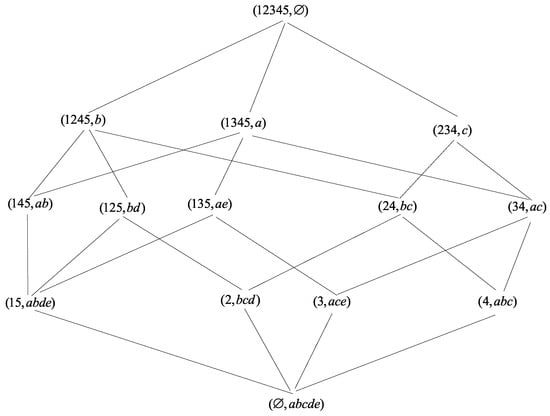
Figure 1.
of Example 2.
3.2. 2R Concepts with a Possibility Theoretic View
Let . For and , we define
Definition 5.
Let , and . Two associated operators and are defined as
where .
Moreover, if and , we call an object-oriented concept, concept for short.
In addition, the set of concepts is denoted as and we call it the object-oriented concept lattice of K, concept lattice for short, and the infimum and supremum in are, respectively, defined as
Definition 6.
Let , and . Two operators and are defined as
where .
Moreover, if and , we call a property-oriented concept, concept for short, and denote the set of concepts by .
In addition, we call the property-oriented concept lattice of K, concept lattice for short, and the infimum and supremum in are, respectively, given by
Definition 7.
Let , and . Two operators and are defined as
where .
Moreover, if and , we call a dual concept, concept for short, and denote the set of concepts by .
In addition, we call a dual concept lattice, concept lattice for short, and the infimum and supremum in are, respectively, defined as
Proposition 2.
Let , and . The following properties hold.
(i) ; .
(ii) ; .
(iii) ; .
(iv) , ; , .
Proof.
(i)
(ii)
(iii)
(iv) By (ii) and (iii), it follows that . Moreover, let . Then, , which leads to .
The rest can be proved by the duality principle. □
Theorem 2.
Let . For , and , the following propositions are equivalent.
(i) is a concept of K.
(ii) is a dual concept of K.
(iii) is an object-oriented concept of .
(iv) is a property-oriented concept of .
Proof.
(i) ⇔ (ii): by Proposition 2 (i), we obatin
(i) ⇔ (iii): by Proposition 2 (ii) and (iii), we obatin
(iii) ⇔ (iv): by Proposition 1 (iv), we obatin
□
The comparisons between formal contexts and 3-valued formal contexts are summarized in Table 5. In fact, the main reason for these differences is that the complement of a 3-valued formal context cannot be defined. As a consequence, it is impossible to relate formal concepts with object-oriented concepts, property-oriented concepts and dual concepts via its complement.
Table 5.
The uniqueness of formal contexts compared with 3-valued formal contexts.
4. Concept Analysis for 2R Formal Contexts
In this section, we propose 3-valued concepts and discuss their properties and the connections with the basic concepts.
Definition 8.
Let . For and , two associated 3-valued operators and are defined as
Let . Then, if and only if .
Proposition 3.
If E, , and S, , , then the following properties hold.
(i) ; .
(ii) ; .
(iii) ; .
(iv) .
(v) ; .
(vi) ; .
Definition 9.
Let , and . If and , we call a 3-valued concept.
The set of 3-valued concepts is denoted by and a partial order between any two 3-valued concepts in is defined as
Theorem 3.
is a complete lattice and for , , it follows that
Hereinafter, we call the 3-valued concept lattice of K.
In what follows, Algorithm 1 describes the process of building the 3-valued concept lattice based on an incremental strategy. The main idea of algorithm 1 adopts an incremental manner to construct the 3-valued concept lattice. Concretely, we first initialize the 3-valued concept lattice to be empty and then for each object of the formal context, we dynamically adjust the lattice until all the objects are considered. Lines 5 to 13 describe the procedure for updating the current lattice when dealing with a new object, which can be divided into the following two steps.
Step 1: Sort in descending order in terms of the sizes of the extents of each 3-valued concept.
Step 2: For each 3-valued concept, perform necessary changes and generate new 3-valued concept as follows.
(i) If , then add into .
(ii) If and there is no 3-valued concept with an intent , then add into .
| Algorithm 1 Algorithm for building 3-valued concept lattice |
| Require: . Ensure: .
|
Example 3.
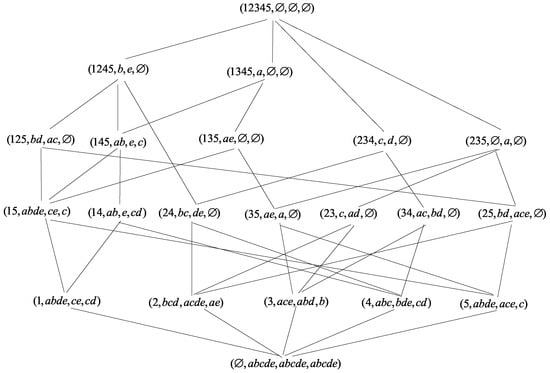
Figure 2.
Three-valued concept lattice .
For the sake of discussion, given a formal context , we collectively call the positive concepts, negative concepts and zero concepts basic concepts of K.
Theorem 4.
Let and be a 3-valued concept of K. Then, the following propositions hold.
(i) is a positive concept.
(ii) is a negative concept.
(iii) is a zero concept.
Proof.
(i) As is a 3-valued concept, we have . Then, , which means that is a positive concept.
In addition, items (ii) and (iii) can be analogously proved. □
Definition 10.
Let , , and . If , then denote this case as and denote the corresponding equivalence class by .
Theorem 5.
is the least element of , if and only if , and .
Proof.
“⇒”. As , , it follows that . Similarly, we also have and . Therefore, . In addition, by the properties of the operators, we have , and . To sum up, we can conclude that , which further implies that
Moreover, by the fact that , , , we can derive
By the condition that is the least element of , we can conclude that , and .
“⇐”. For any , we have , by which we can derive . Similarly, we can show and . Then, it follows that , and ; i.e., is the least element of . □
Theorem 6.
Let and Δ be the collection of the least elements in . Then,
Proof.
Let .
On one hand, let . We have , and . Moreover, as , and , by Theorem 3, we have
By the fact that , we can conclude , which implies .
On the other hand, let . By Theorem 3, we have , and . Then, by the definition of a 3-valued concept, is at hand, which implies .
Then, this theorem is proved. □
The above theorems actually indicate the strong connections between 3-valued concepts and basic concepts. That is, Theorem 4 implies that we can derive basic concepts from 3-valued concepts, while Theorem 6 states a 3-valued concept lattice can be derived by using its basic concept lattices.
5. Experimental Analysis
In this section, some experiments will be conducted to derive several important conclusions.
5.1. Testing on Synthetic Data Sets
This subsection discusses the influences of the number of objects, the number of attributes and the fill ratios on the sizes of 3-valued concept lattices and the basic concept lattices.
In the experiments, Algorithm 2 derives the synthetic formal contexts.
| Algorithm 2 Generating a synthetic formal context |
| Require: Q, T, two ratios and and a possibility p. Ensure: .
|
(i) The influences caused by the number of objects
By setting , , and and changing the size of Q from 20 to 40, we can derive a family of randomly generated formal context, which have 25 attributes, but different numbers of objects. For each generated formal context, we record the number of 3-valued concepts and basic concepts. Then, we show the experimental results in Figure 3.
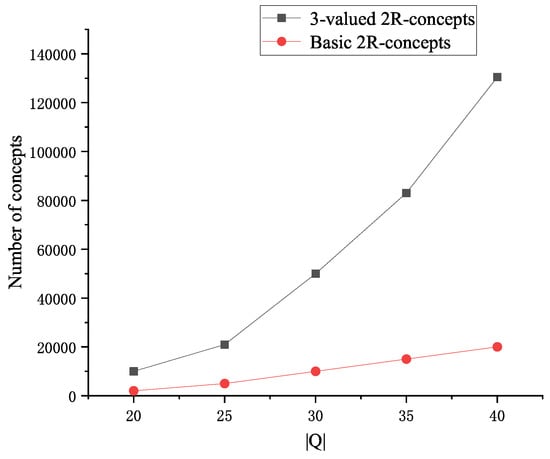
Figure 3.
Three-valued concept vs. basic concept with fixed number of attributes.
(ii) The influences caused by the number of attributes
Let , , and . By changing from 20 to 40, we can derive a family of randomly generated formal contexts, which has 35 objects but different numbers of attributes. By recording the number of 3-valued concepts and basic concepts, we show the experimental results in Figure 4.
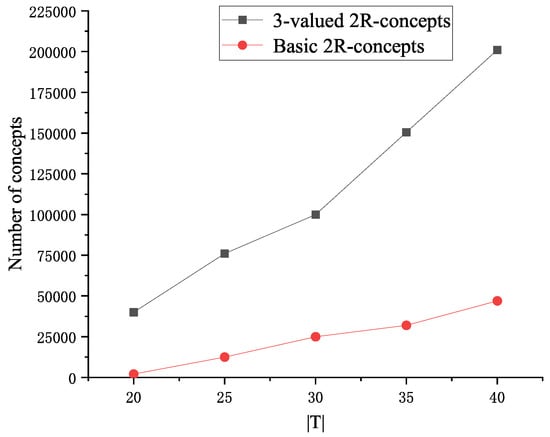
Figure 4.
Three-valued concept vs. basic concept with fixed number of objects.
(iii) The influences caused by different fill ratios
By fixing and setting five different fill ratios , , , and for , we randomly generate five different formal contexts by Algorithm 2, namely , , , and , where for each formal context and . By recording the number of 3-valued concepts and basic concepts of the family of the randomly generated formal contexts, we collectively list the experimental results in Table 6, where , , and represent the numbers of concepts of , , and , respectively, and denotes the ratio between the number of +, − and 0 contained in the formal contexts.
Table 6.
The experimental results with different fill ratios.
The following can be analyzed from the experimental results.
- There is a close correlation between () and the size of 3-valued concept lattices and the basic concept lattices. The larger the values of (), the larger the size of the 3-valued concept lattices and the basic concept lattices.
- Given a formal context, the sizes of basic concept lattices are smaller than that of the 3-valued concept lattice, which implies 3-valued concept lattices embody some unique patterns compared with basic concept lattices.
- When +, − and 0 are evenly filled, the formal contexts contain the fewest 3-valued concepts.
5.2. Case Study
In Table 7, a survey on the usage of a type of Chinese herbal medicine is presented. In this table, there are 15 TCM doctors (denoted as to ), who gave their suggested prescriptions independently to 10 patients (denoted as to ). Concretely, +, − and 0, respectively, denote Aconiti Lateralis Radix Preparata, Aconitum Carmichaeli and Tianxiong. Any one or two of them can cure a certain disease, but all three are toxic to the body. For instance, from this table, it can be observed that doctor has prescribed Aconiti Lateralis Radix Preparata for patients and and has prescribed Aconitum Carmichaeli and Tianxiong for patient .
Table 7.
A survey on the clinical usage of three kinds of Chinese herbal medicines.
In this survey, Aconiti Lateralis Radix Preparata appears 106 times, Aconitum Carmichaeli 55 times and Tianxiong 100 times. In addition, we can derive 406 3-valued concepts from this dataset, and each 3-valued concept denotes a meaningful pattern, based on which many useful pieces of information can be obtained.
For instance, there are 79 3-valued concepts whose extents possess . Among these 79 3-valued concepts, the minimal one is , , which states that gives Aconiti Lateralis Radix Preparata for patients and , Aconitum Carmichaeli for patients and and Tianxiong for patients and and the maximal one is , which implies that all the 15 TCM physicians agree that Aconiti Lateralis Radix Preparata is necessary for patient and Tianxiong for patients and .
According to the prescriptions given by the TCM physicians, the consistency degree of an arbitrary group of TCM physicians can be obtained. Let , and . We define , where and there does not exist such that .
Moreover, we define
Then, the consistency degree .
By using the above formula, the consistency degrees of arbitrary cliques can be computed. For example, the consistency degrees of pairs that contain are collectively listed as follows:
It can be concluded that and have the most similar prescriptions and and have the least similar prescriptions.
6. Conclusions
In this study, motivated by the well-known gambling game Russian Roulette, we defined the formal context. Then, we undertook a systematic study on formal concept analysis for formal contexts. It can be shown that the formal context is a generalized 3-valued formal context, but it has more different properties. In addition, we explored 3-valued concept analysis for 2R formal contexts and presented a novel concept lattice model, i.e., 3-valued concept lattice. Finally, we obtained several important conclusions by experimental analysis and raised a case in Chinese medicine to show the effectiveness of 3-valued concept lattices in knowledge discovery.
Further research needs to consider more complicated cases. For instance, missing data are encountered from time to time due to various reasons in our daily life [43,44]. In addition, sometimes the data are obtained in a distributed and progressive manner [45] and the data may be inaccurate and contain some sort of vagueness [46]. How to model these problems and build the formal concept-analysis model is interesting and deserves our effort. What is more, the inputs of trainers in machine learning are of vital importance [47]. Thus, it is also appealing to model the inputs of trainers in the form of concepts, which may provide some interpretability to machine learning. Last but not least, how to reduce time consumption especially for big data when applying a concept lattice model is an important issue.
Author Contributions
Conceptualization, T.Z. and H.Z.; methodology, H.Z.; software, H.Z.; validation, Y.L., D.Z. and J.X.; formal analysis, H.Z.; investigation, T.Z.; resources, J.X.; data curation, H.Z.; writing—original draft preparation, T.Z. and H.Z.; writing—review and editing, T.Z. and H.Z.; visualization, H.Z.; supervision, Y.L.; project administration, H.Z.; funding acquisition, H.Z. All authors have read and agreed to the published version of the manuscript.
Funding
This work was supported in part by the Natural Science Foundation of Fujian Provincial Science and Technology Department under Grants No. 2023H6034 and No. 2021H6037, in part by the Key Project of Quanzhou Science and Technology Plan under Grant No. 2021C008R and in part by the sixth batch of Quanzhou City’s introduction of high-level talent team projects under Grant No. 2.
Data Availability Statement
Dataset available on request from the authors. The raw data supporting the conclusions of this article will be made available by the authors on request.
Conflicts of Interest
The authors declare no conflicts of interest.
References
- White, L. SO2 laws force U.S. copper smelters into industrial Russian Roulette. Eng. Min. J. 1971, 172, 61–71. [Google Scholar]
- Murata, I.; Shindo, R.; Shiozawa, S. Importance determination method for geometry splitting with Russian Roulette in Monte Carlo calculations of thick and complicated core shielding structure. J. Nucl. Sci. Technol. 1995, 32, 971–980. [Google Scholar] [CrossRef][Green Version]
- Ghassoun, J.; Jehouani, A. Russian Roulette efficiency in Monte Carlo resonant absorption calculations. Appl. Radiat. Isot. 2000, 53, 881–885. [Google Scholar] [CrossRef] [PubMed]
- Frackiewicz, P.; Schmidt, A.G.M. N-person quantum Russian Roulette. Phys. Stat. Mech. Its Appl. 2014, 401, 8–14. [Google Scholar] [CrossRef]
- Tokuyoshi, Y.; Harada, T. Hierarchical Russian Roulette for vertex connections. ACM Trans. Graph. 2019, 38, 36. [Google Scholar] [CrossRef]
- Ganter, B.; Wille, R. Formal Concept Analysis: Mathematical Foundations; Springer: Berlin/Heidelberg, Germany, 1999. [Google Scholar]
- Li, J.H.; Mei, C.L.; Xu, W.H.; Qian, Y.H. Concept learning via granular computing: A cognitive viewpoint. Inf. Sci. 2015, 298, 447–467. [Google Scholar] [CrossRef]
- Xu, W.H.; Li, W.T. Granular computing approach to two-way learning based on formal concept analysis in fuzzy datasets. IEEE Trans. Cybern. 2016, 46, 366–379. [Google Scholar] [CrossRef]
- Zhi, H.L.; Li, J.H. Influence of dynamical changes on concept lattice and implication rules. Int. J. Mach. Learn. Cybern. 2018, 9, 705–805. [Google Scholar] [CrossRef]
- Lang, G.M.; Yao, Y.Y. Formal concept analysis perspectives on three-way conflict analysis. Int. J. Approx. Reason. 2022, 152, 160–182. [Google Scholar] [CrossRef]
- Bazin, A.; Couceiro, M.; Devignes, M.; Napoli, A. Steps towards causal formal concept analysis. Int. J. Approx. Reason. 2022, 142, 338–348. [Google Scholar] [CrossRef]
- Belohlavek, R.; Mikula, T. Typicality: A formal concept analysis account. Int. J. Approx. Reason. 2022, 142, 349–369. [Google Scholar] [CrossRef]
- Jǎkel, C.; Schmidt, S.E. Optimization problems on posets with regard to formal concept analysis. Int. J. Approx. Reason. 2022, 142, 196–205. [Google Scholar] [CrossRef]
- Qi, J.J.; Wei, L.; Yao, Y.Y. Three-way formal concept analysis. In Rough Sets and Knowledge Technology; Miao, D., Pedrycz, W., Śezak, D., Peters, G., Hu, Q., Wang, R., Eds.; RSKT 2014; LNCS; Springer: Cham, Switzerland, 2014; Volume 8818, pp. 732–741. [Google Scholar]
- Qi, J.J.; Qian, T.; Wei, L. The connections between three-way and classical concept lattices. Knowl.-Based Syst. 2016, 91, 143–151. [Google Scholar] [CrossRef]
- Yao, Y.Y. An outline of a theory of three-way decisions. In Rough Sets and Current Trends in Computing; RSCTC 2012; LNCS; Springer: Berlin/Heidelberg, Germany, 2012; Volume 7413, pp. 1–17. [Google Scholar]
- Yao, Y.Y. Three-way decision and granular computing. Int. J. Approx. Reason. 2018, 103, 107–123. [Google Scholar] [CrossRef]
- Hu, J.H.; Chen, D.; Liang, P. A novel interval three-way concept lattice model with its application in medical diagnosis. Mathematics 2019, 7, 103. [Google Scholar] [CrossRef]
- Mouliswaran, S.C.; Kumar, C.A.; Chelliah, C. Role based access control design using three-way formal concept analysis. Int. J. Mach. Learn. Cybern. 2018, 9, 1807–1837. [Google Scholar]
- Singh, P.K.; Kumar, C.A. Bipolar fuzzy graph representation of concept lattice. Inf. Sci. 2014, 288, 437–448. [Google Scholar] [CrossRef]
- Singh, P.K. Medical diagnoses using three-way fuzzy concept lattice and their Euclidean distance. Comput. Appl. Math. 2018, 37, 3283–3306. [Google Scholar] [CrossRef]
- Yan, M.Y.; Li, J.H. Knowledge discovery and updating under the evolution of network formal contexts based on three-way decision. Inf. Sci. 2022, 601, 18–38. [Google Scholar] [CrossRef]
- Zhai, Y.H.; Qi, J.J.; Li, D.Y.; Zhang, C.; Xu, W.H. The structure theorem of three-way concept lattice. Int. J. Approx. Reason. 2022, 146, 157–173. [Google Scholar] [CrossRef]
- Zhi, H.L.; Qi, J.J.; Qian, T.; Wei, L. Three-way dual concept analysis. Int. J. Approx. Reason. 2019, 114, 151–165. [Google Scholar] [CrossRef]
- YChen, H.; Yao, Y.Y. A multiview approach for intelligent data analysis based on data operators. Inf. Sci. 2008, 178, 1–20. [Google Scholar]
- Djouadi, Y.; Prade, H. Possibility-theoretic extension of derivation operators in formal concept analysis over fuzzy lattices. Fuzzy Optim. Decis. Mak. 2011, 10, 287–309. [Google Scholar] [CrossRef]
- Dubois, D.; de Saint-Cyr, F.D.; Prade, H. A possibilty-theoretic view of formal concept analysis. Fundam. Informaticae 2007, 75, 195–213. [Google Scholar]
- Dubois, D.; Prade, H. Possibility theory and formal concept analysis in information systems. In Proceedings of the IFSA/EUSFLAT’09, Lisbon, Portugal, 20–24 July 2009; pp. 1021–1026. [Google Scholar]
- Yao, Y.Y. A comparative study of formal concept analysis and rough set theory in data analysis. In Rough Sets and Current Trends in Computing; Tsumoto, S., Slowinski, R., Komorowski, J., Grzymala-Busse, J.W., Eds.; RSCTC 2004; LNCS; Springer: Berlin/Heidelberg, Germany, 2004; Volume 3066, pp. 59–68. [Google Scholar]
- Yao, Y.Y. Concept lattices in rough set theory. In Proceedings of the International Conference of the North American Fuzzy Information Processing Society, Banff, AB, Canada, 27–30 June 2004; pp. 796–801. [Google Scholar]
- Ma, J.M.; Cai, M.J.; Zou, C.J. Concept acquisition approach of object-oriented concept lattices. Int. J. Mach. Learn. Cybern. 2017, 8, 123–134. [Google Scholar] [CrossRef]
- Ma, J.M.; Leung, Y.; Zhang, W.X. Attribute reductions in object-oriented concept lattices. Int. J. Mach. Learn. Cybern. 2014, 5, 789–813. [Google Scholar] [CrossRef]
- She, Y.H.; He, X.L.; Qian, T.; Wang, Q.Q.; Zeng, W.L. A theoretical study on object-oriented and property-oriented multi-scale formal concept analysis. Int. J. Mach. Learn. Cybern. 2019, 10, 3263–3271. [Google Scholar] [CrossRef]
- Wei, L.; Wan, Q. Granular transformation and irreducible element judgment theory based on pictorial diagrams. IEEE Trans. Cybern. 2017, 46, 380–387. [Google Scholar] [CrossRef]
- Zhi, H.L.; Li, J.H.; Qi, J.J. Close contact detection in social networks via possible attribute analysis. In Rough Sets; Yao, J., Fujita, H., Yue, X., Miao, D., Grzymala-Busse, J., Li, F., Eds.; IJCRS 2022; LNCS; Springer: Cham, Switzerland, 2022; Volume 13633, pp. 304–316. [Google Scholar]
- Qian, T.; Wei, L.; Qi, J.J. A theoretical study on the object (property) oriented concept lattices based on three-way decisions. Soft Comput. 2019, 23, 9477–9489. [Google Scholar] [CrossRef]
- He, X.L.; Wei, L.; She, Y.H. L-fuzzy concept analysis for three-way decisions: Basic definitions and fuzzy inference mechanisms. Int. J. Mach. Learn. Cybern. 2018, 9, 1857–1867. [Google Scholar] [CrossRef]
- Chen, X.Y.; Qi, J.J.; Zhu, X.M.; Wang, X.; Wang, Z. Unlabelled text mining methods based on two extension models of concept lattices. Int. J. Mach. Learn. Cybern. 2020, 11, 475–490. [Google Scholar] [CrossRef]
- Zhi, H.L.; Li, J.H.; Li, Y.N. Multi-level conflict analysis based on fuzzy formal contexts. IEEE Trans. Fuzzy Syst. 2022, 30, 5128–5142. [Google Scholar] [CrossRef]
- Xu, W.H.; Guo, D.D.; Qian, Y.H.; Ding, W.P. Two-way concept-cognitive learning method: A fuzzy-based progressive learning. IEEE Trans. Fuzzy Syst. 2023, 31, 1885–1899. [Google Scholar] [CrossRef]
- Medina, J. Relating attribute reduction in formal, object-oriented and property-oriented concept lattices. Comput. Math. Appl. 2012, 64, 1992–2002. [Google Scholar] [CrossRef]
- Qi, J.J.; Wei, L.; Ren, R.S. 3-way concept analysis based on 3-valued formal contexts. Cogn. Comput. 2022, 14, 1900–1912. [Google Scholar] [CrossRef]
- Yao, Y.Y. Interval sets and three-way concept analysis in incomplete contexts. Int. J. Mach. Learn. Cybern. 2017, 8, 3–20. [Google Scholar] [CrossRef]
- RRen, S.; Wei, L.; Yao, Y.Y. An analysis of three types of partially-known formal concepts. Int. J. Mach. Learn. Cybern. 2018, 9, 1767–1783. [Google Scholar] [CrossRef]
- Xu, W.H.; Li, M.M.; Wang, X.Z. Information Fusion Based on Information Entropy in Fuzzy Multi-source Incomplete Information System. Int. J. Fuzzy Syst. 2017, 19, 1200–1216. [Google Scholar] [CrossRef]
- Zhang, Z. Constructing L-fuzzy concept lattices without fuzzy Galois closure operation. Fuzzy Sets Syst. 2018, 333, 71–86. [Google Scholar] [CrossRef]
- Hosseini, E.; Al-Ghaili, A.M.; Kadir, D.H.; Daneshfar, F.; Gunaseka, S.S.; Devect, M. The evolutionary convergent algorithm: A guiding path of neural network advancement. IEEE Access 2024, 12, 127440–127459. [Google Scholar] [CrossRef]
Disclaimer/Publisher’s Note: The statements, opinions and data contained in all publications are solely those of the individual author(s) and contributor(s) and not of MDPI and/or the editor(s). MDPI and/or the editor(s) disclaim responsibility for any injury to people or property resulting from any ideas, methods, instructions or products referred to in the content. |
© 2024 by the authors. Licensee MDPI, Basel, Switzerland. This article is an open access article distributed under the terms and conditions of the Creative Commons Attribution (CC BY) license (https://creativecommons.org/licenses/by/4.0/).