1. Introduction
Recently, research into the theory of geometric functions related to nephroid and leminscate domains has gained prominence [
1,
2,
3,
4,
5,
6]. Here, the leminscate domain refers to the image of
through the function
, while the image of
through the function
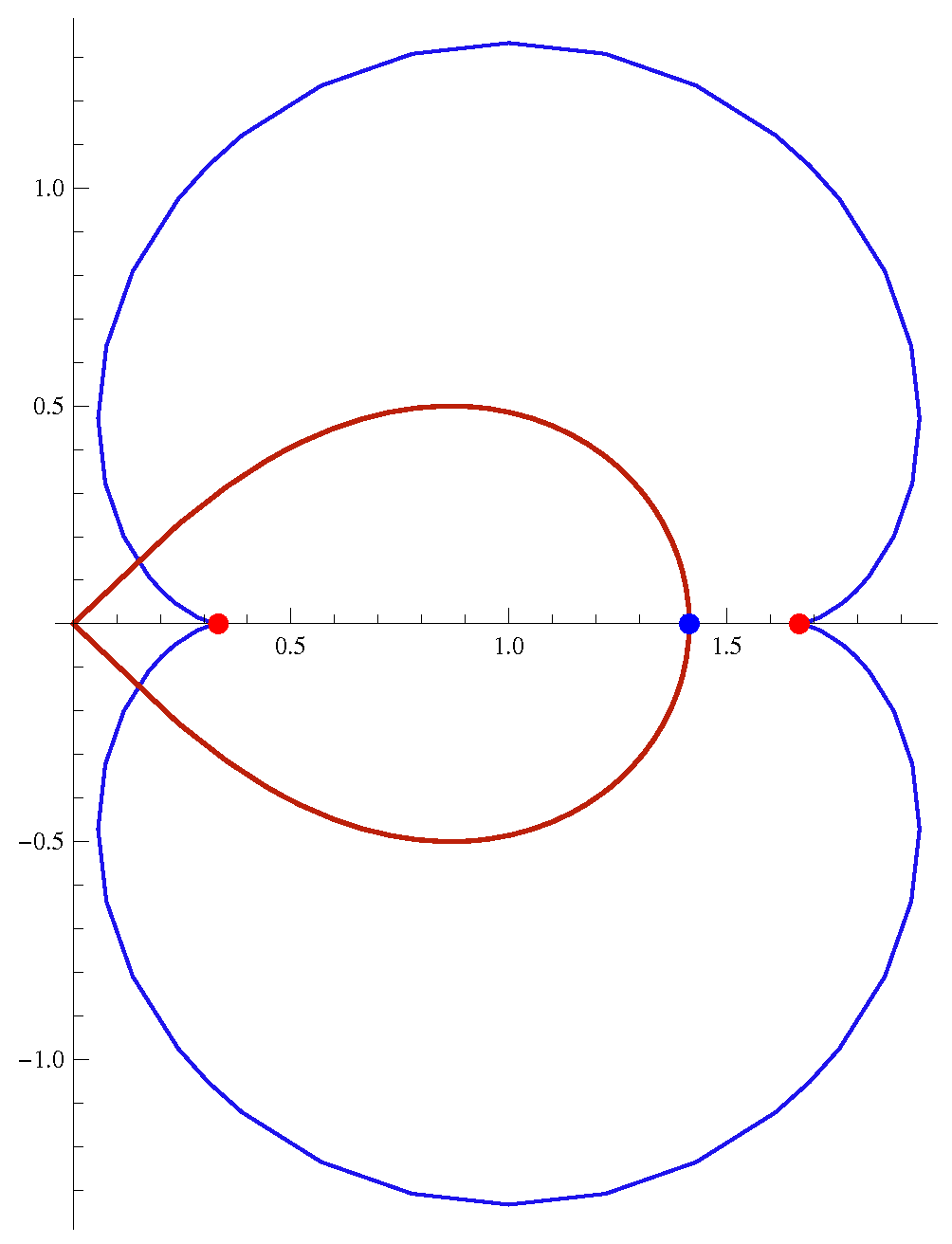
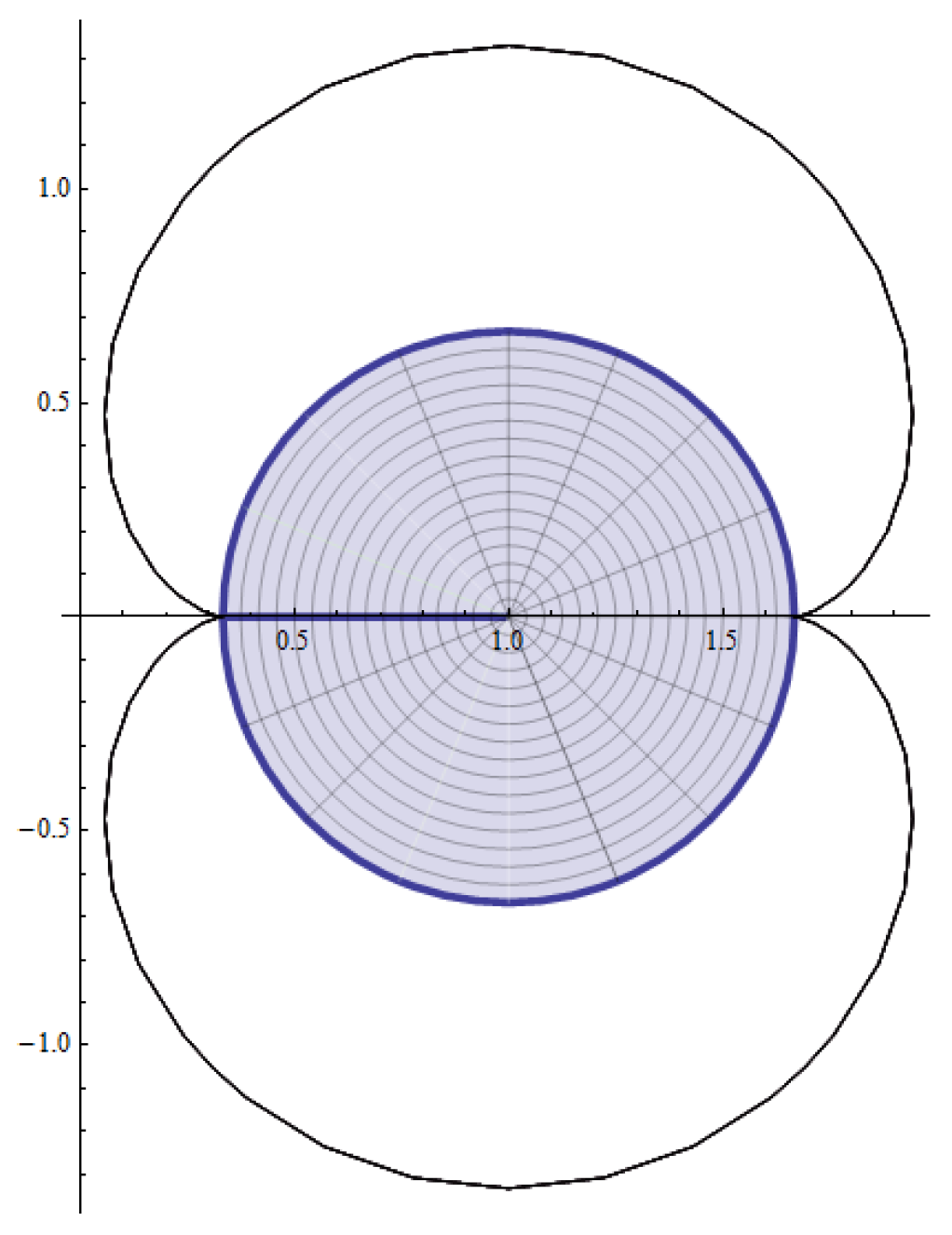
is known as the nephroid domain. The mapping of boundary of unit disc
by
and
is given in
Figure 1.
Now, we recall a few basic concepts of the geometric function theory. The class of functions
f defined on the open unit disk
, and normalized by the conditions
, is denoted by
. We say
if
is the normalized condition. Generally,
possess power series
while
has the power series
Definition 1 (Subordination). For two functions f and g, which are analytic in , we say that f is subordinate to g, and write in , if there exists a Schwartz function , which is analytic in with and , such that .
Subordination [
7] is one of the important concepts of geometric function theory that is useful in studying the geometric properties of analytic functions. There are several important sub-classes of
, namely the class of starlike and convex functions denoted by
and
, respectively. The Cárath}eodory class
includes analytic functions
p that satisfy
and
in
. These sub-classes are related to each other. In analytical terms,
if
, and
if
.
If
is within the region bounded by the right half of the lemniscate of Bernoulli, denoted by
, then the function
is known as the lemniscate convex. This is equivalent to subordination
. In an analogous way, if
, then the function
f is lemniscate starlike. Moreover, if
, then the function
is lemniscate Carathéodory. It is evident that the lemniscate Carathéodory function is univalent as it is a Carathéodory function. More details about the geometric properties associated with lemniscate can be seen in [
5,
8,
9].
In this article, we are going to study the following functions or a combination of them. Details about the nature of the functions are provided in the associated section or subsection. The listed functions are as follows:
Section 2: The function
,
,
Section 3: The polynomial
,
,
Section 7: Bessel and Modified Bessel functions.
Our aim is to derive the condition for which an analytic function or a polynomial, let us denote it as f, maps the unit disc to a domain such that following implication holds: (i) (ii) , but (iii) , but .
2. Results Involving
In this section, we consider the function , . Using the definition of subordination, we derived conditions on the parameter for which and . We also validate the result through graphical representation. Using , we also construct a function that is lemniscate and nephroid starlike under the same condition as .
Theorem 1. The containment holds for , while the containment is true for .
Proof. Consider the function
. Then,
and
. Thus, by the definition of subordination,
Hence, holds for .
For the second part, first we note that
intercepts the x-axis, at
and
. Furthermore,
intercepts the x-axis, at
and at
. From
Figure 1, it is evident that
implies
, provided the left side intercept of
with the x-axis is above
.
In this aspect,
implies the validity of the following inequalities:
In (
2), the left side inequality holds if
, which is equivalent to
. On the other hand, the right hand side inequality holds if
is equivalent to
. Thus, both inequalities hold when
. Similarly, in (
3), the left side inequality holds if
, which is equivalent to
, and the right hand side inequality holds if
is equivalent to
. Thus, both inequalities hold when
. Finally, we conclude that
, equivalently
holds only when
. □
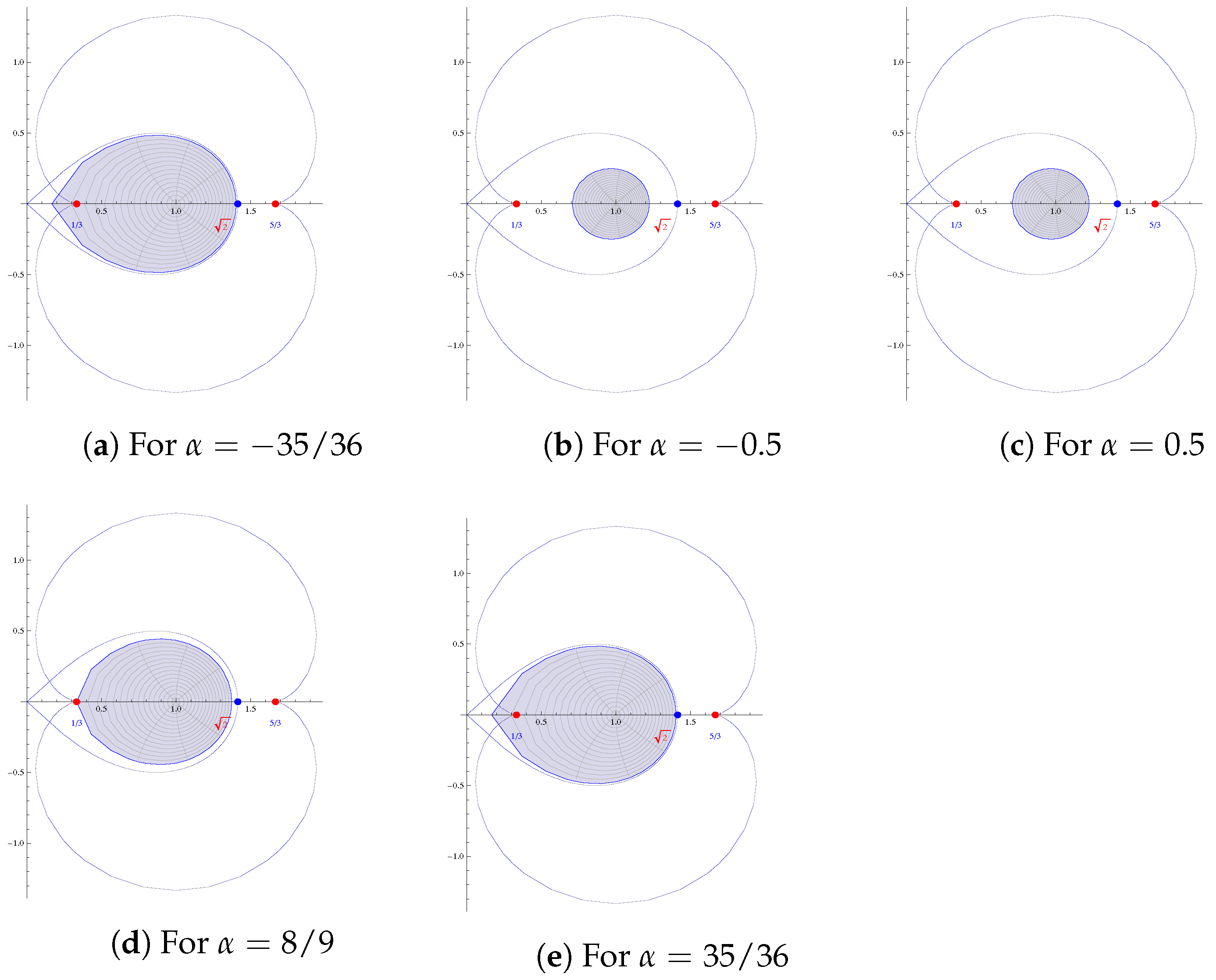
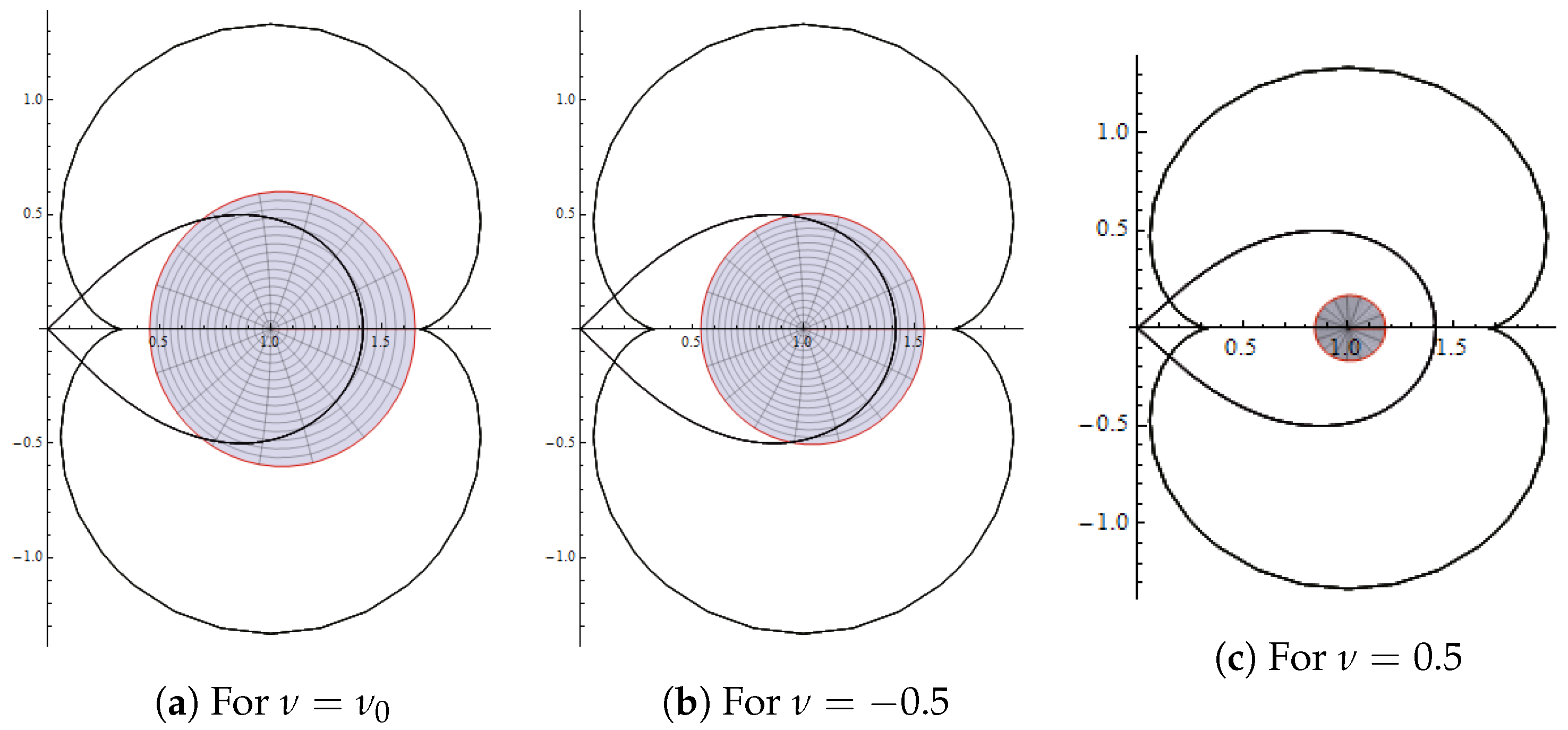
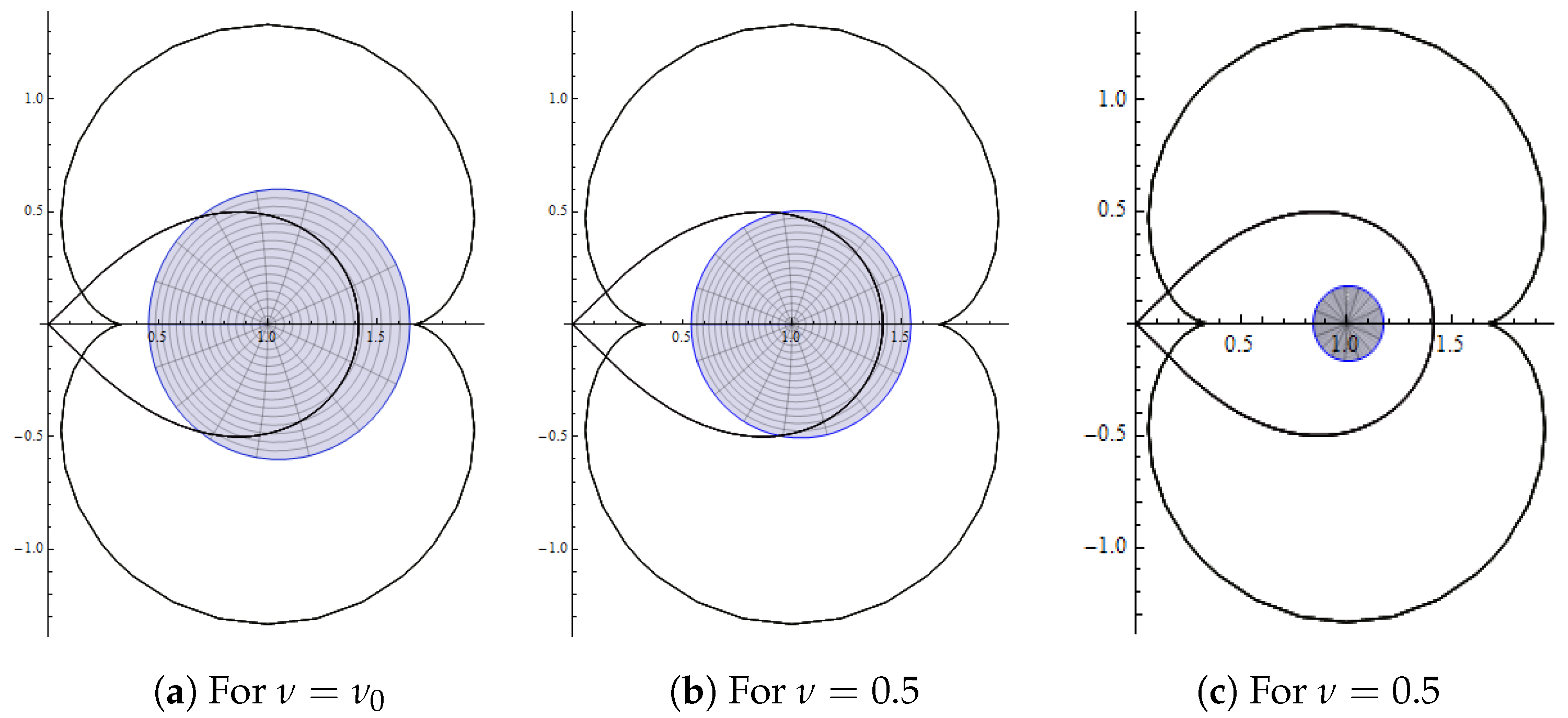
We can interpret the result in Theorem 1 from the following visualization (
Figure 2) by considering different
, namely
.
Theorem 2. For and , the functionis lemniscate starlike for and nephriod starlike when . Proof. To show lemniscate or nephroid starlikeness, our aim is to prove, respectively,
It is clear that
, and a logarithmic differentiation of both sides in (
4) yields
Further simplification of (
5) leads
Thus,
. It is also follows from (
5) that
As Theorem 1 provides us
for
and
for
, we have the conclusion from (
7). □
3. Result Related to
For
, define the function
Clearly,
and
. In our next result, we will find conditions for
and
for which the function
is lemniscate and nephroid starlike. First, we need the following result.
Theorem 3. For , the function for and when and .
Proof. Consider the function
. Clearly,
and
Now, for
and
, it follows
From the definition of subordination, we can conclude that .
In similar way, the second part of the result follows if we consider
. Clearly,
and
. Now, by taking
, we have
This provides the required subordination. □
A logarithmic differentiation of (
8) yields
Therefore, Theorem 3 immediately leads to the following conclusion.
Theorem 4. For , and , the function is lemniscate starlike for and nephroid starlike when and .
4. Results Related to Taylor Series of an Analytic Functions and It’s Partial Sum
Consider a function
, such that
is convergent for
, and also the function
We denote the n-th partial sum of the series as .
For our next result, we need following
Lemma 1 ([
6], Theorem 3.2)
. Suppose that the function satisfies the subordination for . Then, whenever , and this estimate on β is sharp. Theorem 5. For and , the partial sum provided In general, the function provided Proof. Denote
. Then, a calculation yields
Now, consider the Schwarz function
Clearly,
. As
, the hypothesis (
10) implies
Finally, yields . The final conclusion follows from Lemma 1.
Similarly, the general part holds by considering the Schwarz function as
We omit the details proof for this part. □
Remark 1. Instead of the partial sum , the result is still holds if we consider the n th degree polynomial defined by .
Now, judicious choice of in Theorem 5 leads to several interesting examples. Because of the independent significance of each example, we present them as a theorem.
Theorem 6. For and , the polynomials .
Proof. In virtue of Theorem 5 and Remark 1, we have , and, hence, . Thus, . Clearly, . Thus, the result follows from Theorem 5. □
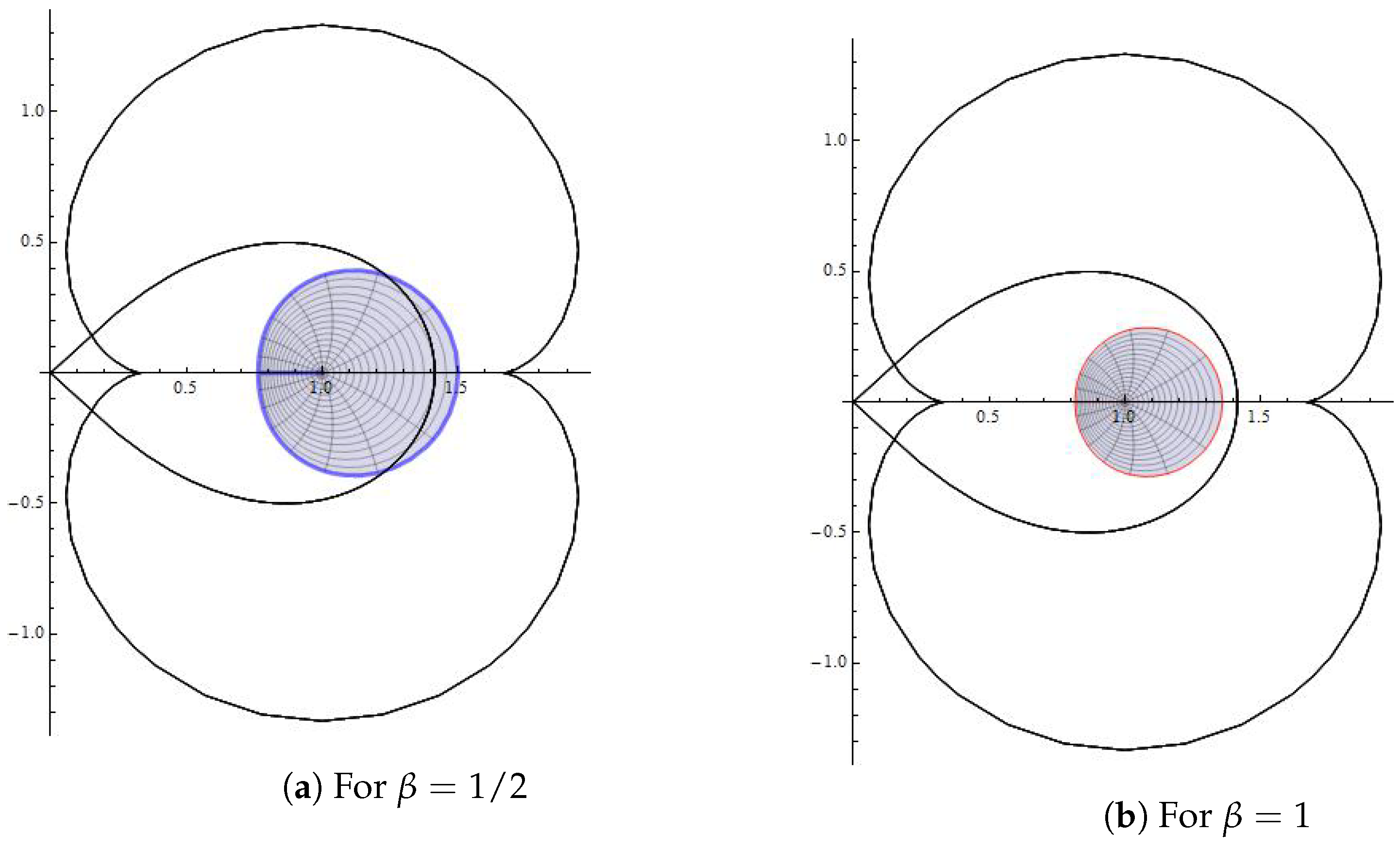
Remark 2. The function is one of the best fitting subordinated functions of , as is evident from the Figure 3. 5. Results Related to Lerch’s Transcendent Functions
Next, we consider the function
Here,
when
and
a is any real number when
.
For
, the function
which is well known Lerch’s transcendent. The Lerch’s transcendent
is given by its power series as
which is convergent for
when
. For this study, we consider
and
. Our aim is to find the answer to the following problem.
Problem 1. Find the triplet , such that and are subordinate by and .
To answer Problem 1, we need to further discuss . The Lerch’s transcendent generalized various special functions, namely
The Hurwitz Zeta function: The function is defined when
and is represented as
Poly-logarithm function: The function is defined as
For more details about this function, see [
10].
Theorem 7. For , , and , the function provides Proof. Clearly,
. Now, to find the condition for which
, we rearrange the terms
, and it follows from (
14) that
Now, for
, the hypothesis in (
16) yields
The result follows from the definition of subordination. □
A natural question arises about the existence of triplet
, for which the hypothesis (
16) of Theorem 7 is true. We investigate numerically two possible cases to explain that such triplets exist.
Fixed r and n: In the following table, we present
, such that the inequality (
16) holds for fixed
n,
r. Here,
is the solution to the equation
Denote,
. Then,
Thus,
is a decreasing function of
a, and hence the inequality (
16) holds for
.
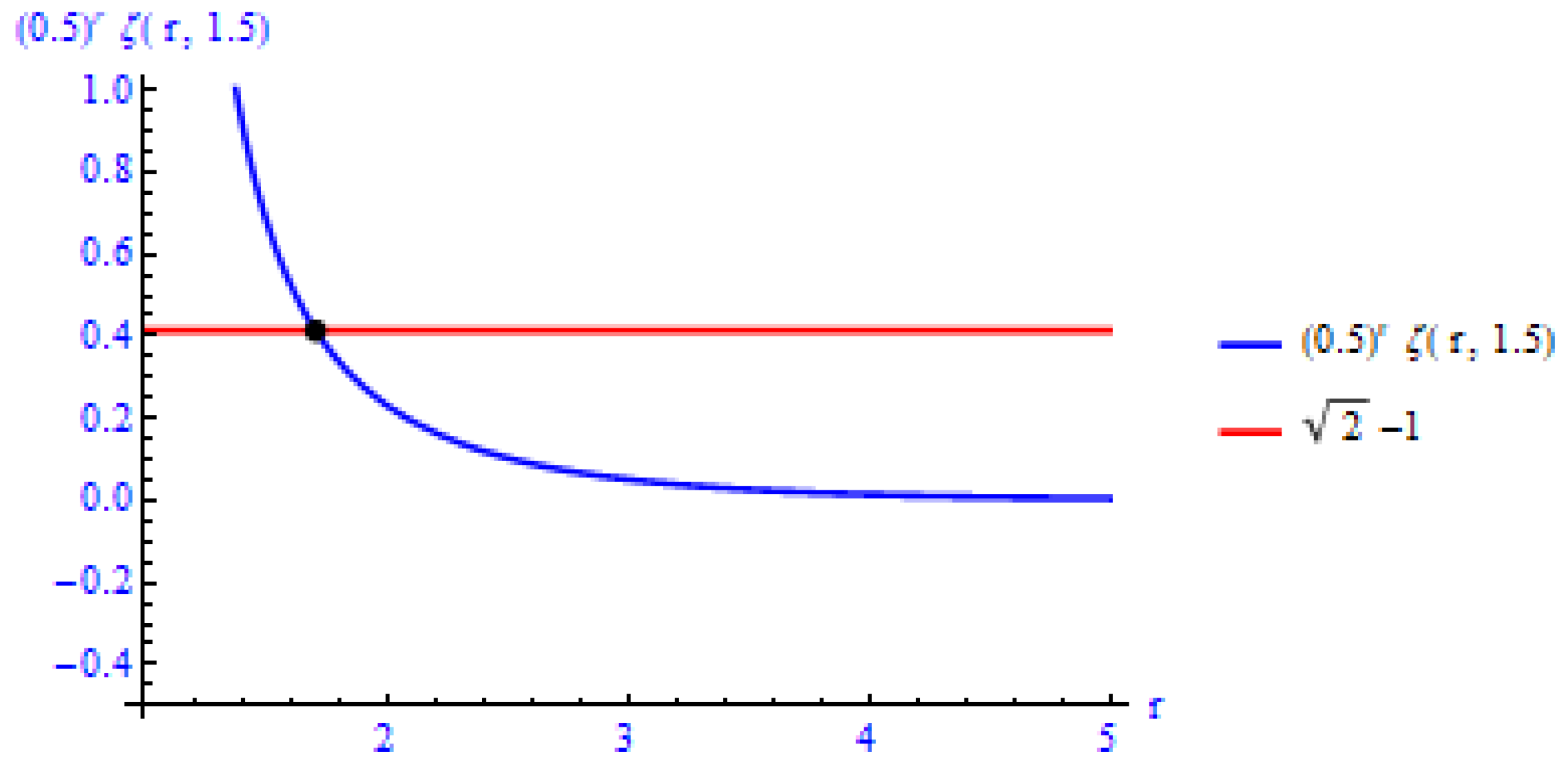
Table 1 lists a few values for
with fixed
r and
n.
Table 1.
The values for with fixed r and n.
Table 1.
The values for with fixed r and n.
| | 1/2 | 3/2 | 2 | 5/2 | 3 |
|---|
| 1 | 0.207107 | 1.25057 | 1.80579 | 2.3658 | 2.92823 |
| 2 | 0.0617472 | 0.733443 | 1.13638 | 1.55064 | 1.97081 |
| 3 | 0.033622 | 0.607962 | 0.980932 | 1.36935 | 1.76586 |
| 4 | 0.0224263 | 0.549594 | 0.911624 | 1.29195 | 1.68176 |
| 5 | 0.0165764 | 0.515237 | 0.872399 | 1.24991 | 1.63784 |
| 6 | 0.0130345 | 0.492324 | 0.847168 | 1.2239 | 1.61168 |
| 7 | 0.0106812 | 0.475811 | 0.82958 | 1.20642 | 1.5947 |
| 8 | 0.00901404 | 0.463262 | 0.816619 | 1.19397 | 1.58302 |
| 9 | 0.00777637 | 0.453352 | 0.806673 | 1.18471 | 1.5746 |
| 10 | 0.00682406 | 0.445295 | 0.798799 | 1.1776 | 1.56834 |
Fixed r and a: In this part, we fix
r and
a and test the validity of inequality (
16) by finding the numerical values of
for
. If the values is less than
, we have the triplet
.
The standout values are bigger than
and the combination of
is not of interest to us. The trend for higher
n and
a can be easily observed from the data in
Table 2.
From
Table 2, one can observe that the number of standout values reduces when
r increases. Now, we test the inequality (
16) when
,
, and
n is large, for example,
, and the outcome is presented in
Table 3. It is clear from
Table 3 that, for a large
n, the value of
may converge to a specific real number. This observation is conducted for each row individually. This raises questions regarding how the exact values should be formulated when
. The answer can be found in the following result.
Table 2.
Validation of inequality (
16) for fixed
.
Table 2.
Validation of inequality (
16) for fixed
.
| a/n | 1 | 2 | 3 | 4 | 5 |
|---|
| r = 0.5 |
| 0.301511 | | | | |
| 0.408248 | | | | |
| | | | | |
| r = 2 |
| 0.1 | 0.00826446 | 0.010532 | 0.0115726 | 0.0121675 | 0.012552 |
| 0.2 | 0.0277778 | 0.0360422 | 0.0399485 | 0.0422161 | 0.0436954 |
| 0.33 | 0.0615637 | 0.081623 | 0.0914436 | 0.097252 | 0.101085 |
| 0.5 | 0.111111 | 0.151111 | 0.171519 | 0.183865 | 0.192129 |
| 0.75 | 0.183673 | 0.258054 | 0.298054 | 0.322984 | 0.339998 |
| 1 | 0.25 | 0.361111 | | | |
| r = 2.5 |
| 0.1 | 0.00249183 | 0.00298665 | 0.00317355 | 0.00326645 | 0.00332029 |
| 0.2 | 0.0113402 | 0.0138321 | 0.0148086 | 0.0153034 | 0.0155936 |
| 0.33 | 0.0306659 | 0.038215 | 0.0413065 | 0.04291 | 0.0438638 |
| 0.5 | 0.06415 | 0.0820386 | 0.0897521 | 0.0938674 | 0.0963592 |
| 0.75 | 0.120243 | 0.159086 | 0.176975 | 0.186881 | 0.193026 |
| 1 | 0.176777 | 0.240927 | 0.272177 | 0.290065 | 0.301405 |
| 1.25 | 0.230048 | 0.32179 | 0.368704 | 0.396365 | |
| 1.5 | 0.278855 | 0.399097 | | | |
| 1.75 | 0.323045 | | | | |
| r = 3 |
| 0.1 | 0.000751315 | 0.000859295 | 0.000892862 | 0.000907371 | 0.00091491 |
| 0.2 | 0.00462963 | 0.00538094 | 0.00562509 | 0.00573306 | 0.00578996 |
| 0.33 | 0.0152752 | 0.0181162 | 0.0190894 | 0.0195321 | 0.0197694 |
| 0.5 | 0.037037 | 0.045037 | 0.0479525 | 0.0493242 | 0.0500755 |
| 0.75 | 0.0787172 | 0.0990027 | 0.107003 | 0.110939 | 0.113158 |
| 1 | 0.125 | 0.162037 | 0.177662 | 0.185662 | 0.190292 |
| 1.25 | 0.171468 | 0.228364 | 0.253806 | 0.267304 | 0.275304 |
| 1.5 | 0.216 | 0.294717 | 0.331754 | 0.35204 | 0.364329 |
| 1.75 | 0.257701 | 0.359331 | 0.409338 | | |
| 2 | 0.296296 | | | | |
Theorem 8. The Lerch’s transcendent when
Theorem 8 can be obtained by considering
Next, we will find the pair , such that the inequality holds well. We discuss this part numerically with a fixed a and find a range of r. It is to be noted here that is not defined for . So, we will consider the case for .
For
, the inequality holds for
, where
is the root of
in
. The range of
r with fixed
is presented in
Figure 4.
Finally, for any
, there exists
, the root of
in
such that
for
. We consider a few arbitrary values of
a and determine
. The outcome is presented in
Table 4. It can be observed that
is increasing along with
a.
Figure 4.
Range of r with fixed .
Figure 4.
Range of r with fixed .
Table 4.
Range of r for arbitrary a.
Table 4.
Range of r for arbitrary a.
| a | | a | |
|---|
| 0.001 | 1.00024 | 0.01 | 1.02208 |
| | | |
| | | |
| | | |
| | 1 | |
| | | |
| 1.75 | | 2 | |
| 5 | | 15 | |
| 20 | | 30 | |
| 40 | | 50 | |
| 100 | 123.917 | 500 | 615.096 |
Theorem 9. Suppose that . Then, the polynomial provided In general, when Next, we need to find out the existence of
and
for which the inequalities (
18) and (
19) hold well. We answer this problem numerically.
Case I: : Taking
and
, we will try to find the range of
n for which the inequality (
18) holds. The numerical values for different
n are tabulated in
Table 5.
It is clear that for
, the inequality (
18) failed.
Case II: : In this case, we consider
and
to validate the inequality (
18). The numerical values for different
n are tabulated in
Table 6.
It is clear from
Table 6 that the value is increasing with
n, but if we take
, we have
Thus, in this case, inequality (
18) holds for all
n and inequality (
19) is also true. This case implies
6. Results Involving Incomplete Gamma Function
Our next example involves incomplete gamma function. The Euler’s integral form of gamma function is defined as
The incomplete gamma function arises by decomposing the integration (
21) into two parts as
The function
is well-known as a lower incomplete gamma function and
is an upper incomplete function. Next, define the function
. Then,
Theorem 10. For , the function Proof. Finally, the result follows from Theorem 5. □
The result stated in Theorem 10 is visible in
Figure 5 for
and
.
7. Results Involving Bessel and Modified-Bessel Function
Next, we consider a function involving well-known Bessel and modified-Bessel functions, which have series form
For further use, we recall here the notation
, the well known Pochhammer symbol, defined as
Theorem 11. Suppose that and . Then, the functionswhen In particular, for , the result holds for . Here, is the solution of Proof. From the series (
27), it follows that
Similarly, from the series (
26), we have
It is easy to verify that for any fixed , the function is a decreasing function of . Our aim is to find the range of for which for all .
A careful re-arrangement of terms of
along with (
27) leads to
Thus,
is equivalent to
For a fixed
, the inequality (
32) holds for
, where
is the root of the equation
The root
depends on
and decreases for increasing
. Thus, the result holds for all
and
. This is equivalent to
, where
is the root of
The inequality (
32) reduces to
This completes the proof. □
One of the most important functions in the literature is the generalized and normalized Bessel functions of the form
where
, such that
.
The function
yields the Spherical Bessel function for
,
and reduces to the normalized classical Bessel (modified Bessel) functions of order
p when
(
). There is a large amount research related to the inclusion of
in different subclasses of univalent functions theory [
11,
12,
13,
14,
15,
16] and some references therein. In [
11], the lemniscate convexity and additional properties of
are examined in detail. The lemniscate starlikeness of
is discussed in [
1].
For this study, we introduce the function
defined as
We note here that . Now, we state and prove the following result involving .
Theorem 12. For , the function if In particular, if Proof. The proof is based on Theorem 5. Let us denote
Now, inequality (
11) holds if
After a routine simplification, we have
As stated before, if
, then
. Thus, taking
in (
38), we have
if
This completes the proof. □
The normalized form of the classical Bessel and Modified Bessel functions as defined in (
26) and (
27) are given as
Notice that
. Now, by taking
and
in (
39), we have the following result from Theorem 12.
Corollary 1. For , the subordination and . Here, is the root of the equation We calculate the value of
using
Mathematica Software and the validity of inequality can be observed from
Figure 6.
We visualize the subordination
and
for
, and present it in
Figure 7 and
Figure 8, respectively. We further note that
8. Results Involving Confluent and Generalized Hypergeometric Function
The well-known confluent hypergeometric function
is represented by series
Here,
In the context of geometric functions theory, the confluent hypergeometric functions has a high significance. Miller and Mocanu [
17] proved that
in
for real
and
, satisfying either
and
, or
and
. Conditions for which
,
are obtained by Ponnusamy and Vuorinen ([
18] Theorem 1.9, p. 77). In addition, they established that
is close-to-convex of the positive order with respect to the identity function. A connection between the confluent and lemniscate is established in [
19,
20] and the references therein.
Now, we state and prove a result involving .
Theorem 13. For , the confluent hypergeometric function , provided Proof. By following the notion of Theorem 5 and series (
43), we have
when the hypothesis (
44) holds. The conclusion follows from Theorem 5. □
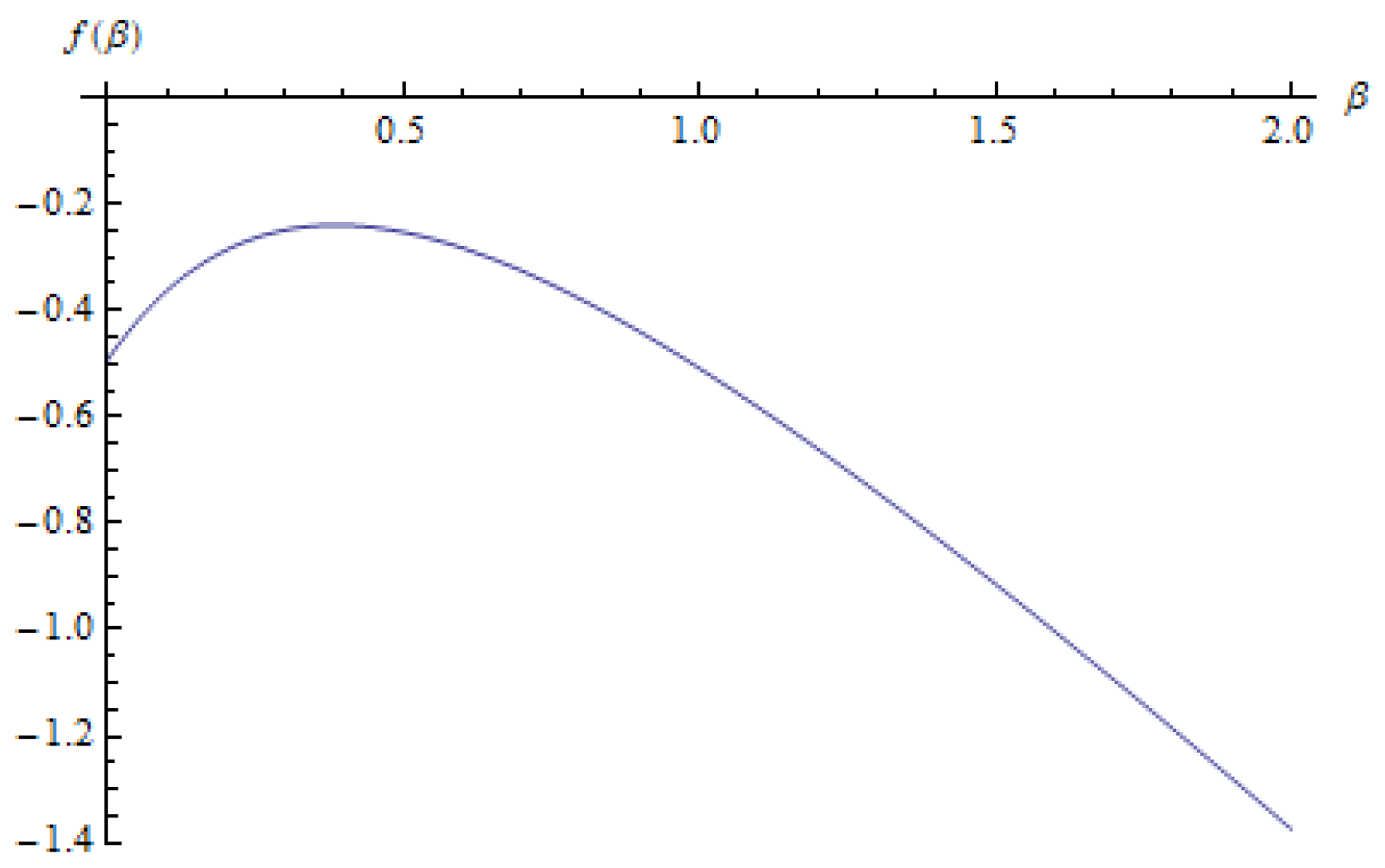
Remark 3. Numerical calculation provides and from Figure 9, it is clear that is a decreasing function of β when . Thus, the inequality (44) holds for all , and hence the condition (44) can be relaxed from Theorem 13. However, as we are not able to prove this inequality analytically, we keep the condition (44). Our last example is on generalized hypergeometric functions.
Consider
substituting in (
11), we have
Here,
is known as generalized hypergeometric functions. The generalized hypergeometric functions denoted by
with series representation
where
are positive. The series (
47) converges if
- (i)
Any of are non-positive.
- (ii)
, the series converges for any finite value of z and, hence, is entire.
Now, for
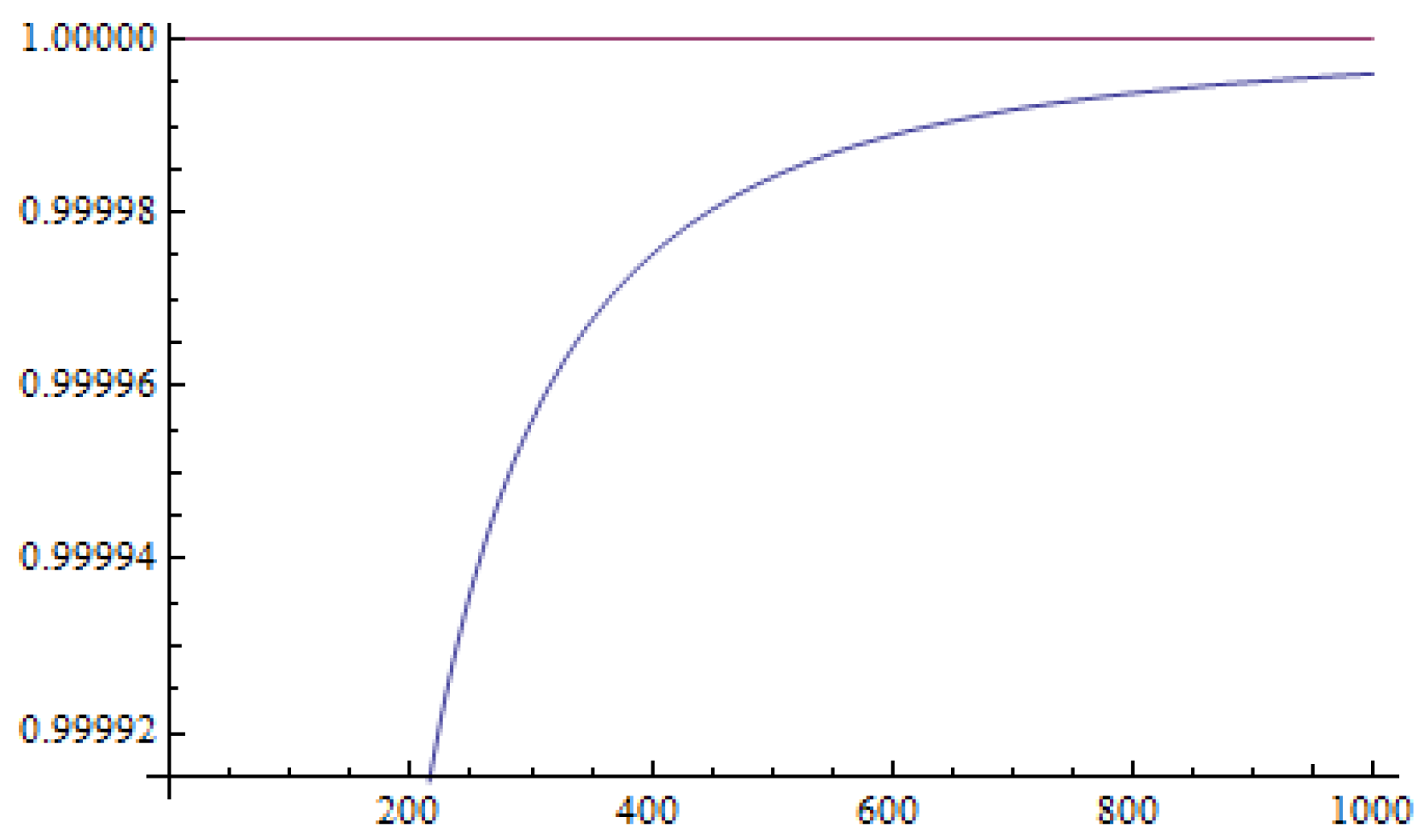
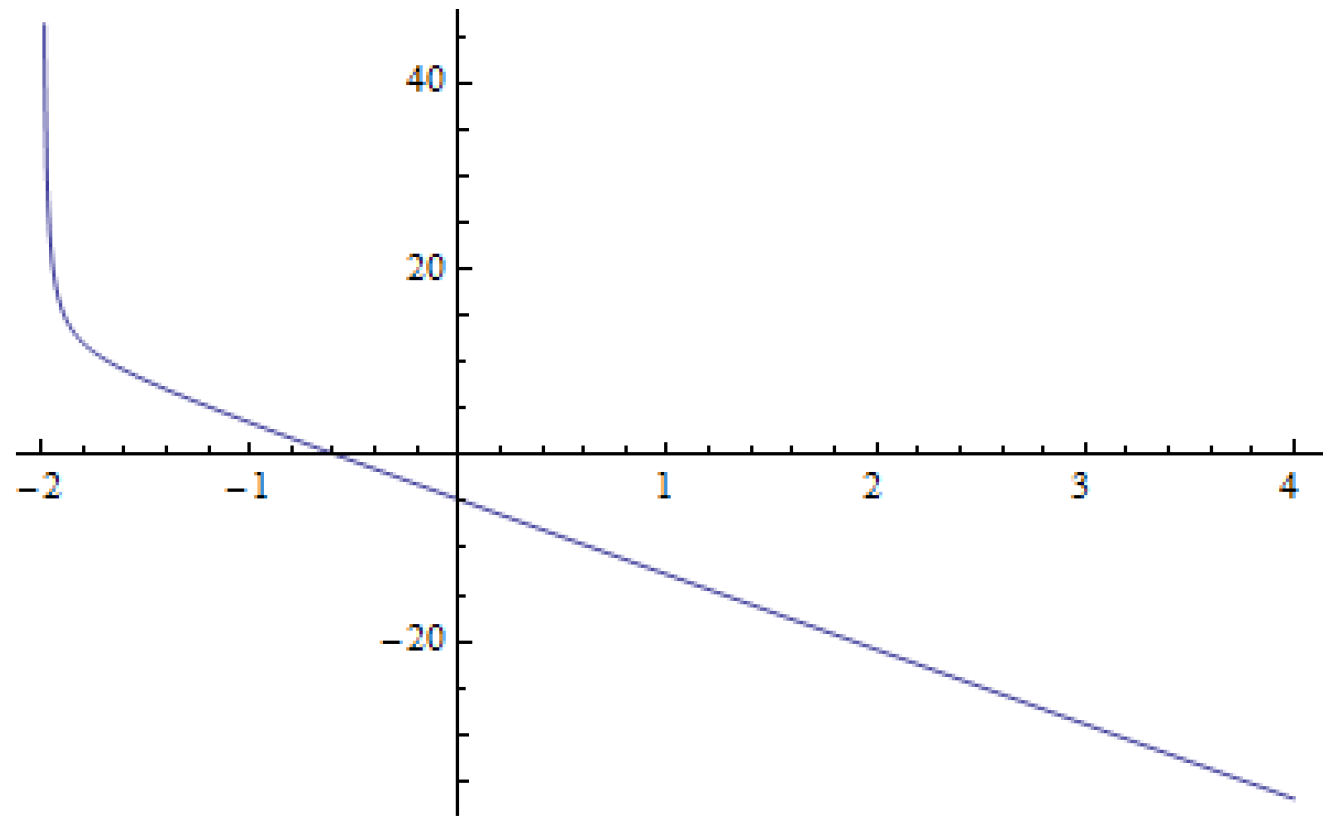
, the graphical representation of the right side of (
46) is given in
Figure 10. As the graph is asymptotic about the parallel line
, we have that
Based on this observation, we have the following result:
Theorem 14. For , the generalized hypergeometric function .
9. Conclusions
The article presents several analytic functions that map the unit disk to domain that are subordinated by lemniscate and nephroid curves. Analogous problems involving subordination implications have been examined previously [
2,
3,
5,
6,
11,
20,
21,
22,
23]. The current article adopts the concept of subordination as its primary approach. In the context of subordination by
, we have established an extremal function. As far as the author is aware, there is no known result in geometric functions theory involving incomplete gamma functions. Likewise, there is no evidence linking Lerch transcendent to the lemniscate and nephrooid domains. Both relations are established in this work. The relation of the Bessel function and modified Bessel function with nephroid domains is also presented.
The results also establish following:
: This is the easiest example because of the large intersecting parts between
and
and the existence of such a function is evident in
Figure 2b–d and
Figure 5b (Involving incomplete gamma function),
Figure 7c (
), and
Figure 8c (
).
, but
: This is the toughest part to establish as an example, as a very small section of
is out of
, but we have been able to construct an example in
Figure 2a,e.
Finally, we remark that we were restricted by using only a few examples. Using Theorem 5 and series representation of functions, we can include many other functions such as Struve functions, Gaussian hypergeometric functions, and Bessel–Struve functions.