Abstract
Malnutrition has led to growth retardation in many adolescents and health deterioration in adults all over the world. Recently, there has been increasing attention on balanced diets as a preventive measure. This study evaluates the daily diet of a student, aiming to optimize the amino acid score (AAS) across three meals per day. By using balanced diet criteria as constraints, we established a single-objective nonlinear programming model, maximizing AAS as the objective function. The model was solved by using a simulated annealing algorithm, and we obtained a diet that is both balanced and high in AAS. This study helps to raise awareness about individual nutritional needs and provides guidance for dietary structure improvements, thereby contributing to global public health enhancement.
Keywords:
single-objective nonlinear programming model; simulated annealing algorithm; amino acid score; balanced diet MSC:
46N10; 65K10; 65K05
1. Introduction
Malnutrition is a global health problem, referring to the body’s inability to obtain sufficient nutrition for maintaining normal physiological function and health due to inadequate intake or metabolic disorders. It also includes excessive nutrition due to overeating or the excessive intake of specific nutrients [1]. Malnutrition can result from insufficient protein intake due to disease, hunger, age, and other factors, leading to changes in body composition and, ultimately, damage to physical and mental functioning [2,3].
Malnutrition is primarily categorized into nutritional deficiency and overnutrition [4]. Nutritional deficiency can be divided into two main aspects: energy deficiency (such as emaciation and being underweight) and micronutrient deficiency (such as iron deficiency anemia, vitamin A deficiency, etc.) [5]. Overnutrition can be divided into traditional nutrition surplus (such as micronutrient excess, overweight, obesity, and diet-related non-communicable diseases) and emerging nutrition surplus [6].
In recent years, the prevalence of malnutrition in countries around the world has been increasing. Malnutrition has become a major cause of the spread of global diseases, posing a major pressure on the global health system [7,8,9,10]. The 2016 global nutrition report shows that 44% of the countries with available data are currently facing severe challenges of malnutrition and adult overweight obesity. Although the situation in some countries has improved slightly, the overall global development trend remains concerning. Its main findings show that “one in three people in the world is malnourished, and malnutrition has become a global ‘new normal’ [11]”. According to the report of the World Health Organization (WHO) in 2013, malnutrition is the primary factor leading to the death of children around the world, accounting for 45%. According to the data on the official website of the American Charity Association in 2015, 48.8 million people in the United States are malnourished, which includes 16.2 million children. Because this situation is so severe in a developed country, the United States, the situation in other countries can only be imagined [12].
Currently, the dietary habits and nutritional status of college students are an important issue in the field of public health. Local college students often skip breakfast, consume snacks and late-night meals, prefer heavily flavored foods, and do not drink enough water to meet physical needs, leading to unbalanced nutrition and other poor eating habits [13]. The consequences of dietary changes are related to adverse health outcomes, including weight gain, elevated blood glucose levels, elevated cholesterol levels, hypertension, and mental problems [14].
In this context, it is particularly important to re-examine and optimize the dietary structure. At present, intervention measures for malnutrition, such as the use of nutritional supplements, dietary structure adjustment, and nutrition education, have become the focus of global research [15]. Against this background, we employ a single-objective nonlinear programming model and a simulated annealing algorithm to study daily dietary structure.
The single-objective programming model is widely used in many fields, including computer science [16,17], production logistics, resource allocation, transportation [18], energy control [19,20], and agriculture, aiming to find the best solution by optimizing the single-objective function. A simulated annealing algorithm has also been extensively applied in research, especially in optimization problems. It can help solve complex optimization problems [21,22], informatics [23], and production logistics [24].
This paper aims to develop a more reasonable dietary structure according to the basic principles of a balanced diet through the single-objective nonlinear programming model and simulated annealing algorithm to ensure that people can obtain comprehensive and balanced nutrition. By comprehensively analyzing existing nutritional theories, dietary patterns, and global health data, we will propose a set of strategies to enhance students’ nutritional awareness, promote public health, and prevent malnutrition and related diseases [25]. Simultaneously, more diversified and nutritionally balanced food options are recommended for university canteens. Our goal is to provide policymakers, nutritionists, and the public with a practical guide to promote global nutrition improvements and lay the foundation for a healthier and more sustainable future.
2. Process of Evaluating Diet
We use the Chinese dietary guidelines as a reference and consider the following five aspects (2.1–2.5) to evaluate whether a daily diet meets the balanced diet criteria. For data sources of all food ingredients, please refer to China Food Composition Tables [26].
2.1. Analysis of Food Structure
According to the basic principles of a balanced diet in the guidelines, the average daily intake of food should include more than 12 different types. Therefore, we can first assess whether a student’s daily diet contains 12 kinds of food and five categories of food through simple statistics.
2.2. Calculation of Main Nutrients Content
The intake of nutrients is crucial for a person’s growth. We consider the daily intake of the following major nutrients that are common and important in life: water, protein, fat, carbohydrates, calcium, iron, zinc, vitamin A, vitamin B1, vitamin B2, and vitamin C. Their content in every 100 g of edible food can be found in China Food Composition Tables.
Suppose we know a student’s daily diet , where represents the content of a certain nutrient (such as in or ) in the diet, represents the quality of a certain nutrient in every 100 g of edible food, represents the edible part quality of the major ingredient, i (see Appendix A for the major ingredient contained in a type of food), in the diet, and represents the number of portions of the major ingredient, i, in the diet. We can use the following formula to calculate the content of the main nutrients in the edible part of a student’s daily intake of food.
where n represents the number of major ingredients in a daily diet.
According to the basic principles of a balanced diet, a student should intake enough nonproductive major nutrients in a day. Table 1 shows the student’s reference intake of nonproductive major nutrients in a day. By comparing the calculation result of formula (1) with it, we can know whether the student ingests enough nonproductive main nutrients.
Table 1.
Dietary reference intakes of nonproductive major nutrients.
2.3. Calculation of Energy Provided by Diet and Meal Ratio
According to the basic principles of a balanced diet, female students should consume 1900 kcal of energy per day, while male students should consume 2400 kcal of energy per day. The reference value of the energy distribution of three meals as a percentage of the total energy (i.e., meal ratio) is 30% for breakfast, 30–40% for lunch, and 30–40% for dinner. Table 2 shows the nutrient energy conversion coefficients.
Table 2.
Nutrient energy conversion coefficient.
Now, use to represent the total energy provided by a certain nutrient in the daily diet. We can use the following formula to calculate it.
where is the energy conversion coefficient of a certain nutrient, represents protein, fat, carbohydrate, or dietary fiber.
If the diet is divided into breakfast, lunch, and dinner, the energy intake corresponding to each of the three meals can be calculated by using the same calculation method, and then the ratio with the total energy can be calculated. The rationality of a student’s daily energy intake can be evaluated by comparing the results with the above reference values.
2.4. Calculation of Energy Sources for Diet
The reference values of daily macronutrient energy supply in the total energy of college students are protein 10–15%, fat 20–30%, and carbohydrate 50–65%. According to the following formula, the percentage of macronutrient energy provided by food intake in one day in total energy can be calculated:
where is the percentage of energy supplied by a certain nutrient in the total energy in a diet. represents protein, fat, or carbohydrate.
The rationality of the student’s energy sources can be evaluated by comparing the calculation results with the above reference values.
Calculation of Protein Amino Acid Score of Each Meal
Amino acid score (AAS), also known as protein chemistry score, is the ratio calculated by comparing the essential amino acids of the tested food protein with the amino acid pattern of the reference protein. The lowest ratio is the first limiting amino acid. The score of the first limiting amino acid is the AAS of the food proteins. The AAS is not only suitable for the evaluation of single-food protein but also for the evaluation of mixed-food protein. The reference protein AAS mode is shown in Table 3.
Table 3.
The reference protein AAS mode.
One of AAS can be calculated as follows:
where represents the amino acid quality per 100 g of the edible part of an ingredient, i, in the daily diet, represents the protein mass per 100 g of the edible part of an ingredient, i, in the daily diet, represents the content of essential amino acids per gram of a reference protein.
Calculate the score of all essential amino acids in sequence according to the above formula, and the lowest score is the AAS of the food protein. The higher the AAS of a student, the more food protein the student ingests to meet their amino acid needs, and the higher their nutritional value.
2.5. Numerical Simulation
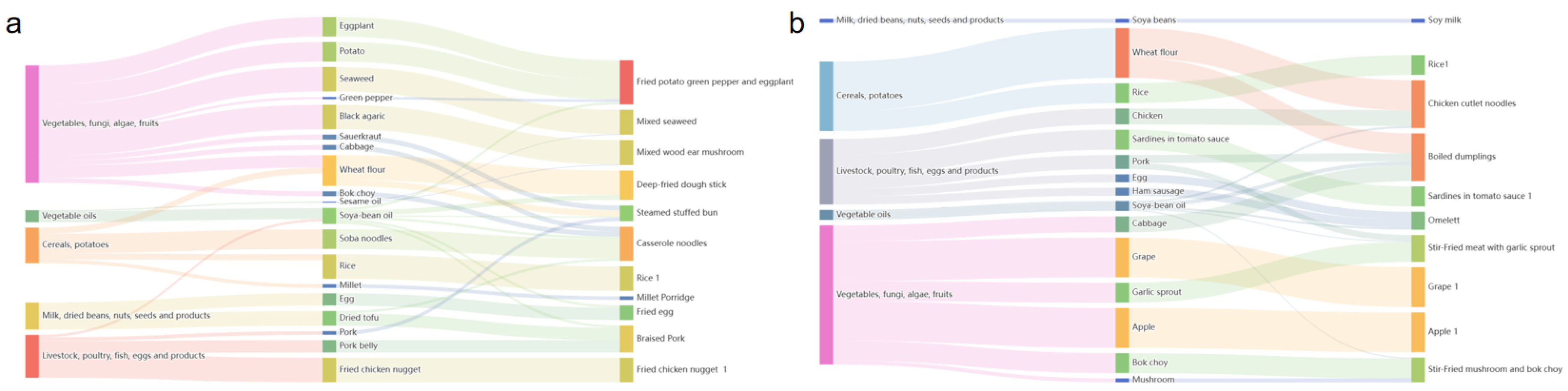
Let us assume that the one-day diet of a male or female college student is as shown in Table 4. Now, let us analyze their diets according to the steps in 2.1–2.5. First, analyze their food structure. Figure 1 shows the classification results of their daily food intake. The observation shows that their daily food intake includes five categories, all of which meet the basic criteria of a balanced diet.
Table 4.
One-day diet of a male or female college student.
Figure 1.
Food classification results of a male (a) and female (b) college student.
Then, we calculate the main nutrient content of their daily diet, as shown in Table 5. From this, we can calculate the energy provided by their daily intake of food, the ratio of meals, and the content of nonproductive main nutrients, as shown in Table 6 and Table 7. We think it is appropriate that the difference between the actual daily energy intake and the target daily energy intake of men and women is within ±10%. From the data in the table above, we can find that the daily energy intake of male college students is 2631.45 kcal/d, which is moderate. The energy provided by female college students’ daily food intake was 1309.84 kcal/d, which was low.
Table 5.
Content of main nutrients.
Table 6.
Energy and meal ratio in male and female students’ day diet.
Table 7.
Contents of nonproductive main nutrients in male and female students’ day diet.
Secondly, the meal ratio of male students was 30.27%, 37.12%, and 32.61%, and the meal ratio of female students was 24.33%, 43.50%, and 32.17%, respectively. Compared with the daily energy intake target of college students, it was found that female students’ breakfast energy intake was too low, and lunch energy intake was too high.
Then, we compared the content of nonproductive main nutrients provided by their diet with the reference intake. By observing Table 7, we found that the daily intake of vitamins for both male students and female students was low, and the daily intake of calcium for female students was insufficient.
Next, we examine the percentage of energy supplied by macronutrients in the total energy intake. The calculated results are shown in Table 8. It was found that the daily fat intake of male students was higher, and the carbohydrate intake was lower than the reference values, while the daily protein intake of female students was higher than the reference value.
Table 8.
Percentage of total energy supplied by macronutrients.
Finally, we get their AAS, as shown in Table 9. According to the rules, a person’s AAS being less than 60 is unreasonable, 60–80 is unreasonable, 80–90 is relatively reasonable, and more than 90 is reasonable. By observing Table 9, it can be concluded that the AAS of female students at three meals is reasonable, while the AAS of male students at dinner is seriously low.
Table 9.
AAS for male and female students.
3. Single-Objective Nonlinear Programming Model
In a meal, the larger the AAS, the higher the nutritional value of protein in the food a student eats at this meal. Therefore, we hope that the AAS of each meal is larger.
Suppose that the food provided by the first to in a canteen diet is breakfast, the food provided by to is lunch, and the food provided by to is dinner. Then, we let the AAS for breakfast, lunch, and dinner be , , and , respectively, which can be calculated by the following formula:
where represents the quality of the essential amino acid j of the food name, i, represents the number of portions of the food name, i , represents the protein quality of the food name i, and is the content of the essential amino acid, j, in the reference protein.
Select the smallest of , , and to make it reach the maximum, which is the objective function Z of the single-objective nonlinear programming model.
Now, consider the constraints of the model. Assume that the difference between a student’s actual daily energy intake and the intake target is within ±10%; thus, the first constraint is as follows:
where represents the fat quality of the food name, i, represents the carbohydrate quality of the food name, i, and represents the dietary fiber quality of the food name, i.
Secondly, the percentage of productive nutrients in the total energy should try to meet the requirements of 10–15% protein, 20–30% fat, and 50–65% carbohydrate; thus, the second constraint is as follows:
Then, the actual intake of the seven main nutrients of production capacity—calcium, iron, zinc, vitamin A, vitamin B1, vitamin B2, and vitamin C—is as close as possible to the reference intake; thus, the third constraint is as follows:
where represents the reference intake of the nutrient j, represents the quality of the nonproductive nutrient, j, in the food name, i, and represents calcium, iron, zinc, vitamin A, vitamin B1, vitamin B2, and vitamin C, respectively.
Finally, as far as possible, the ratio of meal times should meet the requirements of 25–35% for breakfast, 30–40% for lunch, and 30–40% for dinner; thus, the fourth constraint is as follows:
4. Simulated Annealing Algorithm
4.1. Brief Description of Algorithm
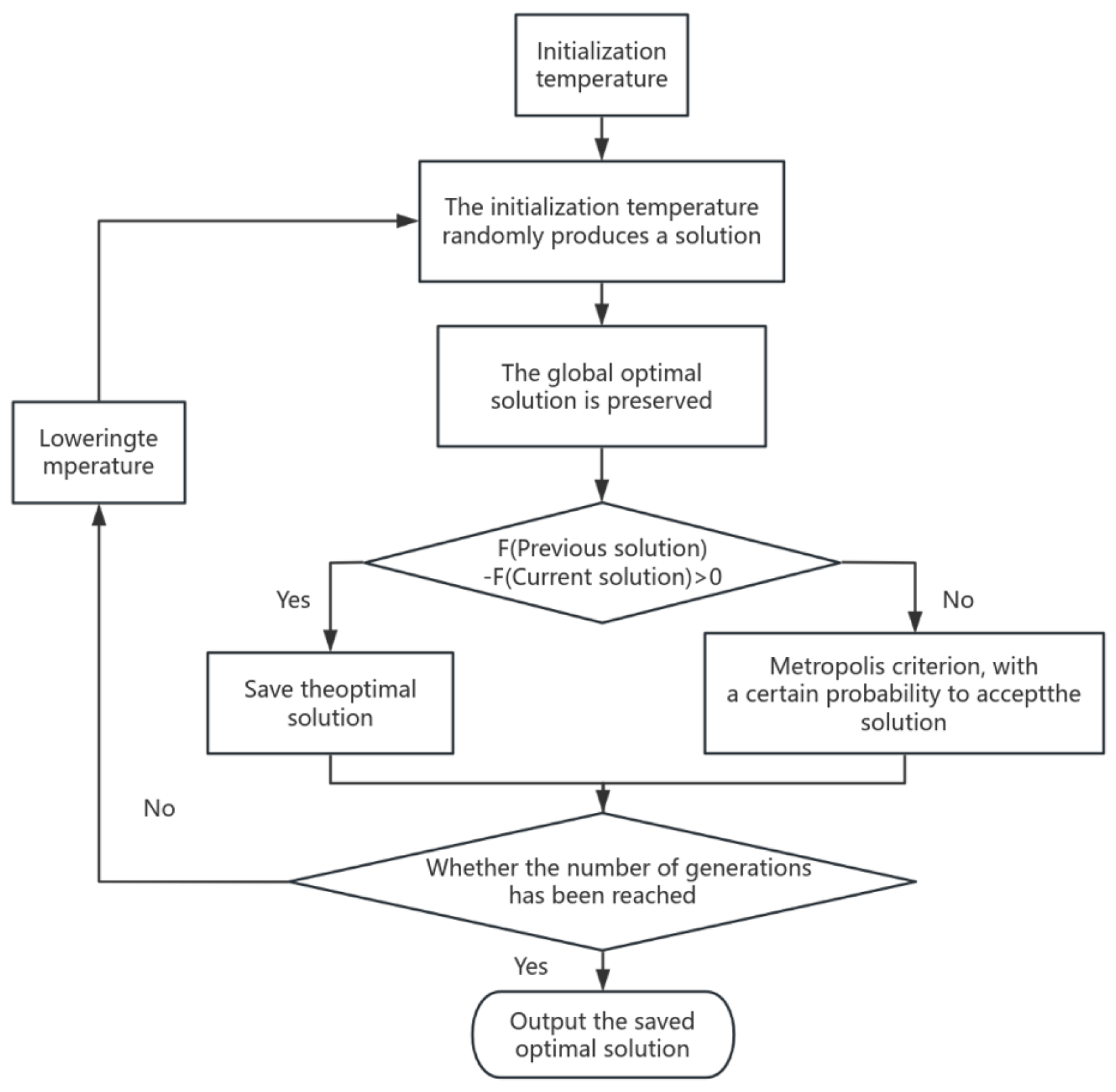
The problem studied in this article belongs to a combinatorial optimization problem. Geng, Xiutang, and others [27] used the classical simulated annealing (SA) algorithm to study the maximum clique problem. Akbulut, Hatice Erdogan, and others [28] have applied SA to solve the faculty-level university course timetabling problem. The inspiration for SA comes from the similarity between the annealing process of solid materials and combinatorial optimization problems. SA is a probabilistic algorithm that simulates the gradual cooling process of solid materials from a high temperature. In this process, the algorithm searches for the optimal solution of the objective function in the solution space and gradually approaches the global optimal solution from the local optimal solution through the iterative process. SA mainly considers the following three processes: the iterative process, the cooling process, and the end condition. The more detailed process is shown in Appendix B.
4.2. Numerical Simulation
This numerical simulation is carried out on the Windows 10 system using MATLAB R2022a. According to the above process, the parameters of the SA we set are shown in Table 10.
Table 10.
Parameter table of SA.
Assuming a university cafeteria provides three meals a day, as shown in Appendix A, based on the single-objective nonlinear programming model and SA established above, we used MATLAB to solve for a daily menu that students can choose from, as shown in Table 11.
Table 11.
Daily available diet for students to choose from.
5. Conclusions
The largest amino acid score (AAS) for one person for three meals a day being greater than 80 is relatively reasonable. From the simulation results, it was found that the AAS of a male is 8% higher than the reasonable value, and the AAS of a female is 20.8% higher than the reasonable value. Thus, after establishing the model and solving the algorithm, the provided recipe ensures a balanced diet and a reasonable combination of nutrients while maximizing the amino acid score (AAS). Due to the randomness of the simulated annealing algorithm, various daily recipes can be obtained, and even a nutritious weekly recipe can be generated.
Naturally, it is difficult to require that students strictly follow the recipes generated by the algorithm, but students should try to pay attention to their eating habits, refer to these recipes, and prevent malnutrition. Additionally, we aim to provide more diverse and nutritionally balanced meal options for university cafeterias worldwide.
The single-objective nonlinear programming mentioned above focuses solely on AAS. In fact, the selection of diet may be influenced by personal economic factors, seasonal factors, and other factors. By considering other factors, we can add more constraints to the model we establish and even establish different objective functions according to different needs to obtain a diverse diet. For the solution of the model, we used the classic simulated annexing method. There are currently many innovative and advanced intelligent algorithms available (such as the sea lion optimization, grey wolf optimization, and whale optimization algorithms), and we can also use these more efficient algorithms to obtain the corresponding diet.

Author Contributions
Writing—original draft preparation, Z.C., M.C. and Y.C.; writing—review and editing, Z.C., M.C., Y.C., K.Z., L.H. and H.G. All authors have read and agreed to the published version of the manuscript.
Funding
This project was supported by the National Natural Science Foundation of China (No. 12301621).
Data Availability Statement
No new data were created or analyzed in this study. Data sharing is not applicable to this article.
Conflicts of Interest
The authors declare no conflict of interest.
Abbreviations
| AAS | Amino acid score |
| SA | Simulated annealing algorithm |
Appendix A. The Menu of a University Canteen
| Breakfast | Lunch | Dinner | |||
| Food name | Main ingredients | Food name | Main ingredients | Food name | Main ingredients |
| Milk | Milk | Rice | Rice | Rice | Rice |
| Yogurt | Yogurt | Steamed bun | Wheat flour | Steamed bun | Wheat flour |
| Soybean Milk | Soya beans | Steamed bread roll | Wheat flour | Steamed bread roll | Wheat flour |
| Rice porridge | Rice | Soybean Milk | Soya beans | Soybean Milk | Soya beans |
| Millet congee | Millet | Pumpkin porridge | Rice | Millet congee | Millet |
| Rice | Rice | Pumpkin | Wonton | Wheat flour | |
| Steamed bun | Wheat flour | Wonton | Wheat flour | Lean pork | |
| Steamed bread roll | Wheat flour | Lean pork | Soya-bean oil | ||
| Deep-fried dough stick | Wheat flour | Soya-bean oil | Chicken curlet noodles | Wheat flour | |
| Soya-bean oil | Chicken curlet noodles | Wheat flour | Chicken | ||
| Boiled egg | Egg | Chicken | Soya-bean oil | ||
| Fried egg | Egg | Soya-bean oil | Casserole noodles | Corn flour | |
| Soya-bean oil | Wontonnoodles | Wheat flour | Cabbage | ||
| Steamed Sweet potato | Sweet potato | Lean pork | Rape | ||
| Pumpkin porridge | Rice | Rape | Dried bean curd | ||
| Pumpkin | Soya-bean oil | Soya-bean oil | |||
| Wonton | Wheat flour | Braised beef noodles | Wheat flour | Steamed stuffed bun | Wheat flour |
| Lean pork | Beef | Pork | |||
| Soya-bean oil | Rape | Sauerkraut | |||
| Chicken curlet noodles | Wheat flour | Soya-bean oil | Soya-bean oil | ||
| Chicken | Casserole noodles | Soba noodles | Waffle | Wheat flour | |
| Soya-bean oil | Egg | Egg | |||
| Wontonnoodles | Wheat flour | Cabbage | Ham sausage | ||
| Lean pork | Rape | Soya-bean oil | |||
| Rape | Spinach | Shredded potato cake | Wheat flour | ||
| Soya-bean oil | Soya-bean oil | Potato | |||
| Steamed stuffed bun | Wheat flour | Steamed stuffed bun | Wheat flour | Egg | |
| Pork | Pork | Soya-bean oil | |||
| Cabbage | Celery | Boiled dumpling | Wheat flour | ||
| Soya-bean oil | Soya-bean oil | Pork | |||
| Pasty | Wheat flour | Pasty | Wheat flour | Chinese leek | |
| Beef | Beef | Soya-bean oil | |||
| Carrot | Onion | Steamed dumpling | Wheat flour | ||
| Soya-bean oil | Soya-bean oil | Egg | |||
| Waffle | Wheat flour | Waffle | Wheat flour | Cucumber | |
| Egg | Egg | Soya-bean oil | |||
| Ham sausage | Ham sausage | Fried Chinese leek dumpling | Wheat flour | ||
| Soya-bean oil | Soya-bean oil | Chinese leek | |||
| Shredded potato cake | Wheat flour | Shredded potato cake | Wheat flour | Egg | |
| Potato | Potato | Soya-bean oil | |||
| Egg | Egg | Radish vermicelli soup | Radish | ||
| Soya-bean oil | Soya-bean oil | Vermicelli | |||
| Pan-fried bun | Wheat flour | Pan-fried bun | Wheat flour | Nori | |
| Pork | Pork | Sesame oil | |||
| Soya-bean oil | Soya-bean oil | Spinach with soy sauce | Spinach | ||
| Boiled dumpling | Wheat flour | Boiled dumpling | Wheat flour | Sesame oil | |
| Pork | Pork | Bean curd with soy sauce | Bean curd | ||
| Celery | Cabbage | Soya-bean oil | |||
| Soya-bean oil | Soya-bean oil | Mixed dried tofu | Dried bean curd | ||
| Fried Chinese leek dumpling | Wheat flour | Steamed dumpling | Wheat flour | Soya-bean oil | |
| Chinese leek | Beef | Mixing black fungus | Black fungus | ||
| Egg | Carrot | Sesame oil | |||
| Soya-bean oil | Soya-bean oil | peanut mixed with celery | Celery | ||
| Spinach with soy sauce | Spinach | Fried Chinese leek dumpling | Wheat flour | Groundnut kernel | |
| Sesame oil | Chinese leek | Sesame oil | |||
| Mixed with shredded kelp | Kelp | Egg | Braised kelp, cabbage and tofu | Kelp | |
| Sesame oil | Soya-bean oil | Cabbage | |||
| Bean curd with soy sauce | Bean curd | Tomato and egg soup | Egg | Bean curd | |
| Soya-bean oil | Tomato | Soya-bean oil | |||
| Mixed dried tofu | Dried bean curd | Nori | Chicken stew with potatoes and carrots | Chicken | |
| Soya-bean oil | Sesame oil | Potato | |||
| Mix the shredded potatoes | Potato | Radish vermicelli soup | Radish | Carrot | |
| Soya-bean oil | Vermicelli | Soya-bean oil | |||
| Mixing black fungus | Black fungus | Nori | Braised tofu with pollak | Bean curd | |
| Sesame oil | Sesame oil | Pollack pollack | |||
| peanut mixed with celery | Celery | Fish ball soup | Fish ball | Soya-bean oil | |
| Groundnut kernel | Spinach | Fried celery powder | Celery | ||
| Sesame oil | Sesame oil | Vermicelli | |||
| Apple | Apple | Spinach soup | Spinach | Soya-bean oil | |
| Orange | Orange | Egg | Stir-fried mushroom with rape | Rape | |
| Grape | Grape | Sesame oil | Mushroom | ||
| Bean curd with soy sauce | Bean curd | Soya-bean oil | |||
| Soya-bean oil | Saute fungus with cabbage | Cabbage | |||
| Mixed dried tofu | Dried bean curd | Black fungus | |||
| Soya-bean oil | Soya-bean oil | ||||
| Mixing black fungus | Black fungus | Stir-fried three slices | Potato | ||
| Sesame oil | Carrot | ||||
| peanut mixed with celery | Celery | Green pepper | |||
| Groundnut kernel | Soya-bean oil | ||||
| Sesame oil | Fried bean sprout vermicelli | Bean sprout | |||
| Braised cabbage with kelp | Kelp | Vermicelli | |||
| Cabbage | Soya-bean oil | ||||
| Soya-bean oil | Scrambled egg with tomato | Egg | |||
| Stewed tofu with cabbage | Cabbage | Tomato | |||
| Bean curd | Soya-bean oil | ||||
| Soya-bean oil | Fried melon slices | Egg | |||
| Chicken stew with potatoes and carrots | Chicken | Cucumber | |||
| Potato | Soya-bean oil | ||||
| Carrot | Home-style tofu | Bean curd | |||
| Soya-bean oil | Pork | ||||
| Braised tofu with pollak | Bean curd | Soya-bean oil | |||
| Pollack pollack | Fried meat and lentil | lentil | |||
| Soya-bean oil | Pork | ||||
| Fried celery powder | Celery | Soya-bean oil | |||
| Vermicelli | Fried meat garlic moss | Garlic sprout | |||
| Soya-bean oil | Pork | ||||
| Stir-fried mushroom with rape | Rape | Soya-bean oil | |||
| Mushroom | Stir-fried meat and green pepper | Green pepper | |||
| Soya-bean oil | Pork | ||||
| Saute fungus with cabbage | Cabbage | Soya-bean oil | |||
| Black fungus | Fried meat pleurotus eryngii | Pleurotus eryngii | |||
| Soya-bean oil | Pork | ||||
| Stir-fried three slices | Potato | Soya-bean oil | |||
| Carrot | Sauteed meat and cabbage powder | Sauerkraut | |||
| Green pepper | Vermicelli | ||||
| Soya-bean oil | Pork | ||||
| Fried bean sprout vermicelli | Bean sprout | Soya-bean oil | |||
| Vermicelli | Crisp fired pork | Pork | |||
| Soya-bean oil | Green pepper | ||||
| Scrambled egg with tomato | Egg | Carrot | |||
| Tomato | Soya-bean oil | ||||
| Soya-bean oil | Braised Pork | Pork belly | |||
| Fried melon slices | Egg | Dried bean curd | |||
| Cucumber | Soya-bean oil | ||||
| Soya-bean oil | Spicy diced chicken with peanut | Chicken | |||
| Fried pitato green pepper and eggplant | Eggplant | Carrot | |||
| Potato | Cucumber | ||||
| Green pepper | Groundnut kernel | ||||
| Soya-bean oil | Soya-bean oil | ||||
| Fried meat and lentil | lentil | Fried chicken nugget | Fried chicken nugget | ||
| Pork | Stir-fried beef | Beef | |||
| Soya-bean oil | Green pepper | ||||
| Fried meat garlic moss | Garlic sprout | Carrot | |||
| Pork | Soya-bean oil | ||||
| Soya-bean oil | Sardines in tomato sauce | Sardines in tomato sauce | |||
| Stir-fried meat and green pepper | Green pepper | Dry fried yellow croaker | Yellow croaker | ||
| Pork | Soya-bean oil | ||||
| Soya-bean oil | Braised belt fish in brown sauce | Hairtail | |||
| Fried meat pleurotus eryngii | Pleurotus eryngii | Green pepper | |||
| Pork | Carrot | ||||
| Soya-bean oil | Soya-bean oil | ||||
| Sauteed meat and cabbage powder | Sauerkraut | Watermelon | Watermelon | ||
| Vermicelli | Banana | Banana | |||
| Pork | Grapefruit | Grapefruit | |||
| Soya-bean oil | Apple | Apple | |||
| Home-style tofu | Bean curd | Grape | Grape | ||
| Pork | |||||
| Soya-bean oil | |||||
| Crisp fired pork | Pork | ||||
| Green pepper | |||||
| Carrot | |||||
| Soya-bean oil | |||||
| Double cooked pork slices | Lean pork | ||||
| Green pepper | |||||
| Carrot | |||||
| Soya-bean oil | |||||
| Braised Pork | Pork belly | ||||
| Dried bean curd | |||||
| Soya-bean oil | |||||
| Barbecued ribs | Pork chops | ||||
| Potato | |||||
| Soya-bean oil | |||||
| Spicy diced chicken with peanut | Chicken | ||||
| Carrot | |||||
| Cucumber | |||||
| Groundnut kernel | |||||
| Soya-bean oil | |||||
| Fried chicken nugget | Fried chicken nugget | ||||
| Stir-fried beef | Beef | ||||
| Green pepper | |||||
| Carrot | |||||
| Soya-bean oil | |||||
| Sardines in tomato sauce | Sardines in tomato sauce | ||||
| Dry fried yellow croaker | Yellow croaker | ||||
| Soya-bean oil | |||||
| Braised belt fish in brown sauce | Hairtail | ||||
| Green pepper | |||||
| Carrot | |||||
| Soya-bean oil | |||||
| Watermelon | Watermelon | ||||
| Banana | Banana | ||||
| Honeydew melon | Honeydew melon | ||||
| Apple | Apple | ||||
| Grape | Grape | ||||
Appendix B. Process of SA
- Iterative process. By using computer simulation, the algorithm continuously determines acceptable solutions and ultimately identifies the optimal solution. Each iteration involves the following three steps:
- (a)
- Determine the new solution. After several iterations, the original data are randomly disrupted in each iteration process, the order of different number points is changed, and a new allocation scheme is calculated.
- (b)
- Cost function difference. Record the result of iteration as l, let the solution generated by iteration be , and let the solution be calculated by random simulation in step i; then, the cost function difference can be determined as
- (c)
- Acceptance criteria. In order to determine the acceptance degree of the new path, computer simulation is used to generate random numbers evenly distributed on [0,1], and the acceptance probability of the iterative process, P, is determined asWe believe that when , that is, the difference of the objective function of this iteration is negative, and the distance is shortened, the new path is accepted. Otherwise, we believe that the iterative results are not completely acceptable and that the new path is accepted with a probability of In the random numbers of computer simulation, if the random number , it is considered acceptable.
- Cooling process. We give the initial temperature, , and select the cooling coefficient, . After each iteration process, we obtain the temperature after cooling. Under the temperature , after multiple transfers, we obtain a new cooling temperature, that is, . The cooling process is repeated under the new temperature, constantly looking for new solutions and alternating with the slow reduction in temperature. Finally, the optimal result of the problem is obtained.
- End condition. We select a termination temperature as . When the temperature drops to , it is judged that the simulated annealing process is over, and the output solution is the global optimal solution. Figure A1 shows the general flow of the algorithm.
Figure A1.
Process diagram of SA.
References
- Rizzi, M.; Mazzuoli, S.; Regano, N.; Inguaggiato, R.; Bianco, M.; Leandro, G.; Bugianesi, E.; Noe, D.; Orzes, N.; Pallini, P.; et al. Undernutrition, risk of malnutrition and obesity in gastroenterological patients: A multicenter study. World J. Gastrointest. Oncol. 2016, 8, 563–572. [Google Scholar] [CrossRef] [PubMed][Green Version]
- Kondrup, J.; Allison, S.; Elia, M.; Vellas, B.; Plauth, M. ESPEN guidelines for nutrition screening 2002. Clin. Nutr. 2003, 22, 415–421. [Google Scholar] [CrossRef]
- Siddiqui, F.; Salam, R.A.; Lassi, Z.S.; Das, J.K. The Intertwined Relationship between Malnutrition and Poverty. Front. Public Health 2020, 8, 453. [Google Scholar] [CrossRef]
- Gate, K.R.; Mfeka-Nkabinde, N.G.; Naidoo, K. An assessment of nutritional status in children of rural, northern KwaZulu-Natal province. South Afr. Fam. Pract. 2020, 62, 1–2. [Google Scholar] [CrossRef]
- World Health Organization. World Health Organization Bulletin; WHO: Geneva, Switzerland, 2024; Volume 123, pp. 55–66. [Google Scholar]
- Daoust, L. Emerging nutritional redundancy. Nat. Food 2023, 4, 637. [Google Scholar] [CrossRef] [PubMed]
- Black, R.E.; Victora, C.G.; Walker, S.P.; Bhutta, Z.A.; Christian, P.; de Onis, M.; Ezzati, M.; Grantham-McGregor, S.; Katz, J.; Martorell, R.; et al. Maternal and child undernutrition and overweight in low-income and middle-income countries. Lancet 2013, 382, 427–451. [Google Scholar] [CrossRef]
- Tydeman-Edwards, R.; Van Rooyen, F.C.; Walsh, C.M. Obesity, undernutrition and the double burden of malnutrition in the urban and rural southern Free State, South Africa. Heliyon 2018, 4, e00983. [Google Scholar] [CrossRef]
- Thavamani, A.; Umapathi, K.K.; Sferra, T.J.; Sankararaman, S. Undernutrition and Obesity Are Associated with Adverse Clinical Outcomes in Hospitalized Children and Adolescents with Acute Pancreatitis. Nutrients 2020, 13, 43. [Google Scholar] [CrossRef]
- Swinburn, B.A.; Kraak, V.I.; Allender, S.; Atkins, V.J.; Dietz, W.H. The Global Syndemic of Obesity, Undernutrition, and Climate Change: The Lancet Commission report. Lancet 2019, 393, 791–846. [Google Scholar] [CrossRef]
- Ifpri, I.F.P.I. Global Nutrition Report 2016: From Promise to Impact: Ending Malnutrition by 2030; International Food Policy Research Institute: Washington, DC, USA, 2016. [Google Scholar]
- Mao, Y.; Wu, J.; Liu, G.; Yu, Y.; Chen, B.; Liu, J.; Wang, J.; Yu, P.; Zhang, C.; Wu, J.; et al. Chinese expert consensus on prevention and intervention for the elderly with malnutrition (2022). Aging Med. 2022, 5, 191–203. [Google Scholar] [CrossRef]
- Ali, O.A.M.; Zayed, B.A.; El-Enin, M.M.M.A.; Sheikha, A.F.E.; Kheir, A.M.S.; El-Tahlawy, Y.A.; Nada, W.M.; Shaaban, A. Fusing Genotype and Soil Organic/Inorganic Amendment to Improve Saline-sodic Properties and Rice Productivity. J. Soil Sci. Plant Nutr. 2024, 24, 2413–2436. [Google Scholar] [CrossRef]
- The factors that influence dietary habits among international students in the United States. J. Int. Stud. 2015, 5, 104–120.
- Uauy, R.; Desjeux, J.F.; Ahmed, T.; Hossain, M.; Brewster, D.; Forbes, D.; Caton, H.; Kleinman, R.E. Global Efforts to Address Severe Acute Malnutrition. J. Pediatr. Gastroenterol. Nutr. 2012, 55, 476–481. [Google Scholar] [CrossRef]
- Li, Y.; Su, J.; Yang, X. Multi-Objective vs. Single-Objective Approaches for Software Defect Prediction. In Proceedings of the 2018 2nd International Conference on Management Engineering, Software Engineering and Service Sciences, Wuhan, China, 13–15 January 2018. [Google Scholar]
- Ereiz, S.; Jimenez-Alonso, J.F.; Gallegos-Calderon, C.; Duvnjak, I.; Limongelli, M.P. Vibration based single-objective finite element model updating using cooperative game theory approach. Mech. Syst. Signal Process. 2024, 212, 111316. [Google Scholar] [CrossRef]
- Matl, P.; Hartl, R.F.; Vidal, T. Leveraging single-objective heuristics to solve bi-objective problems: Heuristic box splitting and its application to vehicle routing. Networks 2019, 73, 382–400. [Google Scholar] [CrossRef]
- Ducheyne, E.I.; Wulf, R.R.D.; Baets, B.D. Single versus multiple objective genetic algorithms for solving the even-flow forest management problem. For. Ecol. Manag. 2004, 201, 259–273. [Google Scholar] [CrossRef]
- Yousefi, G.R.; Haes Alhelou, H.; Hajiakbari Fini, M. Comparative study on the performance of many-objective and single-objective optimisation algorithms in tuning load frequency controllers of multi-area power systems. Iet Gener. Transm. Distrib. 2016, 10, 2915–2923. [Google Scholar]
- Chen, X. Research on Network Optimization Based on Simulated Annealing Genetic Algorithm. In Proceedings of the International Conference on Machinery; Atlantis Press: Amsterdam, The Netherlands, 2017. [Google Scholar]
- Wang, L.; Liu, Y. Application of Simulated Annealing Particle Swarm Optimization Based on Correlation in Parameter Identification of Induction Motor. Math. Probl. Eng. 2018, 2018, 1869232. [Google Scholar] [CrossRef]
- Pei, X.; Li, N.; Wang, S. Application of Simulated Annealing Algorithm in Fingerprint Matching. In Proceedings of the International Conference on Computational Intelligence & Industrial Application; Springer: Berlin/Heidelberg, Germany, 2011. [Google Scholar]
- Yan, D.M.; Lu, C.H. Application Research of Improved Simulated Annealing Algorithm in Vehicle Routing Problems. Appl. Mech. Mater. 2011, 58–60, 1031–1036. [Google Scholar] [CrossRef]
- Hiatt, R.A.; Clayton, M.F.; Collins, K.K.; Gold, H.T.; Laiyemo, A.O.; Truesdale, K.P.; Ritzwoller, D.P. The Pathways to Prevention program: Nutrition as prevention for improved cancer outcomes. J. Natl. Cancer Inst. 2023, 115, 886–895. [Google Scholar] [CrossRef]
- Yang, Y.X.; Wang, G.Y.; Pan, X.C. Chinese Food Composition Tables 2002; Beijing University Medical Press: Beijing, China, 2002. [Google Scholar]
- Geng, X.; Xu, J.; Xiao, J.; Pan, L. A simple simulated annealing algorithm for the maximum clique problem. Inf. Sci. 2007, 177, 5064–5071. [Google Scholar] [CrossRef]
- Akbulut, H.E.; Ozcelik, F.; Sarac, T. A simulated annealing algorithm for the faculty-level university course timetabling problem. Pamukkale Üniversitesi Mühendislik Bilim. Derg. 2024, 30, 17–30. [Google Scholar] [CrossRef]
Disclaimer/Publisher’s Note: The statements, opinions and data contained in all publications are solely those of the individual author(s) and contributor(s) and not of MDPI and/or the editor(s). MDPI and/or the editor(s) disclaim responsibility for any injury to people or property resulting from any ideas, methods, instructions or products referred to in the content. |
© 2024 by the authors. Licensee MDPI, Basel, Switzerland. This article is an open access article distributed under the terms and conditions of the Creative Commons Attribution (CC BY) license (https://creativecommons.org/licenses/by/4.0/).