



A New Variant of the Conjugate Descent Method for Solving Unconstrained Optimization Problems and Applications
 , ,
, ,  and
and 
Abstract
1. Introduction
2. The Proposed Conjugate Descent Variant (CDV) Algorithm and Its Convergence Result
- (i)
- Given any two different iterates and in i.e., neighborhood of the gradient of the objective function satisfies the following inequality:
- (ii)
- Also, the sequences of the gradient as well as are bounded. That is, we can find a constant such that
- (iii)
- Since the objective function is a decreasing function and the sequence of iterates generated by Algorithm 1 is contained in a bounded region, then converges.
| Algorithm 1: A new Conjugate Descent Variant (CDV) algorithm |
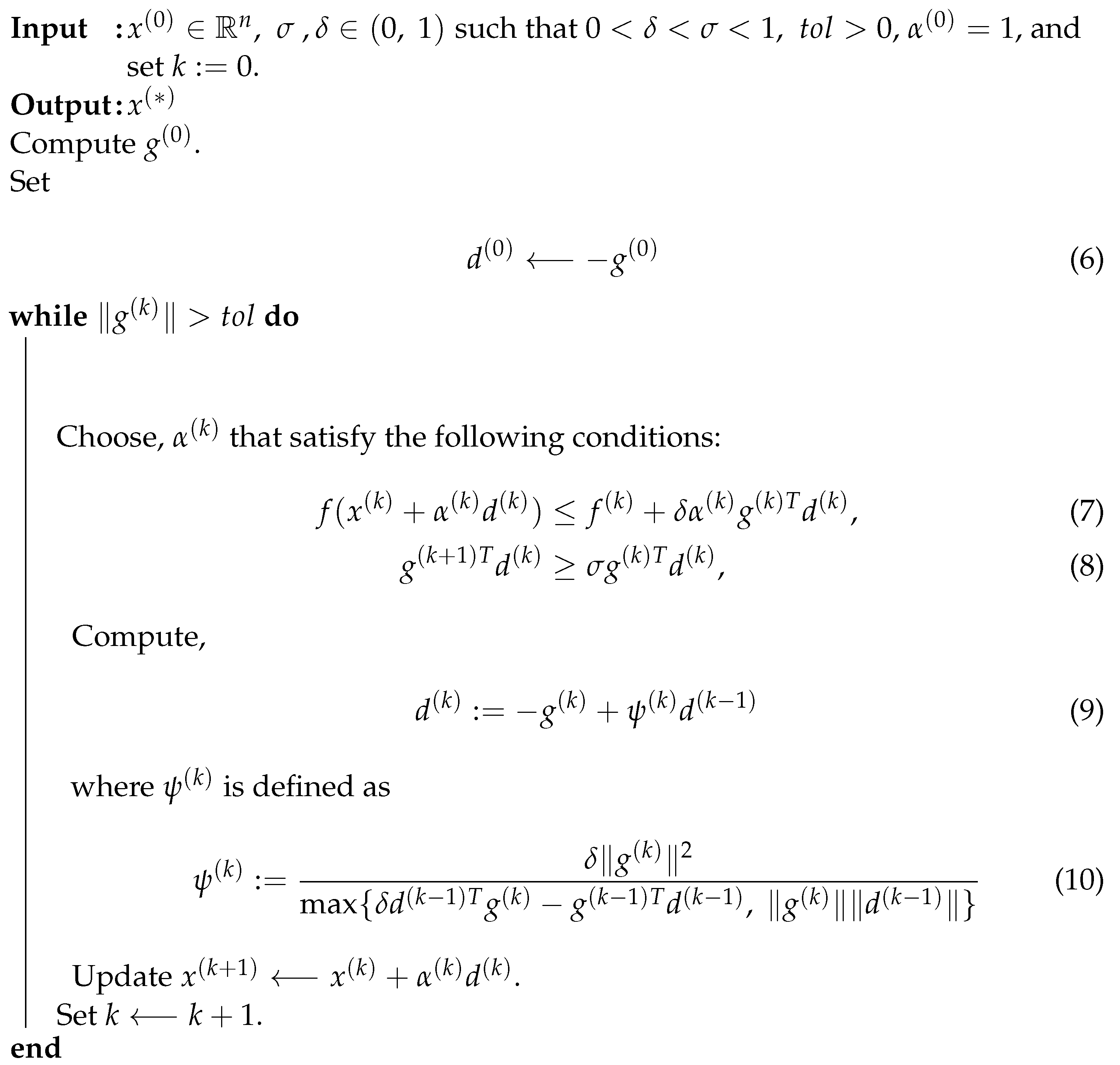 |
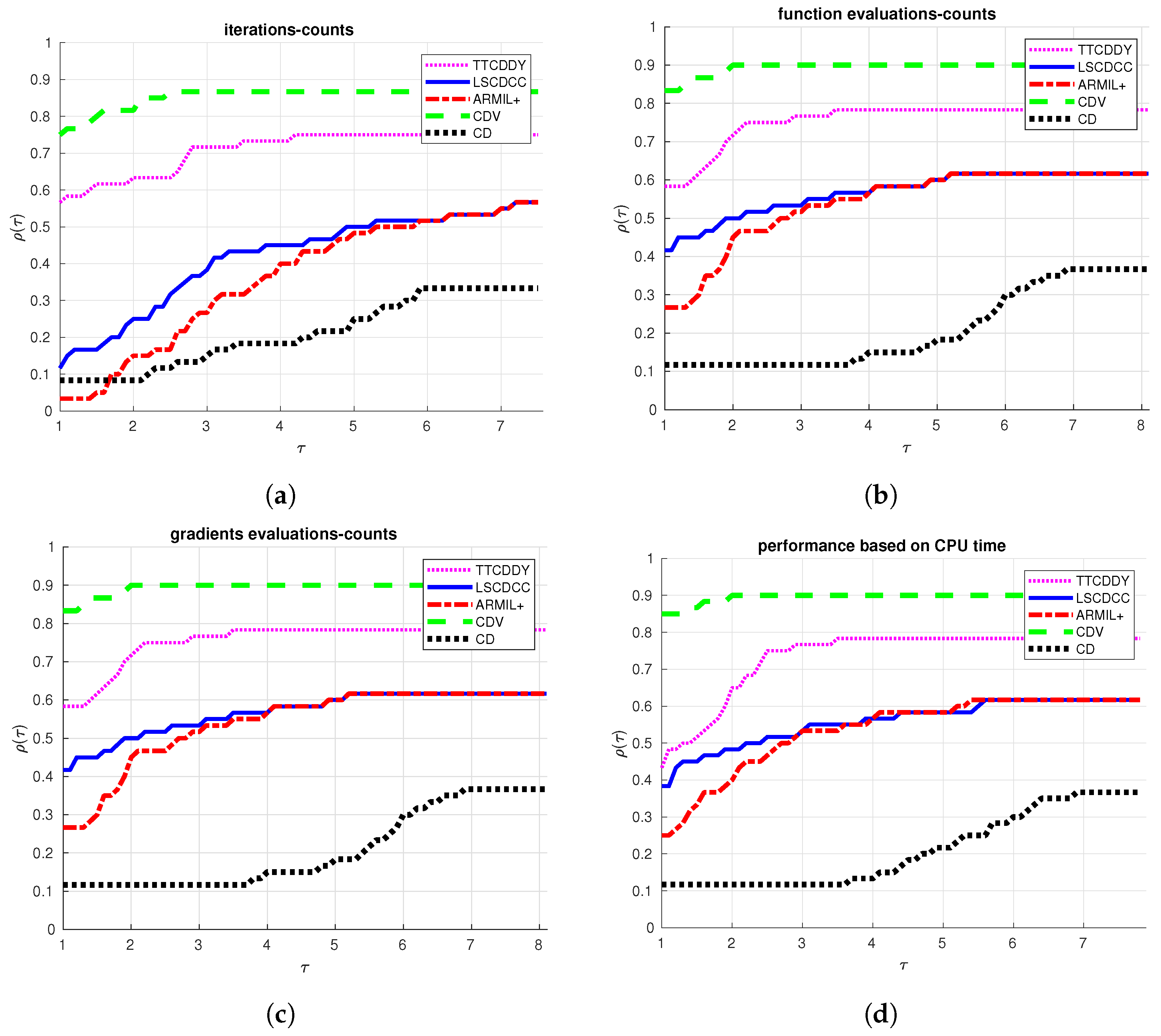
3. Comparative Experimentation
- 1.
- CDV algorithm:The parameters used are , and
- 2.
- TTCDDY algorithm:The parameters are as reported in [31].
- 3.
- ARMIL+ algorithm:We adopted the initialization of the same values for the parameters as reported in [33].
- 4.
- LSCDCC algorithm:The initialization of the parameters is as reported in [32].
- 5.
- CD algorithm [15]:The parameter used is defined in the introduction section and a Wolfe line search strategy, with , and is adopted
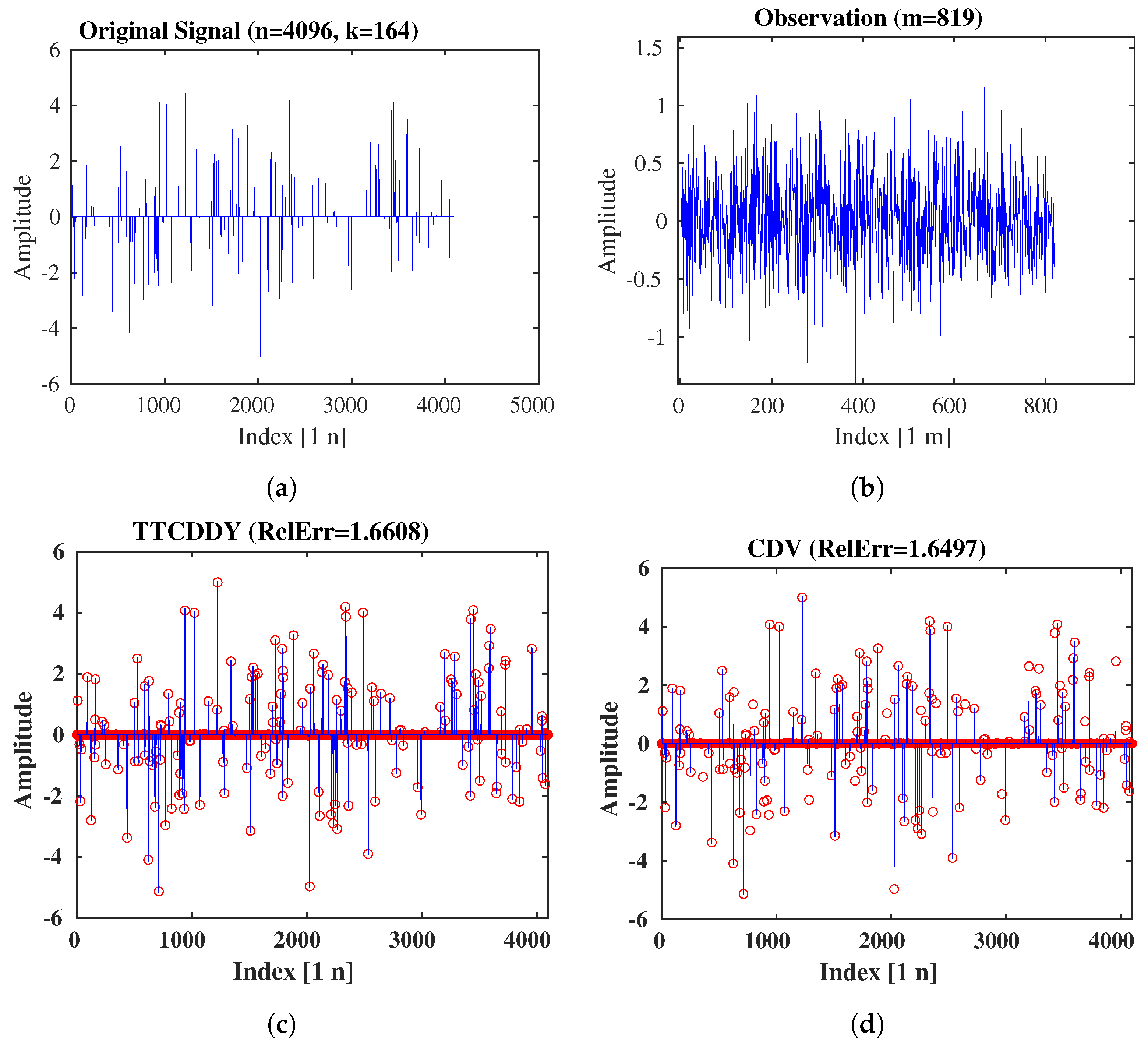
4. Application of the Proposed CDV to Signal Recovery
5. Conclusions
Author Contributions
Funding
Data Availability Statement
Acknowledgments
Conflicts of Interest
References
- Wang, L.; Zhou, B. A Modified Gradient Method for Distributionally Robust Logistic Regression over the Wasserstein Ball. Mathematics 2023, 11, 2431. [Google Scholar] [CrossRef]
- Awwal, A.M.; Sulaiman, I.M.; Malik, M.; Mamat, M.; Kumam, P.; Sitthithakerngkiet, K. A Spectral RMIL+ Conjugate Gradient Method for Unconstrained Optimization With Applications in Portfolio Selection and Motion Control. IEEE Access 2021, 9, 75398–75414. [Google Scholar] [CrossRef]
- Yahaya, M.M.; Kumam, P.; Awwal, A.M.; Aji, S. A structured quasi-Newton algorithm with nonmonotone search strategy for structured NLS problems and its application in robotic motion control. J. Comput. Appl. Math. 2021, 395, 113582. [Google Scholar] [CrossRef]
- Sulaiman, I.M.; Malik, M.; Awwal, A.M.; Kumam, P.; Mamat, M.; Al-Ahmad, S. On three-term conjugate gradient method for optimization problems with applications on COVID-19 model and robotic motion control. Adv. Contin. Discret. Model. 2022, 2022, 1. [Google Scholar] [CrossRef] [PubMed]
- Yahaya, M.M.; Kumam, P.; Chaipunya, P.; Awwal, A.M.; Wang, L. On diagonally structured scheme for nonlinear least squares and data-fitting problems. Rairo-Oper. Res. 2024, 58, 2887–2905. [Google Scholar] [CrossRef]
- Salihu, N.; Babando, H.A.; Arzuka, I.; Salihu, S. A hybrid conjugate gradient method for unconstrained optimization with application. Bangmod Int. J. Math. Comput. Sci. 2023, 9, 24–44. [Google Scholar] [CrossRef]
- Leung, M.F.; Wang, J. A collaborative neurodynamic approach to multiobjective optimization. IEEE Trans. Neural Networks Learn. Syst. 2018, 29, 5738–5748. [Google Scholar] [CrossRef] [PubMed]
- Sun, W.; Yuan, Y.X. Optimization Theory and Methods: Nonlinear Programming; Springer Science & Business Media: Berlin/Heidelberg, Germany, 2006; Volume 1. [Google Scholar]
- Wolfe, P. Convergence conditions for ascent methods. SIAM Rev. 1969, 11, 226–235, Correction on SIAM Rev. 1971, 13, 185–188. [Google Scholar] [CrossRef]
- Hestenes, M.R.; Stiefel, E. Methods of conjugate gradients for solving linear systems. J. Res. Nat. Bur. Stand. 1952, 49, 409–435. [Google Scholar] [CrossRef]
- Polak, E.; Ribiere, G. Note sur la convergence de methodes de directions conjuguees. USSR Comput. Math. Math. Phys. 1969, 9, 94–112. [Google Scholar] [CrossRef]
- Polyak, B.T. A general method for solving extremal problems. Dokl. Akad. Nauk. SSSR 1967, 174, 33–36. [Google Scholar]
- Liu, Y.; Storey, C. Efficient generalized conjugate gradient algorithms, part 1: Theory. J. Optim. Theory Appl. 1991, 69, 129–137. [Google Scholar] [CrossRef]
- Fletcher, R.; Powell, M.J.D. A rapidly convergent descent method for minimization. Comput. J. 1963, 6, 163–168. [Google Scholar] [CrossRef]
- Fletcher, R. Practical Methods of Optimization; A Wiley Interscience Publication: Hoboken, NJ, USA, 1987. [Google Scholar]
- Dai, Y.H.; Yuan, Y.X. A nonlinear conjugate gradient method with a strong global convergence property. SIAM J. Optim. 1999, 10, 177–182. [Google Scholar] [CrossRef]
- Babaie-Kafaki, S. A hybrid conjugate gradient method based on a quadratic relaxation of the Dai–Yuan hybrid conjugate gradient parameter. Optimization 2013, 62, 929–941. [Google Scholar] [CrossRef]
- Hager, W.W.; Zhang, H. A survey of nonlinear conjugate gradient methods. Pac. J. Optim. 2006, 2, 35–58. [Google Scholar]
- Djordjević, S.S. New hybrid conjugate gradient method as a convex combination of LS and CD methods. Filomat 2017, 31, 1813–1825. [Google Scholar] [CrossRef]
- Xue, W.; Ren, J.; Zheng, X.; Liu, Z.; Liang, Y. A new DY conjugate gradient method and applications to image denoising. IEICE Trans. Inf. Syst. 2018, 101, 2984–2990. [Google Scholar] [CrossRef]
- Dai, Z.; Chen, X.; Wen, F. Comments on A hybrid conjugate gradient method based on a quadratic relaxation of the Dai-Yuan hybrid conjugate gradient parameter. Optimization 2015, 64, 1173–1175. [Google Scholar] [CrossRef]
- Djordjević, S.S. New hybrid conjugate gradient method as a convex combination of LS and FR methods. Acta Math. Sci. 2019, 39, 214–228. [Google Scholar] [CrossRef]
- Guefassa, I.; Chaib, Y.; Bechouat, T. Another hybrid conjugate gradient method as a convex combination of WYL and CD methods. Monte Carlo Methods Appl. 2024. [Google Scholar] [CrossRef]
- Hallal, A.; Belloufi, M.; Sellami, B. An efficient new hybrid CG-method as convex combination of DY, CD and HS algorithms. RAIRO-Oper. Res. 2022, 56, 4047–4056. [Google Scholar] [CrossRef]
- Jardow, F.N.; Al-Naemi, G.M. A new hybrid conjugate gradient algorithm for unconstrained optimization with inexact line search. Indones. J. Electr. Eng. Comput. Sci. 2020, 20, 939–947. [Google Scholar] [CrossRef]
- Zhang, L. Two modified Dai-Yuan nonlinear conjugate gradient methods. Numer. Algorithms 2008, 50, 1–16. [Google Scholar] [CrossRef]
- Tian, Q.; Wang, X.; Pang, L.; Zhang, M.; Meng, F. A new hybrid three-term conjugate gradient algorithm for large-scale unconstrained problems. Mathematics 2021, 9, 1353. [Google Scholar] [CrossRef]
- Jian, J.; Yang, L.; Jiang, X.; Liu, P.; Liu, M. A spectral conjugate gradient method with descent property. Mathematics 2020, 8, 280. [Google Scholar] [CrossRef]
- Shi, Z.J.; Guo, J. A new family of conjugate gradient methods. J. Comput. Appl. Math. 2009, 224, 444–457. [Google Scholar] [CrossRef][Green Version]
- Zoutendijk, G. Nonlinear Programming, Computational Methods; Abadie, J., Ed.; Integer and Nonlinear Programming: Amsterdam, The Netherlands, 1970; pp. 37–86. [Google Scholar]
- Deepho, J.; Abubakar, A.B.; Malik, M.; Argyros, I.K. Solving unconstrained optimization problems via hybrid CD-DY conjugate gradient methods with applications. J. Comput. Appl. Math. 2022, 405, 113823. [Google Scholar] [CrossRef]
- Wang, Z.; Li, P.; Li, X.; Pham, H. A Modified Three-Term Type CD Conjugate Gradient Algorithm for Unconstrained Optimization Problems. Math. Probl. Eng. 2020, 2020, 4381515. [Google Scholar] [CrossRef]
- Awwal, A.M.; Wang, L.; Kumam, P.; Sulaiman, M.I.; Salisu, S.; Salihu, N.; Yodjai, P. Generalized RMIL conjugate gradient method under the strong Wolfe line search with application in image processing. Math. Methods Appl. Sci. 2023, 46, 17544–17556. [Google Scholar] [CrossRef]
- Gould, N.I.M.; Orban, D.; Toint, P.L. CUTEr and SifDec: A constrained and unconstrained testing environment, revisited. ACM Trans. Math. Softw. (TOMS) 2003, 29, 373–394. [Google Scholar] [CrossRef]
- Dolan, E.D.; Moré, J.J. Benchmarking optimization software with performance profiles. Math. Program. 2002, 9, 201–213. [Google Scholar] [CrossRef]
- Bagul, Y.J.J. A smooth transcendental approximation to |x|. Int. J. Math. Sci. Eng. Appl. (IJMSEA) 2017, 11, 213–217. [Google Scholar]
- Aminifard, Z.; Hosseini, A.; Babaie-Kafaki, S. Modified conjugate gradient method for solving sparse recovery problem with nonconvex penalty. Signal Process. 2022, 193, 108424. [Google Scholar] [CrossRef]
- Yusuf, A.; Manjak, N.H.; Aphane, M. A Modified Three-Term Conjugate Descent Derivative-Free Method for Constrained Nonlinear Monotone Equations and Signal Reconstruction Problems. Mathematics 2024, 12, 1649. [Google Scholar] [CrossRef]
- Awwal, A.M.; Kumam, P.; Mohammad, H.; Watthayu, W.; Abubakar, A.B. A Perry-type derivative-free algorithm for solving nonlinear system of equations and minimizing ℓ1 regularized problem. Optimization 2021, 70, 1231–1259. [Google Scholar] [CrossRef]
- Awwal, A.M.; Kumam, P.; Sitthithakerngkiet, K.; Muhammad, A.B.; Abubakar, S.H.; Ibrahim, M.S. Derivative-free method based on DFP updating formula for solving convex constrained nonlinear monotone equations and application. AIMS Math. 2021, 6, 8792–8814. [Google Scholar] [CrossRef]
- Awwal, A.M.; Botmart, T. A new sufficiently descent algorithm for pseudomonotone nonlinear operator equations and signal reconstruction. Numer. Algorithms 2023, 94, 1125–1158. [Google Scholar] [CrossRef]

| No. | Function Name | Dimension | Initial Points |
|---|---|---|---|
| Dim | |||
| 1 | COSINE | 6000 | 1.0*ones(Dim,1) |
| 2 | COSINE | 100,000 | 1.0*ones(Dim,1) |
| 3 | COSINE | 500,000 | 1.0*ones(Dim,1) |
| 4 | DIXMAANA | 6000 | 2.0*ones(Dim,1) |
| 5 | DIXMAANA | 90,000 | 2.0*ones(Dim,1) |
| 6 | DIXMAANB | 24,000 | 2.0*ones(Dim,1) |
| 7 | DIXMAANB | 48,000 | 2.0*ones(Dim,1) |
| 8 | DIXMAANC | 2700 | 2.0*ones(Dim,1) |
| 9 | DIXMAANC | 27,000 | 2.0*ones(Dim,1) |
| 10 | DIXMAAND | 12,000 | 2.0*ones(Dim,1) |
| 11 | DIXMAAND | 90,000 | 2.0*ones(Dim,1) |
| 12 | DIXMAANE | 2400 | 2.0*ones(Dim,1) |
| 13 | DQDRTIC | 9000 | 3.0*ones(Dim,1) |
| 14 | DQDRTIC | 90,000 | 3.0*ones(Dim,1) |
| 15 | DQRTIC | 5000 | 2.0*ones(Dim,1) |
| 16 | EDENSCH | 7000 | zeros(Dim,1) |
| 17 | EDENSCH | 40,000 | zeros(Dim,1) |
| 18 | EDENSCH | 100,000 | zeros(Dim,1) |
| 19 | EG2 | 100 | ones(Dim,1) |
| 20 | FLETCHCR | 1000 | zeros(Dim,1) |
| 21 | FLETCHCR | 50,000 | zeros(Dim,1) |
| 22 | FLETCHCR | 200,000 | zeros(Dim,1) |
| 23 | GENROSE | 10,000 | 1/(Dim+1)*ones(Dim,1) |
| 24 | HIMMELBG | 70,000 | 1.5*ones(Dim,1) |
| 25 | PENALTY1 | 4000 | −1.0*ones(Dim,1) |
| 26 | PENALTY1 | 10,000 | 1.0*ones(Dim,1) |
| 27 | QUARTC | 4000 | 2.0*ones(Dim,1) |
| 28 | BDEXP | 5000 | ones(Dim,1) |
| 29 | BDEXP | 50,000 | ones(Dim,1) |
| 30 | BDEXP | 500,000 | ones(Dim,1) |
| 31 | EXDENSCHNB | 6000 | ones(Dim,1) |
| 32 | EXDENSCHNB | 24,000 | ones(Dim,1) |
| 33 | GENQUARTIC | 9000 | ones(Dim,1) |
| 34 | GENQUARTIC | 90,000 | ones(Dim,1) |
| 35 | SINE | 100,000 | ones(Dim,1) |
| 36 | SINE | 250,000 | ones(Dim,1) |
| 37 | SINE | 500,000 | ones(Dim,1) |
| 38 | FLETCBV3 | 100 | (1:Dim)/(Dim+1)*ones(Dim,1) |
| 39 | NONSCOMP | 5000 | 3.0*ones(Dim,1) |
| 40 | NONSCOMP | 80,000 | 3.0*ones(Dim,1) |
| 41 | RAYDAN1 | 500 | ones(Dim,1) |
| 42 | RAYDAN1 | 5000 | ones(Dim,1) |
| 43 | RAYDAN2 | 2000 | ones(Dim,1) |
| 44 | RAYDAN2 | 20,000 | ones(Dim,1) |
| 45 | RAYDAN2 | 500,000 | ones(Dim,1) |
| 46 | DIAGONAL1 | 800 | (1/Dim)*ones(Dim,1) |
| 47 | DIAGONAL1 | 2000 | (1/Dim)*ones(Dim,1) |
| 48 | DIAGONAL2 | 8000 | (1/(1:Dim))*ones(Dim,1) |
| 49 | DIAGONAL3 | 500 | ones(Dim,1) |
| 50 | DIAGONAL3 | 2000 | ones(Dim,1) |
| 51 | BV | 2000 | (1:Dim)/(Dim + 1)*((1:Dim)/(Dim + 1) − 1) |
| 52 | IE | 500 | (1:Dim)/(Dim + 1)*((1:Dim)/(Dim + 1) − 1) |
| 53 | LIN | 100 | ones(Dim,1) |
| 54 | LIN | 1300 | ones(Dim,1) |
| 55 | OSB2 | 11 | [1.3, 0.65, 0.65, 0.7, 0.6, 3, 5, 7, 2, 4.5, 5.5] |
| 56 | PEN2 | 160 | (1/2)*(ones(Dim,1)) |
| 57 | TRID | 500 | (−1)*(ones(Dim,1)) |
| 58 | TRID | 8000 | (−1)*(ones(Dim,1)) |
| No. | TTCDDY | LSCDCC | ARMIL+ | CDV | CD |
|---|---|---|---|---|---|
| ITR/FVAL/GVAL/CPU | ITR/FVAL/GVAL/CPU | ITR/FVAL/GVAL/CPU | ITR/FVAL/GVAL/CPU | ITR/FVAL/GVAL/CPU | |
| 1 | 7/73/73/0.459 | 209/230/230/0.115 | 222/248/248/0.098 | 8/83/83/0.053 | NaN/NaN/NaN/NaN |
| 2 | 11/115/115/0.788 | 834/851/851/5.619 | 842/861/861/5.284 | 10/97/97/0.659 | NaN/NaN/NaN/NaN |
| 3 | 7/69/69/2.370 | 1852/1864/1864/67.264 | 1852/1864/1864/57.620 | 7/67/67/2.139 | NaN/NaN/NaN/NaN |
| 4 | 16/177/177/0.475 | 45/94/94/0.226 | 77/128/128/0.253 | 13/143/143/0.274 | NaN/NaN/NaN/NaN |
| 5 | 51/562/562/13.565 | 140/189/189/4.405 | 197/253/253/5.941 | 13/144/144/3.369 | NaN/NaN/NaN/NaN |
| 6 | 10/111/111/0.875 | 83/135/135/0.956 | 114/163/163/1.171 | 10/111/111/0.767 | NaN/NaN/NaN/NaN |
| 7 | 10/111/111/1.498 | 107/158/158/2.095 | 168/221/221/2.808 | 12/128/128/1.641 | NaN/NaN/NaN/NaN |
| 8 | 10/111/111/0.185 | 36/87/87/0.087 | 63/115/115/0.112 | 11/119/119/0.115 | NaN/NaN/NaN/NaN |
| 9 | 11/122/122/0.926 | 79/129/129/0.971 | 330/389/389/3.077 | 12/133/133/1.057 | NaN/NaN/NaN/NaN |
| 10 | 11/122/122/0.542 | 88/141/141/0.521 | 109/160/160/0.607 | 11/122/122/0.467 | NaN/NaN/NaN/NaN |
| 11 | 12/133/133/3.144 | 133/183/183/4.310 | 301/360/360/8.511 | 12/133/133/3.169 | NaN/NaN/NaN/NaN |
| 12 | 240/2618/2618/2.349 | NaN/NaN/NaN/NaN | NaN/NaN/NaN/NaN | NaN/NaN/NaN/NaN | NaN/NaN/NaN/NaN |
| 13 | 70/771/771/0.123 | NaN/NaN/NaN/NaN | 1373/1430/1430/0.227 | 1090/11951/11951/2.018 | NaN/NaN/NaN/NaN |
| 14 | 40/441/441/0.602 | NaN/NaN/NaN/NaN | NaN/NaN/NaN/NaN | 1282/14045/14045/18.206 | NaN/NaN/NaN/NaN |
| 15 | 26/287/287/0.446 | NaN/NaN/NaN/NaN | NaN/NaN/NaN/NaN | 26/287/287/0.420 | NaN/NaN/NaN/NaN |
| 16 | 10/111/111/0.226 | 42/67/67/0.136 | 80/105/105/0.283 | 18/199/199/0.473 | 821/6151/6151/12.415 |
| 17 | 7/77/77/0.781 | 83/102/102/1.095 | 139/159/159/1.655 | 10/111/111/1.059 | 351/2737/2737/26.945 |
| 18 | 6/62/62/1.511 | 123/143/143/3.844 | 765/785/785/19.804 | 6/61/61/1.543 | 521/3944/3944/96.132 |
| 19 | 427/4584/4584/0.167 | NaN/NaN/NaN/NaN | NaN/NaN/NaN/NaN | NaN/NaN/NaN/NaN | NaN/NaN/NaN/NaN |
| 20 | 15/146/146/0.019 | NaN/NaN/NaN/NaN | NaN/NaN/NaN/NaN | 87/867/867/0.029 | 616/5216/5216/0.164 |
| 21 | 9/95/95/0.085 | 44/68/68/0.074 | NaN/NaN/NaN/NaN | 44/483/483/0.544 | 639/4894/4894/5.359 |
| 22 | 9/99/99/0.397 | 32/54/54/0.302 | 361/382/382/1.784 | 56/612/612/2.298 | 692/5190/5190/17.995 |
| 23 | 7/78/78/0.062 | NaN/NaN/NaN/NaN | NaN/NaN/NaN/NaN | 7/78/78/0.016 | NaN/NaN/NaN/NaN |
| 24 | 10/111/111/0.537 | 373/374/374/1.389 | 373/374/374/1.302 | 10/111/111/0.358 | 2/13/13/0.046 |
| 25 | 12/133/133/1.524 | 34/95/95/1.107 | 34/92/92/1.067 | 12/133/133/1.496 | 150/1232/1232/13.970 |
| 26 | 14/155/155/10.717 | 337/399/399/27.857 | 328/383/383/26.776 | 14/155/155/10.735 | 178/1423/1423/97.388 |
| 27 | 25/276/276/0.312 | NaN/NaN/NaN/NaN | NaN/NaN/NaN/NaN | 25/276/276/0.290 | NaN/NaN/NaN/NaN |
| 28 | 11/122/122/0.177 | 27/28/28/0.035 | 27/28/28/0.032 | 11/122/122/0.101 | 2/18/18/0.009 |
| 29 | 12/133/133/0.986 | 78/79/79/0.620 | 78/79/79/0.633 | 12/133/133/0.983 | 2/22/22/0.109 |
| 30 | 13/144/144/10.223 | 240/241/241/19.090 | 240/241/241/17.660 | 13/144/144/10.324 | 2/15/15/0.906 |
| 31 | 11/121/121/0.035 | 61/107/107/0.013 | 97/148/148/0.016 | 12/129/129/0.013 | NaN/NaN/NaN/NaN |
| 32 | 76/825/825/0.313 | 105/151/151/0.076 | 260/312/312/0.134 | 10/110/110/0.031 | NaN/NaN/NaN/NaN |
| 33 | 11/122/122/0.062 | 75/127/127/0.034 | 92/148/148/0.040 | 16/177/177/0.041 | NaN/NaN/NaN/NaN |
| 34 | 15/166/166/0.278 | 123/173/173/0.362 | 281/336/336/0.612 | 16/177/177/0.266 | NaN/NaN/NaN/NaN |
| 35 | 8/70/70/0.665 | NaN/NaN/NaN/NaN | NaN/NaN/NaN/NaN | 14/123/123/1.193 | NaN/NaN/NaN/NaN |
| 36 | 39/357/357/8.745 | NaN/NaN/NaN/NaN | NaN/NaN/NaN/NaN | 30/300/300/7.311 | NaN/NaN/NaN/NaN |
| 37 | 32/110/110/4.180 | NaN/NaN/NaN/NaN | NaN/NaN/NaN/NaN | 57/135/135/6.346 | NaN/NaN/NaN/NaN |
| 38 | 4/33/33/0.028 | NaN/NaN/NaN/NaN | NaN/NaN/NaN/NaN | 7/76/76/0.010 | 284/1870/1870/0.077 |
| 39 | 163/1744/1744/0.524 | NaN/NaN/NaN/NaN | NaN/NaN/NaN/NaN | 105/1117/1117/0.126 | NaN/NaN/NaN/NaN |
| 40 | 92/950/950/1.201 | NaN/NaN/NaN/NaN | NaN/NaN/NaN/NaN | 91/953/953/1.294 | NaN/NaN/NaN/NaN |
| 41 | NaN/NaN/NaN/NaN | 309/336/336/0.011 | 964/987/987/0.031 | 473/5090/5090/0.144 | NaN/NaN/NaN/NaN |
| 42 | NaN/NaN/NaN/NaN | 187/209/209/0.078 | 582/599/599/0.115 | 295/3134/3134/0.462 | NaN/NaN/NaN/NaN |
| 43 | 6/67/67/0.025 | 28/52/52/0.006 | 28/52/52/0.005 | 6/67/67/0.008 | 339/2037/2037/0.174 |
| 44 | 4/45/45/0.077 | 63/77/77/0.198 | 63/77/77/0.136 | 4/45/45/0.066 | 329/1979/1979/2.317 |
| 45 | 4/43/43/1.402 | 302/314/314/13.846 | 302/314/314/12.031 | 4/43/43/1.331 | 4/28/28/0.973 |
| 46 | NaN/NaN/NaN/NaN | 294/315/315/0.029 | NaN/NaN/NaN/NaN | 134/1294/1294/0.125 | 1818/14215/14215/1.351 |
| 47 | NaN/NaN/NaN/NaN | NaN/NaN/NaN/NaN | 725/745/745/0.145 | 133/1151/1151/0.237 | 1519/11507/11507/2.318 |
| 48 | 311/3176/3176/2.704 | NaN/NaN/NaN/NaN | NaN/NaN/NaN/NaN | NaN/NaN/NaN/NaN | NaN/NaN/NaN/NaN |
| 49 | 825/8973/8973/0.605 | NaN/NaN/NaN/NaN | NaN/NaN/NaN/NaN | 475/5194/5194/0.319 | 1666/12850/12850/0.749 |
| 50 | NaN/NaN/NaN/NaN | 135/157/157/0.035 | 987/1020/1020/0.201 | 234/2544/2544/0.453 | 1090/8444/8444/1.566 |
| 51 | 104/1132/1132/5.885 | NaN/NaN/NaN/NaN | NaN/NaN/NaN/NaN | 709/7742/7742/40.712 | NaN/NaN/NaN/NaN |
| 52 | 18/70/70/3.179 | 12/50/50/2.220 | 47/89/89/3.926 | 17/78/78/4.040 | NaN/NaN/NaN/NaN |
| 53 | 1/9/9/0.054 | 245/269/269/0.194 | 245/269/269/0.191 | 1/9/9/0.013 | 1707/12702/12702/7.174 |
| 54 | 22/102/102/224.403 | 41/96/96/208.022 | 41/96/96/193.448 | 21/99/99/174.088 | NaN/NaN/NaN/NaN |
| 55 | 1815/3663/3663/0.310 | NaN/NaN/NaN/NaN | NaN/NaN/NaN/NaN | NaN/NaN/NaN/NaN | NaN/NaN/NaN/NaN |
| 56 | NaN/NaN/NaN/NaN | 4/8/8/0.004 | 12/22/22/0.003 | 4/16/16/0.004 | NaN/NaN/NaN/NaN |
| 57 | 43/123/123/0.065 | 70/125/125/0.049 | 541/593/593/0.271 | 82/151/151/0.071 | NaN/NaN/NaN/NaN |
| 58 | 69/171/171/13.336 | 871/929/929/84.611 | 163/222/222/20.396 | 476/684/684/61.736 | NaN/NaN/NaN/NaN |
Disclaimer/Publisher’s Note: The statements, opinions and data contained in all publications are solely those of the individual author(s) and contributor(s) and not of MDPI and/or the editor(s). MDPI and/or the editor(s) disclaim responsibility for any injury to people or property resulting from any ideas, methods, instructions or products referred to in the content. |
© 2024 by the authors. Licensee MDPI, Basel, Switzerland. This article is an open access article distributed under the terms and conditions of the Creative Commons Attribution (CC BY) license (https://creativecommons.org/licenses/by/4.0/).
Share and Cite
Awwal, A.M.; Yahaya, M.M.; Pakkaranang, N.; Pholasa, N. A New Variant of the Conjugate Descent Method for Solving Unconstrained Optimization Problems and Applications. Mathematics 2024, 12, 2430. https://doi.org/10.3390/math12152430
Awwal AM, Yahaya MM, Pakkaranang N, Pholasa N. A New Variant of the Conjugate Descent Method for Solving Unconstrained Optimization Problems and Applications. Mathematics. 2024; 12(15):2430. https://doi.org/10.3390/math12152430
Chicago/Turabian StyleAwwal, Aliyu Muhammed, Mahmoud Muhammad Yahaya, Nuttapol Pakkaranang, and Nattawut Pholasa. 2024. "A New Variant of the Conjugate Descent Method for Solving Unconstrained Optimization Problems and Applications" Mathematics 12, no. 15: 2430. https://doi.org/10.3390/math12152430
APA StyleAwwal, A. M., Yahaya, M. M., Pakkaranang, N., & Pholasa, N. (2024). A New Variant of the Conjugate Descent Method for Solving Unconstrained Optimization Problems and Applications. Mathematics, 12(15), 2430. https://doi.org/10.3390/math12152430

