Abstract
In this work, we study a new line-search rule for solving the pseudomonotone variational inequality problem with non-Lipschitz mapping in real Hilbert spaces as well as provide a strong convergence analysis of the sequence generated by our suggested algorithm with double inertial extrapolation steps. In order to speed up the convergence of projection and contraction methods with inertial steps for solving variational inequalities, we propose a new approach that combines double inertial extrapolation steps, the modified Mann-type projection and contraction method, and the line-search rule, which is based on the golden ratio . We demonstrate the efficiency, robustness, and stability of the suggested algorithm with numerical examples.
Keywords:
golden rule; line-search rule; projection and contraction method; variational inequality problem; strong convergence; Hilbert spaces MSC:
47H09; 47H10; 49J20; 49J40
1. Introduction
Let H be a real Hilbert space, C be a nonempty closed convex subset of H, and denote the inner product with the induced norm . The variational inequality problem (VIP) with respect to G is a problem of finding such that
where G is an operator from C into H. We denote by VI(C,G) the set of solutions of (1). In equilibrium situations where no party may unilaterally enhance their position, this inequality (1) frequently occurs. Applications of VIPs can be found in many domains, including engineering, economics, and optimization. They are strongly associated with equilibrium analysis, game theory, and convex optimization. It offers a more comprehensive foundation for gradient-based algorithms than only gradient descent. These algorithms play a key role in solving large-scale, high-dimensional machine learning challenges. Additionally, decisions made by patients and providers can be informed by machine learning techniques applied to actual healthcare data. According to Hess et al. [1], VIPs can aid in the optimization of treatment plans, resource allocation, as well as customized treatments. Decision making in multi-agent systems requires participant interactions and equilibria. VIPs assist in simulating these interactions and identifying solutions that meet equilibrium requirements. VIPs serve as a strong lens through which we may improve decision making across a variety of areas, generally bridging the gap between optimization, equilibrium, and decision making. Understanding VIPs is crucial for effectively addressing real-world difficulties as machine learning advances (see [1,2] for more information). Moreover, in the context of the equilibrium interpretation, VIPs look for solutions in situations in which none of the participants can strengthen their position. This is similar to the idea of fixed points, which are points that do not change when they undergo a transformation. The computational methods and mathematical underpinnings of fixed-point problems and VIPs are similar. Our capacity to tackle challenging issues in a variety of fields is improved by a better understanding of their relationships. In fact, the set of solutions of the VIP can be expressed in terms of fixed points:
where is a positive real number, I is the identity mapping, and is a metric projection onto C. Recently, many methods have been applied for solving (see [3,4,5,6,7,8,9,10,11]). In finite-dimensional Euclidean spaces, Korpelvich [12] and Antipin [13] proposed the extragradient method (EM), which is one of the most simple approaches to solving VIP for a monotone and L-Lipschitz continuous mapping G in the following way:
where . If is not empty, the sequence generated by EM (2) converges to an element of . However, it should be noted that in EM, one needs to calculate two projections onto the feasible set C in each iteration. If the set C is not simple, the EM becomes very difficult and expensive to implement. In addition, the convergence of the method (2) requires a prior estimate of the Lipschitz constant, which is often difficult to estimate, and we emphasize that the step size defined by the process is too small and reduces the convergence rate of the method.
One of the methods to overcome these drawbacks is known as Projection and Contraction Method (PCM) proposed by He [14] for solving VIP. The PCM can be summarized as follows:
where and
where G is a monotone and L-Lipschitz continuous mapping on H. By the assumption of monotonicity on G, they proved that the sequence generated by (3) converges weakly to an element of VI(C,G). Many improvements have been made to the projection and contraction approach, which has drawn a lot of attention (see [15,16,17]). To specifically tackle the problem (VIP), Dong et al. [17] combined the projection and contraction approach with the inertial method to create an inertial PCM algorithm.
where and
where and is a sequence in that controls the inertial term. They proved that under some conditions on the control parameters, the sequence generated by (4) converges weakly to an element of . As the step size depends on the Lipschitz constant L, note that the iterative techniques (2) to (4) may not work when the mapping G is not L-Lipschitz continuous or if its Lipschitz constant is unknown. But the behavior of iterative algorithms toward convergence is known to be strongly influenced by the step size selection. The step size is often determined by researchers using the operator’s Lipschitz constant (see [13,14,15,16,17] and references therein). Yet, this method can be limited, particularly when working with mappings that are not Lipschitz. Instead of relying exclusively on the Lipschitz constant, researchers have put forth an alternate step size rule. In 2021, Tian and Xu [18] proposed the following inertial projection and contraction method in a way to avoid this obstacle.
where are control sequences in , and is defined in (5). The step size is chosen to be the largest such that
They prove that the sequence generated by (6) converges strongly to a point in VI(C,G).
It is assumed by this Equation (6) that G is uniformly continuous on C and pseudomonotone. For the purpose of resolving variational inequalities and associated optimization problems, numerous numerical techniques with inertial exponentiation steps have been developed; refer to [3,4,6,17,19,20,21,22,23,24] as well as the citations included. Furthermore, in 2022, Yao et al. [25] introduced double inertial extrapolation steps into extragradient subgradient methods to improve the effectiveness and speed up the rate of convergence of techniques for solving variational inequality problems. The algorithm stability and performance of the approach are enhanced by these steps, which add more momentum. They proposed the following double inertial steps subgradient extragradient method:
where is L-Lipschitz continuous and pseudomontone. They demonstrated how given the right circumstances, produced by (7) converges weakly to an element in VI(C,G). Since then, the study of double inertial-type algorithms for variational inequality problems has attracted more attention (see [26,27,28,29,30]).
With this in mind, we would like to develop a modified double inertial projection and contraction approach that converges at a lesser condition. Specifically, we take the operator to be a uniformly continuous pseudomonotone. We propose a new method that combines the modified Mann-type projection and contraction method, the line-search rule, which is based on the golden ratio , and double inertial extrapolation steps to speed up the convergence of projection and contraction methods with inertial terms for solving variational inequalities. We provide numerical examples to illustrate the behavior of the proposed method.
2. Preliminaries
We state some known and useful results which will be needed in the proof of our main theorem. In the sequel, we denote strong and weak convergence by “→” and “⇀”, respectively.
Let C be a closed convex subset of a real Hilbert space H. Then, for each , there exists a unique point such that
Theoperator is called the metric projection from H onto C. The following lemma highlights some important characteristics of the projection operator.
Lemma 1
([20]). Let , and be any point. Then, we have that if and only if the following relation holds
Definition 1.
An operator is said to be
- (a)
- L-Lipschitz continuous with if
- (b)
- monotone if
- (c)
- pseudomonotone if
Lemma 2
([20,31]). Let H be a real Hilbert space. Then, for all and , the following hold
- (i)
- ,
- (ii)
- (iii)
Proof.
For (iii), let and , then using Lemma 2(i), we obtain
□
Lemma 3
([32]). Let be a sequence of nonnegative real numbers and be a sequence of real numbers in with the following condition:
and be a sequence of real numbers. Assume that
If for every subsequence of satisfying the condition
then
3. Main Result
In order to solve pseudomonotone (VIP) in real Hilbert spaces, we present novel iterative techniques in the following section that are based on the double inertial PCM. With the help of the new line-search method and Mann-type method, these algorithms ensure robust convergence. Our methods have the benefit of not requiring us to know the mapping’s Lipschitz constant beforehand. It is actually not necessary for the variational inequality mapping to satisfy the Lipschitz continuity; rather, it simply has to satisfy the uniform continuity criterion. The following presumptions must be met by the mapping and parameters used in our methods in order to examine the convergence of the algorithms.
Assumption 1.
- (L1)
- H is a Hilbert space and C is a nonempty, closed and convex subset of H.
- (L2)
- is pseudomonotone and uniformly continuous on H.
- (L3)
- G is weakly sequentially continuous, that is for any , we have implies .
We assume that is a sequence such that , and satisfies the conditions
We present in (Algorithm 1) a double inertial extrapolation with the Mann-type projection and contraction methods using golden rule line search for an approximate solution to the pseudomonotone variational inequality problem.
| Algorithm 1: Double inertial PCM-type method for solving pseudomonotone VIP |
Initialization: Given , , , , . Let be given starting points. Set . Iterative Steps:
Calculate as follows:
|
Remark 1.
- (a)
- The new line-search rule (11) is not the same as the one that was taken into consideration in earlier studies [18,33]. Notably, more efficient numerical solutions are obtained when the step size is selected using the golden ratio.
- (b)
- An alternate strategy for solving variational inequalities is provided by the modified projection and contraction method with the new line-search rule (11). This algorithm uses the golden ratio to efficiently estimate the step size, in contrast to earlier methods (see [34,35,36]), which employed a different line-search method. Its efficacy is shown by numerical experiments, which makes it a promising substitute for solving variational inequalities with non-Lipschitz mappings in real Hilbert spaces.
- (c)
- Our initial computational findings demonstrate that in comparison to the inertial PCM approaches in [17,18], our suggested double inertial extrapolation method is more effective and converges with greater speed (both in CPU time and number of iterations).
The following lemmas are very helpful in analyzing the convergence of Algorithm 1.
Lemma 4
([37]). Assume that (C1)–(C3) holds, then the line-search rule (11) is well defined. In addition, we have .
Lemma 5
([37]). Suppose that Assumption (C1)–(C3) holds. Let and be two sequences generated by Algorithm 1. If there exists a subsequence of such that converges weakly to and , then .
We can obtain the conclusions of Lemmas 4 and 5 by a simple modification of Lemma 3.1 and 3.2 in [37], respectively. To avoid repetitive expression, we omit their proofs here.
Lemma 6.
Suppose that Assumption 1 (C1)–(C3) holds. Let , and be three sequences generated by Algorithm 1. Then, for all
Proof.
Theorem 1.
Suppose that Assumption (C1)–(C3) holds and are chosen such that
where , . Then, the sequence generated by Algorithm 1 converges strongly to , where .
Proof.
Let . The proof is divided into the following four stages.
Stage 1. We prove that the sequence is bounded. Indeed, from Lemma 4, it follows that
Moreover, from the definition of and , we obtain
and letting , then . Therefore, following the same argument of (19), we have
Thus,
Combining (20) and (21), we obtain
With the condition that and converges to 0 as , then there exist positive numbers such that
for all . Therefore, letting , we respectively obtain from (20) and (21) that
and
On the other hand, from the definition of and (23)
and using the fact that for all , , we obtain
Therefore, is bounded and so , , and are also bounded.
Stage 2. We show, for some , that
Indeed, from the definition of and Lemma 2, we obtain
It follows from (13) and (26) that
and
Since is bounded and converges, then there exists such that for all
thus
It follows from (24), (27) and (29) that
Thus, for some , we obtain
Stage 3. Next, we estimate that
where
From the definition of and (28), we obtain
where
Stage 4. Finally, we prove that the sequence converges to zero.
Let be a subsequence of such that
Then
From (25) and using as , we obtain
This implies that
From (11), the definition of and , we obtain
and then
It follows from the definition of that
Using (31) in (32), we obtain
Combining (31) and (33), we obtain
Also, from , where , we obtain
as , and since as , then
Combining (35) and (36), we obtain
from (34) and (37), we obtain
Andsince , then from (31), we obtain
which follows from (38) that
Since is bounded, there exists a subsequence of such that . From (37), we obtain , and it follows from (29) and Lemma 5 that . Furthermore, since and , from Lemma 1, we obtain
it follows from (35) that
which implies that . Therefore, it follows from (33) and Lemma 3 that as . □
4. Numerical Example
In order to demonstrate how the stability and convergence rate of Mann-type inertial projection and contraction methods for solving variational inequality problems can be improved through the additional momentum of inertial terms, known as double inertial extrapolation terms, we first present Example 1 as a comparison in this section. Second, we compare the inertial projection and contraction techniques presented in [18] [Equation (4)] and [17] [Equation (6)] with Algorithm 1 using a computational experiment.
Example 1.
Let and , where and , with norm and inner product , for all , . Define metric projection as follows:
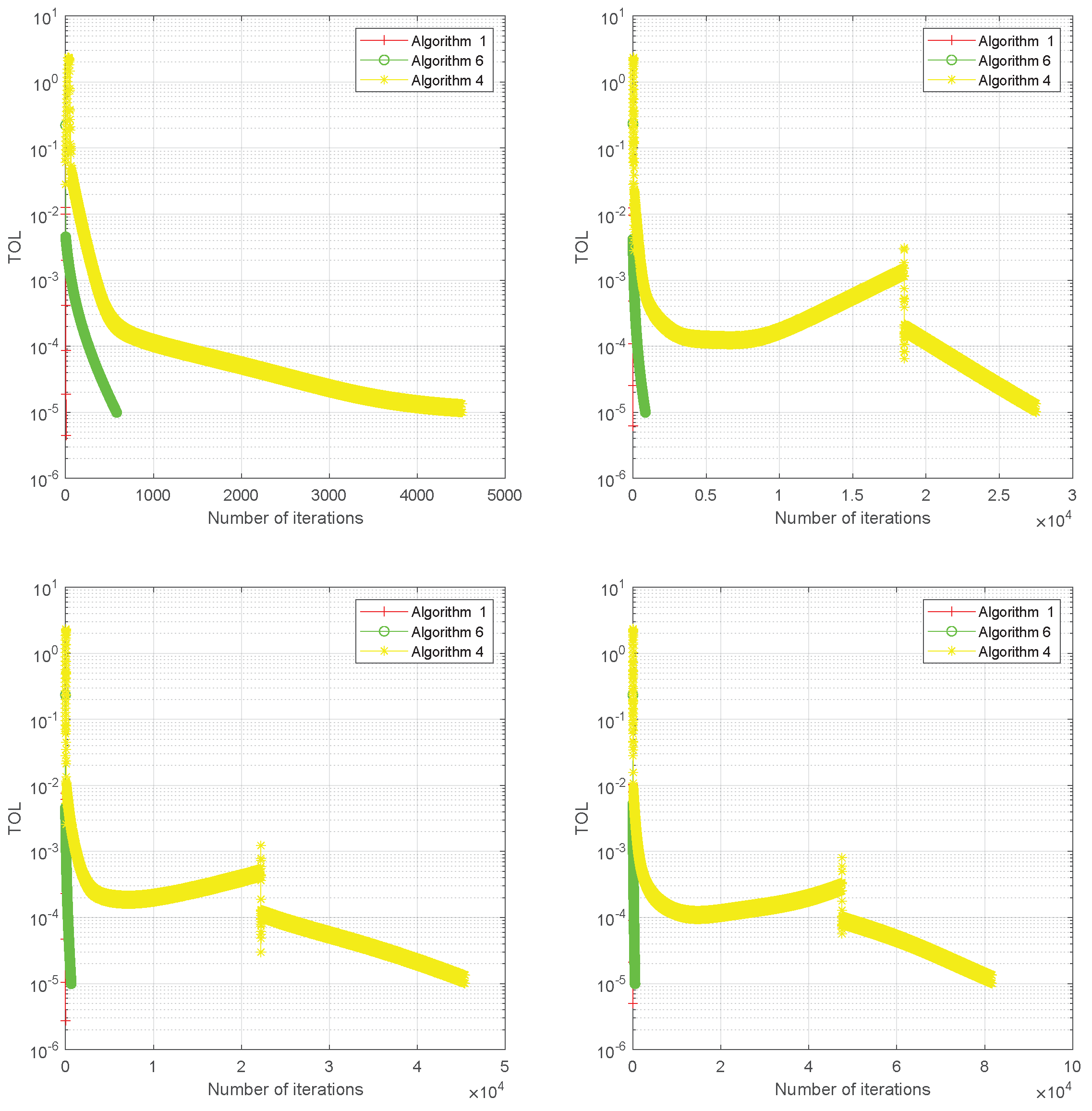
Let be defined by , for all , ; then, G is pseudomonotone and uniformly continuous mapping (see [38]). We choose the following parameters for the algorithms: , , , , , , and . We define the sequence and apply the stopping criterion for the iterative processes because the solution to the problem is unknown. ε is the predetermined error. Here, the terminating condition is set to . For the numerical experiments illustrated in Figure 1 and Table 1 below, we take into consideration the resulting cases.
Figure 1.
(Top Left): Case 1; (Top Right): Case 2; (Bottom Left): Case 3; (Bottom Right): Case 4, the error plotting of comparison of Algorithm 1, and Equation (6) for Example 1.
Table 1.
Comparison of Algorithm 1 and Equation (6).
- Case 1:
- and .
- Case 2:
- and .
- Case 3:
- and .
- Case 4:
- and .
From the numerical results, it is clear that our Algorithm 1 solves the problem with a smaller number of iterations and CPU−time (second). This shows the advantage of using a double inertial terms and golden ratio in Algorithm 1.
Example 2.
Let . Define by , where the matrix M is formed as , where and are the householder and the diagonal matrix, and
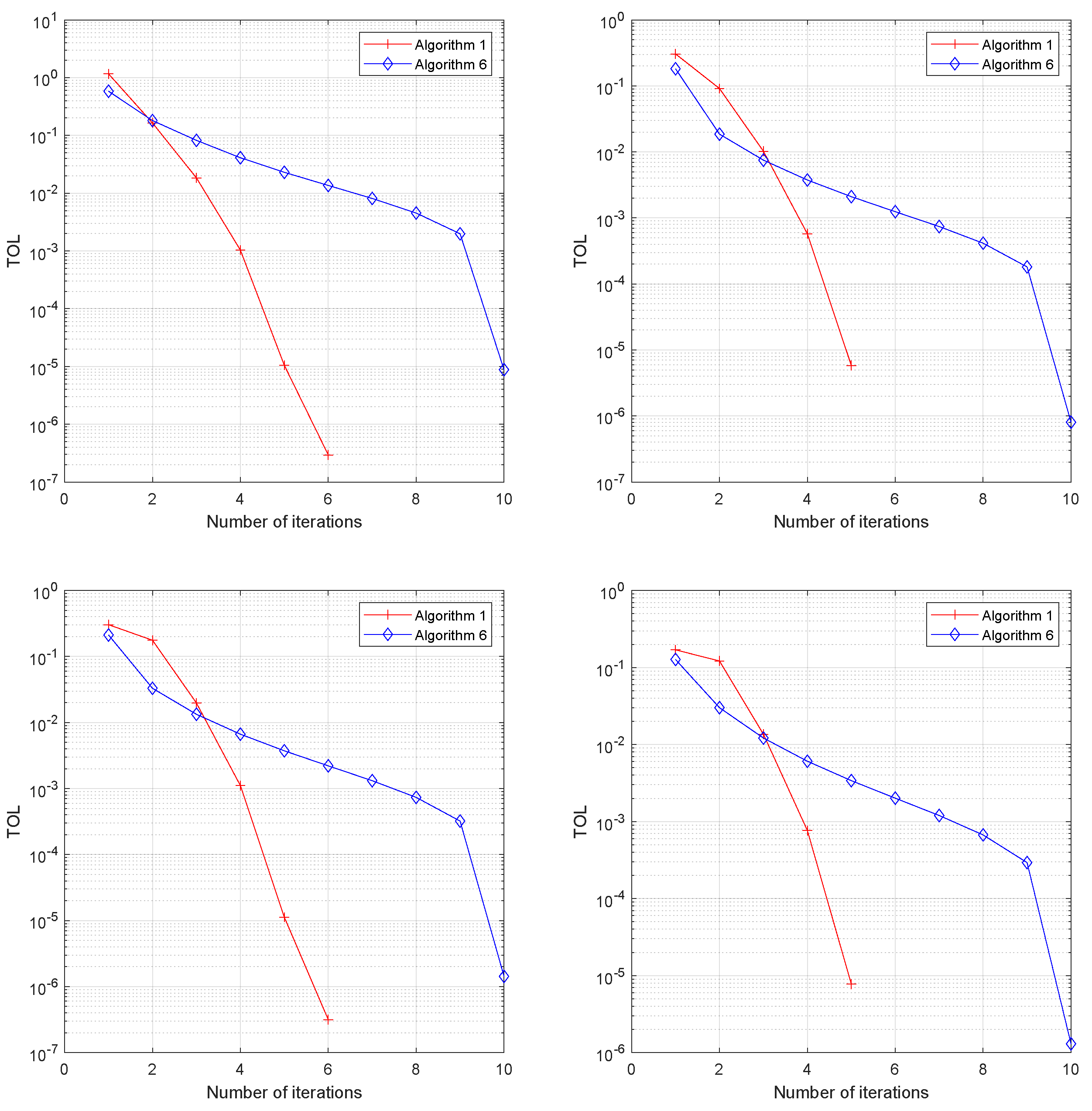
with being the present condition number of M ([39], Example 5.2). In the numerical computation, we choose , and uniformly take the vector in . Thus, G is pseudomonotone and Lipschitz continuous with (see [39]). By setting , Matlab is used to efficiently compute the projection onto C. Moreover, we examine various instances of the problem’s dimension. That is, , with starting points and . We choose the following parameters for Algorithm 1: , , , , , , . We take , , , , and for Equations (4) and (6). In this example, we take the stopping criterion to be and obtain the numerical results shown in Table 2 and Figure 2.
Table 2.
Numerical results for Example 2 with .
Figure 2.
The behavior of with for Example 2: (Top Left): ; (Top Right): ; (Bottom Left): ; (Bottom Right): .
The numerical results show that Algorithm 1 performs better than both Equations (4) and (6) in terms of the number of iterations and CPU time needed for computation. These results are shown in Table 2 and Figure 2. This increase in performance highlights the advantages of using double inertial extrapolation steps, which boost the methods’ effectiveness and accelerate their rate of convergence. These steps also give more momentum to the algorithm, improving its overall performance and stability significantly.
5. Conclusions
The pseudomonotone variational inequality problem in the context of real Hilbert spaces is addressed in this paper using a Mann-type projection and contraction technique. Our approach uses a double inertial extrapolation method, as specified, together with a novel line search step size based on the golden rule to accelerate the rate of convergence. To demonstrate how well our suggested approach works, we provided a numerical example.
Author Contributions
All authors contributed equally to the writing of this paper. All authors have read and agreed to the published version of the manuscript.
Funding
This research received no external funding.
Informed Consent Statement
Not applicable. The authors affirm that this work has not yet been published anywhere and is not currently being considered for publication elsewhere.
Data Availability Statement
Data and source code will be made available on request.
Acknowledgments
The authors are grateful to Department of Mathematics and Applied Mathematics, Sefako Makgato Health Science University South Africa for supporting this research work.
Conflicts of Interest
The authors declare no conflicts of interest.
References
- Brnabic, A.; Hess, L.M. Systematic literature review of machine learning methods used in the analysis of real-world data for patient-provider decision making. BMC Med. Inform. Decis. Mak. 2021, 21, 54. [Google Scholar] [CrossRef] [PubMed]
- Salazar-Reyna, R.; Gonzalez-Aleu, F.; Granda-Gutierrez, E.M.; Diaz-Ramirez, J.; Garza-Reyes, J.A.; Kumar, A. A systematic literature review of data science, data analytics and machine learning applied to healthcare engineering systems. Manag. Decis. 2022, 60, 300–319. [Google Scholar] [CrossRef]
- Abass, H.A.; Ugwunnadi, G.C.; Narain, O.K.; Darvish, V. Inertial extrapolation method for solving variational inequality and fixed point problems of a Bregman demigeneralized mapping in a reflexive Banach space. Numer. Funct. Anal. Optim. 2022, 43, 933–960. [Google Scholar] [CrossRef]
- Alansari, M.; Ali, R.; Farid, M. Strong convergence of an inertial iterative algorithm for variational inequality problem, generalized equilibrium problem and fixed point problem in a Banach space. J. Inequal. Appl. 2020, 2020, 42. [Google Scholar] [CrossRef]
- Censor, Y.; Gibali, A.; Reich, S. Algorithms for the split variational inequality problem. Numer. Algor. 2012, 59, 301–323. [Google Scholar] [CrossRef]
- Ali, B.; Ugwunnadi, G.C.; Lawan, M.S.; Khan, A.R. Modified inertial subgradient extragradient method in reflexive Banach spaces. Bol. Soc. Mat. Mex. 2021, 27, 30. [Google Scholar] [CrossRef]
- Censor, Y.; Gibali, A.; Reich, S. The subgradient extragradient method for solving variational inequalities in Hilbert space. J. Optim. Theory Appl. 2011, 148, 318–335. [Google Scholar] [CrossRef]
- Cholamjiak, P.; Shehu, Y. Inertial forward-backward splitting method in Banach spaces with application to compressed sensing. Appl. Math. 2019, 64, 409–435. [Google Scholar] [CrossRef]
- Shehu, Y.; Vuong, P.T.; Cholamjiak, P. A self-adaptive projection method with an inertial technique for split feasibility problems in Banach spaces with applications to image restoration problems. J. Fixed Point Theory Appl. 2019, 21, 50. [Google Scholar] [CrossRef]
- Suantai, S.; Cho, Y.J.; Cholamjiak, P. Halpern’s iteration for Bregman strongly nonexpansive mappings in reflexive Banach spaces. Comput. Math. Appl. 2012, 64, 489–499. [Google Scholar] [CrossRef]
- Suantai, S.; Pholasa, N.; Cholamjiak, P. The modified inertial relaxed CQ algorithm for solving the split feasibility problems. J. Ind. Manag. Optim. 2018, 14, 1595–1615. [Google Scholar] [CrossRef]
- Korpelevich, G.M. The extragradient method for finding saddle points and other problems. Ekonom. Mate. Metod. 1976, 12, 747–756. [Google Scholar]
- Antipin, A.S. On a method for convex programs using a symmetrical modification of Lagrange function. Ekonom. I Mate. Metod. 1976, 12, 1164–1173. [Google Scholar]
- He, B.S. A class of projection and contraction methods for monotone variational inequalities. Appl. Math. Optim. 1997, 35, 69–76. [Google Scholar] [CrossRef]
- Dong, Q.L.; Cho, Y.J.; Rassias, T.M. The projection and contraction methods for finding common solutions to variational inequality problems. Optim. Lett. 2018, 12, 1871–1896. [Google Scholar] [CrossRef]
- Dong, Q.L.; Jiang, D.; Gibal, A. A modified subgradient extragradient method for solving the variational inequality problem. Numer. Algor. 2018, 9, 927–940. [Google Scholar] [CrossRef]
- Dong, Q.L.; Cho, Y.J.; Zhong, L.L.; Rassias, T.M. Inertial projection and contraction algorithms for variational inequalities. J. Glob. Optim. 2018, 70, 687–704. [Google Scholar] [CrossRef]
- Tian, M.; Xu, G. Improved inertial projection and contraction method for solving pseudomonotone variational inequality problems. J. Inequal. Appl. 2021, 2021, 107. [Google Scholar] [CrossRef]
- Alvarez, F.; Attouch, H. An inertial proximal method for maximal monotone operators via discretization of a nonlinear oscillator with damping. Set-Valued Anal. 2001, 9, 3–11. [Google Scholar] [CrossRef]
- Cioranescu, I. Geometry of Banach Spaces, Duality Mappings and Nonlineqar Problems; Kluwer Academic: Dordrecht, The Netherlands, 1990. [Google Scholar]
- Maluleka, R.; Ugwunnadi, G.C.; Aphane, M. Inertial subgradient extragradient with projection method for solving variational inequality and fixed point problems. AIMS Math. 2023, 8, 30102–30119. [Google Scholar] [CrossRef]
- Li, X.-H. A strong convergence theorem for solving variational inequality problems with pseudo-monotone and Lipschitz mappings. J. Nonlinear Funct. Anal. 2022, 2022, 4. [Google Scholar]
- Liu, L. A stochastic projection and contraction algorithm with inertial effects for stochastic variational inequalities. J. Nonlinear Var. Anal. 2023, 7, 995–1016. [Google Scholar]
- Thong, D.V.; Vuong, P.T. Modified Tseng’s extragradient methods for solving pseudo-monotone variational inequalities. Optimization 2019, 68, 2207–2226. [Google Scholar] [CrossRef]
- Yao, Y.; Iyiola, O.S.; Shehu, Y. Subgradient Extragradient Method with Double Inertial Steps for Variational Inequalities. J. Sci. Comput. 2022, 90, 71. [Google Scholar] [CrossRef]
- Li, H.Y.; Wang, X.F. Subgradient extragradient method with double inertial steps for quasi-monotone variational inequalities. Filomat 2023, 37, 9823–9844. [Google Scholar] [CrossRef]
- Li, H.Y.; Wang, X.F.; Wang, F.H. Projection and contraction method with double inertial steps for quasi-monotone variational inequalities. Optimization 2024, 1–31. [Google Scholar] [CrossRef]
- Ofem, A.E.; Mebawondu, A.A.; Ugwunnadi, G.C.; Cholamjiak, P.; Narain, O.K. Relaxed Tseng splitting method with double inertial steps for solving monotone inclusions and fixed point problems. Numer. Algor. 2024, 96, 1465–1498. [Google Scholar] [CrossRef]
- Thong, D.V.; Li, X.H.; Dung, V.T.; Huyen, P.T.; Tam, H.T. Using Double Inertial Steps Into the Single Projection Method with Non-monotonic Step Sizes for Solving Pseudomontone Variational Inequalities. Netw. Spat. Econ. 2024, 24, 1–26. [Google Scholar] [CrossRef]
- Wang, K.; Wang, Y.H.; Iyiola, O.S.; Shehu, Y. Double inertial projection method for variational inequalities with quasi-monotonicity. Optimization 2024, 73, 707–739. [Google Scholar] [CrossRef]
- Chidume, C.E. Geometric properties of Banach spaces and nonlinear iterations. In Springer Verlag Series; Lecture Notes in Mathematics; Springer: Berlin/Heidelberg, Germany, 2009; ISBN 978-1-84882-189-7. [Google Scholar]
- Saejung, S.; Yotkaew, P. Approximation of zeroes of inverse strongly monotone operators in Banach spaces. Nonlinear Anal. 2012, 75, 742–750. [Google Scholar] [CrossRef]
- Tan, B.; Qin, X. Modified inertial projection and contraction algorithms for solving variational inequality problems with non-Lipschitz continuous operators. Anal. Mathl. Phys. 2022, 12, 26. [Google Scholar]
- Iusem, A.N. An iterative algorithm for the variational inequality problem. Comput. Appl. Math. 1994, 13, 103–114. [Google Scholar]
- Khobotov, E.N. Modifications of the extragradient method for solving variational inequalities and certain optimization problems. USSR Comput. Math. Math. Phys. 1987, 27, 120–127. [Google Scholar] [CrossRef]
- Marcotte, P. Application of Khobotov’s algorithm to variational inequalities and network equilibrium problems. Inf. Syst. Oper. Res. 1991, 29, 258–270. [Google Scholar] [CrossRef]
- Long, X.J.; Yang, J.; Cho, Y.J. Modified Subgradient Extragradient Algorithms with A New Line-Search Rule for Variational Inequalities. Bull. Malays. Math. Sci. Soc. 2023, 46, 140. [Google Scholar] [CrossRef]
- Thong, D.V.; Shehu, Y.; Iyiola, O.S. Weak and strong convergence theorems for solving pseudo-monotone variational inequalities with non-Lipschitz mappings. Numer. Algor. 2019, 84, 795–823. [Google Scholar] [CrossRef]
- He, H.; Ling, C.; Xu, H.K. A relaxed projection method for split variational inequalities. J. Optim. Theory Appl. 2015, 166, 213–233. [Google Scholar] [CrossRef]
Disclaimer/Publisher’s Note: The statements, opinions and data contained in all publications are solely those of the individual author(s) and contributor(s) and not of MDPI and/or the editor(s). MDPI and/or the editor(s) disclaim responsibility for any injury to people or property resulting from any ideas, methods, instructions or products referred to in the content. |
© 2024 by the authors. Licensee MDPI, Basel, Switzerland. This article is an open access article distributed under the terms and conditions of the Creative Commons Attribution (CC BY) license (https://creativecommons.org/licenses/by/4.0/).