Review

Model-Based Adaptive Control of Bioreactors—A Brief Review

1
Department of Mechatronic Bio/Technological Systems, Institute of Robotics, Bulgarian Academy of Science, Acad. G. Bonchev Str., bl. 2, 1113 Sofia, Bulgaria
2
Faculty of Mathematics and Informatics, Sofia University “St. Kliment Ohridski”, 1164 Sofia, Bulgaria
3
Department of Bioinformatics and Mathematical Modelling, Institute of Biophysics and Biomedical Engineering, Bulgarian Academy of Sciences, Acad. G. Bonchev Str., bl. 105, 1113 Sofia, Bulgaria
*
Author to whom correspondence should be addressed.
Mathematics 2024, 12(14), 2205; https://doi.org/10.3390/math12142205
Submission received: 12 June 2024 / Revised: 4 July 2024 / Accepted: 11 July 2024 / Published: 13 July 2024

Abstract

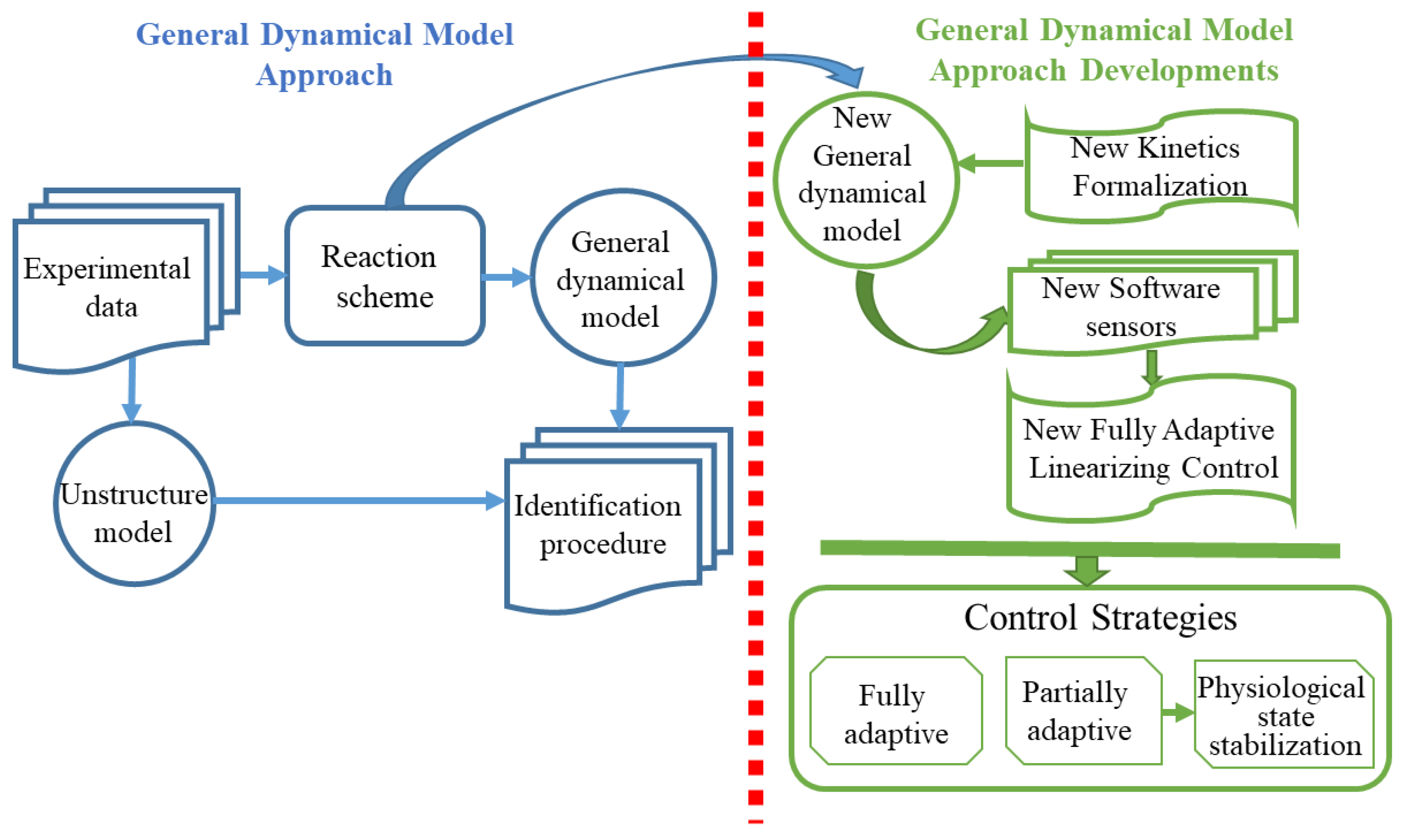
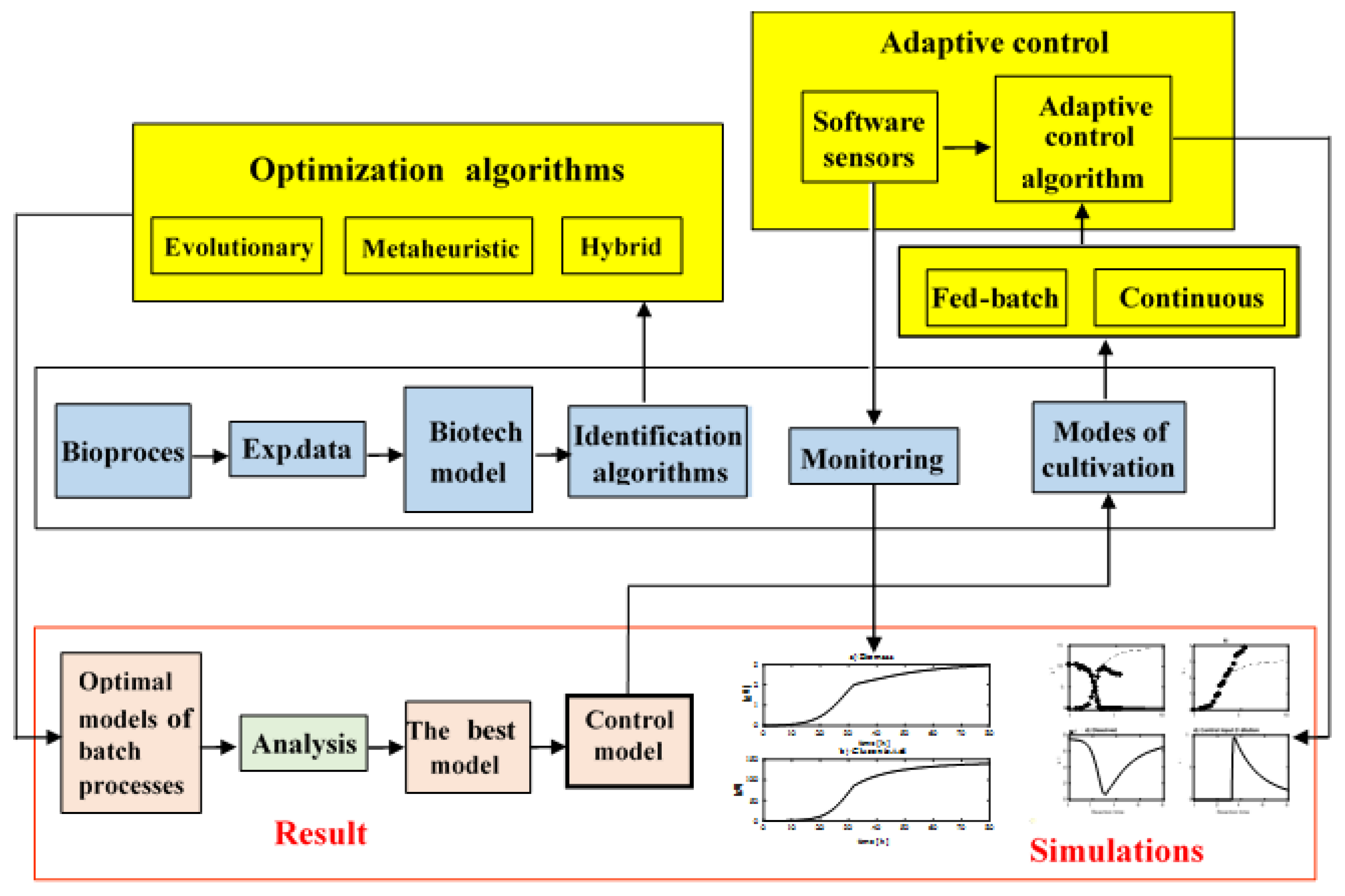
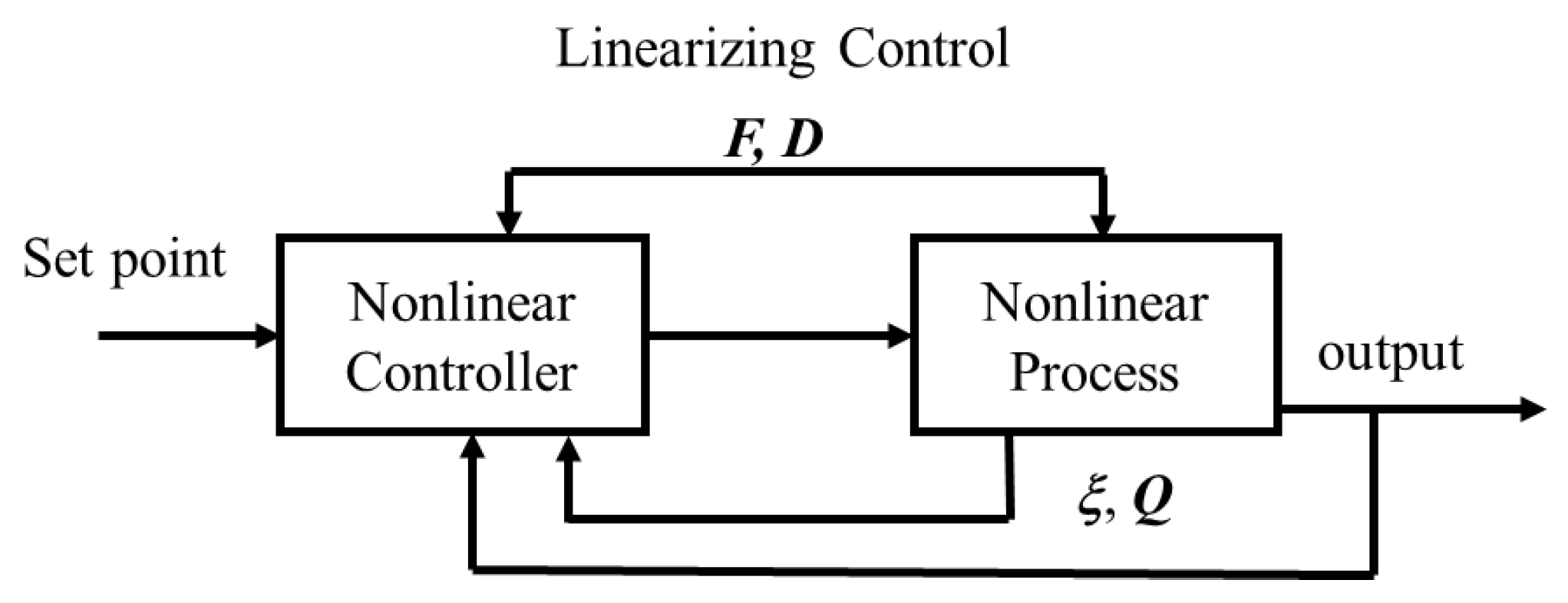
This article summarizes the authors’ experiences in the development and application of the General Dynamical Model Approach related to adaptive linearizing control of biotechnological processes. Special attention has been given to some original, innovative solutions in model-based process control theory: new formalization of biotechnological process kinetics, derivation and tuning of the general software sensor of the full kinetics of biotechnological processes, and a general algorithm for fully adaptive linearizing control with software sensors. These theoretical solutions are the basis of three control strategies—fully adaptive control of the main substrate, partially adaptive control of intermediate metabolite, and recognition and stabilization of the desired physiological state based on the proposed theoretical solutions. Each strategy is illustrated in different case studies. The advantages and limitations of each of them are identified and discussed. The derived algorithms for monitoring and controlling the considered biotechnological processes are realized and included in a software platform named Interactive System for Education in Modelling and Control of Bioprocesses (InSEMCoBio). The InSEMCoBio modules and their main functions are discussed. The effectiveness of the proposed control strategies (achieving maximum productivity) has been proven through a series of simulation investigations of the considered case studies.
Keywords: adaptive control; bioprocesses; software sensors; software system adaptive control; bioprocesses; software sensors; software system