


Abstract
Livestock farming, especially the beef cattle sector, plays a crucial role in the economy and social and environmental balance and occupies a prominent position in Spain. The aim of this study is to highlight the positive impact of this sector in socioeconomic, food, natural heritage conservation, and environmental management aspects in order to obtain an accurate profile of the national panorama and to propose sample subgroups. For this purpose, 252 beef cattle farms in Spain were examined in detail, and the external logistic biplot (ELB) was used with a multivariate approach and from an algebraic and computational perspective. By addressing aspects such as infrastructure, feeding strategies, waste management, biodiversity, productivity, and sustainability, similarities and differences between cattle farms have been obtained, providing an analytical tool for the livestock sector and generating key knowledge on its functioning and contributions to society and the environment. The analysis revealed accuracy in the zootechnical classification of livestock farms, their feeding strategies, and genetics. Finally, significant regional differences in prevailing livestock practices were identified.
Keywords:
multivariate statistics; external logistic biplot; data analysis; livestock production models; meat industry MSC:
62P12; 62H25; 62H30; 62-04
1. Introduction
Livestock plays a vitally important role in the global economy, contributing significantly to the generation of employment, rural development, food safety, and traceability of these products [1,2,3,4,5]. In particular, the beef cattle sector stands out as one of the most relevant components of livestock farming, both globally and in the national context [1,6,7,8]. In Spain, this activity not only represents an important source of economic income but also triggers a series of positive effects in terms of social development and environmental sustainability [9,10].
National beef farms not only satisfy domestic demand but also contribute significantly to exports, positioning Spain as one of the main producers and exporters at the European and world levels [1,2,7,11].
In the field of livestock models, there are a wide variety of approaches and criteria for their organizations [12]. The integrated animal traceability system (SITRAN) establishes a classification based on the various characteristics and methods used by beef cattle farms: fattening, beef production, mixed production, pre-fattening, and heifer rearing, among others [1]. However, some organizations, such as the Spanish Ministry of Agriculture, Fisheries, and Food (MAPA), have proposed a simplification, dividing beef cattle into two main subsectors: suckler cows and calf fattening [8,13]. The main objective of the suckler cow or meat production system is the rearing of calves for meat consumption. Usually, these farms maintain a close relationship with nature, relying mainly on local pastures for their operations. Therefore, they are related to the different extensive systems [8]. Fattening or fattening farms are mostly stable, where feeding is based on feed composed essentially of cereals. This subsector is closely related to intensive production, with feeding based mainly on feed and straw [13,14].
These two subsectors can be carried out in extensive, intensive, or mixed systems. Each of these modalities has particularities that influence aspects such as meat properties, animal welfare, production efficiency, and environmental management. Extensive livestock farming is characterized by the use of vast territorial areas where cattle graze freely and feed mainly on natural pastures. This approach promotes environmental conservation, biodiversity, and ecological balance, in addition to contributing to the maintenance of rural areas and sustainable development [3,8,11,15]. Intensive systems are developed in specialized facilities where the feeding, management, and environment of the livestock are meticulously controlled. These systems are usually more efficient in terms of production, resulting in higher yields per unit of area and time. However, they often pose challenges in terms of waste management and environmental pollution [5,8]. Finally, mixed livestock farms combine elements of extensive and intensive systems, seeking to take advantage of the benefits of both approaches. These types of systems offer certain flexibility and adaptability to local conditions and farmer, consumer, and market preferences, allowing a more balanced management of resources and income diversification [16].
As an alternative strategy, in response to the demands of European society, organic livestock farming emerges [17], closely related to extensive livestock farming, as it is based on land resources and reduces the use of antibiotics and drugs, as well as the adjustment of livestock loads [8,17]. This new approach is presented to develop production models that can adapt to the current situation while preserving their fundamental role in the future of the rural environment. In this context, the revitalization and modernization of pastoral culture are essential, addressing the management of complex landscapes, open land, and pastures, as well as the integration of agricultural and livestock cycles through the exchange of materials [8,17].
In summary, beef cattle farming plays a fundamental role in Spain’s economy, society, and environment. The diversity of livestock systems offers opportunities to boost the sustainability, efficiency, and competitiveness of the sector while guaranteeing product quality and respect for the environment and animal welfare. In this context, it is essential to understand and value the merits of each type of farm and to encourage practices and policies that promote sustainable and equitable livestock development.
There is a great variety of livestock production models in Spanish beef cattle farms. This study seeks to answer the following research questions:
- Q1: Which livestock production models are the most significant in Spanish beef cattle farms?
- Q2: How are the livestock production models described in relation to the livestock characteristics?
- Q3: Are there differences in livestock production depending on their geographical location?
The results of this research are intended to guide stakeholders and policy makers in the creation of policies and strategies aimed at promoting sustainable development in the agricultural sector. This paper is organized into four sections. After the Introduction, Section 2 presents a comprehensive literature review of the multivariate techniques used in this study. Section 3 provides a detailed description of the dataset and methodology used in the statistical analysis. Section 4 presents the results of the study, and Section 5 the discussion. To round off, Section 5 contains the concluding remarks.
2. Multivariate Techniques: Related Works
2.1. Logistic Biplot
Biplots, as described in the literature [18,19], are tools that allow the joint visualization of both variables and individuals in a quantitative data matrix in a lower-dimensional representation, where individuals are represented as points in a factorial plane and variables as vectors. Biplots can be generated through factorial analysis (FA) or principal component analysis (PCA), although it is also possible to obtain them through alternative approaches such as regressions [20], all aimed at maximizing the total variability of the data.
When dealing with a data matrix X of dimension n × p, where the rows correspond to n individuals (beef cattle farms) and the columns measure the p binary qualitative variables, taking the value 0 to indicate the absence of the livestock characteristics and the value 1 for their presence, statistical techniques such as PCA, FA, PCA biplot, or classic biplot are not valid since they do not use qualitative variables. Multiple correspondence analysis (MCA) could be considered a particular form of biplot adjustment for a matrix of categorical data based on distances between individuals and variables [21]. Other types of biplots have emerged for non-continuous data, such as qualitative variables or binary data. A linear biplot approach was proposed, specifically designed for logistic response data, called logistic biplot (LB) [22]. Additionally, another adaptation was presented for these data matrices where the coordinates are generated by an external method, such as principal coordinates analysis (PCoA), known as ELB [23].
The LB corresponds to logistic regression and can be formulated, in terms of probability, as follows:
where is the probability that the jth variable is present in any beef cattle farm, and ais and bjs (i = 1, …, n; j = 1, …, p; s = 1, …, k) are the model parameters, used as row and column markers respectively, and represented in the k-dimensional plane.
The presented logit model is equivalent to the generalized linear regression model applying the function of the same name as a link to avoid scale problems:
Expressed in matrix form:
where π is the matrix of expected probabilities, 1 a vector consisting of ones, b0 a vector containing the intercept terms (added to center the data matrix, similar to what was done with linear or classic biplots), and matrices A and B contain the markers for the rows and columns of matrix X. and B’ represent the transposed matrices of b0 and B, respectively.
This logit model falls into the “latent variables” model, in which the principal axes are considered as new fictitious variables explaining the grouping among the observed variables.
If it is assumed that individuals respond independently to the variables and that the variables are independent for given values of latent traits, the likelihood function is as follows:
Applying the logarithm to this function, the following formula is obtained:
By taking the derivatives of L with respect to the parameters, equating to zero, and solving the system of linear equations, we obtain the estimators.
The iterative algorithm consists of five stages [24], where the first one will involve selecting initial values for the parameter A, which can be derived, for example, from a PCA on matrix X. Subsequently, matrix A is orthogonally normalized to avoid indeterminations. In the regression stage, the parameters bj1, …, bjs for each column xj of X are calculated using standard logistic regression. Then, in the interpolation stage, ai1, …, ais for each individual are jointly calculated using the Newton-Raphson method. Finally, it is evaluated whether the changes in the likelihood function are below a certain threshold to stop the process; otherwise, iterations continue until the desired level of accuracy is reached [22].
2.2. External Logistic Biplots
Following the methodological strategy previously developed by Vicente-Villardón et al. [22], a variant of logistic biplot called external logistic biplot was proposed [23]. This technique combines PCoA and logistic regression in the same algorithm, positing itself as an effective way to identify livestock characteristics that influence the classification of livestock production models.
This proposal is based on the premise that the alternating regression applied to binary data in the columns of matrix X, used in LB [22], is analogous to the adaptation of simple logistic regressions for each column of matrix X on the k-dimensional configuration derived from PCoA [23].
Figure 1 briefly outlines the steps of the ELB algorithm. As detailed previously, this technique starts with a matrix X of binary data. In accordance with previous syntheses [25], a matrix S = (sij) containing the similarities between rows (individuals) (in blue in Figure 1) is defined from X, and thus the algorithm starts with a PCoA (in red in Figure 1) ordering the individuals in a low-dimensional Euclidean space, such that the distance between any two points approximates the dissimilarity between the individuals represented by these points as much as possible. To determine the coordinates of the variables associated with the ordering obtained in the PCoA, the directions that best predict the probability of presence for each variable are sought, and once obtained, the LB methodology [22] is applied (in green in Figure 1).
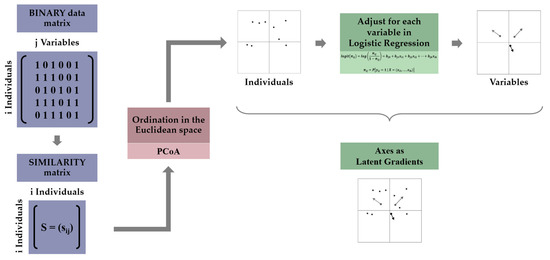
Figure 1.
ELB algorithm.
This procedure is called an external logistic biplot because the coordinates of the n individuals (beef cattle farms in this study) are calculated using an external procedure, such as PCoA. If the as are known parameters, the bs parameters are obtained by fitting simple logistic regressions using each column of matrix X as the dependent variable and the as as predictors.
This procedure allows for generating a bi- or tri-dimensional graph, where the as are represented as points (Spanish beef cattle farms) and the estimated bs for each variable as vectors (livestock characteristics), facilitating the interpretation and visualization of the data matrix [20]. The projection of each point onto each vector allows for obtaining the estimated probability of the presence of livestock characteristics in cattle farming [21]. These graphs were obtained using the MULTBIPLOT package (version 23.0102) [26].
3. Materials and Methods
A multistage study was carried out, in which the first and second stages consisted of stratified sampling. In this process, the classification of Spanish beef cattle farms was carried out according to the criteria established by the MAPA, dividing them according to their typology and the number of heads of cattle. Two main groups were established: suckler cows and fattening cows, due to their differential relevance, in order to ensure the representativeness of each type. Similarly, farms were categorized by size, using smaller intervals for suckler cow farms and larger intervals for fattening farms.
Based on this categorization, an optimal number of farms was established for each stratum, using simple random sampling to select farms within each of the strata [27]. Subsequently, the sample obtained was divided into autonomous regions, and trained interviewers were assigned to conduct the interviews. The sample size was determined to ensure adequate representation of the diversity within the Spanish beef cattle sector.
To perform the analysis, a binary data matrix was used as a starting point, recording various fundamental characteristics distributed across the following seven dimensions: zootechnical characterization, infrastructure qualities, feeding strategies, waste management, protection of diversity and the environment, genetics, and energy use. All these aspects are related to the social and economic sustainability of these businesses and were significant in the developed analysis.
Originally, the binary matrix comprised 252 individuals, representing the beef cattle farms located in Spain for the period between the end of 2020 and the beginning of 2021, and 202 variables. After a preliminary analysis, the number of variables was reduced to 73, which were found to be significant with a goodness of fit greater than 25%.
The importance of multivariate techniques lies in their ability to handle complex and high-dimensional data sets, such as those used in this study. The biplot approximates the distribution of a multivariate sample in a reduced-dimensional space. Due to the binary nature of the data, the ELB has been chosen, which provides a graphical and understandable visualization to identify relationships between variables, between individuals, and between individuals and variables [23]. This tool offers a complete and contextualized perspective of the factors influencing the beef sector, which is essential for understanding its functioning and socioeconomic and environmental contributions, as well as for the formulation of effective strategies and policies in this area.
To the author’s knowledge, the EBL technique has not been applied before in the Spanish beef sector. The aim of this research is to evaluate the profiles and common characteristics present in beef cattle farms through the multivariate ELB technique, which has been applied in numerous fields of science, such as social sciences [28,29,30,31,32,33] and health sciences [23].
Focusing on the two main livestock models and including the geographical regional factor, the technique to identify similarities and differences between the variables was used, with subgroups based on them and their relationship with sustainable practices.
4. Results
4.1. Groupings Based on the Typology of Beef Cattle Farms
After carrying out the preliminary analysis detailed in the methodology, an initial representation is made only with the variables that have demonstrated statistical significance and goodness of fit greater than 25%. Given the number of variables involved in the study, the description of the results has been focused on the first dimension identified, which is the zootechnical characterization. It was observed that among the variables that define the different types of livestock farms, those related to the production of meat or suckler cows (MEAT PRODUCTION) and those destined for fattening the animal (FODDER) emerged as the most significant among the 252 Spanish beef cattle farms examined. Figure 2 shows how these two classifications point in opposite directions, indicating a negative correlation between them. With the resulting biplot, it is possible to interpret the arrangement of the groupings of individuals, which in this context correspond to the cattle farms that make up the sample. It can be seen how the beef cattle farms represented in the right half-plane (Quadrants 1 and 4) have a high probability of carrying out fattening practices in their farms or an intensive model. In contrast, those located in the left half-plane (Quadrants 2 and 3) have a high probability of being destined for meat production, using an extensive or mixed model.
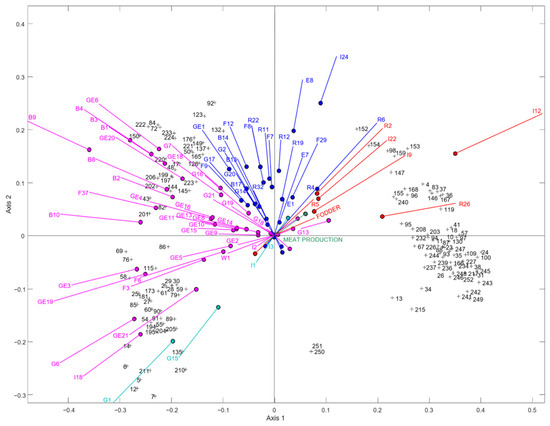
Figure 2.
Graph by farm typology: red indicates variables correlated with FODDER, pink and turquoise with MEAT PRODUCTION, and navy blue with both models.
4.2. Groupings Based on the Most Relevant Livestock Characteristics
Based on the results obtained in Section 4.1, the variables with a goodness of fit greater than 50% have been selected, corresponding to the dimensions of zootechnical classification, infrastructure qualities, feeding strategies, waste management, and genetics, and are shown in Table 1. Variables with a goodness of fit greater than 50% were chosen to facilitate the visualization of the data and to ensure the representativeness of the variables.

Table 1.
Relationship of significant variables with a goodness of fit greater than 50%.
Using the biplot, the graphical representation shown in Figure 3 is obtained, which focuses on the most relevant and significant characteristics of the analysis. A close correlation is observed between the MEAT PRODUCTION variable and the variables related to extensive livestock infrastructure (I1, I2, and I3), as well as feeding strategies (G13) and genetics (GE2). These findings are consistent with farms of native or crossbred breeds that spend most of their life cycle in natural environments, making efficient use of available resources without depending significantly on human intervention for their survival.
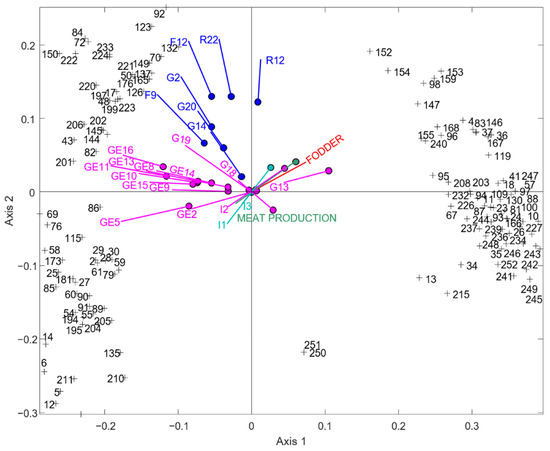
Figure 3.
Graph showing variables with a goodness of fit greater than 50% and their relationship with MEAT PRODUCTION and FODDER zootechnical classifications.
The FODDER variable correlates negatively with the previous zootechnical model, MEAT PRODUCTION. This denotes an absence of the previously developed characteristics, i.e., fattening farms lack the previous peculiarities related to sustainable models. For example, GE2 correlates negatively with FODDER, which is logical since these farms usually use artificial insemination as a reproductive method.
In turn, the fattening model (FODDER) is uncorrelated with variables in the feeding strategies dimension (G2, G14, G18, G19, G20, and F9). The results are consistent, given that they refer to stabled animals that are highly dependent on human intervention for their feeding, care, and management since they are in a controlled environment and do not have direct access to natural resources such as pasture and water.
The overall goodness of fit, expressed as a percentage, reaches 67.32%, suggesting that the two-dimensional solution is adequate for exploring key features of the data as opposed to higher-dimensional representations.
Table 2 presents various measures, including the R2, which refers to the percentage of individuals correctly classified from the expected probabilities (where the prediction is present if the expected probability exceeds 0.5 and absence otherwise), as well as the p-value, an indicator of the significance of the livestock characteristics.
Table 2.
Significance and goodness-of-fit indicators for variables with a goodness-of-fit greater than 50%.
The variables that exceed an R2 of 75% (marked with asterisks in Table 2) are the most relevant livestock characteristics for interpreting the management of Spanish beef cattle farms. These are related to the dimensions corresponding to feeding strategies (G13, G14, G15, G16, and G18) and genetics (GE10).
The remaining items (with R2 values between 50% and 75%) continue to be useful for the classification of cattle farms in the two-dimensional solution, although to a lesser extent, and refer to infrastructure qualities (I1, I2, I3), feeding strategies (G2, G14, G19, G20, F9, F12), waste management (R12, R22), and genetics (GE2, GE5, GE8, GE9, GE11, GE13).
4.3. Prediction Regions for the Most Relevant Characteristics
With the EBL typology, it is also possible to study the estimated probability that a cattle farm has an attribute present, projecting the point that symbolizes a cattle farm in the direction defined by the segment that represents a variable, with the initial extreme being the probability of 0.5 and the final extreme being the probability of 0.75 of the presence of the characteristic. Thus, if a line perpendicular to the segment is drawn through its origin, the graph is divided into two regions, which predict, respectively, the presence and absence of a particular characteristic.
Applying this approach to the most relevant variables of this analysis (Figure 4), in those considered within the dimensions of feeding strategies (G13, G18) and genetics (GE10, GE14, GE15, GE16), it was observed that the number of erroneous predictions was low, especially in the variables G13, GE10, and GE14. Regions predicting presence are colored in red and regions predicting absence in blue, and dots with the same color as the region indicate that the corresponding livestock was correctly classified, according to the prediction of the external logistic model.
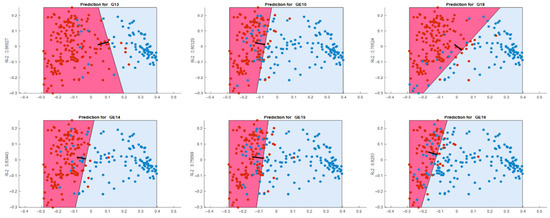
Figure 4.
Prediction regions for variables related to the feeding strategies and genetics dimensions with R2 > 75%.
Repeating this approach for the two variables representing both production models (suckler or fattening), Figure 5 shows a similar situation: the low incidence of erroneous predictions, since few points associated with the presence of the characteristic are located in the rejection region.
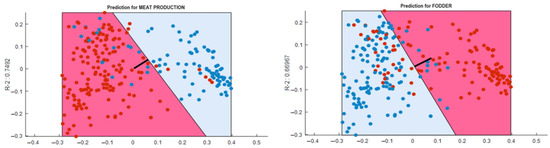
Figure 5.
Prediction regions for MEAT PRODUCTION and FODDER zootechnical classifications.
To complement the results and provide greater depth, a sensitivity analysis of the variables described above was carried out. The results, detailed in Table 3, demonstrate a positive impact on the variables examined, showing a high overall sensitivity, with most values close to 0.9. The value of 0.77, although slightly lower, does not compromise these favorable results.
Table 3.
Significance and sensitivity of variables for the most relevant characteristics.
It can be concluded that, given the accurate predictions for most of the items, the two-dimensional representation has captured most of the information contained in the original variables, and thus, the ELB is useful for describing the multivariate behavior of a dataset [23].
4.4. Clusters by Production Type
The representations provided by the ELB technique are not only useful for the interpretation of individual items but also for several variables as a whole. Figure 6 illustrates the relationship between MEAT PRODUCTION and FODDER, corresponding to the first dimension: zootechnical classifications, previously developed. In this context, four regions of prediction of the categories are identified, in which it is observed that the real values fit almost perfectly: those dedicated exclusively to fattening, beef production farms, those that carry out both processes (breeders that raise their calves until weaning, followed by fattening), and those that do not carry out any of these processes.
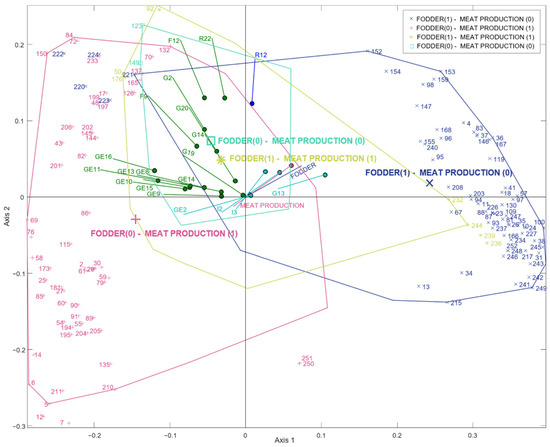
Figure 6.
Clusters of beef cattle farms according to MEAT PRODUCTION and FODDER zootechnical characteristics.
It is relevant to highlight that cattle farms focused on beef fattening are predominantly located in their designated area (Quadrants 1 and 4), with the exception of four fattening farms, which are positioned in the area destined for meat production (located in the upper left part of Quadrant 2). This situation could indicate the presence of mixed models, where these farms carry out both zootechnical classifications.
4.5. Clusters by Autonomous Regions
The peculiarities of the two models have been interpreted using clusters, focusing on the particularities of the different autonomous regions, but again only on those that were found to be significant in the analysis. Spain is divided into 17 regions called autonomous regions. Of these, the most significant were Aragon, Asturias, and Andalusia.
Figure 7 shows that the autonomous region of Aragon has livestock farms that have extensive facilities with fixed enclosures and management chutes (I2, I3), natural pastures (G2), and use them both for grazing and for mowing and conservation (G13, G14). They also use strategies such as pasture parceling and electric grazing (G19, G20). Natural mating is selected as a reproductive method (GE2), and characteristics such as conformation, weight, growth, and meat quality are valued when selecting sires (GE8, GE10, GE11), in addition to fertility and calving when selecting replacement females (GE13, GE14, GE15, GE16). Because of this and the presence of the livestock traits described above, Aragón can be related to a mixed model.
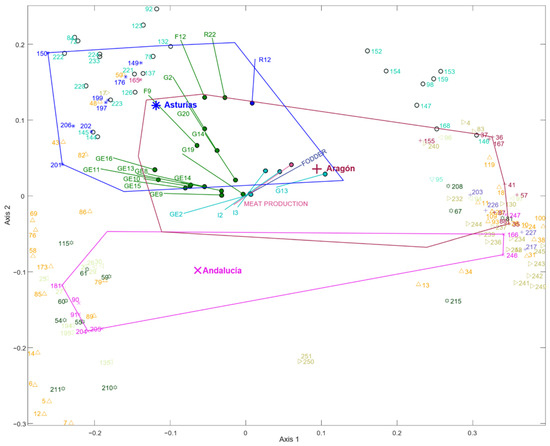
Figure 7.
Clusters of beef cattle farms by autonomous regions.
The farms in Asturias share some of the characteristics of Aragón, such as those related to feeding strategies (G2, G14, G19, G20) and genetics in both stallions (GE8, GE10, GE11) and replacement females (GE13, GE14, GE15, GE16). However, in the feeding strategy, it is not predominant that the consumption by tooth (G13), but the mowing and conservation of pastures (G14), supported by a recurrent consumption of forage and silage (F9, F12). The same occurs with reproductive systems, where natural mating does not prevail (GE2), so other systems such as artificial insemination are used. In addition, in this community, variables totally differentiated from the rest are represented, describing waste management (R12, R22). As a whole, an intensive livestock model is reflected in Asturias, characterized by the stabling of livestock, a dependence mainly on food, and the need to collect the waste generated.
The community of Andalusia is related to life production since they have their own extensive model facilities with fixed enclosures (I2), management chutes (I3), and use the pastures for tooth consumption (G13). As in Aragón, they select natural mating as a reproductive method (GE2). These variables are associated with extensive practices related to biodiversity conservation.
5. Discussion
The selection of the sample used in this study was based on the intention to broaden and deepen relevant factors that may not have been addressed in previous research, which, for the most part, has focused on zootechnical and economic aspects [1,2,5]. This made it possible to explore additional dimensions related to the sustainability and environmental impact of the different livestock systems in the Spanish beef cattle sector.
To answer the first research question, the most significant livestock production models in Spanish beef cattle farms are suckler cow and fattening farms. When examining the relationship between the two main sub-sectors, a negative correlation was found, indicating a divergence in the development of these two activities [5,8,9].
Related to the second research question, a close relationship has been observed between the beef or suckler cow production system and the capacity to keep the animals in the open air, in fixed fencing, the use of pastures by grazing on the teeth, and natural mating as a breeding system. This approach, added to their ruminant nature, not only demonstrates that they do not compete directly with resources destined for human consumption but also play a fundamental role in the cleaning and conservation of pastures and natural vegetation. This reduces the risk of forest fires and contributes to the preservation of biodiversity, highlighting their importance in sustainable practices [8,9,10,15,17]. However, for calf fattening, the opposite behaviors have been found; these farms do not correlate with the possession of natural pastures, the use of pastures by mowing and conservation, the movement of animals according to pasture availability, or the use of electric grazers. These findings suggest that farms oriented toward meat production adopt more extensive practices, while those dedicated to fattening tend to be more resource- and labor-intensive. From a sustainable perspective, this underscores the importance of promoting production models that minimize environmental impact and promote animal welfare while maintaining the economic viability of livestock farms. Finding a balance between productivity and sustainability is crucial to ensuring the long-term resilience of the livestock sector.
To answer the last research question, the regional differences found may reflect the specific geographic, climatic, and even socioeconomic conditions of each region. This highlights the importance of adapting livestock strategies to local characteristics to ensure increased long-term sustainability. For example, in regions with scarce natural resources, it may be necessary to encourage more intensive livestock practices that maximize resource use efficiency.
The findings obtained are partially in line with previous studies in the field of livestock production, which focused mainly on socioeconomic and zootechnical aspects [6,7,11], but this study goes further by specifically identifying the differences between practices in suckler cows and calf fattening [9,14] and their associated characteristics in relation to the seven dimensions studied. Previous research has mentioned regional diversity in farming practices [4,5,8], but this analysis is approached from a more detailed perspective, pointing out the most significant characteristics associated with each region. In addition, the importance of sustainable management practices is highlighted, relating each of these two sub-sectors to their use of natural resources and their environmental impact, underlining the need for livestock development strategies adapted to local characteristics, which were not addressed in depth in previous studies.
This study offers a comprehensive view of livestock characteristics and practices in Spain and highlights the importance of considering environmental and regional factors in the management and planning of beef cattle farms. The results obtained are useful for orienting policies and strategies, and addressing the need to implement measures that consider regional diversity and environmental variations. The guidelines derived from these results can be used to promote a more rational use of natural resources and minimize environmental impact.
From a management perspective, this analysis provides a sound basis for informed decision making, allowing policy makers to design specific programs that address the particularities of each region. This may include the allocation of subsidies, the promotion of sustainable management techniques, and the implementation of conservation measures that are adapted to local conditions.
In terms of planning, the results of this study can guide the creation of educational and training initiatives in society, helping to adopt more sustainable and efficient practices. The transfer of knowledge and technology based on this evidence can facilitate a transition towards a more resilient and environmentally friendly agricultural and livestock model.
Compared to other similar methods, ELB offers a clearer interpretation of the binary data by representing the response as a logistic function rather than a linear function. In addition, this multivariate technique focuses on exploratory analysis of the data matrix rather than attempting to build a model for a two-way table. ELB is a relatively simple method to implement and use, making it accessible to a wide range of researchers. This technique is combined with other methods, such as PCoA or cluster analysis, to gain a deeper understanding of the results. The ELB is specifically designed to handle binary data, where variables represent the presence or absence of a characteristic. In addition, it can be very useful in exploring more complex and deeper relationships between individuals and variables, especially when these relationships are suspected to be non-linear. However, BLE may be less effective in databases with noise, missing data, or even when one or more variables are linearly dependent (collinearity).
6. Conclusions
A wide range of variables was considered to provide a more accurate description of beef cattle farms in Spain. The use of the ELB multivariate statistical technique has allowed the classification of Spanish beef cattle farms according to various dimensions, including zootechnical classification, infrastructure qualities, feeding strategies, waste management, and genetics. Through this analysis, a detailed understanding of the livestock characteristics and dynamics of beef cattle farms in Spain has been provided. Two main models were identified: MEAT PRODUCTION and FODDER, which synthesized the common information provided by the variables studied.
This analysis allowed the development of different profiles associated mainly with livestock systems, highlighting a clear differentiation between beef cattle farms in Spain. A negative correlation was observed between MEAT, PRODUCTION, and FODDER systems, indicating a divergence in associated livestock practices. While farms oriented to meat production have shown characteristics more aligned with extensive or mixed models, those dedicated to fattening tend to be intensive. MEAT PRODUCTION was associated with practices that took advantage of the available natural resources, such as consumption by tooth (G13) and mobilization of animals according to the availability of pasture (G18), in addition to natural mating (GE2) as a reproductive system. Therefore, meat production farms are associated with more environmentally friendly practices. However, FODDER correlated negatively with the above-mentioned livestock characteristics, indicating a food dependency and choosing artificial insemination as the reproductive method.
The analysis revealed accuracy in the zootechnical classification of livestock farms, their feeding strategies, and genetics. This indicated the effectiveness of the two-dimensional representation of the ELB technique to describe this data set in a multivariate manner.
Significant regional differences in prevailing livestock practices were identified. Thus, it was observed that farms in Aragon tended to adopt a mixed approach, while in Asturias, the intensive model prevailed. On the other hand, in Andalusia, extensive practices were predominant.
Despite the valuable insights provided by this study, there are several limitations that future research could address to enhance the sustainability and efficiency of the Spanish beef cattle industry. Future studies could expand the sample size to include more geographical diversity. Conducting longitudinal studies to examine the long-term effects of different management practices and logistic strategies on sustainability and efficiency would also help to identify trends over time and provide more robust data on the effectiveness of different practices. Future research could also focus on a more detailed assessment of the environmental impacts of beef production, including carbon footprint, water usage, and other natural resource consumption. Conducting comparative studies with other countries that have well-established beef and cattle industries would also provide valuable information on best practices and areas for improvement.
Author Contributions
Conceptualization, M.A.-P.; data curation, M.A.-P.; formal analysis, M.A.-P. and M.R.-R.; investigation, M.A.-P. and A.Q.-D.; methodology, M.R.-R.; project administration, P.V.-G.; supervision, M.R.-R., A.Q.-D. and P.V.-G.; validation, M.R.-R. and A.Q.-D.; visualization, M.A.-P.; writing—original draft, M.A.-P.; writing—review & editing, M.R.-R. All authors have read and agreed to the published version of the manuscript.
Funding
This research received no external funding.
Data Availability Statement
The original contributions presented in the study are included in the article, further inquiries can be directed to the corresponding authors.
Acknowledgments
The authors would like to express their sincere acknowledgment to PROVACUNO for providing them with the necessary data to carry out this study.
Conflicts of Interest
The authors declare no conflicts of interest.
References
- Beef Cattle Sector Characterization Summary Report. Available online: https://www.mapa.gob.es/es/ganaderia/temas/produccion-y-mercados-ganaderos/2023informecaracterizacionsectorvacunodecarne_datos2022_pub2_tcm30-553721.pdf (accessed on 10 April 2024).
- Hocquette, J.F.; Chatellier, V. Prospects for the European beef sector over the next 30 years. Anim. Front. 2011, 1, 20–28. [Google Scholar] [CrossRef]
- Fernández-Llamazares, Á.; Fraixedas, S.; Brias-Guinart, A.; Terraube, J. Principles for including conservation messaging in wildlife-based tourism. People Nat. 2020, 2, 596–607. [Google Scholar] [CrossRef]
- Escribano, A.J.; Gaspar, P.; Mesias, F.J.; Escribano, M. The contribution of organic livestock to sustainable rural development in sensitive areas. Int. J. Res. Stud. Agric. Sci. 2015, 1, 21–34. [Google Scholar]
- Baldock, D.; Dwyer, J.; Sumpsi Vinas, J.M. Environmental Integration and the CAP: A Report to the European Commission, DG Agriculture; Institute for European Environmental Policy: Madrid, Spain, 2002. [Google Scholar]
- Perin, L.; Dumas, P.; Vigne, M. Representing Cattle Farming around the World: A Conceptual and Holistic Framework for Environmental and Economic Impact Assessment. Ruminants 2022, 2, 360–381. [Google Scholar] [CrossRef]
- Ríos-Núñez, S.M.; Coq-Huelva, D.; García-Trujillo, R. The Spanish livestock model: A coevolutionary analysis. Ecol. Econ. 2013, 93, 342–350. [Google Scholar] [CrossRef]
- Bases Zootécnicas para el Cálculo del Balance Alimentario de Nitrógeno y Fósforo [Zootechnical Basis for the Calculation of the Nitrogen and Phosphorus Feed Balance]. Ministerio de Agricultura, Pesca y Alimentación. Available online: https://cpage.mpr.gob.es/producto/bases-zootecnicas-para-el-calculo-del-balance-alimentario-de-nitrogeno-y-fosforo-2/ (accessed on 10 April 2024).
- Oteros-Rozas, E.; Herrera, P.M.; Alibés, J.; García, J.; Llorente, M.; Majadas, J.; Manzano, P.; Navarro, A.; Moreno, G.; Ottolini, I.; et al. Livestock Farming and Climate Change: An In-Depth Approach; Fundación Entretantos: Valladolid, Spain, 2020. [Google Scholar]
- Soy-Massoni, E.; Uyttewaal, K.; Prat-Guitart, N.; Varela, E. Fire Eaters: Exploring Consumer Preferences for Labeling Extensive Livestock Products Providing Wildfire Prevention Services. Land 2022, 11, 700. [Google Scholar] [CrossRef]
- Ríos-Núñez, S.M.; Coq-Huelva, D. The Transformation of the Spanish Livestock System in the Second and Third Food Regimes. J. Agrar. Chang. 2015, 15, 519–540. [Google Scholar] [CrossRef]
- Nardone, A.; Gibon, A. Livestock Farming Systems, Research and Development Issues; Technical and Social Systems Approaches for Sustainable Development; Doppler, W., Calatrava, J., Eds.; Mergraf Verlag: Weikersheim, Germany, 2000. [Google Scholar]
- Blanco, M.; Ripoll, G.; Albertí, P.; Sanz, A.; Revilla, R.; Villalba, D.; Casasús, I. Effect of early weaning on performance, carcass and meat quality of spring-born bull calves raised in dry mountain areas. Livest. Sci. 2008, 115, 226–234. [Google Scholar] [CrossRef]
- McAllister, T.A.; Stanford, K.; Chaves, A.V.; Evans, P.R.; de Souza Figueiredo, E.E.; Ribeiro, G. Nutrition, feeding and management of beef cattle in intensive and extensive production systems. In Animal Agriculture; Academic Press: London, UK, 2020; pp. 75–98. [Google Scholar] [CrossRef]
- Eldesouky, A.; Mesias, F.J.; Elghannam, A.; Escribano, M. Can extensification compensate livestock greenhouse gas emissions? A study of the carbon footprint in Spanish agroforestry systems. J. Clean. Prod. 2018, 200, 28–38. [Google Scholar] [CrossRef]
- Veysset, P.; Lherm, M.; Bébin, D.; Roulenc, M. Mixed crop–livestock farming systems: A sustainable way to produce beef? Commercial farms results, questions and perspectives. Animal 2014, 8, 1218–1228. [Google Scholar] [CrossRef]
- Perea, J.; Blanco-Enedo, I.; Barba, C.; Angón, E.; García, A. Organic beef farming in Spain: Typology according to livestock management and economic variables. Rev. Cient. Fac. Vet. 2014, 24, 347–354. [Google Scholar]
- Gabriel, K.R. The Biplot graphic display of matrices with application to principal component analysis. Biometrika 1971, 58, 453–467. [Google Scholar] [CrossRef]
- Galindo, M.P. Una alternativa de representación simultánea: HJ-Biplot. Questiio 1986, 10, 13–23. [Google Scholar]
- Gabriel, K.R.; Zamir, S. Lower rank approximation of matrices by least squares with any choice of weights. Technometrics 1979, 21, 489–498. [Google Scholar] [CrossRef]
- Gower, J.; Hand, D. Biplots; Chapman & Hall: London, UK, 1996. [Google Scholar]
- Vicente-Villardón, J.L.; Galindo, M.P.; Blázquez-Zaballos, A. Logistic Biplots. In Multiple Correspondence Analysis and Related Methods; Greenacre, M., Blasius, J., Eds.; Chapman & Hall/CRC: New York, NY, USA, 2006; pp. 491–509. [Google Scholar] [CrossRef]
- Demey, J.R.; Vicente-Villardón, J.L.; Galindo-Villardón, M.P.; Zambrano, A.Y. Identifying molecular markers associated with classification of genotypes by External Logistic Biplots. Bioinformatics 2008, 24, 2832–2838. [Google Scholar] [CrossRef] [PubMed]
- Hernández-Sánchez, J.C.; Vicente-Villardón, J.L. Logistic biplot for nominal data. Adv. Data Anal. Classif. 2017, 11, 307–326. [Google Scholar] [CrossRef][Green Version]
- Cubilla-Montilla, M.I. Contribuciones al Análisis Biplot Basadas en Soluciones Factoriales Disjuntas y en Soluciones Sparse. Ph.D. Thesis, Universidad de Salamanca, Salamanca, Spain, 2019. [Google Scholar] [CrossRef]
- Vicente-Villardón, J.L. MULTBIPLOT: A Package for Multivariate Analysis Using Biplots [Software]; Ediciones Universidad de Salamanca: Salamanca, Spain, 2010; Available online: http://biplot.usal.es/ClassicalBiplot/index.html (accessed on 23 November 2023).
- Lilienfeld, A.M. Foundations of Epidemiology; Oxford University Press: New York, NY, USA, 1987; pp. 325–327. [Google Scholar]
- Vicente-Galindo, P.; Vaz, T.D.N.; Nijkamp, P. Institutional capacity to dynamically innovate: An application to the Portuguese case. Technol. Forecast. Soc. Chang. 2011, 78, 3–12. [Google Scholar] [CrossRef]
- Martínez-Regalado, J.A.; Murillo-Avalos, C.L.; Vicente-Galindo, P.; Jiménez-Hernández, M.; Vicente-Villardón, J.L. Using HJ-Biplot and external logistic Biplot as machine learning methods for corporate social responsibility practices for sustainable development. Mathematics 2021, 9, 2572. [Google Scholar] [CrossRef]
- Murillo-Avalos, C.L.; Cubilla-Montilla, M.; Celestino-Sánchez, M.Á.; Vicente-Galindo, P. What environmental social responsibility practices do large companies manage for sustainable development? Corp. Soc. Responsib. Environ. Manag. 2021, 28, 153–168. [Google Scholar] [CrossRef]
- Vicente Galindo, P.; Vaz, E.; De Noronha, T. How corporations deal with reporting sustainability: Assessment using the multicriteria logistic biplot approach. Systems 2015, 3, 6–26. [Google Scholar] [CrossRef]
- Gallego-Álvarez, I.; Vicente-Villardón, J.L. Analysis of environmental indicators in international companies by applying the logistic Biplot. Ecol. Indic. 2012, 23, 250–261. [Google Scholar] [CrossRef]
- Tejedor-Flores, N.; Galindo-Villardón, P.; Vicente-Galindo, P. Sustainability multivariate analysis based on the global reporting initiative (GRI) framework, using as a case study: Brazil compared to Spain and Portugal. Urban Regen. Sustain. 2016, 12, 307. [Google Scholar] [CrossRef][Green Version]
Disclaimer/Publisher’s Note: The statements, opinions and data contained in all publications are solely those of the individual author(s) and contributor(s) and not of MDPI and/or the editor(s). MDPI and/or the editor(s) disclaim responsibility for any injury to people or property resulting from any ideas, methods, instructions or products referred to in the content. |
© 2024 by the authors. Licensee MDPI, Basel, Switzerland. This article is an open access article distributed under the terms and conditions of the Creative Commons Attribution (CC BY) license (https://creativecommons.org/licenses/by/4.0/).