1. Introduction
In special relativity, the word “special” alludes to invariance under transformations relating constant relative velocity frames of reference, which are known as Lorentz transformations. A Lorentz invariant quantity is one which assumes an identical form under a Lorentz transformation. While Lorentz invariance and its consequences are well established in special relativity, it seems to have gone unnoticed that the imposition of a Lorentz invariant velocity field
restricts the functional form of the velocity
to the solution of a certain partial differential equation. For example, for a single Cartesian spatial dimension, the requirement that the equation
remains invariant under a Lorentz transformation implies that the velocity
satisfies the partial differential Equations (
11) or (
16).
For those problems involving partial differential equations and boundary or initial conditions, invariance of both the equation and the associated conditions under a one-parameter Lie group of transformations generally implies a major simplification of the problem (see, for example, [
1]). In the present context, solutions of either (
11) or (
16) will generate solutions of those one-dimensional special relativistic problems provided that any boundary or initial conditions also remain invariant under Lorentz transformation. For a single space dimension
x, this means that any associated boundary or initial condition must be assumed to be expressible in terms of the characteristic coordinates
and
and have the general form
for some function
f.
Special relativity has become a standard subject such that almost every text on physics or mechanics has a dedicated chapter. The older texts are closer to the original motivating issues and the developments that gave birth to the subject. Dingle [
2] and McCrea [
3] are student texts, while more comprehensive accounts can be found in Bohm [
4], French [
5] Resnick [
6]. Both Moller [
7] and Tolman [
8] are standard works of reference, and the reader may wish to consult [
9], which contains the original papers of Einstein, Lorentz, Minkowski and Weyl, with additional notes by Arnold Sommerfeld. In the following section we summarise the essential results of special relativity theory that are needed in order to deduce the partial differential Equation (
11) for the velocity field
, which is derived in the section thereafter for a single spatial dimension
x.
2. Essential Results of Special Relativity
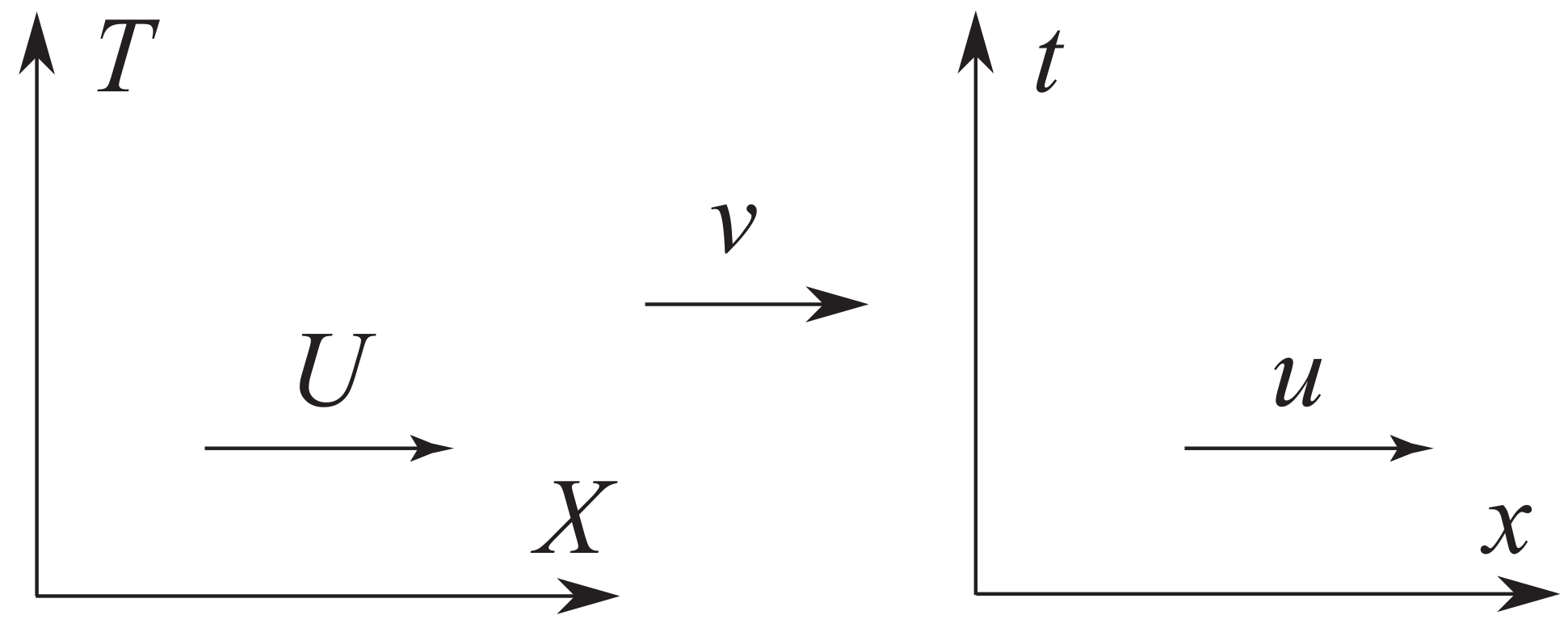
The notion of invariance with respect to frames moving with constant relative velocity underlies special relativistic mechanics, and in particular those transformations of space and time leaving the wave equation unchanged, and are referred to as Lorentz transformations. We consider a rectangular Cartesian frame
and another frame
moving with constant velocity
v relative to the first frame, and the motion is assumed to be in the aligned
X and
x directions, as indicated in
Figure 1. We view the relative velocity
v as a parameter measuring the departure of the current frame
from the rest frame
, and for this purpose, we adopt a notation employing the lower case for variables associated with the moving
frame and the upper case or capitals for those variables associated with the rest
frame. Accordingly, time is measured from the
frame with the variable
T and from the
frame with the variable
t. Following normal practice, we assume that
and
, so that
and
are the variables of principal interest.
For
, the standard Lorentz transformations are
with the inverse and identity transformations characterised by
and
, respectively. Derivations of these equations can be found in many standard textbooks such as Feynmann et al. [
10] and Landau and Lifshitz [
11], and other novel derivations are given by Lee and Kalotas [
12] and Levy-Leblond [
13]. We note that on using the chain rule for partial derivatives, from Equation (
1) we may obtain the differential relations
We adopt the notation
and
for the characteristic variables, and from the above equations, by direct substitution, we may readily deduce the relations
With the notation
,
and
, (
3) becomes simply
and
, so that in particular we may confirm the simple Lorentz invariance
.
The Einstein addition of velocities law is an immediate consequence of the notion of invariance under Lorentz transformations. Since the relative frame velocity
v is assumed to be constant, on taking the differentials of both equations in (
1) with velocities
and
, we obtain
and dividing the first differential by the second yields the Einstein addition-of-velocity law
Immediate consequences of (
5) are the two equivalent alternative identities
and
so that with velocity variables
defined by
Equation (
7) becomes simply the translation
, noting that within the context of special relativity,
v and therefore
are both constants. The angle
is sometimes referred to as the rapidity, and it is the angle in which the Lorentz invariance appears through a translational invariance. We have the elementary relations
and
is the Doppler shift.
The particular form of the identity (
6) may be established using (
5) in the left-hand side of (
6), and this version is fundamental to the development of special relativity in establishing the Lorentz invariance of certain quantities such as the Einstein energy expression
discussed below. The importance of the particular form (
7) is that there exist special relativity theories which apply for relative velocities greater than the speed of light, such as that proposed in [
14,
15]. This theory is complementary to the Einstein special theory of relativity that applies to relative velocities less than the speed of light. The authors in [
14,
15] derive Lorentz transformations corresponding to (
1) for superluminal relative velocities and show that Einstein’s addition-of-velocities law still applies. The two Formulae (
5) and (
6), when expressed in the form (
7), reveal that at least one of the velocities
u,
v or
U must not exceed the speed of light, and in terms of taking square roots or logarithms, all need appropriate rearrangement depending upon the particular values of the three velocities
u,
v and
U.
Here, we suppose that energy and momentum are given, respectively, by the usual expressions
and
, where
m denotes the mass given by
,
u is the velocity in the
frame and
is the rest mass, and we use
to designate the rest energy. The Lorentz invariant energy–momentum relations are given by
where
and
and where
. It is clear from the Lorentz invariant energy–momentum relations (
10) themselves that the quantity
is invariant, while explicit use of the Einstein energy–mass expression
further prescribes this quantity to be the constant
.
3. Lorentz Invariant Velocity Fields
We now determine the most general one-dimensional velocity field
that remains invariant under the Lorentz transformation (
1). Equivalently, under the Lorentz transformation (
1), we determine the velocity field
, which is such that the differential problem
transforms into
for the same function
. Since the Lorentz transformation forms a one-parameter group of transformations in the frame velocity
v, we need only expand (
1) and equate the corresponding infinitesimals for
to obtain the following first-order partial differential equation for
, thus
This partial differential arises as follows. On taking the differentials of (
1), we obtain Equation (
4), and by division there follows Einstein’s expression for velocities in Equation (
5). However, if the velocity equation
itself remains invariant under the Lorentz transformation, the implication is that the velocity equation for
enjoys the same dependence on the upper-case variables as that of
on the lower-case variables, namely,
, where the lower-case function
u is the same in both instances. From
and by expanding both sides for infinitesimal values of the velocity
v, we thus have
so that if
, then the partial differential Equation (
11) follows on reverting to the lower-case variables
.
From (
1) and the formulae in (
2) for the partial derivatives, the operator
L defined below is a Lorentz invariant operator, namely
Further, the partial differential Equation (
11) remains unchanged by the particle–wave space–time transformation
,
and
.
We comment that in a single space dimension
x with
referring to the particle and
referring to the wave, the de Broglie particle–wave duality revolves around the space–time transformation
and
so that the wave velocity
is connected to the particle velocity
through the relation
. In the
Nature article [
16] and elsewhere [
17,
18], de Broglie was first to supplement Planck’s particle energy expression
with the equation for particle momentum
to establish the dual particle–wave nature of matter for all particles and extend the principle of duality to the laws of nature, where
h is the Planck constant and
and
are the frequency and wavelength, respectively, of the associated wave, having a wave speed
. By making use of Einstein’s energy expression, the group velocity of the wave
may be shown to coincide with the particle velocity
u, giving rise to de Broglie’s idea of the wave guiding the motion of the particle [
19,
20].
The invariance of the operator
L is also apparent in terms of the characteristic coordinates
and
, since from
,
and the definition of
L, we have
and the first-order partial differential Equation (
11) becomes
and from which it is clear that the above transformations
and
ensure invariance under the Lorentz group (
1).
In terms of
defined by (
9), the partial differential Equation (
16) becomes simply
This equation may be solved using Lagrange’s characteristic method, which introduces a characteristic parameter
s through the three equations
and then the general solution is obtained by taking one integral of these equations to be an arbitrary function of a second independent integral. Thus, for example, by division of the first equation, we have
which can both be integrated to yield
and
, where
and
denote arbitrary constants. From (
19), we might deduce that the general solution of (
17) may be determined from
, where
denotes an arbitrary function, thus
.
We observe that the expression for
is entirely consistent with the Einstein addition-of-velocity law in its various forms (
5), (
6) or (
7), since under the transformations
and
, we have as required
arising from
and
.
From
and the expressions
,
,
and (
9), the velocity
u, energy
e and momentum
p can be shown to be given, respectively, by
where
. We observe that the particular structure of
e and
p in (
21) ensures
, and that
is given explicitly by
where
denotes an arbitrary function. Alternatively, the velocity
can be expressed as
where the two arbitrary functions
and
are connected by the relation
.
As a specific simple illustration, the extension of special relativity formulated by the author in [
21] assumes that the momentum
and the wave energy
both satisfy the classical wave equation
where
denotes the applied external potential. This potential is assumed to generate a conventional spatial force
and a nonconventional force in the direction of time
such that
In nonlinear continuum mechanics,
is more commonly known as the mass or energy production term. We refer the reader to [
21] for further details of this extended version of special relativity.
From the functional form for
given by the third equation in (
21), we obtain
where
and
and
are as previously defined. From the first wave equation in (
24), we find that
Evidently then, the first term involving
requires that
where
and
denote two arbitrary constants, while the second term involving
requires a similar expression for
. The only way this can happen is that either
and
or
and
, in which case we obtain from (
21) the following two distinct expressions for particle velocity, energy and momentum,
where
and
.
5. Conclusions
For a single spatial dimension
x, we have showed that the requirement for the velocity equation
to remain invariant under the Lorentz transformation (
1) implies that the velocity
satisfies the partial differential Equations (
11) or (
16) and in consequence inherits the particular functional form
, where
denotes an arbitrary function of the indicated argument. As far as the author is aware, neither the partial differential Equation (
11) nor the fact that the energy and momentum satisfy the partial differential relations (
34) have been mentioned previously in the literature. For the particular special relativistic model proposed in [
21], explicit formulae are given for the one-dimensional particle velocity, energy and momentum, which are the only expressions for the proposed model which give rise to Lorentz invariant velocities.
For particles moving in both two and three spatial dimensions, there are corresponding implications that are currently under investigation by the author, and planar Lorentz invariant velocities are examined in [
22]. For the higher spatial dimensions, the constraints appear to be less restrictive so that the outcomes are more varied and more physically interesting. For example, for planar motion, the two velocity components satisfy corresponding partial differential equations to (
11) with general solutions for the velocity components in terms of two arbitrary functions
and
. These partial differential equations admit the singular case
, such that for all arbitrary functions
, the magnitude of the particle velocity is the speed of light. This means that there are infinitely many families of paths with particles moving at the speed of light. In addition, there are associated partial differential relations connecting energy and momentum corresponding to (
34), and these partial differential relations are fully compatible with the planar Lorentz invariant energy–momentum relations and appear not to have been given previously in the literature.