Abstract
With the development of Internet technology, information security and data protection have become particularly important. Reversible data hiding is an effective technique for data integrity and privacy protection, and secret image sharing is a distinct research field within reversible data hiding. Due to the ability of sharing secret information between two receivers and the larger embedding capacity compared to the traditional reversible data hiding scheme, dual digital images have also attracted extensive research in the past decade. In this paper, we propose a reversible data hiding scheme based on matrix coding using dual digital images. By modifying the bits in the pixels, we can conceal three bits of the secret message in two pixels. In other words, the embedding rate reaches 1.5 bits per pixel (bpp). The experimental results demonstrate that our method has a significantly larger embedding capacity of 786,432 bits compared to previous similar methods while still maintaining acceptable image quality defined by a peak signal-to-noise ratio (PSNR) greater than 30 dB. The proposed scheme is suitable for applications required to pass a large amount of data but with minor security of image quality to be visually acceptable.
MSC:
68U10
1. Introduction
Since the Internet age started, the Internet has dominated our daily lives, with a tremendous amount of data and information transmitted through the Internet and world wide web every single minute. Some of the data can contain sensitive or secretive information, which requires higher levels of protection to prevent illegal hacking or misusage.
Securing of personal information or industrial knowhow has become essential; hence, scholars are encouraged to find solutions to resolve these serious problems in order to safeguard the communication channels and give users peace of mind. Data hiding (DH) [1,2] is one of the essential research areas, which provides methodologies to protect data effectively. Depending on the applications, content owners and data hiders can choose assorted schemes suitable for their requirements. Some receivers may only need to extract secret messages; yet, others may want to fully recover the original media. Therefore, the data hiding is branched out into irreversible [3,4] and reversible [5,6] depending on whether the original media can be retrieved completely or not after data recovery. Because the full reversibility of the original media offers wider applicability, studies of reversible data hiding (RDH) [7,8,9,10,11,12] have become more popular in the recent decades.
Digital images are commonly used media for scientists to exercise and verify their concepts and approaches. Secret image sharing (SIS) technology was proved to be a proficient way to protect private images by generating multiple shares called image shadows. The idea of secret image sharing derived from secret sharing was proposed by Shamir back in 1979 [13]. The secret was shared and recovered by employing Lagrange interpolation. Yan et al. realized an SIS scheme based on the Chinese remainder theorem (CRT) [14] later on. With a twist of the SIS technique, a special edition of RDH using dual images was proposed by Chang et al. in 2007 [15]. Dual-image methods generate two stego images, which increase the safety of the secret data, visual image quality, and embedding capacity. Unless both stego images can be obtained simultaneously, the extraction of the secret data cannot be completed. Because dual image schemes can offer stronger safekeeping and recovery abilities, there is higher demand to discover innovative or improved solutions [16,17,18,19,20] to achieve either better visual quality of stego images or higher embedding capacity. Our novel scheme emphasizes enhancing the embedding capacity but with satisfactory image quality. The experimental results assured us that the embedding rates reached 1.5 bits per pixel (bpp). The contributions of this particular study are:
- The embedding capacity is significantly larger, which can be up to 786,432 bits.
- It is a suitable solution for applications requiring high embedding capacity but that can scarify the image quality to be visually acceptable.
- Both the process of embedding and the process of extraction are simple and have a satisfiable execution time. The shadow construction phase took 0.5242 s, while the secret message extraction and the image reconstruction phase took 0.9158 s.
In Section 2, we describe the fundamental concept of a matrix coding method to be utilized in the scheme. The details of data embedding and extraction are explained in Section 3, and the related experiments and analysis are presented in Section 4. At the end of the study, we summarize the findings and the potential future improvement in Section 5.
2. Related Work
In this section, we would like to refresh the principle of a matrix coding method [21], which was initially proposed by Chang et al. in 2008.
The matrix coding method adopts a parity check matrix as shown in Equation (1). Suppose we have a 7-dimensional cover vector and a secret message . According to Equation (2), we can calculate the . Then, we match the calculated syndrome in Table 1 to obtain the corresponding coset leader . Finally, we can calculate the stego vector through Equation (3). To summarize the above process, simply put, the stego vector changes one bit in according to the coset leader associated with the syndrome. In this way, the data embedding process is completed. The extraction process is simpler. According to Equation (4), the secret message can be easily extracted.
Table 1.
The cosets of the matrix coding with the parity check matrix .
Through the matrix coding method, we can modify only one bit in the vector to effectively embed three secret bits. This remarkable efficiency not only ensures minimal impact on the original data but also provides a high level of security in concealing sensitive information.
3. Proposed Scheme
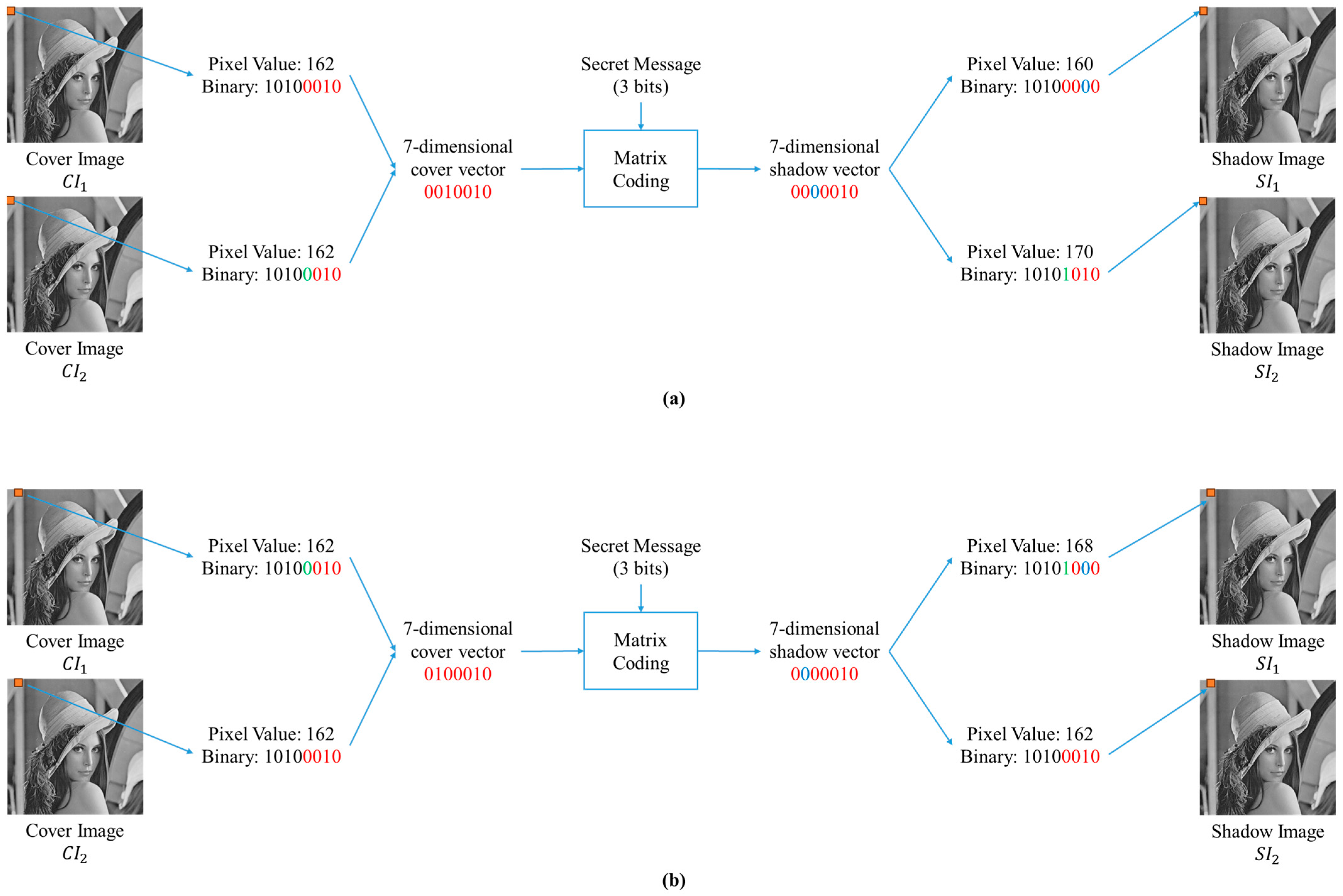
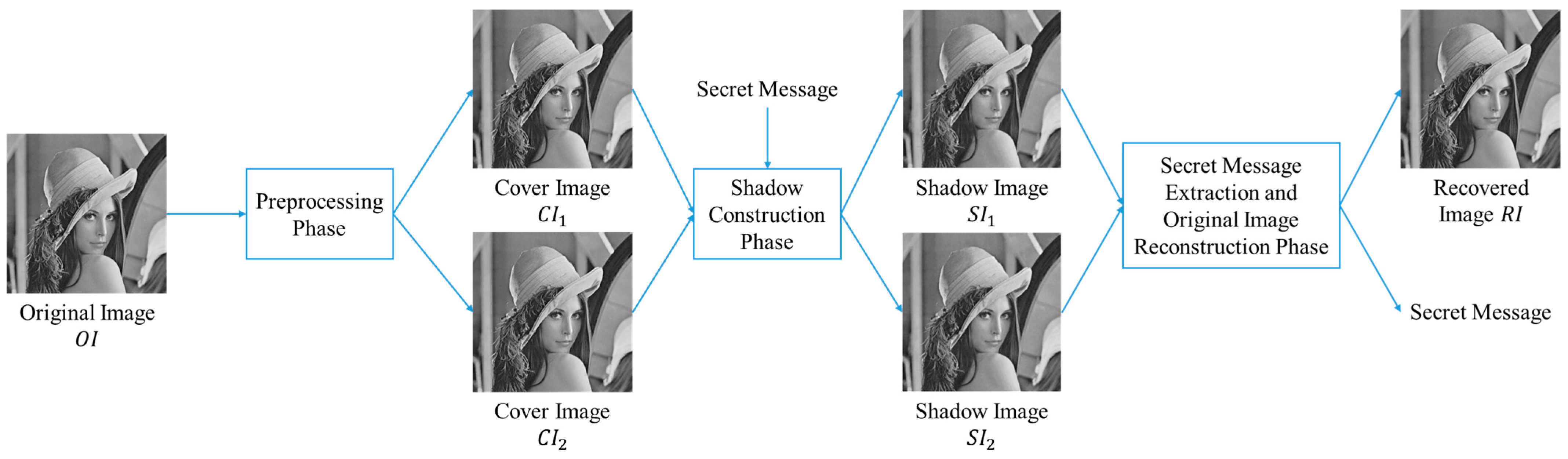
The dual image technique is employed for the novel scheme. The shadow construction phase is described in Section 3.1, and the secret message extraction and original image reconstruction phase are detailed in Section 3.2. Two covered images and are duplicates from the original image with size A secret message is embedded to covered images , to create shadow images and . The shadow images are sent to designated receivers. When both shadow images appear at the same time, both the recovered secret message and the recovered image can be extracted. The scheme process is illustrated in Figure 1.
Figure 1.
Process of the proposed scheme.
To better understand the process, we show two examples in Figure 2 exercising the whole flow. In Figure 2a, the pixel values of the current pixel pair are converted to their binary format (10100010)2 from 162 first, four LSBs (0010)2 are extracted from the cover pixel of the cover image and three LSBs (010)2 are extracted from the cover pixel of the cover image to form a 7-dimensional cover vector (0010010). There are three secret bits that can be embedded into the cover vector to create a 7-dimentional shadow vector (0000010) using the matrix coding technique. We split the shadow vector into four bits (0000) and three bits (010) and replace the corresponding pixels: four LSBs in the shadow pixel of the shadow image and three LSBs in the shadow pixel of the shadow image . A recovery bit is the fourth LSB in the shadow pixel of the shadow image , which records the original bit value of the bit altered during data embedding. By bitwise comparison of two shadow pixels, we can recover the original pixel value with the help of the recovery bit. The pixel value (10100000)2 in the shadow image is 160, and the pixel value (10101010)2 in the shadow image is 170 after the decimal format conversion.
Figure 2.
Examples of the proposed flow: (a) the odd pixel count, (b) the even pixel count.
Figure 2b shows an example similar to Figure 2a, except it is a case when the current pixel count is even. The 7-dimensional cover vertex is composed of three LSBs from the cover pixel of the cover image and four LSBs from the cover pixel of the cover image . After the shadow vertex is generated, the split is three bits for the shadow pixel of the shadow image and four bits for the shadow pixel of the image . The recovery bit becomes the fourth LSB in the shadow pixel of the shadow image . The exchanging of the bit-split patterns based on odd or even pixel count is to minimize the visual distortion of the shadow images and to keep a balanced visual quality of the two shadows.
3.1. Shadow Construction Phase
To embed a secret message, we move through a shadow construction phase to generate two shadow images using the matrix code method described in Section 2.
In order to meet the requirement of being reversible, we use a pixel pair, one from cover image and the corresponding pixel from , where is the total number of pixels in images. , where ∈{0, 1}, and is the length of secret bits. When a cover pixel pair = the two pixel values for the pair are converted into binary format and represented as and . A 7-dimensional cover vector is then constructed by using the least significant bits (LSBs) in these two cover pixels according to Equation (5).
where is the index of the current pixel, and The can also be treated as the current pixel count . Therefore, is the same as . Algorithm 1 describes the construction of shadow images and step by step.
| Algorithm 1. Shadow Construction | |
| Input | An original image and a secret message . |
| Output | Shadow images , . |
| Step 1 | Duplicate the original image and create two cover images , |
| Step 2 | Set the initial secret bit count |
| Step 3 | FOR each |
| Step 3a | Obtain three secret bits |
| Step 3b | Select current cover pixel pair = where pixel from the cover image and pixel from the cover image |
| Step 3c | Convert pixel values and to binary. |
| Step 3d | Construct the 7-dimensional cover vector using Equation (5). |
| Step 3e | Calculate the and obtain the shadow vector using Equations (2) and (3). |
| Step 3f | Let and |
| Step 3g | Set the recovery bit to store the original bit value for recovery as below, IF ELSE WHILE IF BREAK END END END |
| Step 3h | Set shadow pixel pair = where is the current pixel in shadow images and is the current pixel in shadow images according to IF is odd ( ( ELSE = ( = ( END |
| END | |
| Step 4 | Export shadow images , . |
3.2. Secret Message Extraction and Original Image Reconstruction Phase
The secret extraction and recovery of the original image is simple and straight forward, which can save computation time. After having both of the shadow images, a shadow vector can be constructed using Equation (5). Secret bits can be extracted from the shadow vector by looking up Table 1 directly. The shadow vector is the coset value in the matrix coding table to obtain the corresponding syndrome, which is the desired three secret bits to be extracted. By using the value of the recovery bit, the shadow vector is converted back to the original vector (or it can be called a recovered vector). The original vector (or recovered vector) is split into two sets of bits and restores the LSBs of the pixel back to the original image (or the recovered image). To clarify the process of extraction and recovery, Algorithm 2 explains the steps in detail.
| Algorithm 2. Secret Message Extraction and Original Image Reconstruction | |
| Input | Dual shadow images , . |
| Output | Recovered image , and recovered secret message . |
| Step 1 | Duplicate to . |
| Step 2 | Set the initial secret bit count . |
| Step 3 | FOR each |
| Set | |
| Step 3a | Set the current shadow pixel pair = where is the current pixel in the shadow image and is the current pixel in the shadow images . |
| Step 3b | Convert pixel values and to binary and let = and = . |
| Step 3c | Construct the shadow vector = using Equation (5) and use it as the coset leader. |
| Step 3d | Extract three secret bits based on the coset leader in Table 1 and append them to recovered secret message . |
| Step 3e | |
| Step 3f | Obtain the original bit value IF is odd ELSE END |
| Step 3g | Let = ( |
| Step 3h | Set the altered bit value back to its original value by the following: WHILE IF BREAK END END IF END |
| END | |
| Step 4 | Export recovered images and recovered secret message . |
3.3. Processing Flow Examples
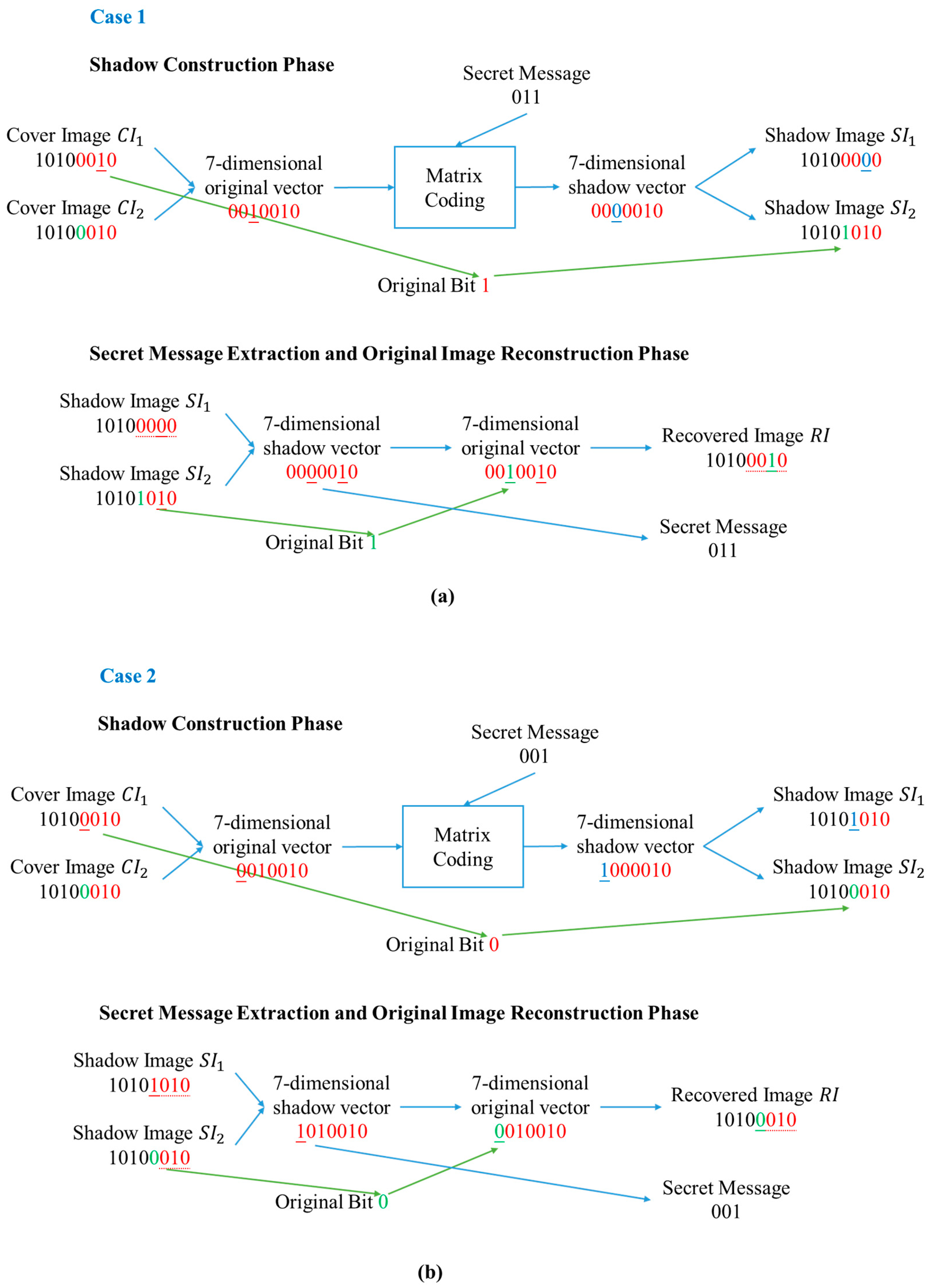
Figure 3 shows the embedding, extraction, and recovery procedures using two examples. The flow examples (a) and (b) first illustrate how bits are extracted from two cover images, how an original vector is formed, and how shadow images are set based on intermediate-created shadow vector after secret embedding using matrix coding. Then, they show how a shadow vector is formed from shadow images to recover hidden secrets and show the recovered vector and the recovered image by replacing the altered bit value with the recovery bit value as well.
Figure 3.
Examples for embedding, extraction, and recovery: (a) the odd pixel count, (b) the even pixel count.
Let us take the example (a), which is the case of dealing with an odd number of pixels. During the shadow construction phase, the two cover pixels are (10100010)2. A 7-dimensional cover vector (0010010)2 is formed by four LSBs of a pixel from the cover image 1 and three LSBs of a pixel from the cover image 2. Assume the secret bits are (011)2, and through lookup Table 1, the syndrome (0010000)2 is the coset leader corresponding to the secret bits (011)2 according to Equation (2). Perform XOR calculation with the original vector, and a 7-dimensional shadow vector (0000010)2 is generated and split to update the four LSBs in the shadow pixel 1 and the three LSBs in the shadow pixel 2. The fourth bit from the left of the shadow pixel 2 is the recovery bit, which records the original bit value (1) for the second bit from the left of the cover pixel 1. In the secret message extraction and the image reconstruction phase, a shadow vector is formed by the two pixels of two shadow images the same way we formed the cover vector from two pixels of two cover images. We can then extract the secret bits (011)2 by using Table 1 directly. As for recovery of the original image, we can convert the shadow vector back to the original vector using the saved recovery bit value and update the four LSBs with any one of the shadow pixels to recover the original pixel, which can also be called a recovered pixel. Figure 3b moves through the same process with an example dealing with an even number of pixels.
4. Experimental Results
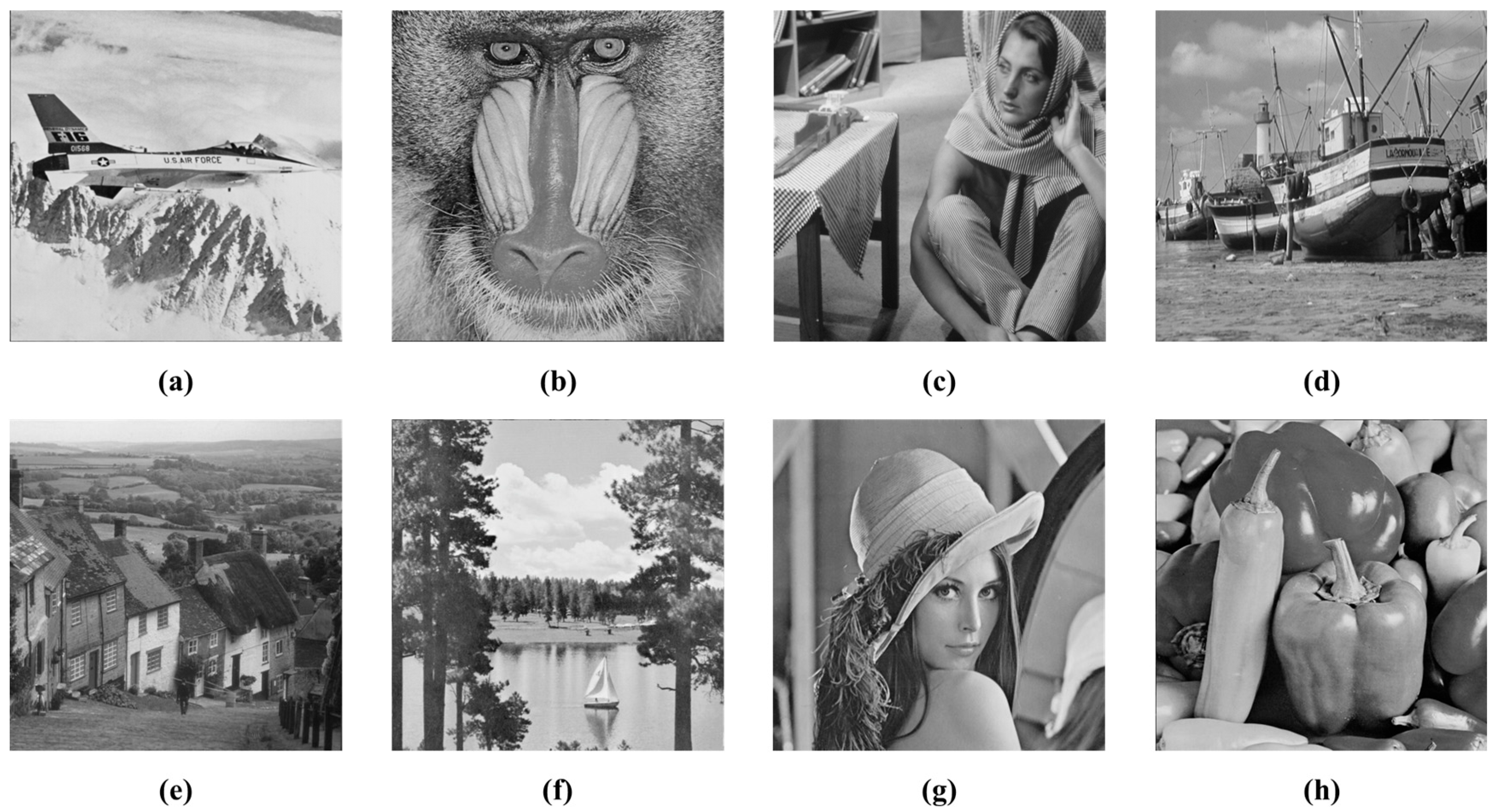
In this section, we evaluate the performance of our proposed matrix coding using a dual digital images scheme. As depicted in Figure 4, we selected eight standard gray images for our experiments. Our experiments were conducted on a laptop running the Windows 10 operating system with MATLAB R2023b. The laptop is equipped with a 3.20 GHz AMD Ryzen 7 CPU and 16 GB of RAM. We also compared the experimental results with other advanced reversible data hiding schemes based on dual images and our scheme demonstrated a significant advantage in embedding capacity (EC).
Figure 4.
Eight 512 × 512 test images: (a) airplane, (b) baboon, (c) Barbara, (d) boat, (e) Goldhill, (f) lake, (g) Lena, (h) peppers.
The Peak Signal-to-Noise Ratio (PSNR) and the Structural Similarity Index (SSIM) are widely used as visual quality indicators for evaluating the performance of data hiding. The PSNR is employed to assess the difference in visual quality between two images and is calculated using Equations (6) and (7). In Equation (7), and represent the size of the image, while and represent individual pixels. In this context, represents the original image, and represents the shadow image. A smaller Mean Square Error (MSE) corresponds to less distortion in the image, indicating higher quality in the constructed image. Conversely, because the PSNR and MSE are inversely proportional, a higher PSNR value reflects the same conclusion.
The SSIM is an indicator that quantifies the similarity between two images. It is primarily used to assess the similarity and dissimilarity between two images, denoted as and . As shown in Equation (8), the SSIM algorithm separately compares the luminance, contrast, and structure of two images and then combines them using weighted products. In this equation, and represent the mean luminance, and denote the standard deviation of the luminance, represents the covariance of and , and is a constant used to maintain stability. The closer the SSIM is to 1, the higher the similarity between the two images.
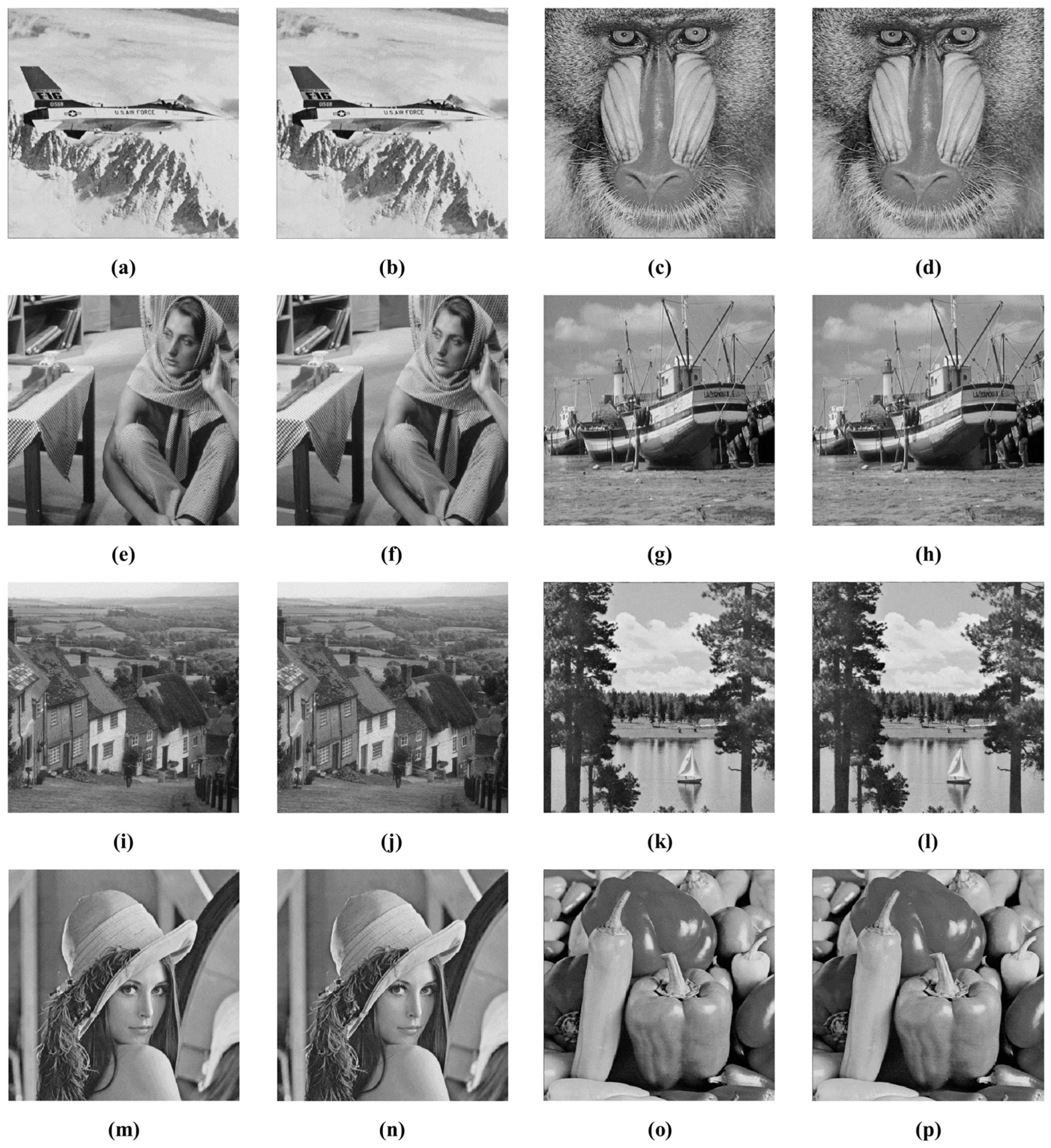
Figure 5 illustrates the shadow image constructed by our innovative matrix coding scheme. Clearly, the disparity between the constructed shadow image and the original image is minimal. It is challenging for us to discern any perceptible distortion with the naked eye, underscoring the superior visual quality achieved by our scheme. Table 2 illustrates the results obtained using our proposed matrix coding scheme to construct shadow 1 and shadow 2 from test images. It calculates the PSNR and SSIM values between these shadow images and the original image, as well as their average values. The average PSNR is approximately 36.34 dB, which is generally considered challenging to distinguish with the naked eye when it exceeds 30; these data support our conclusion. Furthermore, the average SSIM value is remarkably high at 0.9227, approaching 1. This indicates that the shadows constructed by our proposed scheme closely resemble the original images, confirming their excellent visual quality. These outstanding results substantiate the effectiveness of our solution and demonstrate its superiority in preserving image fidelity.
Figure 5.
Shadow images of eight test images, with shadow 1 on the left and shadow 2 on the right: (a,b) airplane, (c,d) baboon, (e,f) Barbara, (g,h) boat, (i,j) Goldhill, (k,l) lake, (m,n) Lena, (o,p) peppers.
Table 2.
Proposed scheme for PSNR and SSIM on different images.
Table 3 presents a comparison of the performance indicators between our scheme and other schemes based on reversible data hiding using dual images. Our primary focus is on the EC and PSNR. The embedding rate is expressed in bits per pixel (bpp), calculated as shown in Equation (9), where and represent the image dimensions. The embedding capacity is divided by all pixels to signify how many bits can be embedded in each pixel. The experimental results demonstrate that the embedding capacity of our proposed scheme reaches 786,432 bits, which is equivalent to 1.5 bpp calculated as using Equation (9). The EC of the novel scheme significantly exceeds that of other schemes. When compared to a scheme with the largest embedding capacity, ours is nearly 50% higher than the one with 557,339 bits. Even with our PSNR above 36 dB, it can be still lower than that of other solutions. However, this is consistent with the laws of nature. A larger embedding capacity inherently entails more modifications, resulting in greater distortion. However, our PSNR remains above 30, meeting the criteria for high visual quality. It is challenging for the naked eye to discern any distortion, making this trade-off acceptable in light of the significantly increased embedding capacity.
Table 3.
Comparison of the maximum EC, bpp, and PSNR values with other reversible data hiding scheme based on dual images.
Table 4 shows the execution time of our proposed scheme in the secret message extraction and original image reconstruction phase. It is evident that the execution time is consistently within 1 s at every stage demonstrating the great performance of our scheme.
Table 4.
The execution time of our proposed scheme.
5. Conclusions
In this paper, we propose a reversible data hiding scheme with a high embedding capacity using matrix coding based on dual images. Our solution only requires modifying or not modifying one bit, enabling us to conceal three bits of a secret message in two pixels. The experimental results demonstrate that this solution significantly increases the embedding capacity when compared to other similar methods, allowing for up to 786,432 bits, which is equivalent to 1.5 bpp, all while maintaining a high level of visual quality. This illustrates the superiority and applicability of our scheme.
Applications that require dual sharing of information between two and only two receivers, such as a couple who share secret arrangements, to recover the original media can consider utilizing our scheme. In the future, we will investigate different types of matrix coding to improve the embedding capacity or to improve the visual quality.
Author Contributions
Conceptualization, J.-C.L., Y.L. and C.-C.C. (Chin-Chen Chang); methodology, J.-C.L., Y.L. and C.-C.C. (Chin-Chen Chang); software, Y.L.; validation, Y.L.; writing—original draft preparation, J.-C.L. and Y.L.; writing—review and editing, J.-C.L., Y.L., C.-C.C. (Chin-Chen Chang), J.-H.H. and C.-C.C. (Ching-Chun Chang). All authors have read and agreed to the published version of the manuscript.
Funding
This research received no external funding.
Data Availability Statement
Data are contained within the article.
Conflicts of Interest
The authors declare no conflicts of interest.
References
- Kumar, R.; Chand, S. A new image steganography technique based on similarity in secret message. In Proceedings of the Confluence 2013: The Next Generation Information Technology Summit (4th International Conference), Noida, India, 26–27 September 2013; IET: Stevenage, Hertfordshire, UK, 2013; pp. 376–379. [Google Scholar] [CrossRef]
- Sahu, A.K.; Swain, G. An optimal information hiding approach based on pixel value differencing and modulus function. Wirel. Pers. Commun. 2019, 108, 159–174. [Google Scholar] [CrossRef]
- Bender, W.; Gruhl, D.; Morimoto, N.; Lu, A. Techniques for data hiding. IBM Syst. J. 1996, 35, 313–336. [Google Scholar] [CrossRef]
- Moulin, P.; O’Sullivan, J.A. Information-theoretic analysis of information hiding. IEEE Trans. Inf. Theory 2003, 49, 563–593. [Google Scholar] [CrossRef]
- Celik, M.U.; Sharma, G.; Tekalp, A.M.; Saber, E. Lossless generalized-LSB data embedding. IEEE Trans. Image Process. 2005, 14, 253–266. [Google Scholar] [CrossRef] [PubMed]
- Zhang, W.; Hu, X.; Li, X.; Yu, N. Recursive histogram modification: Establishing equivalency between reversible data hiding and lossless data compression. IEEE Trans. Image Process. 2013, 22, 2775–2785. [Google Scholar] [CrossRef]
- Lin, C.C.; Liu, X.L.; Tai, W.L.; Yuan, S.M. A novel reversible data hiding scheme based on AMBTC compression technique. Multimed. Tools Appl. 2015, 74, 3823–3842. [Google Scholar] [CrossRef]
- Sun, W.; Lu, Z.M.; Wen, Y.C.; Yu, F.X.; Shen, R.J. High performance reversible data hiding for block truncation coding compressed images. Signal Image Video Process. 2013, 7, 297–306. [Google Scholar] [CrossRef]
- Chen, K.M. High capacity reversible data hiding based on the compression of pixel differences. Mathematics 2020, 8, 1435. [Google Scholar] [CrossRef]
- Rai, A.K.; Kumar, N.; Kumar, R.; Om, H.; Chand, S.; Jung, K.H. Intra-block correlation based reversible data hiding in encrypted images using parametric binary tree labeling. Symmetry 2021, 13, 1072. [Google Scholar] [CrossRef]
- Mittal, S.; Goyal, S.; Aggarwal, S.; Kumar, R. Interpolative AMBTC based reversible data hiding in encrypted images using rhombus mean. In Proceedings of the 2023 International Conference on Device Intelligence, Computing and Communication Technologies (DICCT), Dehradun, India, 17–18 March 2023; IEEE: Piscataway, NJ, USA, 2023; pp. 451–456. [Google Scholar] [CrossRef]
- Kumar, R.; Sharma, D.; Dua, A.; Jung, K.H. A review of different prediction methods for reversible data hiding. J. Inf. Secur. Appl. 2023, 78, 103572. [Google Scholar] [CrossRef]
- Shamir, A. How to share a secret. Commun. ACM 1979, 22, 612–613. [Google Scholar] [CrossRef]
- Yan, W.; Ding, W.; Dongxu, Q. Image sharing based on Chinese remainder theorem. J. North China Univ. Technol. 2000, 12, 6–9. [Google Scholar]
- Chang, C.C.; Kieu, T.D.; Chou, Y.C. Reversible data hiding scheme using two steganographic images. In Proceedings of the TENCON 2007—2007 IEEE Region 10 Conference, Taipei, Taiwan, 30 October–2 November 2007; IEEE: Piscataway, NJ, USA, 2007; pp. 1–4. [Google Scholar] [CrossRef]
- Qin, C.; Chang, C.C.; Hsu, T.J. Reversible data hiding scheme based on exploiting modification direction with two steganographic images. Multimed. Tools Appl. 2015, 74, 5861–5872. [Google Scholar] [CrossRef]
- Lu, T.C.; Tseng, C.Y.; Wu, J.H. Dual imaging-based reversible hiding technique using LSB matching. Signal Process. 2015, 108, 77–89. [Google Scholar] [CrossRef]
- Huang, C.T.; Weng, C.Y.; Shongwe, N.S. Capacity-Raising Reversible Data Hiding Using Empirical Plus–Minus One in Dual Images. Mathematics 2023, 11, 1764. [Google Scholar] [CrossRef]
- Jana, B.; Giri, D.; Kumar Mondal, S. Dual image based reversible data hiding scheme using (7, 4) hamming code. Multimed. Tools Appl. 2018, 77, 763–785. [Google Scholar] [CrossRef]
- Kim, C.; Yang, C.N.; Zhou, Z.; Jung, K.H. Dual efficient reversible data hiding using Hamming code and OPAP. J. Inf. Secur. Appl. 2023, 76, 103544. [Google Scholar] [CrossRef]
- Chang, C.C.; Kieu, T.D.; Chou, Y.C. A high payload steganographic scheme based on (7, 4) hamming code for digital images. In Proceedings of the 2008 International Symposium on Electronic Commerce and Security, Guangzhou, China, 3–5 August 2008; IEEE: Piscataway, NJ, USA, 2008; pp. 16–21. [Google Scholar] [CrossRef]
Disclaimer/Publisher’s Note: The statements, opinions and data contained in all publications are solely those of the individual author(s) and contributor(s) and not of MDPI and/or the editor(s). MDPI and/or the editor(s) disclaim responsibility for any injury to people or property resulting from any ideas, methods, instructions or products referred to in the content. |
© 2023 by the authors. Licensee MDPI, Basel, Switzerland. This article is an open access article distributed under the terms and conditions of the Creative Commons Attribution (CC BY) license (https://creativecommons.org/licenses/by/4.0/).