1. Introduction
In 1988 [
1], Chua and Yang introduced the concept of cellular neural networks (CNNs), which are arrays of dynamical systems. The authors used CNNs for image processing problems and solving partial differential equations [
2]. These publications sparked widespread interest in CNNs among researchers, and since then, many new applications of CNNs have been introduced.
A class of CNNs, shunting inhibitory cellular neural networks (SICNNs), was proposed by Bouzerdoum and Pinter in 1993 [
3]. They are biologically inspired networks in which the synaptic interactions among neurons are mediated via a nonlinear mechanism called shunting inhibition. In the Ref. [
4], the application of SICNNs for medical diagnosis, which is based on some given symptoms and initial data, was shown. SICNNs are very useful for image processing since they can provide contrast and edge enhancement. The SICNNs algorithm allows to achieve a balance between enhancing the dark region, and at the same time retaining the colours in the bright [
5,
6]. The neural networks have been widely applied in various fields such as psychophysics, robotics, perception, and adaptive pattern recognition [
7,
8,
9]. The variable and continuous-time excitatory inputs guarantee rich dynamics for SICNNs, as well as for shunting inhibitory artificial neural networks [
4,
5]. Exceptionally, if they are chaotic, the case will be under investigation of the present research.
It is known that dynamics of the neural networks is very complex, and play an important role in applications. Thus, many studies have been devoted to the study of SICNNs. In particular, the existence and stability of periodic [
10,
11], anti-periodic [
12,
13,
14], almost periodic [
15,
16,
17] and pseudo-periodic solutions [
18,
19] have been investigated.
In its original formulation [
3], the model of SICNNs is as follows. Consider a two-dimensional grid of cells, and denote by
the cell at the
position of the mesh. In SICNNs, neighboring cells exert shunting-type mutual inhibitory interactions. The following differential equation describes the dynamics of the cell
where
is the activity of the cell
is the passive decay rate of the cell activity;
is the connection of postsynaptic activity of the cell
transmitted to the cell
is the activation function;
is the external input to cell
and the
r-neighborhood
of
is
with fixed natural numbers
m and
Currently, only a few studies have investigated the Poisson stable and unpredictable motions of shunting-type cellular neural networks. For instance, the dynamics of the SICNNs (
1), where the inputs
are unpredictable, was investigated in [
20]. Unpredictable oscillations of SICNNs with delay,
were considered in the Ref. [
21]. In system (
2), inputs
are piecewise constant functions, which have not been approved for unpredictability, while in our research they are continuous unpredictable functions obtained through the compartmental algorithm.
In the Ref. [
22], the following symmetrical impulsive SICNNs with a generalized piecewise constant argument,
was considered, and sufficient conditions for the existence and uniqueness of Poisson stable solutions were obtained.
The following neural model is in the focus of our study,
where the coefficients
are continuous periodic functions; the components
connection weights
and inputs
are compartmental periodic unpredictable functions; the activation function
is continuous.
The dynamics of SICNNs (
4), where the functions
are periodic,
are Poisson stable, and connection weights
are constants, were investigated in the Ref. [
23]. This time, all coefficients are time-varying functions, and have a more complex structure that combines periodicity and unpredictability. The Poisson stable and unpredictable solutions of the neural network (
4) are under investigation.
It is indisputable that any theory of functions with applications should be accompanied by a number of methods of construction as well as numerical presentations of the functions. They can be simple algebraic operations, Fourier series and results of theory of operators. The methods of construction as well as numerical analysis of the unpredictable solutions are also on the agenda. A novel way to determine unpredictable functions is suggested, which is rooted at the compartmental paradigm. We start with functions of two variables, which are unpredictable in one of them, and in another are periodic. The domains of the functions are narrowed to diagonals of the argument spaces. The method of diagonals is known for quasi-periodic functions or almost periodic functions [
24,
25]. In the present study, the diagonalization is made on an essentially new level, since dependence on the two variables is significantly different. This is why it is of large interest to look for conditions such that functions on diagonals admit the unpredictability.
Despite many papers on almost periodic and Poisson stable functions, there are no numerical examples, neither for the functions nor solutions, if they are not quasi-periodic. However, the needs of the industry and particularly neuroscience and other modern areas demand numerical presentation of dynamics to support theories. Our study meets the challenges, since we construct several Poisson stable and unpredictable functions numerically, utilizing the merits of the logistic equation. One can emphasise that even for Poisson stable functions, which have been researched for about a century, the concrete samples of functions appeared for the first time in our papers [
26,
27]. The numerical experiments are advantageous, since they are accompanied by newly developed strong instruments of the functions simulations. They are convenient for synchronization of chaos.
Delta synchronization has been introduced, which works for gas discharge-semiconductor systems [
28,
29], where even the generalized synchronization [
30] is not effective. A numerical test for the unpredictable dynamics was suggested in the Ref. [
31], and strange attractors were discovered [
32]. Moreover, we constructed algorithms which allow to see the contribution of periodicity and the unpredictability for the compartmental dynamics [
33]. They are based on the concept of the degree of periodicity. It was learnt that very similar time series can be seen in industrial experiments [
34,
35,
36,
37,
38], and this is a strong argument for the application of our results. We believe that the study of the compartmental functions will shed more light on the problem of the transition from quasi-periodicity to chaos [
39,
40].
The rest of the paper is organized as follows. In
Section 2, the basic and novel definitions are presented. Special relations between periodicity and unpredictability in compartmental arguments are determined to establish the unpredictability of compartmental functions. They are formulated in terms of time sequences. The lemma on the existence of an equivalent integral equation is provided as a key technical step in the analysis. The conditions for neural networks that are sufficient to obtain the results of the article are announced.
Section 3 contains the main results of our study. Using the method of included intervals [
26,
27] and a contraction mapping principle, it is strictly proved that the Poisson stable and unpredictable motions, which are exponentially stable, are present in the dynamics of the SICNNs (
4). In
Section 4, discontinuous and continuous unpredictable functions are defined through the solution of the logistic map. A parameter, the degree of periodicity, which strongly affects the behaviour of the neural network is introduced. Numerical examples with illustrations confirming the feasibility of theoretical results are given. Finally, prospects of the obtained results for chaos control and synchronization in neural networks are discussed in
Section 5.
2. Preliminaries
The definitions of the Poisson stable and unpredictable function are as follows.
Definition 1 ([
41]).
A bounded function is called Poisson stable if there exists a sequence as such that the sequence of functions converges to uniformly on each bounded interval of Definition 2 ([
42]).
A bounded function is said to be unpredictable if there exist positive numbers and sequences as such that uniformly on compact subsets of and for each and . The sequence is called the convergence sequence in Definitions 1, 2, and correspondingly, we shall say about the convergence property, while the existence of positive numbers and sequence is said to be the separation property.
It is easily seen, reading the last two definitions, that all unpredictable functions make a subset of Poisson stable functions specified with an additional property of separation. It was proved in our studies [
42] that the property guarantees chaotic dynamics of the unpredictable motion. Loosely speaking, one can say that an unpredictable function is a Poisson stable function with assigned chaotic behaviour.
Definition 3 ([
33]).
A function is called a compartmental periodic unpredictable function, if where is a bounded continuous function, periodic in u uniformly with respect to and unpredictable in v uniformly with respect to that is, there exist positive numbers , δ and sequences as such that for all uniformly on bounded intervals of and for and . Remark 1. To say that function in the last definition is a compartmental periodic unpredictable function does not mean that it is unpredictable in the sense of Definition 2. The question of whether the function on the diagonal is unpredictable will be answered under the conditions of Lemma 1.
Let us consider the convergence sequence and a fixed positive number One can write that where There exists a subsequence which tends to a real number Consequently, one can find a subsequence such that as The number is called a Poisson shift for the convergence sequence Denote by the set of all Poisson shifts. The number is said to be the Poisson number for We say that the convergence sequence satisfies kappa property with respect to the if
The following lemma is a main auxiliary result of the paper.
Lemma 1. Let a bounded function is periodic in The function is unpredictable if the following conditions are valid:
- (i)
For each there exists a positive number η such that if
There exist positive numbers and sequences both of which diverges to infinity as such that
- (ii)
The sequence satisfies kappa property with respect to the
- (iii)
uniformly on each bounded interval of
- (iv)
Proof. Let us fix a bounded interval
and a positive number
By assumption
one can write, without loss of generality, that
as
Therefore, conditions
and
imply that the following inequalities are valid:
and
for sufficiently large
Using inequalities (
5) and (
6), we obtain that
for all
That is,
converges to
on each arbitrary bounded time interval uniformly, and the function
satisfies the convergence property.
Conditions
and
imply that
for sufficiently large
Applying assumption
one can obtain that
for all
Thus, the separation property is valid. The lemma is proved. □
Remark 2. If the conditions of Lemma 1 are valid, then function admits properties of Definition 3. This is why the lemma provides conditions for unpredictability of a compartmental periodic function.
Using the theory of differential equations [
43], one can verify that the following lemma is true.
Lemma 2. In order for a bounded on function to be a solution of (4), it is necessary and sufficient that it satisfies the integral equationfor all Throughout the paper, we will use the norm where is the absolute value. In what follows, we consider the activation function f in the domain where H is a fixed positive number.
Suppose that is a set of functions with the norm such that all are Poisson stable with a common convergence sequence and
Define on
the operator
T as
where
The following assumptions are needed for system (
4):
- (C1)
functions are -periodic, and
- (C2)
functions and are compartmental periodic unpredictable such that where the functions and are periodic in u uniformly with respect to and unpredictable in v with common sequences uniformly with respect to
- (C3)
convergence sequence satisfies the kappa property;
- (C4)
where is a positive number;
- (C5)
there exists a constant such that if
Condition (C1) implies that there exist constants
and
which satisfy
for all
For the sake of simplicity, the following notations will be used.
for each
We assume that the following conditions are satisfied.
- (C6)
- (C7)
4. Degree of Periodicity and Numerical Simulations
This part of the article emphasises application significance of the theoretical achievements in the
Section 3. Unpredictable continuous and discontinuous functions are constructively determined through discrete Poisson stable and unpredictable motions of the logistic equation. A special technical characteristic, the degree of periodicity, is introduced, which allows to estimate contributions of periodic and unpredictable arguments to the behaviour of the neural network. This can be useful for analysis of experimental data in industries [
34,
35,
36,
37,
38], and this is a strong argument for the application of our results. Finally, two numerical examples with sophisticated dynamics can be seen below.
In the Ref. [
42], it was proved that the logistic map
admits an unpredictable solution
if
That is, there exist sequences
as
and a positive number
such that
tends to
for each
i in a bounded interval of integers and
for
Discontinuous unpredictable function. Consider the function
where
is an unpredictable solution of the logistic Equation (
21),
is a continuous function, and
h is a positive number. Assume that there exist positive numbers
and
such that
and
for each
Let us show that the function is unpredictable. Fix an interval of real numbers and a number such that where s is a natural number. Then for and we have that and
Denote
For a fixed positive number
and sufficiently large number
p, it is true that
Therefore, for
where
l is a fixed integer number from
to
one can obtain that
The last inequality is valid for all Consequently, if Thus, the function satisfies the convergence property.
We have that there exists a positive number and the sequence as such that for each
From
and
it follows that
Therefore,
We obtain that
for all
Thus, the function
satisfies separation property, and one can conclude that it is unpredictable with positive numbers
and sequences
Continuous unpredictable function. Using the function we construct an integral function where is a positive real number. The function is bounded on such that where
Let us discuss the unpredictability of the function
Firstly, we shall approve the convergence property. Fix an interval
and a number
Applying the
method of included intervals [
26], we will show that
uniformly on
There exist numbers
and
such that the following inequalities are valid,
and
Let
p be a large enough number, such that
on
We obtain that
for all
Thus,
as
uniformly on the interval
and the convergence property is fulfilled.
Next, we verify that the separation property is correct. Due to the unpredictability of the function we have that for Fix a natural number p and positive such that Consider two alternative cases: (i) (ii)
It is easily seen that the following relation holds
(i) From the last relation, we obtain that
for
(ii) Using the relation (
23), we obtain that
for
The inequalities (
24) and (
25) prove that the separation property is valid. Thus, the function
is unpredictable with positive numbers
and sequences
Below, we will use the continuous unpredictable function where as a component of compartmental periodic unpredictable coefficients. The number h is said to be the length of step of functions and For compartmental periodic unpredictable functions, the number is called the degree of periodicity.
Let us consider the following compartmental periodic unpredictable function
The function
is
periodic in
u uniformly with respect to
and unpredictable in
v uniformly with respect to
For the function
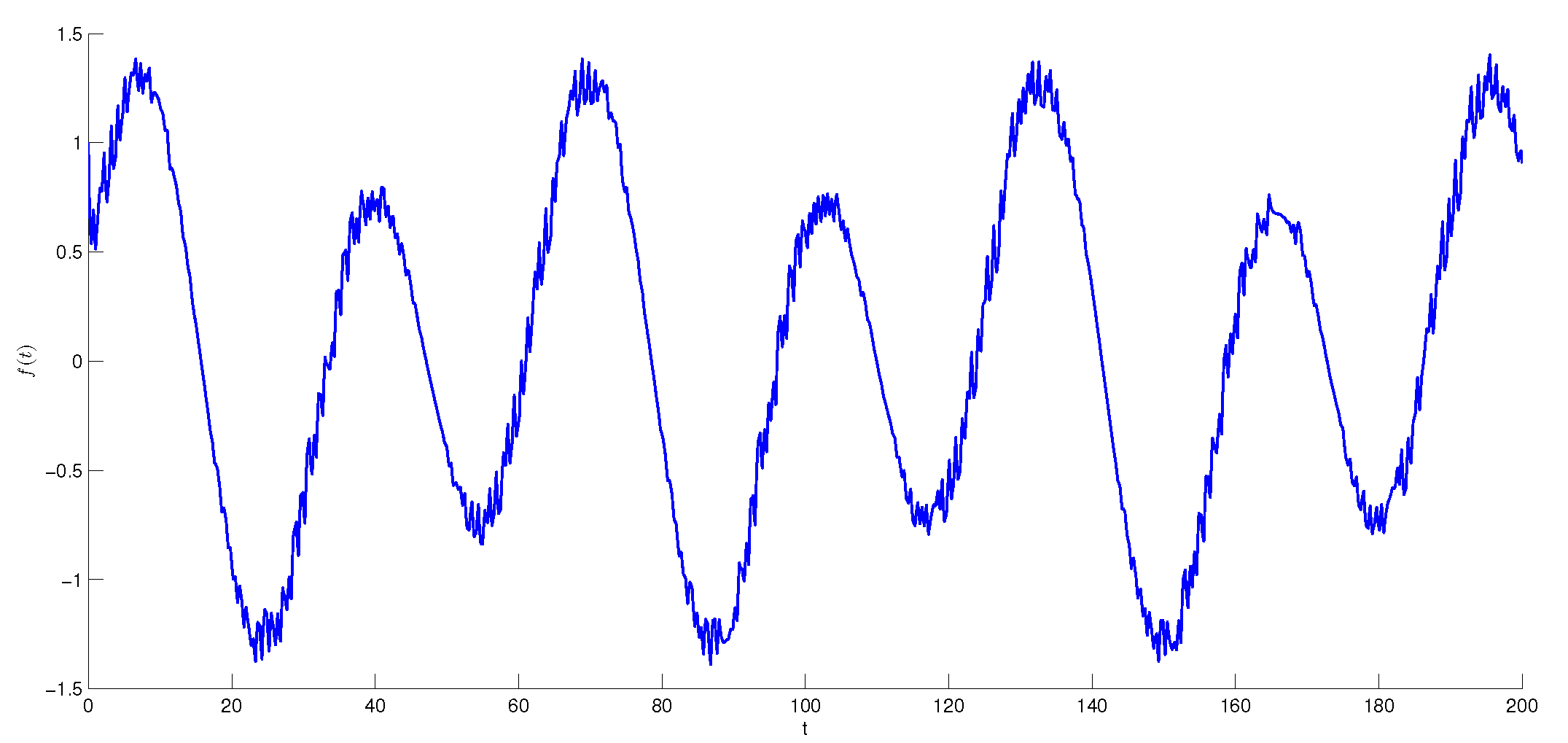
the degree of periodicity is equal to 200. In
Figure 1 the graph of function
is shown.
The following lemma is used in the examples.
Lemma 5 ([
33]).
Assume that bounded function satisfies the inequalities where are positive constants, for all Then the function is unpredictable, provided that is an unpredictable function. Example 1. Let us consider the system: with and The functions and are compartmental periodic unpredictable. The functions are periodic: According Lemma 5, the functions and perturbation are compartmental periodic unpredictable: Condition (C1) is satisfied, and Condition (C3) is valid since the elements of the convergence sequence are multiples of the length of step h and the period ω is equal to Conditions (C4)–(C7) are satisfied with and
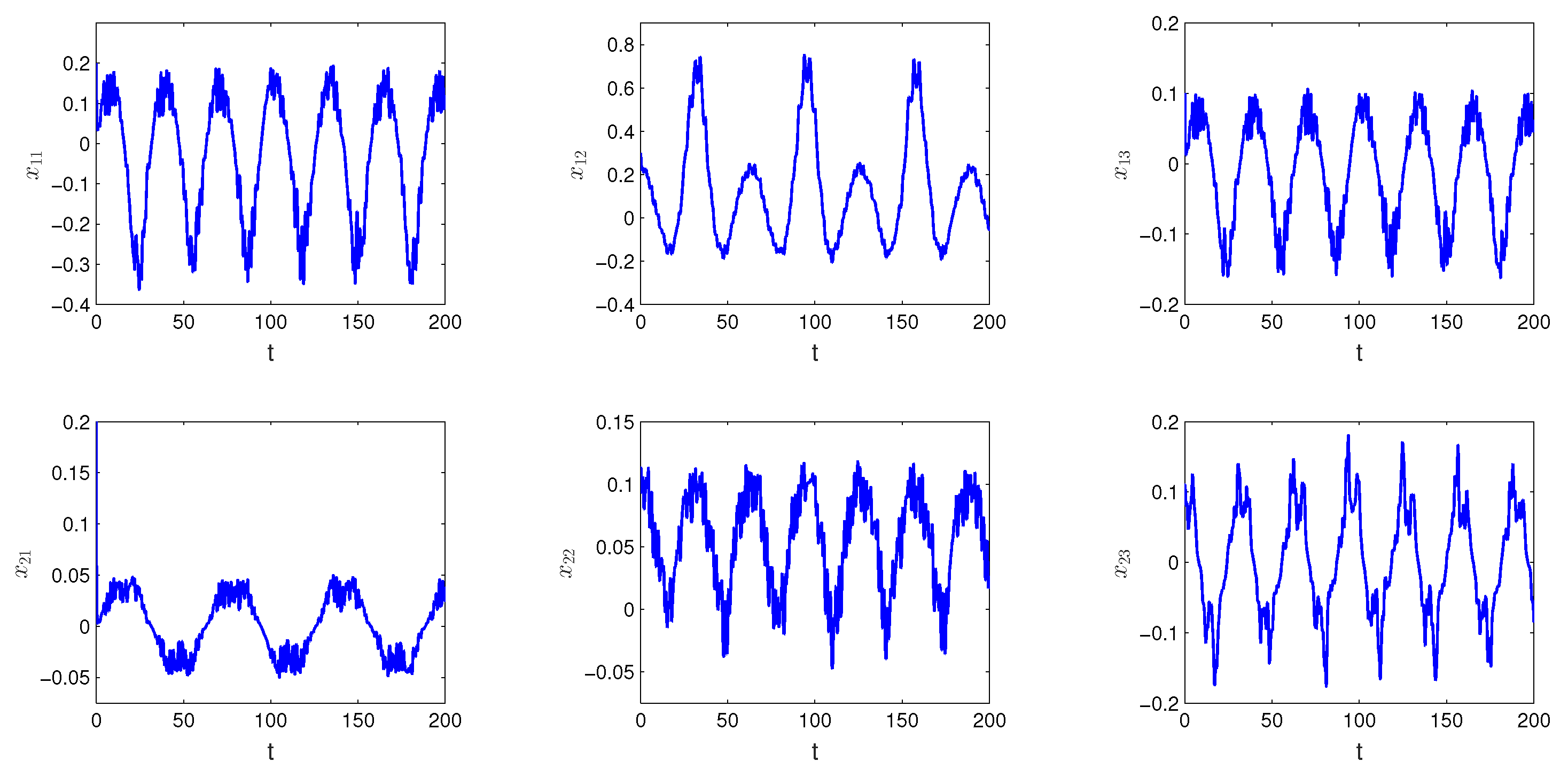
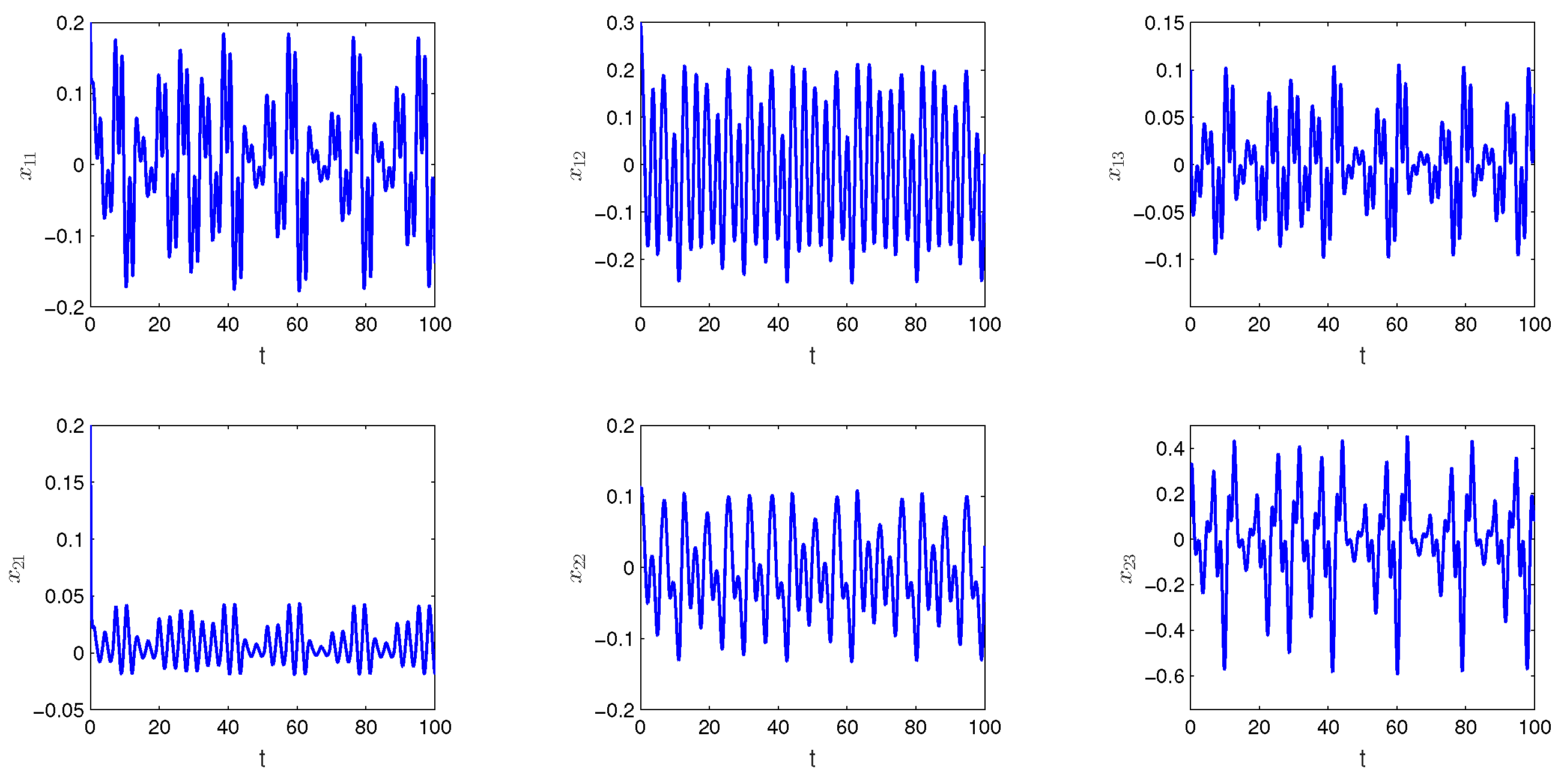
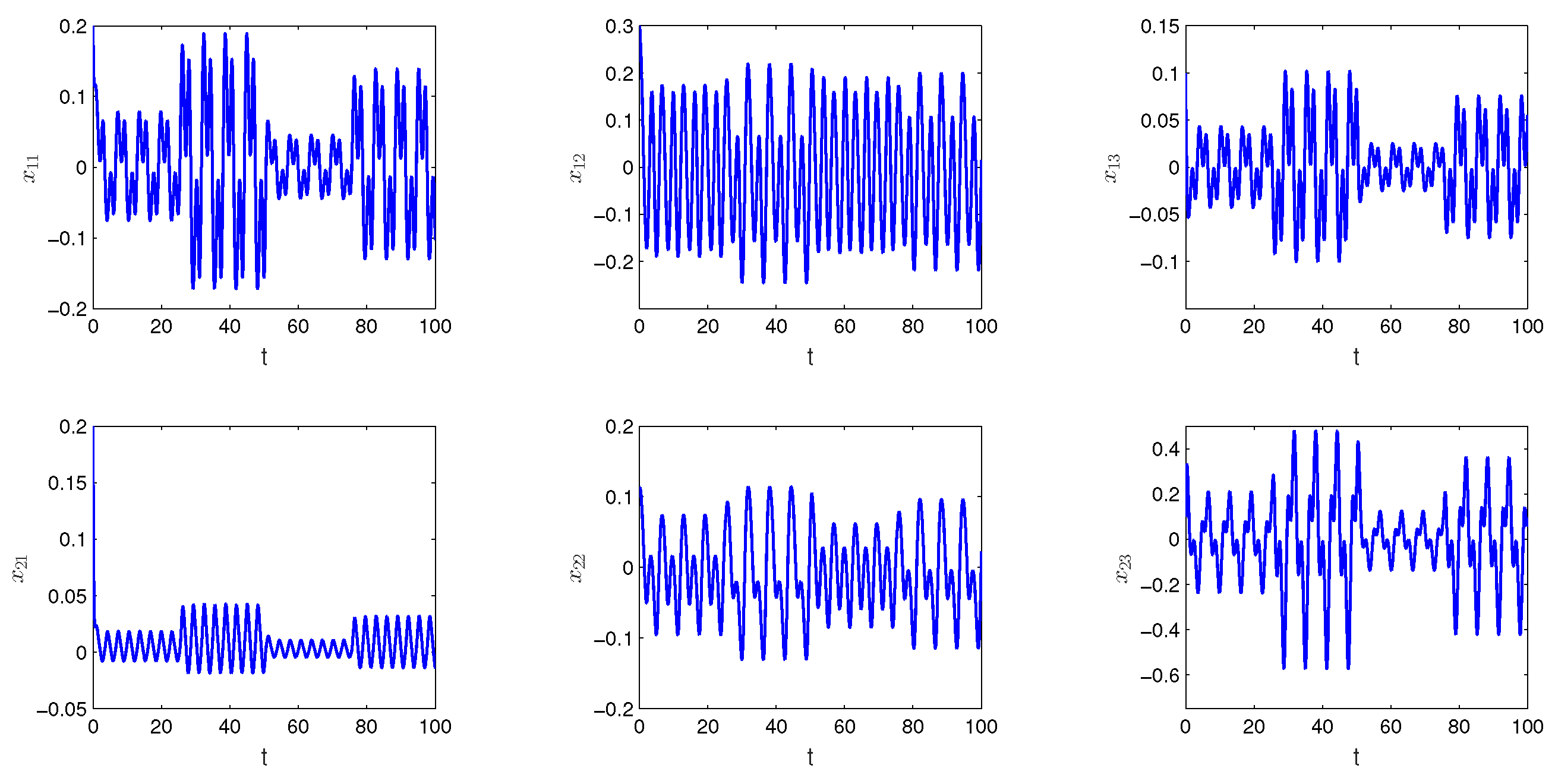
By Theorem 2, the neural network (26) has a unique exponentially stable unpredictable solution Figure 2 and Figure 3 show the solution with the length of step and respectively. The solution exponentially converges to the unpredictable solution Example 2. Let us take into account the SICNNs (26) with The functions and are the same as in Example 1. The period ω is equal to In Figure 4, the graph of the solution of SICNNs (26) with the length of step and the degree of periodicity is demonstrated. Analysing the numerical simulations above, one can make interesting observations concerning dominance of periodicity and unpredictability in compartmental functions.
Figure 2 and
Figure 3 show that the unpredictability prevails if
More precisely, periodicity is not seen if
at all, and it appears only locally on isolated intervals, if
In contrast, if
one can see in
Figure 1 and
Figure 4 that the graphs admit a clear periodic shape, which is enveloped by the unpredictability.
5. Conclusions
In this paper, we considered SICNNs with variable compartmental unpredictable coefficients and inputs. Sufficient conditions were obtained to ensure the existence of exponentially stable unpredictable and Poisson stable solutions. Effectiveness of neural networks strongly depend on the selection of the right inputs [
7,
8,
9]. Obviously, one can consider them not to be constant, but variable. In this case, there are two significantly different sorts of continuous-type inputs, regular (such as periodic, almost periodic, and recurrent) [
10,
11,
12,
13,
14,
15,
16,
17], and irregular or chaotic [
44,
45]. The choice of chaotic bias is an effective approach, since it is rich for infinitely many various motions, and periodic and almost periodic [
46] are among them. The motions can be stabilized by different methods of control [
47]. Recently, we have started to work with chaotic dynamics being focused on a single motion, the unpredictable point. The point is an unpredictable function [
42], if the space is a functional one. The dynamics on the closure of the trajectory was named Poincaré chaos. Thus, all benefits of neural networks with chaotic inputs are also valid for the unpredictable dynamics in neuroscience. Additionally, new characteristics to synchronize have been determined [
28,
29], the convergence and divergence sequences. The characteristics make convenient circumstances for collective analysis of the neural networks. It deserves to be mentioned that the reduction in chaotic analysis to a single motion provides new possibilities for numerical simulations of neural networks, and this was seen in the present paper. We compared
Figure 1,
Figure 2,
Figure 3 and
Figure 4 with experimental data in the Refs. [
34,
35,
36,
37,
38], and it was found that they are surprisingly similar. It means that the compartmental motions can find applications in solutions of industrial problems. Finally, the effectiveness of the compartmental approach to the unpredictability was shown by analysis of contributions of periodicity and unpredictability in the outputs, and it was just the first step in the direction of application of the research, since the next ones will be connected to control of chaos, which will be applied to the compartments’ parameters separately. Moreover, it will be productive if the compartmental nature of the dynamics will be taken into account for synchronization research [
28,
29,
47,
48,
49].