Abstract
The stochastic shallow water wave equation (SSWWE) in the sense of the beta-derivative is considered in this study. The solutions of the SSWWE are obtained using the F-expansion technique with the Riccati equation and He’s semi-inverse method. Since the shallow water equation has many uses in ocean engineering, including river irrigation flows, tidal waves, tsunami prediction, and weather simulations, the solutions discovered can be utilized to represent a wide variety of exciting physical events. We create many 2D and 3D graphs to demonstrate how the beta-derivative and Brownian motion affect the analytical solutions of the SSWWE.
MSC:
35A20; 60H15; 83C15; 35Q51; 60H10
1. Introduction
All physical phenomena are nonlinear in nature, and mathematical models are generally the most accurate way to represent them. To better explore and comprehend the nature of physical phenomena, partial differential equations (PDEs) have been modeled. Finding solutions for traveling waves is one of the most significant physical problems for these models. As a result, finding mathematical methods to produce exact solutions to PDEs has grown to be a large and essential task in nonlinear sciences.Recently, a number of approaches for dealing with PDEs have been proposed, such as spectral methods [1], Hirota’s method [2], tanh-sech method [3,4], Jacobi elliptic function method [5], -expansion method [6], -expansion method [7,8], perturbation method [9,10], bifurcation analysis [11,12,13], etc.
Moreover, stochastic partial differential equations (SPDEs) are used to study physical, biological, and chemical systems that are subject to random influences. Over the past few decades, these models have been the subject of extensive investigation. The significance of taking stochastic effects into consideration when modeling complex systems has been emphasized. For example, the use of SPDEs to mathematically model complicated processes is becoming more popular in the domains of finance, mechanical and electrical engineering, biophysics, information systems, materials sciences, condensed matter physics, and climate systems [14,15]. Recently, some effort has been made to obtain the precise solutions for SPDEs; for example, [16,17,18,19,20] and the references therein.
Therefore, it is essential to take into account PDEs with some stochastic force. Here, we address the modified -dimensional stochastic shallow water wave equation (SSWWE) with beta-derivative:
where is the beta-derivative, and , and it is defined later in next section, is the height of the Riemann wave, is a positive constant. is the Brownian motion, represents the intensity of noise, and is multiplicative noise.
If we put and , then we get the modified -dimensional shallow water wave equation [21,22]:
Equation (2) has various uses in ocean engineering, including river irrigation flows, tidal waves, tsunami prediction, weather simulations, and so on. Therefore, a number of authors have looked at the analytical solutions to Equation (2) by utilizing many different methods such as -expansion [23,24], exp-function [25], and Lie symmetry [26]. For the fractional-derivative of Equation (2), many authors obtained the exact solutions; for example, Phoosree et al. [27] used the simple equation method, and S. Duran [28] used the -expansion method. Equation (2) with the beta-derivative and forced by a stochastic term is not considered.
Our contribution in this article is to deduce the analytical stochastic solutions of SSWWE (1) with the beta-derivative. To get these solutions, we use the F-expansion method with the Riccati equation and He’s semi-inverse method. Physics researchers would find the solutions very helpful in defining several major physical processes because of the stochastic term and beta-derivative present in Equation (1). Additionally, by using the MATLAB software, we introduce numerous graphs to investigate the effects of noise and the beta-derivative on the exact solutions of the SSWWE (1).
An overview of this article is provided as follows: the beta-derivative and Brownian motion are defined, together with some of their properties, in Section 2. We obtain the wave equation of SSWWE (1) in Section 3. In Section 4, The exact solutions of the SSWWE are acquired utilizing F-expansion and He’s semi-inverse methods. The impact of noise and the beta-derivative on the obtained solutions of SSWWE is analyzed in Section 5. Finally, the conclusions of the paper are introduced.
2. Beta-Derivative and Brownian Motion
The beta-derivative was recently suggested by Atangana et al. [29]. These derivatives may not be seen as fractional derivatives but can be considered to be a natural extension of the classical derivative [30]. From this point, let us define the beta-derivative for the function of order as follows [29,31]:
Definition 1.
The beta-derivative for the function is defined as
The beta-derivative meets the following characteristics [29]:
(1) ,
(2) If ,
(3) for all a and b real number,
(4) .
Moreover, Brownian motion is defined as follows [32]:
Definition 2.
The stochastic process is referred to as Brownian motion if it meets the following criteria:
- 1.
- 2.
- is continuous function of ,
- 3.
- is independent for ,
- 4.
- has a normal distribution .
We need the following lemma:
Lemma 1
([32]). for
3. Wave Equation for SSWWE
The wave equation for the SSWWE (1) is created by using the next wave transformation:
where is the deterministic function, and
where and are unknown constants. We observe that
By considering the expectations on both sides, we obtain
Thus, by using Lemma 2, Equation (7) turn into
where . Integrating once and ignoring the integral constant, we get
where
Integrating Equation (9) and ignoring the integral constant, we have
By using homogeneous balancing between with in Equation (10), we can conclude that
4. Exact Solutions of SSWWE
The solutions of the wave Equation (10) are found using the F-expansion technique with the Riccati equation and He’s semi-inverse method. The solutions of the SSWWE (1) are then obtained.
4.1. Expansion Method with Riccati Equation
Let us suppose the solution of Equation (10) has the form (with )
where F is the solutions of the Riccati equation
where is a real constant. Equation (12) has the following solutions:
if or
if or
if
Putting each coefficient to zero
and
When these equations are solved, we obtain three sets:
First set:
Second set:
Third set:
First set: Equation (10) has the solution
For , three cases are present as follows:
Hence, the solutions of SSWWE (1), by utilizing Equations (3) and (16), are
and
where is defined in Equation (4).
Hence, the solutions of SSWWE (1), by utilizing Equations (3) and (16), are
and
where defined in Equation (4).
Case 3: If then we obtain by using (15)
Hence, the solutions of SSWWE (1), by utilizing Equations (3) and (16), are
where is defined in Equation (4).
Second set: We have the same solutions as stated in First set when and While in the case of , the solution of SSWWE (1) is
Third set: The solution of Equation (10) is
For , three cases are present as follows:
Case 1: If then by using (13), we get
Case 2: If then by using (14), we have
Case 3: If then by using (15), we get
4.2. He’s Semi-Inverse Method
Using He’s semi-inverse method mentioned in [33,34,35], we obtain the following variational formulations:
We assume the solution of Equation (9) according to [36] takes the form
where A is an undefined constant. Substituting Equation (29) into Equation (28), we have
Making J stationary with respect to A as follows
By solving Equation (30), we obtain
Therefore, the solution of Equation (9) is
Now, the solution of SSWWE (1) is
where is defined in Equation (4). Similarly, we can consider the solution of Equation (9) as
With the same steps as before, we get
5. Impacts of Noise and Beta-Derivative
We now investigate the effect of noise and the beta-derivative on the exact solution of the SSWWE (1). We provide a number of graphs to describe the behavior of these solutions. For specific solutions that have been obtained, such as (21) and (32), let us establish the parameters and so that we can model these graphs.
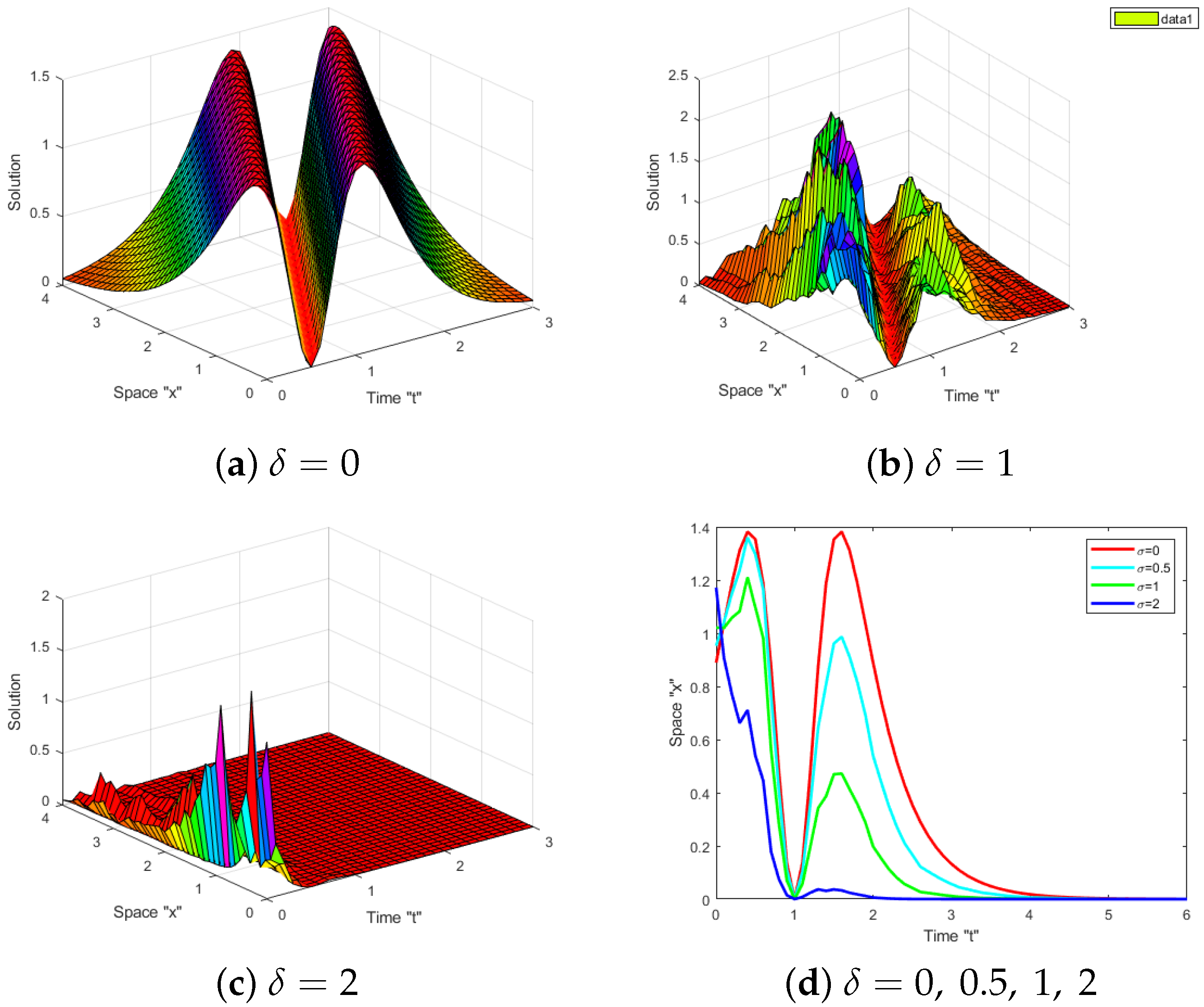
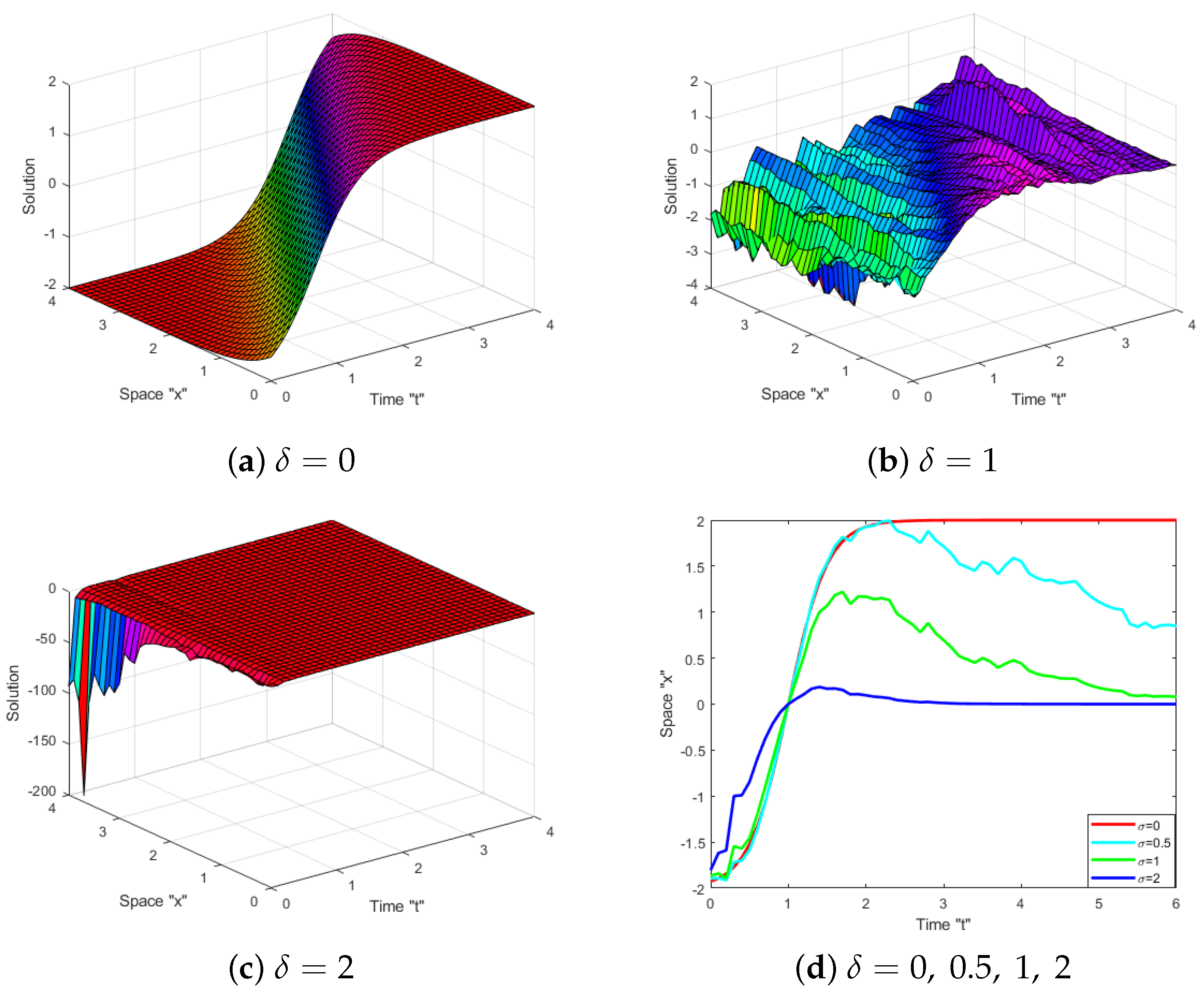
First the noise impacts: In Figure 1 and Figure 2, we see the effect of noise on the solutions as follows:
Figure 1.
(a–c) Three-dimensional graph of solution in Equation (21) for various ; (d) two-dimensional graph for various .
Figure 2.
(a–c) Three-dimensional graph of solution in Equation (32) for various ; (d) two-dimensional graph for various .
From Figure 1 and Figure 2, we can deduce that when the noise is ignored (i.e., at , there are some different types of solutions, such as a periodic solution, kink solution, etc. When noise is added and its strength is increased by , the surface becomes a great deal flatter after small transit patterns, and that was proved with the 2D graph. This indicates that the white noise impacts the SSWWE solutions and stabilizes them around zero.
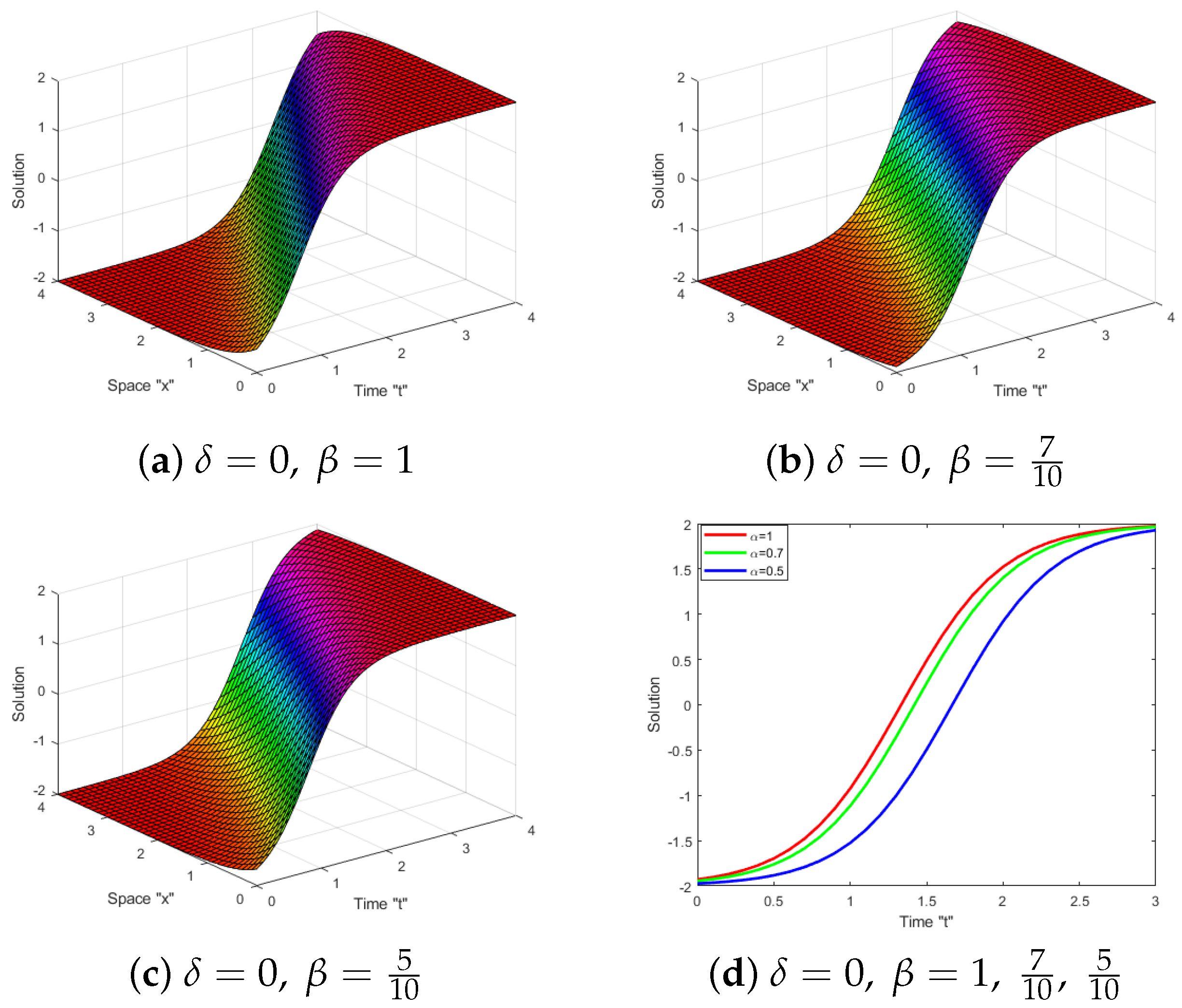
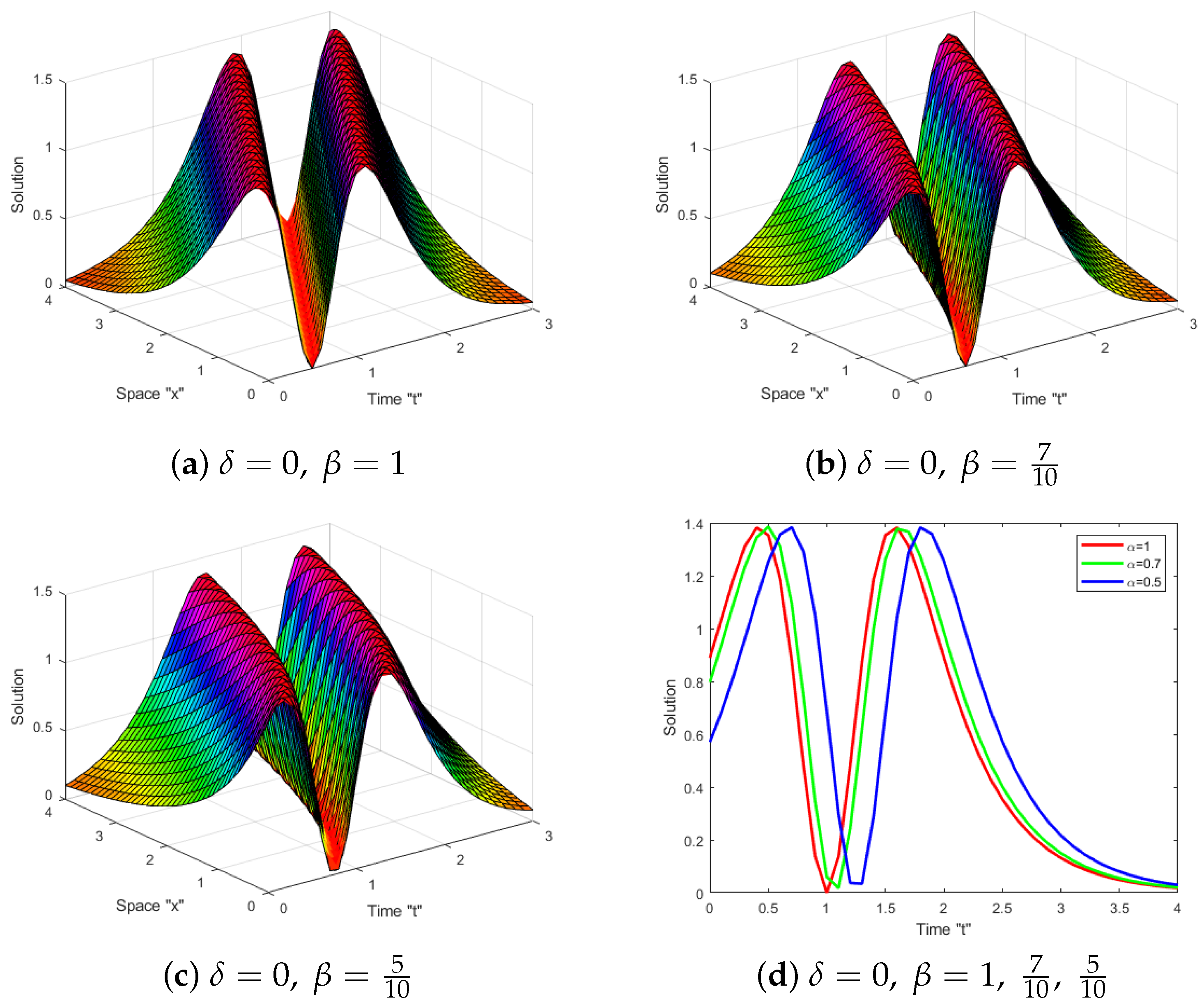
Secondly, the beta derivative impacts: In Figure 3 and Figure 4, if , we can see that the graph’s shape is compressed as the value of decreases:
6. Conclusions
The stochastic shallow water equation (SSWWE) was investigated in the sense of the beta-derivative. By using the F-expansion method with the Riccati equation and He’s semi-inverse method, we were able to find the exact stochastic solutions for SSWWE. These solutions are necessary to understand a wide range of interesting and difficult physical phenomena. In addition, the beta-derivative and multiplicative white noise effects on the analytical solution of SSWWE (1) were demonstrated using the MATLAB software. The beta-derivative moved the surface to the right as the order of derivative decreased, and we deduced that the multiplicative Brownian motion stabilized the solutions around zero.
Author Contributions
Data curation, F.M.A.-A. and W.W.M.; Formal analysis, W.W.M., E.S.A., F.M.A.-A. and C.C.; Funding acquisition, F.M.A.-A.; Methodology, C.C., and E.S.A.; Project administration, W.W.M.; Software, W.W.M.; Supervision, C.C.; Visualization, F.M.A.-A.; Writing—original draft, F.M.A.-A. and E.S.A.; Writing—review and editing, W.W.M. and C.C. All authors have read and agreed to the published version of the manuscript.
Funding
This research received no external funding.
Data Availability Statement
Not applicable.
Acknowledgments
Princess Nourah bint Abdulrahman University Researcher Supporting Project number (PNURSP2023R 273), Princess Nourah bint Abdulrahman University, Riyadh, Saudi Arabia.
Conflicts of Interest
The authors declare no conflict of interest.
References
- Gepreel, K.A.; Mohamed, M.S. An optimal homotopy analysis method nonlinear fractional differential equation. J. Adv. Res. Dyn. Control. Syst. 2014, 6, 1–10. [Google Scholar] [CrossRef]
- Hirota, R. Exact solution of the Korteweg-de Vries equation for multiple collisions of solitons. Phys. Rev. Lett. 1971, 27, 1192–1194. [Google Scholar] [CrossRef]
- Al-Askar, E.M.; Mohammed, W.W.; Albalahi, A.M.; El-Morshedy, M. The Impact of the Wiener process on the analytical solutions of the stochastic (2+ 1)-dimensional breaking soliton equation by using tanh–coth method. Mathematics 2022, 10, 817. [Google Scholar] [CrossRef]
- Malfliet, W.; Hereman, W. The tanh method. I. Exact solutions of nonlinear evolution and wave equations. Phys Scr. 1996, 54, 563–568. [Google Scholar] [CrossRef]
- Yan, Z.L. Abunbant families of Jacobi elliptic function solutions of the dimensional integrable Davey-Stewartson-type equation via a new method. Chaos Solitons Fractals 2003, 18, 299–309. [Google Scholar] [CrossRef]
- Khan, K.; Akbar, M.A. The exp(-ϕ(ς))-expansion method for finding travelling wave solutions of Vakhnenko-Parkes equation. Int. J. Dyn. Syst. Differ. Equ. 2014, 5, 72–83. [Google Scholar]
- Wang, M.L.; Li, X.Z.; Zhang, J.L. The (G′/G)-expansion method and travelling wave solutions of nonlinear evolution equations in mathematical physics. Phys. Lett. A 2008, 372, 417–423. [Google Scholar] [CrossRef]
- Al-Askar, F.M.; Cesarano, C.; Mohammed, W.W. The analytical solutions of stochastic-fractional Drinfel’d-Sokolov-Wilson equations via (G′/G)-expansion method. Symmetry 2022, 14, 2105. [Google Scholar] [CrossRef]
- Mohammed, W.W. Fast-diffusion limit for reaction–diffusion equations with degenerate multiplicative and additive noise. J. Dyn. Differ. Equ. 2021, 33, 577–592. [Google Scholar] [CrossRef]
- Mohammed, W.W. Modulation equation for the Stochastic Swift-Hohenberg equation with cubic and quintic nonlinearities on the Real Line. Mathematics 2020, 6, 1217. [Google Scholar] [CrossRef]
- Elbrolosy, M.; Elmandouh, A. Bifurcation and new traveling wave solutions for (2+1)-dimensional nonlinear Nizhnik-Novikov-Veselov dynamical equation. Eur. Phys. J. Plus 2020, 135, 533. [Google Scholar] [CrossRef]
- Elmandouh, A. Bifurcation and new traveling wave solutions for the 2D Ginzburg–Landau equation. Eur. Phys. J. Plus 2020, 135, 648. [Google Scholar] [CrossRef]
- Elmandouha, A.; Ibrahim, A. Bifurcation and travelling wave solutions for a (2+ 1)-dimensional KdV equation. J. Taibah Univ. Sci. 2020, 14, 139–147. [Google Scholar] [CrossRef]
- Arnold, L. Random Dynamical Systems; Springer: Berlin/Heidelberg, Germany, 1998. [Google Scholar]
- Imkeller, P.; Monahan, A.H. Conceptual stochastic climate models. Stoch. Dyn. 2002, 2, 311–326. [Google Scholar] [CrossRef]
- Elmandouh, A.; Fadhal, E. Bifurcation of Exact Solutions for the Space-Fractional Stochastic Modified Benjamin–Bona–Mahony Equation. Fractal Fract. 2022, 6, 718. [Google Scholar] [CrossRef]
- Al-Askar, F.M.; Mohammed, W.W.; Aly, E.S.; EL-Morshedy, M. Exact solutions of the stochastic Maccari system forced by multiplicative noise. ZAMM-J. Appl. Math. Mech. 2022, e202100199. [Google Scholar] [CrossRef]
- Mohammed, W.W.; Al-Askar, F.M.; Cesarano, C. The analytical solutions of the stochastic mKdV equation via the mapping method. Mathematics 2022, 10, 4212. [Google Scholar] [CrossRef]
- Al-Askar, F.M.; Mohammed, W.W. The analytical solutions of the stochastic fractional RKL equation via Jacobi elliptic function method. Adv. Math. Phys. 2022, 2022, 1534067. [Google Scholar] [CrossRef]
- Mohammed, W.W.; Cesarano, C. The soliton solutions for the (4+1)-dimensional stochastic Fokas equation. Math. Methods Appl. Sci. 2023. [Google Scholar] [CrossRef]
- Clarkson, P.A.; Mansfield, E.L. On a shallow water wave equation. Nonlinearity 1994, 7, 975. [Google Scholar] [CrossRef]
- Wazwaz, A.M. Multiple soliton solutions and multiple-singular soliton solutions for two higher-dimensional shallow water wave equations. Appl. Math. Comput. 2009, 211, 495. [Google Scholar] [CrossRef]
- Bangqing, L.; Meiping, X.; Yulan, M. New exact solutions of (2+1)-dimensional generalization of shallow water wave equation by (G′/G)-expansion method. Appl. Mech. Mater. 2010, 20–23, 1516–1521. [Google Scholar]
- Bekir, A.; Aksoy, E. Exact solutions of shallow water wave equations by using the (G′/G)-expansion method. Waves Random Complex Media 2012, 22, 317–331. [Google Scholar] [CrossRef]
- Bekir, A.; Aksoy, E. Exact solutions of extended shallow water wave equations by exp-function method. Int. J. Numer. Methods Heat Fluid Flow 2013, 23, 305–319. [Google Scholar] [CrossRef]
- Kumar, D.; Kumar, S. Some new periodic solitary wave solutions of (3+1)-dimensional generalized shallow water wave equation by Lie symmetry approach. Comput. Math. Appl. 2019, 78, 857–877. [Google Scholar] [CrossRef]
- Phoosree, S.; Thadee, W. Wave effects of the fractional shallow water equation and the fractional optical fiber equation. Front. Appl. Math. Stat. 2022, 8, 900369. [Google Scholar] [CrossRef]
- Duran, S. Dynamic interaction of behaviors of time-fractional shallow water wave equation system. Mod. Phys. Lett. B 2021, 35, 2150353. [Google Scholar] [CrossRef]
- Atangana, A.; Baleanu, D.; Alsaedi, A. Analysis of time-fractional Hunter-Saxton equation: A model of neumatic liquid crystal. Open Phys. 2016, 14, 145–149. [Google Scholar] [CrossRef]
- Khalil, R.; Al Horani, M.; Yousef, A.; Sababheh, M. A new definition of fractional derivative. J. Comput. Appl. Math. 2014, 264, 65–70. [Google Scholar] [CrossRef]
- Arshed, S.; Raza, N.; Butt, A.R.; Akgül, A. Exact solutions for Kraenkel-Manna-Merle model in saturated ferromagnetic materials using β-derivative. Phys. Scr. 2021, 96, 124018. [Google Scholar] [CrossRef]
- Calin, O. An Informal Introduction to Stochastic Calculus with Applications; World Scientific Publishing Co. Pte. Ltd.: Singapore, 2015. [Google Scholar] [CrossRef]
- He, J.H. Semi-inverse method of establishing generalized variational principles for fluid mechanics with emphasis on turbomachinery aerodynamics. Int. J. Turbo Jet-Engines 1997, 14, 23–28. [Google Scholar] [CrossRef]
- He, J.H. Variational principles for some nonlinear partial dikerential equations with variable coencients. Chaos Solitons Fractals 2004, 19, 847–851. [Google Scholar] [CrossRef]
- He, J.H. Some asymptotic methods for strongly nonlinear equations. Int. J. Modern Phys. B 2006, 20, 1141–1199. [Google Scholar] [CrossRef]
- Ye, Y.H.; Mo, L.F. He’s variational method for the Benjamin–Bona–Mahony equation and the Kawahara equation. Comput. Math. Appl. 2009, 58, 2420–2422. [Google Scholar] [CrossRef]
Disclaimer/Publisher’s Note: The statements, opinions and data contained in all publications are solely those of the individual author(s) and contributor(s) and not of MDPI and/or the editor(s). MDPI and/or the editor(s) disclaim responsibility for any injury to people or property resulting from any ideas, methods, instructions or products referred to in the content. |
© 2023 by the authors. Licensee MDPI, Basel, Switzerland. This article is an open access article distributed under the terms and conditions of the Creative Commons Attribution (CC BY) license (https://creativecommons.org/licenses/by/4.0/).