You are currently viewing a new version of our website. To view the old version click .
Mathematics
  • Review
  • Open Access

27 February 2023

Research Trend, Logical Structure and Outlook on Complex Economic Game

and
1
School of Management, Tianjin Normal University, Tianjin 300387, China
2
Department of Management and Economics, Tianjin University, Tianjin 300072, China
*
Author to whom correspondence should be addressed.
This article belongs to the Special Issue Mathematical Modeling and Optimization for Complex Systems of Economic and Financial Supply Chains

Abstract

Diseases, natural disasters, and other emergencies force the economy and management system to confront nonlinear and random changes. In recent years, complexity science has attracted much attention. Complex economics believes that economic models are dynamic, stochastic, and unpredictable, and that equilibrium and stability are temporary. It is changing traditional economic theory. Based on complexity theory, bibliometric theory, nonlinear theory, and game theory, combined with knowledge graph methods, the article analyzed 200 papers from the Web of Science, covering the period 1998–2022. This research presents the research structure and theoretical evolution of complex economic games through visualization techniques. The clusters of keywords and the logical relationships between them are discussed. Then, the analysis of hot keywords and co-occurrence keywords is carried out. Finally, future research directions for complex economic games are given: (1) the market complexity that comes with intelligent expectations, (2) complex characteristics of the data trading market, and (3) complex risk control for emergencies. The innovation lies in the use of data analysis software combined with manual knowledge to overcome the shortcomings of inflexible software analysis, as well as weak manual storage and computation. This research builds a theoretical foundation for grasping the research direction and selecting advanced topics.
MSC:
91A11; 91A25; 93C10; 34A34

1. Introduction

Complexity theory is profoundly changing economic theory. Neoclassical economics believes that statics and equilibrium are constant states. Players makes decisions in a world of equilibrium. Conversely, complex economics accepts randomness, uncertainty, nonequilibrium, and dynamic change. They also consider that economic systems can self-renew, self-assess, and are uncertain.
Complexity theory originated in the 19th century and did not originally emerge from economics. In chemistry, biology, and physics, scientists found a class of unbalanced, changing, periodic, and random systems and called them complex systems. The complex systems were composed of many individuals that could interact with each other, share information, and adjust their behaviors. So, they were also called complex adaptive systems [1]. Social systems were complex adaptive systems in which individuals communicated with each other and adapted their strategies [2]. In recent years, under the impact of sudden events, such as diseases, technological revolution, natural disasters, and climate change, the economic system has shown clearly complex characteristics. In 1987, the Santa Fe Institute (SFI) located in New Mexico, USA, formally proposed that “The economy can be viewed as an evolving complex system.” In 1999, Arthur first proposed the concept “Complex Economics” [3]. Complex economics is a theory that goes beyond equilibrium; it is uncertain, unpredictable, process-dependent, and evolutionary.
This study provides a review of complex economic games. Based on complexity theory, bibliometric theory, nonlinear theory, and game theory, combined with knowledge graph methods, this paper analyzed 200 articles from 1998 to 2022. This research presents the research structure and theoretical evolution of complex economic games through visualization techniques and scholars’ subjective experience. The clusters of keywords and the logical relationships between them are discussed. Additionally, the analysis of hot keywords and co-occurrence keywords is carried out. Then, future research directions are proposed. The structure of the article is as follows: Section 1 is the introduction; Section 2 is the research framework; Section 3 is cluster analysis and hotspots analysis of existing studies; Section 4 is the overview of related research; Section 5 is the research outlook; and Section 6 is the conclusion.

2. Research Framework

This research includes four steps: data collection, data analysis, review of research hotspots, and future research outlook, as shown in Figure 1. Literature data came from the Web of Science, covering the period 1998–2022. The cluster analysis and hotspots analysis are carried out by CiteSpace, based on the results of the software analysis. The logical framework of the study is given manually.
Figure 1. Research Framework.
The retrieval formula is: “complex” or “complexity” or “chaos” or “stability” or “bifurcation” or “market” or “game” or “competition”. After manual selection one by one, 200 papers are chosen from 1998 to 2022. The data analysis process is as Table 1 shows:
Table 1. Content of bibliometric analysis.

3. Cluster Analysis, Hotspots Analysis, and Research Logic Analysis

3.1. Cluster Analysis and Research Logic Analysis

(1)
Cluster Analysis
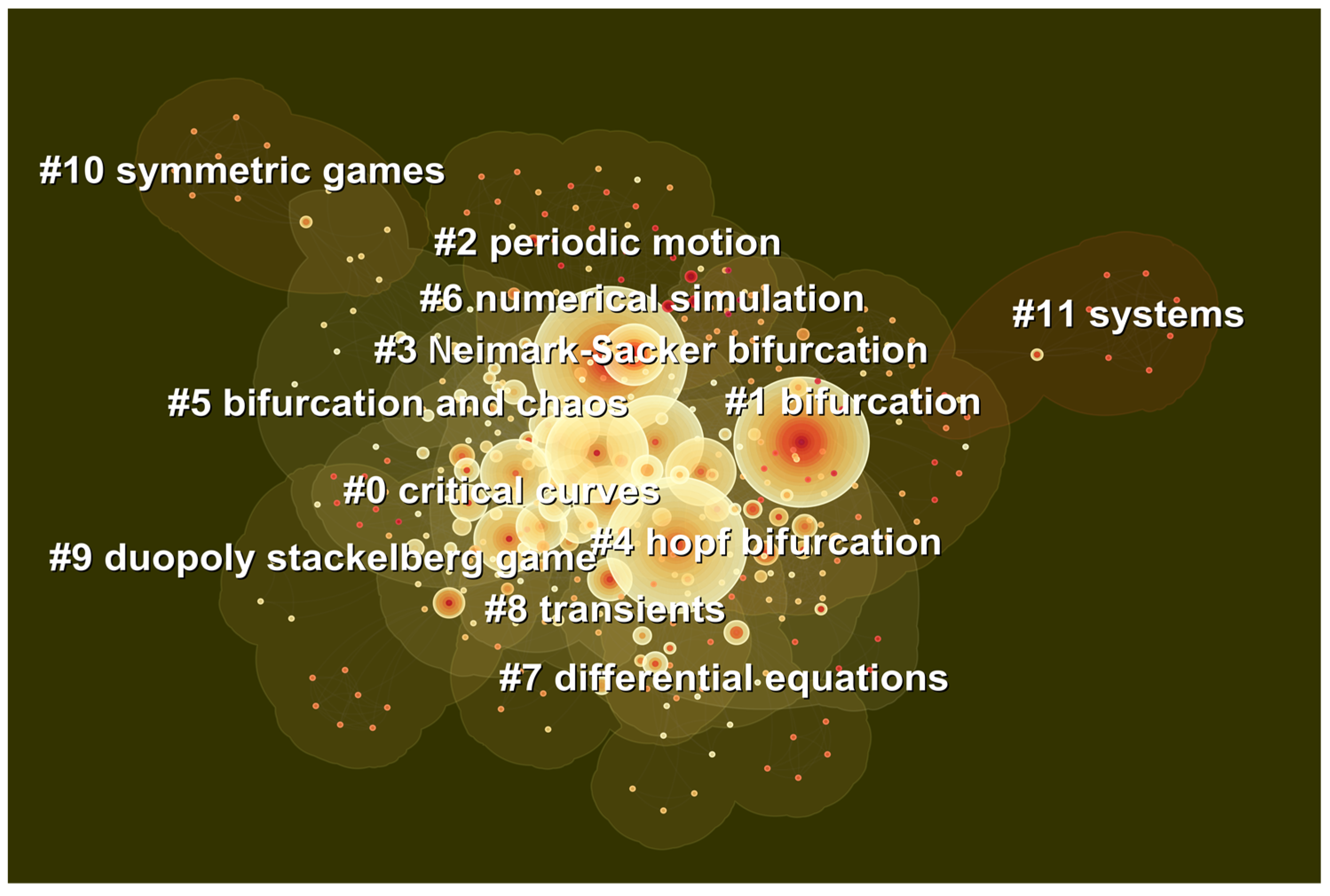
The research is clustered as shown in Figure 2, and the studies are clustered into 12 categories.
Figure 2. The cluster of keywords.
Each study cluster is typical and representative. Table 2 explains each cluster.
Table 2. Cluster explanation.
(2)
Research Logic Analysis
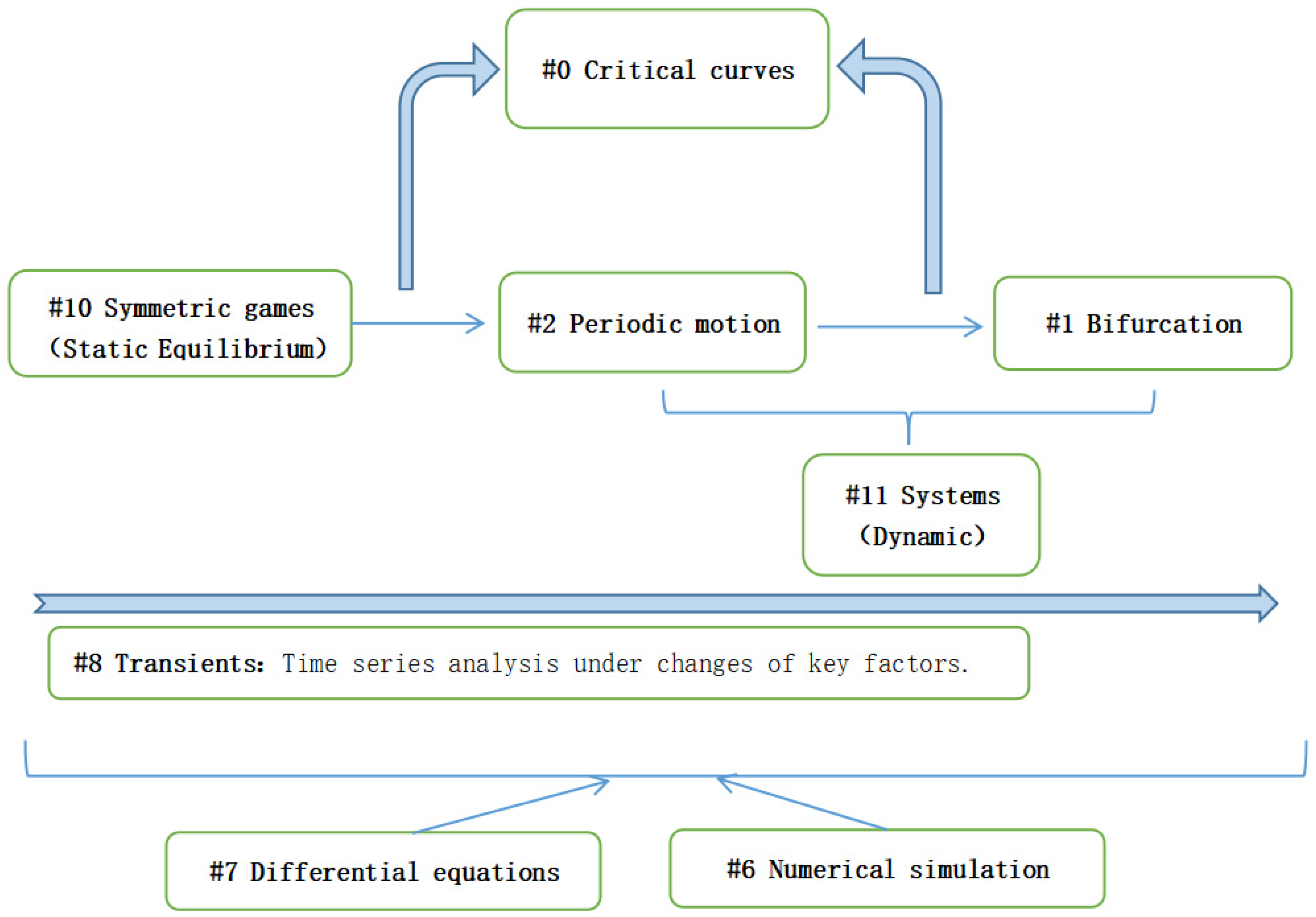
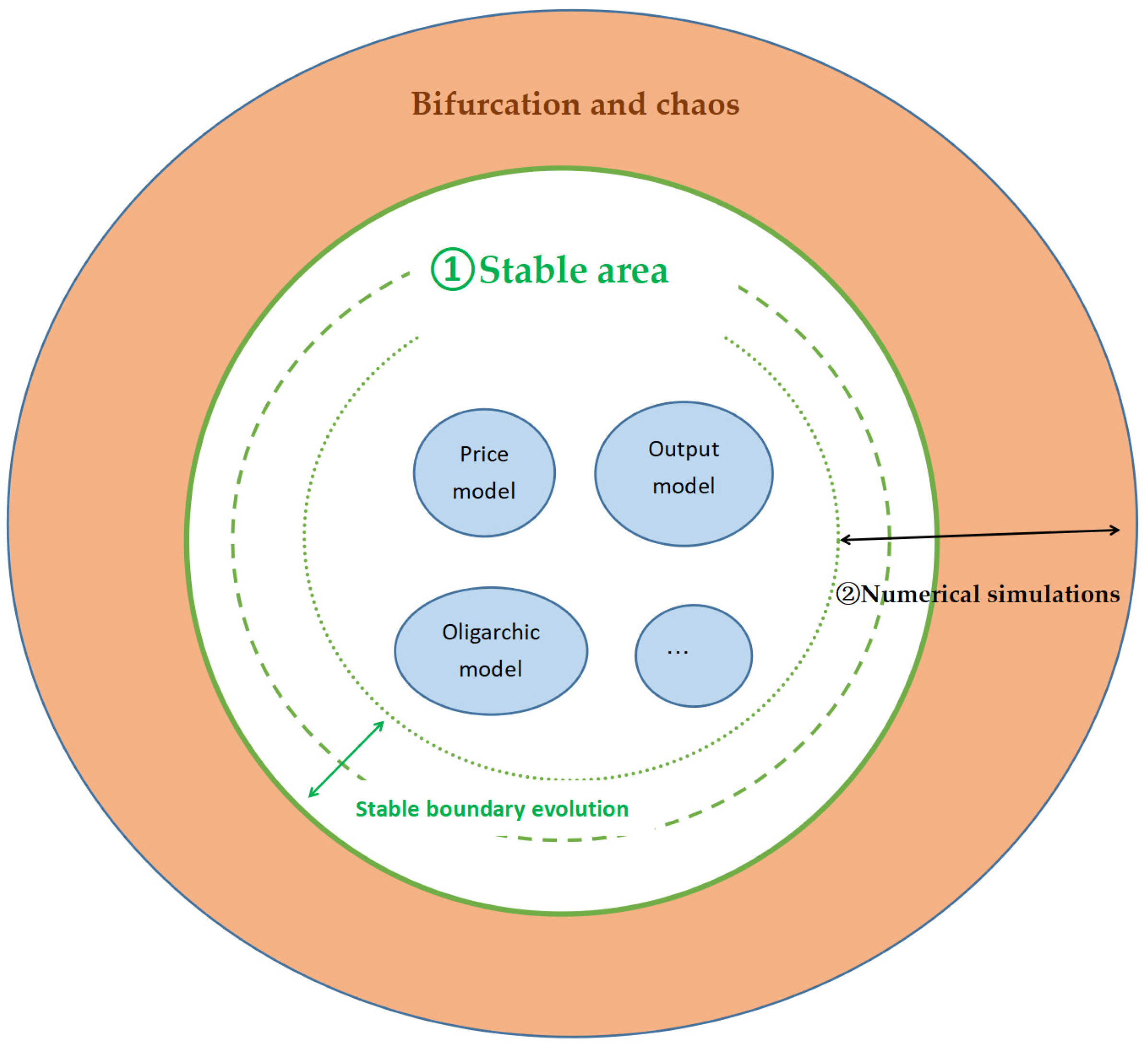
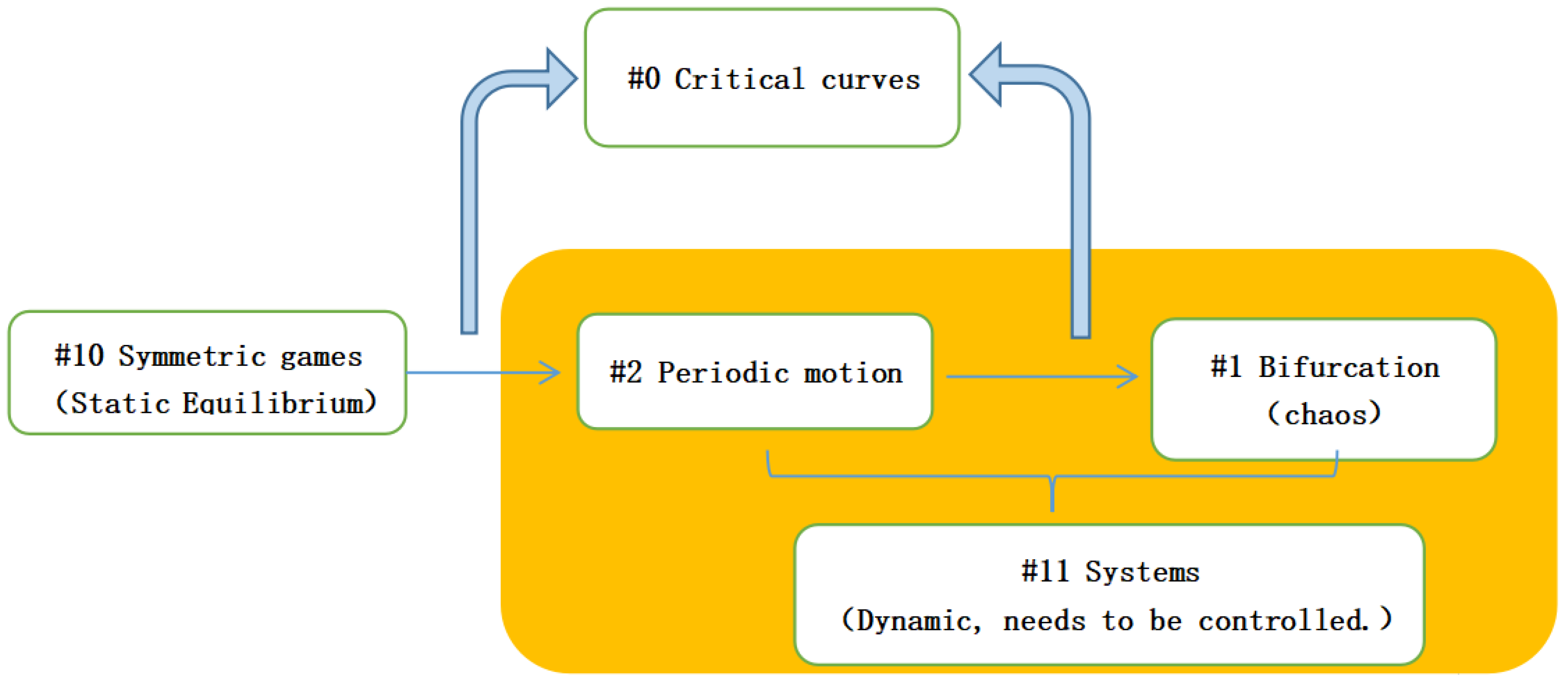
The results of the analysis of the software are not sufficient to express the logical relationships between the studied clusters. By consulting experts, the logical relationships between clusters are given in the research discussions. Figure 3 shows the logical relationship between clusters. The relationship between each cluster is depicted in Figure 3.
Figure 3. The logical relationships between clusters.
Stimulated by complex factors, economic systems evolve from static equilibrium (“Symmetric games”) to “periodic motion”, then to “bifurcation” and chaos. Period and bifurcation studies are part of “dynamic system” analysis. “Critical curves” analysis includes the boundary from static equilibrium to periodic fluctuations and the boundary from periodic fluctuations to bifurcation. It is also a hot research topic in academia. The “transients” of various states are analyzed by time series; the time series model can be constructed by “differential equations”, which represents the recurrence relation, as Equation (1) shows.
{ x t = a 0 + a 1 x t 1 + a 2 x t 2 + + a n x t n y t = b 0 + b 1 y t 1 + b 2 y t 2 + + b n y t n z t = c 0 + c 1 z t 1 + c 2 z t 2 + + c n z t n
Equation (1) is a 3-dimension differential equation group. However, when dimensions increase, the equilibrium solutions, period, and bifurcation research cannot be analyzed by mathematical methods. Therefore, it is necessary to resort to “numerical simulations”.

3.2. Hotspots Analysis and Research Logic Analysis

(1)
Hotspots Analysis by CiteSpace
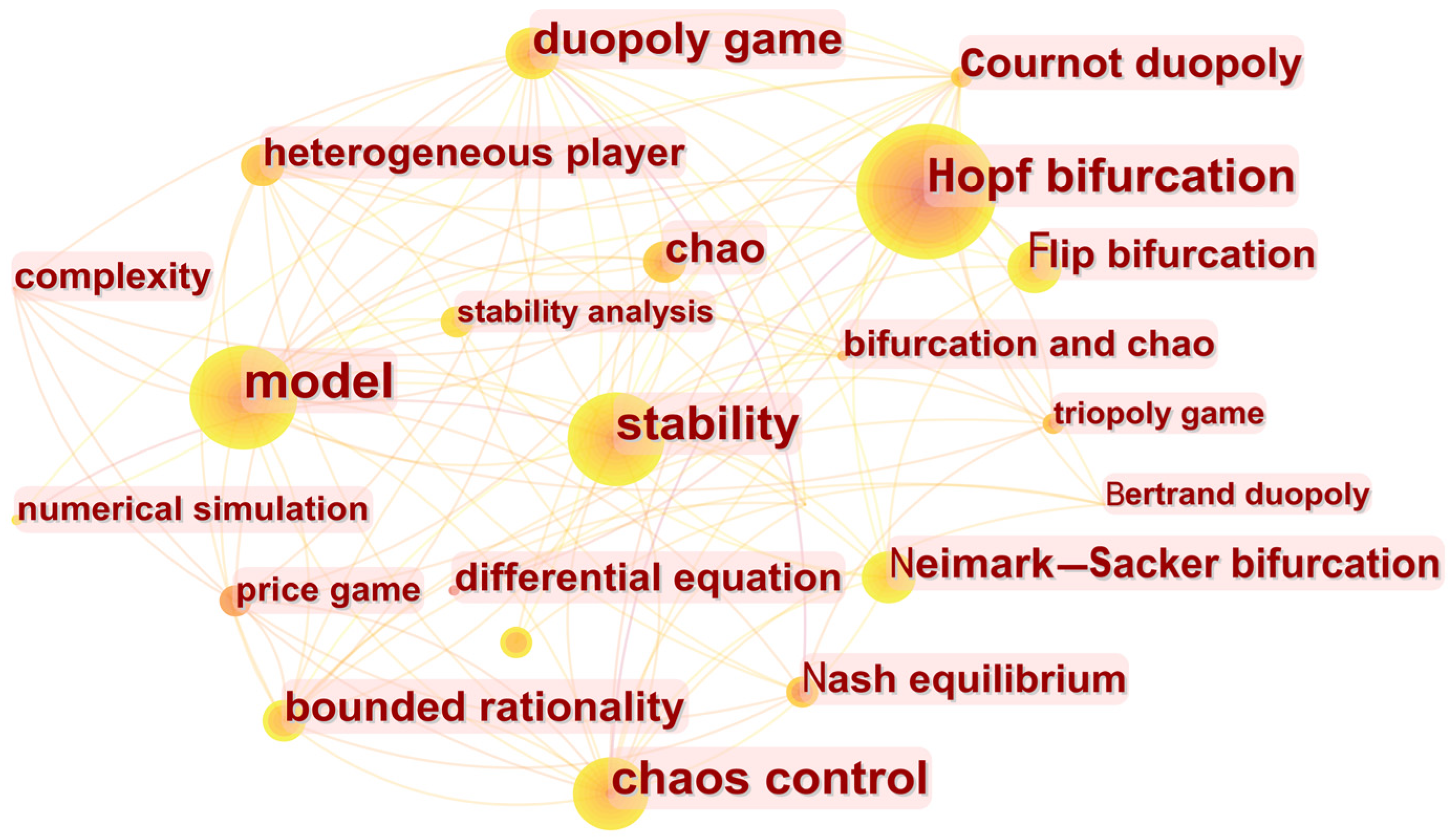
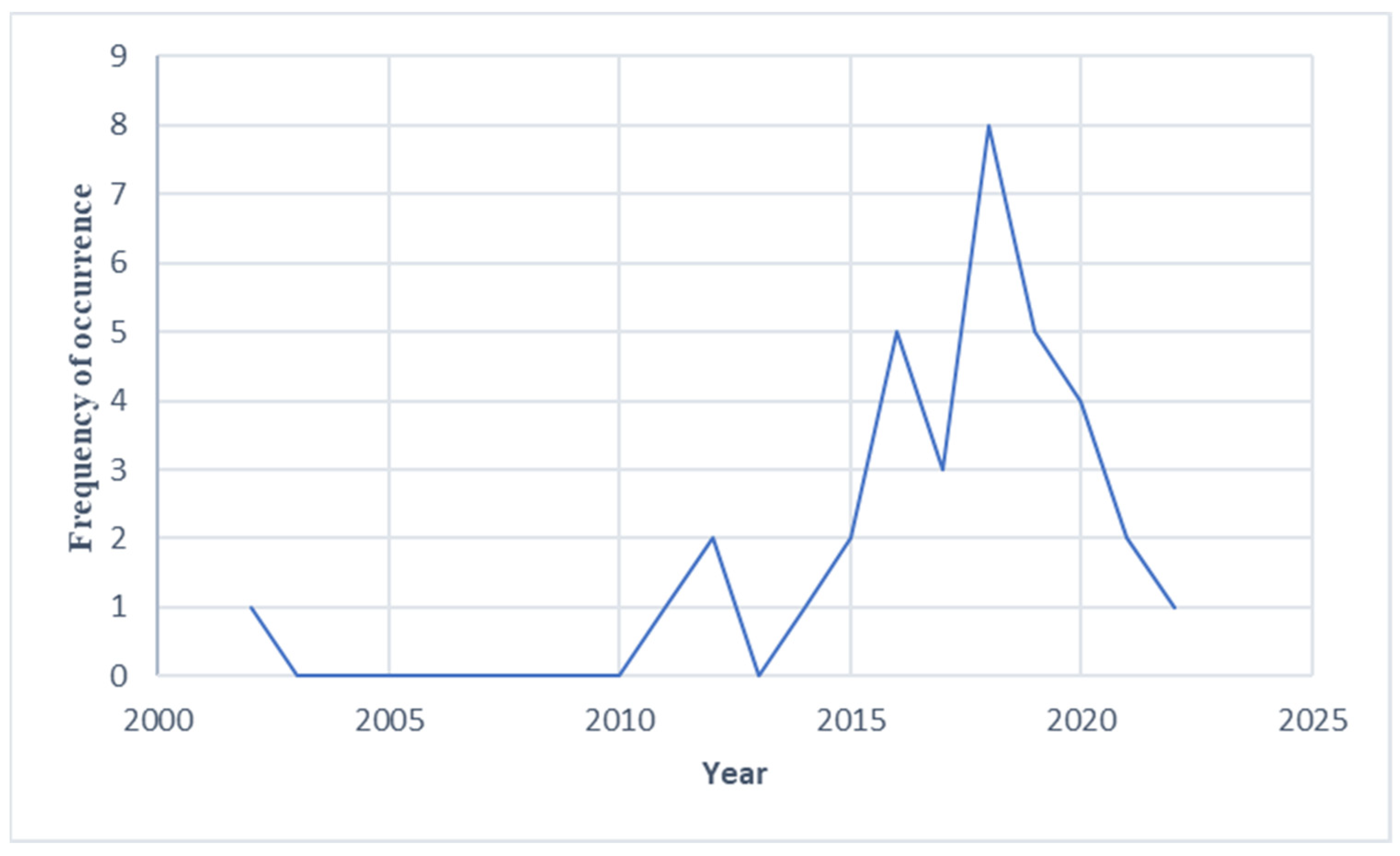
Figure 4 shows hot keywords of 200 papers, and larger font size indicates higher frequency of occurrence.
Figure 4. Hot keywords of these articles.
(2)
Research Logic Analysis of Hot Keywords
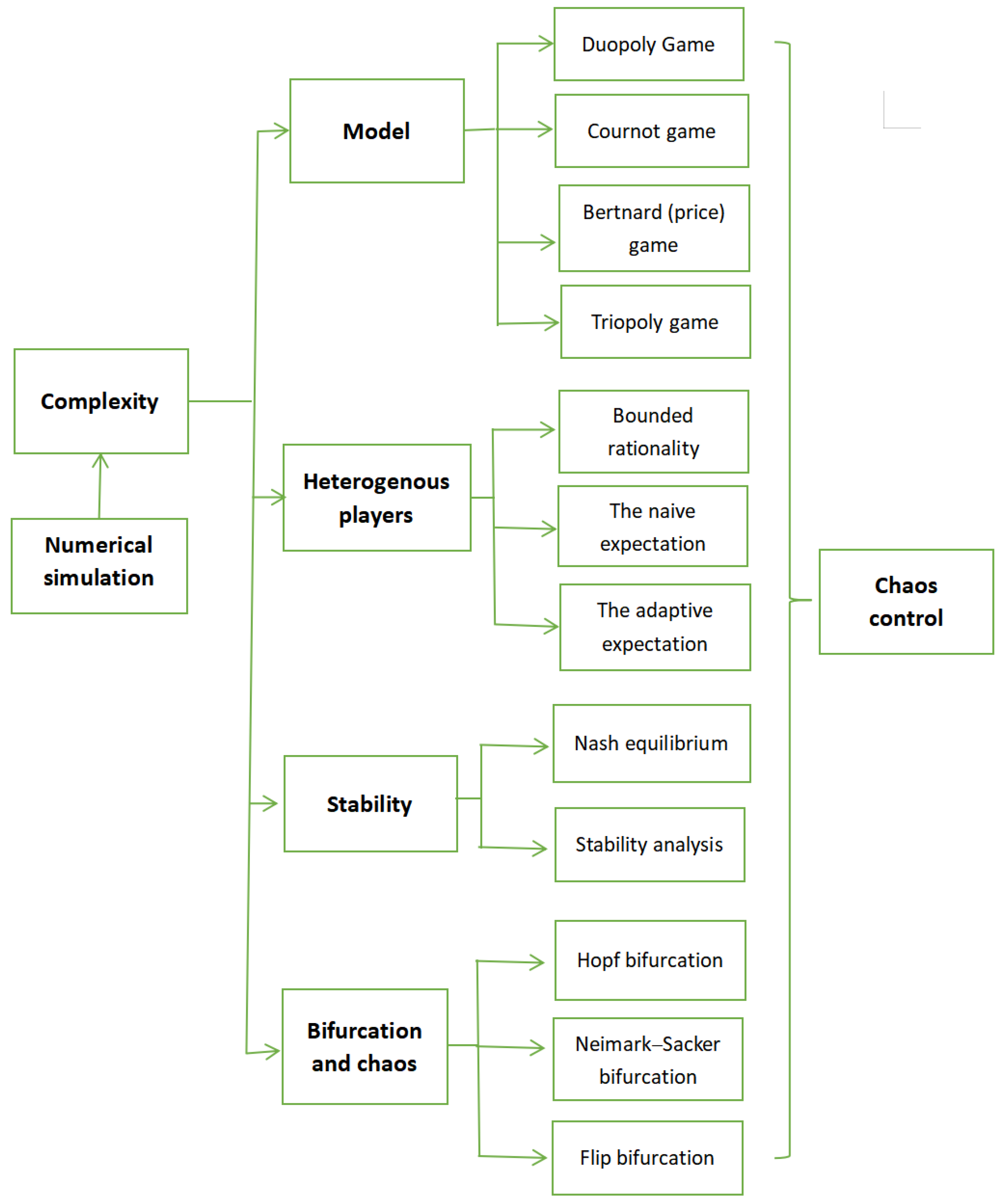
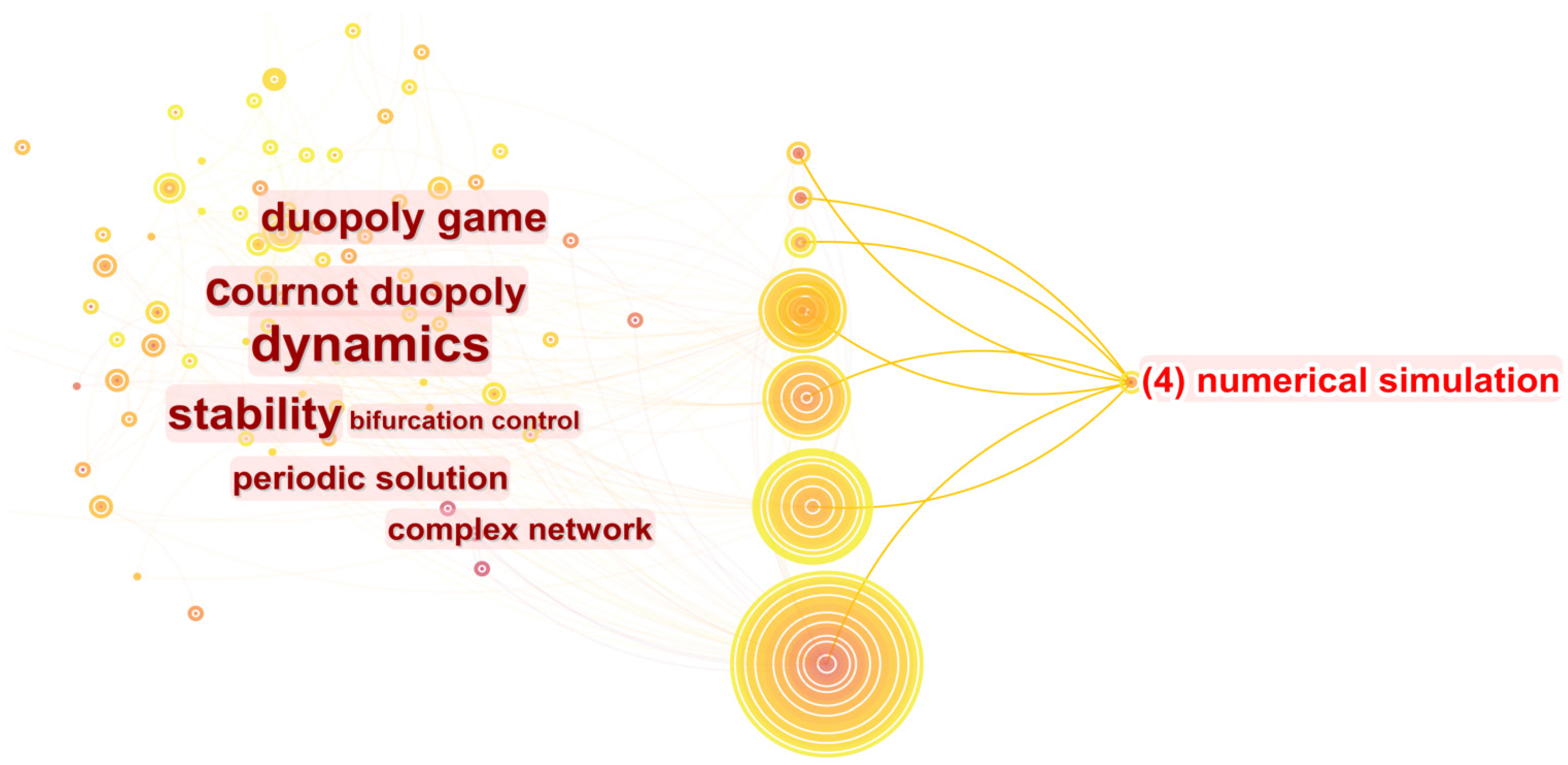
The logical relationship of the research between the hot keywords is represented by Figure 5.
Figure 5. The logical relationship of hot keywords.
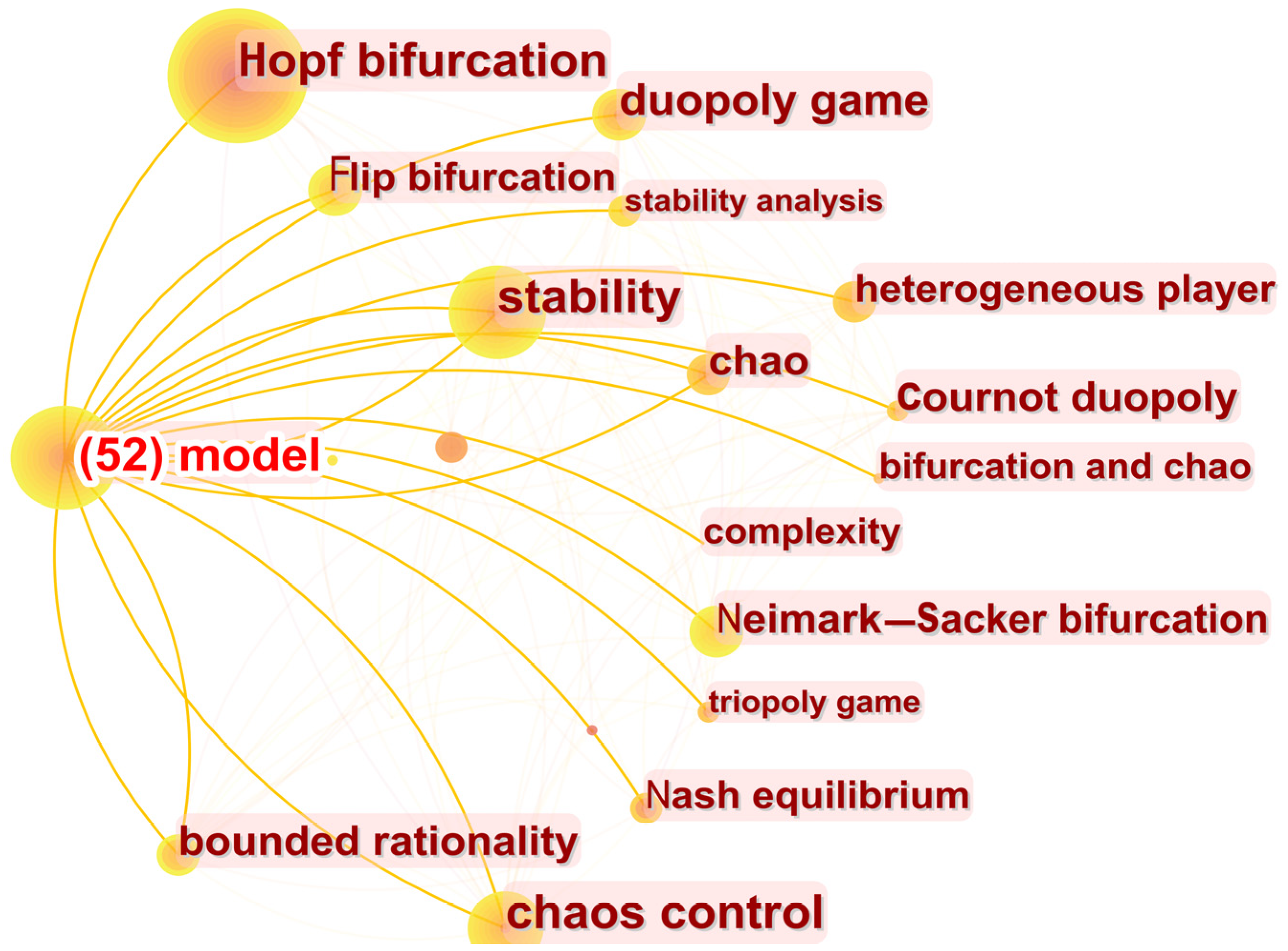
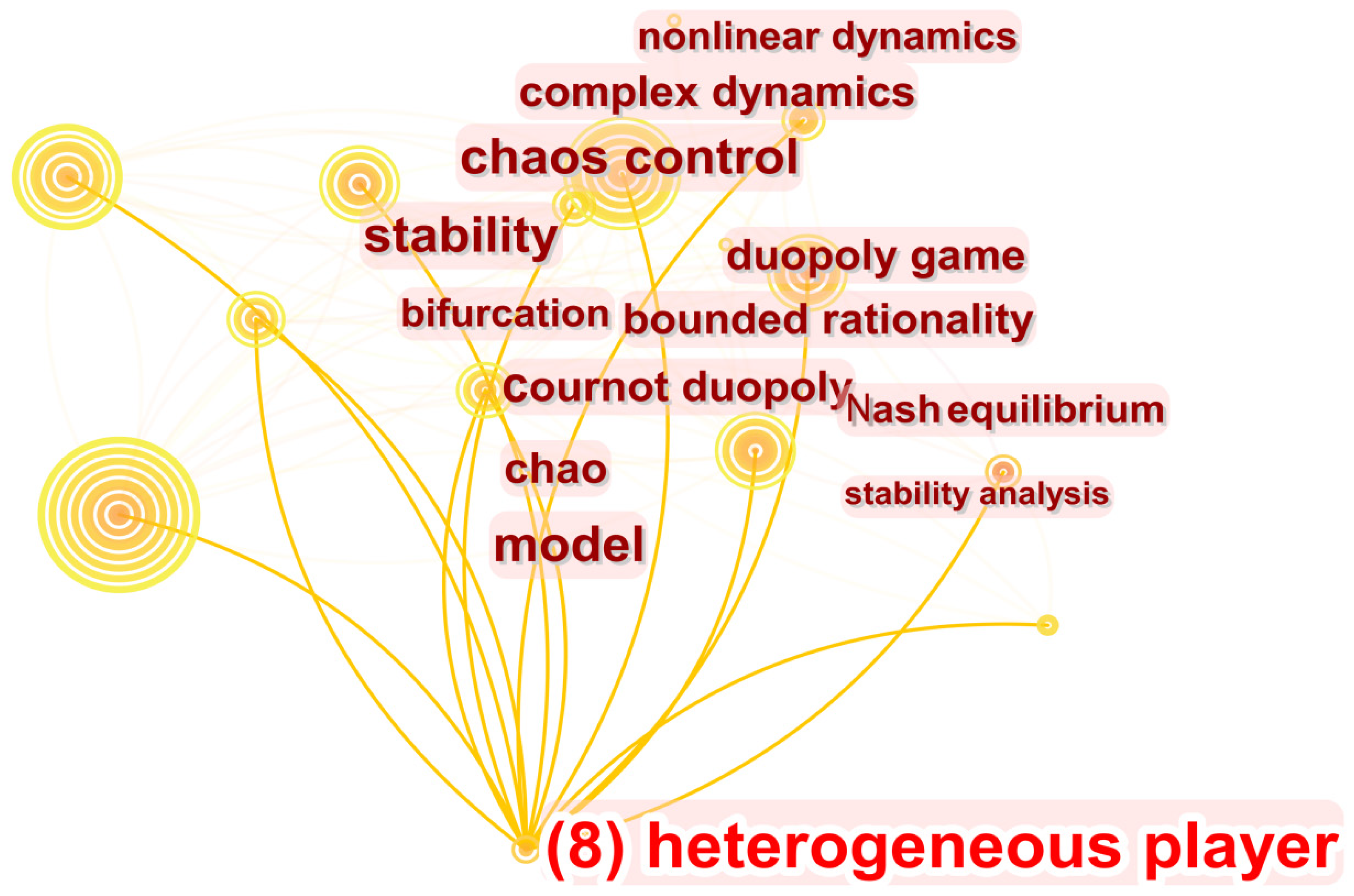
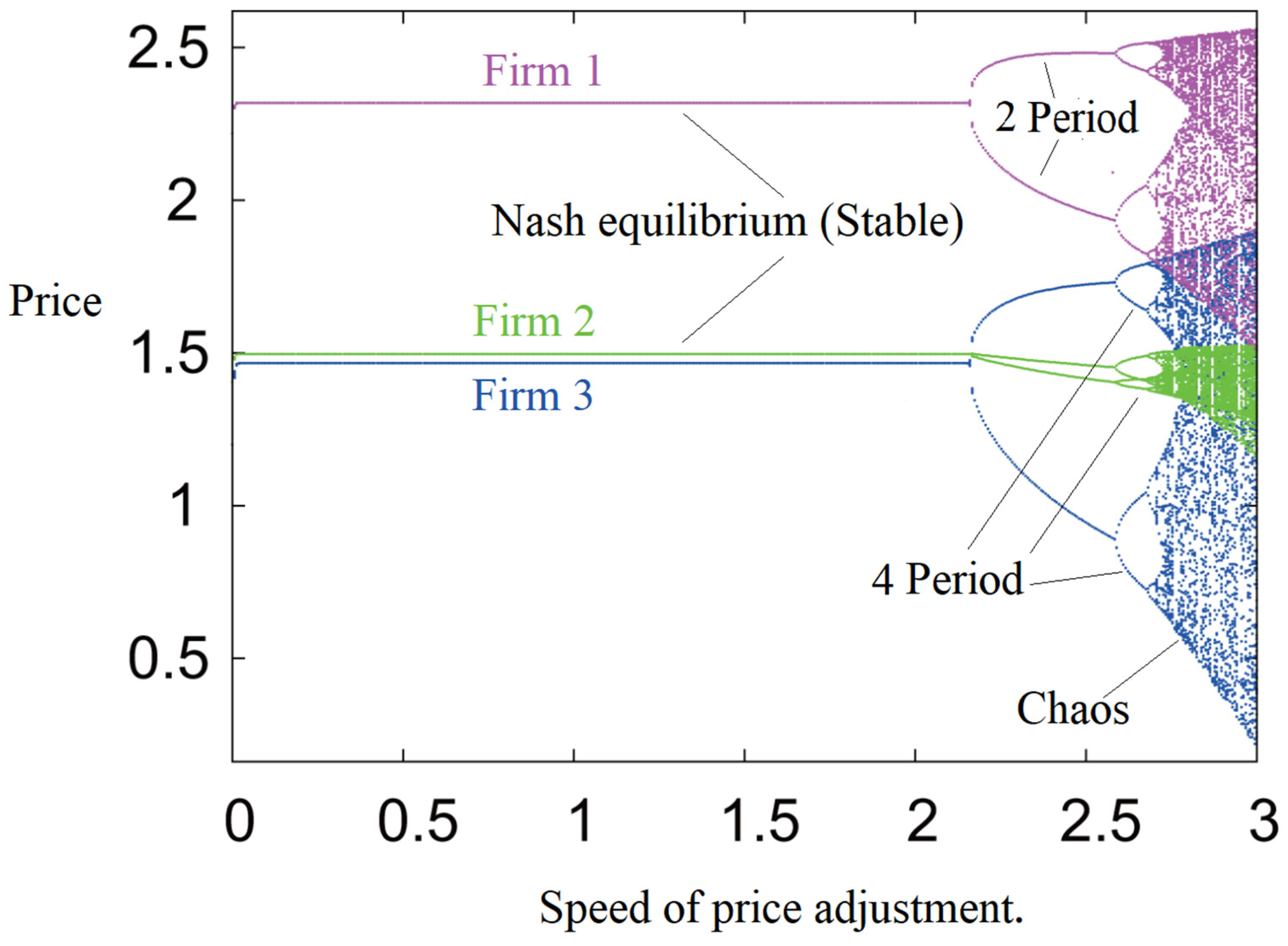
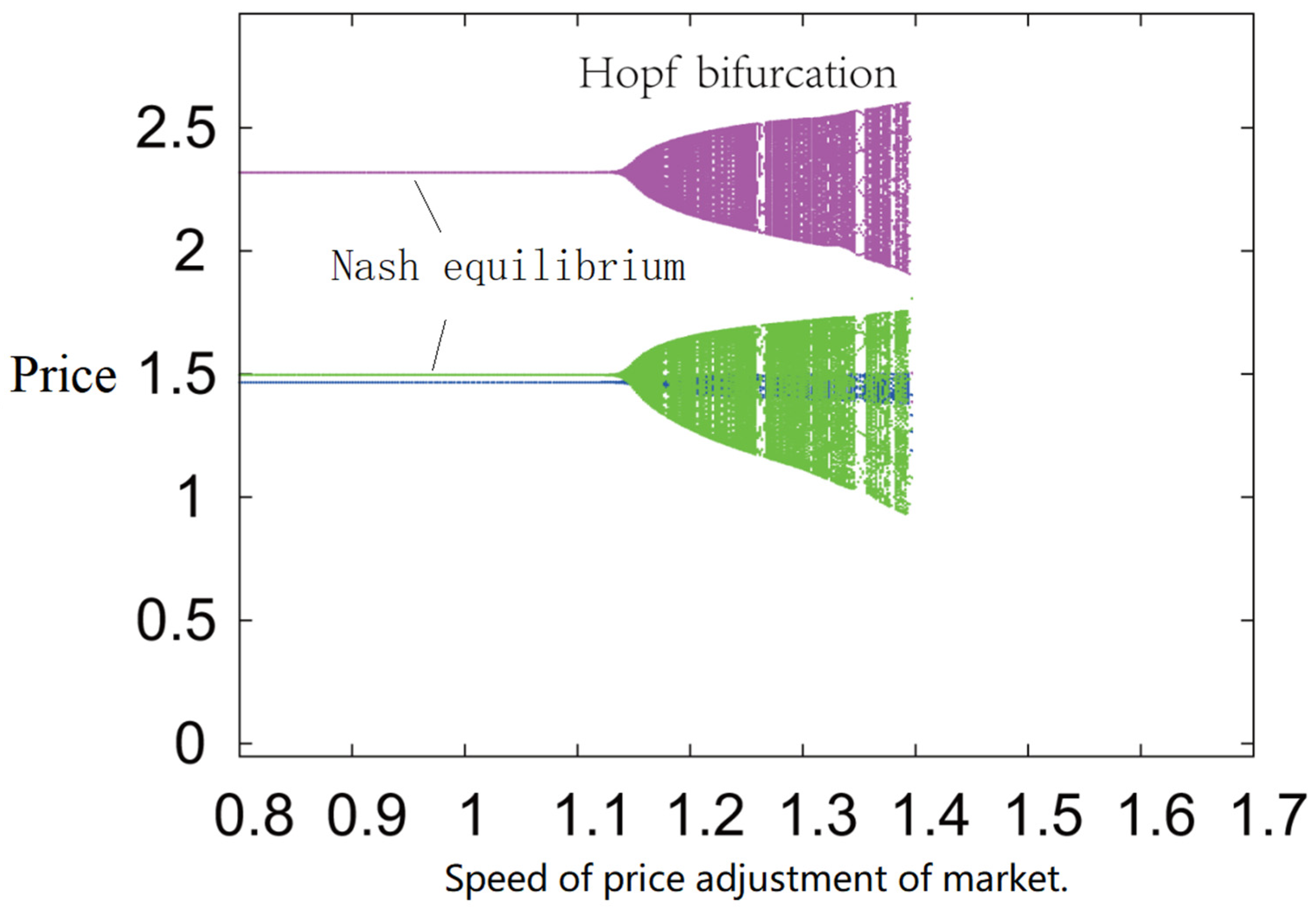
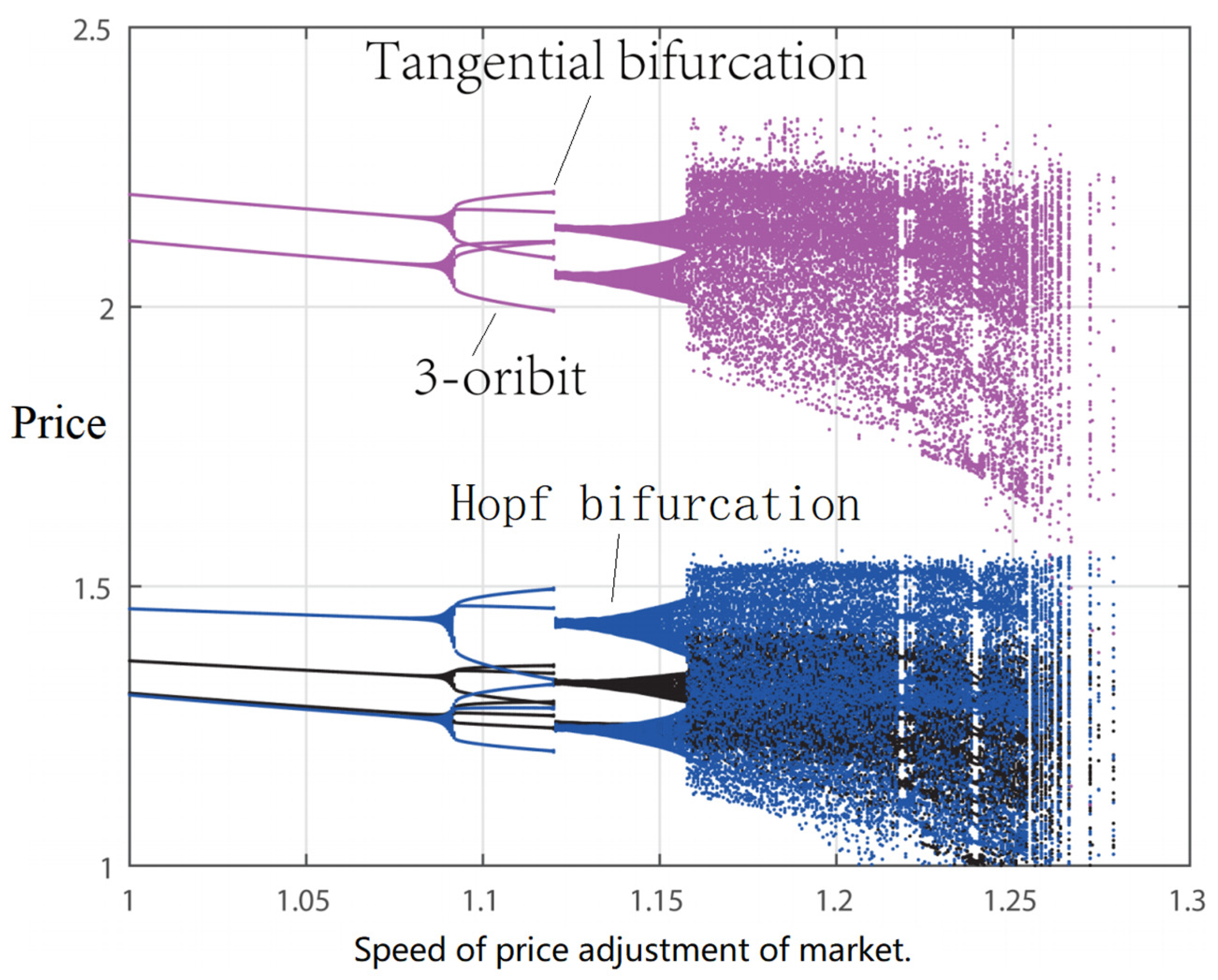
The relationship between hot keywords also reflects the research structure of complex economic games. Firstly, “Numerical simulation” is often used to study complex economics. For example, Lampart and Lampartov [4] studied the control method of heterogeneous Cournot oligopoly by numerical simulation. Ma and Zhang [5] investigated the stability, bifurcation, and chaos in the Chinese insurance market through numerical simulations. Secondly, “model” is the basis for studying complex economic models. The most common models in the literature are “Duopoly game”, “Cournot game”, “price (Bertnard) game”, “Triopoly game”, “Output game”, etc. Thirdly, the “heterogenous players” in the model is important for reasons of complexity, and includes heterogenous expectations [6], variation in goals [7], number of players, etc. Fourthly, the “stability” studies include the “Nash equilibrium” and its ”stability analysis”; the transition path from stable equilibrium to unstable state. Fifthly, when the system breaks stable equilibrium and enters complex fluctuation, the economic model will exhibit periods and bifurcations. The types of bifurcation include Neimark–Sarker bifurcation [8], Hopf bifurcation [9], Flip bifurcation [10], intermittent bifurcation [11], etc. Finally, bifurcation and chaos imply random and unpredictable fluctuations; therefore, chaos control is also a hot topic. In Section 4, the review of the hot keywords bolded in Figure 5 will be carried out.

5. Research Outlook

5.1. Market Expectations Based on Big Data and Artificial Intelligence

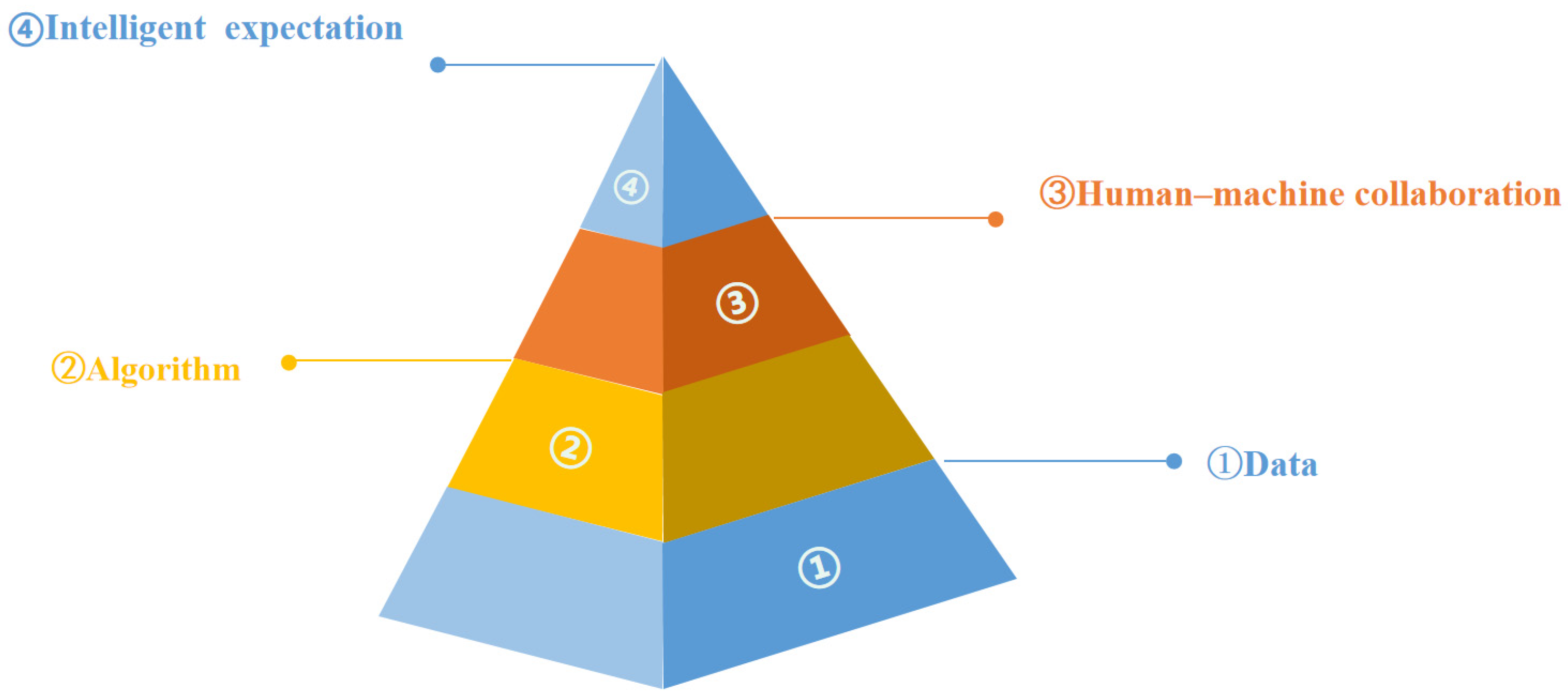
Market expectations are main reasons for complexity, especially the bounded rational expectation; decisions of current production are based on the previous period. By 2023, more than half of GDP will be related to AI-transformed products or services in the world [46]. Big data and AI have changed the structure of market expectations. In this paper, intelligent expectations are defined, based on historical data, as machine learning algorithms that perform case derivation, analogy, statistics to get knowledge, and can estimate the future. Policy makers anticipate the future based on their own experience and the results of AI calculations. The intelligent expectation also reflects the complex characteristics of adaptability, dynamism, and evolution. The basic structure of new expectation rule driven by big data and AI is: “data” → “algorithm” → “human–machine collaboration” → “intelligent expectation”, as Figure 15 shows. Firstly, the right result can be drawn only on the basis of high-quality data. Then, intelligent algorithms are run on the correct data, whereby the effectiveness of the algorithms also directly affects the correctness of decision. Subsequently, when the results are generated, the player makes a decision based on the results given by the AI, which incorporates the player’s preferences and emotions. Finally, a new market expectation of human–machine mixed emerges.
Figure 15. The structure of Intelligent Expectations.
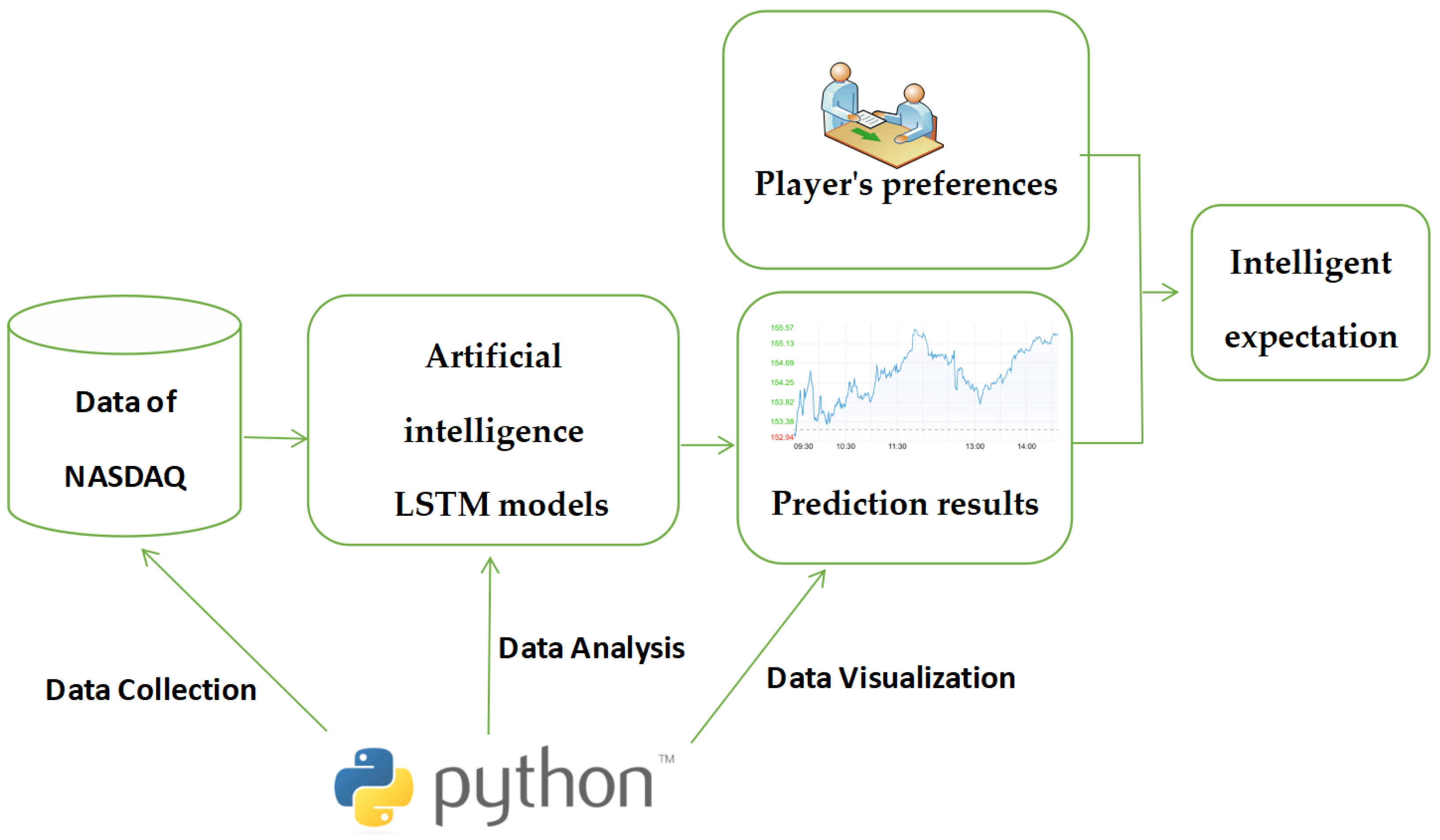
For example, on the GitHub website (an open-source code base), scholars already provide intelligent programs by Python to make predictions for stock markets. For Apple Inc. stock forecasts, the process is as Figure 16 follows: Firstly, the past sequence data of NASDAQ Apple Inc. are collected through Python. Then, artificial intelligence programs, such as LSTM (Long Short-Term Memory) models, are built by Python to analyze the data and give future stock trends. The user considers the AI predictions and personal preferences to make the final decision.
Figure 16. The Intelligent Expectations by Python.
So, what will the new market expectations bring to the economy? It is a subject that needs to be studied urgently.

5.2. Complex Risk of Data Trading

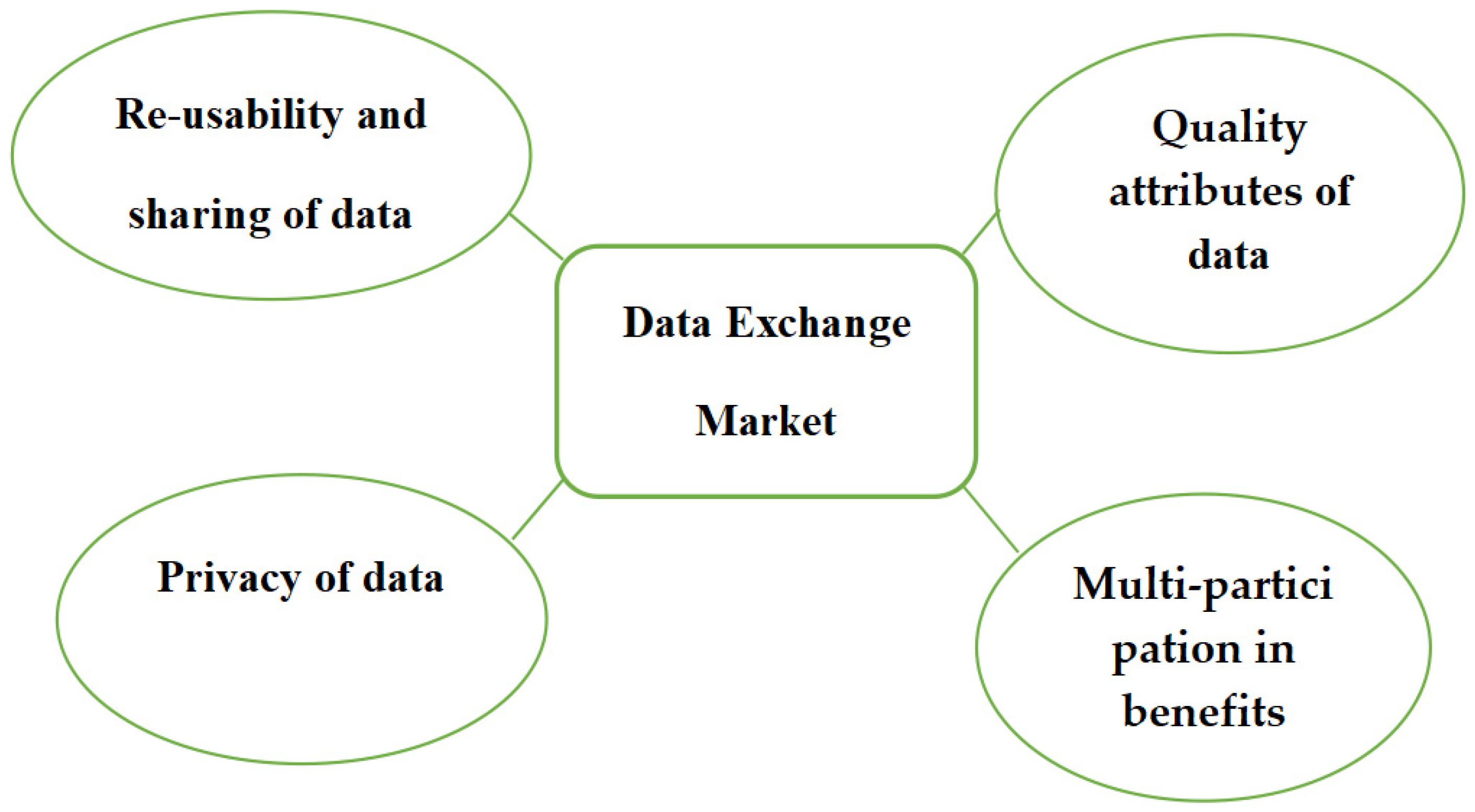
The complex risk of the data trading market is a new issue that needs to be studied. The Internet of Things and cloud computing technologies lead to huge amounts of data that are mined for training artificial intelligence algorithms and supporting decisions. Data are purchased through the data market. Because of the particularity of data product, the data market is different from the ordinary product market: ① the data are reusable and shared. When the data are mined to generate new knowledge and decisions, the original data cannot be consumed and can be reused. ② Data have quality attributes. The collected data need to be preprocessed before it can be used for decisions. Data quality is the basis of decision quality. Better data quality leads to better decisions, which leads to better profits. ③ The benefit distribution in data creation is also different from traditional products. For the final benefit of data, the original data producer and the last data processor should all enjoy the distribution. In addition, data privatization makes the data exchange market lag. The characteristics of data market are shown in Figure 17. The complex dynamics and evolution of the data trading markets is a new research topic.
Figure 17. Data market characteristics.

5.3. Emergency Warning Based on Complexity Theory

A crisis event is uncertain, nonlinear, and difficult to identify. Its occurrence could trigger a new series of crises, via the butterfly effect. Artificial intelligence and the internet have greatly expanded information dissemination and risk derivation channels of emergencies. Typical emergencies were the terrorist attacks on the U.S. World Trade Center and the Pentagon in Washington, D.C. on 11 September 2001. The 911 emergency brought a series of derivative risks to the U.S. and world economies, with the Dow Jones index involving travel, insurance, and aviation plunging and gasoline prices plummeting. The butterfly effect, caused by unexpected events, has imposed a negative impact on the global economy. It is a new research topic using complexity theory to forewarn the derived risks of emergencies. Research can be carried out from the following aspects: ① influencing factors that may trigger derivative risk events; ② the evolutionary path of complex risk and the butterfly effect; ③ chaos risk control, including wave control and system robustness study.

6. The Conclusions

Based on complexity theory, game theory, bibliometrics, and visualization technology, this study provides a review of complex economic games. For 200 articles from 1998 to 2022 in the Web of Science, the study investigates the keyword clusters, hot keywords, and co-occurrence keywords. Subsequently, the logical associations between clusters and the research associations between keywords are given by manual analysis. Finally, future research directions for complex economic games are given: (1) based on historical data, machine learning algorithms perform case derivation, analogy, statistics to get knowledge, and estimate the future. Policy makers anticipate the future based on their own experiences and the results of AI calculations. This intelligent expectation also reflects the complex characteristics of adaptability, dynamism, and evolution. It is a subject that needs to be studied urgently. (2) Data trading markets have special characteristics: data can be shared and reused; data have quality that affects the effectiveness of decisions; and everyone involved in data production should participate in the benefits distribution. Therefore, the complex risks of data trading markets are a new research topic. (3) Uncertainty about emergencies often triggers a series of derivative risks. The influencing factors, evolutionary paths, and control of derivative risks are also issues worthy of study. The innovation of this article lies in the use of big data analysis combined with manual knowledge to overcome the shortcomings of inflexible software analysis and weak manual storage and computation. This research provides a theoretical reference for grasping the research direction and selecting advanced topics.

Author Contributions

Writing—original draft preparation, Visualization Analysis, F.W.; Conceptualizing Complexity, J.M. All authors have read and agreed to the published version of the manuscript.

Funding

This research was supported by the Major Projects of The National Social Science Fund of China: Research on the Information Disclosure Quality of National Major Emergencies (No. 20 & ZD141).

Institutional Review Board Statement

Not applicable.

Data Availability Statement

The data presented in this study are available on request from the corresponding author. The data are not publicly available due to intellectual property reason.

Conflicts of Interest

The authors declare no conflict of interest.

References

  1. Ball, P. Social science goes virtual. Nature 2007, 448, 647–648. [Google Scholar] [CrossRef]
  2. Arthur, W.B. Foundations of complexity economics. Nat. Rev. Phys. 2021, 3, 136–145. [Google Scholar] [CrossRef]
  3. Arthur, W.B. Complexity and the Economy. Science 1999, 284, 107–109. [Google Scholar] [CrossRef]
  4. Lampart, M.; Lampartova, A. Chaos control and anti-control of the heterogeneous cournot oligopoly model. Mathematics 2020, 8, 1670. [Google Scholar] [CrossRef]
  5. Ma, J.H.; Zhang, J.L. Price game and chaos control among three oligarchs with different rationalities in property insurance market. Chao 2012, 22, 043120. [Google Scholar] [CrossRef] [PubMed]
  6. Ma, J.H.; Wu, F. The application and complexity analysis about a high-dimension discrete dynamical system based on heterogeneous triopoly game with multi-product. Nonlinear Dyn. 2014, 77, 781–792. [Google Scholar] [CrossRef]
  7. Wu, F.; Ma, J. The chaos dynamic of multiproduct Cournot duopoly game with managerial delegation. Discret. Dyn. Nat. Soc. 2014, 2014, 206961. [Google Scholar] [CrossRef]
  8. Wu, F.; Ma, J. The equilibrium, complexity analysis and control in epiphytic supply chain with product horizontal diversification. Nonlinear Dyn. 2018, 93, 2145–2158. [Google Scholar] [CrossRef]
  9. Xin, B.; Peng, W.; Guerrini, L. A continuous time Bertrand duopoly game with fractional delay and conformable derivative: Modeling, discretization process, Hopf bifurcation, and chaos. Front. Phys. 2019, 7, 00084. [Google Scholar] [CrossRef]
  10. Zhou, W.; Cao, Y.; Elsonbaty, A.; Elsadny, A.; Chu, T. Bifurcation analysis of a bounded rational duopoly game with consumer surplus. Int. J. Bifurc. Chaos 2021, 31. [Google Scholar] [CrossRef]
  11. Wu, F.; Ma, J.; Li, Y. Complex fluctuation of power price in dual-channel and multienergy supply chain based on sticky expectation. Int. J. Bifurc. Chaos 2021, 31, 206–215. [Google Scholar] [CrossRef]
  12. Forrester, J.W. System dynamics, system thinking and soft OR. Syst. Dyn. Rev. 1994, 10, 1–14. [Google Scholar] [CrossRef]
  13. Holland, J. Adaptation in Natural and Artificial Systems: An Introductory Analysis with Application to Biology, Control, and Artificial Intelligence; University of Michigan Press: Michigan, USA, 1975; pp. 1–20. [Google Scholar]
  14. Warfield, J.N. Societal systems planning, policy and complexity. J. Cybern. 1978, 8, 113–115. [Google Scholar] [CrossRef]
  15. Magda, F. The Santa Fe Perspective on Economics: Emerging patterns in the science of complexity. Cesmep Work. Pap. 2009, 18, 183–212. [Google Scholar] [CrossRef]
  16. Xin, B.G.; Peng, W.; Kwon, Y. A discrete fractional-order Cournot duopoly game. Phys. -Stat. Mech. Its Appl. 2020, 558, 124993. [Google Scholar] [CrossRef]
  17. Ledvina, A.; Sircar, R. Dynamic Bertrand oligopoly. Appl. Math. Optim. 2011, 63, 11–44. [Google Scholar] [CrossRef]
  18. Askar, S.S. Tripoly Stackelberg game model: One leader versus two followers. Appl. Math. Comput. 2018, 328, 301–311. [Google Scholar] [CrossRef]
  19. Xin, B.G.; Chen, T. On a master-slave Bertrand game model. Econ. Model. 2011, 28, 1864–1870. [Google Scholar] [CrossRef]
  20. Cavalli, F.; Naimzada, A. Complex dynamics and multistability with increasing rationality in market games. Chaos Solitons Fractals 2016, 93, 151–161. [Google Scholar] [CrossRef]
  21. Elsadany, A.A.; Awad, A.M. Dynamical analysis and chaos control in a heterogeneous Kopel duopoly game. Indian J. Pure Appl. Math. 2016, 47, 617–639. [Google Scholar] [CrossRef]
  22. Si, F.; Ma, J. Complex dynamics in a triopoly game with multiple delays in the competition of green product level. Int. J. Bifurc. Chaos 2018, 28, 1850027. [Google Scholar] [CrossRef]
  23. Ma, J.; Ren, W. Complexity and Hopf bifurcation analysis on a kind of fractional-order IS-LM macroeconomic system. Int. J. Bifurc. Chaos 2016, 26, 1650181. [Google Scholar] [CrossRef]
  24. Ma, J.; Tu, H. Analysis of the stability and Hopf bifurcation of money supply delay in complex macroeconomic models. Nonlinear Dyn. 2013, 76, 497–508. [Google Scholar] [CrossRef]
  25. Yang, H.; Yang, S.; Zhao, J.; Dong, Z. Complex dynamics and chaos control of electricity markets with heterogeneous expectations. Int. Trans. Electr. Energy Syst. 2013, 24, 1047–1064. [Google Scholar] [CrossRef]
  26. Wu, F.; Ma, J. Evolution dynamics of agricultural internet of things technology promotion and adoption in China. Discret. Dyn. Nat. Soc. 2020, 2020, 1854193. [Google Scholar] [CrossRef]
  27. Garmani, H.; Omar, D.A.; El Amrani, M.; Baslam, M.; Jourhmane, M. A dynamic duopoly game with content providers bounded rationality. Int. J. Bifurc. Chaos 2020, 30, 2050095. [Google Scholar] [CrossRef]
  28. Zhou, W.; Li, H. Complex dynamical behaviors in a Bertrand game with service factor and differentiated products. Nonlinear Dyn. 2021, 106, 2739–2759. [Google Scholar] [CrossRef]
  29. Peng, Y.; Xiao, Y.; Lu, Q.; Wu, X.; Zhao, Y. Chaotic dynamics in Cournot duopoly model with bounded rationality based on relative profit delegation maximization. Phys. A Stat. Mech. Appl. 2020, 560, 125174. [Google Scholar] [CrossRef]
  30. Xiao, Y.; Peng, Y.; Lu, Q.; Wu, X. Chaotic dynamics in nonlinear duopoly Stackelberg game with heterogeneous players. Phys. A: Stat. Mech. Its Appl. 2018, 492, 1980–1987. [Google Scholar] [CrossRef]
  31. Sun, Z.; Ma, J. Complexity of triopoly price game in Chinese cold rolled steel market. Nonlinear Dyn. 2011, 67, 2001–2008. [Google Scholar] [CrossRef]
  32. Rump, C.M.; Stidham, S. Stability and Chaos in input pricing for a service facility with adaptive customer response to congestion. Manag. Sci. 1998, 44, 246–261. [Google Scholar] [CrossRef]
  33. Ilk, N.; Shang, G.; Fan, S.; Zhao, J.L. Stability of transaction fees in Bitcoin: A supply and demand perspective. MIS Q. 2021, 45, 563–692. [Google Scholar] [CrossRef]
  34. Sarafopoulos, G.; Papadopoulos, K. Complexity of a Bertrand duopoly game with homogeneous expectations, quadratic cost functions and chaos control. IFAC-Papers OnLine 2021, 54, 41–46. [Google Scholar] [CrossRef]
  35. Askar, S.S.; Al-Khedhairi, A. A Remanufacturing duopoly game based on a piecewise nonlinear map: Analysis and Investigations. Int. J. Nonlin. Sci. Num. 2020, 21, 549–561. [Google Scholar] [CrossRef]
  36. Zhang, Y.H.; Zhou, W.; Chu, T.; Chu, Y.D.; Yu, J.N. Complex dynamics analysis for a two-stage Cournot duopoly game of semi-collusion in production. Nonlinear Dyn. 2018, 91, 819–835. [Google Scholar] [CrossRef]
  37. Long, J.; Zhao, H. Stability of equilibrium prices in a dynamic duopoly Bertrand game with asymmetric information and cluster spillovers. Int. J. Bifurcat. Chaos 2021, 31, 2150240. [Google Scholar] [CrossRef]
  38. Li, W.N.; Elsadany, A.; Zhou, W.; Zhu, Y.-L. Global analysis, multi-stability and synchronization in a competition model of public enterprises with consumer surplus. Chaos Solitons Fractals 2021, 143, 110604. [Google Scholar] [CrossRef]
  39. Li, H.; Zhou, W.; A Elsadany, A.; Chu, T. Stability, multi-stability and instability in Cournot duopoly game with knowledge spillover effects and relative profit maximization. Chaos Solitons Fractals 2021, 146, 110936. [Google Scholar] [CrossRef]
  40. Awad, A.M.; Askar, S.S.; Elsadany, A.A. Complex dynamics investigations of a mixed Bertrand duopoly game: Synchronization and global analysis. Nonlinear Dyn. 2022, 107, 3983–3999. [Google Scholar] [CrossRef]
  41. Kabir, K.M.A.; Kuga, K.; Tanimoto, J. The impact of information spreading on epidemic vaccination game dynamics in a heterogeneous complex network-A theoretical approach. Chaos Solitons Fractals 2019, 132, 960–979. [Google Scholar] [CrossRef]
  42. Gao, Q.; Ma, J.H. Chaos and Hopf bifurcation of a finance system. Nonlinear Dyn. 2009, 58, 209–216. [Google Scholar] [CrossRef]
  43. Shi, J.; He, K.; Fang, H. Chaos, Hopf bifurcation and control of a fractional-order delay financial system. Math. Comput. Simul. 2022, 194, 248–364. [Google Scholar] [CrossRef]
  44. Li, P.; Yan, J.; Xu, C.; Gao, R.; Li, Y. Understanding dynamics and bifurcation control mechanism for a fractional-order delayed duopoly game model in insurance market. Fractal Fract. 2022, 6, 270. [Google Scholar] [CrossRef]
  45. Peng, Y.; Lu, Q. Complex dynamics analysis for a duopoly Stackelberg game model with bounded rationality. Appl. Math. Comput. 2015, 271, 259–268. [Google Scholar] [CrossRef]
  46. Global IT Industry Outlook 2020. Available online: http://m.thepaper.cn/baijiahao_4917518 (accessed on 8 November 2019).

Disclaimer/Publisher’s Note: The statements, opinions and data contained in all publications are solely those of the individual author(s) and contributor(s) and not of MDPI and/or the editor(s). MDPI and/or the editor(s) disclaim responsibility for any injury to people or property resulting from any ideas, methods, instructions or products referred to in the content.

Article Metrics

Citations

Article Access Statistics

Multiple requests from the same IP address are counted as one view.