


Abstract
A fourth-order energy preserving composition scheme for multi-symplectic structure partial differential equations have been proposed. The accuracy and energy conservation properties of the new scheme were verified. The new scheme is applied to solve the multi-symplectic sine-Gordon equation with periodic boundary conditions and compared with the corresponding second-order average vector field scheme and the second-order Preissmann scheme. The numerical experiments show that the new scheme has fourth-order accuracy and can preserve the energy conservation properties well.
Keywords:
average vector field method; multi-symplectic structure; Fourier pseudo-spectral method; sine-Gordon equation MSC:
37K05; 65M20; 65M70
1. Introduction
The symplectic geometric algorithm for the Hamiltonian system can accurately simulate the evolution of the system over a long period, which preserves the energy conservation of the system [1,2,3,4,5,6]. Marsden et al. [7,8,9] proposed the multi-symplectic method of the partial differential equations (PDE) with the multi-symplectic structure, which can also calculate the equations accurately for a long time and approximately preserve the energy conservation property. Multi-symplectic algorithm has been successfully applied to solve several important equations [10,11,12,13]. Recently, energy-preserving methods for Hamiltonian systems and multi-symplectic structure PDE have received much attention. Celledoni et al. proposed the second-order and higher-order average vector field (AVF) method to the Hamiltonian system, which can preserve the energy conservation of the Hamiltonian system exactly [14,15,16]. At the same time, the second order AVF method has also been proposed to solve the multi-symplectic structure PDE, which can also preserve the energy conservation [17]. However, few people study the high order energy preserving method of the multi-symplectic PDE structures.
Composition method is a class of important method to construct high order scheme of the differential equation. The method of forming multi-level high order schemes with the combination of low order invertible schemes was proposed by Ruth and Yoshida [18,19]. Ruth constructed three order three level composition schemes for the separate Hamiltonian system. Yoshida constructed the high order explicit difference scheme of separable Hamiltonian system. Qin extended the Yoshida’s composition method to the general non-Hamiltonian systems [20,21]. In this paper, we propose a fourth order energy preserving scheme of the multi-symplectic structure PDE by the composition method based on the second order energy preserving average vector field scheme of the multi-symplectic PDE. The new fourth order energy preserving composition scheme is applied to solve the sine-Gordon equation.
This paper is organized as following. In Section 2, the second order multi-symplectic energy-preserving scheme and the fourth order multi-symplectic energy preserving composition scheme are proposed. In Section 3, the sine-Gordon equation is discretizated in spacial direction by the pseudo-spectral method. Then the two energy preserving schemes for the multi-symplectic sine-Gordon equation are proposed by applying the second order AVF method and the fourth order composition AVF method, respectively. In Section 4, the numerical experiments are reported. The accuracy and energy conservation property of the second order AVF scheme and the fourth order composition AVF scheme of the multi-symplectic sine-Gordon equations are investigated compared with the corresponding second order multi-symplectic scheme. At last, we finish the paper with conclusive remarks in Section 5.
2. Multi-Symplectic Discretization for the Partial Differential Equations
Many partial differential equations can be written as the following multi-symplectic structure
where and are skew symmetric matrices, is a scalar smooth function and , ∇ is the gradient of a function [7,8].
2.1. Spatial Discretization for the Partial Differential Equations
Equation (1) can be discretizated in spatial direction by the Fourier pseudo-spectral method [22]. Suppose is a function with , the interval is divided into N equal subintervals, where the integer N is an even number. Denoting , the spatial collocation nodes are given by where is the space step. Let be the approximation of .
Let be the interpolation space. The function is the trigonometric polynomial explicitly given by
where and . The interpolation operator is defined as
Therefore, we have
where
By differentiating (3), the k order derivative of the operator at nodes reads
where is a spectral differential matrix with elements
and .
We can obtain explicitly
In particular, , if k is an odd number.
2.2. Second Order Energy-Preserving Scheme for Multi-Symplectic PDE
Applying the second order AVF method to Equation (9), we can obtain that
where is the time step. It can also be written as
The scheme (11) is consistent with the second order global energy preserving scheme [17]. However, the accuracy of the scheme has not been proved. We prove the accuracy and energy conservation property of the scheme in a new way.
Theorem 1.
Scheme (10) has second order accuracy.
Proof.
Let , , the skew symmetric matrix can be transformed into a diagonal matrix with diagonal element 1 and 0 on diagonal line by a similar transformation [23]. We can get , is a invertible matrix. Equation (9) is equivalent to
Let , , so Equation (12) is equivalent to
where Equation (13) is equivalent to Equation (9). So Equation (10) can be written as
Equations (10) and (14) have the same accuracy. So we can only prove Equation (14) has the second order accuracy.
We give the following partial derivatives definition
where
The corresponding Taylor expansion of can be written as
Theorem 2.
Equation (10) can preserve the energy conservation property.
Proof.
Since is a skew symmetric matrix, it is obvious that
So Equation (10) can preserve the energy conservation property. □
2.3. Fourth Order Energy Preserving Schemes for Multi-Symplectic PDE
The scheme (25) has second order accuracy.
Qin et al. [20] proposed the following composition scheme
When the coefficients , is satisfied, it is proved that the scheme (26) has the fourth order accuracy [20].
We propose a new fourth order energy preserving scheme of Equation (9) based on the second order scheme (10) by the composition method
where , .
The function is expanded at , the Taylor expansion is obtained,
So Equation (30) can be written as
Theorem 3.
Scheme (28) has the fourth order accuracy.
Proof.
The composition scheme (28) can be written as
Multiplying to both side of the equation, we will obtain
expand to s fourth order to calculate their Taylor expansion
The integral appears on the right part of (35), so it should be replaced by its Taylor expansion until it does not appear on the right part. So
The integral and can be expanded by the same method. So
The integral in (37) can be replaced by its Taylor expansion. The final solution is
The integral can be calculated by the same method, the solution is
The integral and in (39) can be replaced by its Taylor expansion. The final solution is
Suppose and Equation (33) is compared with Equation (32), if the following equations are satisfied, Equation (33) can have the fourth order accuracy.
When the above Equations (41) are equivalent to
We can obtain that , .
The coefficients are the same as the coefficients of the Qin composition method. So
We can get , that is .
Theorem 4.
Scheme (27) can preserve the energy conservation property.
Proof.
We only consider the first equation of scheme (27). Since is a skew symmetric matrix, it is obvious that
3. Discrete Schemes of Multi-Symplectic Sine-Gordon Equation
The sine-Gordon equation is an important nonlinear equation of mathematical physics discovered in the 19th century. It has multiple soliton solutions and preserves the energy conservation of the system. The sine-Gordon solitary wave equation is widely used in scientific and engineering problems, such as the motion of a rapid pendulum attached to a stretched wire, nonlinear optics, and can be used to describe many physical phenomena in fields of fluid mechanics, meteorology, and field theory [24,25]. Many scholars applied the numerical methods to solve sine-Gordon equation [26]. Vu-Quoc et al. [27,28] proposed the finite difference scheme of energy momentum conservation of wave equations. McLachlan et al. simulated the evolution of wave equations by symplectic geometry algorithm [29]. We consider the sine-Gordon equation
Let , , the equation satisfies the following energy conservation law [26]
where I stands for energy, c is a constant. Additionally, the equation is equivalent to
and are skew symmetric matrices, is a scalar smooth function. Equation (45) satisfies the following multi-symplectic conservation law
where , , and ∧ is the exterior product.
Suppose two functions and , the exterior product of and is defined as
which is the orient area of the image of the parallelogram with sides and on the , plane. The exterior product of the differential form is defined in the same way. The detailed property of the exterior product can be found in [30].
Applying the Fourier pseudo-spectral method to Equation (48) in spatial direction, the interval is divided into N equal subintervals, we can obtain
where , , , are similar as , ,
is a N-th identity matrix, is a N-th zero matrix, is a N-th spectral differential matrix, .
3.1. Second Order AVF Scheme for Sine-Gordon Equation
Applying the second order AVF method to Equation (51) in time direction, we can obtain the discrete scheme of Equation (45), that is
where is the time step. The scheme (53) can maintain global energy conservation of Equation (45). Equation (53) produces the following singular integrals in the calculation
In 2007, Iavernaro et al. [31] proposed Boole discrete line integral method based on AVF method of the Hamilton system. The AVF scheme can be written as
where is the time step, . Suppose the initial value at is , the numerical solution at is , and the simplest path to connect and is
Applying the Boole integral to the integral term on format (55), let , we can obtain the following Boole discrete line integral scheme
where , . ( is the set of polynomials whose highest degree is less than v). So the integrand of the format (57) has degrees. It can calculate the format (57) exactly. In this case, it is equivalent to a Newton–Coates formula based on the equal distance abscissa of v on the interval of . When , the Boole discrete line integral format can be obtained that
The discrete scheme (59) is equivalent to the following scheme
.
3.2. Fourth Order Composition AVF Scheme for Sine-Gordon Equation
Applying the fourth order composition AVF method to Equation (51) in time direction, we can obtain the discrete scheme of Equation (45), that is
Using the Boole discrete line integral method, the discrete scheme (62) is equivalent to the following scheme
. , are similar as .
The corresponding second order Preissmann scheme of sine-Gordon equation is also given. That is
4. Numerical Experiments
In this section, numerical experiments for the sine-Gordon equation with periodic boundary conditions are presented to investigate the relative energy error and accuracy of convergence. The discrete energy corresponding to (46) can be expressed as .
The energy error at is defined as
where is the initial energy, is the energy value at . The maximal module error of numerical solution and exact solution is defined as
The order of convergence is defined as
4.1. Numerical Experiments for Single Solitary Wave
Firstly, we consider the motion of single solitary wave. Equation (45) has the exact solution [32,33]
where , , , the initial condition is obtained when in Equation (70).
Table 1 shows the maximal module error of numerical solution and exact solution and the order of convergence of the different schemes with different time steps at . It is easy to see that the orders of convergence of fourth order energy preserving composition AVF scheme is almost equal to 4, and the orders of convergence of second order AVF scheme and second order Preissman method are almost equal to 2. The fourth order energy preserving composition AVF scheme is more accurate than the second order AVF scheme and second order Preissman method, this result is consistent with the theory.

Table 1.
The errors and the order of convergence of three different schemes with and different time steps at .
Scheme 1 is the second order Preissman scheme, Scheme 2 is the second order AVF scheme, and Scheme 3 is the fourth order composition AVF scheme.
Figure 1 shows the evolution of single solitary waves in . The numerical solution obtained from the fourth order energy-preserving composition AVF scheme can well simulate the single solitary wave. Figure 2a shows the energy error obtained from the second order AVF scheme. Figure 2b shows the energy error obtained from the fourth order composition AVF scheme. Figure 2c shows the energy error obtained from the second order Preissman scheme. It is obvious that the second order AVF scheme and the fourth order composition AVF scheme can preserve the energy conservation accurately, the second order Preissman scheme only can preserve the energy conservation approximatively.
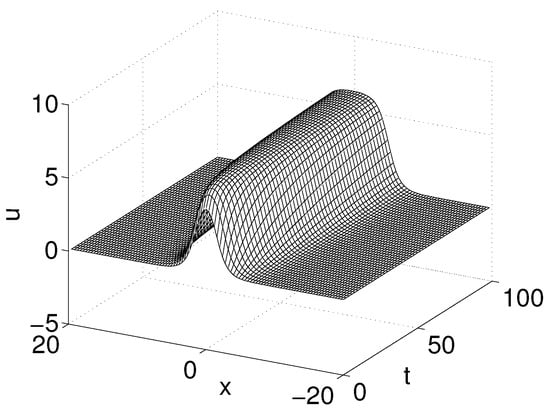
Figure 1.
The numerical solutions from to with and .
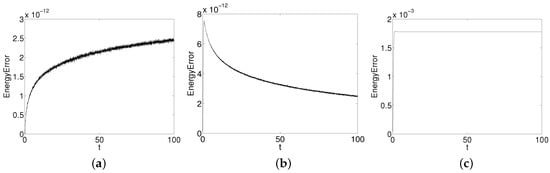
Figure 2.
The double solitary wave’s energy error of second order AVF method, fourth order composition method and second order Preissman method in with , . (a) AVF method; (b) composition method; and (c) Preissman method.
4.2. Numerical Experiments for Kink and Anti-Kink Solitary Waves
In this section, we consider the collision behavior of kink and anti-kink solitary waves. Equation (45) has the exact solution
where , , , , , the initial condition is obtained when in Equation (71).
Table 2 shows the maximal module error of numerical solution and exact solution and the order of convergence of the different schemes with different time steps at . It is easy to see that the orders of convergence of fourth order energy preserving composition AVF scheme is close to 4, and the orders of convergence of second order AVF scheme and second order Preissman method are almost equal to 2. The fourth order energy preserving composition AVF scheme is more accurate than the second order AVF scheme and second order Preissman method, this result is consistent with the theory.
Table 2.
The errors and the order of convergence of three different schemes with and different time steps at .
Scheme 1 is the second order Preissman scheme. Scheme 2 is the second order AVF scheme. Scheme 3 is the fourth order composition AVF scheme.
Figure 3 shows the collision behavior of kink and anti-kink solitary waves with time, the fourth order composition AVF scheme can simulate the waves well. As can be seen from Figure 4a, the error of energy is very small, almost close to zero, the second order AVF scheme can preserve the energy conservation well. Figure 4b shows the error of energy from fourth order composition scheme, we can see that the scheme can preserve the energy accurately. From Figure 4c, the error of energy is . This shows that the second order Preissman scheme can only approximately maintain the energy conservation of the equation.
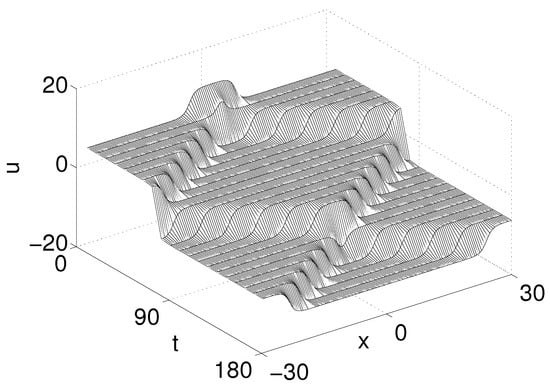
Figure 3.
The numerical solutions from to with and .
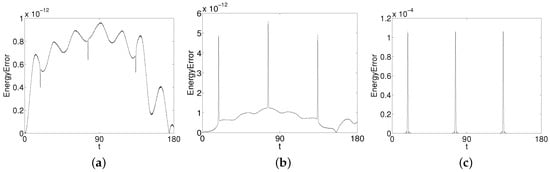
Figure 4.
The kink and anti-kink solitary waves energy error of second order AVF method, fourth order composition method and second order Preissman method in with , . (a) AVF method; (b) composition method; and (c) Preissman method.
5. Concluding Remarks
In this paper, a new fourth order energy preserving composition scheme for the multi-symplectic structure PDE is proposed based on the second other AVF method. The new fourth order composition AVF scheme of sine-Gordon equation is compared with the corresponding second order AVF scheme and the second order Preissman scheme. Numerical results showed that the fourth order composition AVF scheme of sine-Gordon equation can have the fourth order accuracy and preserve the energy conservation property. The fourth order energy preserving scheme of the multi-symplectic structure PDE can also be applied to other multi-symplectic structure PDE.
Author Contributions
Methodology, J.S.; Validation, J.Z.; Formal analysis, J.K. All authors have read and agreed to the published version of the manuscript.
Funding
The work is supported by the Natural Science Foundation of China (Grant Nos.11961020, 11561018, 41974114).
Conflicts of Interest
The authors declare no conflict of interest.
References
- Blanes, S.; Casas, F.; Ros, J. Symplectic intergrators with processing: A general study. SIAM J. Sci. Comput. 1999, 21, 711–727. [Google Scholar] [CrossRef]
- Calvo, M.P.; Sanz-Serna, J.M. The development of variable-step symplectic integrators, with applications to the two-body problem. SIAM J. Sci. Comput. 1993, 14, 936–952. [Google Scholar] [CrossRef]
- Candy, J.; Rozmus, W. A symplectic integration algorithm for separable Hamiltonian functions. J. Comput. Phys. 1991, 92, 230–256. [Google Scholar] [CrossRef]
- Feng, K.; Wu, H.M.; Qin, M.Z.; Wang, D.L. Construction of canonical difference schemes for Hamiltonian formalism via generating functions. J. Comput. Math. 1989, 7, 71–96. [Google Scholar]
- Sun, J.Q.; Gu, X.Y.; Ma, Z.Q. Numerical study of the soliton waves of the coupled nonlinear Schrödinger system. Phys. D Nonlinear Phenom. 2004, 196, 311–328. [Google Scholar] [CrossRef]
- Van de Vyver, H. A fourth order symplectic exponentially fitted integrator. Comput. Phys. Commun. 2006, 174, 255–262. [Google Scholar] [CrossRef]
- Bridges, T.J. Multi-symplectic structures and wave propagation. Math. Proc. Camb. Philos. Soc. 1997, 121, 147–190. [Google Scholar] [CrossRef]
- Marsden, J.E.; Shkoller, S. Multi-symplectic geometry, covariant Hamiltonians and water waves. Math. Proc. Camb. Philos. Soc. 1999, 125, 553–575. [Google Scholar] [CrossRef]
- Reich, S. Multi-symplectic Runge-Kutta collocation methods for Hamiltonian Wave Equation. J. Comput. Phys. 2000, 157, 473–499. [Google Scholar] [CrossRef]
- Ascher, U.M.; McLachlan, R.I. Multi-symplectic box schemes and the KortewegCde Vries equation. Appl. Numer. Math. 2004, 48, 255C–269C. [Google Scholar] [CrossRef]
- Bridges, T.J.; Reich, S. Multi-symplectic integrators: Numerical schemes for Hamiltonian PDEs that conserve symplecticity. Phys. Lett. A 2001, 284, 184–193. [Google Scholar] [CrossRef]
- Chen, J.B. A multisymplectic integrator for the periodic nonlinear Schrödinger equation. Appl. Math. Comput. 2005, 170, 1394–1417. [Google Scholar] [CrossRef]
- Hong, J.L.; Kong, L.H. Novel multi-symplectic integrators for nonlinear fourth-order Schrödinger equation with trapped term. Commun. Comput. Phys. 2010, 7, 613–630. [Google Scholar]
- Celledoni, E.; Grimm, V.; Mclachlan, R.I.; O’Neale, D.; Owren, B.; Quispel, G.R.W. Preserving energy resp. dissipation in numerical PDEs using the Average Vector Field method. Comput. Phys. 2012, 231, 6770–6789. [Google Scholar] [CrossRef]
- McLachlan, R.I.; Quispel, G.R.W.; Robidoux, N. Geometric integration using discrete gradients. Philos. Trans. R. Soc. A 1999, 357, 1021–1046. [Google Scholar] [CrossRef]
- Quispel, G.R.W.; Mclaren, D.I. A new class of energy-preserving numerical integration methods. Phys. A Math. Theor. 2008, 41, 045206. [Google Scholar] [CrossRef]
- Gong, Y.Z.; Cai, J.X.; Wang, Y.S. Some new structure-preserving algorithms for general multi-symplectic formulations of Hamitonian PDEs. Comput. Phys. 2014, 279, 80–102. [Google Scholar] [CrossRef]
- Ruth, R.D. A canonical integration technique. IEEE Trans. Nucl. Sci. 1983, 30, 26–69. [Google Scholar] [CrossRef]
- Yoshida, H. Construction of higher order symplectic intergrators. Phys. Lett. A 1990, 150, 262–268. [Google Scholar] [CrossRef]
- Qin, M.Z.; Zhu, W.J. Construction of higher order symplectic schemes by composition. Computing 1992, 47, 309–321. [Google Scholar]
- Wrubel, O. Qin-Kompositionen mit Lie-Reihen; Diplomarbeit Uni Karlsruhe (TH): Karlsruhe, Germany, 1996. [Google Scholar]
- Chen, J.B.; Qin, M.Z. Multi-symplectic Fourier pseudospectral method for the nonlinear Schrödinger equation. Electr. Trans. Numer. Anal. 2001, 12, 193–204. [Google Scholar]
- Wang, M.Y. Discussion on diagonalization of real antisymmetric matrices. J. Hexi Univ. 2008, 24, 34–37. [Google Scholar]
- Josephson, J.D. Supercurrents through barries. Adv. Phys. 1965, 14, 419–451. [Google Scholar] [CrossRef]
- Liu, A.R.; Gao, W.; Li, H. A fourth-order compact finite volume scheme for 1D sine-Gordon equations. Adv. Appl. Math. 2015, 4, 262–270. [Google Scholar] [CrossRef]
- Guo, B.Y.; Pascual, P.J.; Rodriguez, M.J.; Vázquez, L. Numerical solution of the sine-Gordon equation. Appl. Math. Comput. 1986, 18, 1–14. [Google Scholar]
- Li, S.; Vu-Quoc, L. Finite difference calculus invariant structure of a class of algorithms for the nonlinear Klein-Gordon equation. SIAM. J. Numer. Analys. 1995, 32, 1839–1875. [Google Scholar] [CrossRef]
- Vu-Quoc, L.; Li, S.F. Invariant-conserving finite difference algorithms for the nonlinear Klein-Gordon equation. Compt. Methods Appl. Mech. Eng. 1993, 107, 341–391. [Google Scholar] [CrossRef]
- Mclachlan, R.I. Symplectic integration of Hamiltonian wave equations. Numer. Math. 1993, 66, 465–492. [Google Scholar] [CrossRef]
- Arnold, V.I. Mathematical Methods of Classical Mechanics; Springer: Berlin/Heidelberg, Germany, 1974. [Google Scholar]
- Iavernaro, F.; Pace, B. S-Stage trapezoidal methods for the conservation of Hamiltonian functions of polynomial type. AIP Conf. Proc. 2007, 936, 603–606. [Google Scholar]
- Dehghan, M.; Mirzaei, D. The Boundary Integral Equation Approach for Numerical Solution of the One Dimensional Sine-Gordon Equation; Wiley InterScience: Hoboken, NJ, USA, 2008. [Google Scholar]
- Jiang, C.L.; Sun, J.Q.; Li, H.C.; Wang, Y. A fourth-order AVF method for the numerical integration of sine-Gordon equation. Appl. Math. Comput. 2017, 313, 144–158. [Google Scholar]
Disclaimer/Publisher’s Note: The statements, opinions and data contained in all publications are solely those of the individual author(s) and contributor(s) and not of MDPI and/or the editor(s). MDPI and/or the editor(s) disclaim responsibility for any injury to people or property resulting from any ideas, methods, instructions or products referred to in the content. |
© 2023 by the authors. Licensee MDPI, Basel, Switzerland. This article is an open access article distributed under the terms and conditions of the Creative Commons Attribution (CC BY) license (https://creativecommons.org/licenses/by/4.0/).