


Abstract
This research work is dedicated to solving the n-generalized Korteweg–de Vries (KdV) equation in a fractional sense. The method is a combination of the Sumudu transform and the Adomian decomposition method. This method has significant advantages for solving differential equations that are both linear and nonlinear. It is easy to find the solutions to fractional-order PDEs with less computing labor.
MSC:
34A34; 65M06; 26A33
1. Introduction
Many researchers have dedicated a significant amount of time to flourish structured approaches for handling nonlinear versions of partial differential equations which emerge in real-life problems related to science and engineering [1,2,3,4]. In mathematical writings, the most repeatedly occurring derivative-operators in the fractional form are the Caputo and Riemann–Liouville derivatives [5,6,7]. It has been proven that there is a good harmony between fractional-order derivatives and real-life problems rather than integer-order derivatives. Fractional order differential equations represent many tricky physical and natural prodigies.
In this research article, the nonlinear PDE Korteweg–de Vries (KdV) [8,9,10,11] has been investigated. We use the Korteweg–de-Vries (KdV) equation to formulate it mathematically in the study of waves on shallow water surfaces. This equation was established by Boussinesq [12] and reclaimed by Diederik Korteweg and Gustav de Vries (1895) [13]. We can express the local fractional Korteweg–De Vries (KdV) equation as follows:
The KdV equation is crucial to solving many real-world issues, such as in magma flow, surface waves, Rossby waves, internal waves in a fluid with a stratified density, and plasma waves [13]. The exact solution to the KdV equation was first provided by Kath and Smyth [9] using the inverse scattering transform. For further information, see the KdV equation and associated work [10,14,15].
Additionally, researchers have scrutinized various features of local fractional differential equations by combining nonidentical techniques and methods. Abdel-Rady [16] has incorporated the natural transform method with the Adomain decomposition method, namely the Adomain decomposition transform method, to resolve the nonlinear PDE [17,18,19,20,21,22]. From the motivation of the above-stated approach, we apply the local fractional Sumudu Adomian decomposition method to investigate the local fractional Korteweg–de Vries (KdV) equation [23,24,25,26,27].
The Sumudu transform and Adomian decomposition method were combined to create the local fractional Sumudu decomposition method. This method has significant advantages for solving differential equations. With less computing labour, this method makes it easy to find the solutions to fractional differential equations that are both linear and nonlinear. This method’s ability to solve the nonlinear fractional differential equation without using He’s polynomials for the nonlinear variables is one of its strongest features. There are no constraining assumptions or linearization in the proposed approach.
A number of local fractional differential equations, including the local fractional KdV equation, the local fractional Tricomi equation, the local fractional heat conduction equation, and others, have been applied to the Cantor fractal sets in recent papers by Yang et al. [28,29,30,31] to describe natural phenomena in fractal-like media. Numerous analytical techniques have been developed to address nonlinear problems, including the local fractional Fourier series approach, the Yang–Laplace transform method, the variational iteration method for local fractional derivatives, and the variational iteration transform method [4,11,32,33,34,35,36,37,38,39].
The primary goal of the work is to use a fractal Sumudu–Adomian decomposition method to solve the n-generalized KdV equation in a fractional sense. Consider the following n-generalized fractional KdV equation.
with
The organization of the article is as follows:
- Segment 1: Introduction
- Segment 2: Ground Work
- Segment 3: Existence and uniqueness of solution of fractional KdV equation
- Segment 4: Analysis of the local fractional Sumudu decomposition method (LFSDM)
- Segment 5: Application of the local fractional Sumudu decomposition method (LFSDM) and graphical representation of the solution by using MATLAB software
- Segment 6: Conclusions
2. Ground Work
In this piece of work, elementary definitions and vague abstractions of the calculus of the fractional domain and Sumudu transform are given.
Definition 1.
(see [23,24,25,26,27]) For a real-valued function such that
the local fractal derivative at is defined as
where
Definition 2.
The local fractal integral of of order α in the interval is defined as
where , = max and is a segregation of [30,31].
Definition 3.
The Mittag–Leffler function, sine function, and cosine function are defined as [30,31]:
The following formulae related to the local fractional derivatives and the integral of non-differentiable functions are mentioned in [30,31].
Here, we provide definitions and some properties of the local fractional Sumudu transform.
New transform operator is defined as:
Few cases are:
Definition 4.
The local fractional Sumudu transform of function of order α is elucidated as
The local fractional inverse Sumudu transform is elucidated as
Definition 5.
(linearity) If and , then we have,
Proof.
From the Definition 4, we obtain the result. □
Definition 6.
(1) (The local fractional Sumudu transform of the local-fractional derivative)
If then we have,
when and in (20), we obtain,
(2) (The local fractional Sumudu transform of the local-fractional integral) If then we have,
Proof.
See [23]. □
Definition 7.
(local fractional convolution) If and , then we have,
with
Proof.
See [23]. □
3. Existence and Uniqueness of the Solution of the Local Fractional KdV Equation
Generalized Korteweg–de Vries (KdV) equation taken into account is as follows
now we can write the system in operator form as:
subject to the initial condition
where,
and
Theorem 1.
Let the function defined by
be local, fractional, and continuous, which also satisfies the Lipschitz condition i.e.
Then the system
has a unique solution in , where is a space of a continuous function with a fractal derivative of order α.
Proof.
Let the map be defined by
we first prove by induction that
for , we get
This implies that
Assume the equality holds for
for , consider
further it can be written as,
This implies that,
hence, it proves our assumptions.
Now, we have
as .
Thus has contraction on . Therefore, the system persists to a unique solution. □
4. Analysis of the Local Fractional Sumudu Decomposition Method (LFSDM)
The local fractional non-homogeneous nonlinear KdV equation with the initial condition is given as follows:
applying the local fractional Sumudu transform to the above equation, we obtain the following result.
Using the properties of the local fractional Sumudu transform, we attain
the following is the result of applying the inverse local fractional Sumudu transform on both sides of (41)
now according to the Adomian decompositon method [17,18,19], we decompose in infinite series given by
Therefore the solution of Equation (38) is given by:
5. Appliaction
Here, we’ll use the suggested technique, the local fractional Sumudu decomposition method (LFSDM) to resolve a few cases.
Example 1.
In this illustration, we examine the following local fractional non-homogeneous KdV Equation:
with the initial condition
where
Now, comparing terms on both sides of Equation (52), one has
and
further, the above equation can be written as
similarly, one can find
and so on.
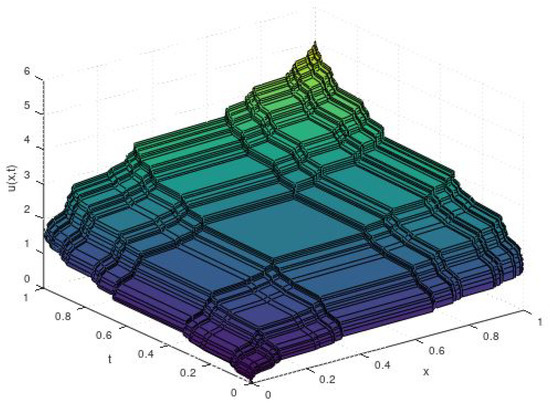
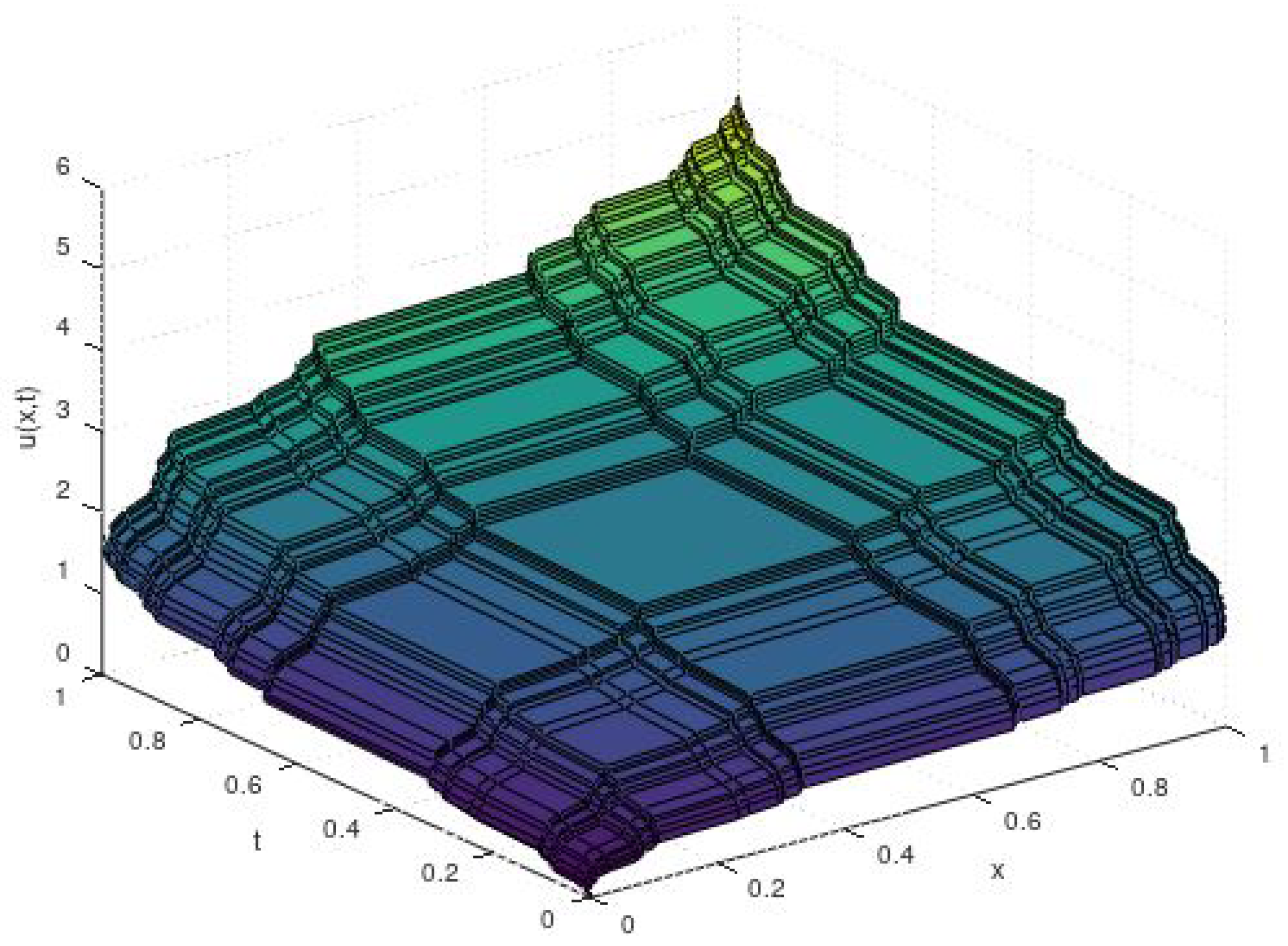
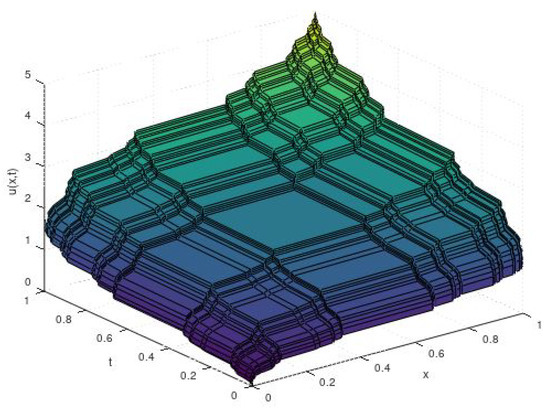
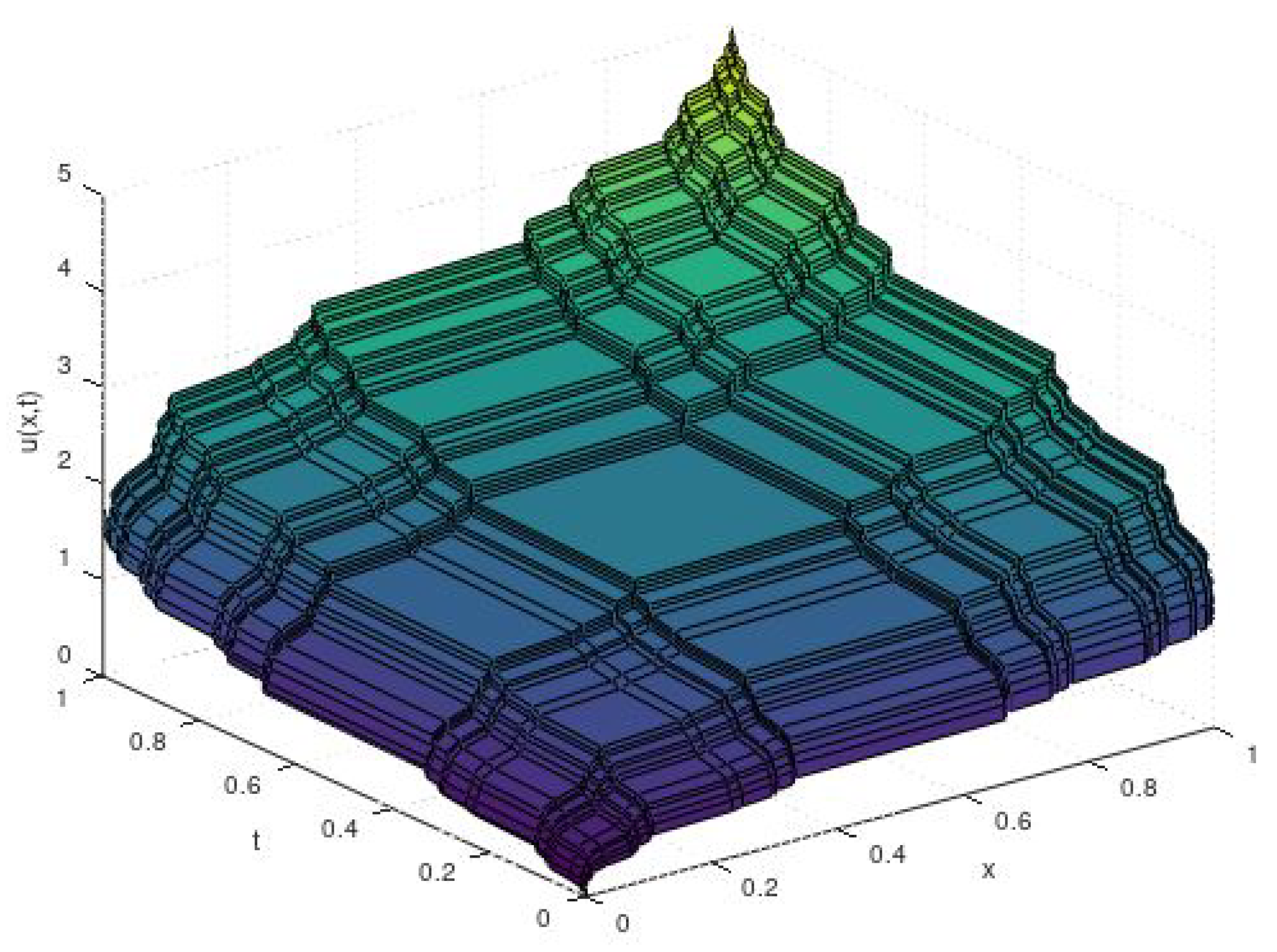
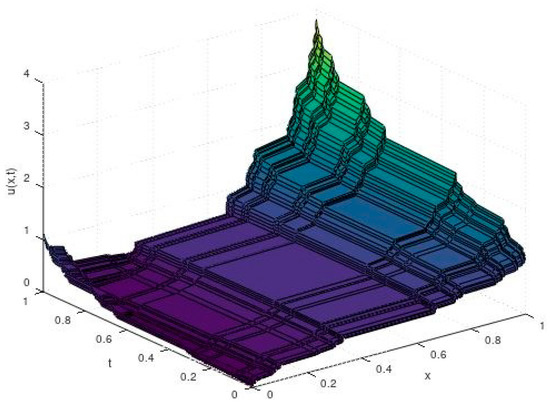
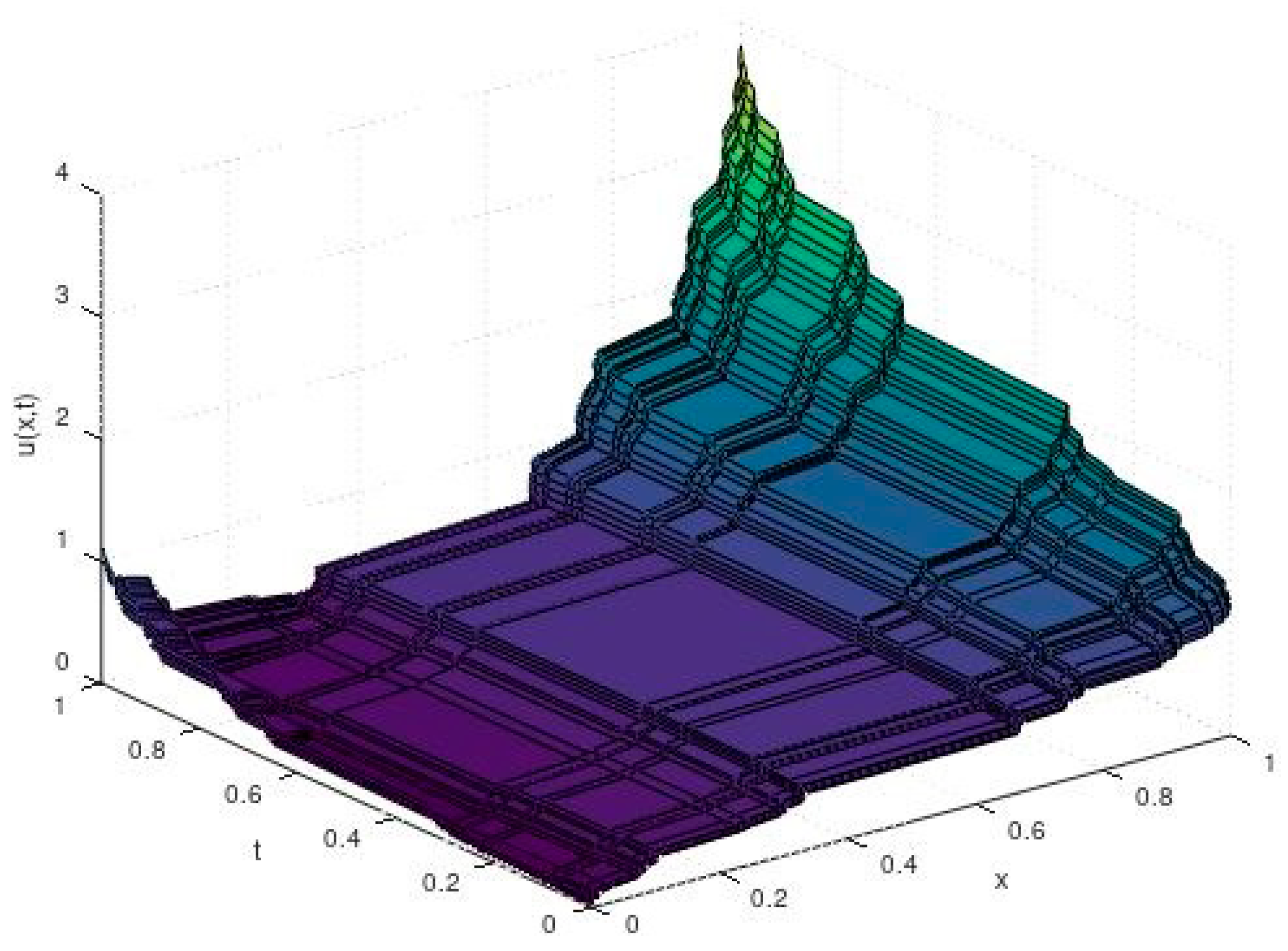
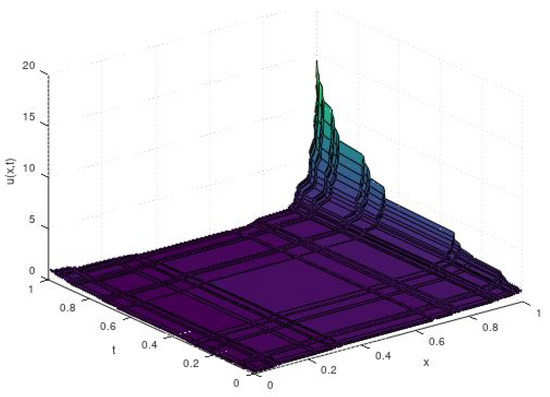
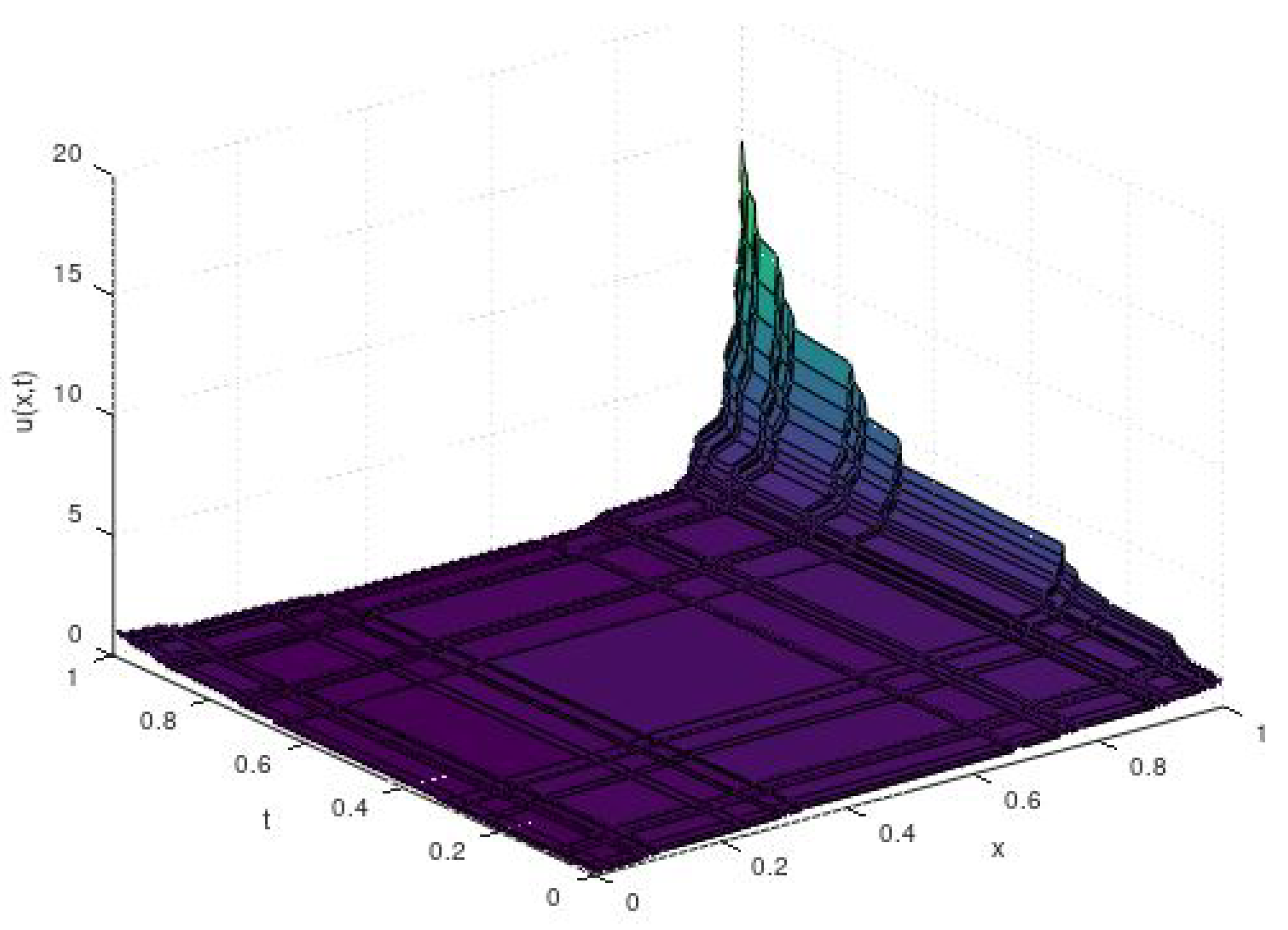
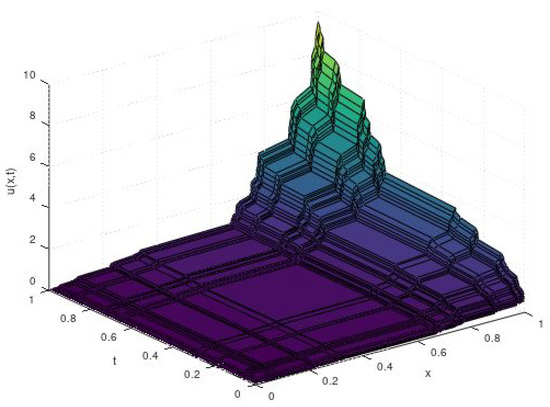
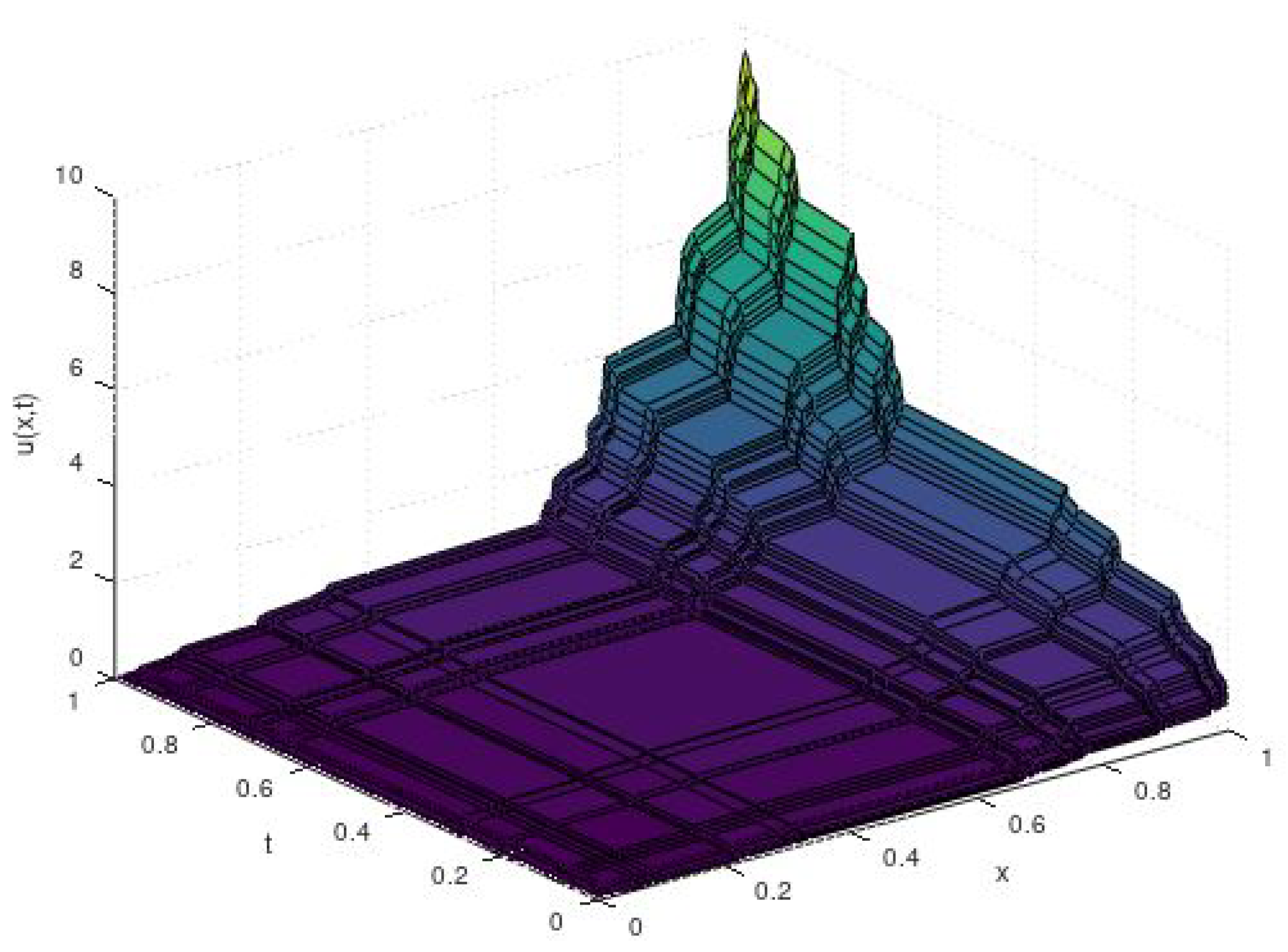
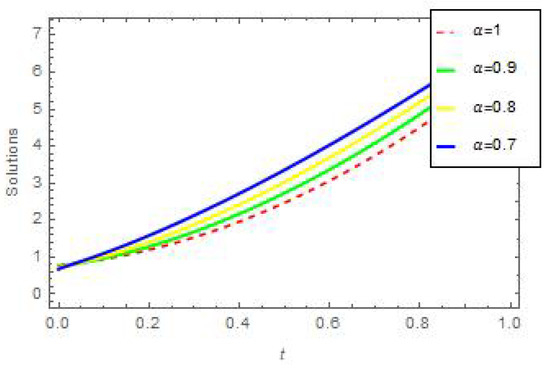
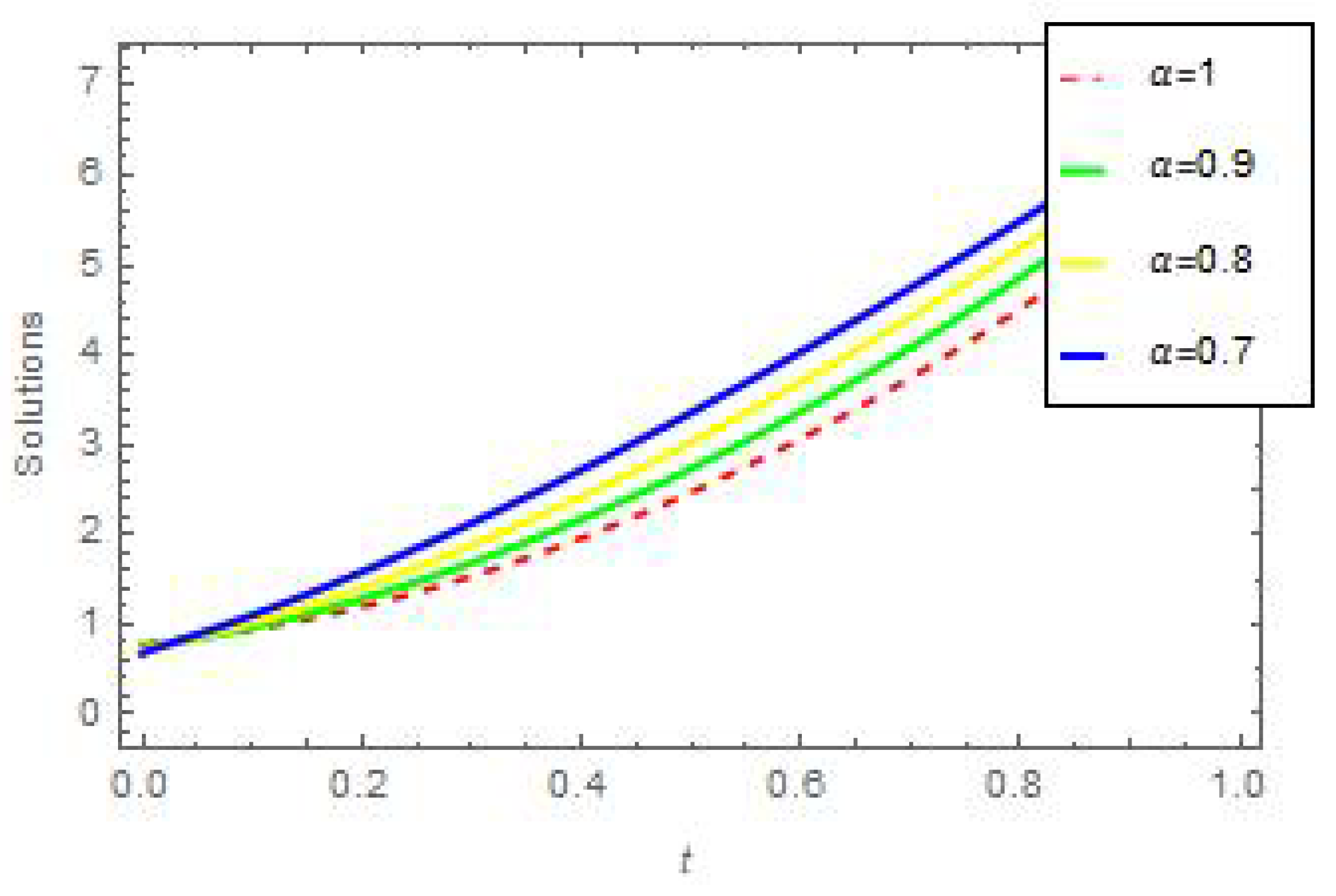
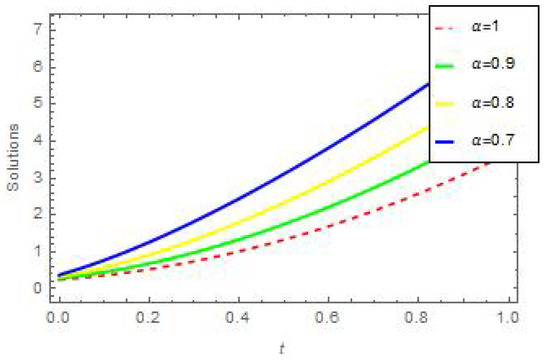
The geometrical interpretation of the above result is (Figure 1, Figure 2, Figure 3, Figure 4, Figure 5 and Figure 6):
Figure 1.
Outcome of Example 1 for at .
Figure 2.
Outcome of Example 1 for at n = 3.
Figure 3.
Outcome of Example 2 for at .
Figure 4.
Outcome of Example2 for at .
Figure 5.
Outcome of Example 2 for at .
Figure 6.
Outcome of Example 1 for different values of at and .
Example 2.
In this illustration, we consider the following local fractional homogeneous KdV equation:
with the initial condition
where the sine function is given by:
Now, comparing terms on both sides of Equation (68), we get
substituting the values of and into the expression of , one gets the following.
similarly, we can find
now, substituting the values of and into , we get
further,
and so on.
Geometrical representation of the above solution is as follows (Figure 7):
Figure 7.
Outcome of Example 2 for at and .
6. Conclusions
This research work uses a method that merges the Sumudu transform and the Adomian decomposition method. Numerous fractional-order nonlinear PDEs can be solved effectively with this technique. This research is dedicated to solving the Korteweg–de Vries (KdV) equation. The applicability of the proposed method is represented in examples. Graphical representations of the solution demonstrate the relevance of the technique. In subsequent work, the method may be utilized to resolve coupled nonlinear PDEs and compare their results to demonstrate the competency of the technique.
Author Contributions
P.G. led the study, interpreted the results, and organized the required literature. J.G.P. wrote the manuscript, conducted all the numerical calculations, and made the graphs. K.S.A. and I.A. summarized the data for the tables, created the study site map, and formatted the final document. All authors have read and agreed to the published version of the manuscript.
Funding
Research Partnership Program no. RP-21-09-06 from the Deanship of Scientific Research of Imam Mohammad Ibn Saud Islamic University (IMSIU).
Data Availability Statement
Not applicable.
Acknowledgments
Authors are grateful to the reviewers for their constructive and fruitful comments. The authors thank the Deanship of Scientific Research at Imam Mohammad Ibn Saud Islamic University (IMSIU) for funding and supporting this work through Research Partnership Program no. RP-21-09-06.
Conflicts of Interest
The authors declare no conflict of interest.
References
- Odibat, Z.; Momani, S.; Xu, H. A reliable algorithm of homotopy analysis method for solving nonlinear fractional differential equations. Appl. Math. Model. 2010, 34, 593–600. [Google Scholar] [CrossRef] [Scilit]
- Ganjiani, M. Solution of nonlinear fractional differential equations using homotopy analysis method. Appl. Math. Model. 2010, 34, 1634–1641. [Google Scholar] [CrossRef] [Scilit]
- Prodanov, D. Fractional velocity as a tool for the study of non-linear problems. Fractal Fract. 2018, 2, 4. [Google Scholar] [CrossRef] [Scilit]
- Maitama, S. An efficient technique for solving linear and nonlinear fractional partial differential equations. Math. Eng. Sci. Aerosp. 2017, 8, 521–534. [Google Scholar]
- Algahtani, O.J.J. Comparing the Atangana–Baleanu and Caputo–Fabrizio derivative with fractional order: Allen Cahnmodel. Chaos Solitons Fractals 2016, 89, 552–559. [Google Scholar] [CrossRef] [Scilit]
- Borisut, P.; Kumam, P.; Ahmed, I.; Sitthithakerngkiet, K. Nonlinear Caputo Fractional Derivative with Nonlocal Riemann-Liouville Fractional Integral Condition Via Fixed Point Theorems. Symmetry 2019, 11, 829. [Google Scholar] [CrossRef] [Scilit]
- Owolabi, K.M.; Atangana, A. Numerical approximation of nonlinear fractional parabolic differential equations with Caputo–Fabrizio derivative in Riemann–Liouville sense. Chaos Solitons Fractals 2017, 99, 171–179. [Google Scholar] [CrossRef] [Scilit]
- Ma, W.X. A polynomial conjecture connected with rogue waves in the KdV equation. Partial. Differ. Equ. Appl. Math. 2021, 3, 100023. [Google Scholar] [CrossRef] [Scilit]
- Kath, W.L.; Smyth, N.F. Solution evolution and radiation loss for the Korteweg -de Vries Equation. Phys. Rev. E 1995, 51, 1484–1492. [Google Scholar] [CrossRef] [Scilit]
- Khaled, S.M.; Baleanu, D.; Atangana, A. New fractional derivatives applied to the Korteweg–de Vries and Korteweg–de Vries–Burger’s equations. Comput. Appl. Math. 2018, 37, 5203–5216. [Google Scholar]
- Sukhinov, A.; Chistyakov, A.; Nikitina, E.T.E.A.; Belova, Y. The Construction and Research of the Modified Upwind Leapfrog Difference Scheme with Improved Dispersion Properties for the Korteweg-de Vries Equation. Mathematics 2022, 10, 2922. [Google Scholar] [CrossRef] [Scilit]
- Boussinesq, J. Essai sur la Theorie des Eaux Courantes; Mémoires présentés par divers savants à l’Académie des sciences de l’Institut national de France, XXIII; Imprimerie Nationale: Paris, France, 1877; pp. 1–680. [Google Scholar]
- Korteweg, D.J.; Devries, G. On the change of form of long waves advancing in a rectangular canal, and on a new sense of long stationary waves. Lond. Edinb. Dublin Philos. Mag. J. Sci. 1895, 39, 422–443. [Google Scholar] [CrossRef] [Scilit]
- Qasim, A.F.; Mohammed, O.A. Approximate solution of the Kersten-Krasil’shchik coupled KdV-MKdV system via reduced differential transform method. Eurasian J. Sci. Eng. 2018, 4, 1–9. [Google Scholar]
- Wazwaz, A.M. Two-mode fifth-order KdV equations: Necessary conditions for multiple-solution solutions to exist. Nonlinear Dyn. 2017, 87, 1685–1691. [Google Scholar] [CrossRef] [Scilit]
- Abdel-Rady, A.S.; Rida, S.Z.; Arafa, A.A.; Abedl-Rahim, H.R. Natural Transform for Solving Fractional Models. J. Appl. Math. Phys. 2015, 3, 1633. [Google Scholar] [CrossRef]
- Bildik, N.; Konuralp, A. Two-dimensional differential transform method, adomian’s decomposition method, and variational iteration method for partial differential equations. Int. J. Comput. Appl. 2006, 83, 973–987. [Google Scholar] [CrossRef] [Scilit]
- Wang, Q. Numerical solutions for fractional KdV-Burgers equation by Adomian decomposition method. Appl. Math. Comput. 2006, 182, 1048–1055. [Google Scholar] [CrossRef] [Scilit]
- Jafari, H.; Daftardar-Gejji, V. Solving linear and nonlinear fractional diffusion and wave equations by Adomian decomposition. Appl. Math. Comput. 2006, 180, 488–497. [Google Scholar] [CrossRef] [Scilit]
- Li, C.; Wang, Y. Numerical algorithm based on Adomian decomposition for fractional differential equations. Comput. Math. Appl. 2009, 57, 1672–1681. [Google Scholar] [CrossRef] [Scilit]
- Ray, S.S.; Bera, R.K. Analytical solution of the Bagley Torvik equation by Adomian decomposition method. Appl. Math. Comput. 2005, 168, 398–410. [Google Scholar] [CrossRef] [Scilit]
- Das, S.; Gupta, P.K. Approximate analytical solutions of time-space fractional diffusion equation by Adomian decomposition method and homotopy perturbation method. Commun. Fract. Calc. 2011, 2, 29–35. [Google Scholar]
- Srivastava, H.M.; Golmankhaneh, A.K.; Baleanu, D.; Yang, X.J. Local fractional sumudu transform with application to IVPs on cantor sets. Abstr. Appl. Anal. 1763, 1–7A, 176395. [Google Scholar] [CrossRef] [Scilit]
- Ziane, D.; Baleanu, D.; Belghaba, K.; Cherif, M.H. Local fractional Sumudu decomposition method for linear partial differential equations with local fractional derivative. J. King Saud Univ. Sci. 2019, 31, 83–88. [Google Scholar] [CrossRef] [Scilit]
- Patel, T.; Meher, R. Adomian decomposition sumudu transform method for solving a solid and porous fin with temperature dependent internal heat generation. SpringerPlus 2016, 5, 489. [Google Scholar] [CrossRef] [Scilit] [PubMed]
- Patel, T.; Meher, R. Adomian Decomposition Sumudu Transform Method for Convective Fin with Temperature-Dependent Internal Heat Generation and Thermal Conductivity of Fractional Order Energy Balance Equation. Int. J. Appl. Comput. Math. 2017, 3, 1879–1895. [Google Scholar] [CrossRef] [Scilit]
- Althobaiti, S.; Dubey, R.S.; Prasad, J.G. Solution of local fractional generaized Fokker-Planck equation using local fractional mohand adomian decompostion method. Fractals 2022, 30, 2240028. [Google Scholar] [CrossRef] [Scilit]
- Yang, X.J.; Tenreiro, J.A.M.; Baleanu, D.; Gao, F. A new numerical technique for local fractional diffusion equation in fractal heat transfer. J. Nonlinear Sci. Appl. 2016, 9, 5621–5628. [Google Scholar] [CrossRef] [Scilit]
- Zhao, D.; Singh, J.; Kumar, D.; Rathore, S.; Yang, X.J. An efficient computational technique for local fractional heat conduction equation in fractal media. J. Nonlinear Sci. Appl. 2017, 10, 1478–1486. [Google Scholar] [CrossRef] [Scilit]
- Yang, X.J. Advanced Local Fractional Calculus and Its Applications; World Science: New York, NY, USA, 2012. [Google Scholar]
- Yang, X.J. Local Fractional Functional Analysis and Its Applications; Asian Academic publisher Limited: Hong Kong, China, 2011. [Google Scholar]
- Sukhinov, A.; Chistyakov, A.; Kuznetsova, I.; Belova, Y.; Rahimbaeva, E. Development and Research of a Modified Upwind Leapfrog Scheme for Solving Transport Problems. Mathematics 2022, 10, 3564. [Google Scholar] [CrossRef] [Scilit]
- Siryk, S.V.; Salnikov, N.N. Numerical solution of Burgers’ equation by Petrov-Galerkin method with adaptive weighting functions. J. Autom. Inf. Sci. 2012, 44, 50–67. [Google Scholar] [CrossRef] [Scilit]
- Salnikov, N.N.; Siryk, S.V.; Tereshchenko, I.A. On construction of finite-dimensional mathematical model of convection-diffusion process with usage of the Petrov-Galerkin method. J. Autom. Inf. Sci. 2010, 42, 67–83. [Google Scholar] [CrossRef] [Scilit]
- AbdulRidha, M.W.; Kashkool, H.A. Space-Time Petrov-Discontinuous Galerkin Finite Element Method for Solving Linear ConvectionDiffusion Problems. J. Phys. Conf. Ser. 2022, 2322, 012007. [Google Scholar] [CrossRef] [Scilit]
- Saadoon, J.J.; Kashkool, H.A. hp-discontinuous Galerkin Finite Element Method for Incompressible Miscible Displacement in Porous Media. J. Phys. Conf. Ser. 2020, 1530, 012001. [Google Scholar]
- Darvishi, M.T.; Najafi, M.; Seadawy, A.R. Dispersive bright, dark and singular optical soliton solutions in conformable fractional optical fiber Schrödinger models and its applications. Opt. Quantum Electron. 2018, 50, 181. [Google Scholar] [CrossRef] [Scilit]
- Darvishi, M.T.; Najafi, M.; Wazwaz, A.M. Conformable space-time fractional nonlinear (1+1)-dimensional Schrödinger-type models and their traveling wave solutions. Chaos Solitons Fractals 2021, 150, 111187. [Google Scholar] [CrossRef] [Scilit]
- Salehi, Y.; Darvishi, M.T.; Schiesser, W.E. Numerical solution of space fractional diffusion equation by the method of lines and splines. Appl. Math. Comput. 2018, 336, 465–480. [Google Scholar] [CrossRef] [Scilit]
Disclaimer/Publisher’s Note: The statements, opinions and data contained in all publications are solely those of the individual author(s) and contributor(s) and not of MDPI and/or the editor(s). MDPI and/or the editor(s) disclaim responsibility for any injury to people or property resulting from any ideas, methods, instructions or products referred to in the content. |
© 2023 by the authors. Licensee MDPI, Basel, Switzerland. This article is an open access article distributed under the terms and conditions of the Creative Commons Attribution (CC BY) license (https://creativecommons.org/licenses/by/4.0/).