


Abstract
Soft continuity can contribute to the development of digital images and computational topological applications other than the field of soft topology. In this work, we study a new class of generalized soft continuous functions defined on the class of soft open sets modulo soft sets of the first category, which is called soft functions with the Baire property. This class includes all soft continuous functions. More precisely, it contains various classes of weak soft continuous functions. The essential properties and operations of the soft functions with the Baire property are established. It is shown that a soft continuous with values in a soft second countable space is identical to a soft function with the Baire property, apart from a topologically negligible soft set. Then we introduce two more subclasses of soft functions with the Baire property and examine their basic properties. Furthermore, we characterize these subclasses in terms of soft continuous functions. At last, we present a diagram that shows the relationships between the classes of soft functions defined in this work and those that exist in the literature.
Keywords:
soft set of the first category; soft set of the second category; soft set with the Baire property; soft function with the Baire property MSC:
54A99; 54E52; 54F65; 03E99
1. Introduction
The reduction in uncertainty is one of the most crucial features that must be addressed in order to improve the robustness of the results acquired from data analysis. However, breaking down the existing uncertainty in order to remove it is frequently a difficult task. For this reason, numerous mathematical techniques created for data analysis ended up short of fulfilling these objectives. Fuzzy sets [1], rough sets [2], and probability are a few of the key mathematical techniques that try to remove uncertainty from data analysis. Divergences from classical mathematics with the goal of removing uncertainty have been made as a result of getting better results with various set types. The decision-making procedures have experienced certain issues as a result of their inability to effectively represent uncertainty. Considering that the lack of a parameterization tool is the primary cause of these challenges, the authors of [3] proposed soft sets. Soft sets represent a particularly effective mathematical model for processing decision-making procedures that focus on the selection of the best alternative since objects supplying parameters can be described in this way. This prompts the fast development of the theory of soft sets and its related field in a short measure of time and gives different applications of soft sets in real-world applications (see, [4,5,6,7,8,9]).
Then, various mathematical branches have been studied in soft set environments. Soft topology is one of the branches introduced in [10,11] as a fresh generality of classical topology. The aforementioned work was crucial to the development of soft topology. After that, in soft set contexts, many traditional topological properties have been generalized, for instance, soft separation axioms [12], soft second countable spaces [13], soft separable spaces [12], soft connected spaces [14], soft compact spaces [15], soft extremally disconnected spaces [16], soft submaximal spaces [17], and soft paracompact spaces [14].
It is understood that soft open sets are the building blocks of soft topology, but other classes of soft sets can contribute to the growth of soft topology. Namely, soft dense [18], soft codense [19], soft somewhat open [20], soft nowhere dense [18], soft meager (first category soft set) [18], soft semiopen [21], soft -open [22], and soft sets with the Baire property [23].
In addition to soft topology, soft continuity is useful in the development of computational topological applications and digital images [24]. Soft continuity of functions was defined by Zorlutuna et al. [25] in 2012. Afterwards, multiple generalized forms of soft continuous functions started to appear in the literature. Namely: soft -continuous functions [26], soft C-continuous functions [27], soft -continuous functions [28], soft somewhat continuous functions [20], soft -continuous functions [22], soft semicontinuous functions [29], etc.
The concept of functions with the Baire property was studied by many mathematicians as a tool for developing several fields of mathematics, such as (descriptive) set theory, general topology, and measure theory (see [30,31,32]). In an analogous manner, studying functions with the Baire property in soft settings will have an interchangeable role in soft topology and soft measure theory. The latter statement and the rich literature on the generalized classes of soft continuous functions with their applications motivate us to investigate the so-called “soft functions with the Baire property”with two more subclasses of such soft functions.
The primary contributions of this paper are follows:
- We introduce a wide class of soft functions, named soft functions with the Baire property, via a mix of topological and algebraic structures, which includes various classes of generalized soft continuous functions.
- We find some conditions under which the class (or a subclass) of soft functions with the Baire property is identical to soft continuity.
- We characterize a subclass of soft functions with the Baire property in terms of the set of soft points of soft discontinuity.
We arrange the content of the paper as follows: Section 2 recalls some properties and operations of soft set theory and some soft topology. Section 3 collects and studies some classes of soft sets with the Baire property in soft topological spaces. In Section 4, we introduce the concept of soft functions with the Baire property and characterize them in terms of soft continuity. In Section 5, we define two subclasses of soft functions with the Baire property and study them. After that, we find their connections to some known classes of generalized soft continuous functions. In Section 6, we finish this work with a brief conclusion.
2. Preliminaries
We start with an overview of soft sets along with some operations.
Definition 1
([3]). Let F be a set-valued mapping from a subset A of a set of parameters E into the power set of an initial universe X. An ordered pair is called the soft set over X.
The class of all soft subsets of X along with A is denoted by .
Definition 2
([7]). The soft complement of a soft set is a soft set , whereas is a mapping for which for each .
Remark 1.
One can easily extend a soft set to the soft set by assuming for all .
Definition 3
([33]). A null soft set with respect to A, , is soft set over X if for each . An absolute soft set with respect to A, , is a soft set such that for each . The null and absolute soft sets are denoted by and , respectively.
Notice that , , and .
Definition 4
([13]). A finite (resp. countable) soft set is such a soft set that is finite (resp. countable) for each . Otherwise, it is called infinite (resp. uncountable).
Definition 5
([34]). A soft set over X is said to be a soft point, referred to , if and for each such that , . The collection of all soft points in X associate with A is denoted by .
Definition 6
([7,35]). Let , be soft sets, where . Then is a soft subset of , denoted by , if and for all . The two soft sets are said to be equal, denoted by , if and .
Definition 7
([33]). Let be a family of soft sets over X, where I is any index set.
- 1.
- The soft union of is defined to be the soft set such that for each .
- 2.
- The soft intersection of is defined to be the soft set such that for each .
Definition 8
([33,36]). Let . Then
- 1.
- The soft set difference and is defined to be the soft set , where for all .
- 2.
- The soft symmetric difference of and is defined by .
One can easily check that .
In what follows, by two distinct soft points we mean either or and by two disjoint soft sets over X, we mean .
Definition 9
([11]). A family is called a soft topology over X if
- 1.
- ,
- 2.
- implies , and
- 3.
- implies .
The triple is called a soft topological space. The elements of θ are called soft open sets, and their complements are called soft closed sets. The set of all soft closed sets is denoted by .
Definition 10
([11]). Let be a soft subset of . Then is called a relative soft topology over Y and is a soft subspace of .
Lemma 1
([11]). Let be a soft subspace of and let . Then iff .
Definition 11
([10]). A (countable) soft base for a soft topology θ is a (countable) family such that elements of θ are soft unions of elements of .
Lemma 2
([11]). Let be a soft topological space, then for each , the collection is a (crisp) topology on X.
Definition 12
([37]). A soft topology generated by a collection is the intersection of all soft topologies over X including .
Definition 13
([38]). Let . Then is a soft neighborhood of if there exists such that , where is the family of all soft open sets containing .
Definition 14
([11]). Let . Then
- 1.
- is called the soft closure of .
- 2.
- is called the soft interior of .
Lemma 3
([39]). Let . Then
- 1.
- .
- 2.
- .
Lemma 4
([39]). Let . Then
Definition 15
([39,40]). Let . The soft boundary of is given by .
Definition 16.
Let . Then is called
- 1.
- soft clopen [41] if is both soft open and soft closed.
- 2.
- soft regular open [42] if .
- 3.
- soft [19] if , where .
- 4.
- soft [19] if , where .
- 5.
- soft dense in [18,19] if .
- 6.
- soft nowhere dense [18] if .
- 7.
- soft semiopen set [21] if .
- 8.
- soft α-open set [22] if .
- 9.
- soft meager [18,43] (or a soft set of the first category) if , where each is soft nowhere dense, otherwise is of the second category.
The collection of all soft sets of the first category (resp. soft sets of the second category, soft nowhere dense sets) over X is denoted by (resp. ). Examples on the aforementioned classes of soft sets can be found in [43], Example 1.
Definition 17
([18,19]). A soft topological space is called soft Baire if the soft intersection of each countable collection of soft open dense sets in is soft dense. Equivalently, each non-null soft open set in is of the second category.
Definition 18
([44]). A non-null class is called a soft ideal over X if satisfies the following conditions:
- 1.
- If , then .
- 2.
- If and , then .
is called a soft σ-ideal if (1) holds for many (countable) soft sets. We denote the family of soft ideals over X by .
Remark 2
([43]). For any soft topological space , forms a soft σ-ideal and forms a soft ideal.
Definition 19
([45]). A collection is a soft algebra over X if:
- 1.
- ,
- 2.
- implies , and
- 3.
- , for all , implies .
If (3) holds true for many (countable) members of , is said to be a soft -algebra on X (see [46]).
Definition 20
([47]). Let . The soft intersection of all soft σ-algebras over X containing is a soft σ-algebra and it is called the soft σ-algebra generated by and is referred to as .
Definition 21
([15]). A soft topological space is called soft compact if every cover of by soft open sets has a finite subcover.
Definition 22
([11]). A soft topological space is called soft regular if each and each , there exists such that .
Definition 23
([13]). A soft topological space is called soft second countable if it has a countable soft base.
Definition 24
([25,48]). Let be collections of soft sets, and let be mappings. The image of a soft set under is a soft subset of which is given by
for each .
The inverse image of a soft set under g is a soft subset such that
for each .
The soft mapping g is injective (resp. surjective, bijective) if both p and q are injective (resp. surjective, bijective).
Lemma 5
([25]). Let be a soft function and . Then
Definition 25.
A soft function is said to be
- 1.
- soft continuous [25] if for each .
- 2.
- soft semicontinuous [29] if is soft semiopen for each .
- 3.
- soft α-continuous [22] if is soft α-open for each .
3. Classes of Soft Sets with the Baire Property
We recall and study some properties of certain classes of soft sets that have the Baire property.
Definition 26
([23,36]). Let . It is said that is soft open modulo if there exists such that . Soft open sets modulo are named soft sets with the Baire property. The family of all soft sets over X with the Baire property is denoted by .
One can easily check that has the Baire property iffit is of the form , where and .
Lemma 6
([23]). Let . The following properties are equivalent:
- 1.
- .
- 2.
- if , where is soft regular open and .
- 3.
- if , where and .
- 4.
- if , where and .
- 5.
- if , where and .
- 6.
- if , where is a soft set and .
- 7.
- if , where is a soft set and .
- 8.
- if there exists such that is soft clopen in .
Lemma 7
([23]). Let . If , then .
Lemma 8
([23]). Let . If , then .
Lemma 9
([23]). Let . If , , then .
We are now in a position to define two subclasses of soft sets of the Baire property. We have seen that iff , where and . From this representation, we introduce the following soft sets:
Definition 27.
Let . Then is said to be of the first type if , where and . And it is of the second type if , where and . We will hereafter refer to soft sets of the first and second types as -sets and -sets, respectively.
Lemma 10.
Let . Then is an -set iff is an -set.
Proof.
Let be an -set. Then for some and . Now, , where and . Thus, is an -set.
The converse is similar. □
Lemma 11.
Let such that or . If is an -set, then is an -set, for .
Proof.
Straightforward. □
Lemma 12.
Let . If is soft dense in , then for each .
Proof.
Let . Since , so . On the other hand, we need to show . Consider the following with applying Lemma 3:
This proves that implies . Thus, . □
Lemma 13.
Let . Then is a soft α-open set iffthen , where and .
Proof.
Suppose is a soft -open set. Consider the identity
Since , then . Therefore, we have , which implies since . If we set and , then we conclude that for some and .
Conversely, if , where and . Now, . Therefore, applying Lemma 3, we have . Since is soft dense, it follows from Lemma 12, and thus . But, clearly, . Hence, is soft -open. □
Proposition 1.
Let . If is a soft α-open set, then is an -set.
Proof.
It follows from the fact that . □
Proposition 2.
Let . If is a soft semiopen set, then is an -set.
Proof.
Suppose is a soft semiopen set in . From Theorem 3.1 in [29], one can find such that . Consider, the identity . Since is soft open, then and so . But , therefore . Set . Therefore, . Hence, is an -set. □
This is a suitable place to illustrate the connections between the previously stated soft sets.
Generally, none of the above arrows are reversible, as is shown in the following example:
Example 1.
Let be the set of real number and A be a set of parameters. Let θ be the soft topology on generated by . The soft set has the Baire property but is neither an -set nor an -set, where is the set of rationals. The soft set is an -set but not soft α-open. The soft set is an -set but not soft semiopen. The soft set is an -set but not an -set, where is the ternary Cantor set. While is an -set but not an -set.
The counterexample for other cases are available in the literature.
4. Soft Functions with the Baire Property
Definition 28.
A soft function is said to have the Baire property if for each .
The Baire property is evidently present in all soft continuous functions. There are, on the other hand, soft functions that have the Baire property but are not soft continuous.
Example 2.
Consider the soft topological space given in Example 1. Define a soft function by
One can easily show g has the Baire property because the inverse image of any soft open set is either a soft open set or a soft open sets union a soft set containing one of the soft points and both though are soft sets the Baire property. On the other hand g cannot be soft continuous. Take the soft open set , where . Then
not a soft open set and hence g is not a soft continuous function.
Theorem 1.
A soft function has the Baire property iff for each .
Proof.
It follows from Lemma 7. □
Proposition 3.
Let have the Baire property and . Then has the Baire property.
Proof.
Let . Then . By hypothesis, we have and, by Lemma 8, □
Theorem 2.
Let be a soft function and let be soft compact. If has the Baire property for each , then g has the Baire property.
Proof.
Let be a soft open cover of . Let . By assumption, has the Baire property in for each i. Since each soft open set has the Baire property, by Lemma 9, . And, by soft compactness of , one can find a finite subset such that . Now,
Therefore, since is closed under finite soft unions, and thus, g has the Baire property. □
Proposition 4.
Let , be soft functions. If g has the Baire property and h is soft continuous, then has the Baire property.
Proof.
Let . By soft continuity of h, . Since g has the Baire property, so . But . Hence, has the Baire property. □
Proposition 5.
Let . Then iff the characteristic soft function of has the Baire property.
Proof.
The characteristic soft function of is a soft function , which is defined by
where is the soft discrete topology on . Suppose . Let . Then
All those soft sets are in since is a soft -algebra. Thus, has the Baire property.
Conversely, since and it contains , by assumption, . The proof is finished. □
Theorem 3.
Let be a soft function such that is soft second countable. Then g has the Baire property iffthere exists such that is soft continuous.
Proof.
Assume g has the Baire property. We need to construct for which is soft continuous. Let and let be a countable soft base of . Then for some in . Since g has the Baire property, so for each n. By Lemma 6,
where , . Set . Then since is a soft -ideal. It remains to show that h is soft continuous. Since
then
Since , therefore,
This implies that . Since is soft open in , so is a soft open set in . Thus, h is soft continuous.
Conversely, suppose there exists such that is soft continuous. Let . By assumption, . That is, , where . Now,
Since , implies . Therefore, . By Lemma 6, and hence, g has the Baire property. □
5. Subclasses of Soft Functions with the Baire Property
We introduce two subclasses of soft functions with the Baire property in this section and discuss their fundamental properties.
Definition 29.
A soft function is said to be the Baire soft function of the first type (or shortly, ) if is an -set for each . It is the Baire soft function of the second type (or shortly, ) if is an -set for each .
By the use of Proposition 5, one can construct the following:
Example 3.
Consider the soft topological space given in Example 1 and let be the soft discrete topology on . Assume the soft function is defined by
where such that is the set of rationals. Then, g is a -function but not since is an -set but not an -set, see Example 1. If we replace by the soft set , where is the ternary Cantor set, we obtain a -function but not . On the other hand, if we replace by the soft set , we obtain a soft function with the Baire property but neither nor .
Proposition 6.
A soft function is iff is an -set for each , and .
Proof.
We only prove when and , the other case is the same. Suppose g is . Let . Then . By assumption, is an -set. But, by Lemma 5, . By Lemma 10, is an -set.
The converse is clear. □
Proposition 7.
A soft function is if it is soft α-continuous.
Proof.
Apply Proposition 1. □
Proposition 8.
A soft function is if it is soft semicontinuous.
Proof.
Apply Proposition 2. □
The earlier two propositions and Figure 1 imply
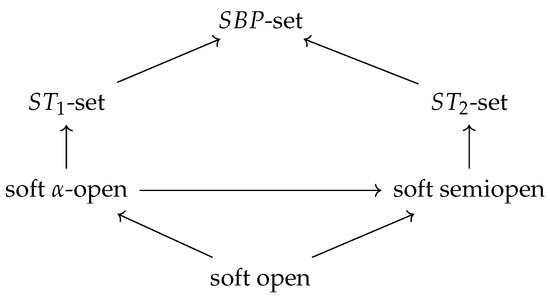
Figure 1.
Generalized soft open sets.
Where an -set means a soft set with the Baire property.
Corollary 1.
If is a soft continuous function, then it is , for .
Theorem 4.
Let be a soft function such that is soft Baire and is soft regular. Then g is iffg is soft continuous.
Proof.
Suppose g is and . Let that contains . By soft regularity of , there exists such that . Since g is , so for some and . Evidently, . To show the soft continuity of g, it suffices to show that . Suppose otherwise that for some . This means that there exists containing such that and , where and . Since , so . Now, we have
This means that , which is not possible since is a soft Baire space. Hence, we must have which implies g is soft continuous.
Conversely, if g is soft continuous, then for each , . Clearly can be written as and thus is an -set. Hence, g is . □
Lemma 14.
Let be a soft function and let be a soft base of ϑ. The set of all soft points of soft discontinuity of g is of the form
Proof.
Let . If is a soft point of soft discontinuity of g, then there exists containing such that is not a soft interior point of . That is, . Since is a soft base of , one can find some such that . Therefore, .
Conversely, if for a soft point , there exists such that . This implies that containing for which is not a soft open set over X, and thus g is not soft continuous at . □
Proposition 9.
Let be a soft function. If the set of all soft points of soft discontinuity of g is in , then g is .
Proof.
Suppose . Let . Since the soft set , then . Therefore, implies is . Hence, g is . □
Proposition 10.
Let be a soft function. If g is and is soft second countable, then the set of all soft points of soft discontinuity of g is in .
Proof.
Let be a countable soft base of . By (1) in Lemma 14,
Since g is , so , and thus as is closed under countable soft unions. □
From Propositions 9 and 10, we have the following result:
Theorem 5.
Let be a soft function such that is soft second countable. Then g is iff is in .
We conclude this work by presenting the Figure 2 below:
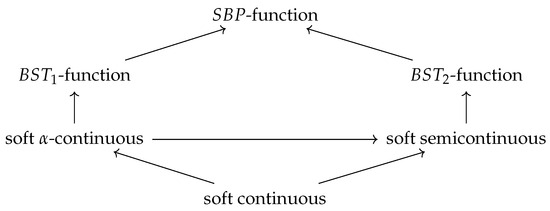
Figure 2.
Generalized soft continuous functions.
Where -function means a soft function with the Baire property.
One can derive from Proposition 5 and Examples 1 and 3 that the remaining examples demonstrating the opposites of the aforementioned arrows are untrue.
6. Conclusions and Future Work
Soft continuity is one of the most natural topics in the field of soft topology, which is a combination of topology and soft set theory. Soft continuity between soft topological spaces has a rich literature. After recalling and studying certain classes of soft sets with the Baire property, we have first started by defining the concept of soft functions having the Baire property. A soft function with the Baire property sends soft open sets back to soft sets with the Baire property. Basic operations on soft functions with the Baire property are discussed, along with some basic properties. We have seen that each soft continuous function is a soft function with the Baire property. The converse is generally false. We have shown that a soft function from a soft topological space into a soft second countable space has the Baire property if and only if there exists a soft set of the first category such that the restriction of the soft function to its complement is soft continuous. Secondly, we have introduced two subfamilies of soft functions with the Baire property called soft functions with the first and second types. We have studied these types of soft functions and established some of their characterizations. In particular, we have proved that a soft function from a soft Baire space into a soft regular space is of the first type if and only if it is soft continuous. And a soft function is of the second type if and only if the set of its discontinuous soft points is a soft set of the first category, provided that the range of the soft function is soft second countable. Moreover, we have shown that soft functions with the first type or second type are weaker than certain natural classes of generalized soft continuous functions, like soft -continuous and soft semicontinuous functions. Lastly, we have built the relationships between the classes of soft functions mentioned above and have offered some counterexamples that disprove the reverse of the relationships.
The conclusions in this article are preliminary, and more study will be necessary. These findings can also be seen as the foundation for researching new topics in soft topology and soft measure theory. Since the soft -algebra of soft set of the Baire property [43], a soft function with the Baire property can be considered a soft measurable function within the context of soft measure theory. As a result, soft functions can contribute to the growth of soft measure theory. Furthermore, by virtue of Proposition 5, one can study the determinacy of the Banach-Mazur game on a certain soft topological space when the characteristic soft function of each soft subset has the Baire property.
Author Contributions
Conceptualization, Z.A.A. and M.H.A.; Methodology, Z.A.A.; Formal Analysis, Z.A.A. and M.H.A.; Investigation, Z.A.A. and M.H.A.; Writing Original Draft Preparation, Z.A.A.; Writing Review & Editing, Z.A.A. and M.H.A.; Funding Acquisition, M.H.A. All authors have read and agreed to the published version of the manuscript.
Funding
This research received no external funding.
Data Availability Statement
Not applicable.
Conflicts of Interest
The authors declare no conflict of interest.
References
- Zadeh, L. Fuzzy sets. Inf. Control 1965, 8, 338–353. [Google Scholar] [CrossRef]
- Pawlak, Z. Rough sets. Int. J. Comput. Inf. Sci. 1982, 11, 341–356. [Google Scholar] [CrossRef]
- Molodtsov, D. Soft set theory—First results. Comput. Math. Appl. 1999, 37, 19–31. [Google Scholar] [CrossRef]
- Dalkılıç, O.; Demirtaş, N. Algorithms for Covid-19 outbreak using soft set theory: Estimation and application. Soft Comput. 2022, 27, 3203–3211. [Google Scholar] [CrossRef] [PubMed]
- Ergül, Z.G.; Demirtaş, N.; Dalkılıç, O. Analysis of parameter relationships influencing prostate cancer using the soft set model. In Proceedings of the International Conference on Applied Engineering and Natural Sciences, New York, NY, USA, 9–10 September 2023; Volume 1, pp. 682–687. [Google Scholar]
- Maji, P.; Roy, A.R.; Biswas, R. An application of soft sets in a decision making problem. Comput. Math. Appl. 2002, 44, 1077–1083. [Google Scholar] [CrossRef]
- Pei, D.; Miao, D. From soft sets to information systems. In Proceedings of the 2005 IEEE International Conference on Granular Computing, Beijing, China, 25–27 July 2005; IEEE: New York, NY, USA, 2005; Volume 2, pp. 617–621. [Google Scholar]
- Voskoglou, M.G. Fuzziness, indeterminacy and soft sets: Frontiers and perspectives. Mathematics 2022, 10, 3909. [Google Scholar] [CrossRef]
- Voskoglou, M.G. A Combined use of soft sets and grey numbers in decision making. J. Comput. Cogn. Eng. 2023, 2, 1. [Google Scholar] [CrossRef]
- Çağman, N.; Karataş, S.; Enginoglu, S. Soft topology. Comput. Math. Appl. 2011, 62, 351–358. [Google Scholar] [CrossRef]
- Shabir, M.; Naz, M. On soft topological spaces. Comput. Math. Appl. 2011, 61, 1786–1799. [Google Scholar] [CrossRef]
- Bayramov, S.; Gunduz, C. A new approach to separability and compactness in soft topological spaces. TWMS J. Pure Appl. Math. 2018, 9, 82–93. [Google Scholar]
- Das, S.; Samanta, S. Soft metric. Ann. Fuzzy Math. Inf. 2013, 6, 77–94. [Google Scholar]
- Lin, F. Soft connected spaces and soft paracompact spaces. Int. J. Math. Comput. 2013, 7, 277–283. [Google Scholar]
- Aygünoğlu, A.; Aygün, H. Some notes on soft topological spaces. Neural Comput. Appl. 2012, 21, 113–119. [Google Scholar] [CrossRef]
- Asaad, B.A. Results on soft extremally disconnectedness of soft topological spaces. J. Math. Comput. Sci. 2017, 17, 448–464. [Google Scholar] [CrossRef]
- Al Ghour, S.; Ameen, Z.A. On soft submaximal spaces. Heliyon 2022, 8, e10574. [Google Scholar] [CrossRef]
- Riaz, M.; Fatima, Z. Certain properties of soft metric spaces. J. Fuzzy Math. 2017, 25, 543–560. [Google Scholar]
- Ameen, Z.A.; Khalaf, A.B. The invariance of soft Baire spaces under soft weak functions. J. Interdiscip. Math. 2022, 25, 1295–1306. [Google Scholar] [CrossRef]
- Ameen, Z.A.; Asaad, B.A.; Al-shami, T.M. Soft somewhat continuous and soft somewhat open functions. TWMS J. Pure Appl. Math. 2023, 13, 92–806. [Google Scholar]
- Chen, B. Soft semi-open sets and related properties in soft topological spaces. Appl. Math. Inf. Sci. 2013, 7, 287–294. [Google Scholar] [CrossRef]
- Akdag, M.; Ozkan, A. Soft α-open sets and soft α-continuous functions. Abstr. Appl. Anal. 2014, 2014, 891341. [Google Scholar] [CrossRef]
- Ameen, Z.A.; Alqahtani, M.H. Congruence representations via soft ideals in soft topological spaces. Axioms (Communicated) 2023. [Google Scholar]
- Öztunç, S.; Ihtiyar, S. Soft isomorphism for digital images and computational topological applications. J. Intell. Fuzzy Syst. 2023, 44, 3011–3021. [Google Scholar] [CrossRef]
- Zorlutuna, İ.; Akdag, M.; Min, W.; Atmaca, S. Remarks on soft topological spaces. Ann. Fuzzy Math. Inform. 2012, 3, 171–185. [Google Scholar]
- Ameen, Z.A. A non-continuous soft mapping that preserves some structural soft sets. J. Intell. Fuzzy Syst. 2022, 42, 5839–5845. [Google Scholar] [CrossRef]
- Al Ghour, S. Soft C-continuity and soft almost C-continuity between soft topological spaces. Heliyon 2023, 9, e16363. [Google Scholar] [CrossRef]
- Al Ghour, S.; Al-Saadi, H. Soft slight omega-continuity and soft ultra-separation axioms. Mathematics 2023, 11, 3334. [Google Scholar] [CrossRef]
- Mahanta, J.; Das, P.K. On soft topological space via semiopen and semiclosed soft sets. Kyungpook Math. J. 2014, 54, 221–236. [Google Scholar] [CrossRef]
- Kuratowski, K. Topology: Volume I; Elsevier: Amsterdam, The Netherlands, 2014; Volume 1. [Google Scholar]
- Oxtoby, J.C. Measure and Category: A Survey of the Analogies between Topological and Measure Spaces; Springer Science & Business Media: Berlin/Heidelberg, Germany, 2013; Volume 2. [Google Scholar]
- Szymanski, A. Proper functions with the Baire property. Ann. New York Acad. Sci. 1992, 659, 176–181. [Google Scholar] [CrossRef]
- Ali, M.I.; Feng, F.; Liu, X.; Min, W.K.; Shabir, M. On some new operations in soft set theory. Comput. Math. Appl. 2009, 57, 1547–1553. [Google Scholar] [CrossRef]
- Xie, N. Soft points and the structure of soft topological spaces. Ann. Fuzzy Math. Inf. 2015, 10, 309–322. [Google Scholar]
- Maji, P.K.; Biswas, R.; Roy, A.R. Soft set theory. Comput. Math. Appl. 2003, 45, 555–562. [Google Scholar] [CrossRef]
- Ameen, Z.A.; Al-shami, T.M.; Asaad, B.A. Further properties of soft somewhere dense continuous functions and soft Baire spaces. J. Math. Comput. Sci. 2024, 32, 54–63. [Google Scholar] [CrossRef]
- Al Ghour, S.; Ameen, Z.A. Maximal soft compact and maximal soft connected topologies. Appl. Comput. Intell. Soft Comput. 2022, 2022, 9860015. [Google Scholar] [CrossRef]
- Nazmul, S.; Samanta, S. Neighbourhood properties of soft topological spaces. Ann. Fuzzy Math. Inf. 2013, 6, 1–15. [Google Scholar]
- Hussain, S.; Ahmad, B. Some properties of soft topological spaces. Comput. Math. Appl. 2011, 62, 4058–4067. [Google Scholar] [CrossRef]
- Azzam, A.; Ameen, Z.A.; Al-shami, T.M.; El-Shafei, M.E. Generating soft topologies via soft set operators. Symmetry 2022, 14, 914. [Google Scholar] [CrossRef]
- Al Ghour, S. Boolean algebra of soft Q-Sets in soft topological spaces. Appl. Comput. Intell. Soft Comput. 2022, 2022, 5200590. [Google Scholar] [CrossRef]
- Yüksel, S.; Tozlu, N.; Ergül, Z.G. Soft regular generalized closed sets in soft topological spaces. Int. J. Math. Anal. 2014, 8, 355–367. [Google Scholar] [CrossRef]
- Ameen, Z.A.; Alqahtani, M.H. Baire category soft sets and thier symmetric local properties. Symmetry 2023, 15, 1810. [Google Scholar] [CrossRef]
- Kandil, A.; AE Tantawy, O.; A El-Sheikh, S.; M Abd El-latif, A. Soft ideal theory soft local function and generated soft topological spaces. Appl. Math. Inf. Sci. 2014, 8, 1595–1603. [Google Scholar] [CrossRef]
- Riaz, M.; Naeem, K.; Ahmad, M.O. Novel concepts of soft sets with applications. Ann. Fuzzy Math. Inform. 2017, 13, 239–251. [Google Scholar] [CrossRef]
- Khameneh, A.Z.; Kilicman, A. On Soft σ-Algebras. Malays. J. Math. Sci. 2013, 7, 17–29. [Google Scholar]
- Ameen, Z.A.; Al-shami, T.M.; Abu-Gdairi, R.; Mhemdi, A. The relationship between ordinary and soft algebras with an application. Mathematics 2023, 11, 2035. [Google Scholar] [CrossRef]
- Kharal, A.; Ahmad, B. Mappings on soft classes. New Math. Nat. Comput. 2011, 7, 471–481. [Google Scholar] [CrossRef]
Disclaimer/Publisher’s Note: The statements, opinions and data contained in all publications are solely those of the individual author(s) and contributor(s) and not of MDPI and/or the editor(s). MDPI and/or the editor(s) disclaim responsibility for any injury to people or property resulting from any ideas, methods, instructions or products referred to in the content. |
© 2023 by the authors. Licensee MDPI, Basel, Switzerland. This article is an open access article distributed under the terms and conditions of the Creative Commons Attribution (CC BY) license (https://creativecommons.org/licenses/by/4.0/).