


Abstract
In recent years, fractional kinetic equations (FKEs) involving various special functions have been widely used to describe and solve significant problems in control theory, biology, physics, image processing, engineering, astrophysics, and many others. This current work proposes a new solution to fractional kinetic equations based on generalized degenerate hypergeometric functions (GDHFs), which has the potential to be applied to calculate changes in the chemical composition of stars such as the sun. Furthermore, this expanded form can also help to solve various problems with phenomena in physics, such as fractional statistical mechanics, anomalous diffusion, and fractional quantum mechanics. Moreover, some of the well-known outcomes are just special cases of this class of pathway-type solutions involving GDHFs, with greater accuracy, while providing an easily calculable solution. Additionally, numerical graphs of these analytical solutions, using MATLAB Software (latest version 2023b), are also considered.
Keywords:
degenerate generalized hypergeometric functions; pathway-type transform; fractional kinetic equations MSC:
15A16; 33B15; 33C05; 33C20; 34A05
1. Introduction
The calculus of derivatives and integrals of any order is the subject of fractional calculus. Because of its scientific uses over the previous three decades, its importance and appeal to researchers have grown to in this field [1,2]. Furthermore, fractional calculus has several applications in physics, finance, biology, image processing, engineering, and other disciplines. It can, for example, be used to simulate the behavior of viscoelastic materials, which have both elastic and viscous properties. Moreover, it can also solve differential equations that standard calculus cannot. We encourage readers to use the cited sources for more information on fractional calculus and its applications [3,4,5].
FKEs are types of differential equations that describe a system’s evolution over time and are based on the concept of fractional calculus [6,7]. One of the most essential applications of FKEs is modeling anomalous diffusion. Anomalous diffusion is a type of diffusion in which the mean square displacement of a particle grows sublinearly with time. This type of diffusion is observed in various systems, including turbulent fluids, porous media, and biological tissues (see, e.g., [8,9,10,11]). Furthermore, FKEs have also been used to model a variety of other systems, including, for example, the relaxation of viscoelastic materials, the spread of disease, the evolution of traffic patterns, and the behavior of financial markets [12,13,14].
Kinetic equation (KE) is defined by (cf. [1,2,3])
The kinetic equation of fractional-order (KEFO) is presented by (see, e.g., [6,7,8,9])
where is the fractional integral operator (cf. [1,2]) given by
Recently, several generalizations of the KEFO have been proposed by several researchers using various special functions. For instance, Alqarni et al. [15] introduced solutions involving the generalized incomplete Wright hypergeometric functions. Meanwhile, Khan et al. [16] considered solutions for KEFO associated with the extended hypergeometric and confluent hypergeometric functions, and Abubakar [17] focused on a solution for KEFO using the -extended -Gauss hypergeometric function. In a similar vein, Fuli He et al. [18] derived the solution of KEFO in terms of the Hadamard product of hypergeometric functions. Further, Hidan et al. [19] discussed the solution of FKEs involving extended Gauss hypergeometric matrix functions. Additionally, the general fractional kinetic model involving the hypergeometric super hyperbolic sine function via the Gauss hypergeometric series was recently presented by Geng et al. [20]. Building upon this research in this context, we present a new generalized structure of the KEFO involving a degenerate generalized hypergeometric function, which was further supported by graphical presentations derived through pathway-type transform approach methodologies. Our investigation provides detailed and different results from those given in previous works and derives several special cases of known and new outcomes.
2. Some Definitions Related to the Concept of DEGENERATE
Carlitz [21,22] initiated the theory of degenerate polynomials by introducing the degenerate forms of the conventional Bernoulli and Euler polynomials. Later, mathematicians investigated degenerate versions of several special numbers and polynomials, such as degenerate Stirling numbers and polynomials [23,24], degenerate Bernoulli and Euler polynomials [25], degenerate generalized Bell polynomials [26], degenerate generalized Laguerre polynomials [27], degenerate Gould–Hopper polynomials [28], degenerate Hermite polynomials [29], and so on (see [30,31,32] and the references therein). It is also worth mentioning that the study of degenerate versions of polynomials and numbers extends to special functions, such as the Euler zeta function [33], the gamma, digamma, and polygamma functions [34,35], and degenerate hypergeometric functions [36,37]. Degenerate exponentials are especially potent tools that can be used to solve various problems in probability, statistics, and other areas of mathematics, such as differential and integral equations.
For any the degenerate exponentials are defined in [23,24,25] by
where for and Note that at then and In [34], Kim-Kim defined the degenerate gamma function as follows:
It is clear that and where is the classical gamma function
Remark 1.
Note here that (6) holds initially for with and that it further holds for any by the analytic continuation, and defines an analytic function on
Recently, Yağci and Şahin [37] introduced the degenerate Pochhammer symbol using the degenerate gamma function (5) as follows:
where and
is the standard Pochhammer symbol. The degenerate Pochhammer symbol (7) satisfied several properties in [37]. Also, based on the definition (7), the GDHF is defined in [37] as
where for and for
Remark 2.
Some particular cases of (9) are as follows
- (I)
- For in (9), we obtain the classical generalized hypergeometric function (see, e.g., [38] [Section 1.5]))where for and for
- (II)
- Taking and in (9), we have the following degenerate Gauss hypergeometric functionwhich is absolutely and uniformly convergent if , where are complex parameters with
- (III)
- Substituting and in (9), we have the following degenerate Kummer (confluent) hypergeometric function
- (VI)
The derivative formula of the GDHF is given in [37] by
3. Pathway-Type Transform
The pathway-type integral transform (transform) of a function , of a real variable w, denoted by is an important concept in mathematics. It has been defined initially in [15,39,40] under certain conditions on , as well as the condition . This transform can be used to convert a given function from its original domain into another domain and can thus provide insight into the properties and behavior of the original functions. Moreover, the pathway-type integral transform is regarded as one of the most helpful mathematics tools and has numerous applications (see, e.g., [41,42,43]). Indeed, the pathway-type integral transform is strongly linked to the Laplace transform, the Mellin transform, and the Fourier transform; see for example [15,43,44].
The pathway-type transform (transform) is given in [15,39,40] in the form
with
and
where is the Laplace transform (see, [1,2]). Moreover, the -transform of a function converges under certain conditions as established in [39] by the following theorem.
Theorem 1.
If
- (i)
- is integrable over a finite limit ;
- (ii)
- for arbitrary positive the integral resort to a finite limit as ;
- (iii)
- as where is the standard big notation which means is of order not exceeding
Then the transform defined in (16) converges absolutely if
Some basic results of the transform are proven in [39,40] as follows
and
where is given in (3). More information about the transform and its applications may be found in [15,39,40,45,46,47,48].
4. Main Results
The purpose of this section is to study the solutions of the new generalized form of the fractional kinetic equations involving GDHFs, as well as some special cases.
Theorem 2.
Let for and for The solution of
is
where is the generalized Mittag-Leffler function defined in [15] as
Proof.
Projecting the Equation (22) to the -transform (16) and using the relations (20), (21), and (9), we observe that
Hence,
where Upon using the following geometric series
and simple computation yields
Applying the inverting transform to the last equation and making use of the relation (24), we arrive at the desired result. □
Theorem 3.
Proof.
We obtain the required result in the same manner as provided in the proof of Theorem 2; thus, the details have been avoided. □
Theorem 4.
Proof.
The proof is similar to that of Theorem 2 with choosing and □
Theorem 5.
Let for and for The solution of
is given by
is the generalized Mittag-Leffler function defined in (24).
Proof.
The proof runs in parallel with that of Theorem 2 when and □
Theorem 6.
Proof.
Special Cases
Some examples of special cases of the theorems mentioned earlier are archived as
Example 2.
Remark 3.
The results already established in [6,7,8,9,15,16,17] can be easily obtained as special cases by applying the functions in Remark 2 to Theorems 2–6, which gives us a more comprehensive understanding of the topic and allows for further exploration.
5. Numerical Representations of the Solutions
In this section, we give graphical representations of the solutions discussed in the previous section for certain values of their parameters. Figure 1 depicts the plots of the solutions to Equation (23) with the chosen values for the parameters as and for different values of in the interval . In Figure 1A–C, we set the value of to while that for and ℘ equal 1. We notice that the shape of the solutions when the values of in the interval tend to be negative because of the negative values of the degenerate gamma function (6) in this interval, as shown in Figure 1A. However, for being in and we observe positive valued solutions, which are large for small values of and smaller for its values when approaching one, as shown in Figure 1B and Figure 1C, respectively.
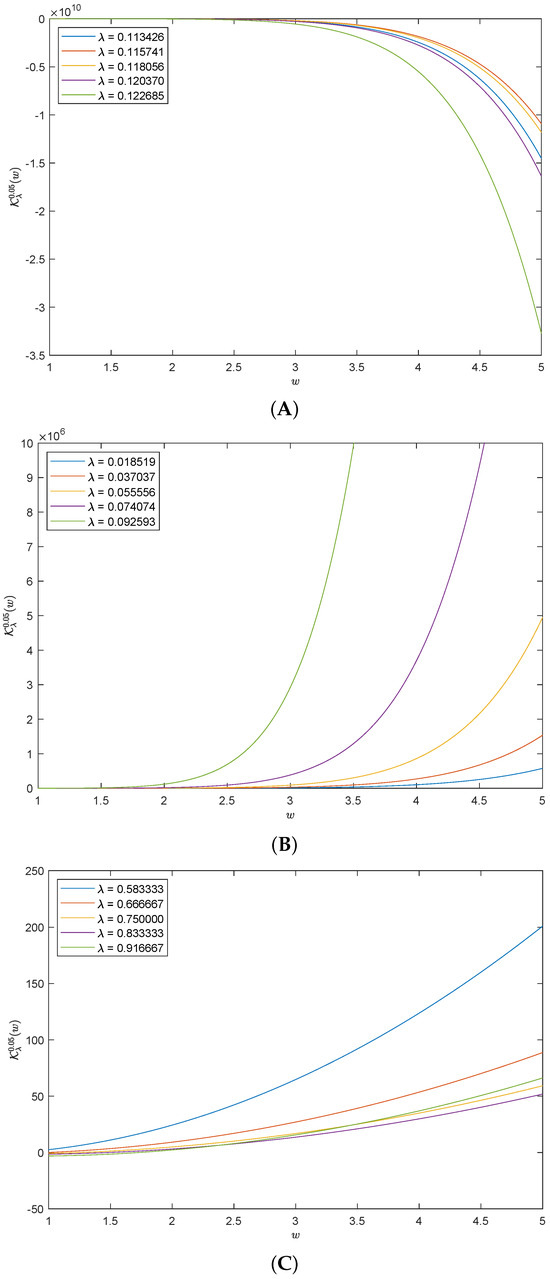
Figure 1.
Solutions of (23) of with different values of in (A–C).
To illustrate the impact of in the solutions of Equation (23), we fix the values of to be while choosing 1 to be the values of and setting in Figure 2. A similar pattern to the solutions in Figure 1 can be seen clearly for various values of in Figure 2A–C, with small-scale deviation in the solutions as increases. Moreover, the large values of lead to the large solutions while the small values of lead to the small solutions in Figure 3, with fixed values of and Furthermore, we could change the values of and to obtain more accurate solutions that do not appear in previous works.
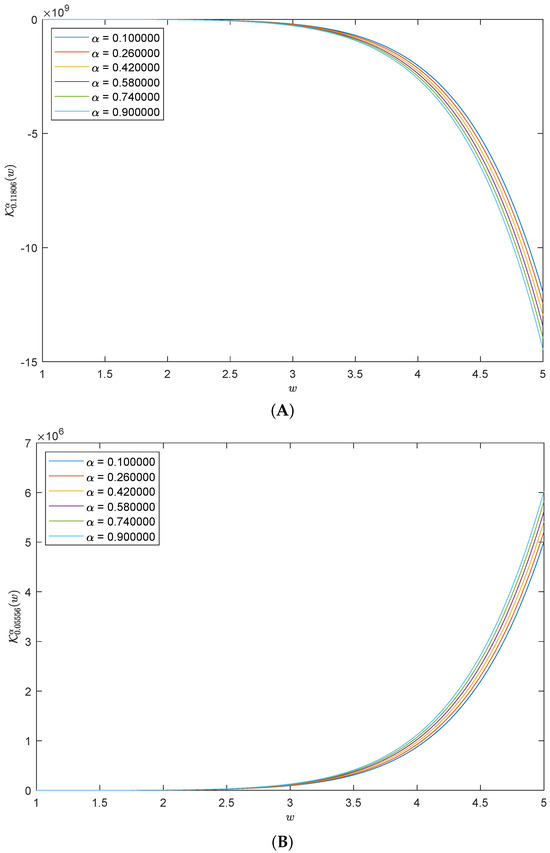
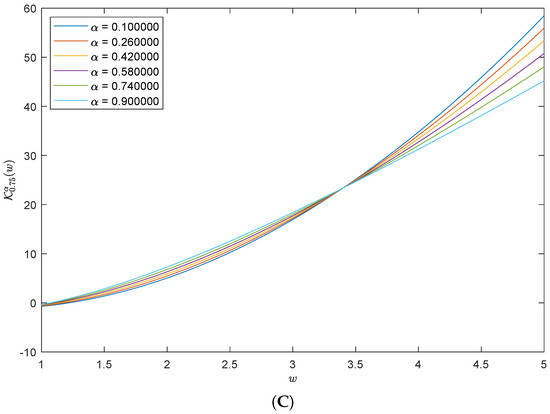
Figure 2.
Solutions of (23) of with different values of in (A–C).
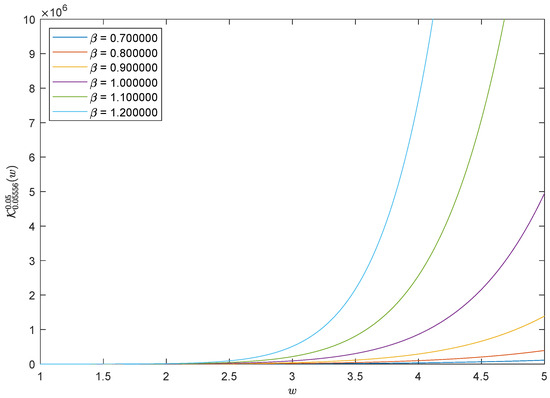
Figure 3.
Solution of (23) for with different values of .
To show the significance of the derivatives of the GDHF in the solutions of Equation (33) in Figure 3, we fix the values of to equal and set with the different values of in Figure 4A and of in Figure 4B.
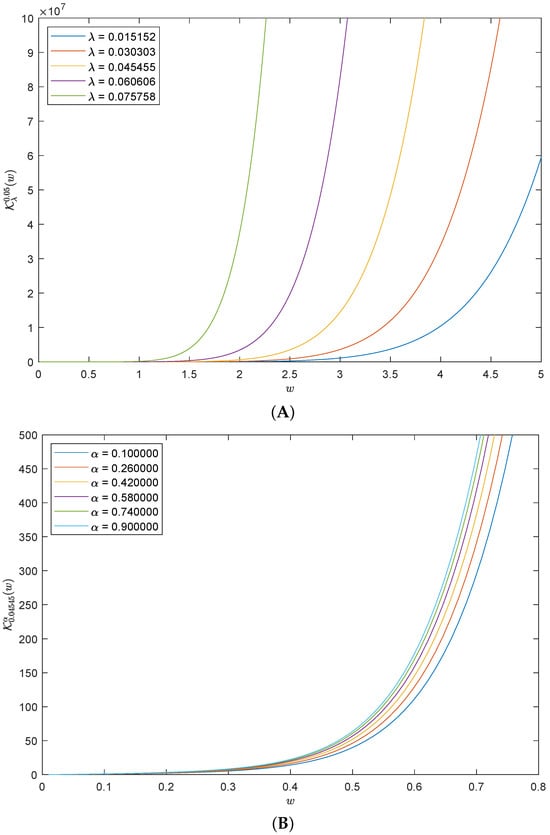
Figure 4.
Solutions of (33) of with different values of and in (A,B).
6. Conclusions
The KE has been widely studied due to its usefulness in astrophysical issues and others. Recently, FKEs have been investigated to describe anomalous reactions in dynamical systems [1,2,3,4]. Various researchers have established solutions to these families of FKEs using Laplace transform [6,7,8,9], Millen transform [49], Sumudu transform [10,11], and pathway-type transform [15,39,40]. To expand upon this research base, the authors developed a new and generalized form of the KEFO involving GDHFs. This new generalization can be used for computing changes in chemical composition, such as those found within stars like our sun [20,50].
Furthermore, we used the transform approach, but other authors applied different transform techniques, and existing results are particular cases of these results, implying that the current work is a generalization. Further, our analysis yields detailed and different results from those presented in previous studies and various situations of known and new results. In addition, plotting the solutions numerically was also supplied to show their conduct and examine unique cases for FKEs.
Author Contributions
Methodology, M.A.; software, M.Z.A.; formal analysis, M.Z.A.; investigation, M.Z.A. and M.A.; data curation, M.A.; writing—original draft, M.Z.A. and M.A.; writing—review and editing, M.A.; supervision, M.A. All authors have read and agreed to the published version of the manuscript.
Funding
This work was funded by the Deanship of Scientific Research at King Khalid University through a large group research project under grant number RGP2/432/44.
Data Availability Statement
No data were used to support this study.
Acknowledgments
The authors extend their appreciation to the Deanship of Scientific Research at King Khalid University for funding this work through a large group research project under grant number RGP2/432/44.
Conflicts of Interest
The authors declare no conflict of interest.
References
- Agarwal, P.; Baleanu, D.; Chen, Y.; Momani, S.; Machado, J. Fractional Calculus. In ICFDA: Proceedings of the International Workshop on Advanced Theory and Applications of Fractional Calculus 2018, Amman, Jordan, 16–18 July 2018; Springer Proceedings in Mathematics Statistics Book Series; Springer: Berlin/Heidelberg, Germany, 2020; Volume 303. [Google Scholar]
- Hilfer, R. Applications of Fractional Calculus in Physics; World Scientific: Singapore, 2000. [Google Scholar]
- Fallahgoul, H.A.; Focardi, S.M.; Fabozzi, F.J. Fractional Calculus and Fractional Processes with Applications to Financial Economics, Theory and Application; Elsevier/Academic Press: London, UK, 2017. [Google Scholar]
- Chakraverty, S.; Jena, R.M.; Jena, S.K. Computational Fractional Dynamical Systems: Fractional Differential Equations and Applications; John Wiley and Sons, Inc.: Hoboken, NJ, USA, 2023. [Google Scholar]
- Boulaaras, S.; Rehman, Z.U.; Abdullah, F.; Jan, R.; Jan, M.A.A. Coronavirus dynamics, infections and preventive interventions using fractional-calculus analysis. Aims Math. 2023, 8, 8680–8701. [Google Scholar] [CrossRef]
- Saxena, R.K.; Mathai, A.M.; Haubold, H.J. On fractional kinetic equations. Astrophys. Space Sci. 2002, 282, 281–287. [Google Scholar] [CrossRef]
- Saxena, R.K.; Mathai, A.M.; Haubold, H.J. On generalized fractional kinetic equations. Phys. Stat. Mech. Its Appl. 2004, 344, 657–664. [Google Scholar] [CrossRef]
- Saichev, A.I.; Zaslavsky, G.M. Fractional kinetic equations: Solutions and applications. Chaos Interdiscip. J. Nonlinear Sci. 1997, 7, 753–764. [Google Scholar] [CrossRef] [PubMed]
- Singh, Y.; Gill, V.; Singh, J.; Kumar, D.; Khan, I. Computable generalization of fractional kinetics equation with special functions. J. King Saud Univ. Sci. 2021, 33, 101221. [Google Scholar] [CrossRef]
- Kolokoltsov, V.N.; Troeva, M. A new approach to fractional Kinetic evolutions. Fractal Fract. 2022, 6, 49. [Google Scholar] [CrossRef]
- Almalkia, Y.; Abdalla, M. Analytic solutions to the fractional kinetic equation involving the generalized Mittag-Leffler function using the degenerate Laplace type integral approach. Eur. Phys. J. Spec. Top. 2023. [Google Scholar] [CrossRef]
- Douglas, J.F. Some applications of fractional calculus to polymer science. Adv. Chem. Phys. 2007, 102, 121–191. [Google Scholar]
- Mathai, A.M.; Haubold, H.J. An Introduction to Fractional Calculus; Nova Science Publishers: New York, NY, USA, 2017. [Google Scholar]
- Yang, X.J. Local Fractional Functional Analysis and Its Applications; Asian Academic Publisher Limited: Singapore, 2011. [Google Scholar]
- Alqarni, M.Z.; Bakhet, A.; Abdalla, M. Application of the pathway-type transform to a new form of a fractional kinetic equation involving the generalized incomplete Wright hypergeometric functions. Fractal Fract. 2023, 7, 348. [Google Scholar] [CrossRef]
- Khan, O.; Khan, N.; Choi, J.; Nisar, K.S. A type of fractional Kinetic equations associated with the (p,q)-extented τ-hypergeomtric and confluent hypergeomtric functions. Nonlinear Funct. Anal. Appl. 2021, 26, 381–392. [Google Scholar]
- Abubakar, U.M. Solutions of fractional kinetic equations using the (p,q;l)-extended τ -Gauss hypergeometric function. J. New Theory. 2022, 38, 25–33. [Google Scholar] [CrossRef]
- He, F.; Bakhet, A.; Hidan, M.; Abd-Elmageed, H. On the construction of (p, k)-hypergeometric function and applications. Fractals 2022, 30, 2240261. [Google Scholar] [CrossRef]
- Hidan, M.; Akell, M.; Abd-Elmageed, H.; Abdalla, M. Solution of fractional kinetic equations involving extended (k,t)-Gauss hypergeometric matrix functions. AIMS Math. 2022, 7, 14474–14491. [Google Scholar] [CrossRef]
- Geng, L.L.; Yang, X.J.; Alsolami, A.A. New fractional integral formulas and kinetic model associated with the hypergeometric superhyperbolic sine function. Math. Methods Appl. Sci. 2023, 46, 1809–1820. [Google Scholar] [CrossRef]
- Carlitz, L. Degenerate Stirling, Bernoulli and Eulerian numbers. Utilitas Math. 1979, 15, 51–88. [Google Scholar]
- Carlitz, L. A degenerate Staudt Clausen theorem. Arch. Math. 1956, 7, 28–33. [Google Scholar] [CrossRef]
- Dolgy, D.; Kim, T. Some explicit formulas of degenerate Stirling numbers associated with the degenerate special numbers and polynomials. Proc. Jangjeon Math. Soc. 2018, 21, 309–317. [Google Scholar]
- Kim, D.S.; Kim, T. Stirling numbers associated with sequences of polynomials. Appl. Comput. Math. 2023, 22, 80–115. [Google Scholar]
- Kim, D.S.; Kim, T. A note on new type degenerate Bernoulli numbers. Russ. J. Math. Phys. 2020, 27, 227–235. [Google Scholar] [CrossRef]
- Kim, T.; Kim, D.S. Some identities on truncated polynomials associated with degenerate Bell polynomials. Russ. J. Math. Phys. 2021, 28, 342–355. [Google Scholar] [CrossRef]
- Kim, T.; Dolgy, D.V.; Kim, D.S.; Kim, H.K.; Park, S.H. A note on degenerate generalized Laguerre polynomials and Lah numbers. Adv. Differ. Equ. 2021, 12, 421. [Google Scholar] [CrossRef]
- Duran, U.; Acikgoz, M. Generalized Gould-Hopper based fully degenerate central Bell polynomials. Turk. J. Anal. Number Theory 2019, 7, 124–134. [Google Scholar] [CrossRef]
- Kim, T.; Kim, D.S.; Jang, L.; Lee, H.; Kim, H. Representations of degenerate Hermite polynomials. Adv. Appl. Math. 2022, 139, 102359. [Google Scholar] [CrossRef]
- Alatawi, M.S.; Khan, W.A. New type of degenerate Changhee-Genocchi polynomials. Axioms 2022, 11, 355. [Google Scholar] [CrossRef]
- Kim, T.; Kim, D.S.; Kim, H.K. On generalized degenerate Euler?Genocchi polynomials. Appl. Math. In Science Eng. 2023, 31, 2159958. [Google Scholar] [CrossRef]
- Kim, D.S. A note on the degenerate type of complex Appell polynomials. Symmetry 2019, 11, 1339. [Google Scholar] [CrossRef]
- Kim, T. Degenerate Euler zeta function. Russ. J. Math. Phys. 2015, 22, 469–472. [Google Scholar] [CrossRef]
- Kim, T.; Kim, D.S. Note on the degenerate Gamma function. Russ. J. Math. Phys. 2020, 27, 352–358. [Google Scholar] [CrossRef]
- He, F.L.; Bakhet, A.; Akel, M.; Abdalla, M. Degenerate analogues of Euler zeta, digamma, and polygamma functions. Math. Probl. Eng. 2020, 2020, 8614841. [Google Scholar] [CrossRef]
- Kim, T.; Kim, D.S.; Lee, H.; Kwon, J. Degenerate binomial coefficients and degenerate hypergeometric functions. Adv. Differ. Equ. 2020, 2020, 115. [Google Scholar] [CrossRef]
- Yağci, O.; Şahin, R. Degenerate Pochhammer symbol, degenerate Sumudu transform, and degenerate hypergeometric function with applications. Hacet. J. Math. Stat. 2021, 50, 1448–1465. [Google Scholar] [CrossRef]
- Srivastava, H.M.; Choi, J. Zeta and q-Zeta Functions and Associated Series and Integrals; Elsevier Science Publishers: Amsterdam, The Netherlands, 2012. [Google Scholar]
- Mathur, G.A.R. Solution of fractional kinetic equations by using integral transform. In AIP Conference Proceedings; AIP Publishing: New York, NY, USA, 2020; Volume 2253, p. 020004. [Google Scholar]
- Kumar, D. Solution of fractional kinetic equation by a class of integral transform of pathway type. J. Math. Phys. 2023, 54, 043509. [Google Scholar] [CrossRef]
- Mathai, A.M. A pathway to matrix-variate gamma and normal densities. Linear Algebra Its Appl. 2005, 396, 317–328. [Google Scholar] [CrossRef]
- Mathai, A.M.; Haubold, H.J. Pathway model, superstatistics, Tsallis statistics and a generalize measure of entropy. Phys. A Stat. Mech. Its Appl. 2007, 375, 110–122. [Google Scholar] [CrossRef]
- Mathai, A.M.; Haubold, H.J. On generalized distributions and path-ways. Phys. Lett. A 2019, 372, 2109–2113. [Google Scholar] [CrossRef]
- Baleanu, D.; Agarwal, A. A composition formula of the pathway integral transform operator. Note Mat. 2014, 34, 145–155. [Google Scholar]
- Amsalu, H.; Shimelis, B.; Suthar, D.L. Pathway fractional integral formulas Involving S-Function in the Kerne. Math. Probl. Eng. 2020, 2020, 4236823. [Google Scholar] [CrossRef]
- Nair, S.S. Pathway fractional integration operator. Fract. Calc. Appl. Anal. 2009, 12, 237–252. [Google Scholar]
- Agarwal, P.; Purohit, S.D. The Unified Pathway Fractional Integral Formulae. J. Fract. Calc. Appl. 2013, 4, 1–8. [Google Scholar]
- Kaur, D.; Chand, M.; Rakshit, M. On pathway fractional integral formulae involving new extended hypergeometric functions. Int. J. Manag. Technol. Eng. 2019, IX, 1461–1469. [Google Scholar]
- Abdalla, M.; Akel, M. Contribution of using Hadamard fractional integral operator via Mellin integral transform for solving certain fractional kinetic matrix equations. Fractal Fract. 2022, 6, 305. [Google Scholar] [CrossRef]
- Aydiner, E. The time-fractional kinetic equation for the non-equilibrium processes. Sci. Rep. 2021, 11, 20625. [Google Scholar] [CrossRef] [PubMed]
Disclaimer/Publisher’s Note: The statements, opinions and data contained in all publications are solely those of the individual author(s) and contributor(s) and not of MDPI and/or the editor(s). MDPI and/or the editor(s) disclaim responsibility for any injury to people or property resulting from any ideas, methods, instructions or products referred to in the content. |
© 2023 by the authors. Licensee MDPI, Basel, Switzerland. This article is an open access article distributed under the terms and conditions of the Creative Commons Attribution (CC BY) license (https://creativecommons.org/licenses/by/4.0/).