


Abstract
Hyperbolic complete monotonicity property () is a way to check if a distribution is a generalized gamma (), hence is infinitely divisible. In this work, we illustrate to which extent the Mittag-Leffler functions , enjoy the property, and then intervene deeply in the probabilistic context. We prove that for suitable and complex numbers z, the real and imaginary part of the functions , are tightly linked to the stable distributions and to the generalized Cauchy kernel.
Keywords:
complete and Thorin Bernstein functions; complete monotonicity; generalized Cauchy distribution; generalized gamma convolutions; hitting time of spectrally positive stable process; hyperbolic complete monotonicity; infinite divisibility; Laplace transform; Mittag-Leffler function; stable distributions; Stieltjes transforms MSC:
26A48; 30E20; 60E05; 60E07; 60E10; 33E12
1. Introduction and First Results
The Mittag-Leffler function,
is a widely studied special function; see [1] and the references therein. The essence of this work is to unveil several probabilistic interpretation for the functions . To this end, we need some setting.
1.1. Bernstein Functions and Infinite Divisibility
A function is completely monotone (we denote ) if it is infinitely differentiable and it satisfies By Bernstein characterization, if and only if, it is the Laplace transform of some measure
A subset of is the class of generalized Stieltjes transforms of order , viz. of functions f represented by
where and U is a Radon measure on such that Stieltjes transforms of order 1 are usually called Stieltjes functions. The class of Bernstein functions consists of functions of the form
where is the so-called killing rate, is the drift, and is the Lévy measure of , i.e., a positive measure on , which satisfies . Two important subclasses of are the ones of Thorin Bernstein functions and of complete Bernstein functions, denoted by and , respectively. A function belongs to (respectively, ) .... if it is represented, for all by
where the positive measures U and V satisfy
Note the equivalences
The book of Hirschman and Widder [2] is a good reference for the classes and, especially for , we refer to [3] (Chapter 2). The books of Schilling, Song, and Vondraçek [3] and the one of Steutel and van Harn [4] are our main references for the class and its subclasses, and for infinitely divisible measures as well. The distribution of a nonnegative random variable X is said to be infinitely divisible, and we denote , if there exists an i.i.d. sequence , such that . The celebrated Lévy-Khintchine formula gives the following characterization through the cumulant function of :
1.2. The HCM Property and GGC Distributions
The class of infinitely divisible distributions behind (respectively, ) is known as the generalized gamma convolutions (respectively, the Bondesson class ), and it corresponds to the smallest class of sub-probability measures on which contains mixtures of gamma (respectively, exponential) distributions and which is closed under convolutions and vague limits. See [3] (Theorem 9.7 and Proposition 9.11). These classes were introduced by Olaf Thorin, and were widely developed by Lennart Bondesson in [5]; see also [3,4]. We will now introduce an important subclass of . A function is said to be hyperbolically completely monotone, and we denote if, for every , the function
(it is easy to see that is always a function of w). In [5] (Theorem 5.3.1), it is shown that the class corresponds to pointwise limits of functions of the form
Property [5] ((iv) p. 68) asserts that
By Bondessons’s definition [3] (Definition 9.10), and by [3] (Theorem 6.1.1), we have
The class of functions are stable under multiplicative convolution [5] (property vii, p. 68), then the Laplace transform of an function is itself . If the p.d.f. of a continuous and positive r.v. X is , we denote . Clearly, we have the classification
where denotes the well-known class of self-decomposable distributions; see [4] for this class. Note that all previous classes of distributions are stable by additive convolution. The importance of the classes and is due to their specific stability properties, one can find in [6]: if X and Y are independent and (respectively ), then
Note that the above stability properties are not shared by general distribution of the half real line. Moreover, by (7), the property reads only on the level of the cumulant function, whereas the one reads on the level of the probability density function, cf. the examples of next subsection. For a better comprehension of the above classes, see Figure 1.
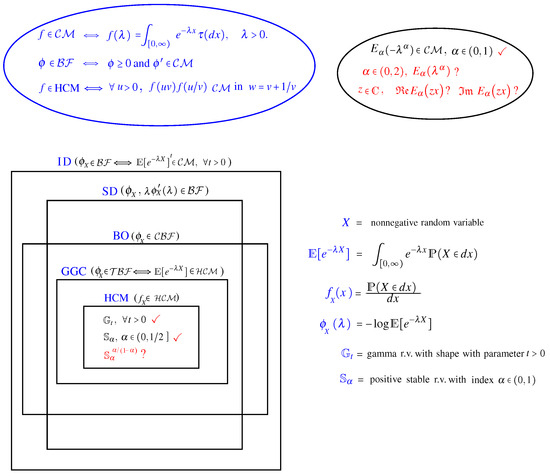
Figure 1.
Classes of infinitely divisible distributions, and motivations.
1.3. Gamma and Positive Stable Distributions
In what follows, denotes a standard gamma distributed random variable with shape with parameter , i.e., with Laplace transform, Mellin transform, and p.d.f.
The last p.d.f. form and (8) ensure that all gamma distributions are . Another example of a distribution is given by the positive stable r.v. , which is associated to the Thorin–Bernstein function
Note that the p.d.f. is not explicit except for ;
nevertheless, the Mellin transform of is explicitly given by
which gives the convergence in distribution
It is then natural to adopt the conventions . Related literature for the stable distribution is referenced on Nolan’s website [7]. The monograph of Zolotarev [8] is one of the major references for general stable distributions. By representation (13), and by the main result of [9], we know that
Additionally, in [10], it was shown that if , then
Using (16), and taking an independent version of , let us define the quotient,
where are i.i.d. and standard exponentially distributed. The p.d.f. of is explicitly given by the generalized Cauchy form
see (75) below for instance. Bosch [11] completed (18) by showing
With the above information, Bosch and Simon found it natural to raise the following open question in [9]:
This open question extends Bondesson’s conjecture [5], which was stated in 1977. This conjecture, which is identical to (22) with , was investigated in [10] and solved in [9].
1.4. First Results on the Mittag-Leffler Functions
From (15), one obtains a first link of the Mittag-Leffler function with the positive stable distribution:
By (13), it is clear that
In [10], if was shown that
Note that the r.v.
appeared in [12] ((184) and (223)), in a context without noticing its property: by (21), we have
Another monotonicity property of the Mittag-Leffler functions can be found in [13]:
and results in case are also shown there. Note that the function is completely monotone, contrary to . In [14] (Theorem 1.2, (a) and (c)), Simon showed that
The choice of the function is intuitive because .
The main objective of this work is to exhibit new monotonicity properties of the and type for the Mittag-Leffler functions. To give a taste of our results, we start by improving Simon’s results (27).
Theorem 1.
For , the following holds.
- (1)
- (2)
- Assume .
- (a)
- The functions and are completely monotone, and is Bernstein.
- (b)
- The function is Stieltjes. Moreover, , if and only if, . In this case, and .
- (3)
- Assume .
- (a)
- The function is completely monotone and is Bernstein.
- (b)
- The function is not if .
- (c)
- If and , then is , and both functions and are in .
Using (15), we see that
thus
which means that is a p.d.f. and is also the Laplace transform of a probability distribution; see (69) below. In case , we have , and the function is not a p.d.f. We complete our previous discussion with the following result.
Theorem 2.
- (1)
- If , then the p.d.f. is the one of a distribution but not a .
- (2)
- If , then the function is a widened , if and only if, . In this case, .
In [16], Simon was interested in the first passage time of the normalized spectrally positive -stable Lévy process , viz.
and
The self-similarity property of with index entails
Additionally, it is well known that
and this explains our focus on . To formalize our next results, we need to recall the biasing procedure for the distribution of a non-negative r.v. Z. For such that , we denote by a version of the length-biased distribution of order u of Z, viz.
We complete Simon’s main result in [16] by explaining (in (37) below) his factorization of obtained in his main theorem, and by the use of the function
Corollary 1.
In addition to the above results, which are a continuation of Simon’s ones [14,15,16], we obtain the following ones that we divide, for sake of coherence, into Section 2 and Section 3:
- Proposition 1 is a key to illustrate several other links between the r.v.s (19), and the Mittag-Leffler functions;
- In Corollary 2 (and also in Theorem 3), we obtain that for any complex number z in the first quadrant, and for , the real and imaginary part of also enjoy , and properties;
- With the help of Proposition 1, we characterize in Theorem 3 the distributions of a peculiar family of distributions, which might be helpful in solving the open question (22);
- We conclude with Corollary 4, which provides more information than
2. A New Class of HCM Distributions and Property for
2.1. The Biasing and the Gamma-Mixture Procedure
Clearly,
A useful result is the stochastic interpretation of property (9):
A random variable has the beta distribution if it has the p.d.f.
Observe that and , if and . By the beta-gamma algebra, we know that if and are independent, then
.
The following fact will be used in the sequel to exhibit several factorizations in law. A positive r.v. X has p.d.f. of the form
if and only if, the distribution of X is a gamma-mixture of order t (shortly X is a -mixture). The latter is equivalent to the existence of a positive r.v. Y such that we have the independent factorization
and in (42), necessarily
An important result due to Kristiansen [17] asserts that
and the beta-gamma algebra ensures that the same holds if the distribution of X is a -mixture, .
2.2. A Generalization of Property (21)
In this work, the functions, defined for and , by
turn out to be crucial, and their properties will unblock several of our problems. Notice that the necessity of the condition is essential since we need to be a Bernstein function in the sequel. Notice that is the composition , where , whereas
On the other hand, the class being stable by composition, we see that
By [3] (Theorem 7.3), we deduce that the logarithmic derivative
i.e., has the representation by (2). By (78) below, we easily deduce that , for any and . A larger range for t is provided by the following result.
Proposition 1.
Let and . Then, the following holds.
- (1)
- The functionis Thorin–Bernstein if and only if and .
- (2)
- Let and . Then, the following assertions are equivalent.
- (i)
- and ;
- (ii)
- The function is completely monotone;
- (iii)
- The function is Bernstein;
- (iv)
- The function is Thorin–Bernstein.
A consequence of Proposition 1 is the following result, which gives more information on the function , and provides a monotonicity property for the Mittag-Leffler function in case .
Corollary 2.
Let For , let be the Mittag-Leffler function and be a positive stable random variable. Then, the following holds.
- (1)
- The seriesis represented by
- (2)
- The following assertions are equivalent.
- (i)
- ;
- (ii)
- the function is completely monotone;
- (iii)
- the function is Bernstein;
- (iv)
- the function is Thorin–Bernstein.
- (3)
- Under any of the conditions in (2), the functions and are represented bywhere is a positive r.v. whose distribution gives no mass in 0. The Thorin measure of , obtained by representation (4), is .
- (4)
- Let z be a complex number such that . Then, , if, and only if, .
Remark 1.
and
then the completely monotonicity of is not a surprise. On the other hand, Proposition 1 gives
The trivial relation
complies with the equality .
We are now able to introduce a new class of p.d.f.s that are reminiscent of representation (8).
Corollary 3.
Probability density functions of the form
are , if and only if, , and . Pointwise limits of functions of the form :
where are .
Thanks to (20), the p.d.f. of is explicitly given by
Therefore, the main result of Bosch [11] (Theorem 1.2) is a particular case of Corollary 3 with and there. Indeed, the condition , and is equivalent to
and then (21) holds true.
3. Stochastic Interpretation of the p.d.f.s in (48) and Property for
Proposition 1 enables us to introduce the positive r.v. associated with the -function in (45), i.e.,
With the convention , the random variable (respectively for ) is well defined for (respectively, ). These r.v.s enjoy a simple independent factorization in law:
and
For and c as in Proposition 1, we have this algebra: if is independent of , then
The latter is a reminiscent of the subordination relation for stable distributions: if is a stable r.v. independent of , then
which yields
The ordinary generating function for the Chebychev’s polynomial of the second kind is
When , we may take
and obtain the Laplace transform
Integrating the latter on , we obtain
Hence,
Then taking the Mellin transform in both sides of the latter, we obtain
or equivalently,
Motivated by the duplication Formula (54), the link (57) with Chebychev’s polynomials, and (60), we explain the distribution of the r.v.s ; in the following result, the case is described in (52) and (53).
Theorem 3.
Let , and
GGC
- (1)
- (2)
- There exists a positive r.v. , such thatwhose Mellin transform isand such that we have the independent factorization in law(recall the size biasing notation (34) for ). In particular, we have the Laplace transform representation:
- (3)
- If z is a complex number such that and , then .
The next result completes Theorem 3 and Bosch’s characterization (21).
Corollary 4.
For and , we have the equivalences:
- (1)
- and ;
- (2)
- ;
- (3)
- ;
- (4)
- the distribution of is a -mixture;
- (5)
- .
With , we have the independent factorizations in law
4. Comments and Prerequisite for the Proofs
4.1. Comments on Theorem 1
Our results in Theorem 1 merit some comments.
- (a)
- (b)
4.2. Comments on Theorem 2
The case in Theorem 2 is specific.
- (a)
- The complete monotonicity of the function in (67) is also a direct consequence of the one of in (28). Indeed, since , thenThe functionsand , were shown to be completely monotone in [16] (Equation (1.4)) and in [14] (Theorem 1.1), respectively. The connection with the r.v. was not noticed there, nor was the property of the function .
- (b)
- One has . One could ask if there exists some such that . Observe that, contrary to the case , the functionis completely monotone (one could even show that it is a Stieltjes function).
- (c)
- In [15] (Equation (3)) and [14] (Equation (2.1)), one can find the following representations valid for :andIn (32), we have seen that , in case , consequently, the functionis a p.d.f. These expressions were not used in our approach.
- (d)
- Using (68), we see that Theorem 2 could be restated as follows: for , we haveIn [5] (Theorem 5.7.1), we have the following computation, valid for all :Note that the latter function is , since it is the Laplace transform of the product and quotient of independent random variables. Using property (9), we see that
4.3. Comments on Theorem 3
In (64), the l.h.s. term is certainly the Laplace transform of a distribution on the positive line, whereas the r.h.s. term is the imaginary part of the Laplace transform (with complex argument) of a signed function. We were not able to invert (64) to obtain the explicit distribution of with elementary computations. On the other hand, formula [18] ((FI II 812, BI (361)(9), p. 498) asserts that
Using (64) and last formula, we may write: for all ,
Letting , we obtain
Then, dividing (72) by the latter, we retrieve another computation of the complicated gamma ratio form of the Mellin transform (62). After searching in several books specialized in integral representations, such as [18], we were unsuccessful in finding this complicated expression. Finally, using identity (63), the fact that , and the beta prime p.d.f. of explicitly given by , we obtain the alternative representation
where those parameters are as in Theorem 3. In particular,
4.4. Comments on Corollary 4
4.5. Some Account of Stable Distributions
We will need the several identities for the positive stable distributions. Shanbhag and Sreehari [19] (Theorem 1) exhibited following independent factorization:
Next independent factorization more classical:
where in the l.h.s, the exponentially distributed r.v. is independent of , and can be easily seen from
Note that the last identity yields the Mellin transform computation in (15), and that the explicit expression of the p.d.f. of is easily retrieved through the expression of the Mellin transform of obtained from (15), the Euler’s reflection formula for the gamma function, and the residue theorem. Additionally, if , then
and the injectivity of the Mellin transform provides the p.d.f. of in (20). Also note that a possible approach to conjecture (22) is Kanter’s factorization, which can be found in [20] (Corollary 4.1):
where denotes an uniform random variable on independent of and is the function defined on by
4.6. Some Account of Thorin and Complete Bernstein Functions
Note that function ϕ belongs to (respectively, ) if if its Lévy measure Π in (3) has a density function of the form (respectively, ), , where the U and V and are positive measures on satisfying (5). Both classes and are convex cones that are closed under pointwise limits; the class is stable by composition, and by [3] (Theorem 8.4), for a Thorin–Bernstein function ϕ, we have
It is immediate that
The following fact is much less evident. By [3] (Theorem 7.3), we also have
An important representation for the logarithmic derivative of is provided by [3] (Theorem 6.17): there exists (a unique) pair and a measurable function such that
For instance, the Thorin–Bernstein function , has an η-function equal to .
5. The Proofs
Proof of Theorem 1.
(1) From [14] (Equation (3.4) and (3.6)), we have
(2a), we have
Let be the random walk generated by given by (25), i.e., where , are n independent copies of . Let be geometrically distributed on with parameter α, and independent of the sequence . Using (25), (28), and the subordinated r.v. , we have the Laplace representation
(2b) From Kanter’s factorization (76), we see that has a completely monotone density, and so does . We deduce that is a Stieltjes function. The equivalence between , and , is due to (21). The function is Stieltjes because , and because of (6). The function is due to (26) and (82).
(3a) We perform as in (2a).
(3b) By (21), we know that if then the distribution of is not . Since in case , then could not be .
As in (2), the mixture property (77) entails has a completely monotone density; hence, so does . The latter proves that is Stieltjes; for its logarithmic derivative, we conclude as in the end of the proof of point (2b).
□
Proof of Theorem 2.
(1) Assume . The function is clearly an function, and by (10), we deduce . If , then the function
is locally increasing in a neighborhood of and cannot be completely monotone. Suppose that . By [5] (Theorem 5.4.1), the function is then the Laplace transform of a and by [5] (Theorems 4.1.1 and 4.1.4), the Thorin mass in (69) equals α; thus, the function in (83) would be completely monotone, a contradiction. We deduce that is not when . To show that , it suffices to show that is a Thorin–Bernstein function (equivalently, is a Stieltjes function), using formula (68). The function (and then ) extends to an analytic function on . We will use the characterization of the Stieltjes function given [3] (by Corollary 7.4), namely, we aim to prove that
Observe that is harmonic on the upper half-plane as the imaginary part of an analytic function. Moreover, uniformly as . Then, from a compactness argument and from the minimum principle, it suffices to show that
Elementary computations give
and for all , we have
where
and
The function is a positive on . Indeed,
thus, is a non-decreasing function on , and since , we deduce that is positive and then for all . Next, since , then
Finally, , for all . All in all, we have proved that the function is Stieltjes, hence is Thorin–Bernstein.
(2) Assume . Using [5] (Theorem 5.4.1) again and the definition of a widened in [5] (Section 3.5), we obtain
and it suffices to prove that the function
is Thorin–Bernstein (equivalently, is a Stieltjes function) if and only if . Elementary computations give
and then,
where
and
We proceed as we did for to show that is a Stieltjes function. For this, we have to check the sign of . The function is a trivial Thorin–Bernstein function. Since for
we see that is a necessary condition for to be positive. Next, let
With the expression
one deduces that if , then the function decreases on and increases on ; thus, for all . Finally, we deduce that if , then
and this shows that is a Stieltjes function.
The property of is straightforward thanks to (31). □
Proof of Corollary 1.
If , then , is Brownian motion, and . The rest of the assertions are straightforward due to the convention . We then treat the case .
(1) Using [16] (Equation (1.4)) and the definition of in (28), one has the Laplace representation
and this gives the Laplace transform representation (36).
(2) From (28) and (85), we obtain
where is a positive r.v. independent of . Further, (86) or (32) imply
hence,
which shows the first factorization in (37). The second factorization in (37) is due to (74) and to the second identity in (38) applied to .
(3) The second factorization in (37) gives
Since , then the power property in (11) ensures that . Property (21) with asserts that , and by property (39) we deduce that Finally, the stability property by independent products in (11) yields .
(4) We know that . Then,
the property of follows from (10). □
Proof of Proposition 1.
- (1)
- The case . We have and the function is not completely monotone if , because its derivative has a change sign. Thus, if .
- (2)
- The case . Trivially, .
- (3)
- The case . The function is if and only if satisfies (80). We then study the logarithmic derivative of :
(3a) The case . Here, we have a first conclusion: if , then does not belong to , and not even to , since
(3b) The case . Recall the r.v. given in (20). Observe that if is standard exponentially distributed and is independent of , then
Using the fact that used that and the latter, we obtain
where
Similarly, we have
where
We finally obtain the representation of the logarithmic derivative of :
where
Due to (81), we can now assert that
We arrive to the last step. Since has the explicit density
then the derivative of is
and finally,
(3b)(i) The case . By (88), the function decreases on , then increases on , and its maximum is equal to . We deduce that (87) is true.
(3b)(ii) The case . By (88), the function increases on , then decreases on , and its maximum is equal to
Note that we have performed the obvious change of variable to obtain the last expression. We deduce that (87) is true if and only if
(2) By (1), we have . Trivially, . It suffices to check . Assume
If , then the denominator has a sign change, and could not be . Assume and , then has two poles . In this case, cannot extend to an analytic function on , then, it could not be . □
Proof of Corollary 2.
(1) Using (24), note that
(2) The equivalences are obtained by the form of the derivative of :
Applying Fubini–Tonelli’s theorem, and performing the change of variable under the expectation, we obtain the Laplace transform representation of :
Thus, , if, and only if, and (hence decreases from to , thus ). The latter is equivalent to or to .
Integrating the last expression from 0 to λ, we retrieve (47). The representation of as the Laplace transform or a positive r.v. is evident since is completely monotone and . The last assertion is also evident due to the alternative Frullani integral form of (47).
(4) It suffices to write , where . □
Proof of Corollary 3.
The first assertion is a straightforward consequence of the Thorin property of the Bernstein function in Proposition 1. Indeed, the definition of distributions gives that
For the second assertion, use the fact that the class is stable by product, closed by pointwise limits [5] (property (ii) p. 68), and property (9). □
Proof of Theorem 3.
(1) We proceed as in the proof of Corollary 2. Let us define
and observe that
Using representations (51) and (90), then performing the change of variable under the expectation, we obtain
The latter gives the expression of , and by integration over , we obtain the one of .
(2) By (51), and Corollary 3, recall that the distribution is , and is associated with the Thorin–Bernstein function in (47) and to the Thorin measure given by (4). Using Corollary 2, then [5] (Theorem 4.1.1), or equivalently [5] (Theorem 4.1.4), we see that the total mass of equals
and we conclude that if and only if identity (63) holds. The Laplace transform in (64) is identified by the equality , which is obtained by taking in (61). By (42), (61) and (63), it is straightforward that
(3) This performed as in proof of point (3) of Corollary 2. □
Proof of Corollary 4.
Equivalences are due to point (2) of Proposition 1 and to (72), corresponds to (41) ⟺ (42), and is due to point (2) of Proposition 1 and to (51). For the last assertion, assume , , in (51), then consider the r.v. , which is linked to by the expression
Integrating both sides in (92), we see that
6. Conclusions and Perspectives
In this paper, we showed that the Mittag-Leffler function (with an eventually complex argument) is tightly linked to the stable distributions by various aspects: we exhibited its non-trivial infinite divisibility, and properties, and we provided its explicit intervention in the distributional properties for the first passage time of the spectrally positive stable process. We also introduced new classes of distributions, and gave a possible direction to solve the open question (22) on the power of the positive stable r.v.s. Indeed, (65) gives
The latter indicates that two independent factorizations are feasible, namely,
In other terms, the distribution of is symmetric. More investigation of the distribution of is then necessary to solve the open question (22).
Author Contributions
Writing—review & editing, N.A. and W.J. All authors have read and agreed to the published version of the manuscript.
Funding
Researchers Supporting Project (RSP2023R162), King Saud University, Riyadh, Saudi Arabia.
Data Availability Statement
No data were created or analyzed in this study. Data sharing is not applicable to this article.
Acknowledgments
We thank the two anonymous reviewers for their valuable comments and suggestions which substantially improved the presentation and the results of this article. The work of the second author was supported by the “Researchers Supporting Project (RSP2023R162), King Saud University, Riyadh, Saudi Arabia”.
Conflicts of Interest
The authors declare no conflict of interest.
References
- Gorenflo, R.; Kilbas, A.A.; Mainardi, F.; Rogosin, S.V. Mittag–Leffler Functions (Related Topics and Applications); Springer: Berlin/Heidelberg, Germany, 2014. [Google Scholar]
- Hirschman, I.I.; Widder, D.V. The Convolution Transform; Princeton University Press: Princeton, NJ, USA, 1955; Volume 20. [Google Scholar]
- Schilling, R.L.; Song, R.; Vondraček, Z. Bernstein Functions. Theory and Applications, 2nd ed.; de Gruyter Studies in Mathematics; Walter de Gruyter & Co.: Berlin, Germany, 2012; Volume 37. [Google Scholar]
- Steutel, L.; Van Harn, K. Infinite Divisibility of Probability Distributions on the Real Line; Marcel Dekker: New York, NY, USA; Basel, Switzerland, 2004. [Google Scholar]
- Bondesson, L. Generalized Gamma Convolutions and Related Classes of Distributions and Densities; Lecture Notes in Statistics; Springer: New York, NY, USA, 1992; Volume 76. [Google Scholar]
- Bondesson, L. A class of probability distributions that is closed with respect to addition as well as multiplication of independent random variables. J. Theor. Probab. 2015, 28, 1063–1081. [Google Scholar] [CrossRef]
- Nolan, J. Bibliography on Stable Distributions, Processes and Related Topics. Available online: https://edspace.american.edu/jpnolan/wp-content/uploads/sites/1720/2022/05/StableBibliography.pdf (accessed on 25 September 2023).
- Zolotarev, V.M. One Dimensional Stable Laws; Translations of Mathematical Monographs; American Mathematical Society: Providence, RI, USA, 1986. [Google Scholar]
- Bosch, P.; Simon, T. A proof of Bondesson’s conjecture on stable densities. Ark. Mat. 2016, 54, 31–38. [Google Scholar] [CrossRef]
- Jedidi, W.; Simon, T. Further examples of GGC and HCM densities. Bernoulli 2013, 19, 1818–1838. [Google Scholar] [CrossRef]
- Bosch, P. HCM property and the half-cauchy distribution. Probab. Math. Stat. 2015, 35, 191–200. [Google Scholar]
- James, L.F.; Roynette, B.; Yor, M. Generalized Gamma Convolutions, Dirichlet means, Thorin measures, with explicit examples. Probab. Surv. 2008, 5, 346–415. [Google Scholar] [CrossRef]
- Bridaa, S.; Jedidi, W.; Sendov, H. Generalized unimodality and subordinators, with applications to stable laws and to the Mittag-Leffler function. J. Theor. Probab. 2023. [Google Scholar] [CrossRef]
- Simon, T. Mittag-Leffler functions and complete monotonicity. Integral Transforms Spec. Funct. 2015, 26, 36–50. [Google Scholar] [CrossRef]
- Simon, T. Fonctions de Mittag-Leffler et processus de Lévy stables sans sauts négatifs. EXPO Math. 2010, 28, 290–298. [Google Scholar] [CrossRef]
- Simon, T. Hitting densities for spectrally positive stable processes. Stochastics 2011, 83, 203–214. [Google Scholar] [CrossRef]
- Kristiansen, G.K. A proof of Steutel’s conjecture. Ann. Probab. 1994, 22, 442–452. [Google Scholar] [CrossRef]
- Gradshteyn, I.S.; Ryzhik, I.M. Table of Integrals, Series, and Products, 7th ed.; Elsevier: Amsterdam, The Netherlands, 2007. [Google Scholar]
- Shanbhag, D.N.; Sreehari, M. An extension of Goldie’s result and further results in infinite divisibility. Z. Wahrscheinlichkeitstheorie Verwandte Geb. 1979, 47, 19–25. [Google Scholar] [CrossRef]
- Kanter, M. Stable densities under change of scale and total variation inequalities. Ann. Probab. 1975, 3, 697–707. [Google Scholar] [CrossRef]
Disclaimer/Publisher’s Note: The statements, opinions and data contained in all publications are solely those of the individual author(s) and contributor(s) and not of MDPI and/or the editor(s). MDPI and/or the editor(s) disclaim responsibility for any injury to people or property resulting from any ideas, methods, instructions or products referred to in the content. |
© 2023 by the authors. Licensee MDPI, Basel, Switzerland. This article is an open access article distributed under the terms and conditions of the Creative Commons Attribution (CC BY) license (https://creativecommons.org/licenses/by/4.0/).