


Abstract
The Neutrosophic Set represents the uncertainty in data with fuzzy attributes beyond true and false values independently. The problem arises when the summation of true , false , and indeterminacy values crosses the membership value of one, that is, . It becomes more crucial during decision-making processes like medical diagnoses or any data sets where . To achieve this goal, the is recently introduced. This study employs the Interval-Valued Fermatean Neutrosophic Set () as its chosen framework to address instances of partial ignorance within the domains of truth, falsehood, or uncertainty. This selection stands out due to its unique approach to managing such complexities within multi-decision processes when compared to alternative methodologies. Furthermore, the proposed method reduces the propensity for information loss often encountered in other techniques. IVFNS excels at preserving intricate relationships between variables even when dealing with incomplete or vague information. In the present work, we introduce the , which deals with partial ignorance in true, false, or uncertain regions independently for multi-decision processes. The contains the interval-valued value, value, and for knowledge representation. The algebraic properties and set theory between the interval-valued have also been presented with an illustrative example.
Keywords:
Fermatean neutrosophic sets; interval-valued Fermatean neutrosophic sets; faculty performance evaluation; multicriteria decision analysis MSC:
03E72; 05C72; 90B50
1. Introduction
The acronyms given in the following Table 1 are used throughout the entire manuscript. For the computation of linguistic words like tall or young, Zadeh proposed FS in 1965 [1]. are used to represent the acceptance and rejection of fuzzy attributes by membership values that lie in [0, 1]. helps to represent the hesitant part with the independent values of , , and such that [2]. Later, interval-valued membership sets were introduced, which dealt with the ignorance of partial data about the membership values [3,4]. Yager [5,6,7] coined a new kind of called the as an extension of the . It has many practical applications in MCDM [8,9]. It is based on the Fermatean fuzzy set [10], which was recently hybridized with the [11,12,13] and Fermatean fuzzy graph [14]. Rani and Mishra [15] studied the . The [16,17] is used in several fields for the DM process because of its extensive properties [18,19].
Table 1.
Acronyms.
The theory is introduced by Smarandache [2] as an extension of the theory to deal with indeterminacy. Wang [4] defined the in 2010 as an extension of interval fuzzy sets [20]. Zhang et al. [21] applied the concept of Interval neutrosophic sets in multicriteria decision-making problems. Wang, T [22] introduced a projection model with unknown weight information within an interval neutrosophic environment and applied it to software quality-in-use evaluation. Another class of the is the with the dependent interval-valued Pythagorean component, proposed by Stephy and Helen [13]. Clearly, it is a generalization of the and can handle more information than the . Motivated by the Jansi [11] defined the and provided its various properties. Jeevaraj [16] introduced the concept of the s and derived mathematical operations on the class of the . Score functions in the are introduced and their properties are studied. Recently, PalaniKumar and Iampan [17] proposed the concept of the spherical . Liu et al. [18] discussed Fermatean fuzzy linguistic term sets, their basic operational laws, and aggregate functions. Broumi et al. [19] proposed the and presented some basic operational laws. He also [23] introduced the and , , and product graphs.
For DM problems in the Neutrosophic context, the value of times squared of the sum of the degrees does not exceed two. To deal with this issue, Sweety and Jansi introduced the [11]. Also, the is a generalization of the and it is characterized by the condition that the cubes of their sum of their , , and degrees do not exceed them twice. Motivated by the above literature, we develop the idea of the and its algebraic operations. The major findings of the present article are as follows:
- To establish and study the and its algebraic operations.
- To introduce the accuracy and score functions of the .
- To illustrate the applications of the .
2. Prerequisites
In this section, we briefly introduce the necessary basic definitions and preliminary results.
A [1] A on is of the form: = where . A [5,6,7] A on is of the form: = , where denotes the membership degree and denotes the to the set , respectively, such that 1. Corresponding to its the indeterminacy degree is given by ,. A [11] A on is of the form as = where represents the , and represents the to the set A, respectively, such that 1. Corresponding to its the indeterminacy degree is given by , A [2] A on is defined by its truth , indeterminacy and falsity membership function such that for all whose all the subset of
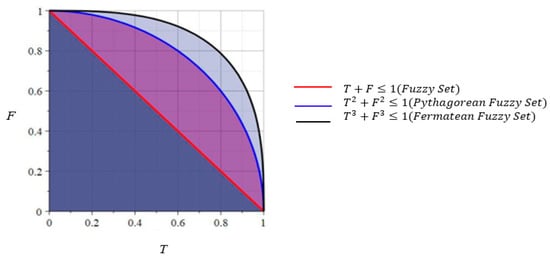
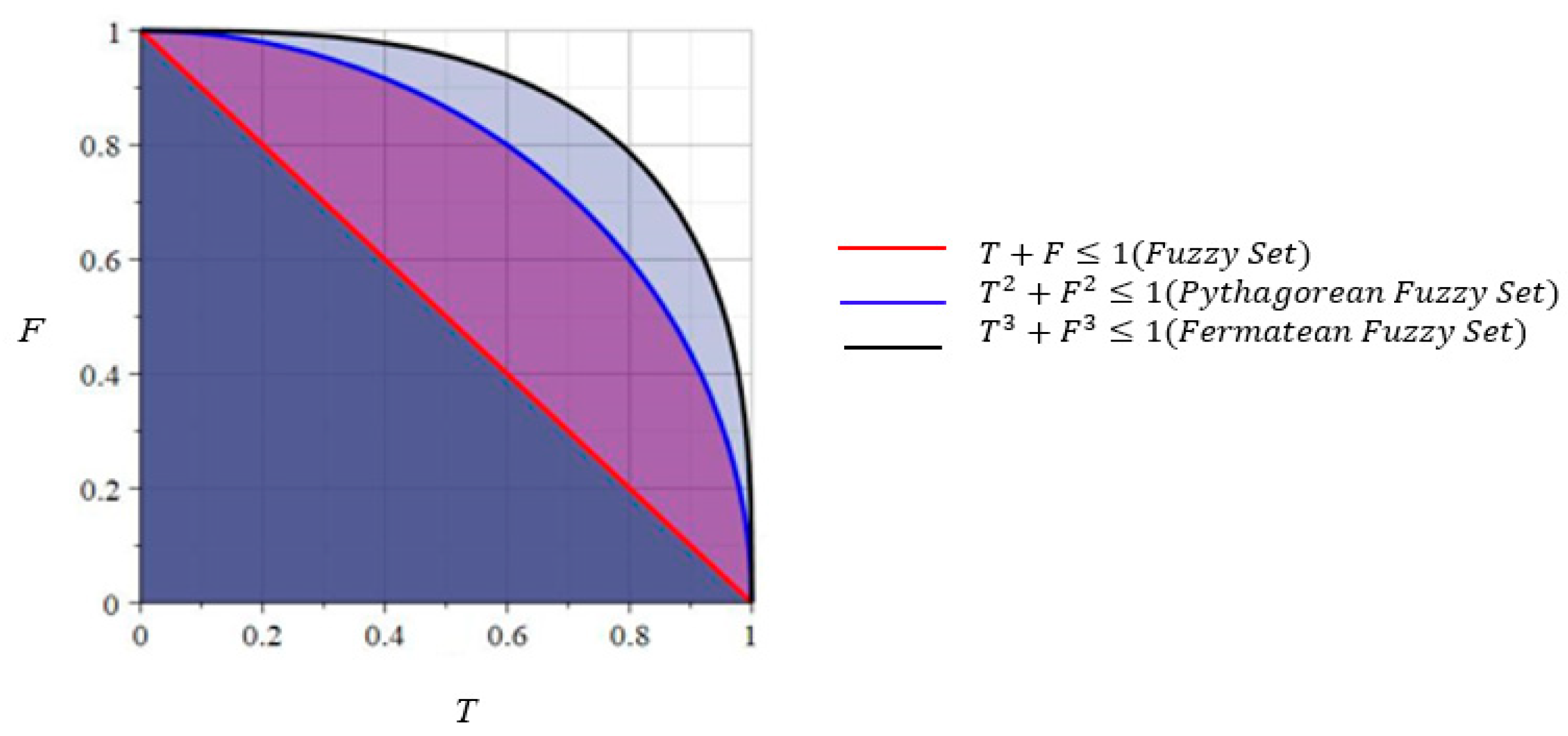
In the following, Figure 1 depicted the graphical visualization between the Intuitionistic, Pythagorean, and Fermatean Fuzzy sets.
Figure 1.
A graphical visualization of the Intuitionistic, Pythagorean, and Fermatean Fuzzy sets.
The [3] A on is is of the form: = , where represents the , represents the and represents the to the setA, respectively, with 3. The [8] is defined as, +1 and 1 then ++ 2. Sweety et al. [11] introduced the as: +1 and 1 then to the set A, with ++2. An [19] set on is a function and the set of all on is denoted by . Suppose that , is the of an element to , , are the least and greatest bounds of to , where . The [10] A on is of the form as: = where , and . [13] A on of the form as: = where , and . A [24] for every point , .
with 0++ 3. An [25] A on is of the form as where represents the least and greatest bounds of truth , represents the least and greatest bounds of and represents the least and greatest bounds of to the set , with ++ 2. In Zhang et al. [21], the operators of set-theoretic on the are defined as follows:
The is contained in another , , , ; .
Two , ,
That is,
The A is empty , and , for all .
complement of the is
defined as follows:
defined as follows:
The difference between two and is the defined as AB = < [], [], ]> where
The scalar division of the A is a, defined as follows:
, defined as follows:
3. Interval-Valued Fermatean Neutrosophic Sets
The concept of the , and their basic properties are introduced in this section.
Definition 1.
The on is of the form where represents the least and greatest bounds of , represents the least and greatest bounds of and represents the least and greatest bounds of to the set , respectively, with + and , ++ means ++2
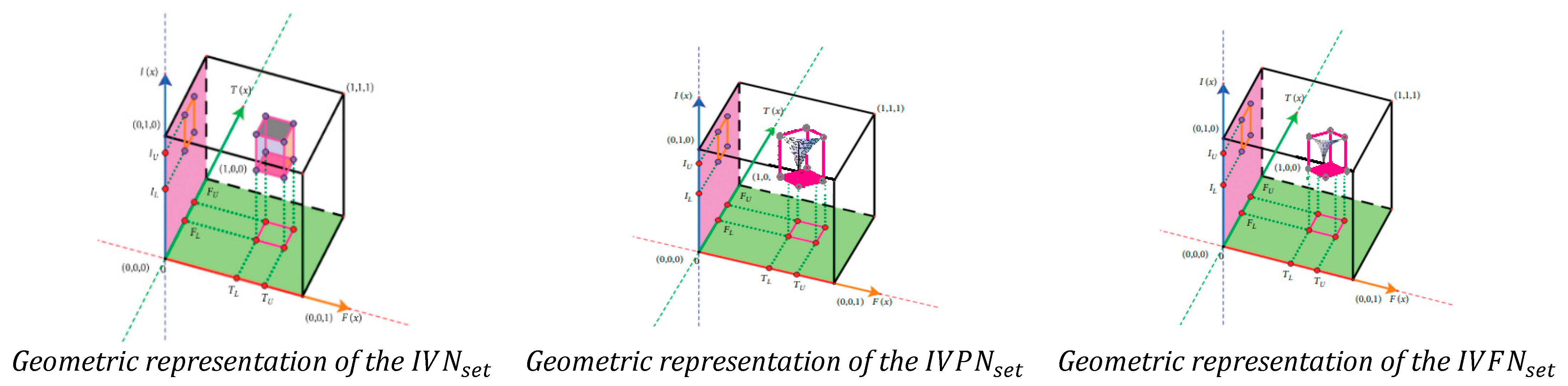
In the following, Figure 2 depicted the Geometric representation of the .
Figure 2.
Geometric representation of the .
Definition 2.
For an which satisfies . Consider
Remark 1.
The is an extension of occupies more space than the . There is no doubt that the is the more appropriate tool for finding the best alternative in complex MCDM uncertainty problems rather than the and
Definition 3.
Let and be two on defined by:
where and
Then for all
- is contained inif and only if
- The union ofandis the, defined byor simply we can write,
- The intersection ofandis the, defined byor simply we can write.
- The complement ofis the, defined byor simply we can write.
Definition 4.
The is known as an absolute , denoted by , its membership values are defined as
Definition 5.
The empty is denoted by , if its membership values are defined as
Example 1.
Consider two defined over as
then
Theorem 1.
For any is defined on the absolute .
- (Identity Law)
- (Domination Law)
Proof.
- (i)
- Let and be two on , defined by, is defined as follows: =So, = ,Therefore, =In a similar way, we can prove
- (ii)
- Let and be two on defined byis defined as follows: =So, = ,Therefore, =In the similar way, we can prove
□
Definition 6.
Suppose
and
be two , then
Definition 7.
Let and be three . Then
- (i)
- if and only if
- (ii)
- if and only if
- (iii)
- (iv)
- (v)
- (vi)
- (vii)
Remark 2.
- Ifthen,
- Ifthen,
- If then
Definition 8.
Consider is a set of the where . Then, the operator is as follows:
Definition 9.
Consider is a set of where . Then, the operator is as follows: where is weight value with and
4. Score and Accuracy Function for the
Finding the solutions to Multi-Criteria Decision-Making (MCDM) problems in an uncertainty situation is a challenging task in today’s world. In real-time situations, the membership values of , and for a certain problem cannot be an exact value but are defined by possible interval values. So, researchers introduced the . There are many studies available in the literature about grouping operators and determination methods in Table 2. In the Decision-Making (DM) process, one can find the best alternative among a set of feasible ones by using MCDM techniques. HWang and Yoon [26] introduced TOPSIS, which is another well-known MCDM approach to finding the best alternative. To date, the are widely used in DM problems. Additionally, the are extensions of the .
Table 2.
Literature Survey.
Singh et al. [24] defined score and accuracy functions using to solve problems in MCDM for ranking the
Definition 10.
Score functions of the Let . That is, be an . The Score function (SF) of the is interpreted as where (Şahin and Nancy [33,34,35])
where (Singh et al. [2])
where .
(Sahin [34]).
Definition 11.
An Accuracy functions of the Let be the . For convenience, the , ( [34,35] is defined as
The Accuracy function (AF) of f (Nancy and Şahin [34,35]) is interpreted as
Definition 12.
Score and accuracy functions of the and Score function of the on is given by Zhang et al. [21], who introduced the (SF) as , where and . The AF is , where
Score and Accuracy functions of the
The score function of the is , where
The accuracy function for the is , where . Garg [31] observed that the above SF and AF for the are suitable for certain cases; for example, are the two , then we obtain, Hence, he proposed an improved score function as follows:
where
Based on the improved score function, he gave the following comparison law for the DM process by the
if , He also verified this with the above two examples,
Definition 13.
Score and accuracy functions of the and . Senapati and Yager [10] proposed the in 2019. They have also compared it to other kinds of Complement operator and set of operations for the were found. They defined SF and AF for the ranking and applied it to the DM problem. Score function of the is where . The accuracy function of the is where Senapati and Yager [10] explained the SF and values lie between [−1,1]. Later, Laxminarayan Sahoo [36] observed that and the function are positive when and negative when . To score functions when score values lie in the interval between 0 and 1, he has also introduced the following formulae.
Rani et al. [15] introduced the following:
The score function of the where where
The accuracy function for the is where
Jeevaraj [16] introduced a new score function for comparing such types of as follows:
The accuracy function for the is
Rani et al. [15] introduced a new score function for comparing such types of as follows:
Definition 14.
Proposed Score Functions of the ()}
The score functions of the
For maximum property, and minimum property,
See in Table 3.
Table 3.
Values of score functions for different membership values.
5. Applications of Interval-Valued Fermatean Neutrosophic Numbers
MCDM techniques are used to solve real-world problems in the context of uncertainty. There are two famous methods that help determine the solution to MCDM problems. The Analytical Hierarchy Process (AHP) is one of these two methods that can be used to analyze such problems by branching techniques to identify the best solution through the weight of the criterion. TOPSIS is another of the most popular MCDM models that helps select the best solutions. But in the AHP model, the number of criteria does not give clear information, whereas TOPSIS determines the ranking based on several criteria. In this technique, ideal values are either positive or negative based on the shortest and farthest distances.
In this section, we study the lecturer evaluation along with the . This study presents a ranking of the six different lecturers who work at one of the leading institutions in Tamil Nadu based on weighted performance evaluation criteria.
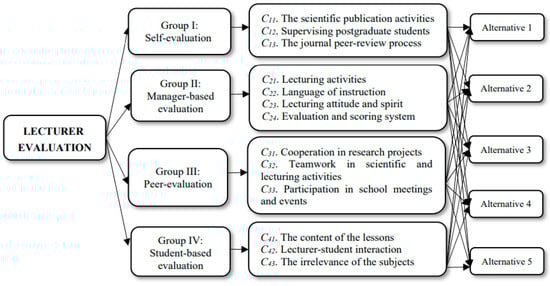
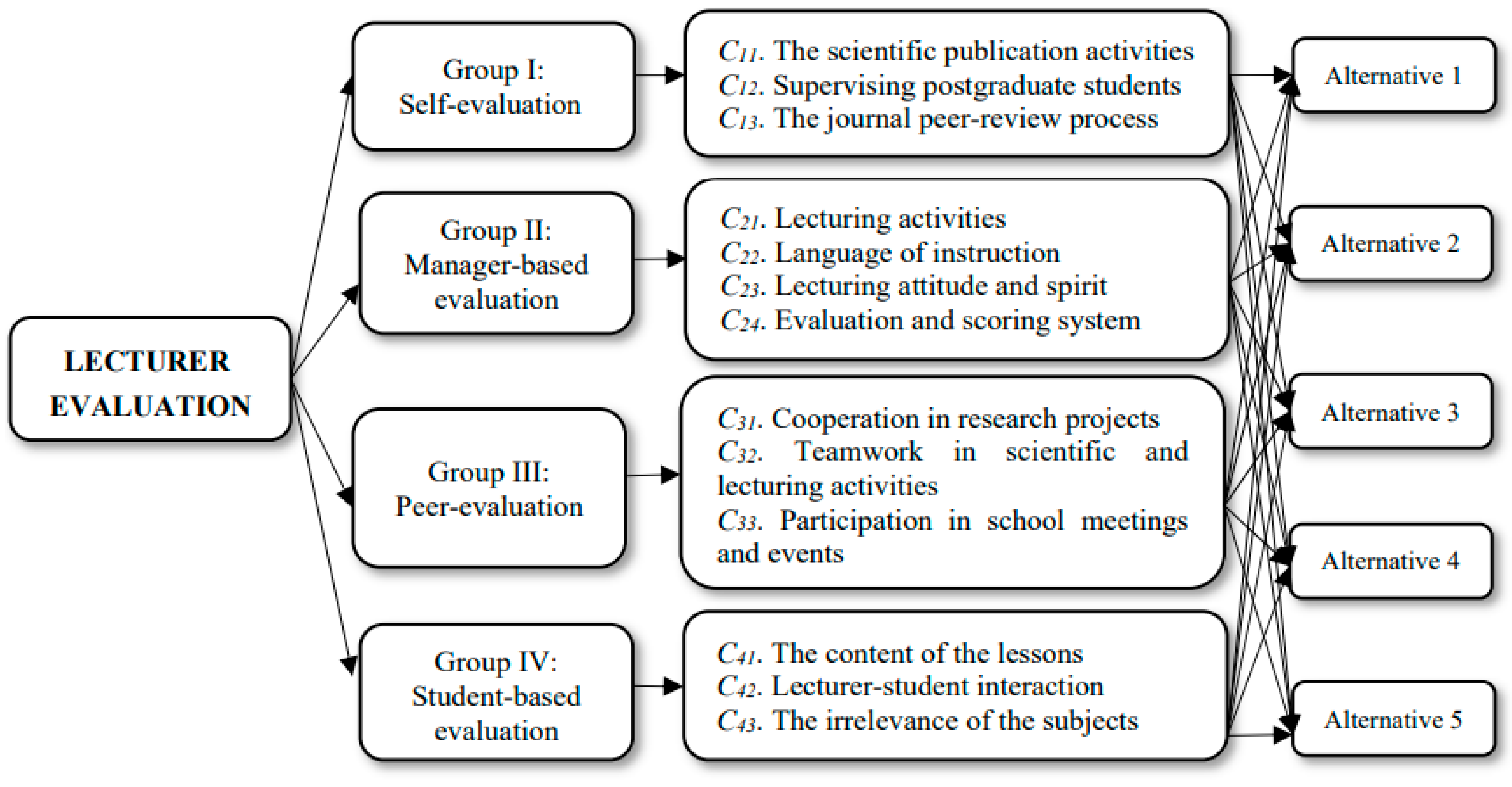
Anh Duc Do et al. [37] divided the criteria for evaluating the efficiency and talent of lecturers in an educational institution into four main groups: self-evaluation, manager valuation, peer evaluation, and student-based evaluation (Wu et al. [38]), as shown in the below Figure 3.
Figure 3.
Lecturer evaluation—criteria.
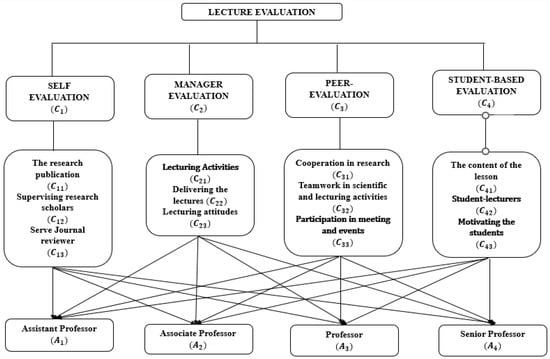
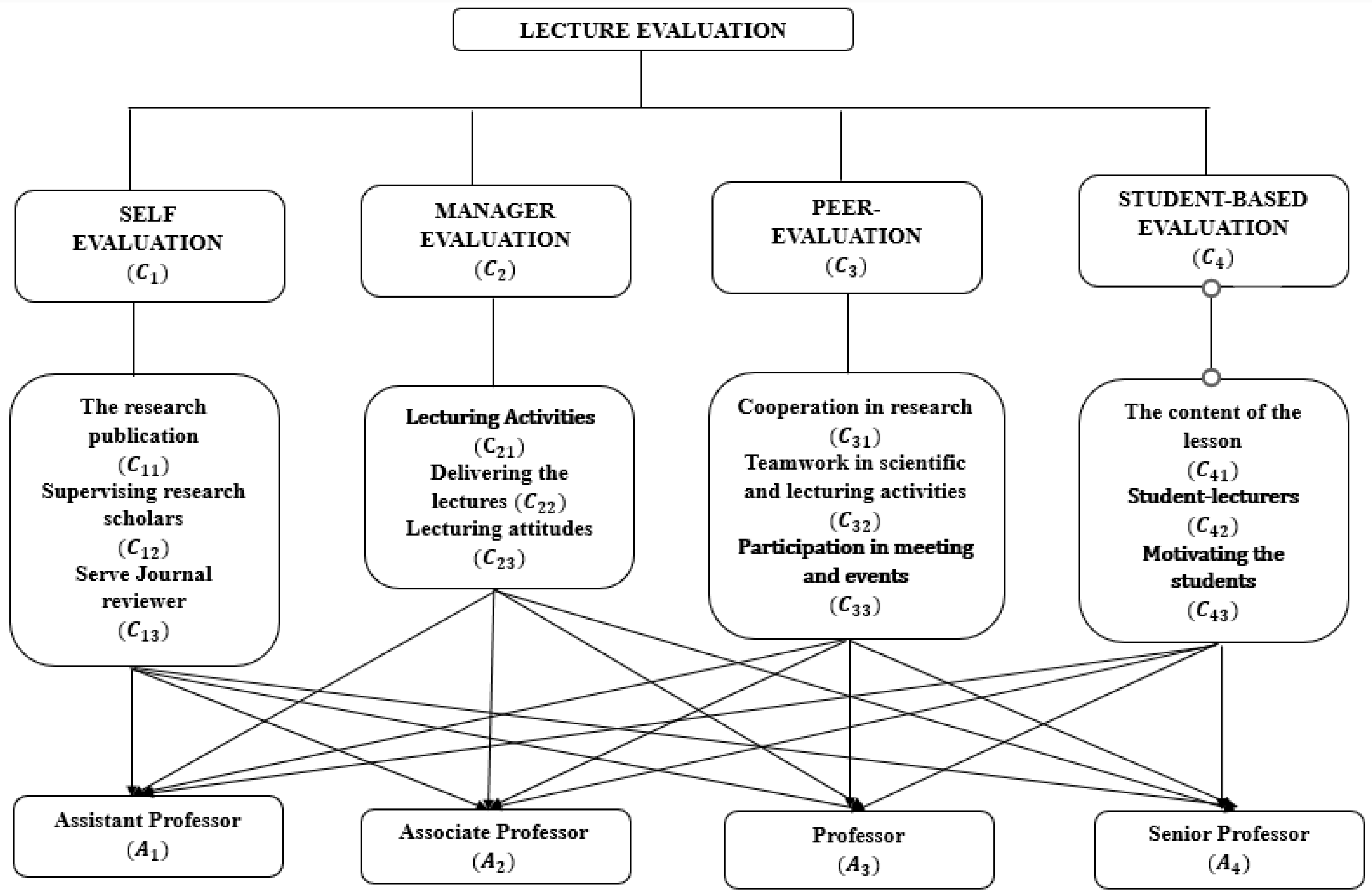
It is noted that the above-listed criteria may differ with respect to the infrastructure, level of students, salary given to the faculty, and workload of each institution. So, we have modified the above list of criteria and sub-criteria. We follow the following criteria structure for the lecturer evaluation in Figure 4 and Table 4:
Figure 4.
Modified criteria used in lecturer evaluation.
Table 4.
Criteria and sub-criteria—Lecturer evaluation framework.
Using the TOPSIS method, the solution of the MCDM problem concludes the relationship between the shortest distance from the positive ideal solution and the farthest distance from the negative ideal solution. The ideal classical TOPSIS method can be presented using the following five levels:
Level 1: Construct the DM matrix
Level 2: Find the Normalized DM .
Level 3: Find the and ideal solutions (PIS and NIS).
Level 4: Calculate the separation measures for both ideal solutions.
Level 5: Finalize the best alternative.
Any educational institution needs to evaluate the quality of the faculty members in the four different positions according to four criteria: self-evaluation , managerevaluation , peer evaluation and student-based evaluation . In every appraisal of the institution, we must measure the quality and quantity of the work performed by different designations of the faculty members. This is mandatory for the gradual growth of the institution. Based on the past five years of data in an educational institution, we construct a decision matrix in terms of the Interval-valued Fermatean Neutrosophic values. Since measuring the faculty’s strength is not based on an exact single value and these values fail under the uncertainty environment, we use The past five years data was obtained through a questionnaire prepared and circulated among all faculty members at a leading education institute in south India.
Level 1: For a multiple attribute decision-making problem, let be a discrete set of alternatives. be the set of attributes. be the weighting vector of the attributes, and where be unknown.
In Level 1, the construct decision matrix, is the decision matrix, where and is in the form of the .
See in Table 5.
Table 5.
Criteria and alternatives with interval-valued Fermatean Neutrosophic values.
That is, the DM matrix
The numbers , corresponding to and , represent that the degree of supports which lies in [], but the degree of does not support , which lies in . Also, the degree of neutral to which lies in . All other degrees of alternativehave the same meaning.
In general, benefit and cost fall into these two categories. Normalize these values into a dimensionless matrix through which criteria can be compared easily. The construction of a Normalized Decision Matrix (NDM) is obtained at the next level by using the rule below:
Level 2: As the criteria of and are the cost criteria and and are the benefit criteria, the NFM-DM of R is given by
Level 3: Converting R into their collective score matrix—using
Level 4: In this level, ideal solutions consist of selecting the best values for each attribute from all alternatives.
Generally, the values of are complements of and vice versa. The degree of to 1 and 0 is fixed, but the decision-maker may vary it. Hence, we consider as follows:
The PIS and NIS of two alternatives are found as
The distance between and the ideal solution is calculated in level 5
Level 5: To compute the closeness coefficient (CC):
See in Table 6.
Table 6.
Closeness coefficient for each alternative.
Level 6: Based on the values of , we rank the alternatives and select the best alternative(s). Therefore, the final and optimized ranking of the four major alternatives is , and thus, the best alternative is .
6. Results and Discussion
In this approach, we describe a combination of quantitative assessment and multi-criteria decision-making models to evaluate lecturers’ performances from various perspectives: self-assessment, peer assessment, managerial assessment, and student-based evaluation. This approach aims to overcome the challenge of differentiating between lecturers’ potential capacities and their actual teaching effectiveness. In our article, we have introduced a new variant of the called Interval-Valued Fermatean Neutrosophic Set This new variant specifically deals with situations where there is partial ignorance, leading to uncertainty about whether something is true, false, or exists in an uncertain region. This concept is applied independently to a multi-decision process. This study expands upon the concept of Fermatean Neutrosophic Set , presenting an extension in the form of the . The article highlights the algebraic properties and set theoretical aspects of the , likely discussing how this new variant handles and represents partial ignorance in more detail. This research appears to be addressing a crucial challenge in education by proposing an innovative approach that considers various assessment perspectives and handles uncertainty effectively through the . The presented results highlight the practical application and effectiveness of our methodology in making informed decisions about lecturers’ performances.
Faculty evaluation is a crucial component of higher education institutions and plays a significant role in shaping educational goals and national development strategies. Evaluating faculty performance is essential for maintaining teaching competency, promoting scientific research, and creating a conducive learning environment. The importance of evaluating faculty performance in terms of teaching competency as a tool for decision-making, including employment and dismissal in this assessment, is seen as a means to ensure the quality of education and contribute to the overall development of the country’s education system. Higher educational institutions should function as scientific research centers and encourage faculty to engage in research activities. This dual role of teaching and research contributes to the institution’s credibility and the advancement of knowledge. Faculty evaluation is seen as a way to create an equal environment that fosters cooperative strategies among faculty members and nurtures the learning spirit of each student. This suggests that a well-structured evaluation system can positively impact the overall educational atmosphere. Assessing faculty performance provides a comprehensive perspective on the institution’s achievements, including improving learning outcomes, identifying and nurturing young talents, and indirectly contributing to the country’s wealth. Such assessments also establish the institution’s reputation at both global and local levels. The evaluation process involves various complex factors such as personal interests, development strategies, and fairness in assessment. It is acknowledged that fair and accurate assessment is challenging and requires a multi-dimensional approach, including input from principals/managers, students, and peer reviews. The absence of appropriate standards and tools can lead to inaccuracies and subjectivity in evaluating faculty competence. We suggest that a well-rounded, multi-dimensional assessment process can enhance faculty knowledge, teaching capabilities, and professional development. As a whole, the multifaceted nature of faculty evaluation, its significance in the educational landscape, and the challenges associated with implementing a fair and effective assessment system place an emphasis on considering local context, fostering research, and promoting a cooperative learning environment. This underscores the holistic approach required to evaluate and enhance faculty performance in higher education institutions.
The criteria and methods used in a Multi-Criteria Decision-Making (MCDM) process assess the performance and relative importance of lecturers. We have mentioned two popular MCDM models—the Analytical Hierarchy Process (AHP) and the Technique for Order Preference by Similarity to Ideal Solution (TOPSIS)—that are commonly used to handle such assessments. The assessment process involves evaluating lecturers based on standards related to research capacity, teaching capacity, and service activities. These criteria are likely important aspects in determining the overall performance of lecturers. MCDM involves making decisions based on multiple criteria that might be conflicting or competing. It is a way to handle complex decision scenarios that cannot be addressed using single criteria. AHP is a widely used MCDM method that breaks down complex problems into a hierarchical structure of criteria and sub-criteria. It allows assigning weights to these criteria based on their relative importance and then comparing alternatives based on these weighted criteria. AHP is particularly useful for dealing with structured problems and hierarchical decision contexts. The application of Neutrosophic Sets and related concepts in the context of lecturer evaluation uses Multi-Criteria Decision-Making (MCDM) techniques. Smarandache [2] introduced the concept of a Neutrosophic Set, which is characterized by three membership degrees: truth membership (T), indeterminacy membership (I), and falsity membership (F). These membership degrees are defined within the real standard or nonstandard unit interval. This concept allows for dealing with uncertainty and imprecision in various domains, including education. Neutrosophic Sets can be applied to educational problems when dealing with ranges that fall within the defined interval. This approach can help address issues related to imprecision and uncertainty in educational contexts. Wang et al. [3] introduced the concepts of a single-valued Neutrosophic Set and an interval-valued Neutrosophic Set. The interval-valued Neutrosophic Set extends the concept of the Neutrosophic Set by incorporating interval values for the membership degrees. This approach has been used in various fields, including decision-making sciences, social sciences, and the humanities, to handle problems involving vague, indeterminate, and inconsistent information. Ye [31] introduced the interval Neutrosophic Linguistic Set, which involves new aggregation operators for interval Neutrosophic linguistic information. This concept contributes to handling uncertain linguistic information. Broumi et al. [39] extended the TOPSIS (Technique for Order Preference by Similarity to Ideal Solution) method to accommodate uncertain linguistic information within interval Neutrosophic Sets. This extension allows for decision-making when dealing with complex and uncertain data. The passage highlights that there is a lack of research integrating hierarchical TOPSIS with interval Fermatean Neutrosophic Sets, especially in the context of lecturer evaluation. This integration could address the limitations of traditional approaches to evaluating lecturers, which often face complexity and uncertainty. The study presented in the passage focuses on evaluating lecturers using MCDM models. The goal is to combine the hierarchical Neutrosophic TOPSIS technique, and the interval-valued complex set in a Neutrosophic environment to improve lecturer evaluation. The application of Neutrosophic Sets and related concepts to address the challenges of uncertainty and imprecision in lecturer evaluation uses MCDM techniques. By combining these innovative approaches, this study aims to provide a more effective and robust framework for assessing and ranking lecturers’ performances.
Comparing with other models: The following table lists the results of the comparison. The proposed method and the classic TOPSIS method can solve problems in uncertain environments. However, the TOPSIS and AHP techniques have some disadvantages in terms of calculation methods and results. Moreover, the extent of the interval-valued Neutrosophic TOPSIS does not consider the capacity of each lecturer in the specific time period.
| Method | Ranking |
| Interval neutrosophic TOPSIS (Chi and Liu [40]). Chi, P., and Liu, P. (2013). An extended TOPSIS method for the multiple attribute decision making problems based on interval neutrosophic set. Neutrosophic Sets and Systems, 1, 1–8. | |
| AHP (Saaty [41]) Saaty, T. L. (1980). The analytic hierarchy process. New York, NY: McGraw-Hill Inc, 17–34. | |
| TOPSIS (Hwang and Yoon [26]) Hwang, C.-L., and Yoon, K. (1981). Multiple Attribute Decision Making: Methods and Applications A State-of-the-Art Survey. Berlin Heidelberg: Springer-Verlag. | |
| Interval complex Neutrosophic set (Anh Duc Doet al. [36]) Anh Duc Doa, Minh Tam Pham, Thi Hang Dinh, The Chi Ngo, Quoc Dat Luue, Ngoc Thach Phamf, Dieu Linh Hag, and Hong Nhat Vuong, Evaluation of lecturers’ performance using a novel hierarchical multi-criteria model based on an interval complex Neutrosophic set, Decision Science Letters 9 (2020) 119–14. | |
| The present work evaluates the quality of the faculty members in the four different positions ) according to four criteria, namely self-evaluation , managerevaluation , peer evaluation , and student-based evaluation . |
7. Conclusions
In this article, our study developed a comprehensive assessment methodology using a hierarchical structure and a hierarchical TOPSIS (Technique for Order of Preference by Similarity to Ideal Solution) approach, incorporating interval-valued complex Neutrosophic Sets for evaluating lecturer capability. The goals of this study seem to include addressing the potential competition between lecturers that can arise from such evaluations and ensuring fairness and transparency in the process. This study’s methodology is designed to handle the complexity of assessment and decision-making in education and management systems. The hierarchical approach is then compared with other related methods to highlight its advantages and practicality. The results indicate that the proposed approach is effective and not limited to just lecturer evaluation; it can potentially be applied to other decision-making problems as well. However, as mentioned, there are certain limitations to this study. Unfortunately, you have not specified what those limitations are. Nonetheless, you also mentioned that future work is proposed to enhance the accuracy of lecturer evaluation. This improvement could be valuable for supporting real-world, dynamic decision-making in educational contexts. In summary, this study appears to contribute a novel approach to lecturer evaluation using a hierarchical structure and TOPSIS methodology, with an emphasis on fairness and transparency. The results suggest its efficiency and broader applicability, though there are acknowledged limitations that may guide future research.
This paper introduces the concept of the and its algebraic properties with an example. Also, we introduce a new set of score functions for the and use these functions to evaluate the lectures’ performances that were studied.
8. Further Study
- To define interval-valued Fermatean Neutrosophic Numbers.
- To study the interval-valued Triangular Fermatean Neutrosophic Linear Programming Problem.
- To study the interval-valued Fermatean trapezoidal and Fermatean triangular Neutrosophic numbers.
Author Contributions
Conceptualization, R.S. and M.S.; methodology, R.S.; validation, R.S., M.S., and S.B.; formal analysis, S.B. and M.T.; investigation, S.B. and M.V.; writing—original draft preparation, R.S.; writing—review and editing, S.B. and M.V; visualization, P.K.S. All authors have read and agreed to the published version of the manuscript.
Funding
There is no funding for this paper.
Data Availability Statement
Not applicable.
Acknowledgments
The authors thank the anonymous reviewers for their valuable comments and suggestions.
Conflicts of Interest
The authors declare no conflict of interest.
References
- Zadeh, L.A. Fuzzy sets. Inf. Control 1965, 8, 338–353. [Google Scholar] [CrossRef] [Scilit]
- Smarandache, F. Neutrosophic set—A generalization of the intuitionistic fuzzy set. Int. J. Pure Appl. Math. 2005, 24, 287–297. [Google Scholar] [CrossRef] [Scilit]
- Wang, H.; Smarandache, F.; Sunderraman, R.; Zhang, Y.Q. Single valued neutrosophic sets. Multispace Multistruct. 2010, 4, 410–413. [Google Scholar]
- Wang, H.; Smarandache, F.; Sunderraman, R.; Zhang, Y.Q. Interval neutrosophic sets and logic: Theory and applications in computing: Theory and applications in computing. Infin. Study 2005, 5, 21–38. [Google Scholar]
- Yager, R.R. Pythagorean fuzzy subsets. In Proceedings of the Joint IFSA World Congress and NAFIPS Annual Meeting, Edmonton, AB, Canada, 24–28 June 2013. [Google Scholar]
- Yager, R.R.; Abbasov, A.M. Pythagorean membership grades, complex numbers, and decision-making. Int. J. Intell. Syst. 2013, 28, 436–452. [Google Scholar] [CrossRef] [Scilit]
- Yager, R.R. Pythagorean membership grades in multi-criteria decision-making. IEEE Trans. Fuzzy Syst. 2014, 22, 958–965. [Google Scholar] [CrossRef] [Scilit]
- Jansi, R.; Mohana, K.; Smarandache, F. Correlation Measure for Pythagorean Neutrosophic Sets with T and F as Dependent Neutrosophic Components. Neutrosophic Sets Syst. 2019, 30, 16. [Google Scholar]
- Garg, H. A novel accuracy function under interval-valued Pythagorean fuzzy environment for solving multicriteria decision making problem. J. Intell. Fuzzy Syst. 2016, 31, 529–540. [Google Scholar] [CrossRef] [Scilit]
- Senapati, T.; Yager, R. Fermatean Fuzzy Sets. J. Ambient Intell. Humaniz. Comput. 2019, 11, 663–674. [Google Scholar] [CrossRef] [Scilit]
- Sweety, C.A.C.; Jansi, R. Fermatean Neutrosophic Sets. Int. J. Adv. Res. Comput. Commun. Eng. 2021, 10, 24–27. [Google Scholar]
- Peng, X.; Yang, Y. Fundamental Properties of Interval-Valued Pythagorean Fuzzy Aggregation Operators. Int. J. Intell. Syst. 2016, 31, 444–487. [Google Scholar] [CrossRef] [Scilit]
- Stephen, S.; Helen, M. Interval-valued Neutrosophic Pythagorean Sets and their Application in decision-making using IVNP-TOPSIS. Int. J. Innov. Res. Sci. Eng. Technol. (IJIRSET) 2021, 10, 114571–114578. [Google Scholar]
- Thamizhendhi, G.; Kiruthica, C.; Suresh, S. Fematean fuzzy hypergraph. J. Hunan Univ. Nat. Sci. 2021, 48, 2333–2340. [Google Scholar]
- Rani, P.; Mishra, A.R. Interval-valued fermatean fuzzy sets with multi-criteria weighted aggregated sum product assessment-based decision analysis framework. Neural Comput. Appl. 2022, 34, 8051–8067. [Google Scholar] [CrossRef] [Scilit] [PubMed]
- Jeevaraj, S. Ordering of interval-valued Fermatean fuzzy sets and its applications. Expert Syst. Appl. 2021, 185, 115613. [Google Scholar] [CrossRef] [Scilit]
- Palanikumar, M.; Iampan, A. Spherical Fermatean Interval Valued Fuzzy Soft Set Based on Multi Criteria Group decision-making. ICIC Int. 2022, 18, 607–619. [Google Scholar]
- Liu, D.; Liu, Y.; Chen, X. Fermatean fuzzy linguistic set and its application in multicriteria decision making. Int. J. Intell. Syst. 2018, 34, 878–894. [Google Scholar] [CrossRef] [Scilit]
- Broumi, S.; Sundareswaran, R.; Shanmugapriya, M.; Nordo, G.; Talea, M.; Bakali, A.; Smarandache, F. Interval-Valued Fermatean Neutrosophic Graphs, Decision-Making: Applications in Management and Engineering; SCImago Journal Rank: Belgrade, Serbia, 2022. [Google Scholar]
- Gorzałczany, M.B. A method of inference in approximate reasoning based on interval-valued fuzzy sets. Fuzzy Sets Syst. 1987, 21, 1–17. [Google Scholar] [CrossRef] [Scilit]
- Zhang, H.Y.; Wang, J.Q.; Chen, X.H. Interval neutrosophic sets and their application in multicriteria decision-making problems. Sci. World J. 2014, 15, 645953. [Google Scholar] [CrossRef] [Scilit]
- Wang, T. The Projection Model with Unknown Weight Information under Interval Neutrosophic Environment and Its Application to Software Quality-in-Use Evaluation. Math. Probl. Eng. 2020, 2020, 7279420. [Google Scholar] [CrossRef] [Scilit]
- Broumi, S.; Sundareswaran, R.; Shanmugapriya, M.; Bakali, A.; Talea, M. Theory and Applications of Fermatean Neutrosophic Graphs. Neutrosophic Sets Syst. 2022, 50, 248–286. [Google Scholar]
- Singh, A.; Bhat, S.A. A novel score and accuracy function for neutrosophic sets and their real-world applications to multi-criteria decision-making process. Neutrosophic Sets Syst. 2021, 41, 168–197. [Google Scholar]
- Garg, H. A novel correlation coefficient between pythagorean fuzzy sets and its applications to decision-making processes. Int. J. Intell. Syst. 2016, 31, 1234–1253. [Google Scholar] [CrossRef] [Scilit]
- Hwang, C.L.; Yoon, K. Multiple Attribute Decision-Making; Springer: Berlin, Germany, 1981. [Google Scholar]
- Nayagam, V.L.G.; Jeevaraj, S.; Sivaraman, G. Complete Ranking of Intuitionistic Fuzzy Numbers. Fuzzy Inf. Eng. 2008, 8, 1971–1974. [Google Scholar] [CrossRef] [Scilit]
- Nayagam, V.L.G.; Jeevaraj, S.; Dhanasekaran, P. An intuitionistic fuzzy multi-criteria decision-making method based on non-hesitance score for interval-valued intuitionistic fuzzy sets. Soft Comput. 2018, 21, 7077–7082. [Google Scholar] [CrossRef] [Scilit]
- Xu, Z.S. Method for aggregating interval-valued intuitionistic fuzzy information and their application to decision-making. Control. Decis. 2007, 22, 1179–1187. [Google Scholar]
- Liu, Y.; Xie, N. Amelioration operators of fuzzy number intuitionistic fuzzy geometric and their application to Multi-criteria decision-making. In Proceedings of the 2009 Chinese Control and Decision Conference, Guilin, China, 17–19 June 2009; pp. 6172–6176. [Google Scholar] [CrossRef] [Scilit]
- Ye, J. A multicriteria decision-making method using aggregation operators for simplified neutrosophic sets. J. Intell. Fuzzy Syst. 2014, 26, 2459–2466. [Google Scholar] [CrossRef] [Scilit]
- Ye, J. Multicriteria decision-making method using the correlation coefficient under single-value neutrosophic environment. Int. J. Gen. Syst. 2013, 42, 386–439. [Google Scholar] [CrossRef] [Scilit]
- Garg, H. Generalized intuitionistic fuzzy multiplicative interactive geometric operators and their application to multiple criteria decision-making. Int. J. Machine Learn. Cybern. 2016, 7, 1075–1092. [Google Scholar] [CrossRef] [Scilit]
- Sahin, R. Multi-criteria neutrosophic decision-making method based on score and accuracy functions under neutrosophic environment. arXiv 2014, arXiv:1412.5202. [Google Scholar]
- Garg, H. An Improved Score Function for Ranking Neutrosophic Sets and Its Application to Decision-Making Process. Int. J. Uncertain. Quantif. 2016, 6, 377–385. [Google Scholar] [CrossRef] [Scilit]
- Sahoo, L. Similarity measures for Fermatean fuzzy sets and its applications in group decision-making. Decis. Sci. Lett. 2022, 11, 167–180. [Google Scholar]
- Do, A.D.; Pham, M.T.; Dinh, T.H.; Ngo, T.C.; Luu, Q.D.; Pham, N.T.; Ha, D.L.; Vuong, H.N. Evaluation of lecturers’ performance using a novel hierarchical multi-criteria model based on an interval complex Neutrosophic set. Decis. Sci. Lett. 2020, 119–144. [Google Scholar] [CrossRef] [Scilit]
- Wu, H.-Y.; Chen, J.-K.; Chen, I.-S.; Zhuo, H.-H. Ranking universities based on performance evaluation by a hybrid MCDM model. Measurement 2012, 45, 856–880. [Google Scholar] [CrossRef] [Scilit]
- Broumi, S.; Ye, J.; Smarandache, F. An Extended TOPSIS Method for Multiple Attribute Decision Making based on Interval Neutrosophic Uncertain Linguistic Variables. Neutrosophic Sets Syst. 2015, 8, 22–31. [Google Scholar]
- Chi, P.; Liu, P. An Extended TOPSIS Method for the Multiple Attribute Decision Making Problems Based on Interval Neutrosophic Set. Neutrosophic Sets Syst. 2013, 1, 63–70. [Google Scholar]
- Saaty, T.L. The Analytic Hierarchy Process; McGraw-Hill: New York, NY, USA, 1980. [Google Scholar]

Disclaimer/Publisher’s Note: The statements, opinions and data contained in all publications are solely those of the individual author(s) and contributor(s) and not of MDPI and/or the editor(s). MDPI and/or the editor(s) disclaim responsibility for any injury to people or property resulting from any ideas, methods, instructions or products referred to in the content. |
© 2023 by the authors. Licensee MDPI, Basel, Switzerland. This article is an open access article distributed under the terms and conditions of the Creative Commons Attribution (CC BY) license (https://creativecommons.org/licenses/by/4.0/).