Abstract
In this study, we consider framed curves as regular or singular space curves with an adapted frame in Euclidean 3-space. We define framed natural mates of a framed curve that are tangent to the generalized principal normal of the framed curve. Subsequently, we present the relationships between a framed curve and its framed natural mates. In particular, we establish some necessary and sufficient conditions for the framed natural mates of specific framed curves, such as framed spherical curves, framed helices, framed slant helices, and framed rectifying curves. Finally, we support the concept with some examples.
MSC:
53A04; 58K05
1. Introduction
A regular space curve has no singular point in Euclidean space. In this case, the curvature and torsion functions of a regular space curve are well defined at every point. However, this situation is not applicable to all space curves, as some may have singular points. Therefore, the Frenet–Serret frame fails at singular points. Honda and Takahashi [1] introduced a framed curve, which is a regular curve or singular space curve with a moving frame in Euclidean space. Similar to curvature functions of a regular curve, they also defined the framed curvature functions, which are well defined even at singular points. Also, Fukunaga and Takahashi [2] studied the existence conditions of framed curves. Additionally, Wang et al. [3] proposed an adapted frame as an alternative to the moving frame of a framed curve in Euclidean space, with its elements referred to as the generalized tangent vector, generalized principal normal vector, and generalized binormal vector, respectively.
Naturally, the theory of framed curves, which includes regular curves as well, has captured the interest of researchers. As a result, concepts traditionally belonging to the category of regular curves (e.g., helix [4,5], slant helix [6,7], rectifying curve [8], Salkowski curve [9], etc.) have now been extended to the theory of framed curves. In this regard, recently, the concepts of framed helix [10], framed slant helix [11], framed clad helix [12], framed rectifying curve [3,13], framed normal curve [14], and framed Bertrand and Mannheim curves [15] have been introduced. References [16,17,18] are additional noteworthy studies that contribute to the theory of framed curves. Furthermore, a group of researchers, known as Li et al. and referenced in [19,20,21,22,23,24], conducted theoretical research and development on submanifold theory, soliton theory, etc. We can find more motivations from some papers [25,26,27,28,29,30,31,32,33,34,35,36,37,38,39,40,41,42,43,44,45,46,47,48,49,50,51]. Their work has contributed to the advancement of related research topics.
Moreover, Legendre curves are a special case of framed curves. Therefore, References [52,53,54,55,56,57,58,59,60,61,62,63,64,65] are other notable studies that contribute to the field of framed curves, specifically in the category of frontal or front curves.
Additionally, in the category of curves associated with the Frenet–Serret elements of regular curves, the concept of the principal direction (binormal direction) curve was introduced. It is defined as the integral curve of the principal normal vector (binormal vector) of a regular Frenet curve by Choi et al. [66]. Moreover, the natural mate (resp. conjugate mate) is a regular curve that is tangent to the principal normal (resp. binormal) vector of the base regular curve. These curves were introduced as partner curves of any regular curve by Deshmukh et al. [67].
On the other hand, natural and conjugate mates correspond to principal direction and binormal direction curves from the algebraic viewpoint, respectively. But, since the integral curve is defined only for vector fields on a region that contains a curve (i.e., not along a curve), it is more suitable to use the terminology of natural and conjugate mate from a geometric viewpoint. In this sense, as a generalization of the concept of natural mates of a regular space curve, we introduce framed natural mates of the framed curve in Euclidean space by using the adapted frame in [3]. After, we give the necessary and sufficient conditions for framed natural mates of a framed curve when the frame curve is a framed helix, framed slant helix, framed rectifying curve, or framed spherical curve. Finally, the concept of framed natural mate with some examples is enriched.
2. Preliminary
Let denote the Euclidean 3-space, that is, the 3-dimensional real vector space endowed with the standard inner product for all . The norm of a vector is defined by . Also, the cross-product of vectors x and y is given by .
Framed Curves in Euclidean 3-Space
Let : be a space curve. If at , then is called a singular point of . It is easy to see that the Frenet frame of any space curve is not well defined at any singular of the curve. Now, let us give the following concept about framed curves, which is a regular curve with linear independent condition or singular space curve in (see [1,2,3,10] for more detail and background).
Let us take the set as a 3-dimensional manifold.
Definition 1.
: is called a framed curve, if for all . is also called a framed curve (or framed base curve) if there exists : such that is a framed curve [1].
Now, unlike the Frenet frame, a well-defined moving frame can be constructed along the framed curve , which may have singular points. Let be a framed curve, and let be a regular spherical curve such that for all . Hence, is an orthonormal frame, which is a moving frame along the framed curve in . Then, the Frenet–Serret-type formulas are given by:
and there exists a smooth function such that
Here, the quadruple smooth functions are called the curvature of the framed curve .
Remark 1.
It is clear that if is a singular point of , then . Moreover, since we suppose that is a regular spherical curve (i.e., that ), then for all .
Similar to Bishop frame [68] of regular curves, Wang et al. [3] give the following adapted frame, which is an alternative to the moving frame of the framed curve:
Let and be a smooth function such that
It is easy to see that : is also a framed curve and . Now, we assume that and such that , then we have an adapted frame along the framed curve and the following Frenet–Serret-type formulas:
where
The triple smooth functions are called framed curvature with respect to the adapted frame along the framed curve . Moreover, the vectors are called the generalized tangent vector, the generalized principal normal vector, and the generalized binormal vector of the framed curve, respectively.
Proposition 1.
Let : be a framed curve with framed curvature . If the framed curve is a regular curve with curvature κ and torsion τ, then we have and [3].
Now, we introduce the framed Darboux vector (framed centrode) and the framed co-Darboux vector (framed co-centrode) with respect to the adapted frame of framed curve , respectively.
Definition 2.
Let be a framed curve in with adapted frame apparatus . Then, the framed Darboux vector of the framed curve is defined by , which satisfies the following equations:
Moreover, we call that
is the unit framed Darboux vector of .
Definition 3.
Let be a framed curve in with adapted frame apparatus . Then, the framed co-Darboux vector of the framed curve is defined by . Moreover, we call that
is the unit framed co-Darboux vector of . Also, it is easy to see that .
Now, we give the following framed versions (i.e., that generalized versions) of well-known definitions and characterizations for regular space curves.
Definition 4.
Let be a framed curve in . Then, is called a framed planar curve if it lies on a plane in [1].
By using Proposition 3.3 in [1] with Equation (3), we give the following characterization of framed planar curves with respect to the adapted curvature.
Theorem 1.
Let be a framed curve in with framed curvature . Then, is a framed planar curve if and only if .
Definition 5.
Let be a framed curve in . Then, is called a framed spherical curve if it lies on a sphere with a radius r in [3].
We give Theorem 2 and Corollary 1 by using Proposition 2 and Corollary 1 in [3] with Equation (3).
Theorem 2.
Let be a framed curve in with framed curvature . Then, is a framed spherical curve, which is a circle in if and only if and is a constant such that .
Corollary 1.
Let be a framed curve in with framed curvature . Then, is a framed spherical curve, which is a great circle in if and only if and such that .
Theorem 3.
Let be a framed curve in with framed curvature . Then, is a framed spherical curve in if and only if
or equivalently,
Ref. [14].
Definition 6.
Let be a framed curve in with framed curvature . Then, the framed harmonic curvature of is given by [11].
Definition 7.
Let be a framed curve in with adapted frame . Then, is called a framed helix if its generalized tangent vector ν makes a constant angle with a fixed unit vector ζ [3,10].
Theorem 4.
Let be a framed curve in with framed curvature . Then, is a framed helix if and only if such that ϕ is a constant angle [3].
Definition 8.
Let be a framed curve in with adapted frame . Then, is called a framed slant helix if its generalized principal normal vector makes a constant angle with a fixed unit vector ζ. That is, , where is a constant angle [11].
Theorem 5.
Let be a framed curve in with framed curvature . Then, is a framed slant helix if and only if
is a constant function [11].
Definition 9.
Let be a framed curve in with adapted frame . Then, is called a framed rectifying curve if its position vector satisfies
for some smooth functions [3].
Theorem 6.
Let be a framed curve in with framed curvature . Then, is a framed rectifying curve if and only if its framed harmonic curvature is given by
for some constants , and [3].
3. Framed Natural Mates
In this section, we give the concept of framed natural mates of a framed curve as a regular or singular space curve. This concept is more general than the concept of a natural mate of a Frenet curve in [67].
Definition 10.
Let : be a framed curve with an adapted frame . Then, a framed curve : with an adapted frame is called a framed natural mate of , if the generalized tangent vector of is tangent to the generalized principal normal vector of the framed curve (i.e., that for all ).
From now on, we call that the framed curve is a framed natural mate of the framed curve , if and are framed natural mates.
Theorem 7.
Let and be framed curves. Then, a framed natural mate of the framed curve is given by
with the following adapted frame apparatus
where is a smooth function.
Proof.
Let be a framed curve in with adapted frame apparatus . Then, we see that is an orthonormal basis along the framed curve in , where are given by (4) and (5), respectively. Moreover, by using Equation (2), we have the following equations:
such that
where is the framed harmonic curvature of . In that case, from the Existence and Uniqueness Theorems of framed curves in [1], there exists a framed curve in with the adapted frame apparatus whose elements are determined by the Equation (8). Also, by using (1), we have This equality leads to the framed curve being given by (7) such that : is a smooth function. Finally, by Definition 10, it is nothing but a framed natural mate of . □
Remark 2.
By Theorem 7, there exists a smooth function : such that a framed natural mate of is given by (7). Hence, we see that each smooth function generates a different framed natural mate of , and so a framed natural mate of a framed curve is not unique. Moreover, by Definition 1, it is easy to see that the framed natural mate of is given by , which is also a framed curve in .
Remark 3.
Particularly, when framed curves are regular curves and are their speed functions, which are equal to 1, then the concept of framed natural mate coincides with the concept of Frenet natural mate [67] (also, the concept of principal normal direction curve of [66]). So, the concept of framed natural mate is a generalized version of [67].
Now, when is a framed helix or slant helix, it is easy to see that the following results by using Theorems 1, 4, and 5.
Corollary 2.
Let be a framed natural mate of the framed curve in . Then, is a framed helix if and only if is a framed planar curve.
Corollary 3.
Let be a framed natural mate of the framed curve in . Then, is a framed slant helix if and only if is a framed helix.
Now, we give the following relationship between framed curvatures of a framed rectifying curve and its framed natural mate.
Corollary 4.
Let and be framed natural mates in with framed curvatures and , respectively. Then, is a framed rectifying curve if and only if the following equation holds:
where λ is a nonzero constant.
Proof.
Assume that is a framed rectifying curve in with framed curvature and is its framed harmonic curvature. Then, by using Theorem 6, for some constants and . Also, let be a framed natural mate of with a framed curvature . Then, by using (8), we have
Thus, the last equations lead to easily (9). Conversely, let and be framed natural mates, which satisfy the Equation (9). Then, if (8) is taken into account with (9), , where is a nonzero constant. Consequently, is a framed rectifying curve in with respect to Theorem 6, □
Now, we give a relation with respect to the framed curvatures of a framed spherical curve and its framed natural mate.
Corollary 5.
Let and be framed natural mates in with framed curvatures and , respectively. Then, is a framed spherical curve in if and only if the following equation holds:
Proof.
Assume that is a framed spherical curve in with framed curvatures . Then, by using Theorem 3, we have
and so,
Moreover, after using Equation (8) and accordingly, the ratio of over is
Thus, it is easy to see that Equation (10) from the last two equations. Conversely, let and be framed natural mates, which satisfy the Equation (10). Then, by taking into account the Equation (8), we obtain
This leads to the following equation
and after suitable settings, we obtain
As the first case, if in (11), then the proof is clear by Theorem 2. In the other case, if in (11), then we reach
Finally, the desired result is obtained by using Theorem 3. □
After that, let us concentrate on the results of some special framed natural mates of .
Theorem 8.
Let and be framed natural mates in with framed curvatures and , respectively. If is a framed curve with framed curvature such that r is a positive constant, then its framed natural mate is a framed spherical curve in such that is a positive constant. The converse is true only when is a framed spherical curve that is not a circle (i.e., that ) and is a positive constant.
Proof.
Suppose that the framed curvature of is such that r is a positive constant. Then, for framed curvature functions of a framed natural mate , we have
As the first case, if in (12), then it is clear that is a framed circle with a radius by Theorem 2. In the other case, we suppose that in (12) and is a positive constant, then by using (12), we obtain
Thus, by using Theorem 3, is a framed spherical curve in .
Conversely, we assume that is a framed spherical curve in such that , and is a positive constant. Then, by using Equation (6),
and after suitable settings and integration, without loss of generality, we obtain
Now, if we choose as the framed harmonic curvature such that is a smooth function, then this choice leads to by applying Equation (8). Thus, by taking into account (13), we obtain . Moreover, by applying Equation (8), . Hence, we conclude that by the last two equations of . □
Let be a framed curve with framed curvature such that is a positive constant and is a smooth function. Then, by using Equation (8), we see that its framed natural mate has the framed curvature . Now, let us give the following theorem for the converse of this statement.
Theorem 9.
Let be a framed natural mate of the framed curve in . If has the framed curvature such that λ is a positive constant, then the framed curvature of is given by:
Proof.
By Theorem 9, we obtain the following results, which are answer to the question: “When does the framed curve become a framed spherical curve for its framed natural mate with a framed curvature ”
Theorem 10.
Let and be framed natural mates with framed curvatures and such that and λ are some positive constants, respectively. Then, is a framed spherical curve in if and only if has the framed curvature for a positive constant .
Proof.
Suppose that is a framed spherical curve with framed curvature in such that is a positive constant, and its framed natural mate has framed curvature such that is a positive constant. Then, by using Theorems 3 and 9, we have
where , and so
We see that there exists a positive constant such that by the last equation. Accordingly, after suitable settings, we have
and next step, by applying integration, we obtain
This equation leads to the following equation
Finally, the desired result is obtained by .
Conversely, we suppose that has framed curvature such that is a positive constant, and has framed curvature
such that is a positive constant. Now, if we take as , then by using Theorem 9 and hypothesis, we have
Moreover, by using hypothesis, f is given by (14). Now, we must check the Equation (6). After applying Equations (14) and (15) in Equation (6), we obtain the positive constant . Consequently, is a framed spherical curve in by Theorem 3. □
Corollary 6.
Let be a framed curve and be its framed natural mate with framed curvature such that λ is a positive constant. Then, is a framed spherical curve, which is not a circle in if and only if has the framed curvature such that .
Proof.
The proof is clear by using Corollary 5 and Theorem 10. □
4. Some Examples of Framed Natural Mates
By using the following Frenet-type method (cf. [10]), we can uniquely determine the adapted frame apparatus of any framed curves as regular or singular space curves in .
Let be a regular spherical curve, and be a smooth function. Then, there exists a framed curve with the adapted frame
such that . Thus, the smooth function corresponds to the speed function of .
Example 1.
Let be a small circle in given by:
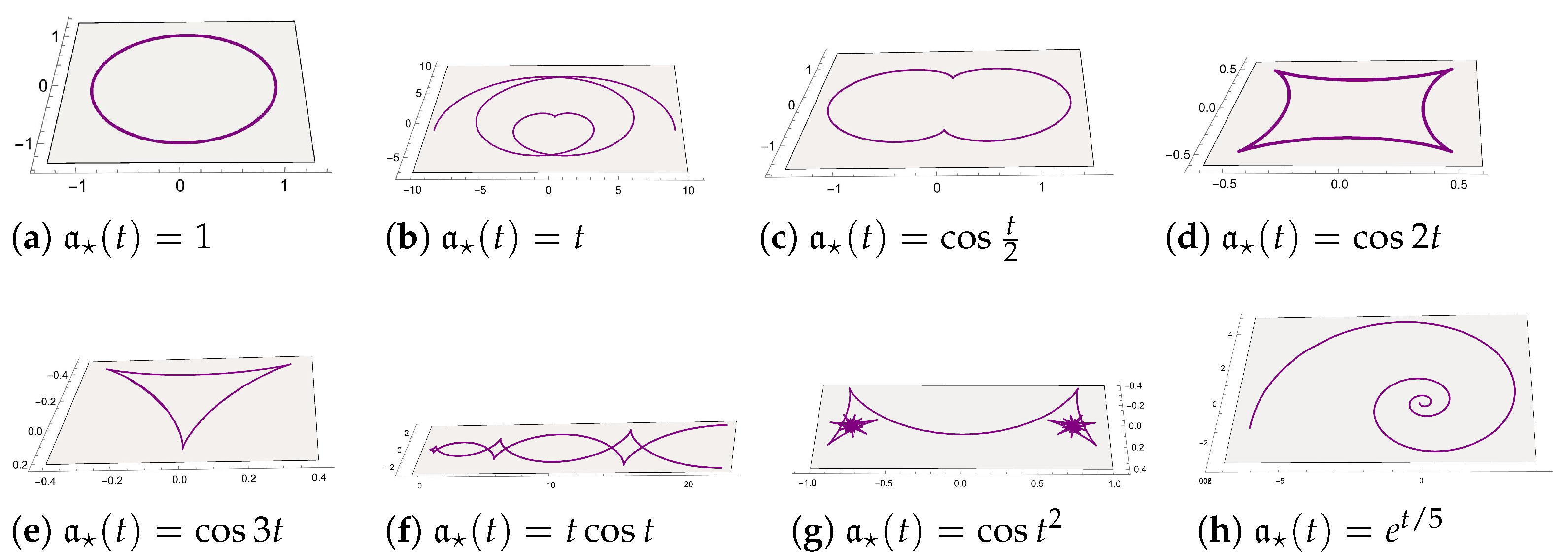
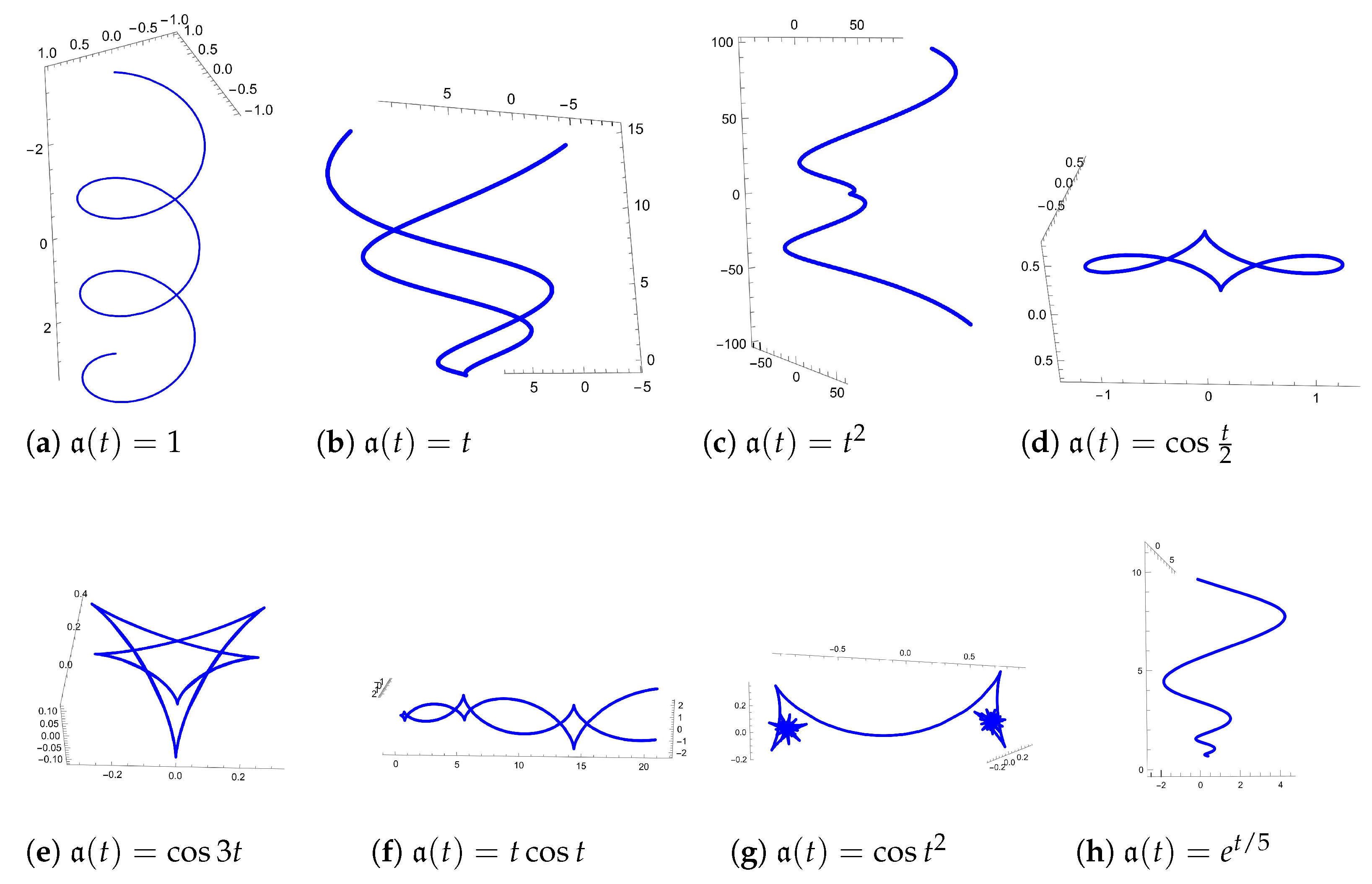
Then, by integrating (1) for any smooth function , we obtain a family of framed helices with framed curvature , which are generated by and . Moreover, by using (7) and (16), framed natural mates of are a family of framed planar curves with framed curvature for any smooth function . For example, if , then the parametrization of framed helix is given by
(see Figure 1e) and the framed natural mate , which is a framed planar curve, is given by
such that (see Figure 2e).
Figure 1.
Some framed helices with framed curvature .
Figure 2.
Some framed planar curves with framed curvature , which are framed natural mates of framed helices in Figure 1.
Example 2.
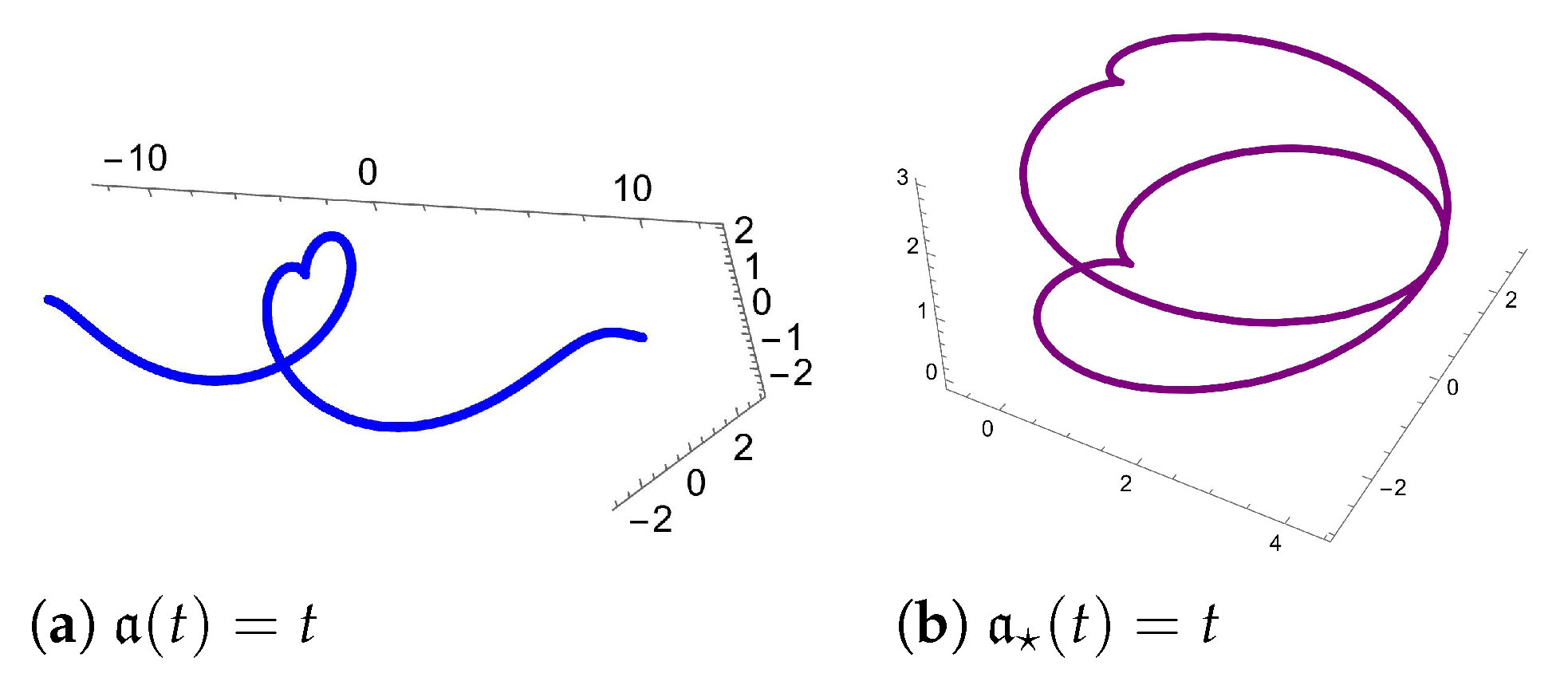
Let be a unit speed spherical helix in given by
and , then the parametrization of framed slant helix is given by
with framed curvature and (see Figure 3a). Thus, for the choice , a framed natural mate, which is a framed helix of is given by
with framed curvature and (see Figure 3b).
Figure 3.
(a) Framed slant helix ; (b) its framed natural mate , which is a framed helix.
Example 3.
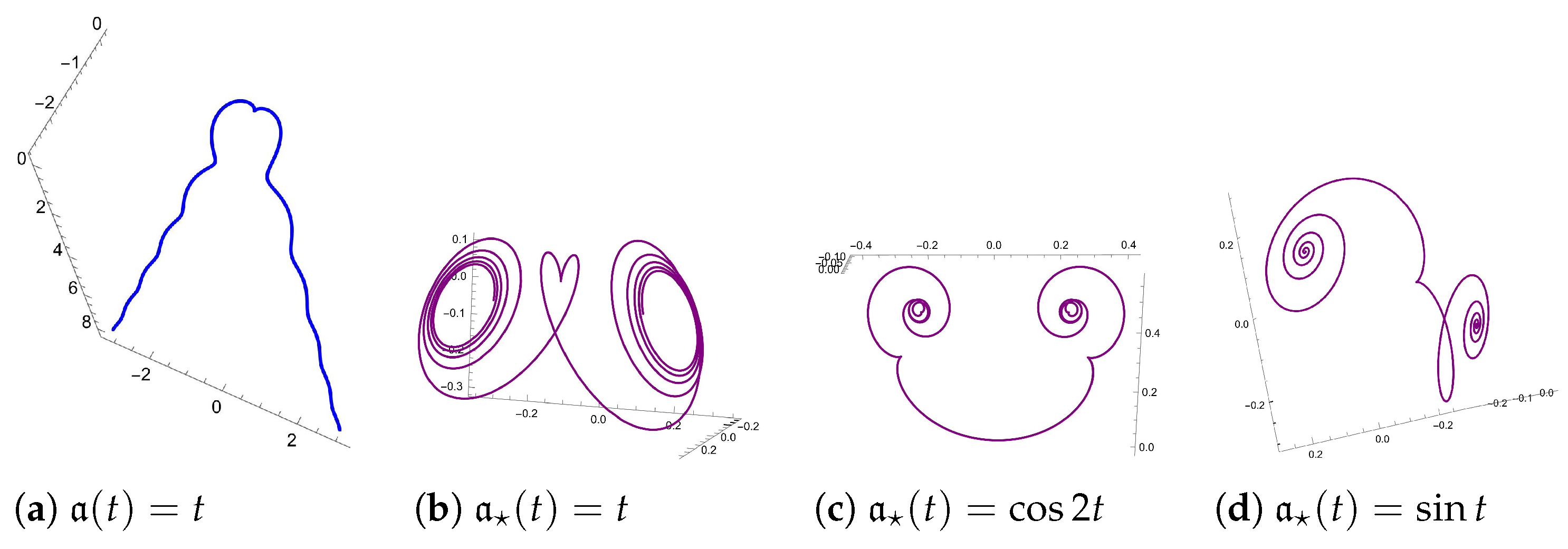
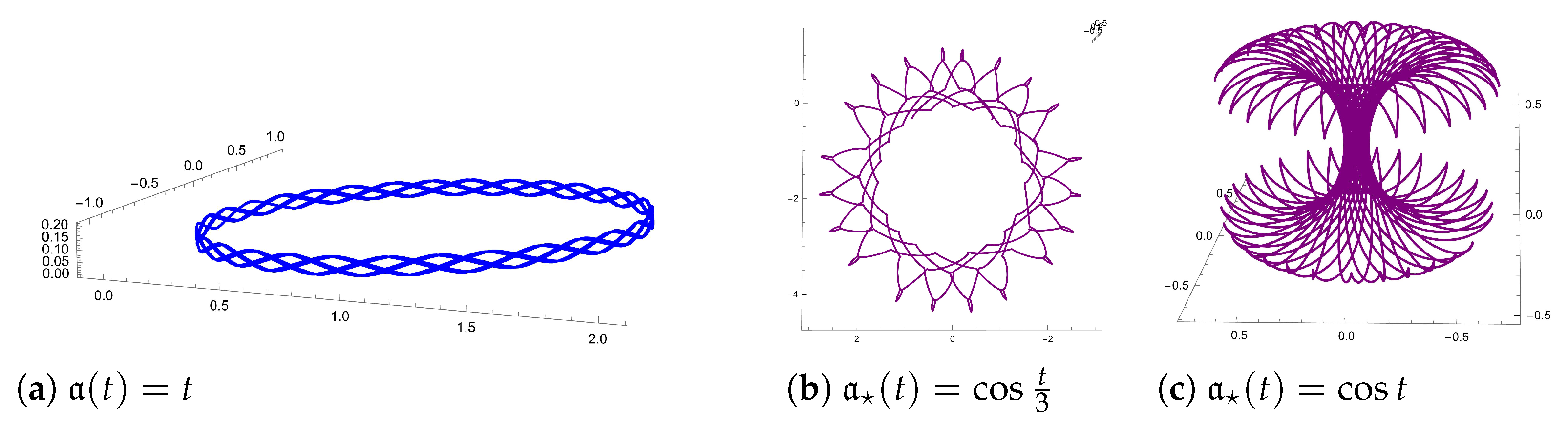
Let and be adapted frame apparatus of and , respectively. According to the Existence and Uniqueness Theorems of framed curves in [1], if the framed curvature of a framed curve is given, then we can draw a congruent graphic to the framed curve by applying numerical solution method to Frenet-type differential Equations (1)–(3) with the initial conditions. Also, the framed curvature of its framed natural mate is determined from by Theorem 7. Thus, the following graphics of the framed curve and its framed natural mate are obtained by using the “NDSolve” command in Mathematica [69].
Let be a framed curve with framed curvature . By using Theorem 6, is a framed rectifying curve (see Figure 4a). Thus, we obtain its framed natural mates, which has the framed curvature (see Figure 4b–d).
Figure 4.
(a) Framed rectifying curve ; (b–d) its framed natural mates , which are a spiral-type framed curve.
Finally, as an application of by Theorem 10, if we choose such that . Then, is a framed spherical curve in with framed curvature (see Figure 5a). Thus, we obtain its framed natural mates, which has the framed curvature (see Figure 5b,c).
Figure 5.
(a) Framed spherical curve ; (b,c) its framed natural mates .
Author Contributions
Conceptualization, Y.L. and M.M.; methodology, M.M.; software, M.M.; validation, Y.L. and M.M.; writing—original draft preparation, M.M.; writing—review and editing, Y.L. and M.M.; visualization, M.M.; funding acquisition, Y.L. All authors have read and agreed to the published version of the manuscript.
Funding
This research was funded by the National Natural Science Foundation of China (Grant No. 12101168) and the Zhejiang Provincial Natural Science Foundation of China (Grant No. LQ22A010014).
Data Availability Statement
This manuscript has no associated data.
Acknowledgments
The authors would like to express their sincere thanks to the editor and the anonymous reviewers for their helpful comments and suggestions.
Conflicts of Interest
The authors declare no conflict of interest.
References
- Honda, S.; Takahashi, M. Framed curves in the Euclidean space. Adv. Geom. 2016, 16, 265–276. [Google Scholar] [CrossRef]
- Fukunaga, T.; Takahashi, M. Existence conditions of framed curves for smooth curves. J. Geom. 2017, 108, 763–774. [Google Scholar] [CrossRef]
- Wang, Y.; Pei, D.; Gao, R. Generic properties of framed rectifying curves. Mathematics 2019, 7, 37. [Google Scholar] [CrossRef]
- Lancret, M.A. Memoire sur less courbes a double courbure. Mem. Present. Inst. 1806, 1, 416–454. [Google Scholar]
- Altınbaş, H.; Mak, M.; Altunkaya, B.; Kula, L. Mappings that transform helices from Euclidean space to Minkowski space. Hacet. J. Math. Stat. 2022, 51, 1333–1347. [Google Scholar] [CrossRef]
- Izumiya, S.; Takeuchi, N. New special curves and developable surfaces. Turk. J. Math. 2004, 28, 153–164. [Google Scholar]
- Yılmaz, B.; Has, A. New Approach to Slant Helix. Int. Electron. J. Geom. 2019, 12, 111–115. [Google Scholar] [CrossRef]
- Chen, B.Y. When does the position vector of a space curve always lie in its rectifying plane? Am. Math. Mon. 2003, 110, 147–152. [Google Scholar] [CrossRef]
- Monterde, J. Salkowski curves revisited: A family of curves with constant curvature and non-constant torsion. Comput. Aided Geom. Des. 2009, 26, 271–278. [Google Scholar] [CrossRef]
- Honda, S. Rectifying developable surfaces of framed base curves and framed helices. Adv. Stud. Pure Math. 2018, 78, 273–292. [Google Scholar]
- Okuyucu, O.Z.; Canbirdi, M. Framed slant helices in Euclidean 3-space. Adv. Differ. Equ. 2021, 2021, 504. [Google Scholar] [CrossRef]
- Mak, M. Framed Clad Helices in Euclidean 3-Space. Filomat, 2023; in press. [Google Scholar]
- Yazıcı, B.D.; Karakus, S.Ö.; Tosun, M. On the classification of framed rectifying curves in Euclidean space. Math. Meth. Appl. Sci. 2021, 45, 12089–12098. [Google Scholar] [CrossRef]
- Yazıcı, B.D.; Karakus, S.Ö.; Tosun, M. Framed normal curves in Euclidean space. Tbilisi Math. J. 2021, 1, 27–37. [Google Scholar]
- Honda, S.I.; Takahashi, M. Bertrand and Mannheim curves of framed curves in the 3-dimensional Euclidean space. Turk. J. Math. 2020, 44, 883–899. [Google Scholar] [CrossRef]
- Duldul, M.; Bulbul, Z. Integral Curves Connected with a Framed Curve in 3-Space. Honam Math. J. 2023, 45, 130–145. [Google Scholar]
- Yao, K.; Li, M.; Li, E.; Pei, D. Pedal and Contrapedal Curves of Framed Immersions in the Euclidean 3-Space. Mediterr. J. Math. 2023, 20, 204. [Google Scholar] [CrossRef]
- Honda, S.; Takahashi, M.; Yu, H. Bertrand and Mannheim curves of framed curves in the 4-dimensional Euclidean space. J. Geom. 2023, 114, 12. [Google Scholar] [CrossRef]
- Li, Y.; Gezer, A.; Karakaş, E. Some notes on the tangent bundle with a Ricci quarter-symmetric metric connection. AIMS Math. 2023, 8, 17335–17353. [Google Scholar] [CrossRef]
- Li, Y.; Bhattacharyya, S.; Azami, S.; Saha, A.; Hui, S.K. Harnack Estimation for Nonlinear, Weighted, Heat-Type Equation along Geometric Flow and Applications. Mathematics 2023, 11, 2516. [Google Scholar] [CrossRef]
- Li, Y.; Eren, K.; Ersoy, S. On simultaneous characterizations of partner-ruled surfaces in Minkowski 3-space. AIMS Math. 2023, 8, 22256–22273. [Google Scholar] [CrossRef]
- Li, Y.; Kumara, H.A.; Siddesha, M.S.; Naik, D.M. Characterization of Ricci Almost Soliton on Lorentzian Manifolds. Symmetry 2023, 15, 1175. [Google Scholar] [CrossRef]
- Li, Y.; Güler, E. A Hypersurfaces of Revolution Family in the Five-Dimensional Pseudo-Euclidean Space . Mathematics 2023, 11, 3427. [Google Scholar] [CrossRef]
- Li, Y.; Gupta, M.K.; Sharma, S.; Chaubey, S.K. On Ricci Curvature of a Homogeneous Generalized Matsumoto Finsler Space. Mathematics 2023, 11, 3365. [Google Scholar] [CrossRef]
- Gür, S.; Şenyurt, S.; Grilli, L. The Dual Expression of Parallel Equidistant Ruled Surfaces in Euclidean 3-Space. Symmetry 2022, 14, 1062. [Google Scholar]
- Gür, S. Geometric properties of timelike surfaces in Lorentz-Minkowski 3-space. Filomat 2023, 37, 5735–5749. [Google Scholar]
- Çalışkan, A.; Şenyurt, S. Curves and ruled surfaces according to alternative frame in dual space. Commun. Fac. Sci. Univ. 2020, 69, 684–698. [Google Scholar] [CrossRef]
- Çalışkan, A.; Şenyurt, S. The dual spatial quaternionic expression of ruled surfaces. Therm. Sci. 2019, 23, 403–411. [Google Scholar] [CrossRef]
- Gür, S.; Şenyurt, S.; Grilli, L. The Invariants of Dual Parallel Equidistant Ruled Surfaces. Symmetry 2023, 15, 206. [Google Scholar]
- Şenyurt, S.; Çalışkan, A. The quaternionic expression of ruled surfaces. Filomat 2018, 32, 5753–5766. [Google Scholar] [CrossRef]
- As, E.; Şenyurt, S. Some Characteristic Properties of Parallel-Equidistant Ruled Surfaces. Math. Probl. Eng. 2013, 2013, 587289. [Google Scholar] [CrossRef][Green Version]
- Özcan, B.; Şenyurt, S. On Some Characterizations of Ruled Surface of a Closed Timelike Curve in Dual Lorentzian Space. Adv. Appl. Clifford Al. 2012, 22, 939–953. [Google Scholar]
- Şenyurt, S.; Gür, S. Spacelike surface geometry. Int. J. Geom. Methods Mod. Phys. 2017, 14, 1750118. [Google Scholar] [CrossRef]
- Antić, M.; Hu, Z.; Moruz, M.; Vrancken, L. Surfaces of the nearly Kähler preserved by the almost product structure. Math. Nachr. 2021, 294, 2286–2301. [Google Scholar] [CrossRef]
- Antić, M.; Djordje, K. Non-Existence of Real Hypersurfaces with Parallel Structure Jacobi Operator in S6(1). Mathematics 2022, 10, 2271. [Google Scholar] [CrossRef]
- Antić, M. A class of four-dimensional CR submanifolds in six dimensional nearly Kähler manifolds. Math. Slovaca 2018, 68, 1129–1140. [Google Scholar] [CrossRef]
- Antić, M.; Moruz, M.; Van, J. H-Umbilical Lagrangian Submanifolds of the Nearly Kähler . Mathematics 2020, 8, 1427. [Google Scholar] [CrossRef]
- Antić, M. Characterization of Warped Product Lagrangian Submanifolds in . Results Math. 2022, 77, 106. [Google Scholar] [CrossRef]
- Antić, M.; Vrancken, L. Conformally flat, minimal, Lagrangian submanifolds in complex space forms. Sci. China Math. 2022, 65, 1641–1660. [Google Scholar] [CrossRef]
- Antić, M. A class of four dimensional CR submanifolds of the sphere S6(1). J. Geom. Phys. 2016, 110, 78–89. [Google Scholar] [CrossRef]
- Gulbahar, M.; Kilic, E.; Keles, S.; Tripathi, M.M. Some basic inequalities for submanifolds of nearly quasi-constant curvature manifolds. Differ. Geom. Dyn. Sys. 2014, 16, 156–167. [Google Scholar]
- Tripathi, M.M.; Gülbahar, M.; Kiliç, E.; Keleş, S. Inequalities for scalar curvature of pseudo-Riemannian submanifolds. J. Geom. Phys. 2017, 112, 74–84. [Google Scholar] [CrossRef]
- Gulbahar, M.; Kiliç, E.; Keles, S. A useful orthonormal basis on bi-slant submanifolds of almost Hermitian manifolds. Tamkang J. Math. 2016, 47, 143–161. [Google Scholar] [CrossRef]
- Gulbahar, M. Qualar curvatures of pseudo Riemannian manifolds and pseudo Riemannian submanifolds. AIMS Math. 2021, 6, 1366–1377. [Google Scholar] [CrossRef]
- Kiliç, E.; Gulbahar, M.; Kavuk, E. Concurrent Vector Fields on Lightlike Hypersurfaces. Mathematics 2020, 9, 59. [Google Scholar] [CrossRef]
- Ali, A.T. Non-lightlike ruled surfaces with constant curvatures in Minkowski 3-space. Int. J. Geom. Methods Mod. Phys. 2018, 15, 1850068. [Google Scholar] [CrossRef]
- Ali, A.T. Non-lightlike constant angle ruled surfaces in Minkowski 3-space. J. Geom. Phys. 2020, 157, 103833. [Google Scholar] [CrossRef]
- Ali, A.T. A constant angle ruled surfaces. Int. J. Geom. 2018, 7, 69–80. [Google Scholar]
- Ali, A.T.; Abdel Aziz, H.S.; Sorour, A.H. On some geometric properties of quadric surfaces in Euclidean space. Honam Math. J. 2016, 38, 593–611. [Google Scholar] [CrossRef]
- Ali, A.T.; Abdel Aziz, H.S.; Sorour, A.H. On curvatures and points of the translation surfaces in Euclidean 3-space. J. Egypt. Math. Soc. 2015, 23, 167–172. [Google Scholar] [CrossRef]
- Ali, A.T.; Hamdoon, F.M. Surfaces foliated by ellipses with constant Gaussian curvature in Euclidean 3-space. Korean J. Math. 2017, 25, 537–554. [Google Scholar]
- Fukunaga, T.; Takahashi, M. Existence and uniqueness for Legendre curves. J. Geom. 2013, 104, 297–307. [Google Scholar] [CrossRef]
- Fukunaga, T.; Takahashi, M. Evolutes of Fronts in the Euclidean Plane. J. Singul. 2014, 10, 92–107. [Google Scholar] [CrossRef]
- Fukunaga, T.; Takahashi, M. Involutes of Fronts in the Euclidean Plane. Beitr. Algebra Geom. 2016, 57, 637–653. [Google Scholar] [CrossRef]
- Fukunaga, T.; Takahashi, M. Evolutes and Involutes of Frontals in the Euclidean Plane. Demonstr. Math. 2015, 48, 147–166. [Google Scholar] [CrossRef]
- Chen, L.; Takahashi, M. Dualities and evolutes of fronts in hyperbolic and de Sitter space. J. Math. Anal. Appl. 2016, 437, 133–159. [Google Scholar] [CrossRef]
- Honda, S.; Takahashi, M. Evolutes and focal surfaces of framed immersions in the Euclidean space. Proc. Roy. Soc. Edinb. Sect. A 2020, 150, 497–516. [Google Scholar] [CrossRef]
- Tuncer, O.O.; Ceyhan, H.; Gök, İ.; Ekmekci, F.N. Notes on pedal and contrapedal curves of fronts in the Euclidean plane. Math. Meth. Appl. Sci. 2018, 41, 5096–5111. [Google Scholar] [CrossRef]
- Zhao, X.; Pei, D. Pedal Curves of the Mixed-Type Curves in the Lorentz-Minkowski Plane. Mathematics 2021, 9, 2852. [Google Scholar] [CrossRef]
- Li, M.; Yao, K.; Li, P.; Pei, D. Pedal Curves of Non-Lightlike Curves in Minkowski 3-Space. Symmetry 2022, 14, 59. [Google Scholar] [CrossRef]
- Yu, H.; Pei, D.; Cui, X. Evolutes of fronts on Euclidean 2-sphere. J. Nonlinear Sci. Appl. 2015, 8, 678–686. [Google Scholar] [CrossRef]
- Takahashi, M. Legendre curves in the unit spherical bundle over the unit sphere and evolutes. Contemp. Math. 2016, 675, 337–355. [Google Scholar]
- Li, Y.; Pei, D. Pedal curves of fronts in the sphere. J. Nonlinear Sci. Appl. 2016, 9, 836–844. [Google Scholar] [CrossRef]
- Li, E.; Pei, D. Involute-evolute and pedal-contrapedal curve pairs on S2. Math. Meth. Appl. Sci. 2022, 45, 11986–12000. [Google Scholar]
- Li, Y.; Tuncer, O.O. On (contra)pedals and (anti)orthotomics of frontals in de Sitter 2-space. Math. Meth. Appl. Sci. 2023, 46, 11157–11171. [Google Scholar] [CrossRef]
- Choi, J.H.; Kim, Y.H. Associated curves of a Frenet curve and their applications. Appl. Math. Comput. 2012, 218, 9116–9124. [Google Scholar] [CrossRef]
- Deshmukh, S.; Chen, B.Y.; Alghanemi, A. Natural mates of Frenet curves in Euclidean 3-space. Turk. J. Math. 2018, 42, 2826–2840. [Google Scholar] [CrossRef]
- Bishop, R.L. There is more than one way to frame a curve. Am. Math. Mon. 1975, 82, 246–251. [Google Scholar] [CrossRef]
- Gray, A.; Abbena, E.; Salamon, S. Modern Differential Geometry of Curves and Surfaces with Mathematica, 3rd ed.; Chapman and Hall/CRC: Boca Raton, FL, USA, 2006. [Google Scholar]
Disclaimer/Publisher’s Note: The statements, opinions and data contained in all publications are solely those of the individual author(s) and contributor(s) and not of MDPI and/or the editor(s). MDPI and/or the editor(s) disclaim responsibility for any injury to people or property resulting from any ideas, methods, instructions or products referred to in the content. |
© 2023 by the authors. Licensee MDPI, Basel, Switzerland. This article is an open access article distributed under the terms and conditions of the Creative Commons Attribution (CC BY) license (https://creativecommons.org/licenses/by/4.0/).