1. Introduction and Preliminaries
In the literature on fuzzy mathematics, we find numerous definitions of fuzzy similarity measures that naturally restrict a value in
giving two popular yet structurally different approaches. Among these, the first one comprises of an axiomatic structure-based approach [
1,
2,
3], while the other one concentrates on developing new formulas for fuzzy similarity measures based on fuzzification of the existing similarity measures for ordinary sets [
4,
5,
6]. This second approach to building similarity measures for fuzzy sets from ordinary sets has utilized distances between sets as well as sets of theoretic constructions and gained equal popularity in terms of practical applications in various scientific domains.
To be more specific for ordinary sets, a set theoretic-based approach to building a similarity relation between sets initially builds a feature vector based on an appropriate set of attributes/features apparently common in both the objects/sets under consideration. This feature vector has binary entries exhibiting the existence (1) or non-existence (0) of every feature under consideration. A comparison (similarity or inclusion) between the two feature vectors are equivalent to a process of generating a comparison of the two objects themselves on the basis of each attribute one by one. This in turn, provides us with the degree of similarity between objects in context of each attribute individually and is naturally in the form of a vector with dimension the same as the feature vector.
The comparison of two objects under consideration on the basis of attributes is a local or pointwise phenomenon which, however, requires a global or overall view of similarity. This final number is called the “Similarity Degree of two objects”, which is formulated by utilizing a cardinality measure of the underlying ordinary sets. Similarly, in a fuzzy environment, these measures involving cardinalities employ feature vectors that have entries from
representing the fuzziness of the sets involved. The
-valued similarity measure called fuzzy similarity measure developed by this method originated as a generalization of some of the famous similarity measures for crisp sets [
5,
6,
7].
Likewise, in an intuitionistic fuzzy environment, we find researchers working in this area that have attempted to generalize the measure of similarity of fuzzy sets to their intuitionistic forms [
8,
9,
10,
11,
12,
13,
14]. Though many different forms of intuitionistic fuzzy similarity measures have been introduced so far, yet a comparative study reveals that among all these measures, it is difficult for one to claim the existence of a single measure which alone has the capability of recognizing every single pattern assigned to it. Moreover, unlike their fuzzy counterparts, most of these measures for intuitionistic fuzzy sets are distance-based and hardly any having set-theoretic constructions involved.
Therefore in this paper, we have focused on the development of a novel four-parameter class of fuzzy similarity measures for intuitionistic fuzzy sets employing a feature vector having an intuitionistic fuzzy framework, i.e., every element within the feature vector is characterized by two degrees (membership and nonmembership) exclusively from obeying the condition that demands their sum not to exceed one. Thus, we can say that a feature comparison vector that represents an intuitionistic fuzzy set has components that are naturally scaled to the lattice Furthermore, we have studied the properties of the members of the new class of measures and found them to obey most of the axioms of the similarity measure existing in the literature. In addition, we have discovered a special feature of this class of measures which distinct it from the other parallel similarity measures existing in the literature, i.e., its every member not only possesses the capability of successfully recognizing any pattern assigned to it up to a fine accuracy but also a choice of different t-norms and co-norms within a single member equips it with a capacity to portray the different mind sets of a decision-maker who, besides being unbiased, can possess a deep psychology of being optimist, pessimist, or possessing neutral behavior in general without disturbing the final output. Moreover, we have utilized some members of this family to build a medical diagnosis technique for COVID-19.
We have organized our work as follows: in
Section 1, a brief introduction of the fuzzy and intuitionistic fuzzy concepts involved in this work are presented. Moreover, as the new similarity measures required set theoretic based operations; therefore, in an attempt to define these measures, we have generalized some of the existing crisp set-theoretic operations and identities to their respective intuitionistic fuzzy set versions. After defining these necessary operations, the new parametric family of similarity measures for intuitionistic fuzzy sets are introduced in
Section 2 and studied for its properties, while in the third and last section of this work we have presented the effective utility of these new measures of similarity in initial diagnosis of COVID-19, among other close viral infections.
Let be a universe and be a complete bounded lattice given by set: with order defined as if and .This lattice has elements and that act as its smallest and largest elements. An intuitionistic fuzzy set (IFS) E on X is defined as a map given by satisfying However, it may be defined alternatively by its founder as:
Definition 1 ([
15])
. Let X be the universe of discourse then an intuitionistic fuzzy set (IFS ) on X is given by Here, and are the functions representing the membership degree and the nonmembership degree of x in the set E, such that The complement of E is defined as: The set of all IFS on X is denoted by Definition 2 ([
16])
. The weighted average cardinality of IFS is a map defined as: Throughout this study, will be regarded as the scalar cardinality of E and will be .
Definition 3 ([
17])
. A map which is commutative, increasing and associative satisfying the condition ; is said to be an IF-t-norm. Likewise, an IF t-conorm is a commutative, increasing, and associative map satisfying ; ∀
Definition 4 ([
17])
. An IF t-norm (respectively, t-conorm ) is called t-representable if there exists a t-norm T and a t-conorm S on (respectively, a t-conorm and a t-norm on ) such that, for Remark 1.
(1) Throughout this study we have modeled the union and intersection between by IF Frank t-norms and co-norms given as:such that Thus, notion will represent the three members of fuzzy Frank t-norms given as follows: - (a)
for all
- (b)
for all
- (c)
for all
and represents their corresponding dual t-co-norms.
- (2)
Moreover, we will introduce here some of the intuitionistic fuzzy versions of the classical set-theoretic identities that we have built by employing the weighted average cardinality measure and be utilized in the construction of our newly introduced class of set theoretic-based similarity measures for intuitionistic fuzzy set:
- (a)
will be modeled by:
- (b)
will be modeled by: - (c)
will be modeled by:
Definition 5 ([
18])
. A fuzzy equivalence relation on the class of all fuzzy sets on X is a fuzzy relation Π
on satisfying the following condtions:- (1)
Reflexivity:
- (2)
Symmetry:
- (3)
Transitivity: , for all and
Here, for all (Lukasiewicz fuzzy implicator).
2. Parametric Family of Fuzzy Similarity Measures for IFSs
According to Zadeh, it has always been a challenging problem to build a valid and general-purpose definition of similarity measures besides its wide applications in various domains, namely, decision-making, information retrieval, pattern recognition, chemistry, biology, and machine learning.
In this section, we will present our new class of similarity measures, the
Parametric family of Fuzzy Similarity Measures for IFSs. This class of measures that we have introduced is close to the one introduced in [
19]. The extension involves the intersections of
by the family of frank t-norms for IFSs and their scalar cardinality.
Definition 6.
A Parametric family of Fuzzy Similarity Measures for Intuitionistic Fuzzy Sets is a class of maps defined as: where are positive real numbers such that
This condition on the parameters enforces and hence defines a class of -valued similarity measures for IFSs in the form of rational expressions. Next, we present here intuitionistic fuzzy versions of the famous similarity measures that are derived from the above-defined parametric family by setting different combinations of the parameters involved, as well as by using the expressions of set-theoretic identities, unions, and intersection for IFSs introduced in Remark 1. Moreover, in this study, we have employed the notation to specify these transformed members of the family , such that The results obtained here are represented as follows:
- (a).
Intuitionistic Jaccard
= for .
- (b).
Intuitionistic Simple Matching
= for
- (c).
Intuitionistic Dice
= for .
- (d).
Intuitionistic Rogers and Tanimoto
= for
.
- (e).
Intuitionistic Sokal and Sneath 1
= for
.
- (f).
Intuitionistic Sokal and Sneath 2 =
for
.
Theorem 1.
For all
the members of the family obey the following properties:
(a)
, for
(b)
, ∀;
(c-1)
or ;
(c-2)
⇔E is a fuzzy set;
(d)
;
(e)
For , and where and
Proof. As an example, we prove (b), (c-1), (e) for and and (c-2) for and
(b)
⇔
, ∀
⇔, ∀
(c-1)
⇔
then and ∀
⇔ either and or and ∀
⇔ either and or and ∀
⇔ either or
(c-2)
⇔
⇔, ∀
⇔
⇔E is fuzzy set.
(e) Let
⇒ and
⇒
and
⇒
and
⇒
, ∀
⇒
similarly we can obtain □
Corollary 1.
For all the fuzzy similarity measure defines a fuzzy equivalence relation on
3. Medical Diagnosis of Coronavirus (COVID-19) by Parametric Family of
Fuzzy Similarity Measures for IFSs
In recent times, the medical industry has widely accepted fuzzy logic in areas including the construction of knowledge-based systems in medicine with objective of interpretation of medical findings, for an actual and timely monitoring of patients’ records, for medicine syndrome differentiations involving diagnosis in modern medicine and the selection of the best possible medical procedure employing western/eastern medical knowledge of medicine [
20,
21]. However, with the advancement of such medical knowledge, the real-time situations occurred that demanded the description of a medical problem in a more generalized way rather than by mere use of a fuzzy linguistic variable involving membership function only. The Intuitionistic fuzzy set (IFS), introduced by Atanassov [
15] among many generalizations of fuzzy sets originated as a real-time solution to this highly demanding situation of medical diagnosis that requires flexibility due to the possible existence of hesitation at every step of evaluation.
In this section, we present an efficient and easy method of diagnosis based on the new class of similarity measures . The method initially involves the construction of a database, i.e., a comprehensive description of symptoms collection; a set of diagnoses and the patient’s medical state based on the knowledge of his/her medical test results. All this information/data is presented in the form of an IFS, which is built on the basis of different attributes of symptoms and diseases.
The complete three-stage diagnosis process is as follows:
- (1)
Symptom identification;
- (2)
Formation of medical information employing IFSs;
- (3)
Disease diagnosis technique by pattern recognition employing where , and .
In this particular case study, we have a patient whose initial medical examination reveals the presence of the following symptoms: Temperature, Headache, Nausea with Weakness, Sore Throat with Cough, and Stuffed Nose/Trouble Breathing, all having different levels of intensity.
In the first stage of this diagnosis procedure, the medical expert working on this case formulates a set of symptoms that are an ordinary set acting as a universe of discourse. In this particular case study, it is: {(Temperature), (Headache), (Nausea with Weakness), (Sore Throat with Cough), (Stuffed Nose/Trouble Breathing)}.
In the next stage, the medical expert by utilizing all of his/her medical expertise and previous knowledge composes all possible diagnoses for this case and will formulate a set of diagnosis say
{
(HINI),
(COVID-19),
(H5NI),
(Hanta Virus),
(SARS)} with each of these diagnoses acting as an intuitionistic fuzzy set on
say given as (
Table 1):
The
Table 1 relates every disease to every symptom assigning it a possible degree of belonging and a degree of non-belonging depending on medical databases collected from different sources. For instance, the first entry (0.40, 0.0) of the table states the fact the symptom
(Temperature) has appeared in
(HINI) up to 40 percent while its nonappearance is recorded as 0 percent.
In addition, according to this technique, the medical state of the patient
is represented by an IFS on the set of symptoms
For this particular case study, let it be (
Table 2):
Clearly, in
Table 2, we see that the symptom
(Temperature) has appeared in patient
up to 80 percent while its nonappearance is recorded as 10 percent.
In the last stage of this diagnosis problem, the expert applies the pattern recognition technique for the classification of the pattern
in one of the classes
and
The proper diagnosis
among
is derived according to the formula:
Now, particularly for this example, we shall present here both the diagnosis table along with a graphical representation of the pattern recognition result obtained for
and
; while for the rest of the members of the family
where
and
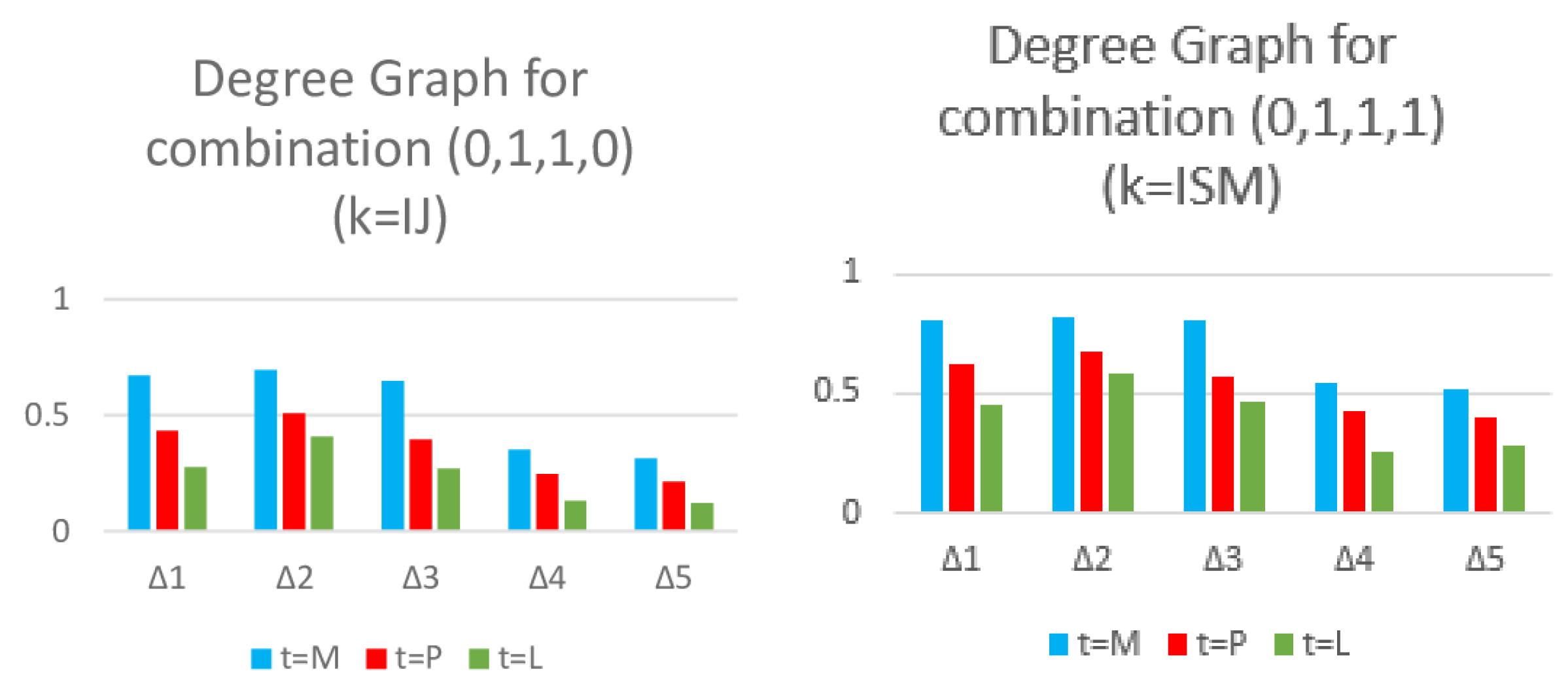
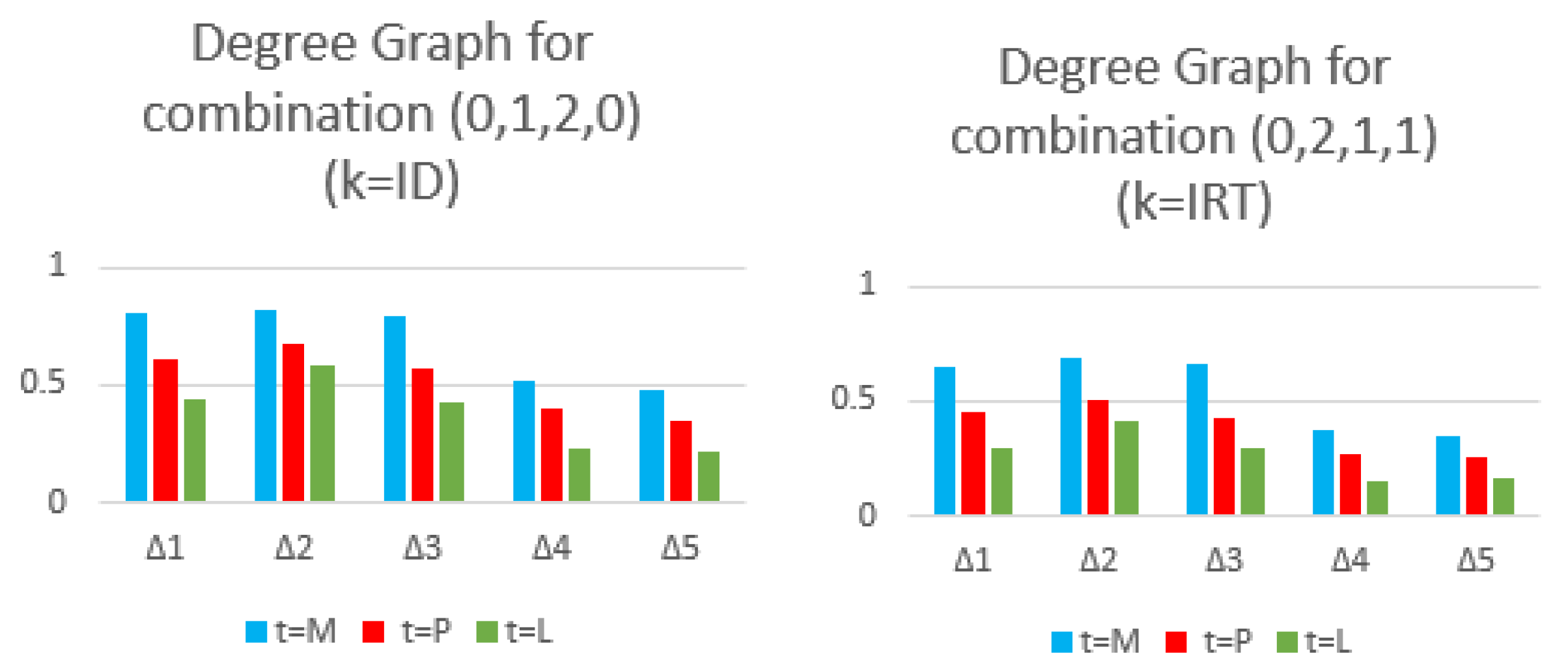
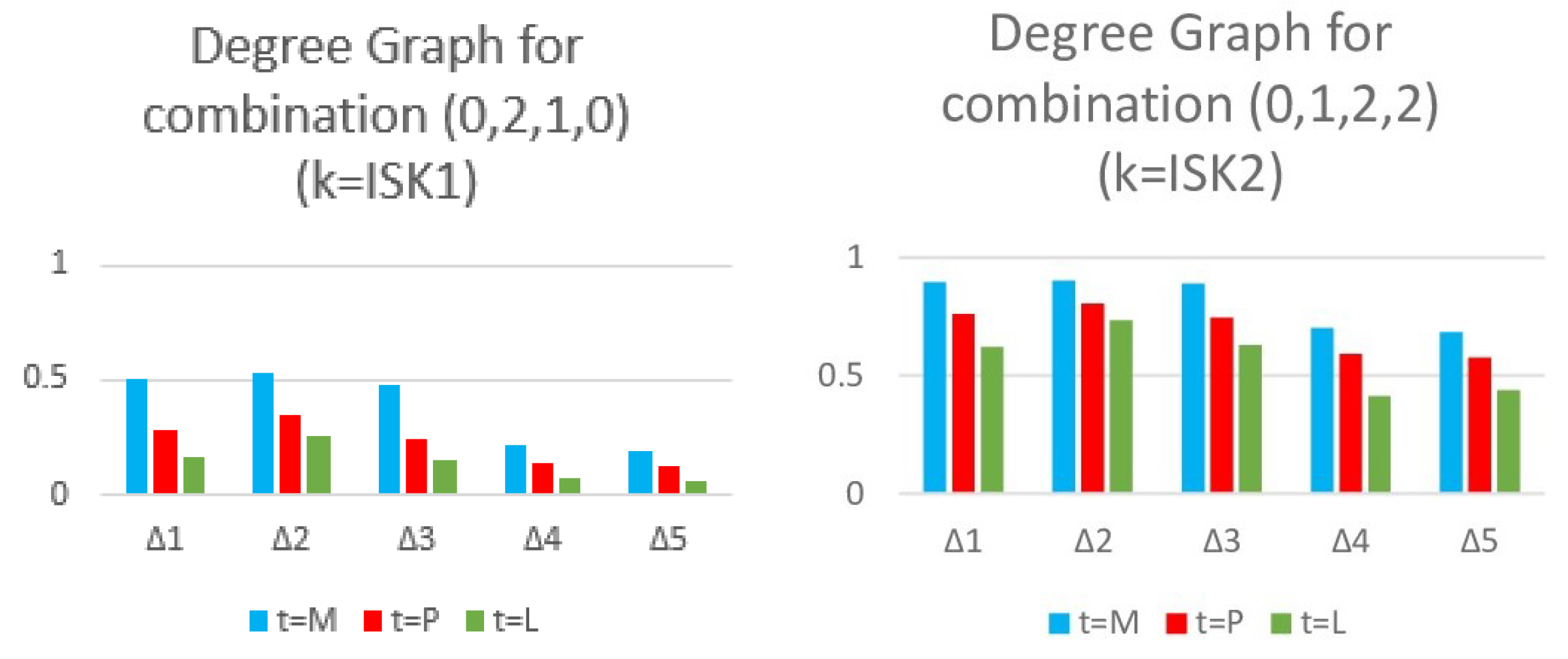
the calculational results are represented graphically only (see
Figure 1,
Figure 2 and
Figure 3) (
Table 3):
Now, when we apply the Formula (
3) to every
, and
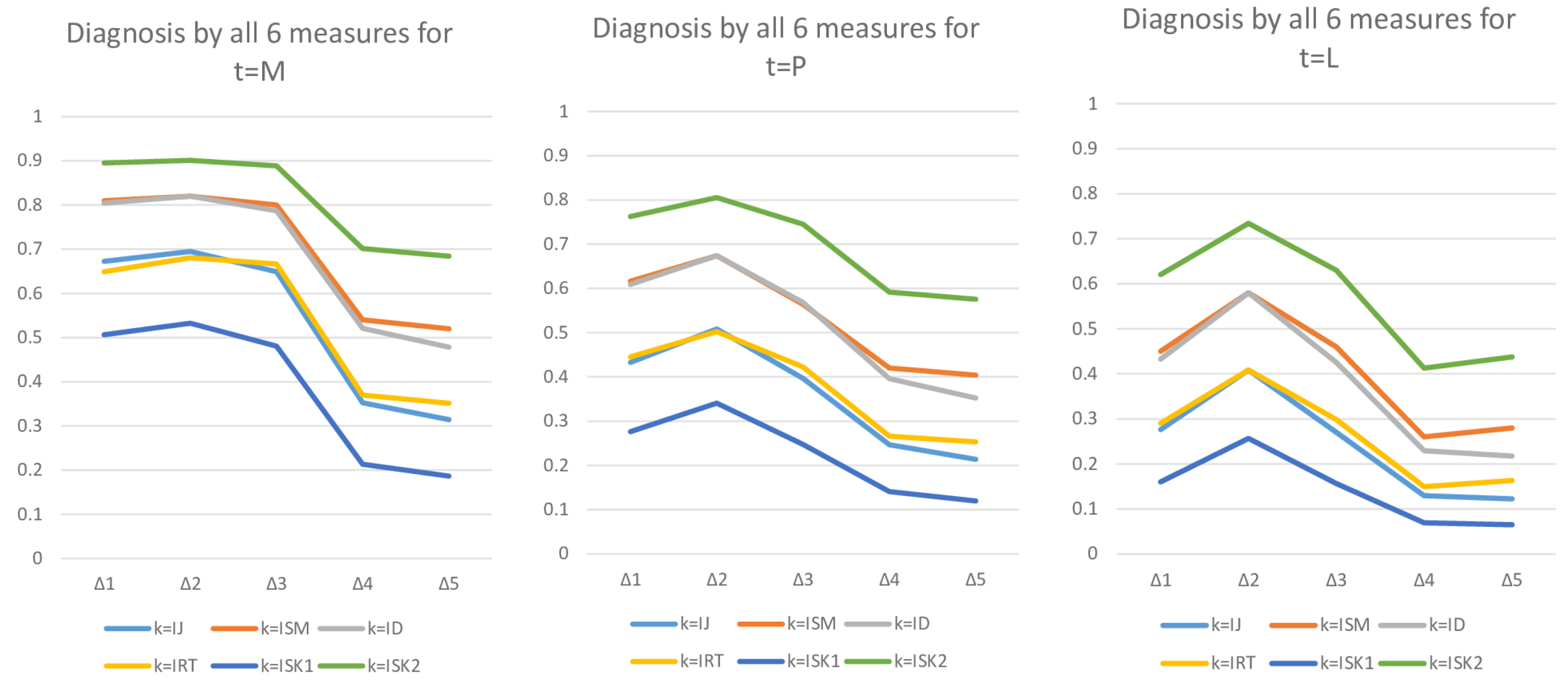
we obtain results for 18 intuitionistic fuzzy similarity measures belonging to this family and each of these remarkably assigned the same diagnosis
COVID-19) to the patient
utilizing recognition principal (see
Figure 4).