


Abstract
In this paper, we generate new degenerate quantum Euler polynomials (DQE polynomials), which are related to both degenerate Euler polynomials and q-Euler polynomials. We obtain several -differential equations for DQE polynomials and find some relations of q-differential and h-differential equations. By varying the values of , and h, we observe the values of DQE numbers and approximate roots of DQE polynomials to obtain some properties and conjectures.
MSC:
34A25; 33F05; 11B68; 65H04
1. Basic Concepts and Introduction
Before clarifying the objectives of this paper, we first introduce the necessary basic concepts. We identify several definitions and properties and present the goals of this paper based on them.
Let with . The quantum number, q-number, discovered by Jackson is
and we note that . In particular, for , is called q-integer; see [1,2,3,4].
Many mathematicians in various fields have worked on the introduction of q-numbers, such as q-discrete distribution, q-differential equations, q-series, q-calculus, and so on; see [5,6,7,8].
The following equation,
is the q-Gaussian binomial coefficient where m and r are non-negative integers; see [4,5]. For , the value of q-Gaussian binomial coefficients is 1 since the numerator and the denominator are both empty products. One notes that and .
In [9], a two-parameter time scale was introduced as follows:
Definition 1
([9,10]). Let be any function. Then, the delta -derivative of f is defined by
From the above definition, we can see several properties as follows:
- (i)
- For , if and only if is a constant;
- (ii)
- for all if and only if with some constant c;
- (iii)
- For , if and only if , where and are constant.
In Definition 1, we can see that , the delta -derivative of f reduces to , the q-derivative of f for and reduces to , the h-derivative of f for .
In addition, we can find the product rule and quotient rule for the delta -derivative.
Theorem 1
([9,10]). Let be arbitrary functions.
Definition 2
([10,11]). The generalized quantum binomial is defined by
where .
The generalized quantum binomial reduces to q-binomial as and to h-binomial when . Also, we note .
Definition 3
([10]). The generalized quantum exponential function is defined as
where α is an arbitrary nonzero constant.
Clearly, we note . As and , the generalized quantum exponential function becomes the so-called q-exponential function ; see [4,5]. Also, as and , the generalized quantum exponential function reduces to the so-called h-exponential function ; see [4].
Based on the above concepts, many mathematicians have studied q-special functions, q-differential equations, q-calculus, and so on; see [12,13,14,15,16]. For example, Duran, Acikgoz and Araci [16] considered different trigonometric functions and hyperbolic functions related to quantum numbers and looked for properties related to them. Mathematicians also discovered various theorems about basic concepts related to h-numbers. Benaoum [11] obtained Newton’s binomial formula in terms of , and Cermak and Nechvatal [9] created a version of fractional calculus. In 2011, Rahmat [17] studied the -Laplace transform. Silindir and Yantir [10] studied the quantum generalization of Taylor’s formula and the q-binomial coefficient in 2019; their work motivated the research reported in this paper. Mathematicians who study polynomials have already defined and characterized degenerate Euler polynomials. They also studied the definition and properties of Euler polynomials when combined with quantum numbers.
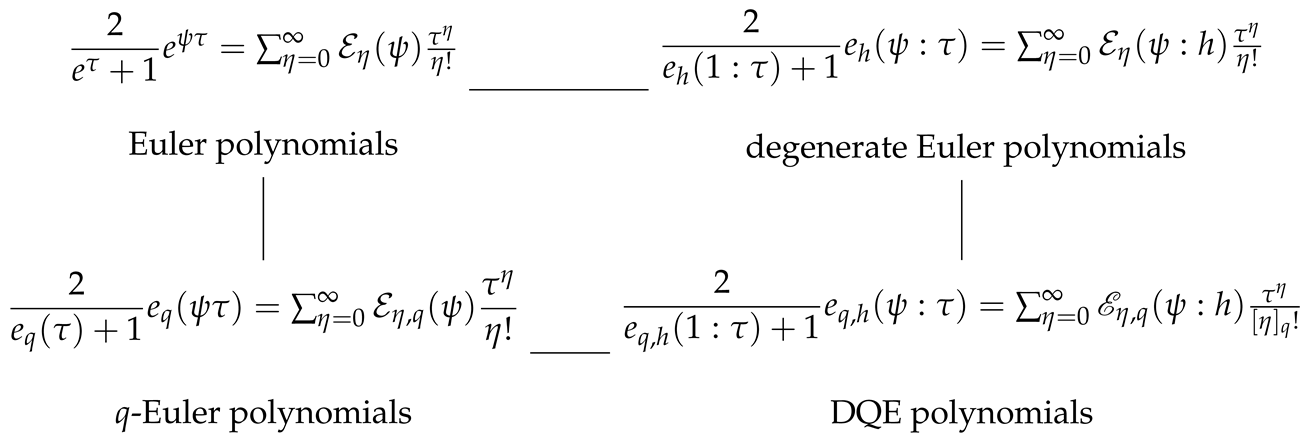
The main purpose of this paper is to construct degenerate quantum Euler polynomials (DQE polynomials) using properties of q-numbers and the -derivative. The topic of this paper is a field of mathematics that can be expanded into subareas such as series methods or generalizations of existing series. Its results can also be applied in interdisciplinary areas such as nonlinear physics, as well as for solutions to nonlinear differential equations providing instrumental defects such as kinks, vortices, etc. The diagram below shows the relationship of Euler, q-Euler, and degenerate Euler polynomials to the degenerate quantum Euler polynomials (DQE polynomials) that we define here.
Definition 4
([14,18]). q-Euler numbers and polynomials are defined as:
Definition 5
([19,20]). Degenerate Euler numbers and polynomials are defined as:
The structure of this paper is as follows. In Section 2, we define DQE numbers and polynomials. We find several properties of these polynomials by using q-numbers and -derivatives. In addition, we construct several higher-order differential equations whose solutions are DQE polynomials. Section 3 shows the structure of approximate roots of DQE polynomials, which are solutions of the higher-order differential equations obtained in Section 2. By observing various structures of these approximate roots, we can make several conjectures.
2. -Differential Equations That are Related to DQE Polynomials
In this section, we define a degenerate q-exponential function and DQE numbers and polynomials. We find several -differential equations that are related to DQE polynomials by the -derivative. We also discuss how these DQE polynomials relate to both q-Euler polynomials and degenerate Euler polynomials. We introduce the following degenerate quantum exponential function:
For example, substituting in the above equation, we have
where .
Definition 6.
Let and let h be a non-negative integer. Then, we define the DQE polynomials as:
When , we can note that
We denote as the DQE numbers. From Definition 6, we can see several relationships between Euler polynomials. Setting in Definition 6, we can find the q-Euler numbers and polynomials as
Let and in Definition 6. Then, we have the Euler numbers and polynomials as
In addition, for in Definition 6, we can see the degenerate Euler numbers and polynomials as follows:
where .
Theorem 2.
Let and . Then, we have
Proof.
From the generating function of the DQE polynomials, we can find
Applying the coefficient comparison method to the above equation, we find a relation of DQE numbers and polynomials such as
Using the -derivative in Equation (1), we can obtain the following equation:
Considering Equation (1) and the above equation together, we have the required result. □
Corollary 1.
Let k be a non-negative integer. From Theorem 2, one holds
Corollary 2.
From Theorem 2, the following holds:
(i) Setting in Theorem 2, we have
where is the h-derivative and is the degenerate Euler polynomial.
(ii) Putting in Theorem 2, we have
where is the q-derivative and is the q-Euler polynomial.
Theorem 3.
The DQE polynomials represent a solution of the -differential equation of higher order shown below:
Proof.
Consider in the generating function of the DQE polynomials. Then, we have
The left-hand side of Equation (2) is transformed as
The right-hand side of Equation (2) is changed as
From the above equations, we can obtain
Considering both Corollary 2 and Equation (3), we have
which is the desired result. □
Corollary 3.
Setting in Theorem 3, it holds that:
where is the h-derivative and is the degenerate Euler polynomial.
Corollary 4.
Let in Theorem 3. Then, it holds that:
where is the q-derivative and is the q-Euler polynomial.
Theorem 4.
DQE polynomials are the solutions to the -differential equation of higher order as
Proof.
From Definition 6, we have
Using the generating function of DQE polynomials, we find the following relation:
Comparing the coefficients of both sides, we obtain
Replacing for in Equation (4), we derive
The equation above completes the proof of Theorem 4. □
Corollary 5.
Setting in Theorem 4, it holds that:
where is the q-derivative and is the q-Euler polynomial.
Corollary 6.
Putting in Theorem 4, the following holds:
where is the h-derivative and is the degenerate Euler polynomial.
From a property of , we note a relation
Theorem 5.
The following higher-order differential equation has DQE polynomials as the solution:
Proof.
Consider Equation (5) in the generating function of the DQE polynomials. Then, we find
From , we have the relation
From the above equation, we find
Substituting for in Corollary 2, we note that
Applying the above equation in Equation (6), we have
which gives the required result. □
Corollary 7.
Setting in Theorem 5, it holds that:
where is the q-derivative and is the q-Euler polynomial.
3. Properties for Approximate Roots of DQE Polynomials
In this section, we use Mathematica to show the structures and shapes of approximate roots of DQE polynomials. These DQE polynomials share several properties with both degenerate Euler polynomials and q-Euler polynomials. Here, the purpose of changing the q-number is to explore the properties of q-Euler polynomials, while the reason for changing the value of h is to explore the properties of degenerate Euler polynomials.
Let . From the generating function of DQE numbers, we have
Using the Cauchy product in the above equation, we obtain
Therefore, we derive
From the above equation, we show several DQE numbers as follows:
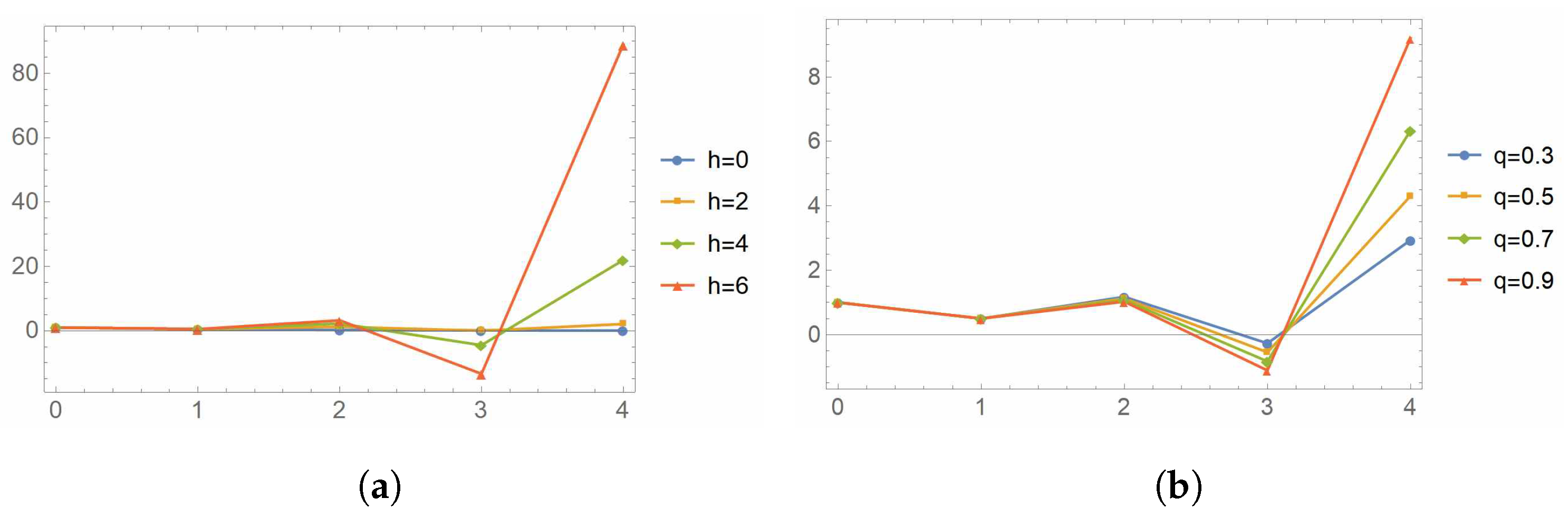
Figure 1 shows the values of obtained by varying the values of q, , and h. Non-negative integers on the x-axis in Figure 1 represent the value of , with the 0 mark on the x-axis corresponding to , the 1 mark indicating , and so on. The lines represent variations of the approximate values for DQE numbers. The approximate values of -Euler numbers in Figure 1a are the blue dots, yellow squares, green rhombuses, and red triangles, respectively, for . Here, we can think of the blue dots as approximate values of q-Euler numbers. In Figure 1b, the blue dots, yellow squares, green rhombuses, and red triangles are the approximate values of -Euler numbers in the respective cases . The red triangles can be thought of as approximate values of h-Euler numbers.
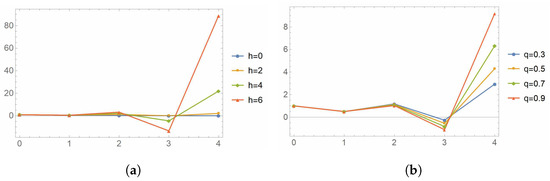
Figure 1.
Positions of for with (a) and (b) .
We next consider the approximate roots of DQE polynomials. In order to identify some of these approximate roots and their properties, we need the exact shapes of the polynomials. Several DQE polynomials are shown in the following:
Based on the DQE polynomials obtained above, we hope to find out about the various behaviors of their approximate roots according to the changes in the values of q and h. We will restrict the value of q to less than 1, since DQE polynomials become degenerate Euler polynomials when q approaches 1 Also, DQE polynomials become q-Euler polynomials when h goes to 0, so the value of h has to exclude 0. According to the above condition, we can check the structures of approximate roots of DQE polynomials. Consider the case when the value of h is changed and but the value of q is fixed.
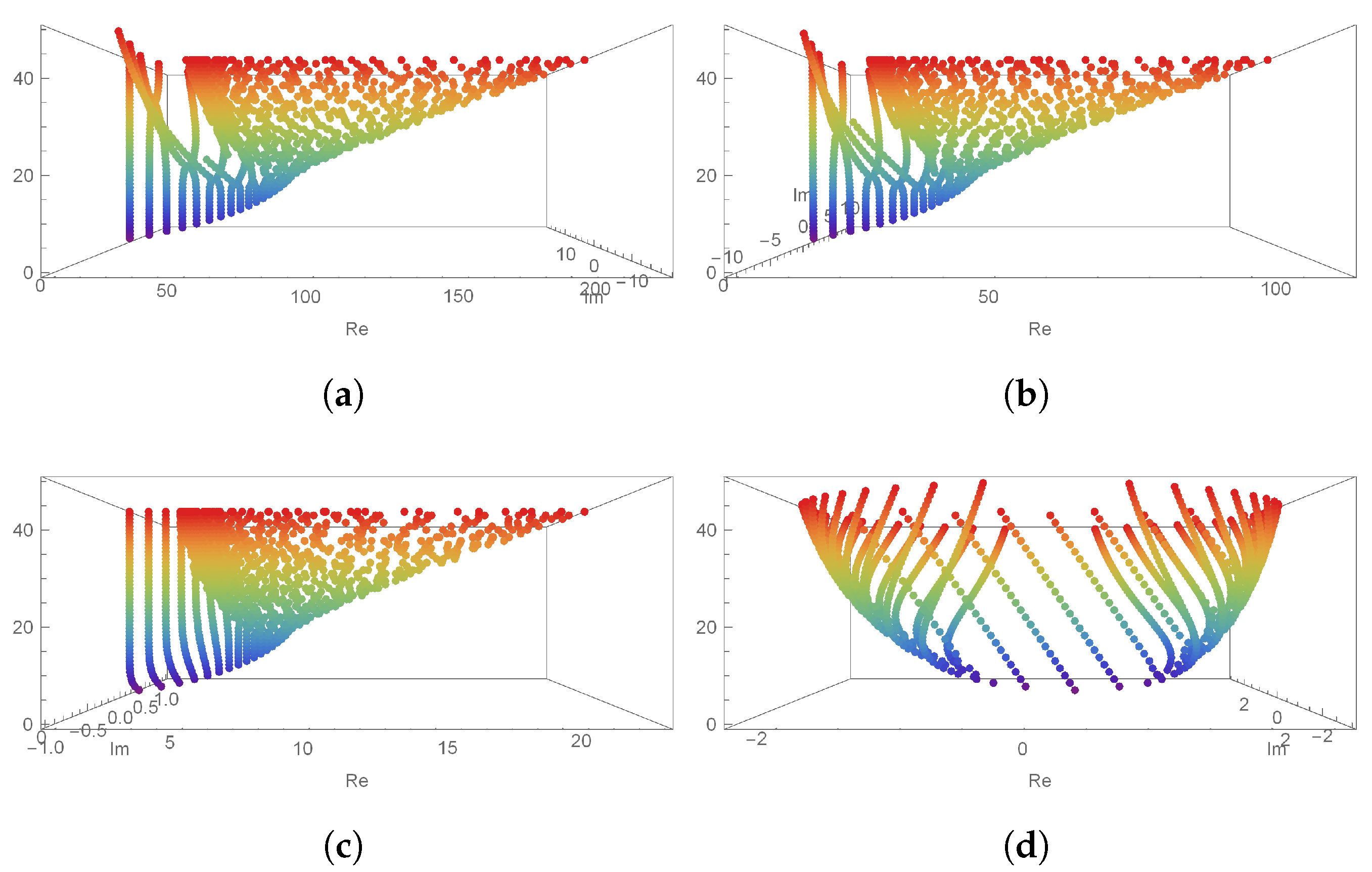
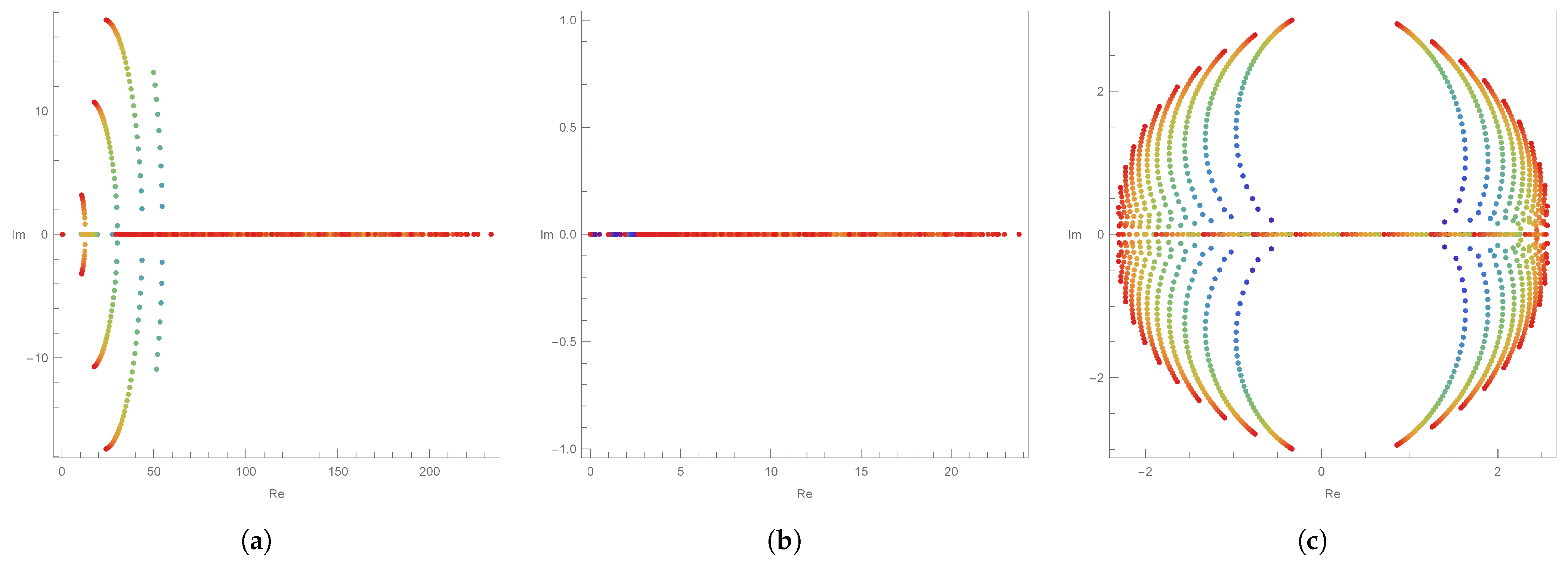
Let us fix and . Then, Figure 2 illustrates the structures of the approximate roots of DQE polynomials obtained by varying h. The condition of the top-left panel Figure 2a shows the case where ; the condition of the top-right Figure 2b is shown when ; the condition of the bottom-left Figure 2c is shown when ; and the condition of the bottom-right Figure 2d is shown when . From Figure 2d, it can be seen that, when the value of h becomes 0, the shape of the approximate roots reduces to the approximate roots of q-Euler polynomials. The blue dots are the positions of the approximate roots that appear when the value of n is small, and the red dots are the positions of the approximate roots that appear when in Figure 2, Figure 3, Figure 4 and Figure 5.
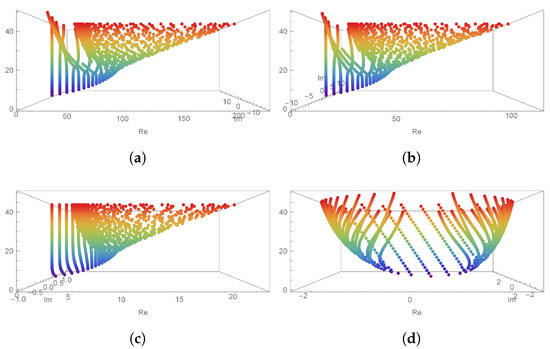
Figure 2.
Approximate roots viewed from the front under the following conditions: (a) , (b) , (c) , (d) .
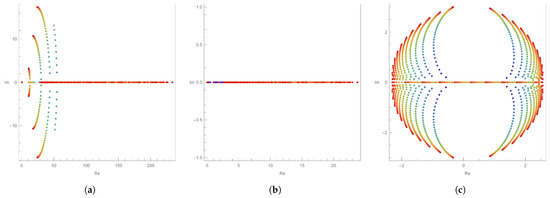
Figure 3.
Approximate roots viewed from the top under the following conditions: (a) , (b) , (c) .
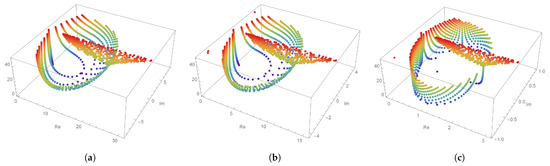
Figure 4.
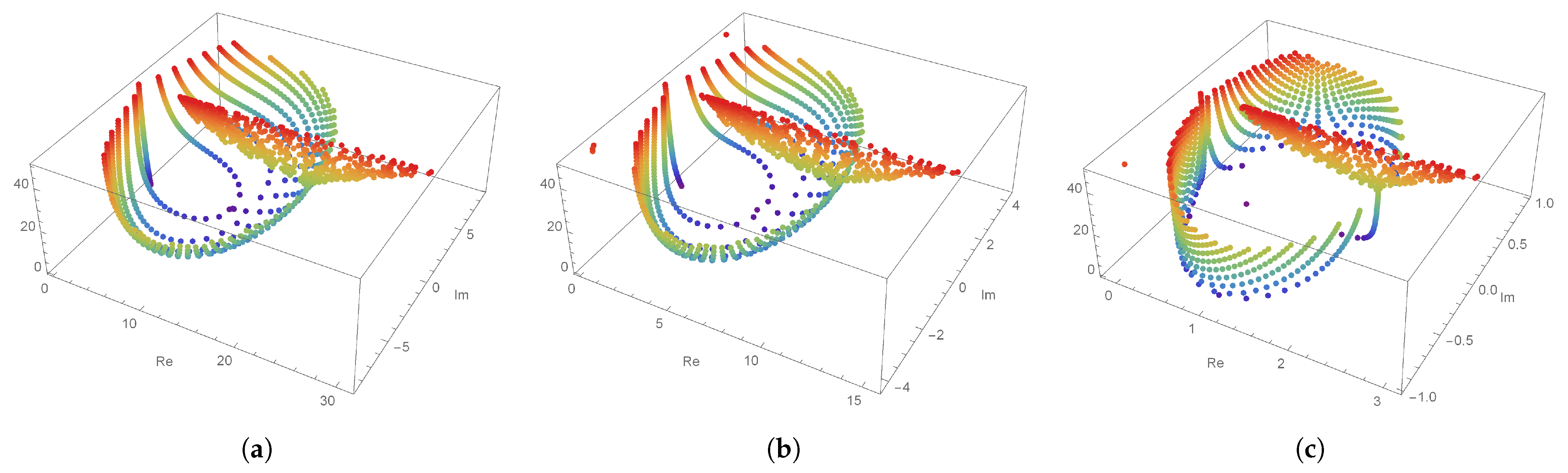
The shape of the 3-dimensional approximate roots under the following conditions: (a) , (b) , (c) .
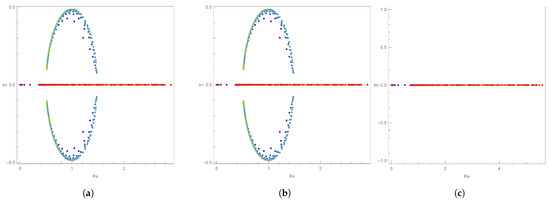
Figure 5.
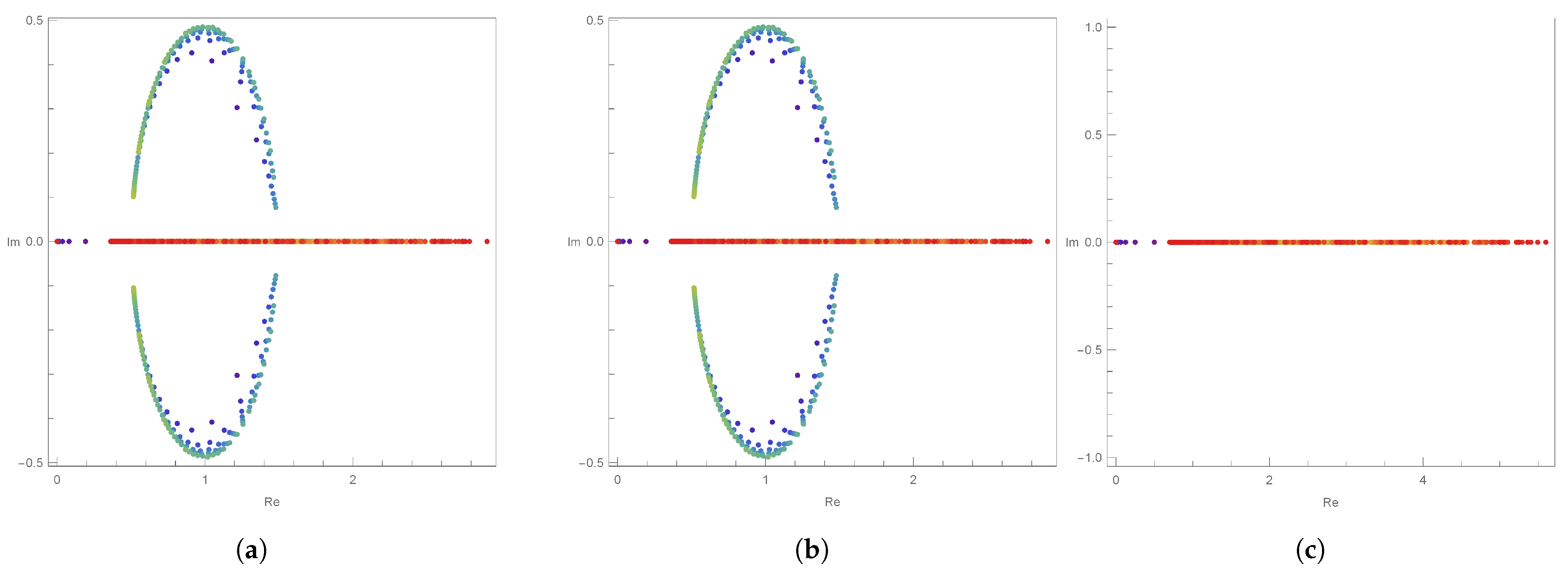
Approximate roots viewed from above under the following conditions: (a) , (b) , (c) .
Looking at Figure 2 from above gives the features shown in Figure 3. There, we can see an interesting phenomenon: Figure 3 shows the change in h with fixed for . For , it seems that all values of real numbers are approximate roots in Figure 3a. In Figure 3b with , it can be seen that the approximate roots all have values of real numbers. In Figure 3c, where , we see that the shapes of the approximate roots have symmetric properties.
Based on Figure 3, we can see real values shown in Table 1, which shows approximate values of real numbers that appear when h is changed.

Table 1.
Numbers of approximate real zeros of .
Table 1 shows that the numbers of approximate real roots match the value of when h is 1. When h is 1, the numbers of approximated real roots are also equal to the value of n. However, when h is 0, we can see that the approximated roots come out with both real and imaginary values. Considering Figure 2 and Figure 3, and Table 1, we can make the following conjecture:
Conjecture 1.
Let us fix . If , , then all values of approximate roots for DQE polynomials will be found on the real axis.
Figure 4 shows the shapes that appear when q is fixed at . The conditions of panels (a), (b), and (c) in Figure 4 are as follows:
- (a)
- for ,
- (b)
- for ,
- (c)
- for .
In Figure 4, the blue dots correspond to , and the red dots indicate . In (a), (b), and (c) of Figure 4, it can be seen that the approximate roots continue to accumulate even if increases and the value of h changes at one position.
Table 2 shows the approximate roots of one pillar location in Figure 4; we can see that the positions of approximate roots stacked are close to 0. Based on Figure 4 and Table 2, we can make the following conjecture:
Table 2.
Approximate real roots of .
Conjecture 2.
One of the approximate roots of the DQE polynomial has a value close to zero under the conditions , , and .
Next, we explore further properties of DQE polynomials by varying the q-number, given the conditions and . Figure 5 shows a view from above of the 3D shape that appears when the q-number is changed under these constraints. The blue dots represent the low values of n; the red dots indicate where . In Figure 5, the q value of the shape on the left is , the q value in the middle is , and the q value on the right is . Figure 5 shows that the position of the red dots changes according to the value of q and, based on this, we can make the following conjecture:
Conjecture 3.
Let us fix . Then, all values of approximate roots for higher-order DQE polynomials will appear on the real axis as the q-number approaches 0.
4. Conclusions
In this paper, we have introduced DQE polynomials and found higher-order differential equations related to these polynomials. By separately varying the q-number and the h-number of these DQE polynomials, we have shown some properties of their approximate roots and the structure of those roots. We have proposed several further conjectures on questions of interest which we hope will lead to new theorems and properties. This result can be applied to nonlinear physics or problems of finding solutions to nonlinear differential equations. Furthermore, we think the study of quantum polynomials with two variables is an interesting topic.
Author Contributions
Methodology, J.-Y.K. and C.-S.R.; writing—original draft, J.-Y.K.; visualization, C.-S.R. All authors have read and agreed to the published version of the manuscript.
Funding
This research received no external funding.
Data Availability Statement
Not applicable.
Conflicts of Interest
The authors declare no conflict of interest.
References
- Jackson, H.F. q-Difference equations. Am. J. Math. 1910, 32, 305–314. [Google Scholar] [CrossRef]
- Jackson, H.F. On q-functions and a certain difference operator. Trans. R. Soc. Edinb. 1909, 46, 253–281. [Google Scholar] [CrossRef]
- Cao, J.; Zhou, H.-L.; Arjika, S. Generalized q-difference equations for (q,c)-hypergeometric polynomials and some applications. Ramanujan J. 2023, 60, 1033–1067. [Google Scholar] [CrossRef]
- Kac, V.; Cheung, P. Quantum Calculus; Part of the Universitext book Series (UTX); Springer: Basel, Switzerland, 2002; ISBN 978-0-387-95341-0. [Google Scholar]
- Bangerezako, G. Variational q–calculus. J. Math. Anal. Appl. 2004, 289, 650–665. [Google Scholar] [CrossRef]
- Carmichael, R.D. The general theory of linear q-difference equations. Am. J. Math 1912, 34, 147–168. [Google Scholar] [CrossRef]
- Duran, U.; Acikgoz, M.; Araci, S. A Study on Some New Results Arising from (p,q)-Calculus. Preprints 2018. [Google Scholar] [CrossRef]
- Mason, T.E. On properties of the solution of linear q-difference equations with entire function coefficients. Am. J. Math. 1915, 37, 439–444. [Google Scholar] [CrossRef]
- Cermak, J.; Nechvatal, L. On (q,h)-analogue of fractional calculus. J. Nonlinear Math. Phys. 2010, 17, 51–68. [Google Scholar] [CrossRef]
- Silindir, B.; Yantir, A. Generalized quantum exponential function and its applications. Filomat 2019, 33, 4907–4922. [Google Scholar] [CrossRef]
- Benaoum, H.B. (q,h)-analogue of Newton’s binomial Formula. J. Phys. A Math. Gen. 1999, 32, 2037–2040. [Google Scholar] [CrossRef]
- Endre, S.; David, M. An Introduction to Numerical Analysis; Cambridge University Press: Cambridge, UK, 2003; ISBN 0-521-00794-1. [Google Scholar]
- Konvalina, J. A unified interpretation of the binomial coefficients, the Stirling numbers, and the Gaussian coefficients. Am. Math. Mon. 2000, 107, 901–910. [Google Scholar] [CrossRef]
- Luo, Q.M.; Srivastava, H.M. q-extension of some relationships between the Bernoulli and Euler polynomials. Taiwan. J. Math. 2011, 15, 241–257. [Google Scholar] [CrossRef]
- Trjitzinsky, W.J. Analytic theory of linear q-difference equations. Acta Math. 1933, 61, 1–38. [Google Scholar] [CrossRef]
- Cao, J.; Huang, J.-Y.; Fadel, M.; Arjika, S. A Review of q-Difference Equations for Al-Salam-Carlitz Polynomials and Applications to U(n+1) Type Generating Functions and Ramanujan’s Integrals. Mathematics 2023, 11, 1655. [Google Scholar] [CrossRef]
- Rahmat, M.R.S. The (q,h)-Laplace transform on discrete time scales. Comput. Math. Appl. 2011, 62, 272–281. [Google Scholar] [CrossRef]
- Ryoo, C.S.; Kang, J.Y. Various Types of q-Differential Equations of Higher Order for q-Euler and q-Genocchi Polynomials. Mathematics 2022, 10, 1181. [Google Scholar] [CrossRef]
- Ryoo, C.S. Some properties of degenerate Calits-type twisted q-Euler numbers and polynomials. J. Appl. Math. Inform. 2021, 39, 1–11. [Google Scholar]
- Ryoo, C.S.; Kim, T.; Agarwal, R.P. A numerical investigation of the roots of q-polynomials. Int. J. Comput. Math. 2006, 83, 223–234. [Google Scholar] [CrossRef]
Disclaimer/Publisher’s Note: The statements, opinions and data contained in all publications are solely those of the individual author(s) and contributor(s) and not of MDPI and/or the editor(s). MDPI and/or the editor(s) disclaim responsibility for any injury to people or property resulting from any ideas, methods, instructions or products referred to in the content. |
© 2023 by the authors. Licensee MDPI, Basel, Switzerland. This article is an open access article distributed under the terms and conditions of the Creative Commons Attribution (CC BY) license (https://creativecommons.org/licenses/by/4.0/).