


Abstract
In this paper, we develop a generalized moment method with a continuous weight function for the Smoluchowski coagulation equation in its continuous form to study the mass conservation property of this equation. We first establish some basic inequalities for the generalized moment and prove the mass conservation property under a sufficient condition on the kernel and an initial condition, utilizing these inequalities. Additionally, we provide some concrete examples of coagulation kernels that exhibit mass conservation properties and show that these kernels exhibit either polynomial or exponential growth along specific particular curves.
MSC:
60H15
1. Introduction
Coagulation is widespread in nature. There are various types of coagulation phenomena happening on different scales: microscopic, mesoscopic, and microscopic. Researchers have also observed coagulation events at the nanoscopic level [1]. For irreversible binary coagulation, a well-known equation is the Smoluchowski coagulation equation. Different phenomena can be explained by this equation. This equation is not only used in different fields of science and engineering but also other fields such as phase separation in liquid mixtures [2]; polymerization [3]; raindrop or snowflake formation in clouds [4,5]; the formation of metal from metal powder [6]; the characterization of proteins in drug design [7]; the coalescence of ancestral lineages in the genealogy of populations [8]; the clumping of antigens and antibodies in blood agglutination [9]; the formation of large-scale structure such as planets, stars, and galaxies in the expanding universe [10]; and even in economics for predicting future financial behavior in bank mergers [11].
Concerning the mathematical model of coagulation, initially, in 1916, Smoluchowski presented the discrete coagulation model [12]. Subsequently, a continuous form of the coagulation model was proposed by Müller [13]. Nowadays, the following continuous coagulation model has been studied in a variety of scientific fields:
for and . In this paper, we refer to (1) as the Smoluchowski Coagulation Equation (SCE) and consider its initial value problem with the initial condition:
We consider as the size (volume or mass) of a particle. The size distribution represents the continuous distribution of the number of particles with size at time . Through a pairwise merging of particles of sizes x and y, a bigger particle of size is created. The rate of this coagulation is determined by the coagulation kernel function in the SCE, which is proportional to the probability of a particle with mass y merging into another particle with mass x. Different physical problems require different forms of the coagulation kernel. We refer the reader to [14,15] for examples of such kernels that appear in various fields.
In mathematical and numerical analyses of the SCE, various methods have been developed. Analytical methods, such as the moment method [16], desingularized Laplace transformation method [17], and self-similar solution approach [18], have been applied to solve the SCE. Several numerical methods have also been successfully implemented, e.g., the Monte Carlo simulation [19], finite element method [20], finite volume method [21], and Pade approximation method [22].
It is well-known that the SCE can be written in the following flux form [21,23,24]
where the flux is defined by
In particular, we set . We provide a more precise statement for (2) in Section 2 and a physical derivation of in Appendix A. One of the most effective tools in the analysis of the SCE is the moment method. We simply define the k-th moment of by
The zeroth moment, , represents the total number of particles, whereas the first moment, , represents the total mass of the coagulation system. Since the SCE is written in the form of a conservation law (2), it is expected that the total mass is conserved. In some cases, such as when or , the mass is conserved (see also Corollary 2). However, for certain kernels, the mass conservation property is known to break, such as when [25,26] (see also Proposition 4). The mass conservation, i.e., , holds for until a finite time , but it fails if , as [26,27]. Mathematically, this phenomenon is referred to as gelation, drawing an analogy to the physical gelation in a sol-gel phase transition.
In their study on the mathematical analysis of the mass conservation property, Escobedo et al. [28,29] considered a class of kernels of the form
and proved its mass conservation property, building upon several pioneering works, e.g., Norris [30]. Regarding the mathematical analysis of gelation, Laurençot [27] and also Escobedo et al. [26] provided a proof that gelation occurs for (4) when . For the sake of convenience, we have included a proof of gelation for the case , in the appendix. For further details, we refer the reader to the above papers and the references cited therein.
The aim of this paper is to establish a generalized moment method using a truncated moment identity and provide a sufficient condition for a broader class of kernels where mass is conserved.
The outline of this paper is as follows. Section 2 describes the flux form (conservation law) of the SCE. Section 3 discusses the generalized moment and truncated moment identity. Section 4 illustrates the mass conservation property for a special class of kernels using the generalized moment method. Section 5 provides some examples of new valid kernels for which mass is conserved, as well as some numerical examples. Finally, Section 6 presents the conclusions. Appendix A presents the physical derivation of flux and Appendix B provides a simple proof of the gelation. Appendix C and Appendix D provide a supplementary lemma and definitions of convexity and superadditivity, respectively.
2. Flux Form of Smoluchowski Coagulation Equation
Throughout this paper, we make the following assumptions regarding the coagulation kernel :
- (a1)
- (a2)
- (a3)
In the following sections, we consider a classical solution of the SCE, which is defined as follows.
Definition 1 (Classical solution).
A function u is called a classical solution of the SCE on if it satisfies the following conditions:
- (b1)
- (b2)
- (b3)
- (b4)
- (b5)
- (1) holds for .
Furthermore, u is called a classical solution of the SCE on if it is a classical solution of the SCE on for any .
Lemma 1.
If u satisfies (b1), (b3), and (b4) in Definition 1, then is well-defined and , , and the following equality holds:
Proof.
Setting , we have
where
Since
and , is well-defined and
holds.
On the other hand, is well-defined and satisfies
where
and . We note that , , and . For some fixed , by applying Lemma 4, we obtain , and
holds for . Then, setting , we have
By changing the integral variable , we also have
This implies that
Therefore, we obtain and , and finally
□
This lemma immediately implies the following proposition. We skip its proof.
Proposition 1.
A function u is a classical solution of the SCE on if and only if u satisfies (b1)–(b4) in Definition 1, and the following conservation law (flux form) holds:
3. Generalized Moment Method
In some works, the k-th moment is effectively used in the analysis of the SCE [16]. Here, we introduce a generalized moment by choosing a more general weight function .
Definition 2.
Suppose that and . Then, we define the following moments of the function u. For and , we define
We consider as a k-th moment and as a truncated k-th moment.
For and , we define
If , then and . We call a generalized b-moment and a truncated b-moment. When , and .
If u is a classical solution of the SCE on , it is known that it satisfies the generalized moment identity [31]
for any weight function . A function u that satisfies (8) is called a weak solution in some works, but we do not consider the concept of the weak solution in this paper.
The following formula is a truncated version of (8) and plays a key role in the proof of our main theorem (Theorem 2).
Theorem 1 (Truncated moment identity).
If u is a classical solution of the SCE on , then for any and , the following equality holds:
Proof.
By using Fubini’s theorem, becomes
where we replace the variable with x.
For , we have
From the symmetry of , it follows that
Using this equality, we obtain
Corollary 1.
Let u be a classical solution of the SCE on . If and , then
Proof.
This immediately follows from (9) since . □
Proposition 2.
We suppose that u is a classical solution of the SCE on and or . If , then holds for .
Proof.
By choosing in Corollary 1, we have
In both cases, we have
Then, taking , we obtain . □
4. Mass Conservation Theorem
In this section, we state our main theorem, which gives a sufficient condition on the coagulation kernel and the weight function for the mass conservation property. We suppose that satisfies the properties (a1)–(a3) and
Furthermore, we assume that there exist some constants , and the following conditions hold for all :
- (c1)
- (c2)
For example, if the coagulation kernel is sublinear, i.e., there exists such that for , then conditions (c1) and (c2) hold for .
When a weight function is given as in (12), the following proposition provides an example of a coagulation kernel that satisfies conditions (c1) and (c2).
Proposition 3.
Proof.
Lemma 2.
We suppose that u is a classical solution of the SCE on , and that (12) and (c2) hold. If and , there exists such that for .
Proof.
From Corollary 1 and (c2), taking into account Proposition 2, we have
where we set . By solving the differential inequality, we obtain
where . By taking , we conclude that . □
Lemma 3.
We suppose that u is a classical solution of the SCE on , and that (12) and (c1) and (c2) hold. If and , it holds that
Proof.
For , we define
Since , we have
where the last inequality holds from Proposition 2 and Lemma 2.
Since
and the three terms on the right-hand side tend to zero as , we obtain
From (14), we also have
By Lebesgue’s dominated convergence theorem [32], we obtain
This completes the proof of Lemma 3. □
Lemma 3 guarantees that no mass flux can escape to infinity. Hence, we can prove the following mass conservation theorem using Lemma 3.
Theorem 2 (Mass conservation).
We suppose that u is a classical solution of the SCE on , and that (12) and (c1) and (c2) hold. If and , then it holds that and for , where B is a constant defined in Lemma 2.
Proof.
The assertion has already been shown in Lemma 2. The other assertion is shown as follows. For and , integrating (7) with respect to x over , we obtain
So, we have
Taking and applying Lemma 3, we obtain
Hence, the proof is complete. □
As an application of this theorem, we can prove the following corollary, which is a special case of the results presented in [28,29].
Corollary 2.
We suppose that K satisfies (a1)–(a3) and there exists such that
If u is a classical solution for the SCE on and , then and for .
Proof.
It is clear that (c1) and (c2) hold with because . Then, the assertion follows from Theorem 2. □
5. Examples of Mass-Conserving Kernels
As an application of Theorem 2 and Proposition 3, we provide several examples of kernels for which the mass conservation property holds but is not sublinear.
5.1. Polynomial Growth Kernel I
Setting and , we apply Proposition 3. Then, we have
where is a binomial coefficient. We note that this kernel is continuous on , even when (see (17)). Since it satisfies (c1) and (c2), if , then the mass is conserved. However, for , it satisfies
This means that the kernel has a polynomial growth of the order of along the curve . This is an example of a mass-conserving kernel that does not have sublinear growth.
5.2. Polynomial Growth Kernel II
As in the previous example, we can construct another more simple mass-conserving kernel with polynomial growth. Again, we set and define
We note that holds since is continuous in . Furthermore, using the inequality
we have
Then, we obtain
Since satisfies conditions (c1) and (c2), follows the same conditions.
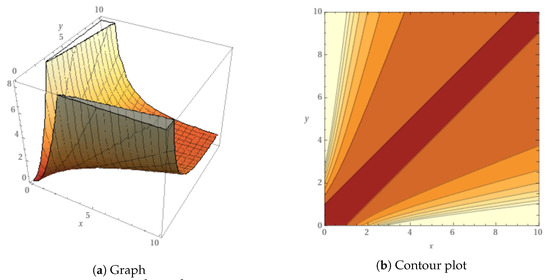
For , it satisfies
In particular, when , it becomes
which exhibits a quadratic growth along the curve :
We show a graph and a contour plot of in Figure 1.
Figure 1.
.
5.3. Exponential Growth Kernel
We set and and apply Proposition 3. Then, we have
where we chose because is continuous at only if . Since , if it means that
so the mass is conserved.
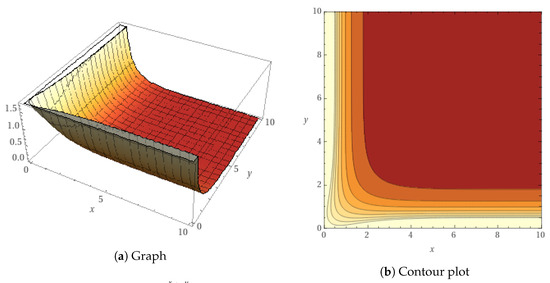
Along the curve , it satisfies
This is an example of an exponentially growing and mass-conserving kernel. We provide a graph and a contour plot of in Figure 2.
Figure 2.
.
5.4. Discussion
In the introduction, we discussed the conservation of mass and gel phenomena for various types of kernels. Here, using the numerical simulation, we compare our new kernels that satisfy (c1) and (c2) with some previously known kernels. For the numerical simulation, we employ the finite volume method proposed by Filbet and Laurençot [21].
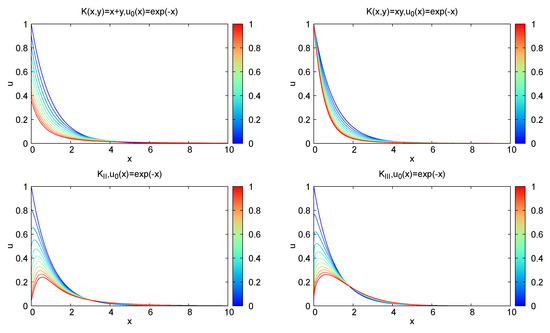
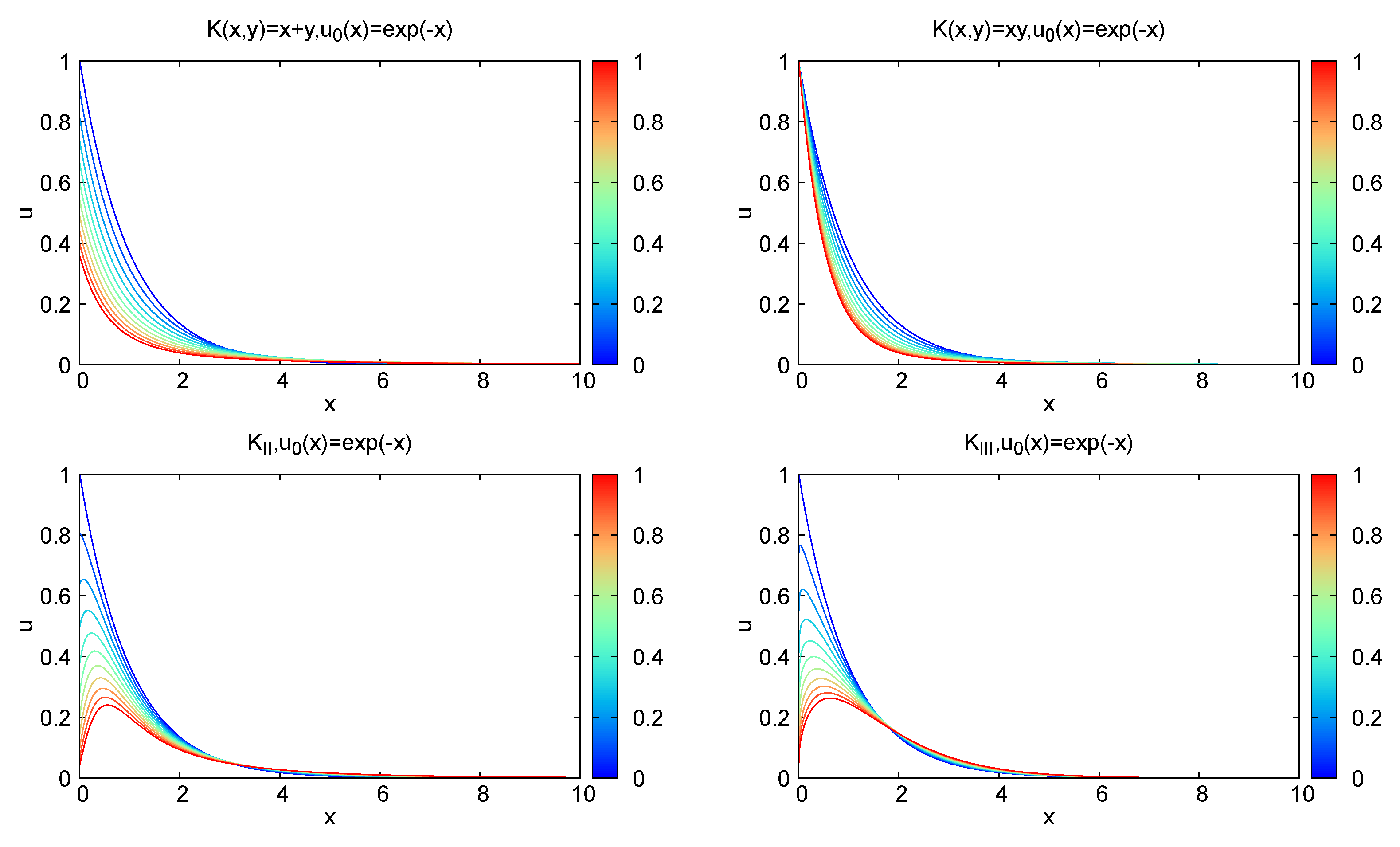
In Figure 3, we can see the time evolution of the solution profile with an initial condition for previously known kernels and , as well as our chosen kernels and . In these numerical computations, we truncate to the interval with and divide as , where and . However, we only show the interval in the figures. For time, we compute with and . The color bars on the right side of the figures represent the corresponding time t.
Figure 3.
Solution graphs for different kernels. The color bar on the right represents the time t.
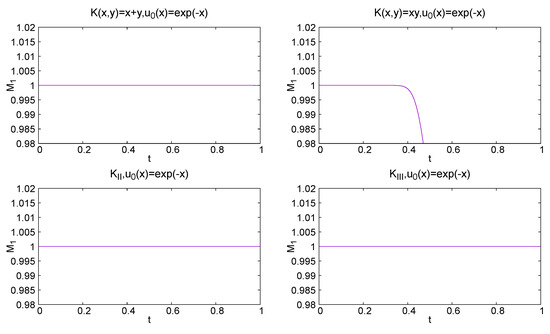
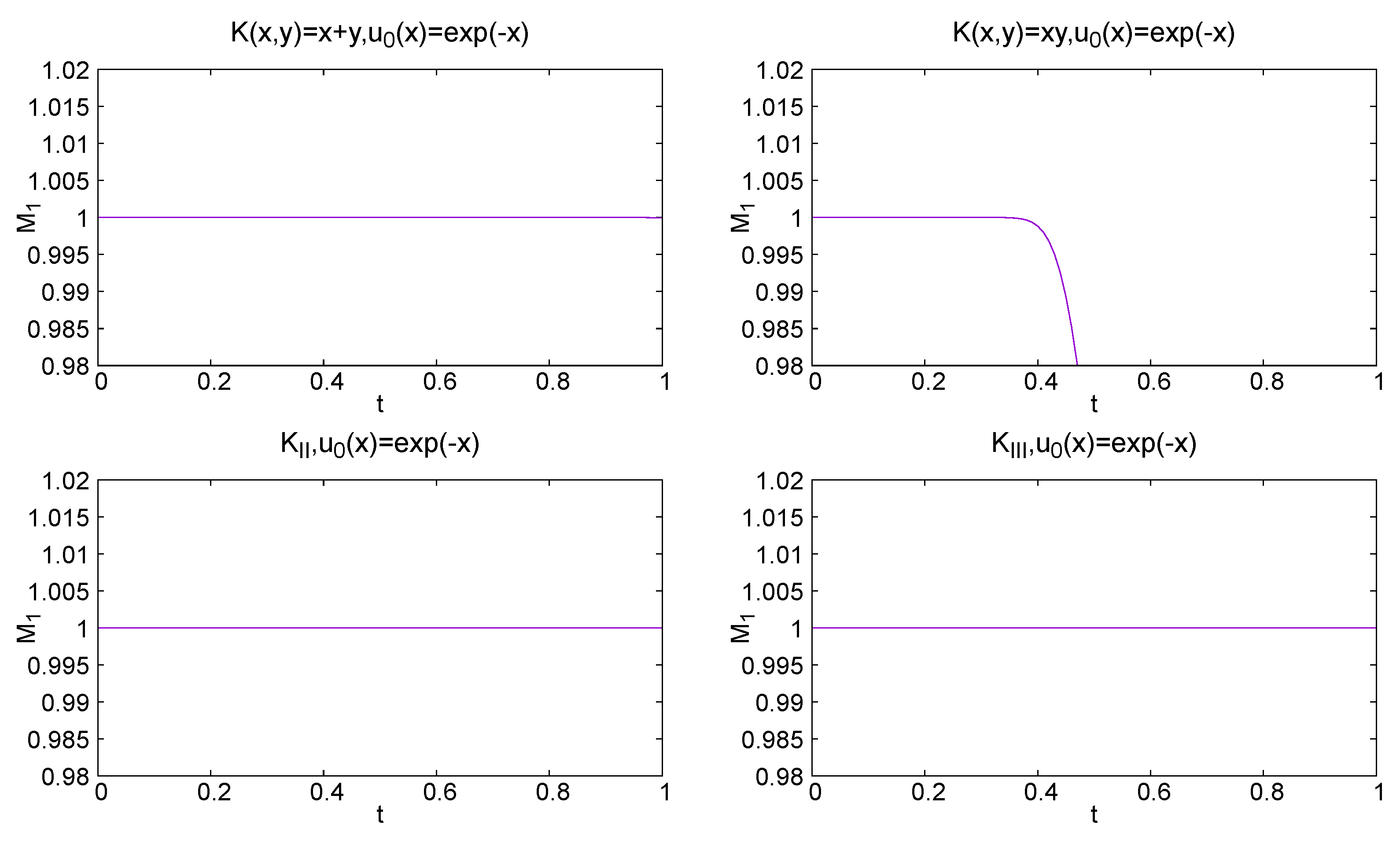
In Figure 4, the time evolution of the total mass is plotted. As expected, mass conservation holds for the kernel (Corollary 2), whereas it is not conserved for (Proposition 4). We also observe that mass is conserved for our chosen kernels: and . For the mass-conserving kernel, the plot shows a straight line throughout the time interval, whereas for the non-conserving kernel, the straight line breaks, indicating the occurrence of the gel phenomenon.
Figure 4.
Graph of for different kernels.
6. Conclusions
In this paper, we proposed the generalized moment method based on the truncated moment identity (Theorem 1). Using this generalized moment, in Section 4, we studied a sufficient condition of the mass conservation property for the coagulation kernel and the initial condition (Theorem 2). As a result of our main theorem, we provided several examples of new kernels, along with some numerical illustrations, where mass conservation was achieved.
In most previous works, the focus has been on studying mass conservation and gelation phenomena for homogeneous kernels, i.e., , or under the assumption that admits an inequality with a homogeneous kernel. Roughly speaking, if , mass is conserved, and if , gelation occurs [15,26,28,29].
On the other hand, the mass-conserving kernels discussed in Section 5 are not homogeneous and cannot be bounded from above by a linear-order growth function, i.e., (15) does not hold for any . Furthermore, we also demonstrated that the kernels and exhibit polynomial growth, whereas exhibits exponential growth along specific curves such as .
In addition, our main result, Theorem 2, strongly suggests that the occurrence of mass conservation or gelation depends not only on the growth properties of the coagulation kernel but also on the boundedness of the initial generalized moment . In this sense, it would be interesting to further investigate gelation phenomena using the generalized moment method.
Author Contributions
M.S.I. and M.K. contributed to the conceptualization, analysis, and writing—original draft preparation. H.M. contributed to the analysis and simulations. All authors have read and agreed to the published version of the manuscript.
Funding
M.S.I. was the recipient of the MEXT LocSEES scholarship.
Data Availability Statement
The data for the numerical simulations in this study are available from the authors.
Conflicts of Interest
The authors declare no conflict of interest.
Appendix A. Derivation of Flux
A mass flux density (often simply called a mass flux) for is defined as the rate of mass flow in the size domain across from the side to the other side , which must satisfy
where we set since we consider only coagulation. Specifically, from (A1), we obtain the conservation law (2). Furthermore, from (A2), the mass conservation is expected if . This is the key idea of the proof of Theorem 2.
In this section, we derive the mass flux from the viewpoint of the elementary physical process. For the mass distribution , the mass distribution is represented by . We fix and take any particle of mass and another particle of mass . For the particle of mass y, we consider a coagulation rate of the mass change per unit time by coagulating with a particle of mass , which is given by
The mass flux is given by
Appendix B. A Simple Proof of Gelation Phenomena
In this appendix, we provide proof of the occurrence of gelation for the coagulation kernel . This type of proof is provided in [26,27]. We include it here for the reader’s convenience.
Proposition 4.
We suppose that , with , and u is a weak solution of SCE on , with . Then, we obtain
In particular, it implies that a gelation should occur if , where
Proof.
From the truncated moment identity (Theorem 1) with , we have
Integrating within , we obtain
From Proposition 2 and Fatou’s lemma, taking , we have
This implies that,
where we have used that is non-increasing (Proposition 2). Hence, we have proven the assertion. □
Appendix C. Supplementary Lemma
Lemma 4.
Let for , and let . We suppose that satisfies and , and define for . Then, , and it holds that
Proof.
For , since , we have
This implies that and (A3). □
Appendix D. Convexity and Superadditivity
In this appendix, we provide some brief information about the convexity and superadditivity of a function defined on .
Definition 3.
Let be a function, . Then,
- b is called convex on if
- b is called superadditive on if
Proposition 5.
If b is convex on , the following inequality holds
In particular, if b is convex on and , then b is superadditive on .
Proof.
When or , (A4) holds. If and , we have
Similarly, we have
Adding these inequalities, we obtain (A4). □
References
- Pesmazoglou, I.; Kempf, A.; Navarro-Martinez, S. Stochastic modelling of particle aggregation. Int. J. Multiph. Flow 2016, 80, 118–130. [Google Scholar] [CrossRef] [Scilit]
- Ernst, M.; Ziff, R.M.; Hendriks, E. Coagulation processes with a phase transition. J. Colloid Interface Sci. 1984, 97, 266–277. [Google Scholar] [CrossRef] [Scilit]
- Ziff, R.M. Kinetics of polymerization. J. Stat. Phys. 1980, 23, 241–263. [Google Scholar] [CrossRef] [Scilit]
- Drake, R.L. A general mathematical survey of the coagulation equation. Int. Rev. Aerosol Phys. Chem. 1972, 3, 201–376. [Google Scholar]
- Seinfeld, J.H. ES and T books: Atmospheric chemistry and physics of air pollution. Environ. Sci. Technol. 1986, 20, 863. [Google Scholar] [CrossRef] [Scilit] [PubMed]
- Kumar, J.; Warnecke, G.; Peglow, M.; Heinrich, S. Comparison of numerical methods for solving population balance equations incorporating aggregation and breakage. Powder Technol. 2009, 189, 218–229. [Google Scholar] [CrossRef] [Scilit]
- Zidar, M.; Kuzman, D.; Ravnik, M. Characterisation of protein aggregation with the Smoluchowski coagulation approach for use in biopharmaceuticals. Soft Matter 2018, 14, 6001–6012. [Google Scholar] [CrossRef] [Scilit]
- Tavaré, S. Line-of-descent and genealogical processes, and their applications in population genetics models. Theor. Popul. Biol. 1984, 26, 119–164. [Google Scholar] [CrossRef] [Scilit]
- Family, F.; Landau, D.P. Kinetics of Aggregation and Gelation; Elsevier: Amsterdam, The Netherlands, 2012. [Google Scholar]
- Silk, J.; White, S.D. The development of structure in the expanding universe. Astrophys. J. 1978, 223, L59–L62. [Google Scholar] [CrossRef] [Scilit]
- Banakar, Z.; Tavana, M.; Huff, B.; Di Caprio, D. A bank merger predictive model using the Smoluchowski stochastic coagulation equation and reverse engineering. Int. J. Bank Mark. 2018, 36, 634–662. [Google Scholar] [CrossRef] [Scilit]
- Smoluchowski, M. Drei vorträge über diffusion, brownsche molekularbewegung und koagulation von kolloidteilchen. Pisma Marian. Smoluchowskiego 1927, 2, 530–594. [Google Scholar]
- Müller, H. Zur allgemeinen Theorie ser raschen Koagulation. Kolloidchem. Beih. 1928, 27, 223–250. [Google Scholar] [CrossRef] [Scilit]
- Smit, D.; Hounslow, M.; Paterson, W. Aggregation and gelation—I. Analytical solutions for CST and batch operation. Chem. Eng. Sci. 1994, 49, 1025–1035. [Google Scholar] [CrossRef] [Scilit]
- Aldous, D.J. Deterministic and stochastic models for coalescence (aggregation and coagulation): A review of the mean-field theory for probabilists. Bernoulli 1999, 5, 3–48. [Google Scholar] [CrossRef] [Scilit]
- Estrada, P.R.; Cuzzi, J.N. Solving the coagulation equation by the moments method. Astrophys. J. 2008, 682, 515–526. [Google Scholar] [CrossRef] [Scilit]
- Menon, G.; Pego, R.L. Approach to self-similarity in Smoluchowski’s coagulation equations. Commun. Pure Appl. Math. A J. Issued Courant Inst. Math. Sci. 2004, 57, 1197–1232. [Google Scholar] [CrossRef] [Scilit]
- Van Dongen, P.; Ernst, M. Scaling solutions of Smoluchowski’s coagulation equation. J. Stat. Phys. 1988, 50, 295–329. [Google Scholar] [CrossRef] [Scilit]
- Kruis, F.E.; Maisels, A.; Fissan, H. Direct simulation Monte Carlo method for particle coagulation and aggregation. Am. Inst. Chem. Eng. J. 2000, 46, 1735–1742. [Google Scholar] [CrossRef] [Scilit]
- Mahoney, A.W.; Ramkrishna, D. Efficient solution of population balance equations with discontinuities by finite elements. Chem. Eng. Sci. 2002, 57, 1107–1119. [Google Scholar] [CrossRef] [Scilit]
- Filbet, F.; Laurençot, P. Numerical simulation of the Smoluchowski coagulation equation. SIAM J. Sci. Comput. 2004, 25, 2004–2028. [Google Scholar] [CrossRef] [Scilit]
- Sadri, K.; Ebrahimi, H. New Method for Homogeneous Smoluchowski Coagulation Equation. J. Appl. Comput. Math. 2015, 4, 2. [Google Scholar]
- Makino, J.; Fukushige, T.; Funato, Y.; Kokubo, E. On the mass distribution of planetesimals in the early runaway stage. New Astron. 1998, 3, 411–417. [Google Scholar] [CrossRef] [Scilit]
- Tanaka, H.; Inaba, S.; Nakazawa, K. Steady-state size distribution for the self-similar collision cascade. Icarus 1996, 123, 450–455. [Google Scholar] [CrossRef] [Scilit]
- McLeod, J. On an infinite set of non-linear differential equations. Q. J. Math. 1962, 13, 119–128. [Google Scholar] [CrossRef] [Scilit]
- Escobedo, M.; Mischler, S.; Perthame, B. Gelation in coagulation and fragmentation models. Commun. Math. Phys. 2002, 231, 157–188. [Google Scholar] [CrossRef] [Scilit]
- Laurençot, P. On a class of continuous coagulation-fragmentation equations. J. Differ. Equ. 2000, 167, 245–274. [Google Scholar] [CrossRef] [Scilit]
- Escobedo, M.; Mischler, S.; Ricard, M.R. On self-similarity and stationary problem for fragmentation and coagulation models. Ann. l’Inst. Henri Poincaré C Anal. Non Linéaire 2005, 22, 99–125. [Google Scholar] [CrossRef] [Scilit]
- Escobedo, M.; Mischler, S. Dust and self-similarity for the Smoluchowski coagulation equation. Ann. l’Inst. Henri Poincaré C Anal. Non Linéaire 2006, 23, 331–362. [Google Scholar] [CrossRef] [Scilit]
- Norris, J.R. Smoluchowski’s coagulation equation: Uniqueness, nonuniqueness and a hydrodynamic limit for the stochastic coalescent. Ann. Appl. Probab. 1999, 9, 78–109. [Google Scholar] [CrossRef] [Scilit]
- Pego, R.L. Dynamics and scaling in models of coarsening and coagulation. In Proceedings of the Pan-American Advanced Studies Institute (VIII America’s Conference on Differential Equations), Mexico City, Mexico, 15–17 October 2009; 26p. [Google Scholar]
- Evans, L.C.; Gariepy, R.F. Measure Theory and Fine Properties of Functions; CRC Press: Boca Raton, FL, USA, 2015. [Google Scholar]
Disclaimer/Publisher’s Note: The statements, opinions and data contained in all publications are solely those of the individual author(s) and contributor(s) and not of MDPI and/or the editor(s). MDPI and/or the editor(s) disclaim responsibility for any injury to people or property resulting from any ideas, methods, instructions or products referred to in the content. |
© 2023 by the authors. Licensee MDPI, Basel, Switzerland. This article is an open access article distributed under the terms and conditions of the Creative Commons Attribution (CC BY) license (https://creativecommons.org/licenses/by/4.0/).