Abstract
In this paper, by introducing environmental white noise and telegraph noise, we proposed a stochastic predator–prey model with the Beddington–DeAngelis type functional response and investigated its dynamical behavior. Persistence and extinction are two core contents of population model research, so we analyzed these two properties. The sufficient conditions of the strong persistence in the mean and extinction were established and the threshold between them was obtained. Moreover, we took stability into account and, by means of structuring a suitable Lyapunov function with regime switching, we proved that the stochastic system has a unique stationary distribution. Finally, numerical simulations were used to illustrate our theoretical results.
Keywords:
stochastic predator–prey model; Beddington–DeAngelis functional response; regime switching; persistence in the mean; stationary distribution MSC:
60G10; 60H10; 92B05
1. Introduction
Predator–prey models arise naturally in mathematical ecology, physics, and so on [1,2]. Beddington [3] and DeAngelis et al. [4] first introduced the Beddington–DeAngelis (B-D) type predator–prey model; we also refer the reader to [5,6,7,8]. In the literature, many scholars have focused on the following predator–prey system with the B-D functional response:
where and represent predator and prey densities, respectively, and and are positive constants, ; see [9,10,11,12,13,14,15,16,17,18,19,20,21] and the references therein. In [9], the authors studied the dynamics of a non-autonomous predator–prey system with the Beddington–DeAngelis functional response, and in [10,11], the authors established sufficient conditions for the existence of an almost periodic solution and a positive periodic solution of the non-autonomous B-D predator–prey system. The authors of [21] proposed the following stochastic B-D predator–prey system and the predator and prey in it are density dependent,
and they obtained the existence of the stationary distribution. The authors of [22] investigated the non-autonomous form of system (2) and discussed the moment boundedness and the growth rate of the population.
However, living things in nature are always more or less affected by environmental noise, the most important being white noise and colored noise (or telegraph noise); see [21,22,23,24,25,26,27,28,29,30,31,32,33,34] for more details. So far, the tools that can deal with stochastic models having colored noise (see [26,27,35,36,37,38,39,40]) are limited. Refs. [37,38] gave the methods for studying the ergodicity and stationary distribution of stochastic differential equations with Markovian switching and, based on them, the authors of [35,36,39] obtained the ergodic property for a Lotka–Volterra predator–prey model with white and colored noise and a Lotka–Volterra mutualistic system, respectively. Until recently, there is little research on the dynamical properties of a stochastic predator–prey model with the B-D functional response with regime switching. Therefore, in this work, we introduced white noise, which affects the intrinsic growth rate and death rate, that is, , ( and represent the white noise intensities), and the continuous-time Markov chain taking values in a finite state space into system (1); then, it can be rewritten in the form:
In this model, is 1-dimensional standard Brownian motion with defined on the complete probability space with a filtration , satisfying the usual conditions (i.e., it is right continuous and contains all P-null sets). Throughout this paper, we assume that, for each , , , , and are positive constants, .
We make the following arrangement for each chapter. Section 2 presents some basic theories. In Section 3, we discuss the strong persistence in the mean and the extinction. In Section 4, we establish the sufficient conditions for the stationary distribution. Section 5 proposes an example and figures to illustrate our results. This paper ends with our conclusions and plans for future research.
2. Preliminaries
We denote by the positive zone in , i.e., . Define a Markov chain , which is right-continuous on the probability space taking values in a finite-state space and its generator is
where , is the transition probability from the state i to state j and (), while In this paper, we assumed that if and the Markov chain is irreducible and independent of the Brownian motion. In light of the theory of a Markov chain, the finite states imply the ergodic property and positive recurrence of . Hence, the Markov chain has a unique stationary distribution such that , , and, for any vector ,
Let , and
To investigate the positive recurrence and the ergodic property of the stochastic system (3), we first introduced the following lemma (see [37,38]). Let be the diffusion process of the equation:
where and are the d-dimensional Brownian motion and the right-continuous Markov chain, respectively, and , with . For any twice continuously differentiable function , for each , define the differential operator by
where
Lemma 1.
Suppose the following conditions hold:
- (i)
- For
- (ii)
- For each is symmetric and satisfies for all , with some constant for all
- (iii)
- There exists a nonnegative -function such that outside some compact set.
Then, of the system (5) is ergodic and positive recurrent, and then there exists a unique stationary density and, for any Borel measurable function such that
we have
Lemma 2.
Let . If, for any , there exists positive constants , and , such that
then
Lemma 3.
For any given initial value , system (3) has a unique continuous positive solution which will remain in with probability 1.
The proof of Lemma 3 is standard [27,28,41,42], so we only list the key point, namely the construction of the Lyapunov function,
3. The Strong Persistence in the Mean and the Extinction
In this section, we will demonstrate two critical aspects of population dynamics. Before the proof, we first review the basic concepts which can be found in the article [28].
Definition 1.
- ⋄
- ⋄
Let be a homogeneous Markov process, which is exactly depicted by the following SDE system:
. The properties of the 1-dimensional stochastic system (6) are listed as follows:
- (a)
- a.s., if the condition holds (see [26]);
- (b)
- by the strong law of large numbers for martingales (see [35], p. 16), where is a real-valued continuous local martingale;
- (c)
- (see Theorem 5.1 in [43]);
- (d)
- According to the literature [44], if , for any Borel measurable function , then SDE (6) has a unique stationary distribution with the ergodic property:
On the basis of the well-known comparison theorem and , for any , and a.s., which can lead to a.s., and then a.s. In this paper, we suppose that , in order to prevent the extinction of the predator caused by the prey’s extinction.
Furthermore, the generalized It’s formula on system (6) shows that
The equality (8) will play a crucial role in the following theorem about the properties of population dynamics.
Theorem 1.
In system (3), for any given initial value , if , then the following statements hold:
- (i)
- If , the predator population goes to extinction a.s.;
- (ii)
- If , system (3) will be strongly persistent in the mean.
Here,
Proof.
From (7) and (11), we have
and so
Substituting (12) into (9) yields
Here,
The property of inferior limits implies that, for arbitrary , there exists such that
and . Making use of these inequalities, one can obtain from (13) that
and from the arbitrariness of and Lemma 2, it is easy to deduce
- (i)
- On the second equation of (3), we use the generalized It’s formula and then
- (ii)
- Applying It’s formula on the first equation of (3) gives
Thus, holds and, furthermore, the threshold between the strong persistence in the mean and the extinction of the SDE (3) is obtained. A physical interpretation of the threshold is that, when the capture density of predators exceeds the sum of fluctuation intensity and mortality, the predator population will persist for a long time. If not, it tends to become extinct. A more relevant physical analysis can be referred to in [41]. □
4. Ergodic Property of Positive Recurrence
The aim of this section is to prove the ergodic property and the existence of the unique stationary distribution of the solution in system (3). First, we utilize variable substitution , and It’s formula, which yield the following transformed system:
with the initial value . Hence, our aim is equivalent to demonstrating them in system (16) (see [35]).
In what follows, let us introduce the assumption:
Theorem 2.
If assumption holds, then for any and for any given initial value , the solution of system (3) is ergodic and has a unique stationary distribution in .
Proof.
We will apply Lemma 1. For any sufficiently small number , define a bounded open subset
Obviously, condition in Lemma 1 is satisfied by the assumption in Section 2. Let , and then is positive definite. Consequently, condition in Lemma 1 holds. Now, we check condition in Lemma 1.
Define a -function by
here, , and, obviously, . Here, , will be determined in the proof. We put in order to make non-negative. Here, . From the monotonically property of the partial derivative equations, it is easy to see that has a unique minimum point (a similar procedure is given in [39]). Hence, we assert that , so is non-negative.
Note,
and
Thus,
Next, for any ,
Define a vector with . Note that the generator matrix is irreducible, then for , there exists a solution of the poisson system expressed as (see Lemma 2.3 in [44]), such that
where denotes the column vector with all its entries equal to 1. Hence, for all , we have that
Thus,
In what follows, let us choose as sufficiently small in the set , such that
where , . For convenience, divide into four domains,
We prove on each domain time , respectively.
Case 1. On the domain , since , it is easy to verify that . The It’s formula shows that
Thus, for all .
Case 3. For any ,
then we can derive that from (27).
Case 4. Analogously, when , we also have
Hence, on the basis of (28), on .
Thus,
The three conditions of Lemma 1 are verified. Thus, we assert that is ergodic and positive recurrent, and so system (3) has a unique stationary distribution. Similarly, a physical interpretation of the threshold can be referred to in [41]. The stationary density is in , which can be established by a proof similar to that in Lemma 3.1 of [23]. □
Remark 1.
In Theorem 2, and
Then, for a sufficiently small positive constant , taking expectations yields
where
here, . This implies that
and it then follows that
and then
From the continuity of on any , one can obtain that
Theorem 2 proved that the SDE (3) has a unique stationary distribution in , expressed as , and Remark 1 implies that the function is integrable with respect to the measure . Using these properties, we have further, for any ,
From the dominated convergence theorem, one can obtain
Note that
Similarly,
Note a.s., which can be seen from (11); otherwise, either or , and tends to 0 or when , which contradicts the fact that its stationary density lies in . It then follows from the first equation of (3) that
On the second equation of (3), we have
We immediately get the following theorem.
Theorem 3.
If assumption holds, then for any , we have that
and
5. Examples and Computer Simulations
In this section, we discuss the effect of Markov switching and white noise by using the method developed in [45]. We consider the discretization transformation of (3) as
where , are Gaussian random variables . For the sake of simplicity, assume that is a right-continuous Markov chain taking values in state space with the generator
The stationary distribution is given by .
Example 1.
Without loss of generality, we fix the parameters , and take as the initial value point. To study the different effects caused by white noise, one can consider the following two cases separated by the intensity of white noise.
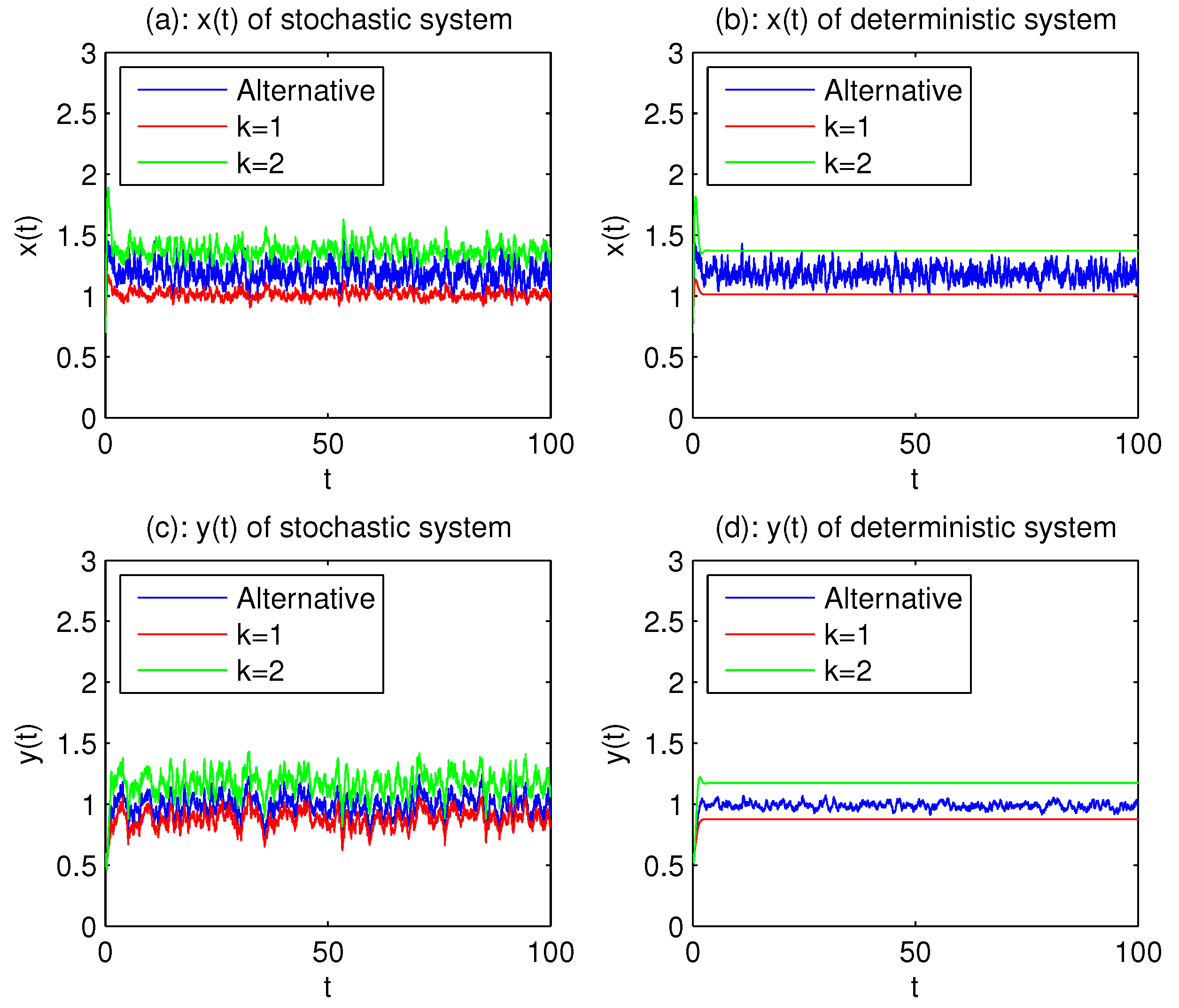
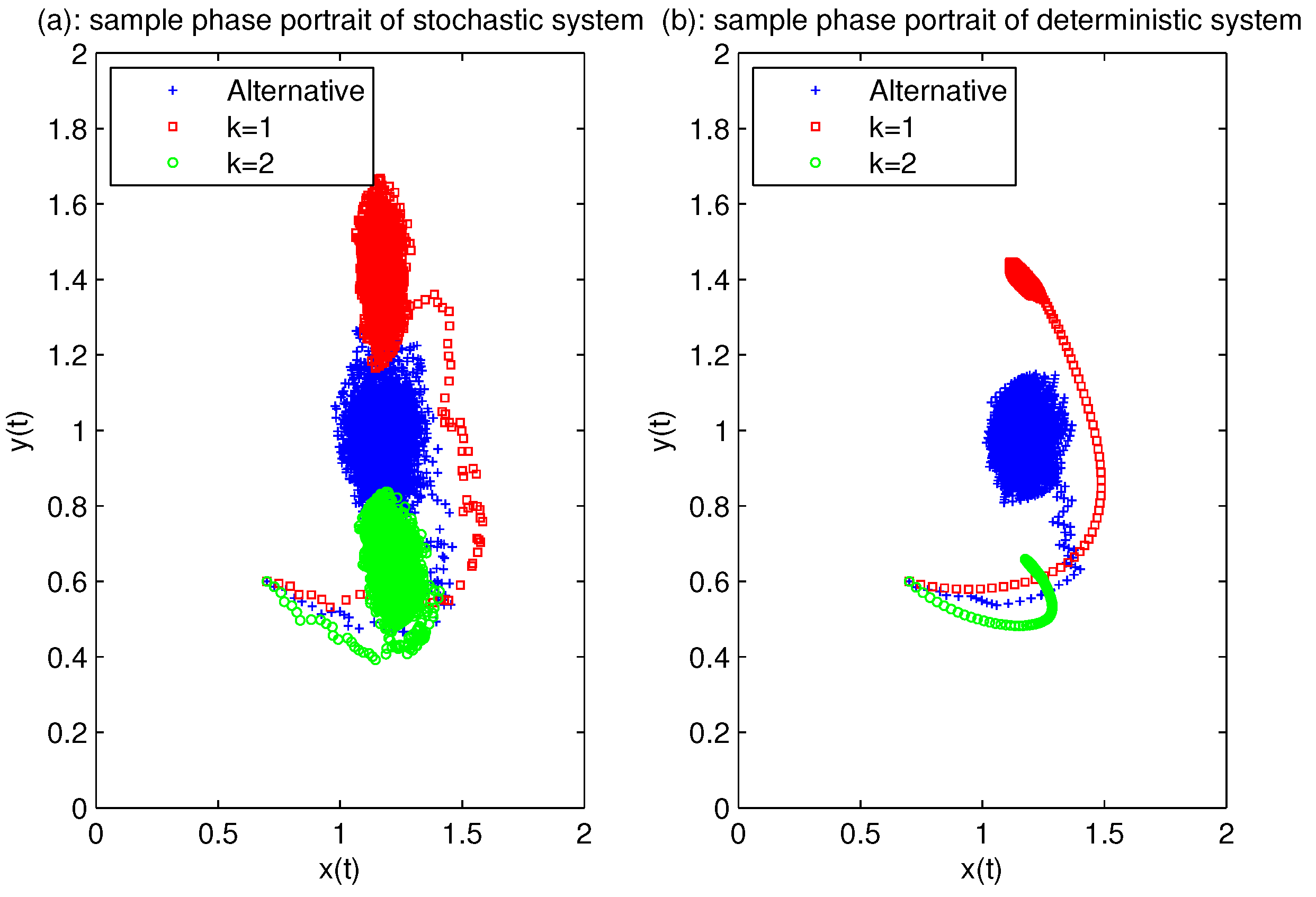
When we choose , this means that the two species are affected by smaller white noise. Since and , from Theorem 2, SDE (3) has a unique stationary distribution, as shown Figure 1 and Figure 2.
Figure 1.
The subgraphs (a,b) represent the sample phase portraits of the stochastic system (3) and the corresponding deterministic system, respectively. Three colors represent three states— and the alternative case—between them. The white noise intensities on and are relatively small. and .
Figure 2.
Representatively, the populations of and change over time in the states , and the alternative case, respectively. The volatility of stochastic systems solutions is not great. and .
The red, green, and blue colors represent the phase of x and y when they are in the states , and switching back and forth from one state to another state according to the movement of , respectively. Figure 1 and Figure 2 show that the blue sandwiches between red and green are either deterministic or stochastic systems, which means that, when white noise is small, Markov switching helps to reduce the risk of species extinction. We can also see from Figure 1a that the three colored regions are all distributed in small areas, and in Figure 2a,c, the fluctuation of stochastic curves are gentle. From Figure 1 and Figure 2, one can clearly see the impact of small white noise and colored environment noise on populations.
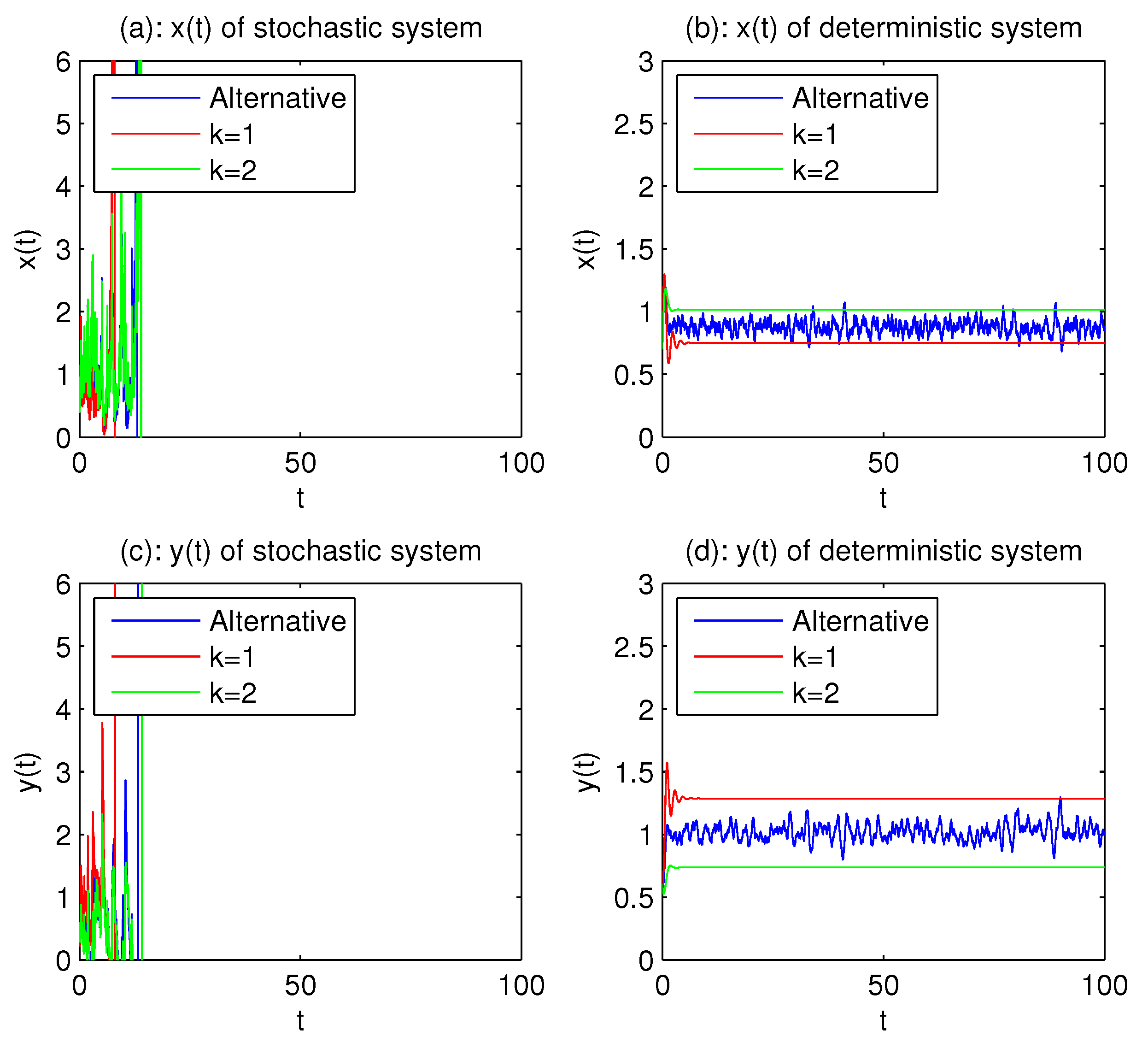
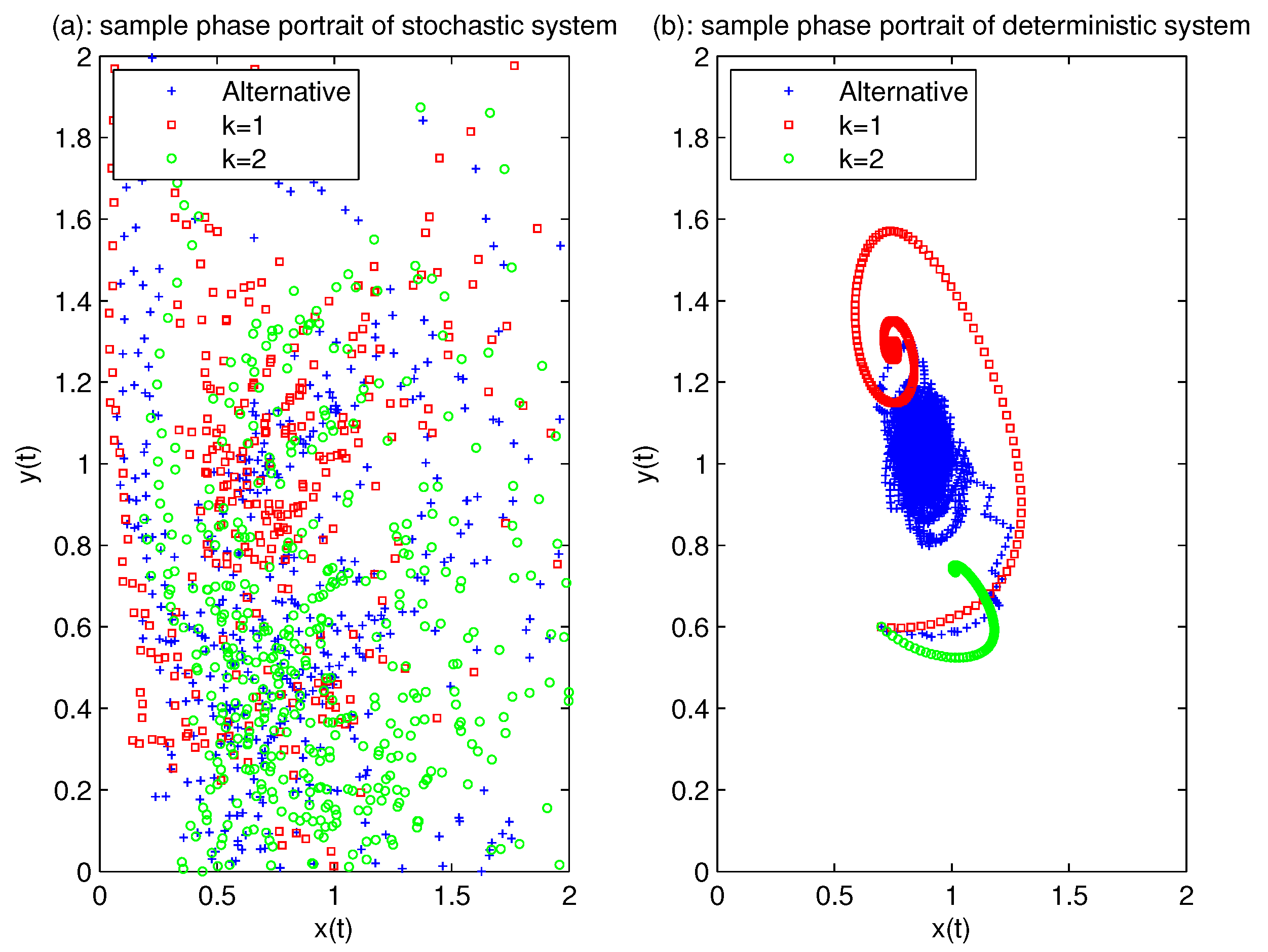
When we choose , then and ; hence, assumption does not hold. Making use of Theorem 1 leads to the conclusion that both prey population x and predator population y go to extinction. Figure 3a and Figure 4a,c confirm this. Large white noise can lead to population extinction, even though the corresponding deterministic model is persistent (see Figure 3b and Figure 4b,d) and the existence of an ergodic.
Figure 3.
The definitions of the subgraphs (a,b) are the same as in Figure 1. The big white noise intensity caused extinction of and as shown in (a). , .
Figure 4.
The definitions of the subgraphs are the same as in Figure 2. , .
6. Conclusions and Future Directions
This paper discussed the properties of a stochastic predator–prey model with the Beddington–DeAngelis functional response. We investigated the strong persistence in the mean and the extinction of the SDE (3) with regime switching. The threshold between them was obtained. We also established the sufficient conditions for the existence of an ergodic stationary distribution of SDE (3) with regime switching. Our results suggest that the value of each coefficient and the intensity of white noise in and determine the persistence and the extinction of a species, which is consistent with reality. The presence of the Markov chain in SDE (3) can contribute to the survival of the population, and reduce the risk of extinction when the white noise is not big.
At the theoretical level, the findings of this paper provide a theoretical basis for other biological predator–prey models with functional response, and competitive systems. The mathematical tools used in this paper may also be helpful for discussing 2-dimensional models of species interaction. At the biological application level, because the Beddington–DeAngelis functional response function has similar rate-dependent qualitative properties and there is no singularity in low population density regions, it can better describe predator–prey interactions, especially predator feeding. Environmental noise is ubiquitous in nature. Scholars usually use Brownian motion to explain the environmental white noise and Markov chain to represent the switching process. Their introduction can better describe the inevitable random interference of the population in nature. In other words, the model developed in this paper has universal and realistic significance. We envision that, in the future, with the establishment and improvement of relevant databases with which to record changes in species populations and environmental fluctuations, more data will be available for reference. The expression of the threshold value and the condition of the stationary distribution obtained in this paper can be used to monitor the quantitative change trend of species in nature reserves. When the monitored data exceeds the threshold, the protection mechanism can be enabled. The early warning can be lifted by controlling the intensity of white noise. Therefore, we hope that, in the future, under the right conditions, endangered species and biodiversity can be protected in this way.
Author Contributions
Conceptualization, D.J.; Methodology, D.J.; Software, Q.W.; Validation, Q.W. and L.Z.; Formal analysis, Q.W. and L.Z.; Investigation, Q.W. and L.Z.; Resources, L.Z.; Data curation, D.O.; Writing—original draft, Q.W.; Writing—review & editing, D.O.; Visualization, Q.W.; Supervision, L.Z., D.J. and D.O.; Project administration, L.Z.; Funding acquisition, L.Z. and D.J. All authors have read and agreed to the published version of the manuscript.
Funding
The work was supported by the National Natural Science Foundation of PR China (No: 12261029, No: 12271201), the specific research fund of The Innovation Platform for Academicians of Hainan Province (Yu Changbin), the Higher Education Project of Hainan Provincial Department of Education (No: HnjgY2022ZD-4), the Research Funds for Department of Science and Technology of Jilin Province (No: 20210509040RQ).
Data Availability Statement
All data generated or analyzed during this study are included in this published article.
Acknowledgments
Thanks to the hard work and cooperation of the four authors, which ensured that the article was completed smoothly. At the same time, the authors’ units provide library materials and hardware support.
Conflicts of Interest
The authors declare that they have no competing interest.
References
- Perc, M.; Szolnoki, A.; Szab, G. Cyclical interactions with alliance-specific heterogeneous invasion rates. Phys. Rev. E 2007, 75, 052102. [Google Scholar] [CrossRef]
- Perc, M.; Szolnoki, A. Noise-guided evolution within cyclical interactions. New J. Phys. 2007, 9, 267. [Google Scholar] [CrossRef]
- Beddington, J.R. Mutual interference between parasites or predators and its effect on searching efficiency. J. Animal Ecol. 1975, 44, 331–341. [Google Scholar] [CrossRef]
- DeAngelis, D.L.; Goldsten, R.A.; Neill, R. A model for trophic interaction. Ecology 1975, 56, 881–892. [Google Scholar] [CrossRef]
- Skalski, G.T.; Gilliam, J.F. Functional responses with predator interference: Viable alternatives to the Holling type II model. Ecology 2001, 82, 3083–3092. [Google Scholar] [CrossRef]
- Cosner, C.; Deangelis, D.L.; Ault, J.S.; Olson, D.B. Effects of spatial grouping on the functional response of predators. Theor. Popul. Biol. 1999, 56, 65–75. [Google Scholar] [CrossRef]
- Wang, Y.; Lu, M.M.; Liu, J. Global stability of a delayed virus model with latent infection and Beddington–DeAngelis infection function. Appl. Math. Lett. 2020, 1007, 106463. [Google Scholar] [CrossRef]
- Ming, Q.; Yang, L.L. Steady state in a cross-diffusion predator–prey model with the Beddington–DeAngelis functional response. Nonlinear Anal. Real World Appl. 2019, 45, 401–413. [Google Scholar] [CrossRef]
- Fan, M.; Kuang, Y. Dynamics of a nonautonomous predator–prey system with the Beddington–DeAngelis functional response. J. Math. Anal. Appl. 2004, 295, 15–39. [Google Scholar] [CrossRef]
- Lin, X.; Chen, F. Almost periodic solution for a Volterra model with mutual interference and Beddington–DeAngelis functional response. Appl. Math. Comput. 2009, 214, 548–556. [Google Scholar] [CrossRef]
- Guo, H.J.; Chen, X.X. Existence and global attractivity of positive periodic solution for a Volterra model with mutual interference and Beddington–DeAngelis functional response. Appl. Math. Comput. 2011, 217, 5830–5837. [Google Scholar] [CrossRef]
- Wang, X.T.; Zhao, M. Chaos in a Hybrid Three-Species Food Chain with Beddington–DeAngelis Functional Response. Procedia Environ. Sci. 2011, 10, 128–134. [Google Scholar] [CrossRef]
- Wang, Z.; Wang, Y. Bifurcations in diffusive predator–prey systems with Beddington–DeAngelis functional response. Nonlinear Dyn. 2021, 105, 1045–1061. [Google Scholar] [CrossRef]
- Hwang, T.W. Uniqueness of limit cycles of the predator–prey system with Beddington–DeAngelis functional response. J. Math. Anal. Appl. 2004, 290, 113–122. [Google Scholar] [CrossRef]
- Baek, H. Qualitative analysis of Beddington–DeAngelis type impulsive predator–prey models. Nonlinear Anal. Real World Appl. 2010, 11, 1312–1322. [Google Scholar] [CrossRef]
- Li, H.; Cheng, X. Dynamics of Stage-Structured Predator–Prey Model with Beddington–DeAngelis Functional Response and Harvesting. Mathematics 2021, 9, 2169. [Google Scholar] [CrossRef]
- Dimitrov, D.; Kojouharov, H. Complete mathematical analysis of predator–prey models with linear prey growth and Beddington–DeAngelis functional response. Appl. Math. Comput. 2005, 162, 523–538. [Google Scholar] [CrossRef]
- Xu, C.; Wang, M. Permanence for a delayed discrete three-level food-chain model with Beddington–DeAngelis functional response. Appl. Math. Comput. 2007, 187, 1109–1119. [Google Scholar] [CrossRef]
- Ko, W.; Ryu, K. Analysis of diffusive two-competing-prey and one-predator systems with Beddington–DeAngelis functional response. Nonlinear Anal. 2009, 71, 4185–4202. [Google Scholar] [CrossRef]
- Li, H.; Takeuchi, Y. Dynamics of the density dependent predator–prey system with Beddington–DeAngelis functional response. J. Math. Anal. Appl. 2011, 374, 644–654. [Google Scholar] [CrossRef]
- Ji, C.Y.; Jiang, D.Q. Dynamics of a stochastic density dependent predator–prey system with Beddington–DeAngelis functional response. J. Math. Anal. Appl. 2011, 381, 441–453. [Google Scholar] [CrossRef]
- Qiu, H.; Liu, M.; Wang, K.; Wang, Y. Dynamics of a stochastic predator–prey system with Beddington–DeAngelis functional response. Appl. Math. Comput. 2012, 219, 2303–2312. [Google Scholar] [CrossRef]
- Yagi, A.; Viet, T.T. Dynamic of a stochastic predator–prey population. Appl. Math. Comput. 2011, 218, 3100–3109. [Google Scholar] [CrossRef]
- Ji, C.Y.; Jiang, D.Q.; Shi, N.Z. A note on a predator–prey model with modified Leslie-Gower and Holling-type II schemes with stochastic perturbation. J. Math. Anal. Appl. 2011, 377, 435–440. [Google Scholar] [CrossRef]
- Liu, M.; Wang, K. Global stability of a nonlinear stochastic predator–prey system with Beddington–DeAngelis functional response. Commun. Nonlinear Sci. Numer. Simulat. 2011, 16, 1114–1121. [Google Scholar] [CrossRef]
- Li, X.Y.; Gray, A.; Jiang, D.Q.; Mao, X.R. Sufficient and necessary conditions of stochastic permanence and extinction for stochastic logistic populations under regime switching. J. Math. Anal. Appl. 2011, 376, 11–28. [Google Scholar] [CrossRef]
- Li, X.Y.; Jiang, D.Q.; Mao, X.R. Population dynamical behavior of Lotka-Volterra system under regime switching. J. Comput. Appl. Math. 2009, 232, 427–448. [Google Scholar] [CrossRef]
- Liu, M.; Wang, K. Dynamics of a Leslie-Gower Holling-type II predator–prey system with Le´vy jumps. Nonlinear Anal. 2013, 85, 204–213. [Google Scholar] [CrossRef]
- Mao, X.R.; Yuan, C.G. Stochastic Differential Equations with Markovian Switching; Imperial College Press: London, UK, 2006. [Google Scholar]
- Mao, X.; Marion, G.; Renshaw, E. Environmental noise suppresses explosion in population dynamics. Stoch. Process. Appl. 2002, 97, 95–110. [Google Scholar] [CrossRef]
- Mao, X. Stationary distribution of stochastic population systems. Syst. Control. Lett. 2011, 60, 398–405. [Google Scholar] [CrossRef]
- Zu, L.; Jiang, D.Q.; O’Regan, D.; Hayat, T.; Ahmad, B. Ergodic property of a Lotka–Volterra predator–prey model with white noise higher order perturbation under regime switching. Appl. Math. Comput. 2018, 330, 93–102. [Google Scholar] [CrossRef]
- Jiang, X.B.; Zu, L.; Jiang, D.Q.; O’Regan, D. Analysis of a Stochastic Holling Type II Predator–Prey Model Under Regime Switching. Bull. Malays. Math. Sci. Soc. 2020, 43, 2171–2197. [Google Scholar] [CrossRef]
- Zu, L.; Jiang, D.Q.; O’Regan, D.; Hayat, T. Dynamic analysis of a stochastic toxin-mediated predator-prey model in aquatic environments. J. Math. Anal. Appl. 2021, 504, 125424. [Google Scholar] [CrossRef]
- Liu, H.; Li, X.X.; Yang, Q.S. The ergodic property and positive recurrence of a multi-group Lotka-Volterra mutualistic system with regime switching. Syst. Control Lett. 2013, 62, 805–810. [Google Scholar] [CrossRef]
- Settati, A.; Lahrouz, A. Stationary distribution of stochastic population systems under regime switching. Appl. Math. Comput. 2014, 244, 235–243. [Google Scholar] [CrossRef]
- Zhu, C.; Yin, G. Asymptotic properties of hybrid diffusion systems. SIAM J. Control Optim. 2007, 46, 1155–1179. [Google Scholar] [CrossRef]
- Zhu, C.; Yin, G. On competitive Lotka-Volterra model in random environments. J. Math. Anal. Appl. 2009, 357, 154–170. [Google Scholar] [CrossRef]
- Zu, L.; Jiang, D.Q.; O’Regan, D. Conditions for persistence and ergodicity of a stochastic Lotka-Volterra predator–prey model with regime switching. Commun. Nonlinear Sci. Numer. Simulat. 2015, 29, 1–11. [Google Scholar] [CrossRef]
- Liu, M.; Wang, K.; Wu, Q. Survival analysis of stochastic competitive models in a polluted environment and stochastic competitive exclusion principle. Bull. Math. Biol. 2011, 73, 1969–2012. [Google Scholar] [CrossRef]
- Bibi Ruhomally, Y.; Zaid Dauhoo, M.; Dumas, L. Stochastic modelling of marijuana use in Washington: Pre-and post-Initiative-502 (I-502). IMA J. Appl. Math. 2022, 87, 1121–1150. [Google Scholar] [CrossRef]
- Lahrouz, A.; Omari, L. Extinction and stationary distribution of a stochastic SIRS epidemic model with non-linear incidence. Stat. Probab. Lett. 2013, 83, 960–968. [Google Scholar] [CrossRef]
- Ruan, S.; Xiao, D. Global analysis in a predator–prey system with nonmonotonic functional response. SIAM J. Appl. Math. 2001, 61, 1445–1472. [Google Scholar]
- Khasminskii, R.Z.; Zhu, C.; Yin, G. Stability of regime-switching diffusions. Stoch. Process. Appl. 2007, 117, 1037–1051. [Google Scholar] [CrossRef]
- Higham, D.J. An algorithmic introduction to numerical simulation of stochastic differential equations. SIAM Rev. 2001, 43, 525–546. [Google Scholar] [CrossRef]
Disclaimer/Publisher’s Note: The statements, opinions and data contained in all publications are solely those of the individual author(s) and contributor(s) and not of MDPI and/or the editor(s). MDPI and/or the editor(s) disclaim responsibility for any injury to people or property resulting from any ideas, methods, instructions or products referred to in the content. |
© 2023 by the authors. Licensee MDPI, Basel, Switzerland. This article is an open access article distributed under the terms and conditions of the Creative Commons Attribution (CC BY) license (https://creativecommons.org/licenses/by/4.0/).