Abstract
Haros graphs are a graph-theoretical representation of real numbers in the unit interval. The degree distribution of the Haros graphs provides information regarding the topological structure and the associated real number. This article provides a comprehensive demonstration of a conjecture concerning the analytical formulation of the degree distribution. Specifically, a theorem outlines the relationship between Haros graphs, the corresponding continued fraction of its associated real number, and the subsequent symbolic paths in the Farey binary tree. Moreover, an expression that is continuous and piecewise linear in subintervals defined by Farey fractions can be derived from an additional conclusion for the degree distribution of Haros graphs.
MSC:
05C40
1. Introduction
The study of the structure of real numbers has been approached from a variety of perspectives [1,2,3,4]. The representation by continued fractions and the representation through the Farey tree are examples of canonical representations [5,6,7]. Recent graph-theoretical research has provided a new representation of real numbers using Haros graphs [8]. These graphs are swayed by the approach of Horizontal Visibility Graphs to the quasiperiodic route [9,10,11,12]. Furthermore, Haros graphs are similar to other structures, such as Farey graphs [13,14,15]. Haros graphs provide a graph description of the unit interval establishing a one-to-one correspondence with the well-known Farey sequences , where
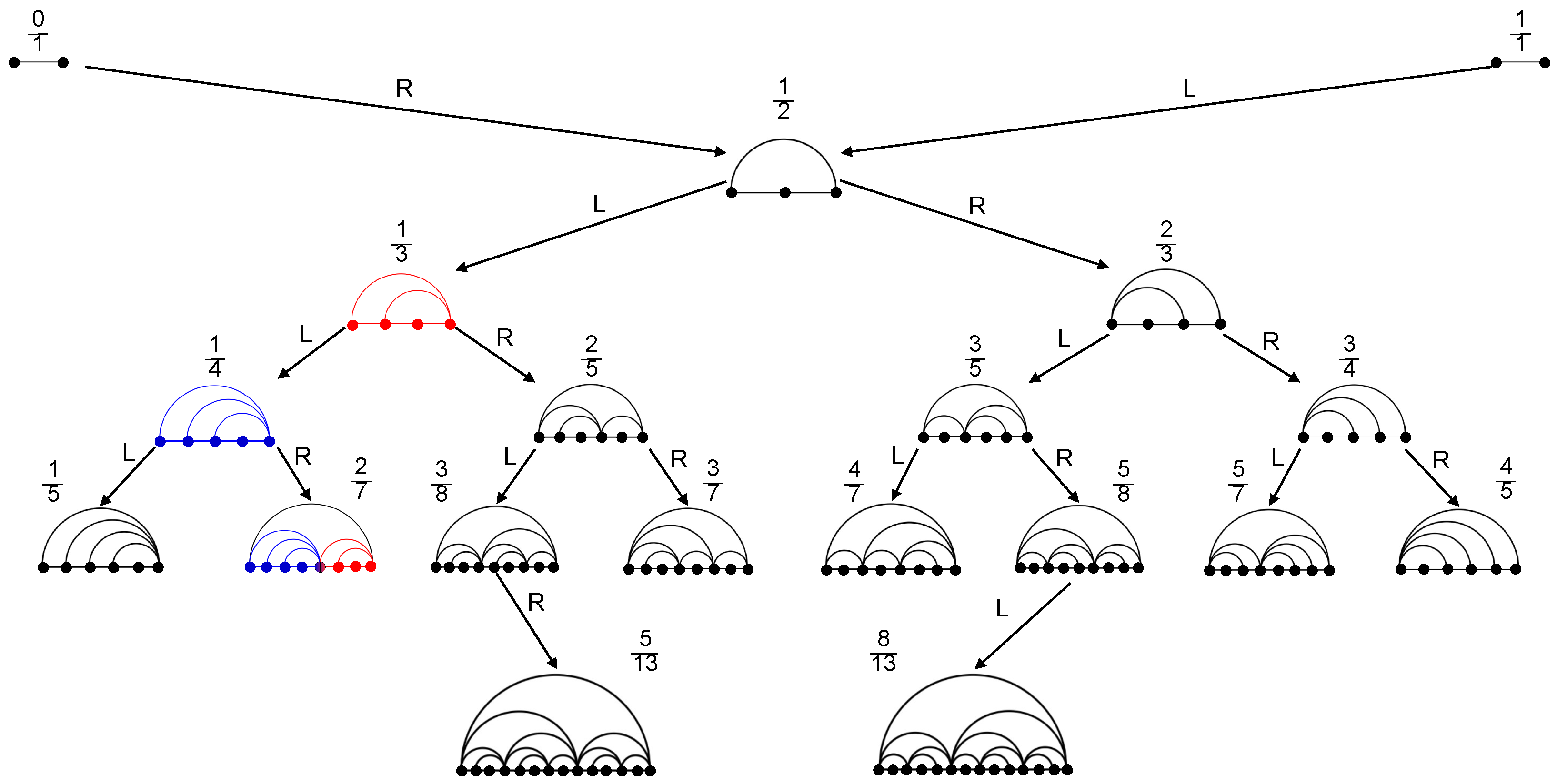
The Haros graph set is recursively generated from an initial graph (defined as two nodes joined by an edge) and the concatenation graph-operator ⊕ shown in Figure 1. Hence, the set may be represented as a binary tree (see Figure 1). Since , the bijection can be extended to the unit interval, where rational numbers are associated with finite Haros graphs, and irrational numbers correspond to infinite Haros graphs.
Figure 1.
Six levels of the Haros graph tree with Haros graphs associated with the corresponding rational fractions (due to space constraints, only two of these are shown at the sixth level). The first level is formed by two copies of the initial graph . The graph operator merges the two nearby extreme nodes, adding a connection to the resulting graph that connects the new extreme nodes. On the left, the Haros graph is generated by concatenating (blue) and (red), i.e., .
Consequently, a one-to-one correspondence exists between real numbers and Haros graphs . One of the main features investigated in [8] is the degree distribution of Haros graphs , which is the probability that a randomly selected node in has degree k. The degree distribution was deemed a fruitful tool because Haros graphs are uniquely determined by the degree sequence [16], whereas the degree distribution is a marginal distribution of the degree sequence. Indeed, the degree distribution for the three initial values of k confirms:
In contrast to the initial values, which are related to the real number x associated with , the closed form of the degree distribution has only been drawn for degrees . Taking the above fact into account, this paper outlines two theorems to complete the degree distribution expression, based on two distinct approaches. Initially, a complete description of is provided only in terms of the continued fraction of x or, alternatively, in terms of the Haros graph creation process codified along the symbolic binary path. The second result demonstrates the properties of as a continuous real-valued piecewise linear function.
This paper is separated into four sections. Section 2 gives a brief overview of Haros graphs and their connections to Farey sequences, continued fractions, and the Farey binary tree. Section 3 provides the two main results: the first theorem states the closed form of with respect to truncations of the continued fraction of , whereas a second theorem rewrites the preceding result using the position of in the Farey binary tree. Section 4 concludes the work. In addition, Appendix A includes detailed proofs for the assertions in Section 3.
2. Preliminaries
The Farey binary tree is a canonical way of representing the set of rational numbers in as a binary tree starting with the fractions —the elements of the Farey sequence —and creating new irreducible fractions by the mediant sum of two consecutive fractions in :
The binary tree representation allocates each rational number to a level k of the tree, denoted . For instance, the three first levels consist of:
This representation is closely related to the continued fraction, a powerful technique for representing a real number in the interval as
The relationship was presented in [7], and it has been established that a number with a continued fraction expression is associated with a symbolic binary path in the Farey binary tree , where is interpreted as a sequence of q symbols L (if the symbolic path is finite, the last symbol has an index ). Therefore, since every irrational number has an infinite continued fraction, the irrational numbers are reachable through an infinite path in the Farey binary tree. Moreover, the continued fraction allows a sequence of rational so-called convergents [6] defined as:
with initial values and , where
As stated in the preceding section, the Haros graphs set provides a graph-based representation of the unit interval . The primary objective is to reproduce, in a graph scenario, the mediant sum—described in Equation (2)—that was utilized to construct [1]. The concatenation graph is depicted in Figure 1, and Flanagan et al. [17] provide a comprehensive definition. Every Haros graph G (except for the initial graph) is therefore described as , where are also Haros graphs. However, just as the mediant sum only takes to two nearby fractions in Farey sequences, Haros graphs only can be concatenated if and are also adjacent.
In order to analyze the topological structure of a Haros graph, the probability distribution degree proves to be a useful instrument. Equation (1) identifies the three first values of k, although by construction . In addition, for degrees , Theorem 2, in [8], determines that the degree values for which rely on the symbol repetition— or —in the symbolic path of the Haros graph tree to reach . Moreover, the same research conjectures follow for the closed form of . The aim is to provide a formal proof of this claim.
Prior to this, a brief explanation of the emergence of degrees is provided: the emergence of degrees occurs if there is a change in symbol or in the path of the Haros graph tree. Consequently, the degree it emerges, or not, is related to the level at which this symbolic change occurs. Suppose that we have covered the path . Next, the downstream of generates a new degree, which had previously appeared as a boundary node before the shift in direction (the node resulting from the identification of the extreme nodes). Specifically, in the first downstream R, the degree appears in the merging node, and the number of nodes with this degree increases by one with each descent. Therefore, when we reach , there will be nodes of that degree. In addition, the Haros graph achieved is associated with .
Now, in order to reach the Haros graph associated with , we must descend to R and then times to L. If there were nodes of that degree previously, a new descent will result in nodes. Then, performing a descent requires concatenating the Haros graph reached by with copies of the Haros graph reached by , so that the resultant Haros graph has nodes of that degree.
In other words, the emergence of the degree occurs, according to the recursive equation , where the terms correspond to the continued fraction , with initial conditions . Hence, this recursive equation converges to the denominator of the continued fraction .
3. Main Results
The first presented result provides an explicit description of the degree distribution related to the truncations of the continued fraction of , the rational number associated with Haros graph :
Theorem 1.
Let , with . Then, the degree distribution of the Haros graph is:
Proof.
See Appendix A.1 for a complete proof. □
The theorem has several consequences: first, it unveils the whole expression for providing a large amount of topological information. Moreover, as stated in the previous section, the values are related to the continued fraction and, consequently, with the symbolic path reached in the Haros graph tree. In addition, the result reduces the computational cost for obtaining the degree distribution of the Haros graph . Initially, we observe that the denominator of the n-th convergent of verifies , where is the Golden number [18]. Hence, as the Haros graph has nodes, its growth is exponential, but Theorem 1 uses only continued fractions [3,19].
Let us illustrate an example: consider the Haros graph , where . Hence, the symbolic path in the Haros graph tree is (see Figure 2 for an illustration). Numerically, its degree distribution is as follows:
Figure 2.
Haros graph . As , it is clear that the binary symbolic path to reach this Haros graph is . According to the boundary node convention, the extreme nodes are identified as a single boundary node, while the total number of degrees is maintained. Then, the degree sequence is .
Then, we can verify that there are nodes of degree and that this number corresponds with the denominator of the continued fraction
moreover, there are nodes of degree , which is the denominator of the continued fraction
Lastly, corresponds with the degree of the boundary node; therefore, it only appears once.
With Theorem 1, we are able to provide a proof for the conjecture presented in [8]. Contrary to the previous finding, the subsequent theorem results in a formulation of the degree distribution relating to the number x, but the computation of for every k depends on the location of x in the subintervals given by the levels in the Farey binary tree .
Theorem 2.
Let and the associated Haros graph . Let us consider , and ; clearly, we have :
Therefore, the degree distribution of the Haros graph for degrees is:
Proof.
See Appendix A.2 for a complete proof. □
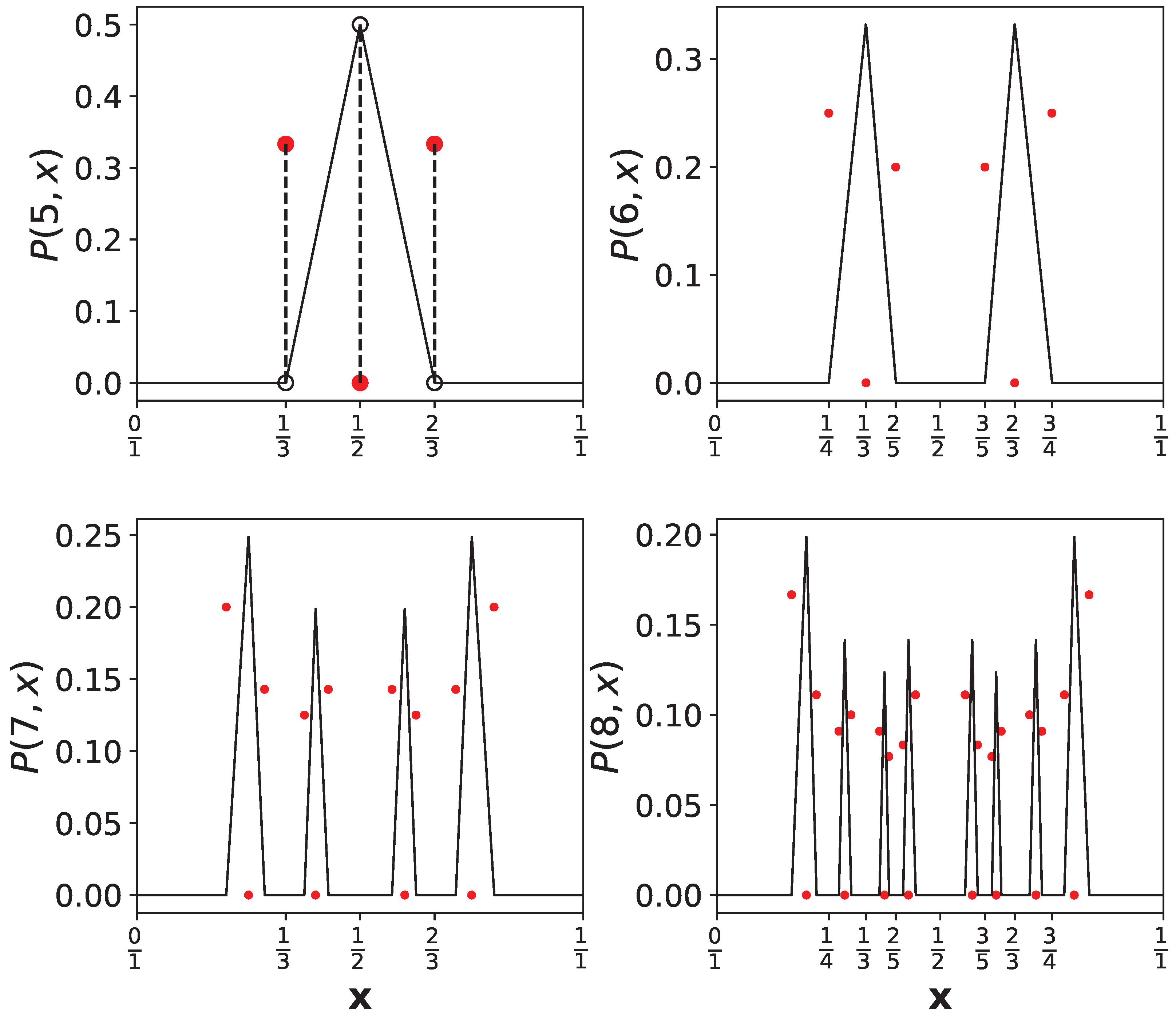
The theorem can be extended from rational numbers to all real numbers. Figure 3 depicts a numerical computation of for the first values of verifying the statement of Theorem 2. Moreover, this new formulation allows the following statement to emphasize some aspects of the degree distribution as a real function over the variable x:
Figure 3.
The numerical computation of the degree distribution as a function of x for , and for all Haros graphs with . The red points represent removable discontinuities, whereas the solid black lines shows the piecewise linear behavior. Due to the lack of space, only the left upper panel of accurately shows that the red points represent the Haros graph located in levels , for , i.e., the Haros graph (without nodes of degree ), and for , i.e., the Haros graphs , where the degree is located at the boundary node.
Corollary 1.
The degree distribution over the variable x is a piecewise linear and continuous function, with the exception of the measure null set.
Now, let us illustrate the theorem by applying the result to the case when . Then, it is a simple matter to confirm that if , then
In comparison, the continued fractions of rational numbers start with the term . In virtue of Theorem 1, the degree would have a frequency of , where is the denominator of . Let us examine how the two expressions coincide:
Hence, is the denominator of the continued fraction according to Theorem 1. This finding may be generalizable to all degree values k, requiring the partition of by the levels and .
4. Conclusions
The topological properties of rational Haros graphs were investigated in detail. The full formulation of the degree distribution of a Haros graph was demonstrated. Different methods were used to prove two theorems. The first theorem unveiled the closed form of obtained by truncations of the continued fraction of x. With this result, not only did we obtain the complete expression of the degree distribution, but we also computed it more efficiently. The second theorem provided a piecewise linear and continuous expression of , except for a measure null set. This result confirmed a conjecture presented in [8] revealing that the degree distribution exhibited a self-similar behavior related to the subintervals defined by Farey fractions.
Funding
The author acknowledges funding from the Spanish Ministry of Science and Innovation under project M2505 (PID2020-113737GB-I00).
Data Availability Statement
Not applicable.
Acknowledgments
I am grateful to Bartolomé Luque and Lucas Lacasa for their guidance and advice.
Conflicts of Interest
The author declares no conflict of interest.
Appendix A
Appendix A.1. Proof of Theorem 1
Proof.
The values are calculated in (1), while the value corresponds to the degree of the boundary node, which has a frequency of 1 according to the the results of Appendix B in [8].
Let us consider the Haros graph , with . Thus, the symbolic path in the Haros graph tree is , with or depending on whether m is odd or even, respectively. In virtue of Theorem 2 presented in [8], it can be determined that nonzero values of the degree distribution correspond to the degrees for the values . It remains, however, to determine its precise value. To accomplish this, we conduct an induction exercise on the levels of the Haros graph tree :
At level , the first Haros graph with degree is associated to proving that
the value of the denominator of the continued fraction . This level also includes the Haros graph , which fulfils the theorem because it contains only the boundary node with degree .
We assume the result holds for all levels of the Haros graph tree , with . Let us verify that it is satisfied at level . To accomplish this, we consider an arbitrary Haros graph at level n, where . Henceforth, we demonstrate that both its left and right descendants satisfy Equation (4).
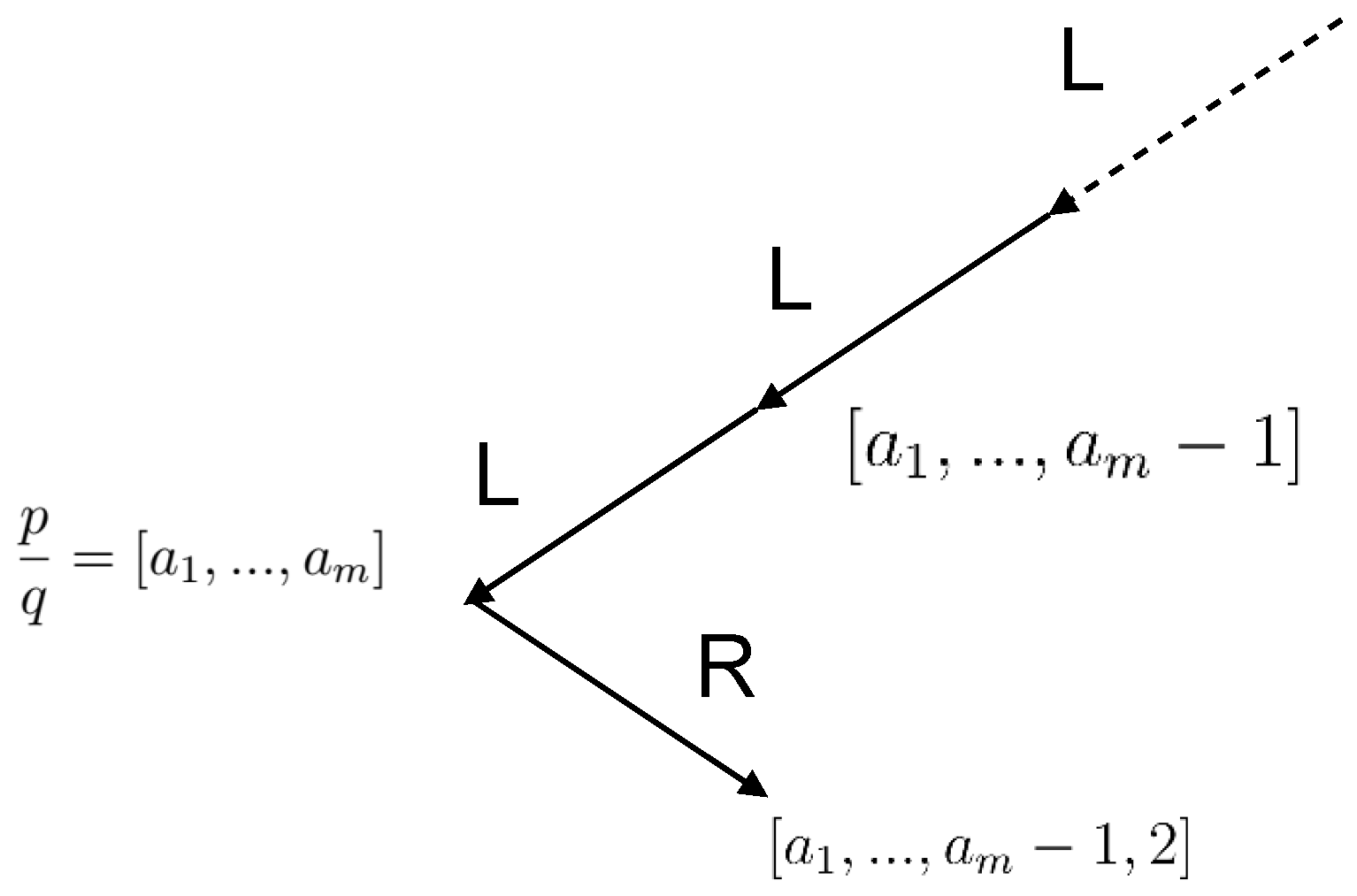
Let us suppose, without loss of generality, that the last descents that result until we reach are left descents L, as seen in Figure A1. Moreover, Cvitanovic et al. [20] showed that if , then its left descendant is expressed in a continued fraction as , whereas the right descendant has a continued fraction expression .
Figure A1.
Diagram of the descendants of the Haros graph , with . Let us suppose that the Haros graph contains a symbolic path that terminates in descents to the left L (the result is analogous for descents to right R). The continued fraction for the left descendant of the Haros graph is , whereas the right descendant has a continued fraction .
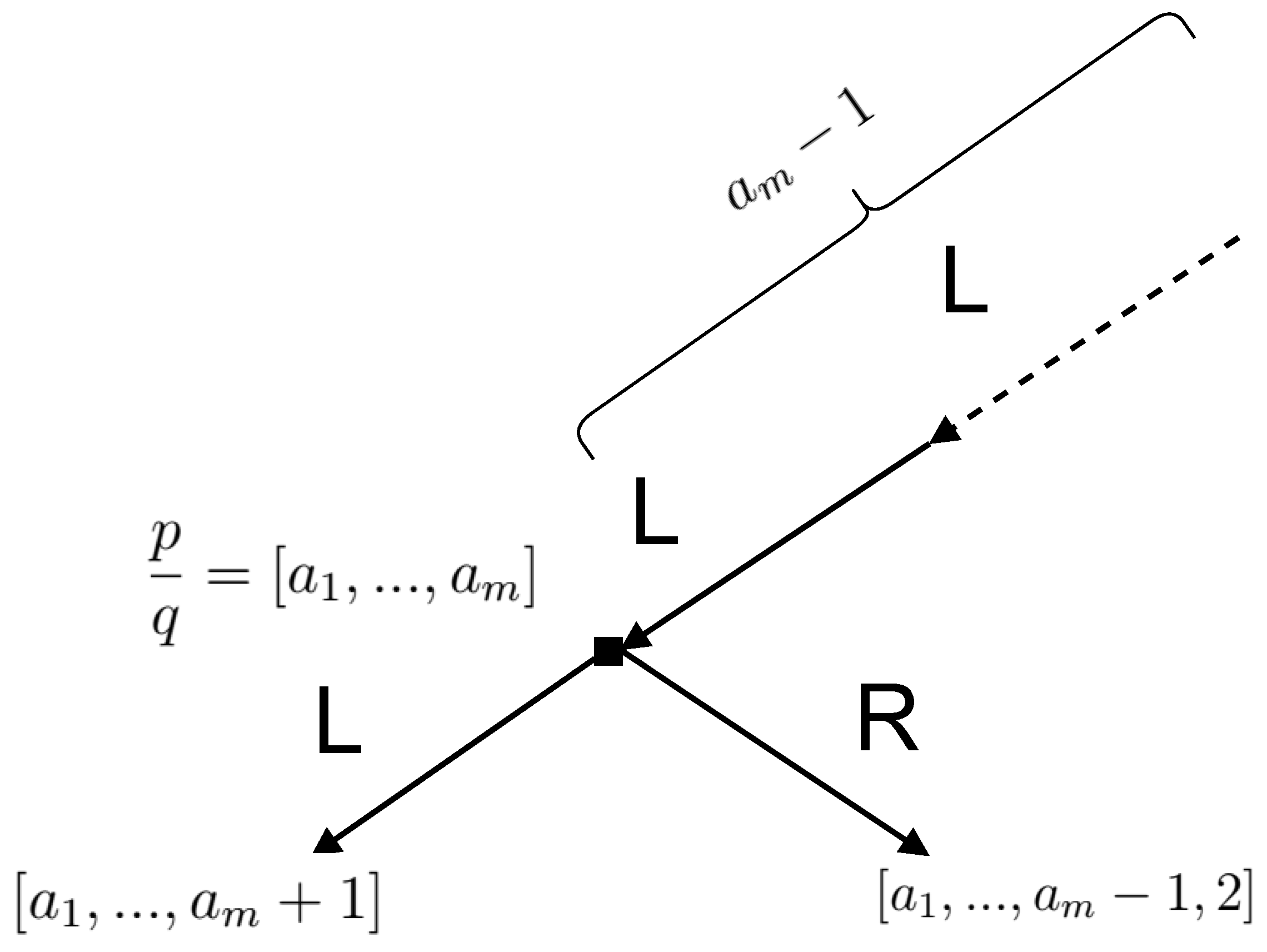
Let us start by dealing with the left descendant. This case is depicted in Figure A2, which illustrates how this descendant is formed by concatenating the convergent of order of with itself. By setting a value , we will be in the degree . Now, it is clear that the number of nodes with degree in the left descendant is equal to the total of the number of nodes with that degree in its two ascendants and .
Figure A2.
Diagram of the construction for the left descendant of , where . The left descendant is expressed as and is obtained by concatenating and , where is the convergent of order of .
By induction hypothesis, the denominators of the continued fractions are the number of nodes of degree of its ascendants, denoted by and , respectively. Hence, we have:
and
This notation also reflects that the term of Equation (A2) is the previous convergent of Equation (A1). The recursivity of the continued fractions (shown in Equation (3)) entails:
Denoting by the number of nodes with degree in the left descendant, we obtain the conclusion that:
where the right-hand side of Equation (A4) is the denominator of the continued fraction , as we aimed to demonstrate.
The value is required to complete the study of the left descendant; therefore, it is necessary to check the result for the degree . The reason for separate consideration is that does not contain the degree . Nonetheless, this degree first appears at the level of the Haros graph tree, i.e., as the boundary node of the right descendant of . The number of nodes with that degree will increase by one with each successive left descent until the Haros graph is reached. Moreover, the induction hypothesis applied to determines that there are nodes of this degree, i.e., the denominator of
Therefore, there will be nodes, or equivalently, there will be nodes of this degree. This number is the denominator of the truncated continued fraction , thus finishing the study of the left descent.
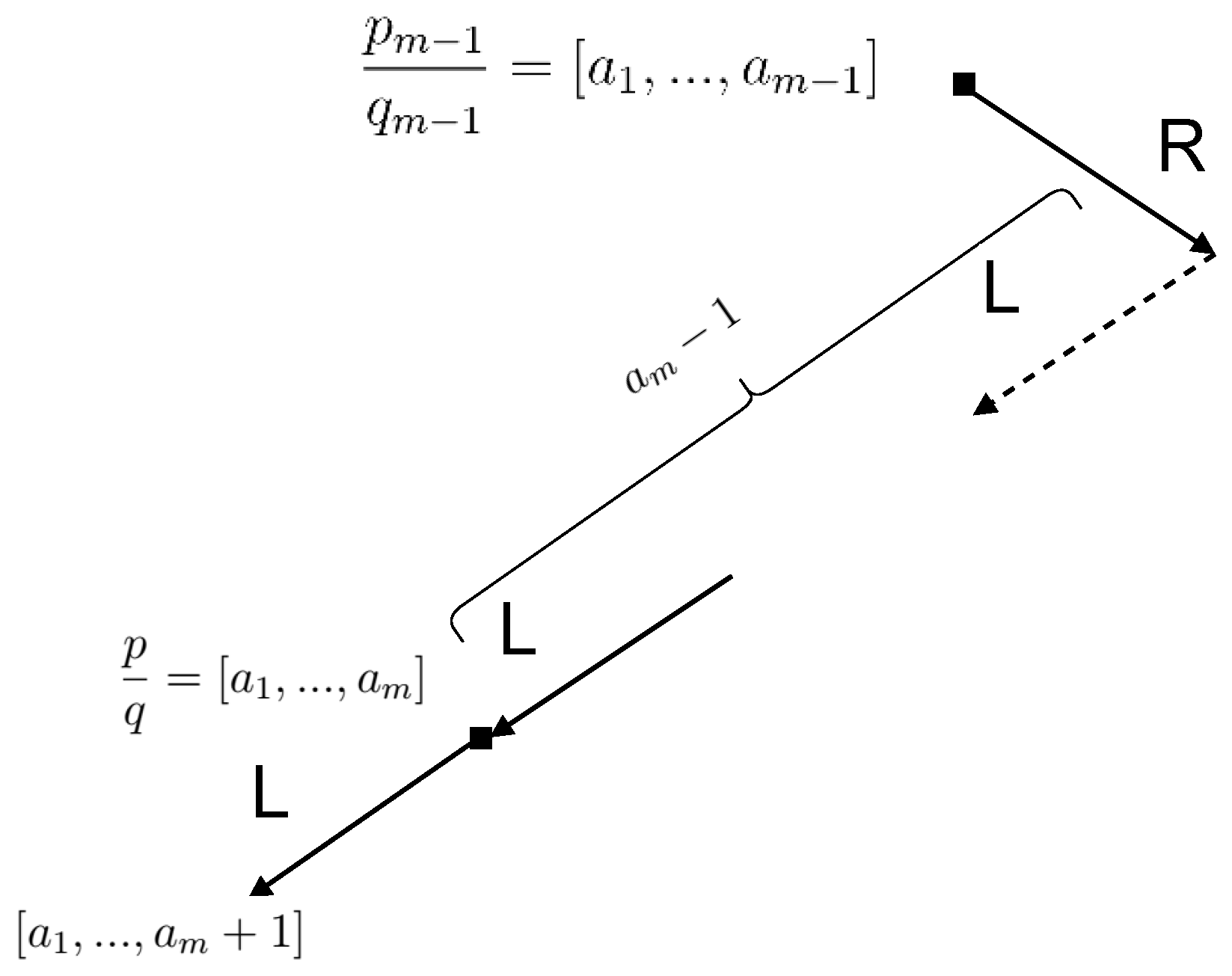
Let us now turn our attention to the right descendant, depicted in Figure A3. In this instance, the concatenation occurs between the Haros graph and its right ancestor, i.e., the Haros graph associated with the continued fraction .
Figure A3.
Diagram of the construction for the right descendant of , where . The right descendant is expressed as and is obtained by concatenating the Haros graphs and , where is the -th convergent of .
Let us consider the degrees , with . The right descendant is obtained by concatenating , where . Therefore, we must represent the truncations of and , as well as their convergents, which are indicated as follows:
and
It is easy to show that the continued fractions in Equations (A5) and (A6) match in all the terms with the exception of the last one; hence, all the denominators of the convergent with , we verify that . Using the induction hypothesis, the recursive Equation (3) for the convergent, and denoting by the number of nodes of degree in the right descendant, we have:
where the right-hand side of Equation (A7) is the denominator of the truncated continued fraction . Finally, the right descent has a single node with degree
This is the merging node obtained by the concatenating the extreme nodes of and , in agreement with the denominator of the last truncated right descendant, which is , thereby ending the proof. □
Appendix A.2. Proof of Theorem 2
In order to demonstrate the result, we must introduce the continuants, recursively defined polynomials stated by Euler, where:
The continuants allow us to express the continued fractions as
In addition, two properties of the continuants must be introduced. The first generalizes the definition (A8) , with as follows:
The second equality was established by Muir and Metzler in [21]:
Proof.
The intervals, where the degree distribution , are determined by the elements , i.e., the Farey fractions of a certain level in the Farey tree, and their descendants located at a lower level . Let us first establish that
then, if r is even, we obtain
whereas for r odd we have:
Let us suppose, without loss of generality, the case r odd, and consider a rational number
Then, the first r terms of the continued fraction are determined as follows:
Furthermore, if , then . Let us verify that the numerator of the expression stated in Theorem 2 and the term stated in Theorem 1 have the same value for the degree . Hence, applying the continuant expression in Equation (A9) to and (described in Equation (A12)), and the property presented in Equation (A10), we obtain:
Using the definition (A8) for , we obtain:
and applying the Equation (A11), we obtain the following value for the first bracket in Equation (A14):
In addition, for the second bracket in Equation (A14), we have:
Therefore, Equation (A14) is simplified as follows:
where the right-hand side is:
i.e., it is the denominator of the truncated continued fraction , as we aimed to demonstrate. Observe that if r is even, has a continued fraction expression , and the argumentation would be valid with the opposite sign .
It remains to verify the result for rational numbers:
In that case, the first r terms of the continued fraction of are determined as:
Reproducing the scheme of the demonstration in the last case, we obtain
Using the definition (A8) for , we have:
The first bracket in Equation (A18) is now:
In addition, the second bracket requires the following equality:
resulting in:
Thus, Equation (A18) is simplified as:
i.e., it is the denominator of the continued fraction , or equivalently, for , as we want to demonstrate. To conclude, if r is even, then , and changing the sign to equality results in equivalent reasoning. □
References
- Hardy, G.H.; Wright, E.M.; Heath-Brown, D.R.; Silverman, J.H. An Introduction to the Theory of Numbers, 6th ed.; Oxford University Press: Oxford, UK, 2008. [Google Scholar]
- Niqui, M. Exact arithmetic on the Stern-Brocot tree. J. Discret. Algorithms 2007, 5, 356–379. [Google Scholar] [CrossRef]
- Vuillemin, J. Exact real computer arithmetic with continued fractions. In Proceedings of the 1988 ACM Conference on LISP and Functional Programming, Snowbird, UT, USA, 25–27 July 1988; pp. 14–27. [Google Scholar]
- Angell, D. Irrationality and Transcendence in Number Theory; Chapman and Hall/CRC: Boca Raton, FL, USA, 2022. [Google Scholar]
- Adamczewski, B.; Bugeaud, Y. On the complexity of algebraic numbers, II. Continued fractions. Acta Math. 2005, 195, 1–20. [Google Scholar] [CrossRef]
- Khinchin, A.Y. Continued Fractions; Translated from the Third (1961) Russian Edition. Reprint of the 1964 Translation Edition; Dover Publications: New York, NY, USA, 1997. [Google Scholar]
- Bonnano, C.; Isola, S. Orderings of the rationals and dynamical systems. Colloq. Math. 2009, 116, 165–189. [Google Scholar] [CrossRef]
- Calero-Sanz, J.; Luque, B.; Lacasa, L. Haros graphs: An exotic representation of real numbers. J. Complex Netw. 2022, 10, cnac043. [Google Scholar] [CrossRef]
- Lacasa, L.; Luque, B.; Ballesteros, F.; Luque, J.; Nuño, J.C. From time series to complex networks: The visibility graph. Proc. Natl. Acad. Sci. USA 2008, 105, 4972–4975. [Google Scholar] [CrossRef] [PubMed]
- Luque, B.; Lacasa, L.; Ballesteros, F.J.; Robledo, A. Feigenbaum Graphs: A Complex Network Perspective of Chaos. PLoS ONE 2011, 6, 1–8. [Google Scholar] [CrossRef] [PubMed]
- Luque, B.; Lacasa, L.; Ballesteros, F.J.; Robledo, A. Analytical properties of horizontal visibility graphs in the Feigenbaum scenario. Chaos Interdiscip. J. Nonlinear Sci. 2012, 22, 013109. [Google Scholar] [CrossRef] [PubMed]
- Núnez, A.M.; Luque, B.; Lacasa, L.; Gómez, J.P.; Robledo, A. Horizontal visibility graphs generated by type-I intermittency. Phys. Rev. E 2013, 87, 052801. [Google Scholar] [CrossRef] [PubMed]
- Jones, G.A.; Singerman, D.W.K. The modular group and generalized Farey graphs. Groups St. Andrews 1989 1991, 2, 316. [Google Scholar]
- Kurkofka, J. The Farey graph is uniquely determined by its connectivity. J. Comb. Theory Ser. B 2021, 151, 223–234. [Google Scholar] [CrossRef]
- Kurkofka, J. Ubiquity and the Farey graph. Eur. J. Comb. 2021, 95, 103326. [Google Scholar] [CrossRef]
- Luque, B.; Lacasa, L. Canonical horizontal visibility graphs are uniquely determined by their degree sequence. Eur. Phys. J. Spec. Top. 2017, 226, 383–389. [Google Scholar] [CrossRef]
- Flanagan, R.; Lacasa, L.; Nicosia, V. On the spectral properties of Feigenbaum graphs. J. Phys. A Math. Theor. 2019, 53, 025702. [Google Scholar] [CrossRef]
- Tsigaridas, E.P.; Emiris, I.Z. Univariate polynomial real root isolation: Continued fractions revisited. In Proceedings of the European Symposium on Algorithms, Zurich, Switzerland, 11–13 September 2006; Springer: Berlin/Heidelberg, Germany, 2006; pp. 817–828. [Google Scholar]
- Welch, L.; Scholtz, R. Continued fractions and Berlekamp’s algorithm. IEEE Trans. Inf. Theory 1979, 25, 19–27. [Google Scholar] [CrossRef]
- Cvitanovic, P.; Shraiman, B.; Söderberg, B. Scaling laws for mode lockings in circle maps. Phys. Scr. 1985, 32, 263. [Google Scholar] [CrossRef][Green Version]
- Muir, T.; Metzler, W.H. A Treatise on the Theory of Determinants; Courier Corporation: New York, NY, USA, 2003. [Google Scholar]
Disclaimer/Publisher’s Note: The statements, opinions and data contained in all publications are solely those of the individual author(s) and contributor(s) and not of MDPI and/or the editor(s). MDPI and/or the editor(s) disclaim responsibility for any injury to people or property resulting from any ideas, methods, instructions or products referred to in the content. |
© 2022 by the author. Licensee MDPI, Basel, Switzerland. This article is an open access article distributed under the terms and conditions of the Creative Commons Attribution (CC BY) license (https://creativecommons.org/licenses/by/4.0/).