1. Introduction
Human immunodeficiency virus (HIV) is an infectious disease that attacks the body’s immune system, reducing humoral immunity and destroying the body’s ability to fight off certain infections and other diseases [
1]. Research has shown that HIV is widely found in the blood, semen, vaginal secretions, saliva, urine, cerebrospinal fluid and brain tissue of the HIV-infected population. Therefore, the most common mode of transmission is sexual intercourse with HIV-infected people, followed by mother-to-child infection, sharing drug-injecting equipment, and via contaminated blood or instruments in healthcare settings [
2]. The symptoms of HIV vary depending on the stage of infection. Though people living with HIV tend to be most infectious in the first few months after being infected, many are unaware of their status until the later stages. In the first few weeks after initial infection, people may experience no symptoms or an influenza-like illness, including fever, headache, rash or sore throat. As the infection progressively weakens the immune system, they can develop other signs and symptoms, such as swollen lymph nodes, weight loss, fever, diarrhea and cough. Acquired immune deficiency syndrome (AIDS) refers to the most advanced stages of HIV infection, defined by the occurrence of any of more than 20 opportunistic infections or related cancers. By the end of 2020, there were still 1.053 million people living with HIV (PLWH), with a cumulative reported death toll of 351,000 in China, and the epidemic continues to spread. AIDS remains a primary public health problem and a major cause of death [
3]. At the same time, statistics show that the proportion of heterosexual and homosexual transmission increased from
and
in 2009 to
and
in 2020, respectively, whereas the proportion of HIV transmission by injection drug user (IDU) declined substantially from
in 2009 to less than
in 2020 [
4]. The alarming data remind us of the need to pay special attention to the mode of sexual transmission during HIV/AIDS transmission and to control it effectively.
Mathematical models have been widely used in epidemiological studies to improve the understanding of the mechanisms of the transmission of infectious diseases. The mathematical modeling of HIV/AIDS based on the dynamics of infectious diseases can be traced back to the 1980s, especially from 1986 to 1989, when Blythe, Anderson, May et al. established some HIV/AIDS transmission models in the form of ordinary differential equations based on the transmission mechanism of HIV/AIDS among gay people in Britain and the United States [
5,
6,
7,
8,
9] and obtained a series of important research results, which laid a foundation for AIDS dynamic modeling. May and Anderson [
10] proposed a dynamical model of the transmission of HIV/AIDS, and discussed the relationship between epidemiological parameters, such as eventual fraction infected, incubation period, mortality and heterosexual transmission rate in an epidemic of HIV and the basic reproduction number. In recent years, works on HIV/AIDS models have progressed considerably, with more factors influencing the spread of the disease being added to mathematical models. For instance, Tripathi et al. [
11] proposed a non-linear mathematical model to study the effect of screening of unaware infectives on the spread of HIV/AIDS in a homogeneous population, and dynamical analysis showed that the screening of unaware infectives reduces the spread of this disease. In Refs. [
12,
13,
14], scholars concerned about the role of education in the HIV/AIDS transmission models found that public health education campaigns can reduce the basic reproduction number to values below unity as intended for disease control and thus would succeed in eliminating this disease.
In traditional epidemic models, the assumption of homogeneity is applied to these populations in the same region, ignoring the fact that individuals in the same class may also behave differently. However, in the real world, these heterogeneities are one of the factors that contribute to the outbreak or frequency of infectious diseases. On the one hand, the spread of an infectious disease may elicit behavioral responses from susceptible people who try to protect themselves and thus reduce the impact of this disease on them. From the perspective of mathematical modeling, Funk et al. [
15] developed and analyzed an epidemic model with a sense of protection, which suggested that self-protection awareness prevents the disease from developing into an epidemic in cases where the infection rate is below the threshold. Recently, epidemic models dividing susceptible individuals into those who are self-protective and those who are not have been widely discussed, see for example [
16,
17,
18,
19] and the references therein. In particular, Musa et al. [
19] proposed an epidemic model to study the impact on transmission of coronavirus disease (COVID-19), and the results indicated that raising the level of awareness of the population through effective enlightenment can significantly reduce infectiousness. On the other hand, in the process of disease transmission and control, seemingly ‘healthy individuals’ who are infected can transmit the virus, i.e., asymptomatic virus carriers induce the complexity of disease transmission. Gaeta et al. [
20] formulated a SIR model with a large set of asymptomatic individuals, and drew conclusions that not taking into account the presence of a large set of asymptomatic individuals would give the wrong estimate of very relevant quantities, such as the need for hospital beds and the time to the epidemic peak. Hu et al. [
21] constructed a compartmental model to simulate the transmission of COVID-19 among wild animal host, human population, and the environment, in which the infected class is divided into the asymptomatic infected class and symptomatic infected class according to individual differences, and obtained the moment when the number of infected individuals increases to a peak in the human population-only model with blocking migration and environment. Similarly, considering the asymptomatic infection facilitates the rapid dissemination of COVID-19, the infected individuals are divided into asymptomatic and symptomatic, Sintunavarat et al. [
22] developed a fractional-order extended SEIR model of COVID-19, and analyzed the population’s dynamics by using the fractional operator.
Chronological age is a heterogeneity characteristic of all individuals in the population and the impact on disease transmission varies greatly among people of diverse ages and infection rates for various diseases, such as HIV/AIDS, Hepatitis B (HB), pertussis and pneumococcal, which change gradually with age. Capturing this feature, the introduction of chronological age in modeling the transmission of infectious diseases has received widespread attention [
23,
24,
25,
26]. In particular, Zou et al. [
27] proposed and studied an age-structured model for the transmission dynamics of Hepatitis B in which the population is stratified by age; theoretical analysis and numerical simulation results show that the optimal control strategy is a combination of immunization of newborns and retroactive immunization of susceptible adults. In [
28], Wang et al. modeled an age-structured pertussis model with multiple infections during a lifetime and presented the analysis including existence and stability of steady states, and discussed the impact of three infections on the transmission of this disease. Since the elderly and young children are more susceptible to pneumococcal infections, Sutton et al. [
29] studied an age-structure model of pneumococcal infection, and discussed the effects of targeting the colonization and infection stages on the age profiles of morbidity in a population.
Modern society is the era of information explosion. There is no doubt that media coverage also plays an integral role in the spread of infectious diseases. In this time, people can learn the situation about diseases from media reports, resulting in some changes in susceptible individual behaviors and a reduction in the probability and frequency contacts [
30,
31]. Particularly, Cui et al. [
32] proposed a SEI (susceptible–exposed–infected) model to investigate the impact of media coverage for the spread and control of SARS (severe acute respiratory syndrome), in which the effective contact rate is
(where
I denotes the quantity of infected individuals), to describe the influence of media reports coefficient
m on human behavior. In addition, some references also characterized the impact of media coverage by introducing a new state variable
M to measure [
33,
34,
35]. Zhang et al. [
34] proposed and analyzed a TB (tuberculosis) model with fast and slow progression and media coverage, where media information is set up as a separate compartment. Conclusions show that media coverage can encourage people to take measures to avoid potential infections and control the spread of TB. Pawelek et al. [
35] assumed that the disease transmission
was reduced by a factor
due to the behavior change of the public after reading tweets about influenza, where
determined how effectively the disease information could influence the transmission rate. As mentioned in [
36], mass media, such as newspapers and television programs, play a critical role in disseminating information about HIV/AIDS to the general public, and health agencies use mass media to raise awareness about the disease. Enhancing collaboration between health educators and the media can be an important strategy for disseminating HIV/AIDS knowledge. Therefore, it is more relevant to consider the influence of media coverage in the HIV/AIDS transmission model.
Motivated by the above debates, we introduce a hybrid HIV/AIDS model with age-structured, self-protection and media coverage to discuss the impact of these factors on the spread of HIV/AIDS. The remainder of this paper is organized as the following. In
Section 2, we briefly describe and formulate this model as a mixed PDEs-ODE system.
Section 3 is devoted to the existence of the unique, bounded and positive flow associated to the hybrid system. In
Section 4, the basic reproduction number
is determined, and the existence of steady states is established.
Section 5 and
Section 6 describe the stability of steady states and the uniform persistence of the disease, respectively. The numerical simulations are conducted to explain the main results in
Section 7, and a brief conclusion is provided in the last section.
2. Model Formulation and Preliminaries
The total population is divided into five classes: unprotected susceptible class, protected susceptible class, asymptomatic or undetected HIV-infectious class, symptomatic or confirmed HIV-infectious class and AIDS class. Their numbers at time
t with age
a are denoted by
,
,
,
and
, respectively. Assuming
,
, where
denotes the maximal age of human. The age-dependent numbers of the total population are
. It is supposed that AIDS patients do not touch susceptible people due to the severity of its symptoms. Then, we take the force of infection as the separable intercohort constitutive form (see Ref. [
37])
where
and
are the age-specific per-capita contact rate corresponding to asymptomatic infectious and symptomatic infectious, respectively;
is the age-specific probability of becoming infected through contact with HIV-infected individuals of age
a. Further, let
denote the amount of media coverage, measured possibly by the time exposure to TV, internet and radio advertising for the HIV/AIDS at time
t. It is assumed that positive parameter
determines how effectively the disease-related media messages can influence the infection force and the infection force
is reduced by a factor
(see Refs. [
34,
35]), thus
.
The athe bove basic assumptions derive the epidemiological model for the transmission of HIV/AIDS, which can be developed by a PDEs-ODE coupled system as
with the boundary conditions
and the initial conditions
.
The meanings of model parameters are as follows:
implies that the protected susceptible individuals actively reduce contact with HIV-infected;
and
are age-specific fertility and mortality which are supposed to not be affected by the disease;
is the age-specific rate at which unprotected susceptible individuals become aware about the disease and take protective measures due to education; asymptomatic or undetected infected individuals become symptomatic or confirmed infected because of HIV testing at an age-specific rate
, and humans with symptomatic infections develop AIDS at an age-specific rate
; and
measures the amount of media coverage is proportional to the number of symptomatic or confirmed HIV-infectious and AIDS patients reported by the media and
is the rate that message become outdated. Furthermore, according to the biological significance of model (
1), the following assumptions are made for these parameters:
- ()
, , where as the space of all essentially bounded and positive functions, which are Lebesgue-integrable, as the space of all essentially bounded and positive functions which are locally Lebesgue-integrable, and . , for , and all these functions are extended by zero outside of the interval .
- ()
The non-negative initial age functions , all age-specific parameters , , , , , belong to , while , and are positive constants.
- ()
is also called the contagion rate which measures the influence of the HIV-infected class upon the susceptible class and satisfies conditions: and in the age interval .
Summing up the first to the fifth equations of model (
1), the total population
is
which is the standard age-structured Mckendrick–Von Foerster equation (see Ref. [
38]). Therefore, the steady state of model (
2) satisfies
whose solution yields
. Then, it is straightforward to obtain that the net reproduction number of the population is equal to unity, i.e.,
. Solving model (
2) along the characteristic curve
(for more details, see Ref. [
39]), one has
From
and the population reaching its steady state (see Ref. [
40]), then
Let
; by integrating both sides of (
3) from 0 to
, one has
Instead of model (
1) throughout this article and working with the normalized model, we make the following transformations:
then model (
1) becomes
with the boundary conditions
and the initial conditions
where
Integrating the first five equations in (
4) along the characteristic line
, one has
3. Well-Posedness
Since variable
is time-dependent only, it can be solved by using the constant variation formula, that is,
As a result, model (
4) is rewritten as the following PDEs with (
5) and (
6),
Let
,
,
,
,
Thus, system (
13) can be written as
In order to consider the existence and uniqueness of solution of system (
14), we reinterpret (
14) as the flow determined by a semigroup on Banach space
with norm
for
, where
. Let
be defined by
for
, where
,
denotes the Sobolev space of all absolutely continuous functions on
.
Clearly,
is an unbounded linear operator on
X (see Ref. [
41]). Therefore, under the operation of the operator
defined above, system (
14) can be formulated as a semilinear Cauchy problem on
Before giving the main results, we first derive the following lemma.
Lemma 1. If assumptions and are satisfied, then we have the following:
The operator generates a contraction semigroup on X;
The nonlinear operator is continuous in t and uniformly Lipschitzian in .
Proof. Conclusion (i) can be obtained directly from Theorem 5 on page 421 in Ref. [
41]. Now, we focus on conclusion (ii). It is clear that
is continuous on
t for
. Let
, where
. For
,
Hence g is uniformly Lipschitz-continuous in . This completes the proof. □
Regarding the existence and uniqueness of the solution of system (
15), there is the following theorem.
Theorem 1. If assumptions and are satisfied, then the Cauchy problem (
15)
admits a unique classical solution on , which is given by Proof. X is a Banach space and
, then Lemma 1 tells us
g is a Lipschitz-continuous operator from
into
X. According to the Corollary 2.4.3 in Ref. [
42], the function
given by (
16) is a unique classical solution to problem (
15) on
. □
Next, we give some basic properties of this solution (
16).
Lemma 2. The solution Φ given by (16) is bounded. Proof. Since
,
is a contraction semigroup on
X, then
. Thus, according to (
16),
for all
, where
. The proof is completed. □
Let be a positive cone of X, in other words, is a closed convex subset of X satisfying the following two properties: if , for all , then ; and , then .
Theorem 2. If , then for , where is the solution of (
15).
Proof. Firstly, we show that
,
, is a positive semigroup. Since
,
is a contraction semigroup, one has
, where
is the resolvent set of
. For all
, the resolvent operator
can be defined by
, with
where
I represents the unit matrix and
Thus,
, for all
, and then
is resolvent-positive. Consequently,
,
, is a positive semigroup.
Secondly, we need to show that system (
15) admits a solution
,
of the form (
16) when
. Since
g is not positive on
, we cannot claim that the solution (
16) is non-negative when
. Hence model (
15) is written in the equivalent form
where
to be determined. It is clear that for each
,
generates a contraction semigroup
,
. Furthermore, for each
,
is resolvent-positive, namely, for all
,
. Consequently,
,
is a positive semigroup. It is easy to see that for any
, there exists
such that
, where
. Then the solution corresponding to (
17) is given by
and it is non-negative obviously when
. The proof is completed. □
Therefore, model (
4) with (
5) and (
6) has a unique positive global solution with respect to the positive initial conditions and can be concluded by the following theorem.
Theorem 3. If assumptions and are satisfied, then model (4) with (5) and (6) admits a unique bounded solution on . This solution is positive when . Proof. Theorem 1 and Lemma 2 respectively prove the existence, uniqueness, and boundedness of the solution of system (
13). Theorem 2 states that the solution of system (
13) is positive for
. Then, from expression (
12), we further have the existence, uniqueness, boundedness and positivity of
for
. In summary, model (
4) with (
5) and (
6) admits a unique bounded solution on
, and this solution is positive when
. □
Finally, let
and define the state space for model (
4) with (
5) and (
6) by
where
denotes the total population size.
7. Numerical Simulations and Discussion
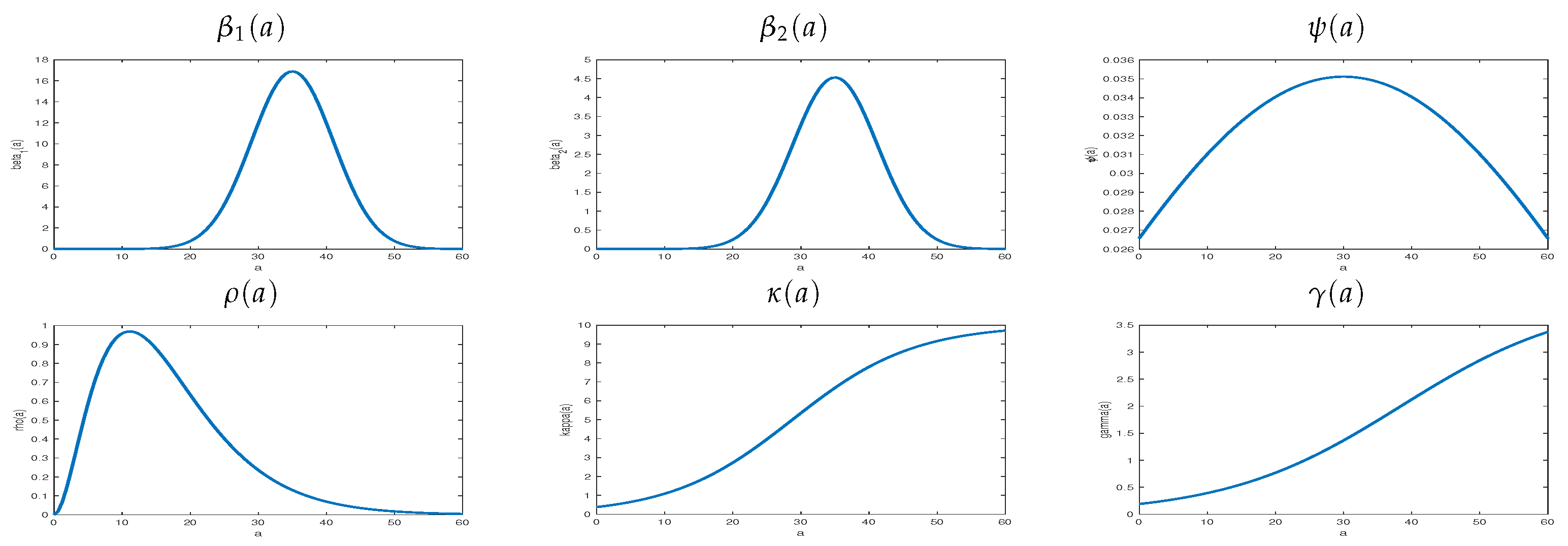
In this section, some numerical simulations are conducted to illustrate our theoretical analysis results as well as the influence of education campaigns and media coverage factors on the spread of HIV/AIDS by the finite difference method of characteristics through MATLAB. Considering the age heterogeneity of HIV/AIDS transmission, that is, HIV/AIDS transmission is mainly among young adults aged
(unit is
), then we assume that age-specific contagions take the form as normal distribution
and fix the age-specific probability of becoming infected through contact with infectious individuals for
In addition, suppose that unprotected susceptible individuals become aware about the HIV/AIDS and take protective measures only due to learning about related knowledge education in school, thus
, where
. Disease progression rates, including the rate of undiagnosed individuals to confirmed
and the rate
of confirmed to AIDS, are all in the form
, where
,
. The images of these model parameters are given by
Figure 1.
Example 1. The global asymptotical stability of the disease-free steady state of model (
4).
Model parameters are chosen as follows:
,
,
,
,
,
,
. Let
,
,
,
in the expression (
36),
in the expression (
37). By numerical calculations, we obtain the basic reproduction number
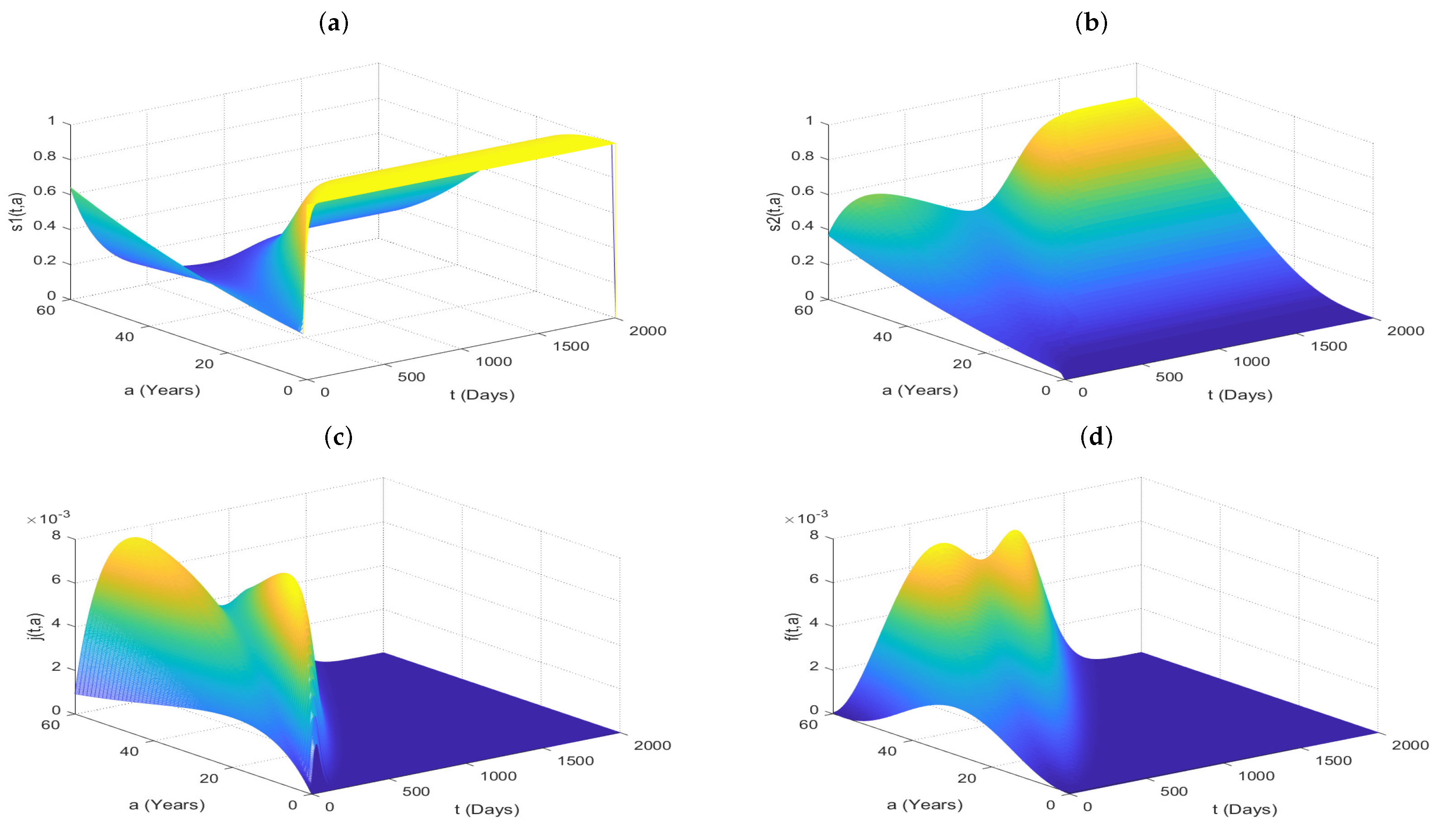
. The plots in
Figure 2a–d show the theoretical result that disease-free steady state of model (
4) is globally asymptotically stable. In particular, the plots in
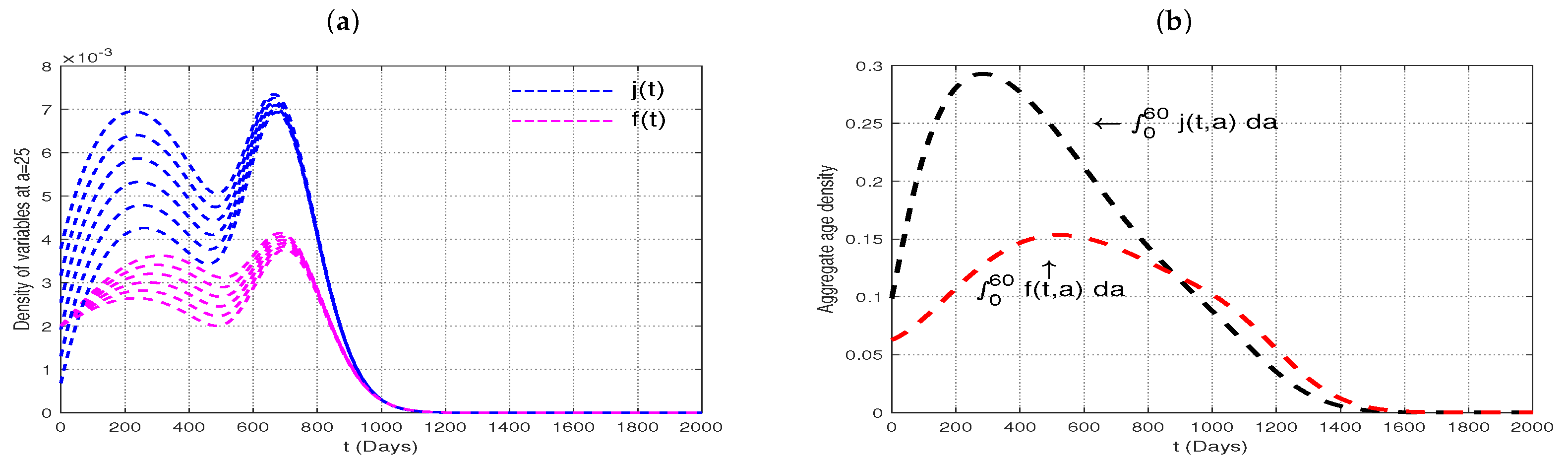
Figure 3a show that trajectories of
and
at age
from different initial values all tend to zero, and
Figure 3b portrays that total subpopulations
and
also tend to zero as
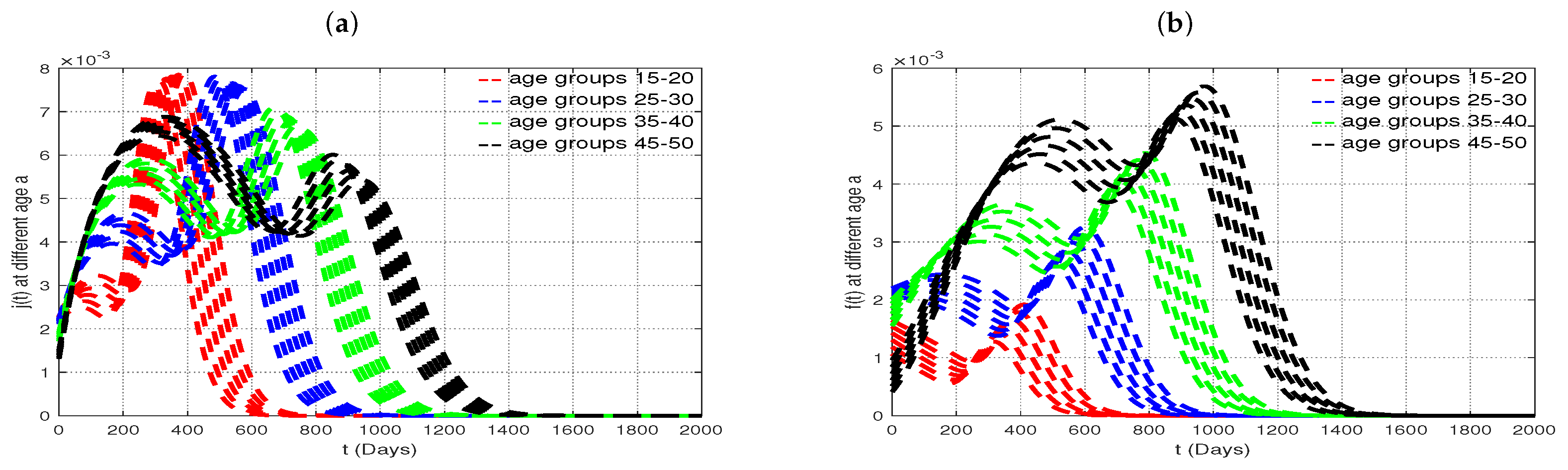
. In addition, the distribution of different age groups in each compartment is shown in
Figure 4. The plots in
Figure 4a illustrate that the majority of HIV-infected persons are young people aged 15–30 years.
Figure 4b shows that AIDS patients are mostly elderly, which may be because we did not consider the mortality rate due to the disease so that all HIV-infected people survive to old age.
Example 2. The persistence of disease, the stability of the endemic steady state of model (
4).
Let
,
,
,
,
,
,
. Further, choose that
,
,
,
,
in (
36) and (
37), respectively. We obtain basic reproduction number
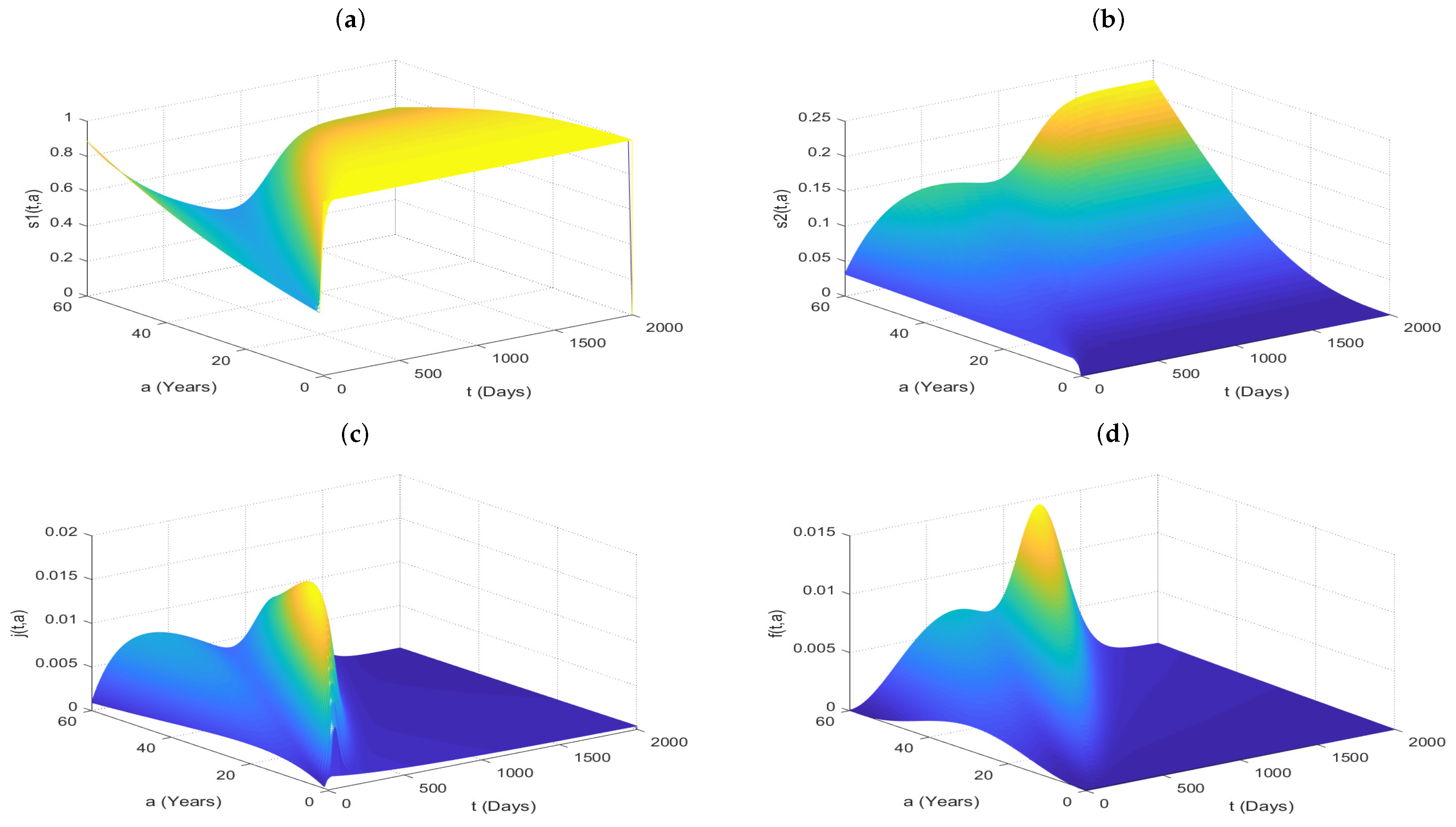
. The plots in
Figure 5a–d show the distribution of solution
of model (
4), we can see that the moment and scale of HIV/AIDS outbreaks are diverse for people of different ages, which suggests that the age factor is not negligible in the process of HIV transmission. Further, the plots in
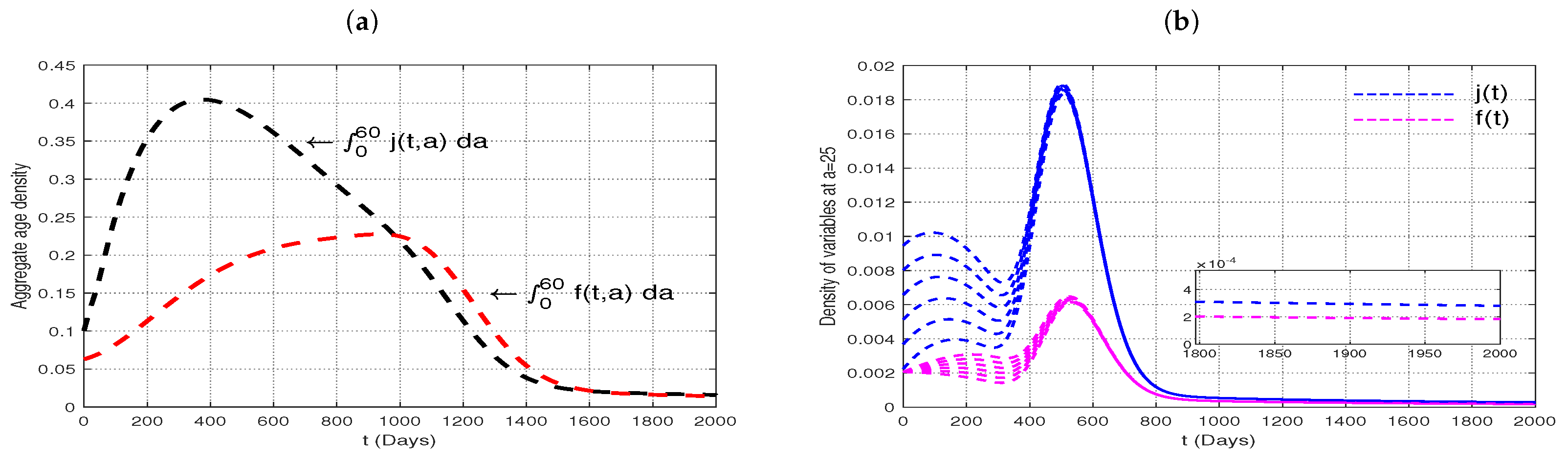
Figure 6a show the sum-age curves
and
, which imply that the quantities of confirmed HIV-infectious individuals and AIDS individuals are at a certain level, that is, the disease will persist in the region for a long time. Further,
Figure 6b shows the trajectories of
and
at age
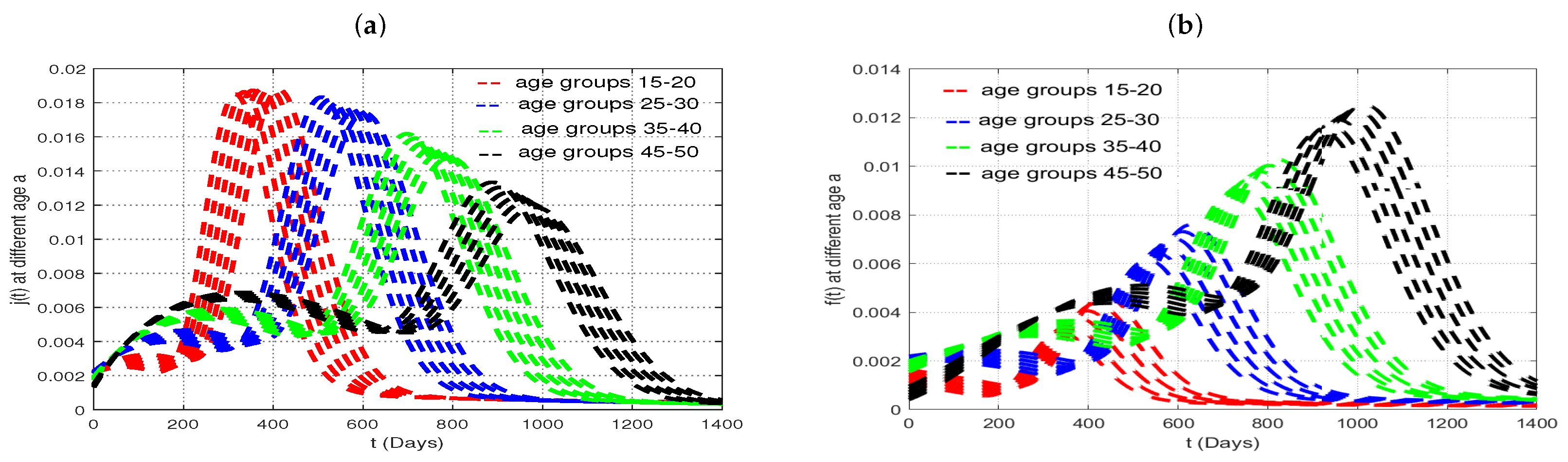
from different initial values shown, which means that the endemic steady states are asymptotically stable. Further, the distributions of patients with confirmed HIV and AIDS in different age groups (15∼20, 25∼30, 35∼40, 45∼50, unit is
) are given in
Figure 7a,b. Numerical simulations show that the young people (15∼20 years old) are the min force of HIV at the beginning of the disease outbreak, taking the lead in reaching the peak of the disease. Over time, these people gradually enter into other groups (25∼30 years old). Eventually, the distribution of those infected people gradually tends to be flat, and HIV becomes endemic in the region. These suggest that reducing the rate of infection in young people is one of the key factors in controlling the disease during the transmission of HIV.
Example 3. The influence of education campaign of model (
4).
In order to evaluate the effect of education campaign on the transmission of HIV/AIDS, we choose
,
,
,
and
in expressions of (
36) and (
37), respectively. Let
,
,
,
,
,
,
. The plots in
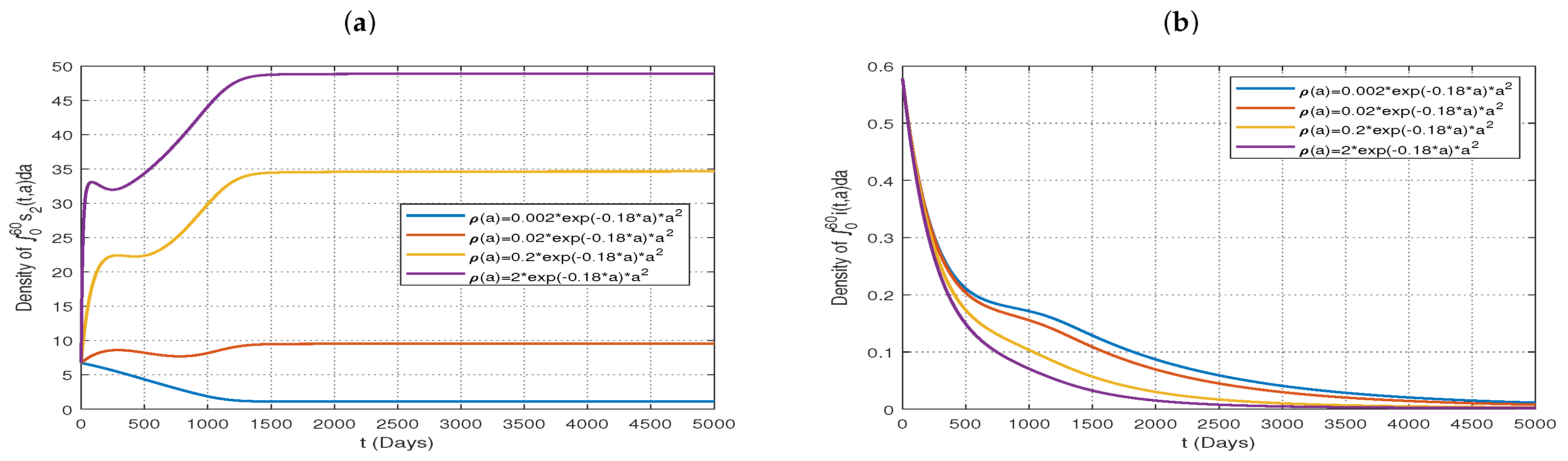
Figure 8a,b demonstrate the effect of change in cumulative distribution (that is,
and
) with
for protection-aware susceptible and asymptomatic infected individuals, respectively, where,
is chosen as
,
,
and
, respectively. Numerical simulations show that in high-risk areas of HIV outbreaks, even though the rate of disease suppression by personal protective measures is relatively small (i.e.,
is larger), one can achieve disease elimination by adopting a greater educational strategy (increasing the value of
) to turn the majority of unprotected susceptible individuals into those who are aware of protection.
Example 4. The influence of media coverage of model (
4).
To assess the impact of media coverage on the transmission of HIV/AIDS, one chooses
,
,
,
and
in expressions of (
36) and (
37), respectively. Let
,
,
,
,
. The plots in
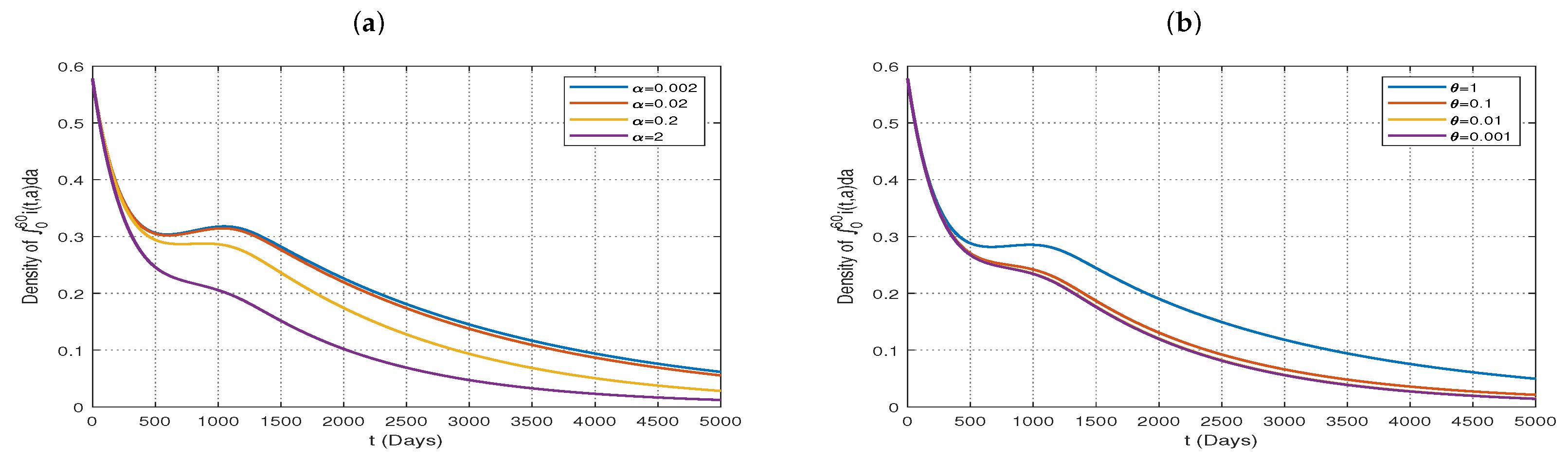
Figure 9a show that the cumulative distribution
of asymptomatic infected individuals decreases as the strength of the media coverage effect
increases from
,
and
to
. A similar result is obtained for the plots in
Figure 9b, that is, there is a significant decrease in
as the duration of the media effect is maintained (i.e., the rate of media effect dissipation decreased from 1,
and
to
). Moreover, the plots in
Figure 9b also show that when the duration of the media effect increases to a certain level (e.g.,
increases form
to
), the trend of the
changes negligibly. This is perhaps the phenomenon of aesthetic fatigue of the media effect. These numerical simulations also agree exactly with the theoretical results we obtained: media effect parameters
,
and
do not affect the value of
from the expression of the basic reproduction number
. More specifically, these parameters do not change the persistence and extinction of the disease, but do influence the intensity and duration of outbreaks.
Example 5. Sensitivity of the main parameters of model (
4)
on the basic production number . Finally, we discuss the sensitivity of the main parameters of model (
4) to the basic reproduction number
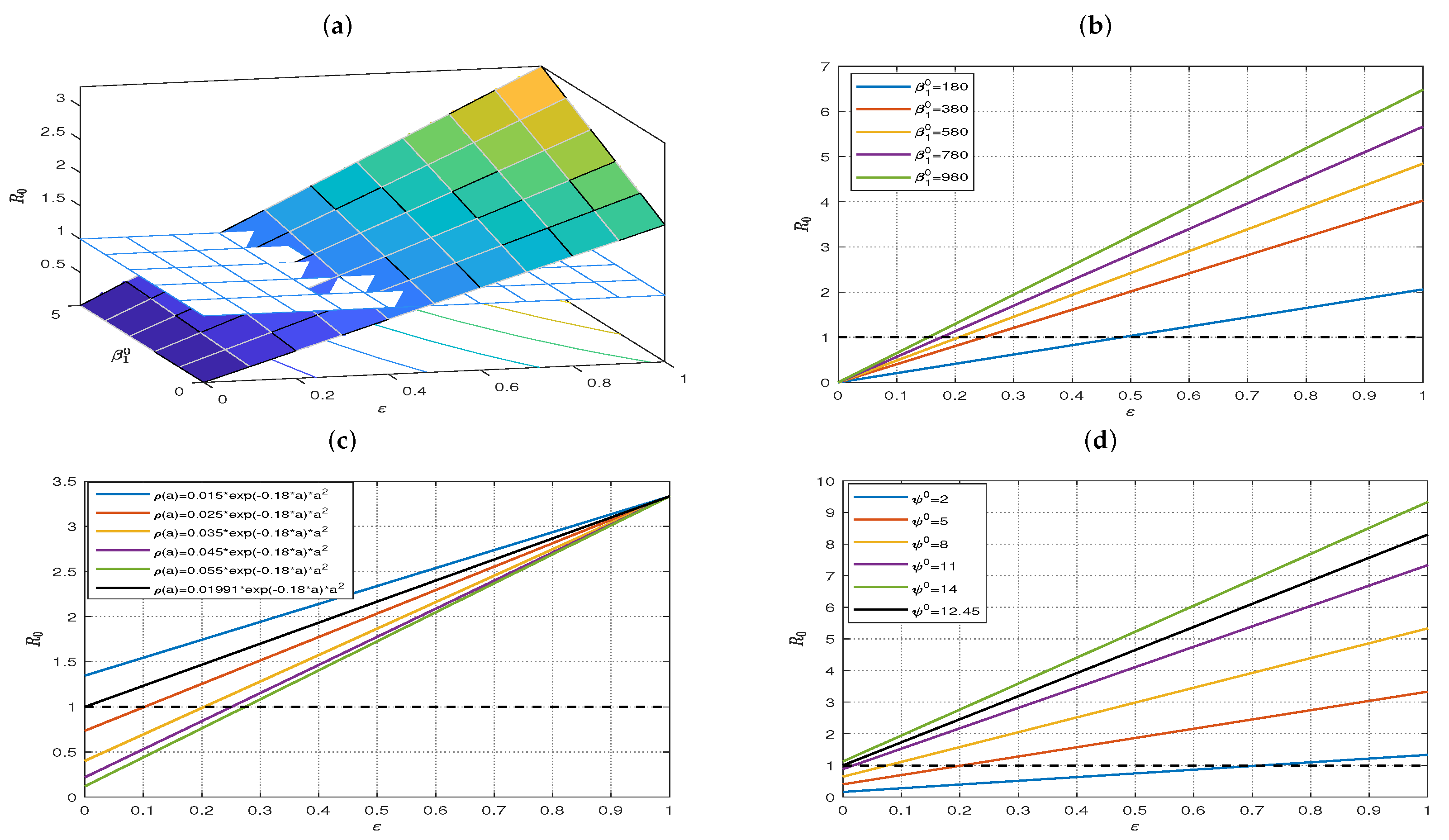
. It is not difficult to see from
Figure 10a–d that
,
and
are positively correlated with
, while
is negatively correlated. More specifically, unprotected susceptibles receive AIDS-related education to become protective-aware, and protected susceptibles improve protective awareness and do a good job of implementing protective measures, such as the correct use of condoms, fixed sexual partners, and reducing the number of sexual partners, which can greatly reduce the basic reproduction number so as to achieve the purpose of disease control. In addition, people infected with HIV can reduce their infectivity
through formal antiviral treatment, which may also be effective in controlling the epidemic.
8. Conclusions
The range of social activities and behaviors of people of different ages are completely different, which results in some age groups being at high risk for certain diseases. AIDS is a typical age-dependent infectious disease, and the specificity of its transmission route determines that biological age is one of the noteworthy factors in its transmission process [
44]. For the reason that the risk from infection increases along with the chronological age of the person and different age groups interact heterogeneously, age-structured PDEs are terrific to characterize the dynamics of HIV transmission. In recent years, the increasing media coverage has not only enabled people to be aware of the infection mode and incidence of the disease, but has also changed the behavior and habits of the population, thus curbing the rate of disease transmission to a certain extent. As we all know, media coverage comprises public reports, which is not affected by age, and thus the ODE is used to describe how it changes. Most importantly, people of all ages can receive relevant information from media coverage. Based on the above factors, this paper proposes a nonlinear hybrid system to describe the spread of HIV, which consists of coupled partial differential equations and ordinary differential equation. This hybrid model not only fully takes into account the age factor in the HIV transmission process, but also takes into account the age-free nature of the cumulative density reported by the media. This is uncommon in the dynamical modeling of HIV and is one of our highlights. In addition, considering the complexity of the HIV transmission process, in this model, we classified susceptible individuals into two categories: protected and unprotected. We divided infected individuals into asymptomatic infected individuals and confirmed patients. This classification increases the complexity of the theoretical analysis, but is more in line with the characteristics of HIV transmission.
By classifying the nonlinear hybrid system as an abstract Cauchy problem, we obtain the well-posedness, that is, the existence, uniqueness and boundedness of the global positive solution of this model, which is the basis of discussing model dynamics. Further, we discuss the existence of the endemic steady state, the exact expression of the basic reproduction number , and explain the biological significance of . We also discuss the global asymptotic stability of the disease-free steady state and the local stability of the endemic steady state. Under additional conditions, the endemic steady state is locally stable. Particularly, in order to characterize the prevalence of the disease, the uniform persistence of our model is demonstrated, which is another highlight of this paper. Finally, numerical simulations are also conducted to illustrate our theoretical results, which also show that young people are the main cause of the HIV surge and that awareness of personal protection has a significant impact on the disease. Additionally, epidemic-dependent media coverage, while not eliminating the disease, can influence the peak of the outbreak. Most importantly, numerical simulations demonstrate that the timing and magnitude of HIV/AIDS outbreaks vary for different ages, confirming that age variability is a non-negligible factor in HIV transmission. If this factor is ignored in the modeling, it can overestimate or underestimate the risk of disease outbreaks. As a result, precise prevention and control measures for a certain age group cannot be determined to effectively slow down the risk of infection.
In order to analyze the effects of age factors and media reports on HIV transmission, this paper ignored the effects of population mobility, spatial heterogeneity, and viral latency on HIV transmission in model building. Establishing a model of HIV transmission with multiple factors coupled is worth further consideration in the future. For example, the spatial model needs to be used in order to understand a detailed dynamic and it is reasonable to establish a reaction–diffusion HIV/AIDS transmission model in a spatial heterogeneous environment. An age-structured HIV/AIDS transmission model with time delay is a work worthy of further study. Moreover, in recent years, fractional differential equation models have been widely used to analyze and discuss the real-world infectious disease problems [
22,
45], and thus a fractional order HIV/AIDS epidemic model with age structure is also something we need to consider in our future work.