1. Introduction
Algebraic curves and surfaces are essential entities for practical applications (see, for example [
1,
2]). In fact, one may find a lot of literature dealing with different problems related to curves defined by irreducible polynomials (see, e.g., [
3,
4]). In this paper, we introduce the concept of infinity branches for surfaces. Intuitively speaking, an infinity branch represents the behavior of an algebraic surface at the points with “sufficiently large coordinates”. Informally speaking and generalizing the situation of algebraic curves, an infinity branch is associated with a projective “place” centered at an “infinity point”, and it can be “parametrized” by means of “Puiseux series” (the formal definition of these notions can be seen in
Section 2 and
Section 3).
Infinity branches are necessary and essential for the study of surfaces since they reveal the behavior at a point at infinity of a real algebraic surface. For instance, the infinity branches of an implicit algebraic plane curve are an important tool to sketch its graph as well as to analyze its topology (see e.g., [
5,
6,
7,
8,
9]). It should be mentioned that for the case of curves, in [
10], the notion of a g-asymptote is introduced. A g-asymptote generalizes the well-known notion of linear asymptotes, and these asymptotes can be computed from the infinity branches. More precisely, we say that a curve
is a
generalized asymptote (or
g-asymptote) of an input curve
if
approaches
at some infinity branch. Furthermore, the input curve
cannot be approached by a new curve having a lower degree. In this paper, we generalize some of these notions introduced previously for curves in [
5] to the case of surfaces.
The notion of an infinity branch allows us to define convergent branches and approaching surfaces (see
Section 4). More precisely, we say that two infinity branches converge if they get closer as they tend to infinity. Furthermore, an algebraic surface
approaches at its infinity branch
B if
has another infinity branch
such that
is convergent with
B. We obtain important results that characterize whether two algebraic surfaces are approaching.
Using these results, we obtain an algorithm that compares the the behavior of two surfaces at infinity (see
Section 5). Finally, it is shown that if two algebraic surfaces defined implicitly have the same
asymptotic behavior, then the Hausdorff distance between them is finite.
The results that we obtain in this paper (and also for the case of curves) are essential for some applications in the framework of computer-aided geometric design (CAGD) as, for instance, in the approximate parametrization problem (see [
11]). This problem can be stated as follows: we are given a non-rational affine surface
(we assume that it is a perturbation of a rational surface), and we would like to compute, if it exists, a parametrization of a new rational affine surface denoted by
, which is near to the input surface. The effectiveness of the algorithm depends on the closeness of
and
, and then, here, one needs to show that the Hausdorff distance between
V and
is finite.
This paper is structured as follows: in
Section 2, we present the notions and preliminaries that will be used throughout the paper.
Section 3 introduces the concept of
infinity branch, and here, we prove some important properties.
Section 4 provides the notions of
convergent branches and
approaching surfaces. Additionally, we characterize whether or not two algebraic surfaces approach each other. The results presented in this section will be used in
Section 5, where an algorithm to compare the asymptotic behavior of two algebraic surfaces is designed. Finally, we prove that if two given algebraic surfaces have the same asymptotic behavior, the Hausdorff distance between them is finite. We finish with a section for conclusions and future work (
Section 6).
2. Preliminaries and Terminology
In the following, we present some concepts and notions that will be used throughout the paper. In particular, we introduce some previous results concerning local parametrizations and Puiseux series. For further details, one may see for instance, Section 2.5 in [
3], Chapter 4 (
Section 2) in [
4], [
12,
13,
14,
15], etc.
We represent by
the domain of
formal power series in the variable
t with coefficients in the field of complex numbers
. That is,
is the set of all the sums
,
. The quotient field of
is the field of a
formal Laurent series, which is denoted by
. Every non-zero formal Laurent series
can be written in the form
Furthermore, the field
is the field of a
formal Puiseux series. By Puiseux’s Theorem, one gets that the field
is algebraically closed. Observe that Puiseux series are power series with fractional exponents. Furthermore, given a Puiseux series,
, one has a bound for the denominators of exponents with non-vanishing coefficients of
. This bound is known as
the ramification index of
, and we represent it as
(see [
13]).
The order of a (Puiseux or Laurent) series A is the smallest exponent of a term with a non-vanishing coefficient in A. We represent it by , and we say that the order of 0 is ∞.
Let be a Puiseux series solving , , and let n be the least integer for which (i.e., ). We set , and then is a local parametrization with center at the origin. The solutions of of order 0 are places with a center on the y-axis different from the origin. The solutions of negative order are places at infinity (that is, places with center at an infinity point).
Let
be a Puiseux series with
. The series
,
are defined as the
conjugates of
Y, where
The set of all the conjugates of
Y is called the
conjugacy class of
Y. The number of different conjugates of
Y is
. Two Puiseux series provide the same place if they belong to the same conjugacy class (see [
13,
16]).
For the case of Puiseux power series in several variables, one may use the notation introduced in [
14]. More precisely, let us fix a vector of variables
, and an integer
. We will use the lexicographic order
on
, which can be defined as follows: since we can assign to every monomial
the vector
of its exponents, we consider the lexicographic order of the group
of monomials by writing
This extension will also be called the lexocographic order for monomials, and it is a group order. The same argument follows for the group , of monomials with vectors of exponents in .
Let
be the set of all the functions
; then
is an abelian group with respect to the usual addition of functions. If we fix a vector
x of variables, we may write every
as a formal sum
where
and, if
, then
. In this case, we set
. We call the support of
f the set
Finally, let us denote by
the subgroup
of
, which is a field constructed by induction (see [
14]). Under these conditions, if
, then
if
is a well-ordered subset of
for the lexicographic order. The elements of
will be called generalized Puiseux power series.
In the next definition, we introduce the concept of projective local parametrization for a projective algebraic surface.
Definition 1. Let be a projective algebraic surface defined by the homogeneous polynomial . Let be series in such that: (i) (where the three series converge), and (ii) there is no such that . Then is called a projective local parametrization of .
One can always find such a parametrization such that , and the point is called the center of .
For a given affine surface, the previous notion can be stated as follows:
Definition 2. Let be a real algebraic surface over implicitly defined by the irreducible polynomial . Let be series in such that: (i) (where the series converge), and (ii) not A and B and C, are constants. Then is called an (affine) local parametrization of . If , and the point is called the center of .
In the following, we deal with affine surfaces. The results and notions presented can be adapted easily for projective algebraic surfaces.
For our purposes, we will need a generalization of the above definition. More precisely, we will be in the conditions of Definition 2, but the place will be the center of .
Definition 3. An equivalence class of irreducible local parametrizations of the surface is called a place of . The common center of the local parametrizations (if it exists) is the center of the place.
Now, we introduce the notion of a branch of a surface.
Definition 4. Given a local parametrization of a surface , the set of all points obtained by allowing to vary within some neighborhood of 0 where and and converge is called a branch of .
It can be proved that two equivalent local parametrizations provide the same branch. Hence, one gets a branch for each place of the input surface.
Furthermore, the center of a local parametrization of is a point on . Reciprocally, from the following theorems, we also get that every point on is the center of at least one place of .
Theorem 1. Let be a surface defined by . To each root of with there corresponds a unique place of with a center at the origin. Conversely, to each place of with a center at the origin, there correspond roots of , each of order greater than zero.
3. Infinity Branches
In the following, we define an infinity branch (see Definition 5), and we get some important properties which will be essential for the results we will obtain.
For this purpose, let be an algebraic affine surface over implicitly defined by the irreducible polynomial . Let be its corresponding projective surface defined by the homogeneous polynomial . In addition, let , where be a local parametrization of an infinity curve of implicitly defined by the irreducible polynomial that divides (see Definition 2). Observe that , and by abuse of notation, we refer to as an infinity point of the input surface .
We compute the series expansion for the solutions of
w.r.t
in some neighborhood of
. We obtain solutions given by different Puiseux series that can be grouped into conjugacy classes. Let one of these solutions be given by the Puiseux series
:
where, for
,
,
,
,
, and the lexicographic order for monomials is considered. We have that
in some neighborhood of
where
converges. Then, there exists some
such that
where
and
which implies that
for
and
. We set
, and we obtain that
where
for .
Since
, we get that there are
different series in its conjugacy class (with respect to the variable
). Let
be these series, and
where
are the
complex roots of
. Similarly, one reasons for
. Now, we introduce the notion of an infinity branch.
Definition 5. The set whereis called an infinity branch
of the affine surface . The subsets are called the leaves
of the infinity branch B. Remark 1. Note that, up to conjugation, an infinity branch is uniquely determined from one leaf. That is, if , where , and then , up to conjugation; i.e., where , and . Similarly, one reasons for . Let . In the following, we consider .
Let be a series expansion for a solution of . We consider and we observe that is a local projective parametrization, with a center at , of the projective surface .
Thus, from ( are the different series in the conjugacy class of ). We obtain equivalent local projective parametrizations, (note that they are equivalent since belong to the same conjugacy class). Therefore, the leaves of B are all associated to a unique infinity place.
Conversely, from a given infinity place defined by a local projective parametrization
, we obtain
Puiseux series,
,
, that provide different expressions
. Hence, the infinity branch
B is defined by the leaves
From the previous disquisitions, we conclude that there exists a one-to-one relation between infinity places and infinity branches, and we may say that each infinity branch is associated with a unique infinity point (which is given by the center of the corresponding infinity place). Reciprocally, from the previous construction, we obtain that every infinity point has associated, at least, one infinity branch. Thus, every algebraic surface has, at least, one infinity branch. Furthermore, every algebraic surface has a finite number of branches.
The above process can be applied to an infinity point of the form
that provides a local parametrization
of an infinity curve. For the case that
, we may reason similarly by considering the surface implicitly defined by the polynomial
. Observe that
where
,
is a local parametrization of an infinity curve of
implicitly defined by the irreducible polynomial
that divides
. In this case,
, and by abuse of notation, we refer to
as an
infinity point of the input surface. In this situation, we get that there exists
such that
for
and
, where for
,
,
(and the lexicographic order for monomials is considered) is a series expansion for a solution of
with respect to
in some neighborhood of
. We set
, and we get that
where
for
.
Thus, we obtain an infinity branch
whose leaves have the form:
Observe that we may apply this construction to any infinity point of the form .
Finally, for the case
, we may consider the surface implicitly defined by the polynomial
. Observe that
where
,
is a local parametrization of an infinity curve of
implicitly defined by the irreducible polynomial
that divides
. In this case,
, and by abuse of notation, we refer to
as an
infinity point of the input surface. In this situation, we get that there exists
such that
for
and
, where for
,
,
(and the lexicographic order for monomials is considered) is a series expansion for a solution of
. We set
and we get that
for .
Thus, we obtain an infinity branch
whose leaves have the form:
Observe that we may apply this construction to any infinity point of the form .
Definition 6. Let be an affine surface over defined by an irreducible polynomial .
An infinity branch of
of type 1
associated with the infinity point is a set , where , , , and are the conjugates of (similarly for ); An infinity branch of
of type 2
associated with the infinity point is a set , where , , , and are the conjugates of (similarly for ); An infinity branch of
of type 3
associated with the infinity point is a set , where , , , and are the conjugates of (similarly for ).
Remark 2. In the following, we work with the type 1 infinity branches of a given algebraic surface . Similarly, one can reason for the other infinity branches;
We will say that is the ramification index of the branch B with respect to , and we will write it as . Note that B has leaves.
In the following examples, we compute the infinity branches for some given surfaces.
Example 1. Let be the a surface implicitly defined by the irreducible polynomial The corresponding projective surface is defined by Note that is an infinity point of .
We determine the infinity branches associated with P. For this purpose, we consider the curve defined by the irreducible polynomial , and we observe that where is a rational parametrization of the curve defined implicitly by . Note that in this case, we have more than a local parametrization of but a rational parametrization of .
Now, we compute the series expansion for the solutions of with respect to around . In this case, since is rational over , we compute a parametrization and we get that: Observe that , and . Note that , which implies that we only have one Puiseux series in the conjugacy class of . Thus, we obtain one infinity branch: Example 2. Let be the surface implicitly defined by the irreducible polynomial The corresponding projective surface is defined by Note that and are the two infinity points of . We determine the infinity branches associated with and . For this purpose, we consider the curve defined by , and we observe that where . Note that in this case, we have more than a local parametrization of but a rational parametrization of .
Now, we compute the series expansion for the solutions of with respect to around . In this case, is not rational over ; thus, we compute a local parametrization, and we get two different solutions:
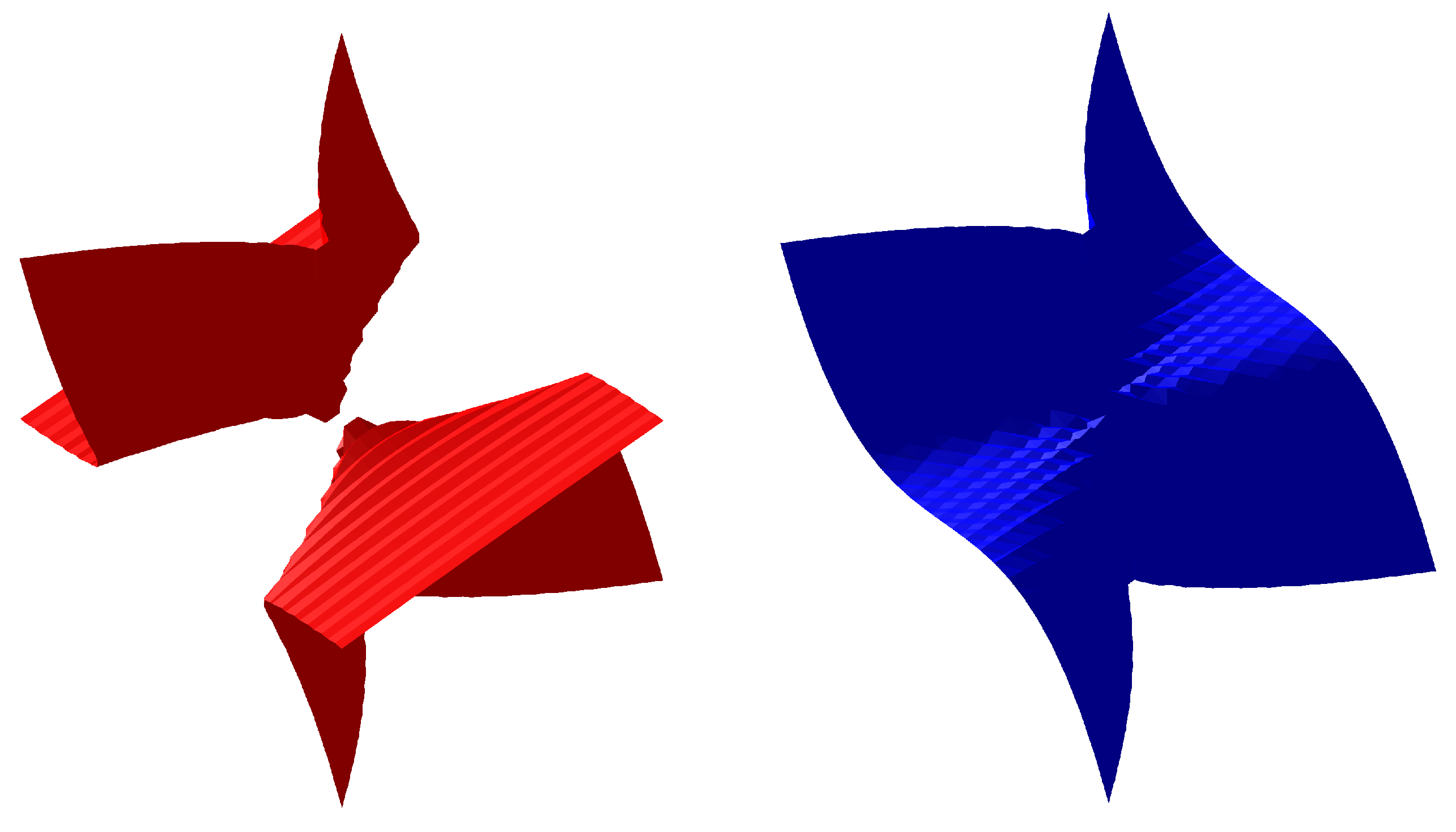
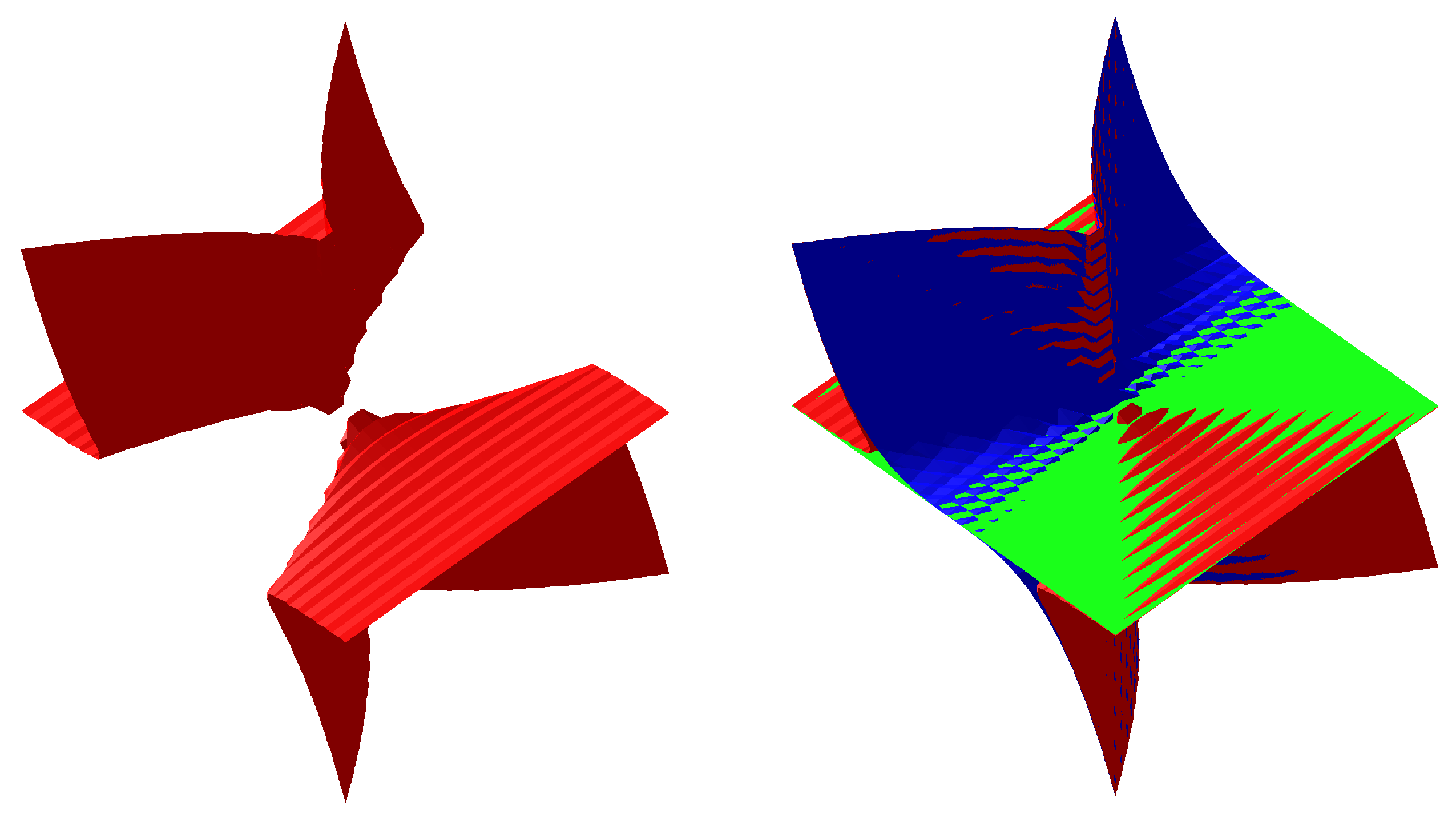
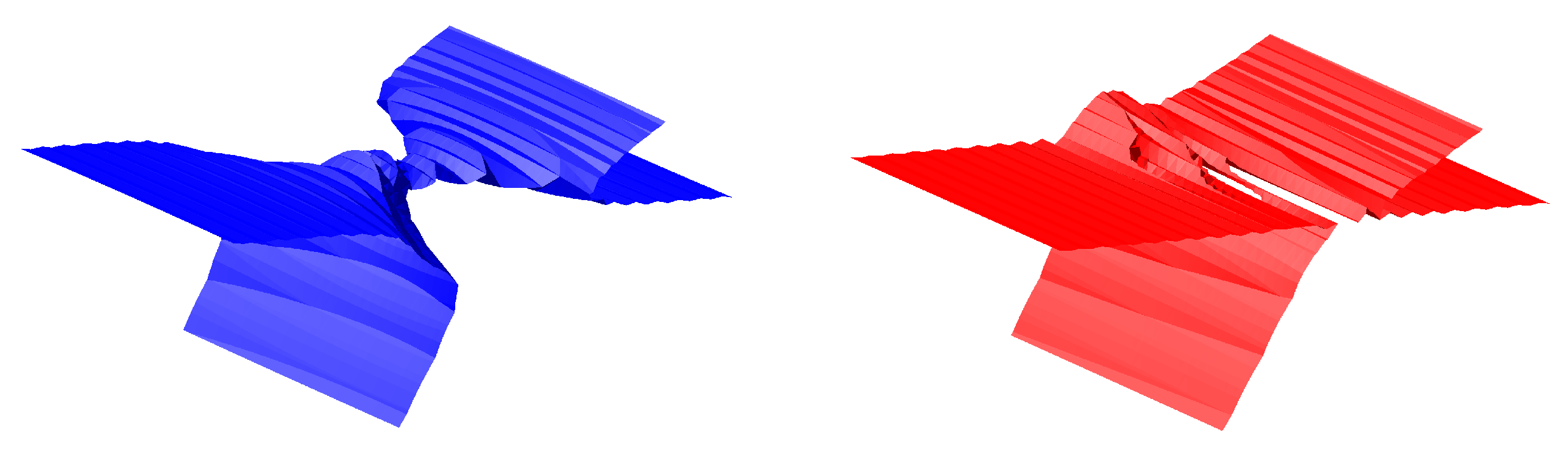
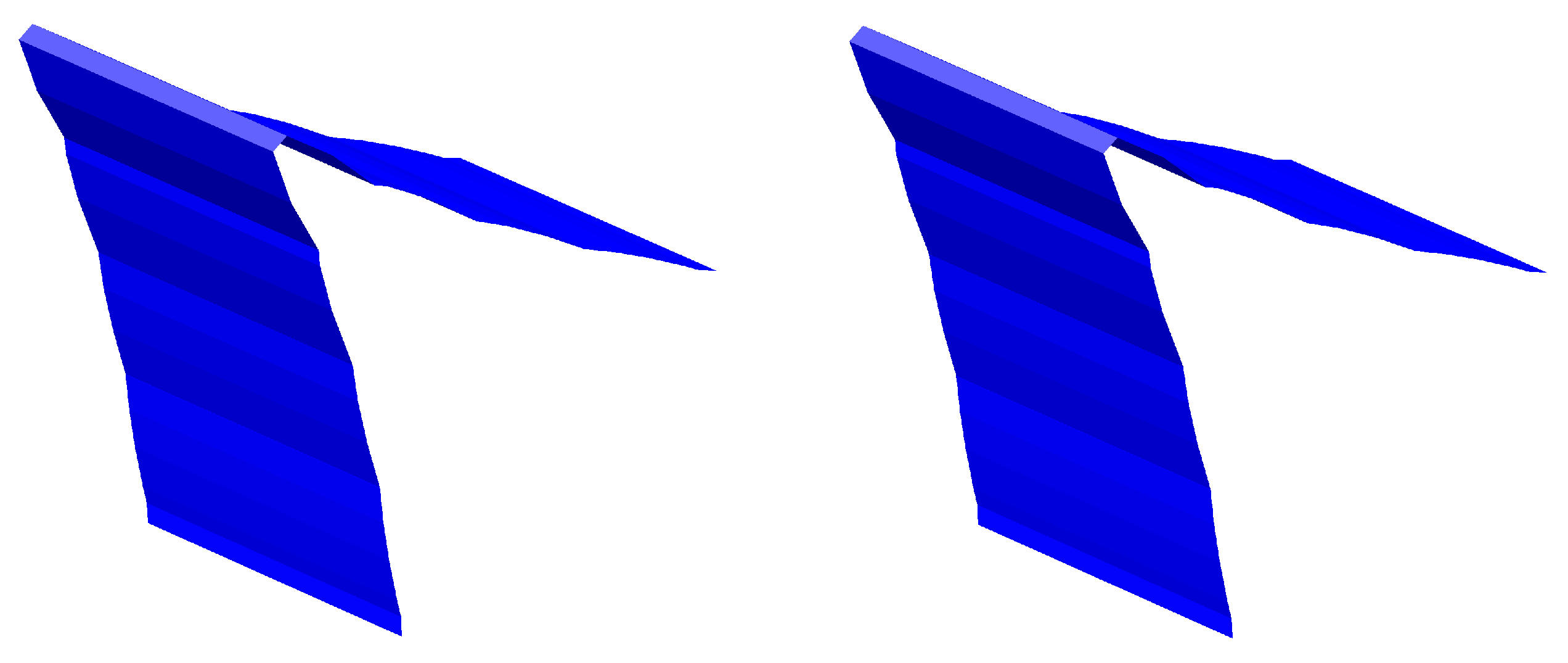
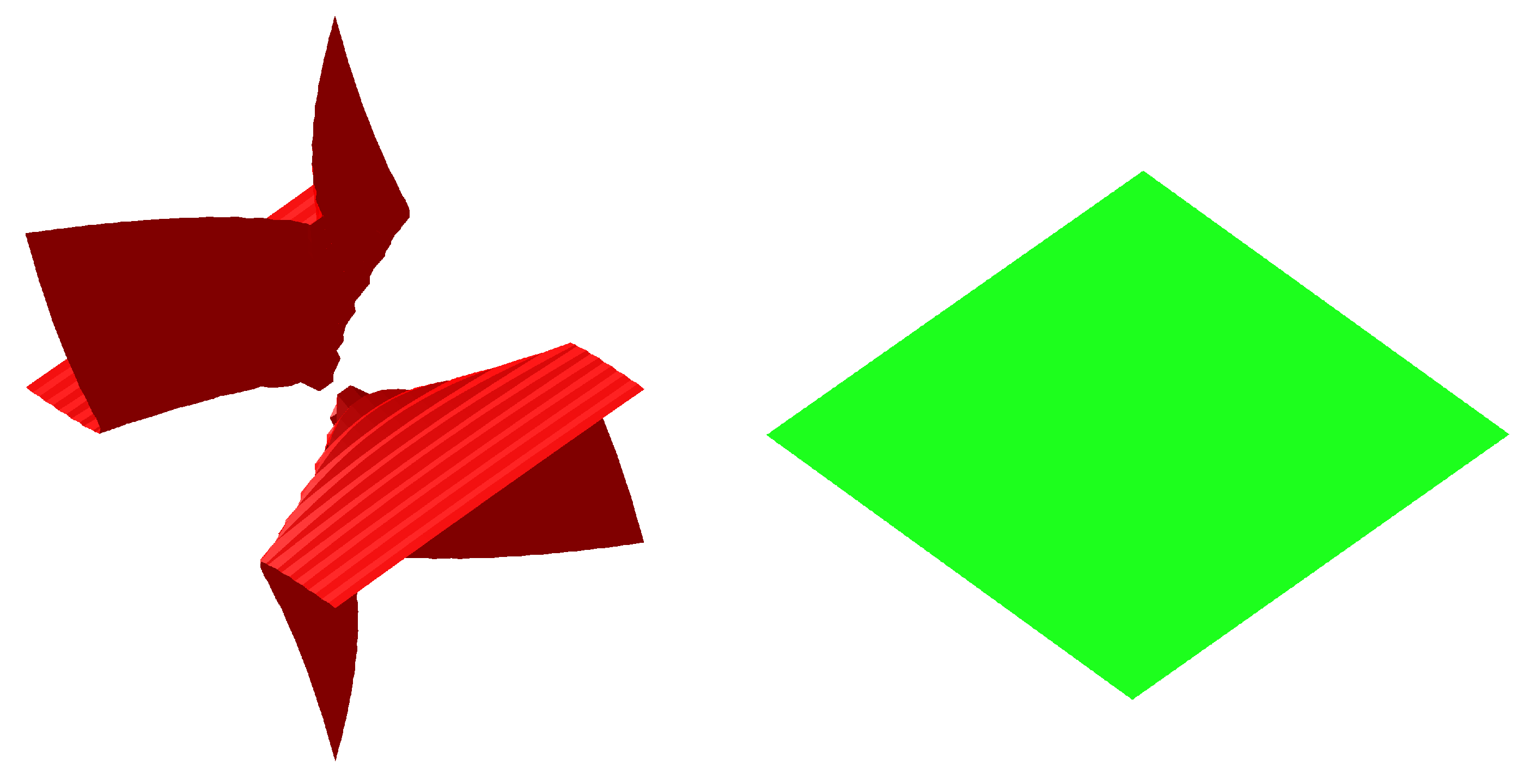
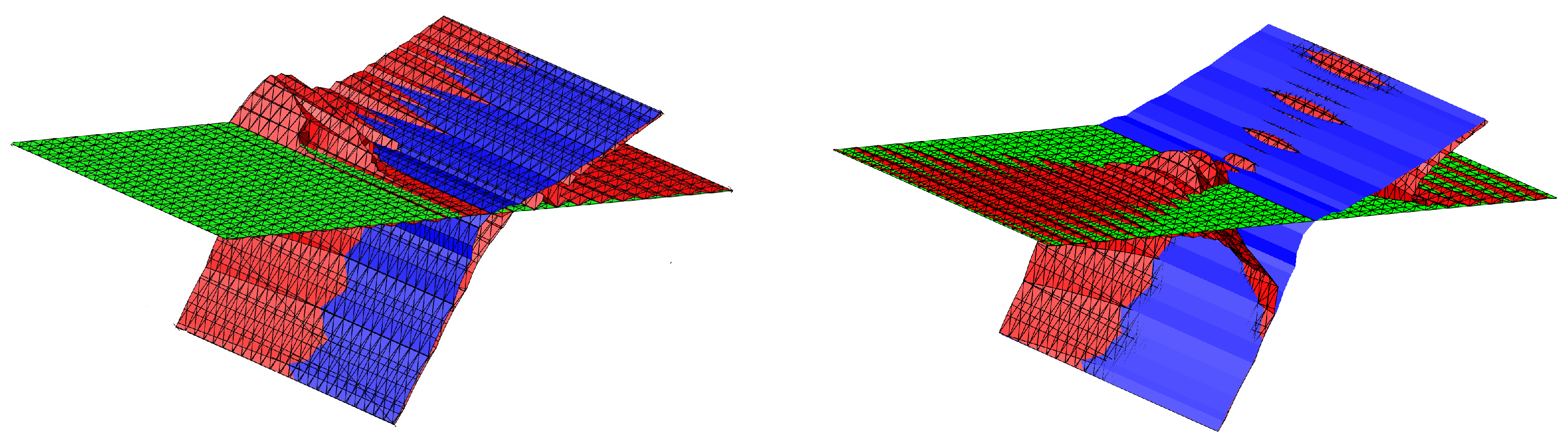
First, we get that , where Observe that , and . Note that , which implies that we only have one Puiseux series in the conjugacy class of . Thus, we obtain one infinity branch: In Figure 1, we plot the surface and a surface, , constructed from the infinity branch that approach the input surface (see Section 4); We also get that , where Observe that , and . Note that , which implies that we only have one Puiseux series in the conjugacy class of . Thus, we obtain one infinity branch: In Figure 2, we plot the surface and a surface, , constructed from the infinity branch that approach the input surface (see Section 4). In Figure 3, we plot the surface and the surfaces and together.
Remark 3. The computation of is not an easy question. In some cases, this problem can be easily solved as in Examples 1 and 2. For a more general cases, and also for the case of surfaces parametrically defined, we will deal with this question in a future work.
In the following, we prove that any point of the surface with sufficiently large coordinates belongs to some infinity branch. For this purpose, we recall that if
h is a complex-valued function of a complex variable,
, we say that the limit of
as
approaches
∞ is
L, written
. If whenever
is a sequence of points with
, it holds that
(see, e.g., [
17] or [
18]).
Lemma 1. Let be an algebraic surface. There exists such that for every with , it holds that , where is an infinity branch of .
Proof. Let us assume that the lemma does not hold, and we consider a sequence such that . Then, for every , there exists a point such that , and does not belong to any infinity branch of .
Let . Since , then . Thus, we distinguish the following different cases:
- (a)
If there exist two not-bounded monotone subsequences,
and
, we have that
and then
and
Hence,
where
, which implies that
is an infinity point of
;
- (b)
If there exist a not-bounded monotone subsequence
and a bounded monotone subsequence
, we have that
and
, and then
and
(if
). Hence,
where
, which implies that
is an infinity point of
.
Note that if
, then we consider
. Hence,
where
, which implies that
is an infinity point of
;
- (c)
If there exist two bounded monotone subsequences
and
, we have that
and
(if
). Thus,
where
, which implies that
is an infinity point of
.
If
, that is,
, since
(we assume that
), we get that
. Thus,
where
, which implies that
is an infinity point of
.
If
, that is,
, then
or
. Let us assume that
. Then, since
, we get that
where
, which implies that
is an infinity point of
.
- (d)
If there exist a bounded monotone subsequence
and a not-bounded monotone subsequence
, we have that
and
Thus,
where
, which implies that
is an infinity point of
.
Note that if
, then since
, we get that
. Thus,
where
, which implies that
is an infinity point of
.
From both situations, we deduce that there exists a sequence that approaches to an infinity point P as n tends to infinity; i.e., there exists such that for . Therefore, one may conclude that can be determined by a place centered at P. Thus, belongs to some infinity branch of , which contradicts the hypothesis. □
Remark 4. Reasoning as in Lemma 1; one gets that there exists satisfying that for every , , it holds that , where is an infinity branch of . The reasoning is similar if .
4. Convergent Branches and Approaching Surfaces
In the following, we define convergent branches and approaching surfaces. We say that two infinity branches converge if they get closer as they tend to infinity. This notion will allow us to analyze whether two surfaces approach each other at the infinity.
The results obtained in this section will be used in
Section 5. In
Section 5, we present a method that compares the asymptotic behavior of two surfaces implicitly defined.
Definition 7. Given two leaves, and , we say that they are convergent if for .
Lemma 2. Two leaves and are convergent if and only if the monomials on the variable that have a non-negative exponent in the series and are the same (for ).
Proof. Let
, and
. Then,
Note that if and only if has no monomials having a non-negative exponent. This situation holds if the monomials on the variable that have a non-negative exponent in both series, and , are the same.
One reasons similarly for and . □
Remark 5. From Lemma 2, we deduce that and then, L and are associated with the same infinity point;
Note that the number of monomials with regard to that have a positive exponent in both series is finite.
Definition 8. Two infinity branches, B and , are convergent if there exist two convergent leaves and .
Remark 6. Statement 1 in Remark 5 implies that two convergent infinity branches are associated with the same infinity point.
Proposition 1. Two infinity branches B and are convergent if and only if for each leaf there exists a leaf convergent with L, and reciprocally.
Proof. The proof follows reasoning similarly as in Proposition 4.6 in [
5]. □
Remark 7. Two convergent infinity branches may have different ramification indexes; that is, they may have different numbers of leaves. However, , which is obtained by simplifying the non-negative exponents in the variable , is the same in both branches. We refer to it as the degree of the infinity branch with respect to . Note that from the proof of Proposition 1, we get that two convergent infinity branches have the same degree with respect to .
Two convergent infinity branches may be contained in the same surface or they may belong to different surfaces. In this second case, we will say that those surfaces approach each other. In order to define this concept in a more formal way, we first introduce the following distance:
Definition 9. Given an algebraic surface over and a point , we define the distance from p to as
Remark 8. We should note that since is a closed set, this minimum exists.
Definition 10. Let be an algebraic surface over with an infinity branch B. We say that a surface approaches at its infinity branch B if there exists one leaf such that
We will show that this condition is satisfied for one leaf of B if and only if it is satisfied for every leaf of B. It will be derived as a consequence of the following theorem.
Theorem 2. Let be an algebraic surface over with an infinity branch B. An algebraic surface approaches at B if and only if has an infinity branch, , such that B and are convergent.
Proof. The proof follows reasoning similarly as in Theorem 4.11 in [
5]. □
Remark 9. Theorem 2 implies that “proximity” is a symmetric relation. More precisely, the surface approaches the surface at some infinity branch B if and only if approaches at some infinity branch . In the following, we say that and approach each other or that they are approaching surfaces ;
From Theorem 2 and Remark 6, we get that two approaching surfaces have a common infinity point;
Theorem 2 and Proposition 1 imply that approaches
at an infinity branch B if for every leaf it holds that
Corollary 1. Let be an algebraic surface with an infinity branch B. Let and be two different surfaces that approach at B. Then, and approach each other.
Proof. From Theorem 2, there exist two infinity branches
and
, convergent with
B. Thus, for each leaf
, there exist two leaves
and
such that
and
. Then
(one reasons similarly for
). Therefore,
and
approach each other. □
In Example 3, we illustrate the above results.
Example 3. Let and be two surfaces implicitly defined by the polynomialsrespectively. Let us prove that and approach each other at the infinity branch associated with the infinity points(note that both surfaces have and as infinity points). Reasoning as in Example 2, we get that the infinity branch of associated with is given bywhere The infinity branch of associated with is given bywhere On the other hand, the infinity branch of associated with is given bywhere The infinity branch of associated with is given bywhere From Lemma 2, we conclude that both branches converge, since the terms with non-negative exponent in both series, and , are the same.
Remark 10. In the above example, the surfaces and are approaching surfaces, since approaches at one of its infinity branches reciprocally.
In fact, approaches at all of its infinity branches and reciprocally. In this case, we say that both surfaces have the same asymptotic behavior. We focus on this special relation in the next section.