2. Preliminaries
In this article, connected, simple and undirected networks are considered. We denote
for the path network,
for the complete network and
for the complete bipartite network with
n nodes. We follow [
1,
2,
3,
4], for the notation and terminology which are not defined in this article.
Assume that is a network having node set which are connected by the link is denoted by . The cardinality of network W is denoted as . Let , then denote be the set of entire adjacent nodes with y in ℵ. We denote the degree of by . The minimum degree of ℵ is denoted by , and defined as . Let is a subset of which is induced by A. The networks and denote as any network construct from ℵ by removing the node and by removing the link , respectively. In the same way, can be determined from ℵ by adding a link .
The quantity denotes the union of two networks and with and . If and are disjoint nodes, then we let denote the join of and , which is the network obtained from by adding all the links between the nodes and . For disjoint networks having , then the joining is the network . In short, we indicate and for the union and for the joining of k time disjoint copies of ℵ, simultaneously. For instance, is exactly the k isolated nodes, whereas is indicating the joining
For a network, the distance among x and y is denoted by and defined by the length of a shortest x-y path. Assume that denotes the eccentricity of a node, then it can be defined as be the eccentricity of x. Next, is the diameter of a network ℵ which is defined as diam The path P is called a diametrical path of a network ℵ if it satisfies .
Let ℵ be a simple network and is the node set of ℵ. Then, can be divided into two disjoint subsets and in such a way that there is at least one link between these two disjoint subsets, then ℵ is called a bipartite network. On the other hand if every node of is adjacent to every node of such network is called a complete bipartite network. Generally, it is denoted by , where , . A node independent set of any network ℵ is the node subset in which satisfies that any of the two distinct nodes in the set are not adjacent. The independence number is defined as the maximum cardinality in all of the independent sets of ℵ and it is denoted by .
Any two distinctive links of the set that are not incident with a common node is called a link independent set of any network ℵ. Similarly, a link independence number of any network ℵ is the maximum cardinalities among entire link independent sets. It is indicated as . The set of nodes (links) in which every link (node) of ℵ is incident with at least one node (link) of the set is called a node (link) cover of a network ℵ. The minimum of the cardinalities among entire node (link) covers is said to be the node (link) cover number of a given network ℵ and is indicated as . In any connected network ℵ with order n, has a matching number must fulfill . Meanwhile, in the case of a link cover of any network, one can constantly suppose that the network should consists no isolated node. It can easily be observed that for a network ℵ of order n, . Additionally, if ℵ has no isolated node, then one has . For a bipartite network ℵ, one has , and .
For the sake of simplicity, we assume that is the class of all bipartite networks with order n having matching number q. Whereas, indicate the class of all bipartite networks with order n having diameter d. Similarly, (resp. ) be the class of all n-node bipartite networks with connectivity s (resp. link connectivity t).
We define
as the first Zagreb index of a network
ℵ. Similarly,
is the second Zagreb index of a network
ℵ, for further detail one can see [
5].
Inspired from the above definitions Vukičević and Graovac [
6], Ghorbani and Hosseinzadeh [
7] invented another similar kinds of network invariant called the first (resp. second) Zagreb eccentricity index.
The first (resp. second) Zagreb eccentricity index of
ℵ is denoted by
(resp.
and defined as
Some extremal problems related to first and second Zagreb eccentricity indices are presented by Das and Lee in [
8]. In [
9] the authors obtained trees having sharp lower bound of Zagreb eccentricity indices with given domination number, maximum degree, and bipartition size. Some extremal problems of unicyclic networks which minimize and maximize the first and second Zagreb eccentricity indices are considered by Qi and Zhou in [
10]. The networks having maximum also second maximum with respect to the second Zagreb eccentricity index among entire
n-node bicyclic networks figured out by Li and Zhang in [
11]. The Zagreb eccentricity indices of generalized hierarchical product is computed by Luo and Wu in [
12].
Studies given under [
13,
14,
15,
16,
17] led us to consider the extremal problem on
n-node bipartite networks with given matching number and diameter among
and
. In order to formulate our main results, the following Lemma is helpful.
Lemma 1 ([
8], P:121).
Let ℵ be any connected bipartite network with order n having bipartition , , and . Then where and 3. Network Contain Minimum Zagreb Eccentricity Indices among All n-Node Bipartite Networks with Given Matching Number q
In this section, we characterize the networks among having minimum Zagreb eccentricity indices.
Lemma 2. Assume that ℵ be any connected bipartite network having with and .
- (i)
If , then and , in this case .
- (ii)
If , and then and , in this case .
- (iii)
If , then and , with equality if and only if .
Due to Lemma 2 we characterize all the bipartite networks which are connected and having order .
Theorem 1. Assume that is an n-node bipartite network with matching number q, and .
- (i)
If , then and , where .
- (ii)
If , then and . The equality holds if and only if .
Proof. By a direct calculation, one has
Hence, we only need to show that among with minimum Zagreb eccentricity indices is a unique network .
Choose ℵ, in such that its first Zagreb eccentricity index and the second Zagreb eccentricity index are minimum. For , due to Lemma 1 an extremal network is exactly as desired. Therefore, we only consider the case .
Let the bipartition node set in ℵ is denoted by , such that . Assume that M is a maximal matching in ℵ, then due to Lemma 1, the addition of new link(s) decreases the first Zagreb eccentricity index as well as the second Zagreb eccentricity index of a network. In what follows, if , then the extremal network is . Hence, we consider the case .
Assume that M is a matching set and (resp. ) be the set of nodes of X (resp. Y) which are incident to the links of M. Therefore, . Keeping in mind that ℵ does not contain links between the nodes of and the nodes of . Otherwise, any such link together with M producing the matching of cardinality more than as that in M, which contradicts the maximality in M.
By adding entire potential links between the nodes of
and
,
and
,
and
we get a network
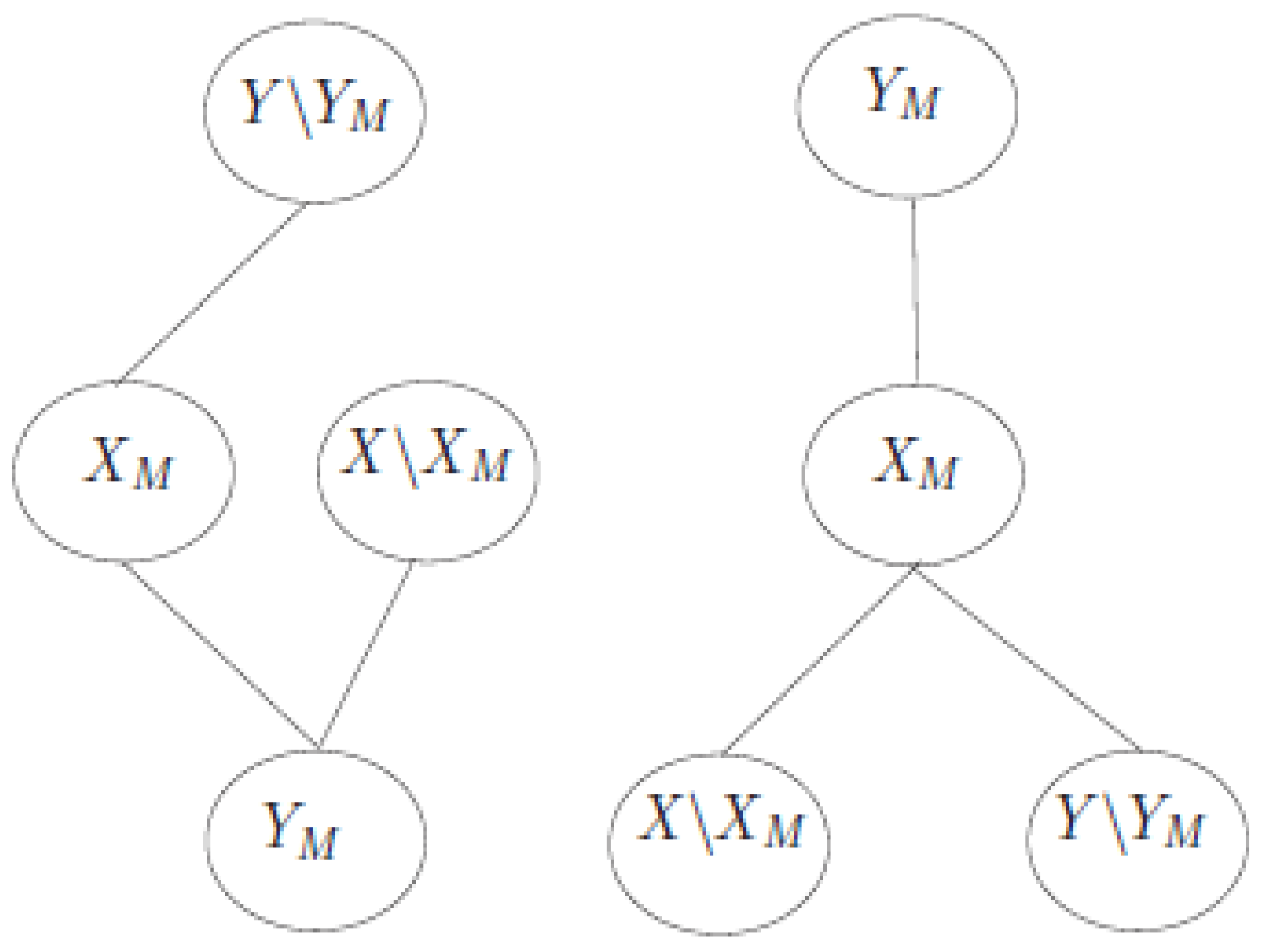
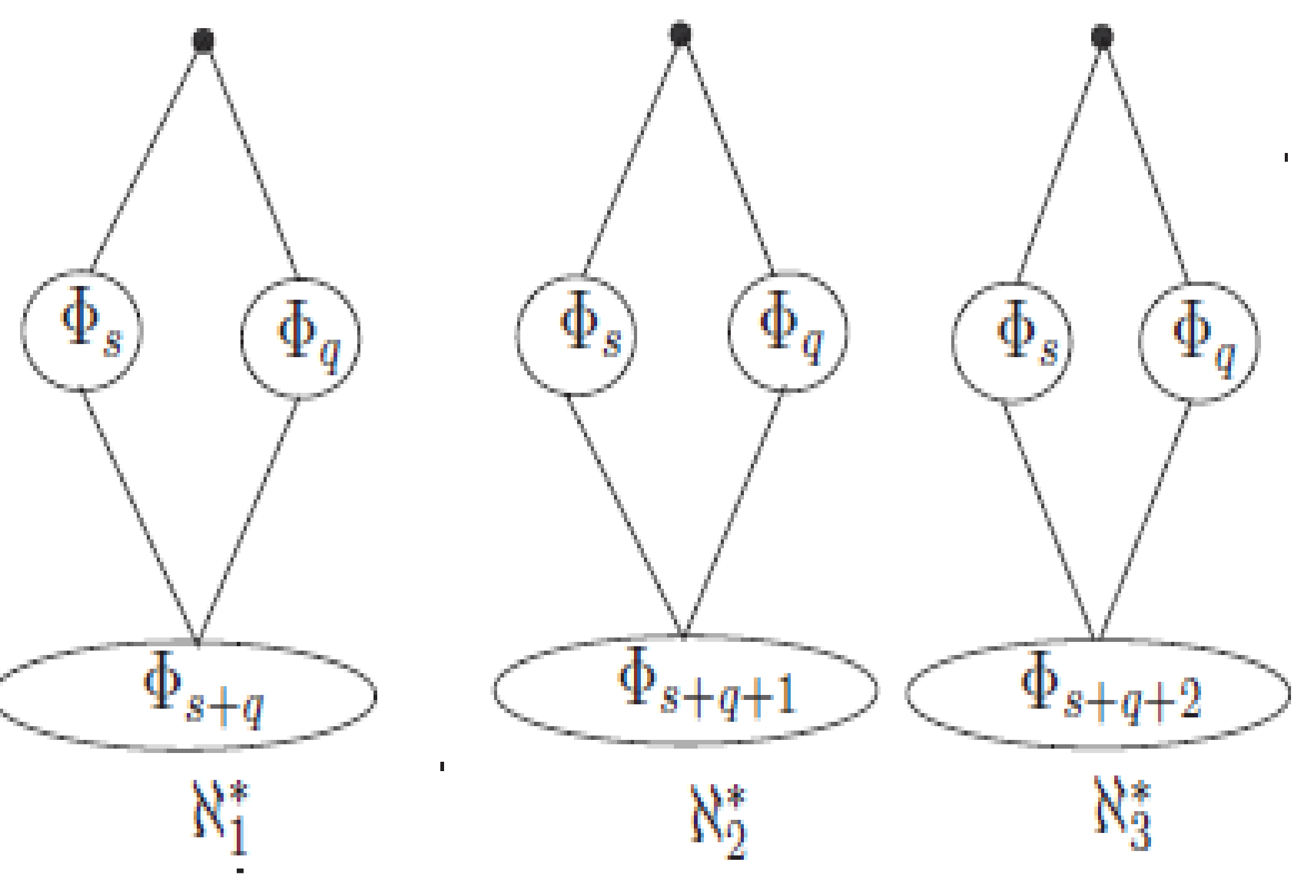
as depicted in
Figure 1, with
and
. It can be noticed that a matching number in
is at least
. Thus,
and
. Due to
, one can build a new network, say
, which is determine by keeping
in such a way that first delete entire links among
and
, and then add entire links among
as well
, see
Figure 1. Thereby, it is easy to see that
.
Assume that
,
let
. We partition
into
as depicted in
Figure 1. Through the direct calculation, for every
one can see easily as
By a similar argument as above, and by comparing the structure of networks
and
, one has
This gives
where the inequalities (
1) and (
2) follows from the fact that
,
. Hence we obtain that
for
, give contradiction. This completes our desired result. □
Keeping in mind the connections between the parameters such as of a bipartite network ℵ which is in fact a connected then, the following result is a straight analogous of Theorem 1.
Corollary 1. A network is the only network having minimum , , among all of the bipartite networks with order n having node cover number or node independence number or link cover number σ.
4. Network Having Minimum -Value, w.r.t
In the current section, networks in having minimum -value is considered. Assume that every member in , has a diametrical path that is to say . Then for any in , there is a partition of with in every node . Named to distance layer in . If then the two distance layers , in are adjacent. Assume that throughout this section. Clearly, .
If , where d is odd, then suppose . Whereas, if , and d is even then, assume .
Lemma 3. For any network with the above partition of , induces an empty network (i.e., containing no link) for each .
Proof. It can be seen that . There must be two paths P and Q such that and , once there exists a link in for some . Meanwhile, is an odd cycle in a network ℵ, if P and Q have no internal node in common, this gives a contradiction. Else, assume that is the last common internal node in P as well as Q. Thereby, again an odd cycle. This contradicts the statement that ℵ is a bipartite. □
Lemma 4. A bipartite network is complete in which .
Proof. By Lemma 3, is an empty network for each . In contrary, suppose that is not a complete bipartite network, then one can construct another network with adding entire potential links among as well as . Due to Lemma 1, one has , for a contradiction. Hence, is a complete bipartite network. Thus, we get our desired result. □
Theorem 2. Assume that ℵ be any network in .
- (i)
If , then . The equality holds if and only if , and .
- (ii)
If , then . The equality holds if and only if , and .
Proof. (i) Due to Lemma 1 we have
, as
. Assume that
,
. Thereby, it is straightforward to see that for every
x(resp.
y) in
(resp.
), we have
. This gives
(ii) Similarly, if
, then due to Lemma 1 one has
, as
. Assume that
. Thereby, one can check it easily that for every
x (resp.
y) in
(resp.
), we have
. This gives
Note that, by the addition of any link(s) between any two nodes, does not increases the node eccentricity. Thus we have
. Using this fact, one has
and
, where
e is any link in
. Thus, we get our desired result. □
Theorem 3. Assume that ℵ belongs to with the minimum -value. If , then for odd d, where is already defined.
Proof. We opt such that its -value is as small as possible. Let is the diametrical path. Thereby, we partition as . To complete the proof, we need the following claim. □
Proof of Claim 1. Note that and . Here, we only need to prove that holds. In the same way, one can show that , we omit the procedure here.
Since, for , the desired result is trivial. In what follows we choose the case , for odd d. In the case , then we opt any and let . Here, is the node partition of ; the choice of ℵ as well as in view of Lemma 4 i.e., for two of the neighbour blocks in induces the complete bipartite subnetwork and for .
By considering the construction of
ℵ and
, it is easy to verify that
,
for every
. This gives
The last inequality (
6), follows by
and
.
which contradicts our selection of
ℵ. Hence,
. In a similar manner one can also prove that
.
Next we show that if d is odd, then . Without loss of generality, we assume that . Then it suffices to show that If this is not true, then Choose let
Then the node partition of
is
and every two adjacent blocks in
induce a complete bipartite network. Based on the constructions of
ℵ and
, it is straightforward to see that
for every
. Thus
This shows a class of networks such that where , which contradicts the option of ℵ. Hence, this completes the proof of Claim 1.
Hence for odd
d, by Lemma 4 and Equation (
5), we obtain that
, as desired. □
Theorem 4. Let ℵ be in with the minimum -value. If , then for even d, where is defined as above.
Proof. Without loss of generality, choose such that its -value is as small as possible. Let is the diametrical path. We partition as . To fulfill all the conditions of the proof, we need to show the following claim.
Proof of Claim 2. By a similar argument as in Claim 1, it is straightforward to show that
. We only need to show that
. Suppose that
. Then, this is enough to see that
. If this is not true, then
. It is routine to check that at least one of
and
contains at least two nodes. Hence, we assume without loss of generality that
. Choose
and let
Then the node partition of
is
and every two adjacent blocks in
give a complete bipartite network. By direct calculation, we have
all other eccentricities are equal. Thus
gives a contradiction to the choice of
ℵ. Hence, we get our desired result.
Hence for even
d, by Lemma 4 and Equation (
7), we obtain that
, as desired. □
In Theorem 3 (resp. Theorem 4), if d is odd (resp. even), the sharp lower bound for the second Zagreb eccentricity is not solved. Hence, we propose the following two research problems.
Problem 1. Let ℵ be in . If d is odd, how to determine the sharp lower bound of the second Zagreb eccentricity.
Problem 2. Let ℵ be in . If d is even, how to determine the sharp lower bound of the second Zagreb eccentricity.
5. The Network with Minimum Zagreb Eccentricity Indices w.r.t (resp. )
This section deals with the sharp lower bounds on Zagreb eccentricity indices among and , respectively.
In , without loss of generality suppose that . In case of , we assume that . Let us construct the networks and . The notion Δ represents union between networks whereas denote an empty network with order s and . The notion is any network operation that links entirely nodes in with the nodes which belongs among the partitions of cardinality in (resp. in ). Similarly, an operator represents a network operation which joins entirely nodes in with nodes that belong to in (resp. in ). It can be noted that the operator is expressed only if and .
Lemma 5. Let and be two networks. Then
- (i)
- (ii)
If then
Proof. Assume that
belongs to
ℵ and
belongs to
, respectively. Here
ℵ and
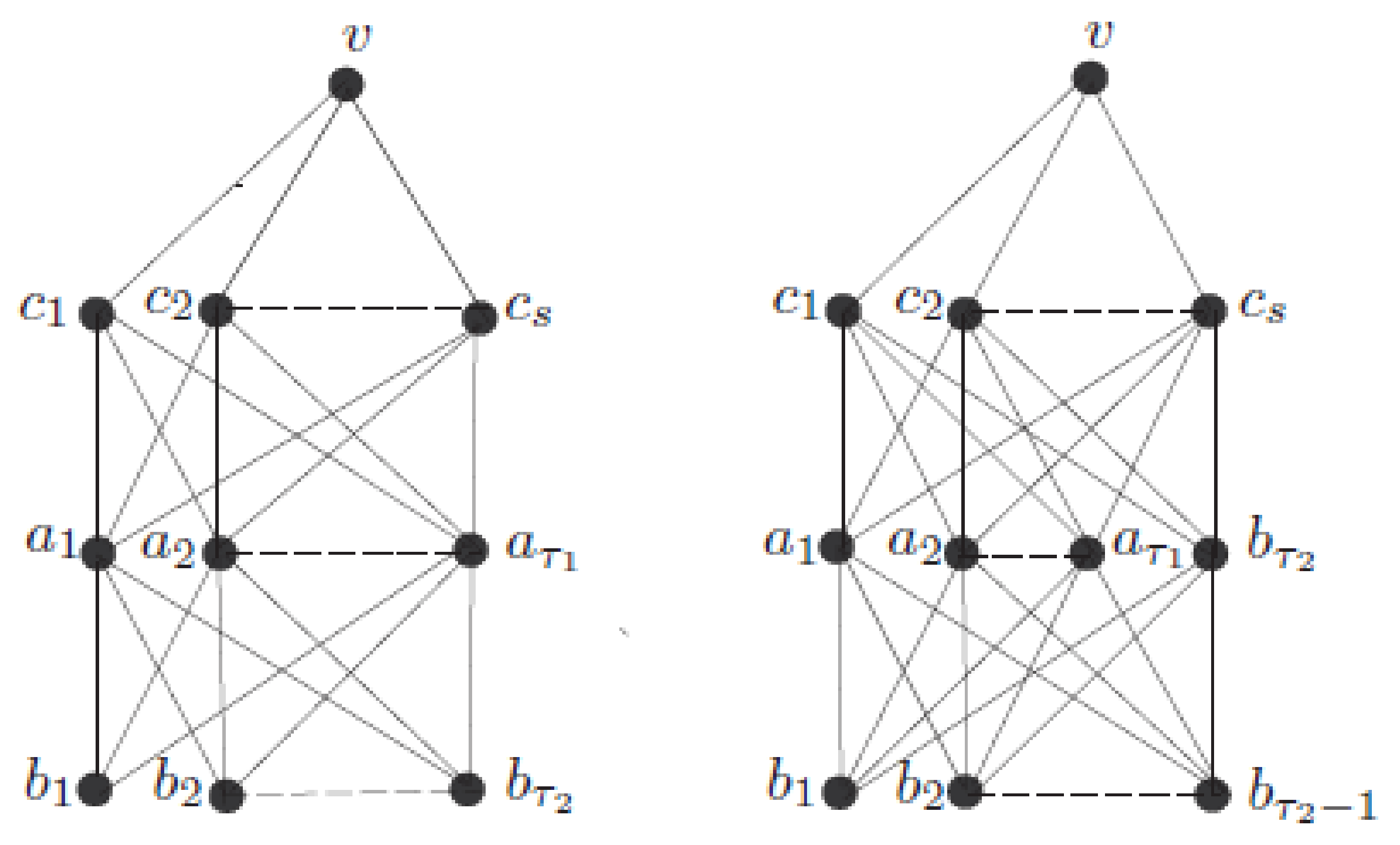
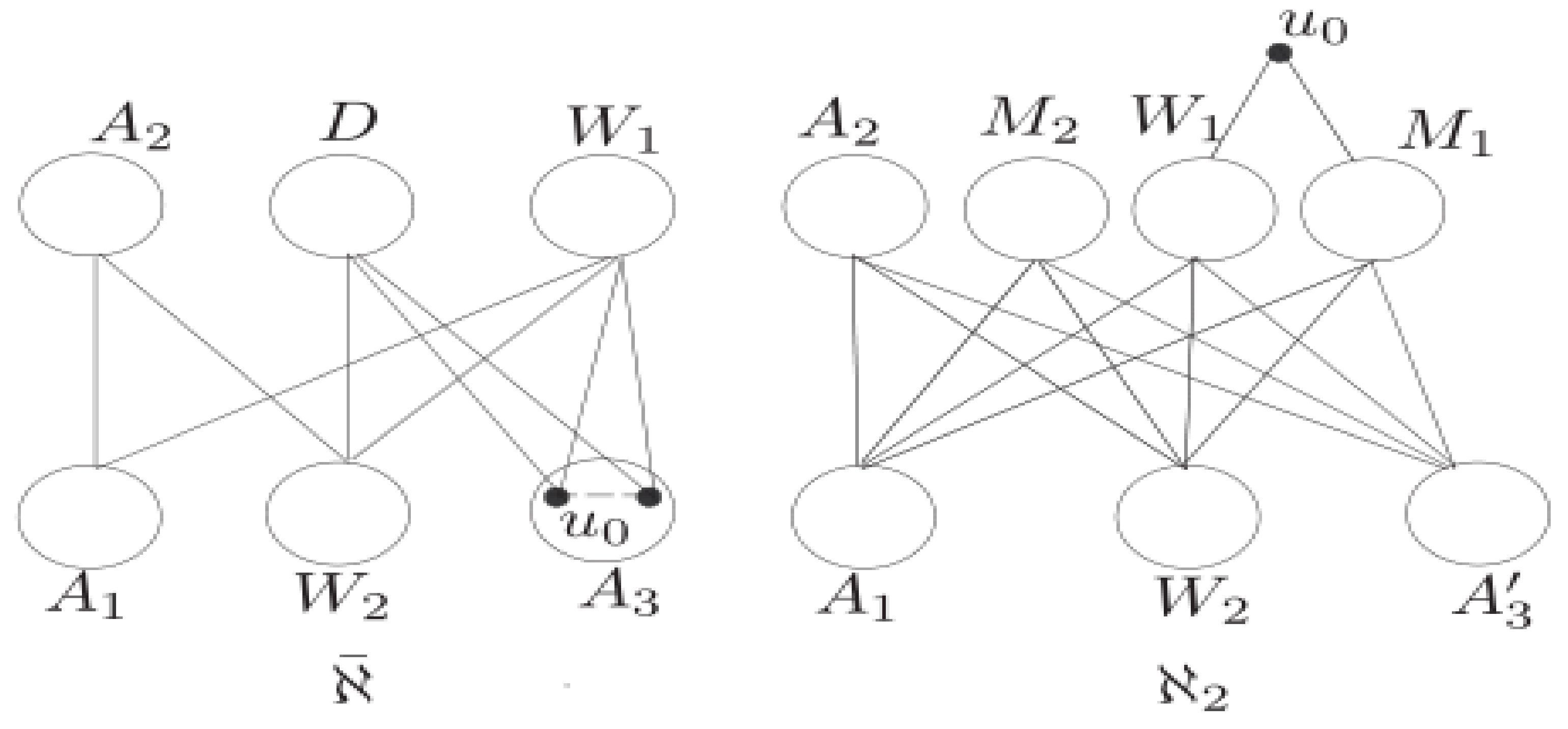
are depicted in
Figure 2. We partition
with
, where
,
and
.
By direct calculation we have
all other eccentricities are equal. Thus
Hence, holds.
Now we prove
. By direct calculation we have
,
,
, all other eccentricities are equal. Thus
This completes the proof of
. □
Corollary 2. Let and be two networks. Then
- (i)
- (ii)
The equality holds in both cases if and only if
Proof. Let and . We partition with , where , and .
By direct calculation we get
all other eccentricities are equal. Thus
Hence, holds.
Now we prove
. By direct calculation we have
all other eccentricities are equal. Thus
Hence, we get our desired result. □
Lemma 6. Assume and be the networks. Then
- (i)
- (ii)
Proof. (i) Let us denote
by
ℵ and
by
. We partition
with
. We define
and
as
,
and
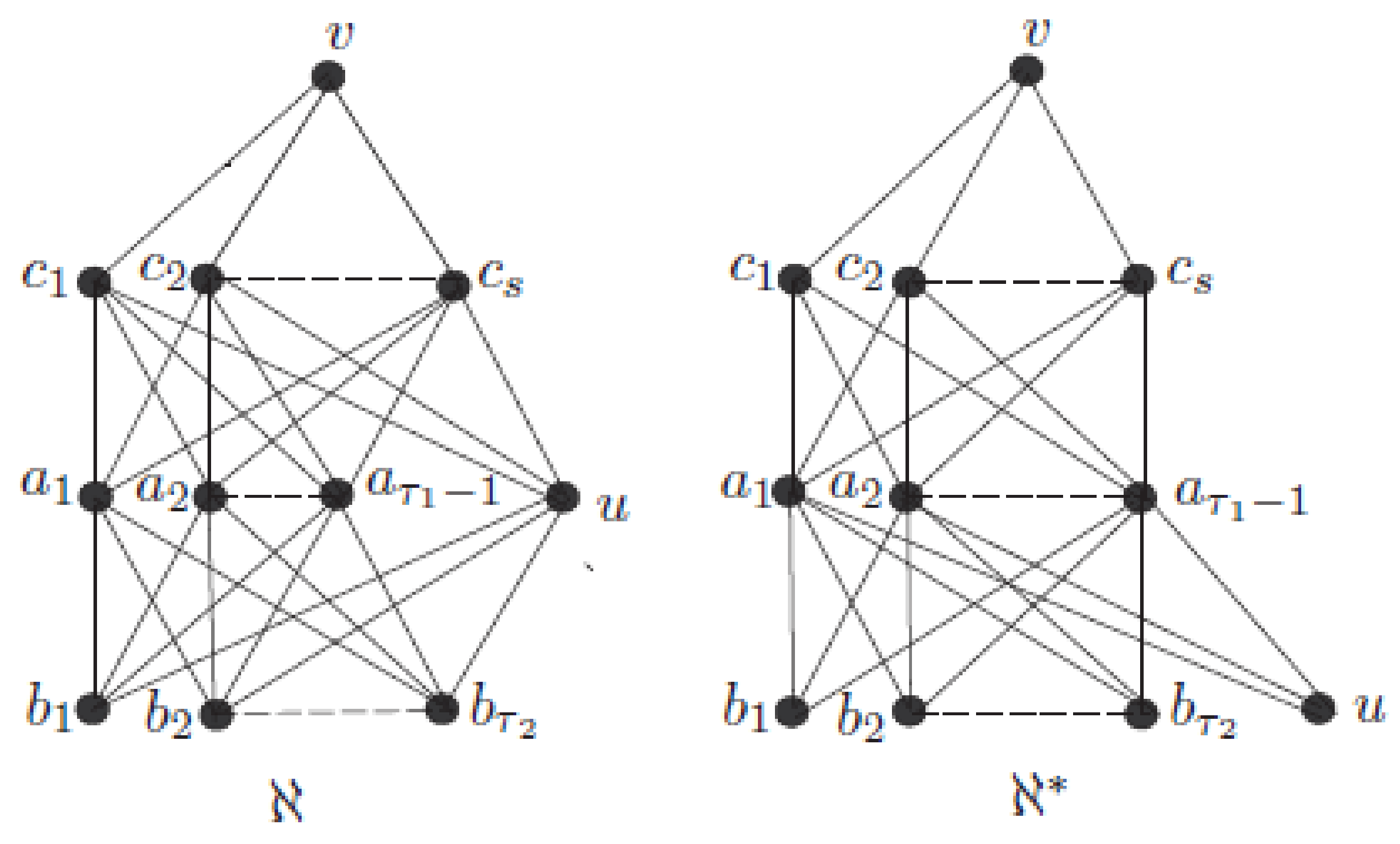
, respectively (see
Figure 3).
Then by direct calculation we have
all other eccentricities are equal. Thus
This completes the proof of
.
Similar to
, let us denote
by
ℵ and
by
. We partition
with
. We define
and
as
,
and
(see
Figure 3).
Then by direct calculation we have
,
,
all other eccentricities are equal. Thus
The last inequality holds as . This completes the proof of . □
Corollary 3. Let , and be the networks. Then
- (i)
If then The equality holds if and only if .
- (ii)
If then with equality if and only if .
Proof. (i) Let us denote by ℵ and by . We partition with , where and . Then by direct calculation we get , , , ,
This gives
This completes the proof of
.
Let us denote
by
ℵ and
by
. We partition
with
, where
and
. Then by direct calculation we get
,
,
,
This gives
This completes the proof of
. □
Lemma 7. Let and has two nontrivial components, where W is any node-cut set of order s in ℵ, then ℵ cannot be the network with minimum Zagreb eccentricity indices in
Proof. Assume that
and
are two nontrivial components of
having the two partitions
and
, simultaneously. Suppose that
be the two partitions of
W which is induced from the bipartition of
ℵ. Next, we join entire links among all the nodes of
and
,
and
,
and
we get a network
which implies that
,
. Therefore we suppose that
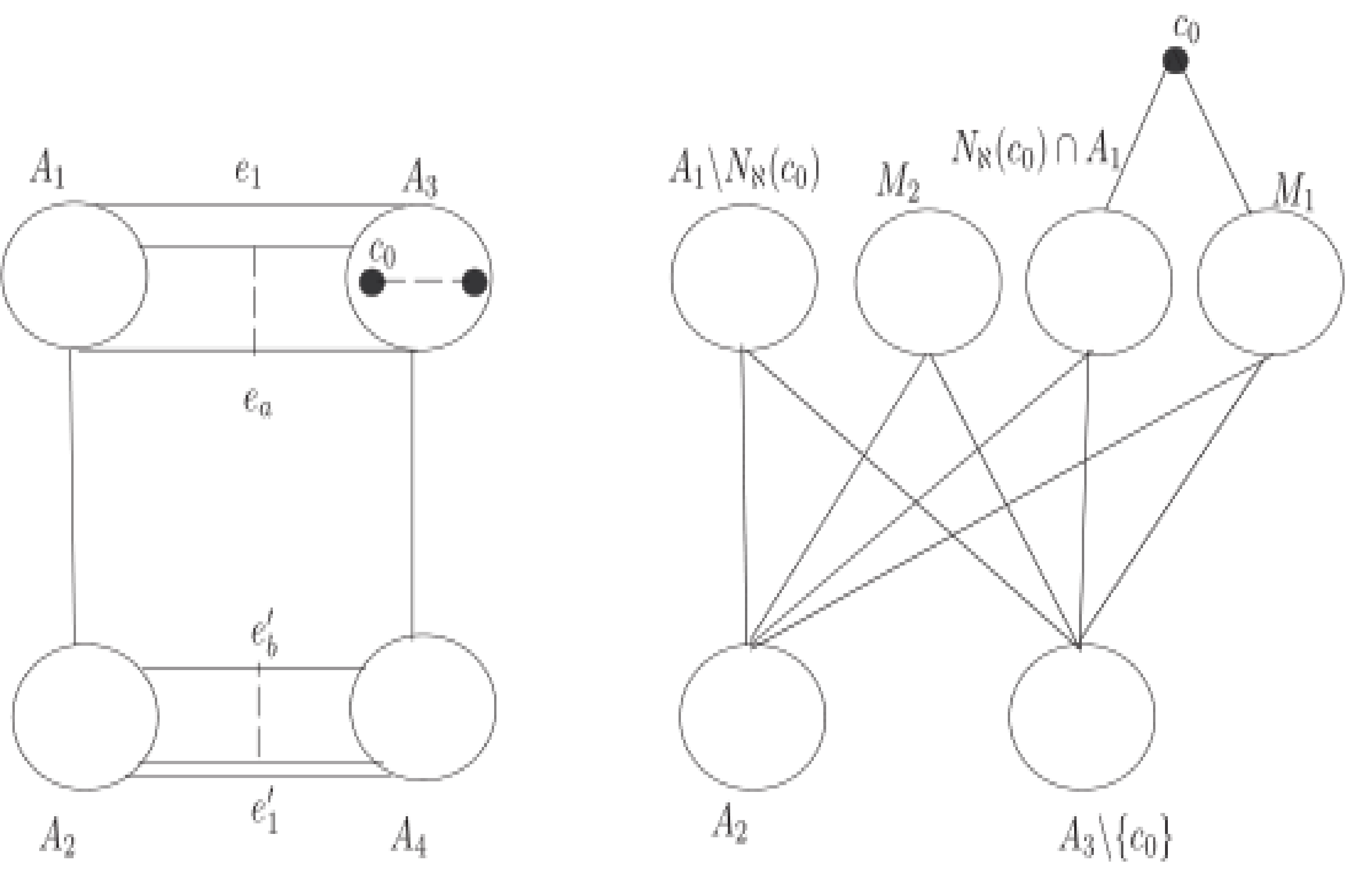
; see
Figure 4.
If it is possible that there exists any node
w in
in such a way that
, in this situation we can obtain a complete bipartite network inside the nodes of
. Hence, it is easy to see that we can get a network in
which has smaller Zagreb eccentricity indices. Thereby, one can see that every node inside of
having degree more than
s. Without loss of generality,
,
,
,
,
,
. Therefore, one can opt a node
and perceive that
, since
is the overall amount of links which join
with the nodes of
. Note that
represents the node-cut set with order
s, hence
,
. Assume that
without loss of generality, note that
,
and
. Now, we opt a subset
of
in such a way
hence,
. Let
It is routine to check that
having bipartition
. The quantity
and
with
, and
. Here,
is depicted in
Figure 5. Notice that, for
By direct calculation we get
,
,
,
,
,
,
All other eccentricities are equal. Thus
By the similar argument as above, and by comparing the structure of networks
ℵ and
one can see easily that
,
,
,
,
,
,
,
,
.
,
,
,
,
,
,
,
,
,
,
,
,
,
All other eccentricities are equal. Thus
□
Lemma 8. Let and has two nontrivial components, which implies that is any link cut-set of order t in ℵ. Then ℵ may not be the network having minimum Zagreb eccentricity indices in .
Proof. Assume that
and
be two nontrivial components of
having the two partitions
and
, respectively. Now joining all possible links between the nodes of
and
,
and
yields a network, say
, in
such that
;
. Therefore, in
we suppose that
; see
Figure 5.
It can be noticed that for some node one has . For the existence of some node w in ℵ we have . By adding entirely probable links inside the subnetwork of ℵ which is induced from the nodes of , then finally we would reach at a two partition network . For , we have ; in view of Lemma 1. Thereby, we suppose that every node in ℵ has degree more than t.
Assume that and the amount of links among and (respectively and ), in ℵ, is i(resp. j).
Hence, it is easy to see that and .
Choose any node
and perceive that
, the quantity
is the overall amount of links which join
with the nodes belongs to
. It can be noticed that
is any link-cut set with size
, for further detail one can see
Figure 6. Hence,
. Moreover, we opt a subset
of
which satisfies
. Let
It is easy to see that
, for detail one can see the construction of
Figure 5.
We denote the sets which are assumed to be the end-nodes of the links of in and by , and , respectively. Let .
Moreover
and note that
. By direct calculation we get
,
All other eccentricities are equal. Thus
By the similar argument as above, and by comparing the structure of networks
and
one can see easily that
All other eccentricities are equal.
□
Theorem 5. Let ℵ be a network in with minimum and with and respectively. If n is odd then , otherwise . In Fig.6, we have shown the networks and .
Proof. Assume that ℵ be a network with minimum Zagreb eccentricity indices in . Let W be any node cut of ℵ which contains s number of nodes. By removing these nodes gives the components in . The quantity t is greater than or equal to 2. Meanwhile, if any component of of has at least two nodes, then that should be a complete bipartite. Similarly, if few component in are singleton, that is to say , as a result u is connected to entire nodes of W; else . Thus, the subnetwork is induced from W which contains no links, and belongs with the alike partition of ℵ. To proceed further we need we need the following two cases.
Case 1. Entire components of being singletons. In this case, one has for or It is straightforward to see that, if n is odd then , and otherwise as desired. To prove the first Zagreb eccentricity index, let us assume that Then by Corollary 3(i), , this gives a contradiction to the minimality in ℵ. To prove the second Zagreb eccentricity index, let Then by Corollary 3(ii), , which also contradicts the minimality of ℵ. Thus, not every of the components in are supposed to be singletons.
Case 2. Only single component in that is to say , containing at least two nodes. In such situation, containing exactly two components, else there is a complete bipartite network which consists the nodes of . Hence, one can construct a new network from ℵ having smaller Zagreb eccentricity indices such that , which gives a contradiction. Let are the two components in . Due to Lemma 8, we have or . Suppose that . In such scenario u is joining by entire nodes of W, and every node in W is joining each node of these are under the same partition as that of u. It can be noticed that ℵ be any network with minimum Zagreb eccentricity indices, hence due to Corollary 3, in few and . One can notice that , else s may not be the node connectivity in ℵ. The result follows for if ; and if , then the result follows for . Again, if , then applying Lemma 5(ii) multiple times we have , for odd n, similarly for even n. At last, if , then by applying Lemma 7(ii) multiple times, one has ℵ in one hand or on the other hand depending on even n or odd n. This gives our desired result. □
The below result is similar to the proof of Theorem 5, so we omit its proof.
Theorem 6. Assume that ℵ is any network in with minimum and with and respectively. For odd n we have , otherwise . The networks and are shown inFigure 6.