


Abstract
Let G be a connected, undirected and simple graph. The distance Laplacian matrix is defined as , where denotes the distance matrix of G and denotes a diagonal matrix of the vertex transmissions. Denote by the distance Laplacian spectral radius of G. In this paper, we determine a lower bound of the distance Laplacian spectral radius of the n-vertex bipartite graphs with diameter 4. We characterize the extremal graphs attaining this lower bound.
MSC:
05C50
1. Introduction
The distance Laplacian and distance signless Laplacian matrices of a graph G proposed by Aouchiche and Hansen [1] are defined as and , respectively. Much attention has been paid to them since they were put forward. Aouchiche et al. [2] described some elementary properties of the distance Laplacian eigenvalues of graphs. Niu et al. [3] determined some extremal graphs minimizing the distance Laplacian spectral radius among bipartite graphs in terms of the matching number and the vertex connectivity, respectively. Nath and Paul [4] focused on the graph whose complement is a tree or a unicyclic graph and considered the second-smallest distance Laplacian eigenvalue. Lin and Zhou [5] determined some extremal graphs among several classes of graphs. Tian et al. [6] proved four conjectures put forward by Aouchiche and Hansen in [2]. One can refer to [7,8,9,10,11] for more details on the distance signless Laplacian spectral radius of graphs.
Although lots of conclusions have been obtained, many more problems remain unsolved. For instance, there are few papers focusing on the distance (signless) Laplacian spectral radius of graphs in terms of diameter, an important parameter of graphs. For adjacency matrices of graphs, several conclusions with respect to the diameter have been derived (e.g., [12,13,14]). In [12], the authors determined some extremal graphs with small diameter. Generally, the communication network is organized with small diameter to improve the quality of the service on the networks. Motivated by this, in the present paper, we deduce a lower bound of the distance Laplacian spectral radius among bipartite graphs with diameter 4, and we hope that it could be used to address a general case.
This paper is arranged as follows. In Section 2, some elementary notions and lemmas applied in the next parts are presented. In Section 3, the lower bound for the distance Laplacian spectral radius is obtained for bipartite graphs with diameter 4. Moreover, the extremal graph attaining the lower bound is determined.
2. Preliminaries
All graphs considered in this paper are undirected, connected and simple. By , we denote the vertex set of G, and the order of G is . Denote by the set of vertices adjacent to u. If for , then they are called twin points. Generally, a subset is called a twin point set, if for any . The distance between , denoted by , is the length of the shortest path between u and v. The diameter of graph G, written as (d for short), is the maximum distance among all pairs of vertices of G. The chromatic number of G means the least number of colors required to color all the vertices of G such that each pair of adjacent vertices has different colors. The spanning subgraph of G is obtained by deleting some edges from G with order invariable. The transmission of a vertex u is referred to as the sum of the distances of u to all other vertices of , i.e., . means the maximal vertex transmission of G. Let be the set of all n-vertex bipartite graphs with diameter d and the set of all n-vertex graphs with chromatic number k.
Suppose . The distance matrix of G is an symmetric real matrix with as the -entry. Let the diagonal matrix , called the vertex transmission matrix of G, be
The largest eigenvalue of the distance Laplacian matrix is called the distance Laplacian spectral radius, written as . For any matrix M, always denotes the largest eigenvalue of M.
A vector can be considered as a function defined on , which maps to , i.e., . Thus, for ,
It is clear that is an eigenvector corresponding to the eigenvalue zero of . Thus, if is an eigenvector of corresponding to a nonzero eigenvalue, then .
Lemma 1
(Rayleigh’s Principal Theorem, p. 29, [15]). Let A be a symmetric real matrix and u any unit nonzero vector. Then with equality if and only if u is the eigenvector corresponding to .
Lemma 2
(Courant-Weyl Inequality, p. 31, [15]). Let and be two symmetric real matrices of order n. Then
Lemma 3
(Interlacing Theorem, p. 30, [15]). Suppose A is a symmetric real matrix of order n and M a principal submatrix of A with order . Then
The next lemma follows from Lemma 3 immediately.
Lemma 4
(Proposition 2.11, [6]). Let G be an n-vertex graph and M a principal submatrix of with order . Then .
Lemma 5
(Theorem 3.5, [1]). Suppose is the graph obtained from G by adding an edge joining u and v. Then
3. The Lower Bound of the Distance Laplacian Spectral Radius of Graphs among
If , then there exists a partition of such that and for and .
Lemma 6
(Lemma 2.1, [12]). Let with a vertex partition described as above. Then induces an empty graph (i.e., containing no edge) for each .
Lemma 7.
Let and . If when any edge e is added to G, then and the induced subgraph is a complete bipartite graph.
Proof.
From Lemma 6, it is clear that is a complete bipartite graph. Moreover, let and . Assume, on the contrary, that , then the graph , a contradiction. □
Remark 1.
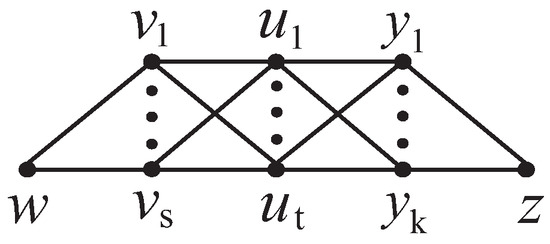
Denote a subset of by , consisting of all the graphs satisfying Lemma 7. For instance, if , then G is of the form shown in Figure 1. Then the partition of can be written as , , , and , where and .
Figure 1.
A graph .
Before giving the main conclusion of this section, we first investigate the properties of the eigenvector corresponding to for .
Let and the partition of be arranged as in Remark 1. Without loss of generality, suppose (i.e., ).
Lemma 8.
Let the eigenvector corresponding to be x. Then
Proof.
Since the proofs of the three results are parallel, here we only give the first one. As the vertices of are twin points (if ), for each , and thus . Considering the characteristic equations indexed by and , it is obtained that
Then it follows that . From Lemma 4, we easily obtain
Thus, follows. □
For the eigenvector x in Lemma 8, suppose , , , and . Then x can be written as
Lemma 9.
Let x be as just described. If (i.e., ), then
Proof.
Applying Lemma 8, the characteristic equation can be simplified in the conventional form as follows:
where and .
The sum of the first equality and the fifth one gives
Since and , we have
Take a principal submatrix M of , where Note that for . Then, applying Lemma 4,
Thus, we obtain , from (3). Similarly, from the second and the fourth equalities in (1), it follows that
Since and , , . The fourth equality in (1) minus the second one indicates that
If , then . Further, from (4), it follows that (note that ). Recalling that , we know , and thus x is a zero vector, a contradiction. Hence, . Similarly, , which implies . The proof is complete. □
For convenience, denote the graph by with vertex partition shown in Remark 1. We next determine the unique extremal graph minimizing the distance Laplacian spectral radius among .
Theorem 1.
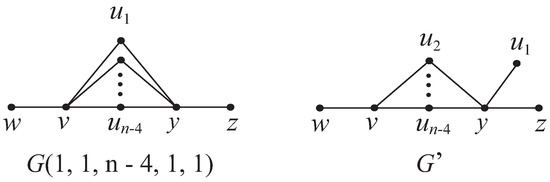
The graph in Figure 2 is the unique graph with minimum distance Laplacian spectral radius among .
Figure 2.
The graph and graph .
Proof.
Let with and . Without loss of generality, assume that . We proceed by proving the following three claims, which will imply the conclusion.
Claim 1. If in graph , then let . We claim that .
In graph , let and be expressed as that in Remark 1. Then we easily obtain
and the distance Laplacian matrix of is
Further, we have
where
From the above, we say that the largest eigenvalue of is the spectral radius of . In fact, from Lemma 3, and , and are the eigenvalues of apart from those of from (6). Furthermore, and by (5) clearly. Thus, holds.
For graph , we obtain the matrices and by substituting and for s and k in and , respectively. Analogously, we have . Denote the characteristic polynomials of and by and , respectively. Next, we are aimed at proving
By using MATLAB, we obtain
Let Then the derivative of is
with symmetry axis . Since , in graph , and thus from Lemma 4. By simple calculation, we obtain , and since , we have
We now say that is strictly increasing for . Moreover, from , it follows that
Applying (8), we can easily prove that . Assume on the contrary that (noting that since and ). Observing that tends to infinity when tends to infinity (as the leading coefficient of is 1), we can find a sufficiently large such that . As is a continuous function, from and , it follows that for a positive number p between and q, which is a contradiction to the fact that is the largest root of . Therefore, .
Claim 2. Assume , where and . Then we claim that .
Let the unit eigenvector corresponding to be
By Rayleigh’s principle,
Next, we show that . First, if , then from Lemma 9, it follows that and , and thus
On the other hand, suppose and in (10). Then . Substitute for t in (4), and then follows by applying . In addition, by replacing s, k and t with , and in (2), respectively, it gives
and hence for the reason that Recalling that , we have , and then eigenvector x is the zero vector, a contradiction. Hence, if , then
In summary, holds.
Claim 3. If in graph , then let . We claim that .
Let the unit eigenvector corresponding to be
Then by Rayleigh’s principle and Lemma 9,
Now we are in a position to complete the proof of the theorem.
For graph , suppose . If and , then by Claim 1,
with equality if and only if . Furthermore, from Claim 2, we have
On the other side, if and , then by Claim 1,
with equality if and only if . Moreover, from Claim 3,
Finally, from Claim 2, it follows that
For the case of and , from Claim 3, it is straightforward that
This completes the proof. □
From Theorem 1 and Lemma 5, we indicate that if is not a spanning subgraph of , then . In addition, if and in (7), then we obtain by using MATLAB, i.e.,
Thus, we have the following theorem.
Theorem 2.
Let . Then with equality if and only if .
Proof.
Denote the graph by (see Figure 2). First, we show that . Take a principal submatrix from . By simple calculation, . From Lemma 4, it follows that
Thus, we say that for any spanning subgraph of , from Lemma 5.
Hence, now, it is clear from Theorem 1 and the above result that for any graph ,
with equality if and only if . □
4. Conclusions
In this paper, a lower bound of the distance Laplacian spectral radius of the n-vertex bipartite graphs with diameter 4 is obtained. The method used here is helpful for solving the general case and we conjecture that the graph is the unique one minimizing the distance Laplacian spectral radius among n-vertex bipartite graphs with even diameter .
Author Contributions
Conceptualization, L.Q. and L.M.; methodology, W.Z.; formal analysis, L.L.; writing—original draft preparation, L.Q.; writing—review and editing, W.Z. and L.L.; supervision, L.M.; project administration, L.M.; funding acquisition, L.M. All authors have read and agreed to the published version of the manuscript.
Funding
This work was supported by the 2021 Visiting Scholar “Teacher Professional Development Project” in the University of Zhejiang Provincial Department of Education (Grant No. FX2021169).
Institutional Review Board Statement
Not applicable.
Informed Consent Statement
Not applicable.
Data Availability Statement
Not applicable.
Conflicts of Interest
The authors declare no conflict of interest.
References
- Aouchiche, M.; Hansen, P. Two Laplacians for the distance matrix of a graph. Linear Algebra Appl. 2013, 439, 21–33. [Google Scholar] [CrossRef]
- Aouchiche, M.; Hansen, P. Montréal, Some properties of the distance Laplacian eigenvalues of a graph. Czechoslov. Math. J. 2014, 64, 751–761. [Google Scholar] [CrossRef]
- Niu, A.; Fan, D.; Wang, G. On the distance Laplacian spectral radius of bipartite graphs. Discret. Appl. Math. 2015, 186, 207–213. [Google Scholar] [CrossRef]
- Nath, M.; Paul, S. On the distance Laplacian spectra of graphs. Linear Algebra Appl. 2014, 460, 97–110. [Google Scholar] [CrossRef]
- Lin, H.; Zhou, B. On the distance Laplacian spectral radius of graphs. Linear Algebra Appl. 2015, 475, 265–275. [Google Scholar] [CrossRef]
- Tian, F.; Wong, D. Jianling Rou, Proof for four conjectures about the distance Laplacian and distance signless Laplacian eigenvalues of a graph. Linear Algebra Appl. 2015, 471, 10–20. [Google Scholar] [CrossRef]
- Aouchiche, M.; Hansen, P. On the distance signless Laplacian of a graph. Linear Multilinear Algebra 2016, 64, 1113–1123. [Google Scholar] [CrossRef]
- Xing, R.; Zhou, B. On the distance and distance signless Laplacian spectral radii of bicyclic graphs. Linear Algebra Appl. 2013, 439, 3955–3963. [Google Scholar] [CrossRef]
- Xing, R.; Zhou, B.; Li, J. On the distance signless Laplacian spectral radius of graphs. Linear Multilinear Algebra 2014, 62, 1377–1387. [Google Scholar] [CrossRef]
- Das, K.C. Proof of conjectures on the distance signless Laplacian eigenvalues of graphs. Linear Algebra Appl. 2015, 467, 100–115. [Google Scholar] [CrossRef]
- Lin, H.; Lu, X. Bounds on the distance signless Laplacian spectral radius in terms of clique number. Linear Multilinear Algebra 2015, 63, 1750–1759. [Google Scholar] [CrossRef]
- Zhai, M.; Liu, R.; Shu, J. On the spectral radius of bipartite graphs with given diameter. Linear Algebra Appl. 2009, 430, 1165–1170. [Google Scholar] [CrossRef][Green Version]
- van Dam, E.R. Graphs with given diameter maximizing the spectral radius. Linear Algebra Appl. 2007, 426, 454–457. [Google Scholar] [CrossRef]
- van Dam, E.R.; Kooij, R.E. The minimal spectral radius of graphs with a given diameter. Linear Algebra Appl. 2007, 423, 408–419. [Google Scholar] [CrossRef]
- Brouwer, A.E.; Haemers, W.H. Spectra of Graphs; Springer: New York, NY, USA, 2012. [Google Scholar]
Publisher’s Note: MDPI stays neutral with regard to jurisdictional claims in published maps and institutional affiliations. |
© 2022 by the authors. Licensee MDPI, Basel, Switzerland. This article is an open access article distributed under the terms and conditions of the Creative Commons Attribution (CC BY) license (https://creativecommons.org/licenses/by/4.0/).