


Abstract
Generalized Bernstein-like functions (gB-like functions) with different shape parameters are used in this work. Parametric and geometric conditions in generalized form are developed. Some numerical examples of the parametric continuity (PC) and geometric continuity (GC) constraints of generalized Bézier-like curves (gB-like curves) are analyzed with graphical representation. Bézier-like symmetric rotation surfaces are constructed by gB-like curves. Vase and Capsule Taurus surfaces are modeled with the help of symmetry. The effect of shape parameters on surfaces are also analyzed. The illustrating figures reveal that the proposed curves and surfaces yield an accommodating strategy and mathematical depiction of Bézier curves and surfaces, allowing them to be a beneficial way to describe curves and surfaces.
Keywords:
gB-like functions; gB-like curves; symmetric; ordinary Bézier curves; geometric properties; PC; GC MSC:
65D17; 68U07; 93B51; 41A15; 94C30
1. Introduction
The idea of curves and surfaces with the aid of parametric polynomials has a good impact on research in computer graphics (CG) and computer aided geometric design (CAGD). The primary goal of this research is to create curves that are both user-friendly and worthwhile. These concepts are used in many fields, particularly in industrial and medical fields. The Bézier curves are among most familiar mathematical depictions of surfaces and curves. These curves are represented by two mathematicians, Pierre Bézier and Paul de Casteljau, as given in Farin [1]. These are mostly helpful in many areas of CAGD, including computer-aided manufacturing (CAM) and computer-aided design (CAD) systems. With the help of this, we are able to manage and evaluate the curves. Farin et al. [2] provided a comprehensive coverage of the fields, such as: geometric modeling, CAD, and scientific visualization, or CAGD. The Bézier models are good methods for generating new curves and surfaces in CAGD. Most of them have their own potential, but they have one common paucity in their models. After defining the functions, the curves are committed through their control points. To resolve the Bézier curve’s insufficiency, some researchers presented new models that are interconnected to the Bézier model by adding some shape controls into the functions [3,4,5]. These new models also meet the Bézier curve properties and remain in their adjustable form. At the end of the 1950s, de Casteljau was the first mathematician to present the Bézier surfaces along the triangular domain, and Boehm sustained his work and results, see [6].
Many authors did more work on the Bézier model in the 1970s and 1980s [7,8,9,10,11]. The cooperation of such authors clarified the triangular Bézier surface theory. Many authors are drawn to the triangular surface modeling approach because of its enormous potential for creating complex forms. However, after the Bézier surface idea was proven to be accurate, other researchers looked into how to improve the triangular Bézier structure [12,13,14,15]. In [16], a trigonometric Bézier curve of degree four having single shape control was introduced by Uzma et al. Users can update the shape of the curve by simply updating the shape parameter’s value without altering the control points. By using this, they gave an accurate shape of ellipse. Azhar et al. established a new generalized basis in [17]. This is similar to the cubic Bézier curve. They generalized the basis function up to n degrees and discussed its geometric properties. They also gave conditions of PC as well as GC in generalized form.
Sidra et al. [18] created a generalized basis functions and generalized Bézier curves in trigonometric form with two different shape parameters. The geometric features of these basis functions and curves are similar to those of traditional Bézier curves. These generalized trigonometric Bézier curves satisfied the requirements both for continuity of geometric and parametric. In [19], Qin et al. introduced a new basis function with shape parameters. They constructed different curves and surfaces as an application. Young et al. [20] showed that the best constrained degree reduction of a given Bézier curve f of degree from n to m with -continuity at the boundary in -norm is equivalent to the best weighted Euclidean approximation of the vector of Bernstein-Bézier coefficients of f from the vector of degree raised Bernstein-Bézier coefficients of polynomials of degree m with -continuity at the boundary. Ammad et al. [21] constructed the biquintic Bézier surfaces. They discussed the geometric properties of surfaces and provide some surfaces with shape adjustment. Hu et al. [22] introduced Bézier-like surfaces with separate shape controls, which have the similar geometric properties as Bézier-like curves. They controlled the surfaces by just altering the value of shape parameters. They gave conditions for continuity, beta continuity, and Farin-Boehm continuity among two consecutive developed surfaces of Bézier-like. They analyzed few characteristics and applications of the developed Bézier-like surfaces. In [23], Rachid et al. presented a weighted least squares approximation of Bézier coefficients with factored Hahn weights provided the best constrained polynomial degree reduction with respect to the Jacobi -norm. In [24], Hu et al. introduced the generalized form of Bézier surfaces and with different shape controls and mentioned its applications in engineering. They also discussed PC of the proposed curve.
The differences/advantages/disadvantages of proposed gB-like functions and gB-like curves and their shape parameters and are listed in Table 1.

Table 1.
Contrasting research proposals.
The following are some of the contributions made in this work:
- Some geometric properties of gB-like functions and gB-like curve with two shape controls are discussed;
- Developed PC and GC requirements in general form;
- PC and GC are examined through some numerical examples;
- Bézier-like symmetric rotation surfaces are discussed;
- Some surfaces i.e., vase and torus capsule, are constructed by symmetry;
- The effect of shape controls on symmetric surfaces is discussed.
The research article can be summarized as follows: Some preliminaries and geometric characteristics of gB-like functions and gB-like curves with two different shape controls are discussed in Section 2. The PC and GC requirements are constructed in Section 3. Some numerical examples of these requirements are also discussed in this section. In Section 4, Bézier-like symmetric rotation surfaces are discussed. Vase and capsule taurus surfaces are also modeled in this section. This section also looks at the impact of shape controls on symmetric surfaces. The final portion contains our concluding remarks.
2. Some Preliminaries
2.1. Bernstein-like Functions
This section covers the definition and features of gB-like functions having two different shape controls.
Definition 1.
Given , for , the functions
are known as quadratic Bernstein-like functions as given in [25].
For any integer , the functions are recursively explained by
where are known as gB-like functions of degree n [25]. The gB-like functions becomes zero when or . Figure 1 shows the graphs of different degree of gB-like functions.
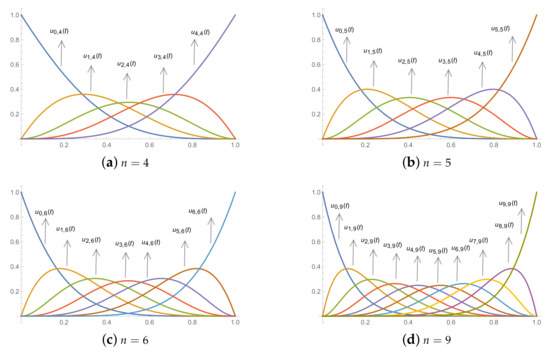
Figure 1.
gB-like functions.
Theorem 1.
The characteristics of gB-like functions are as follows:
- 1.
- Degeneracy: By putting , gB-like functions converts into the classical bernstein basis function;
- 2.
- Non-negativity: For , the functions is non-negative;
- 3.
- Partition of unity: All gB-like functions of degree n add up to one;
- 4.
- Symmetry: The functions are symmetric i.e.,
- 5.
- End points:Given ;
- 6.
- Derivative at the corner points:For ;and
- 7.
- Linear Independence:The gB-like functions are linearly independent, i.e., iff .
Proof.
All these properties have been proved in [25]. □
2.2. Construction and Properties of the Bézier-like Curve
Definition 2.
Given control points , the expression
is known as a gB-like curve of degree n, where are the gB-like functions (2).
Most of the advantages of ordinary Bézier curves such as convex hull property, geometric invariance, symmetry, end points and shape adjustable property, are taken over by gB-like curves. All these properties have been proved in [25].
Figure 2 displays a comparison between gB-like curves, the classical Bézier curve and the classical rational Bézier curve. These quintic curves are formed at the same control points. The blue curve shows classical quintic rational Bézier curve, the red curve shows the classical quintic Bézier curve and the cyan, green and black curves are quintic gB-like curves with different values of shape parameters. It is clear from the figure that our proposed model is better than the classical Bézier curve and rational Bézier curve because we can modify the curve as user required by just changing the values of shape parameters. Due to their fixed form and position relative to their control polygon, standard Bézier curves still have significant drawbacks [1]. Practical implementations of Bézier curves in geometric modeling and engineering are limited owing to their drawbacks, and much work has been done to alleviate these problems [16,17,18,25]. By including form control parameters into the Bézier technique, the control over the shape and location of curves is improved. Another drawback of traditional Bézier curves is their polynomial representation. As a result, numerous researchers are looking for a solution to this problem in a non-polynomial function space. Thus the proposed model is better than the existing techniques due to its computationally economical (see Tables 2 and 3 in [25]).
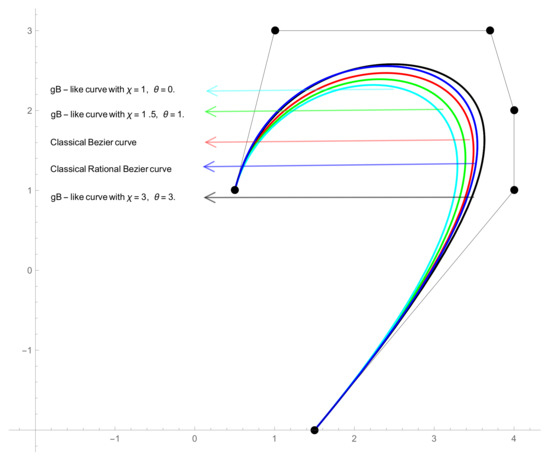
Figure 2.
Comparison.
3. The Continuity of gB-like Curve
3.1. Continuity Conditions
The requirements of continuity between two gB-like curves segments can be seen below:
Lemma 1.
[19] For Bézier-like curve with control points where and with control points , the necessary and sufficient constraints (N&SC) for PC shall be determined by:
- i.
- for continuity of ;
- ii.
- , for continuity of ;
- iii.
- , , for continuity of .
Lemma 2.
[19] For Bézier-like curve with control points where and with control points , the N&SC for GC curves are given by:
- i.
- for continuity of ;
- ii.
- , , for continuity of ;
- iii.
- , , and the curvaturefor continuity of .
With the help of terminal characteristic of Bézier-like curve, the following theorem demonstrates the continuity conditions of the gB-like curve.
Theorem 2.
The N&SC for PC of two gB-like curve segments with control points where and with control points , are defined by:
- i.
- , for the continuity;
- ii.
- For continuity
- iii.
- For continuity
Proof.
- i.
- It is obvious.
- ii.
- Using continuity condition and Sincewe get
- iii.
- Using continuity conditions , , and . After some simplifications, we can obtain the continuity condition given in Equation (8).
□
Theorem 3.
The N&SC for GC of two gB-like curve segments with control points where and with control points , are defined by:
- i.
- , for continuity;
- ii.
- For continuity,when , the continuity becomes ;
- iii.
- For continuity,
Proof.
- i.
- It is obvious.
- ii.
- Using continuity condition and SinceAfter some simplification, we get
- iii.
- Using continuity conditions and the curvature . The reversal normal vector of and the vice-normal vector of in go in the same path, so the four vectors are the coplanar, such thatConsiderThus, , . From ,and putting in the following equationand the continuity condition (9) can be achieved.
□
3.2. Some Test Examples
In this section, some test examples of PC and GC are presented.
Example 1.
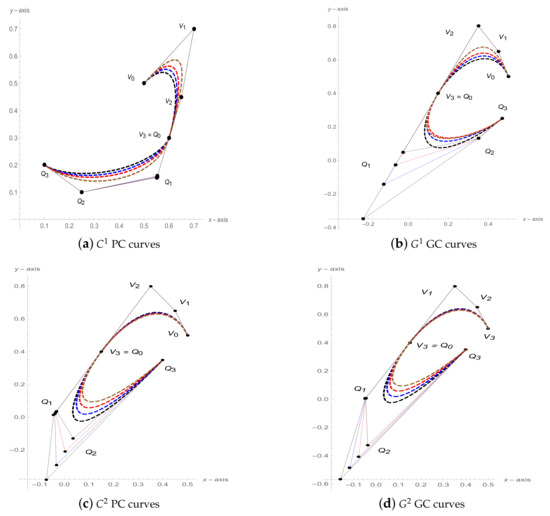
Figure 3a demonstrates the continuity of two cubic Bézier-like curve with different control points and the shape controls and . Using requirements of continuity for the gB-like curve from Theorem 2, the point for every curve segment can be determined as and .
Figure 3.
PC and GC curve modelling.
Example 2.
Figure 3b demonstrates the continuity of two cubic Bézier-like curve segments with different control points , , ,, , and the shape controls , , , , . Using requirements of continuity for the gB-like curve from Theorem 3, the point for every curve segment can be determined as and .
Example 3.
Figure 3c depicts the continuity of two cubic Bézier-like curve segments with control points , , ,, and the shape controls , , , . Using N&SC of continuity for the gB-like curve from Theorem 2, the points and for every curve segment can be determined as and , respectively.
Example 4.
Figure 3d shows the continuity of two cubic Bézier-like curve with control points , , ,, and the shape controls , , , . Using continuity requirements for the gB-like curve from Theorem 3, the control point and for every curve segment can be determined as and , respectively.
4. Construction of Bézier-like Surfaces
Definition 3.
Given an array where , and the tensor product gB-like surfaces could be stated as:
with control points where and are gB-like functions [25] and and are the shape controls for the functions and , respectively.
4.1. Bézier-like Symmetric Rotation Surfaces
Like revolution surfaces, the issue of spinning surfaces on an any three-dimensional axis gives a crucial role in many areas, such as molecular modeling, architectural sketch and computer animation, etc. A curve is rotated around the rotation axis in space to generate the rotation surface, so the azimuth symmetry exists in corresponding surface. In three-dimensional, the spinning axis of a space will pass through the origin if it is translated. The rotating axis is in the plane when we rotate the space around the z-axis, and it drops into the z-axis when the space is spin along y-axis. As a result, by permitting the employment of translational and rotational transformations, the symmetrical rotation (SR) surfaces of the Bézier may be moved to the defined position in either direction. The rotation axis in space for every object is seen in Figure 4.
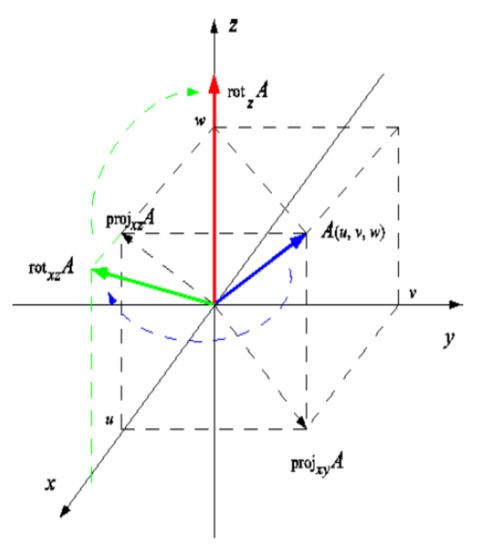
Figure 4.
Rotation of undefined pole in .
Assume that the producing line in the plane is a Bézier-like curve. The matrix and rotation equation can be exhibited as if the rotation axis is the x-axis for constructing symmetrical surfaces:
Likewise, for plane and plane, the rotation surface equation for the y-axis and z-axis can be represented as:
There is . As a consequence, the Bézier-like curve may be utilized as a creating curve, a set of rotating surfaces could be created and we can influence the appearance of the graphs by adjusting the values of the shape controls.
Theorem 4.
Using the coordinates provided of the control points where in the plane of , the entire rotation surface equation is acquired through rotation of the creating curve around the y-axis with one revolution.
and by having to join such two expressions and we can get the Bézier-like formation surface in plane. The and coordinates are given as:
where are the gB-like functions (2), and are the coordinates of the control points.
Proof.
It can be found in [26]. □
The symmetrical rotation surfaces in and can also be created by the rotation formula.
4.2. Vase Symmetry with a Bézier-like Rotating Surface
In practical application, architects typically begin with a rugged idea of generating the appropriate surface structure. Typically, they create an algorithm to estimate and visualize their concept. The rotation surface is a common example.
Figure 5a,b depict the symmetry’s right and left halves, respectively. Figure 5c demonstrates the related Vase graph using a Bézier-like movement disk, see Theorem 4. Figure 6a–f portray the symmetrical description of Vase surfaces by Bézier-like rotation surface with different shape controls. If the surface of rotation has four independent shape controls, we could even alter the structure of the curve as we desire by modifying these shape parameters. In the case of the collection of control points in the plane of , who’s coordinates are being used:
to use the expressions provided in Theorem 4, we can obtain a symmetrical description of the vase as shown in Figure 6.
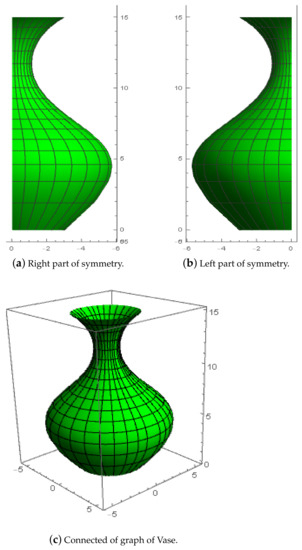
Figure 5.
Construction of a symmetric figure of the vase.
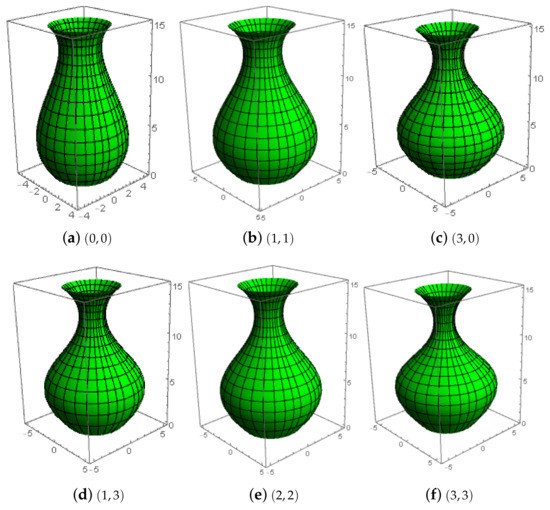
Figure 6.
Recognition of the vase as a Bézier-like symmetrical rotation surface with different values of shape parameters and .
4.3. Capsule Torus Symmetry by Bézier-like Rotation Surfaces
Figure 7 portrays the symmetrical image of the capsule torus (CT), that often acts as a rotating surface and will spin around a rotation axis. Because there are four independent shape controls on the Bézier-like rotating surface and the variance of these shape parameters can be seen on the CT side. This capsule torus is composed of a Bézier-like rotation surface strategy and it has an uniform appearance on both sides. However, as we change the values of the surface’s shape controls, the surface changes.
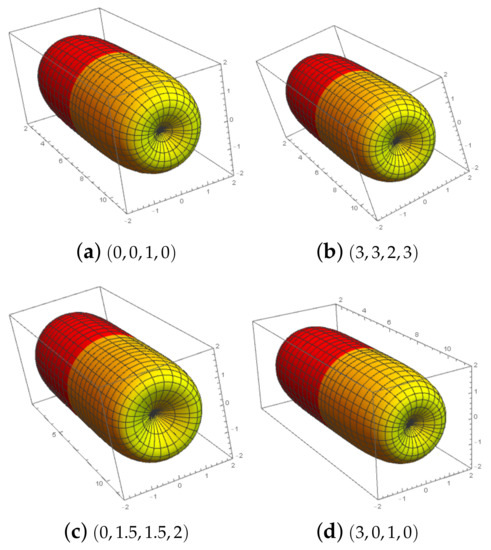
Figure 7.
Symmetric Bézier-like rotation surfaces of the capsule torus with different values of shape controls and .
5. Conclusions
gB-like functions with two different shape controls have been discussed in this work. By changing the values of the shape controls, different degrees of gB-like functions have been modeled. Furthermore, the constraints for PC and GC of joining two adjacent curve segments have been constructed. These specific continuity-preserving curves have been shape-commanding characteristics that may be utilized in CAD/CAM. Some numerical examples of PC and GC have been examined via graphs. Bézier-like symmetric rotation surfaces have been discussed and it helped us to model different surfaces like vase and capsule taurus. The influence of shape controls on these surfaces have been investigated, which allowed us to reconfigure them without changing the control points.
Author Contributions
Conceptualization, M.A. (Moavia Ameer), M.A. (Muhammad Abbas), K.T.M., A.M. and T.N.; Formal analysis, M.A. (Moavia Ameer), M.A. (Muhammad Abbas), K.T.M., A.M. and T.N.; Funding acquisition, K.T.M.; Methodology, M.A. (Moavia Ameer), M.A. (Muhammad Abbas), K.T.M., A.M. and T.N.; Software, M.A. (Moavia Ameer), M.A. (Muhammad Abbas), K.T.M., A.M. and T.N.; Visualization, M.A. (Moavia Ameer), M.A. (Muhammad Abbas), K.T.M., A.M. and T.N.; Writing—original draft, M.A. (Moavia Ameer), M.A. (Muhammad Abbas), K.T.M., A.M. and T.N.; writing—review and editing, M.A. (Moavia Ameer), M.A. (Muhammad Abbas), K.T.M., A.M. and T.N. All authors read and approved the final manuscript.
Funding
This research received no external funding.
Institutional Review Board Statement
Not applicable.
Informed Consent Statement
Not applicable.
Data Availability Statement
Not applicable.
Acknowledgments
This research was supported by Department of Mechanical Engineering, Shizuoka University, Hamamatsu, 432-8561 Shizuoka, Japan. The authors are also grateful to the anonymous referees for their valuable suggestions that significantly improved this manuscript.
Conflicts of Interest
The authors declare no conflict of interest.
Sample Availability
Not applicable.
References
- Farin, G.E. Curves and Surfaces for Computer-Aided Geometric Design: A Practical Code; Academic Press Inc.: Cambridge, MA, USA, 1996. [Google Scholar]
- Farin, G.; Hoschek, J.; Kim, M.S. (Eds.) Handbook of Computer aided Geometric Design; Elsevier: Amsterdam, The Netherlands, 2002. [Google Scholar]
- Chen, Q.; Wang, G. A class of Bézier-like curves. Comput. Aided Geom. Des. 2003, 20, 29–39. [Google Scholar]
- Han, X.; Ma, Y.; Huang, X. A novel generalization of Bézier curve and surface. J. Comput. Appl. Math. 2008, 217, 180–193. [Google Scholar]
- Zhang, J. C-curves: An extension of cubic curves. Comput. Aided Geom. Des. 1996, 13, 199–217. [Google Scholar]
- Farin, G. Triangular Bernstein Bézier patches. Comput. Aided Geom. Des. 1986, 3, 83–127. [Google Scholar]
- Barnhill, R.E.; Gregory, J.A. Compatible smooth interpolation in triangles. J. Approx. Theory 1975, 15, 214–225. [Google Scholar]
- Powell, M.J.D.; Sabin, M.A. Piecewise quadratic approximations on triangles. ACM Trans. Math. Softw. 1977, 3, 316–332. [Google Scholar]
- Gregory, J.A.; Charrot, P. A C1 triangular interpolation patch for computer-aided geometric design. Comput. Graph. Image Process. 1980, 13, 80–87. [Google Scholar]
- Farin, G. Designing C1 surfaces consisting of triangular cubic patches. Comput. Aided Des. 1982, 14, 253–256. [Google Scholar]
- Chang, G.; Feng, Y. An improved condition for the convexity of Bernstein Bézier surfaces over triangles. Comput. Aided Geom. Des. 1984, 1, 279–283. [Google Scholar]
- Goodman, T.N.T.; Said, H.B. Properties of generalized Ball curves and surfaces. Comput. Des. 1991, 23, 554–560. [Google Scholar]
- Hu, S.M.; Wang, G.J.; Sun, J.G. A type of triangular Ball-surface and its properties. J. Comput. Sci. Technol. 1998, 13, 63–72. [Google Scholar]
- Zhang, C.; Cheng, F. Triangular patch modeling using combination method. Comput. Aided Geom. Des. 2002, 19, 645–662. [Google Scholar]
- Chen, J.; Wang, G. Construction of triangular DP surface and its application. J. Comput. Appl. Math. 2008, 219, 312–326. [Google Scholar]
- Uzma, B.; Abbas, M.; Awang, M.N.H.; Ali, J.M. The quadratic trigonometric Bézier curve with single shape parameter. J. Basic Appl. Sci. Res. 2012, 2, 2541–2546. [Google Scholar]
- Ahmad, A.; Amat, A.H.; Ali, J.M. A generalization of a Bézier-like curve. Educ. J. Sci. Math. Technol. 2014, 1, 56–68. [Google Scholar]
- Maqsood, S.; Abbas, M.; Hu, G.; Ramli, A.L.A.; Miura, K.T. A novel generalization of trigonometric Bézier curve and surface with shape parameters and its applications. Math. Probl. Eng. 2020, 2020, 25. [Google Scholar]
- Qin, X.; Hu, G.; Zhang, N.; Shen, X.; Yang, Y. A novel extension to the polynomial basis functions describing Bézier curves and surfaces of degree n with multiple shape parameters. Appl. Math. Comput. 2013, 223, 1–16. [Google Scholar]
- Ahn, Y.J.; Lee, B.G.; Park, Y.; Yoo, J. Constrained polynomial degree reduction in the L2-norm equals best weighted Euclidean approximation of Bézier coefficients. Comput. Aided Geom. Des. 2004, 21, 181–191. [Google Scholar]
- Ammad, M.; Misro, M.Y. Construction of local shape adjustable surfaces using quintic trigonometric Bézier curve. Symmetry 2020, 12, 1205. [Google Scholar]
- Hu, G.; Cao, H.; Zhang, S.; Wei, G. Developable Bézier-like surfaces with multiple shape parameters and its continuity conditions. Appl. Math. Model. 2017, 45, 728–747. [Google Scholar]
- Ait-Haddou, R.; Barton, M. Constrained multi-degree reduction with respect to Jacobi norms. Comput. Aided Geom. Des. 2016, 42, 23–30. [Google Scholar]
- Hu, G.; Wu, J.; Qin, X. A novel extension of the Bézier model and its applications to surface modeling. Adv. Eng. Softw. 2018, 125, 27–54. [Google Scholar]
- Ameer, M.; Abbas, M.; Abdeljawad, T.; Nazir, T. A Novel Generalization of Bezier-like Curves and Surfaces with Shape Parameters. Mathematics 2022, 10, 376. [Google Scholar]
- Hu, G.; Wei, G.; Wu, J. Shape Adjustable Generalized Bézier Rotation with the multiple shape parameters. Results Math. 2017, 72, 1281–1313. [Google Scholar]
Publisher’s Note: MDPI stays neutral with regard to jurisdictional claims in published maps and institutional affiliations. |
© 2022 by the authors. Licensee MDPI, Basel, Switzerland. This article is an open access article distributed under the terms and conditions of the Creative Commons Attribution (CC BY) license (https://creativecommons.org/licenses/by/4.0/).