


Abstract
The symmetry group method is applied to study a class of time-fractional generalized porous media equations with Riemann–Liouville fractional derivatives. All point symmetry groups and the corresponding optimal subgroups are determined. Then, the similarity reduction is performed to the given equation and some explicit solutions are derived. The asymptotic behaviours for the solutions are also discussed. Through the concept of nonlinear self-adjointness, the conservation laws arising from the admitted point symmetries are listed.
Keywords:
time-fractional generalized porous media equation; symmetry group; conservation law; exact solutions MSC:
35R11; 70G65
1. Introductions
The theory of differentiations and integrations of arbitrary order (real or complex) is named as fractional calculus, and was born on 30 September 1695 in a letter from Leibniz to L‘Hopital discussing the derivative of order . The differential equation with arbitrary order derivatives, called a fractional differential equation (FDE), is a generalization of the differential equation with integer order derivatives, investigated by the theory of fractional calculus. FDEs are of considerable interest in various fields of science and engineering; in particular, modeling the phenomena relating hereditary, nonlocal and intrinsic memory properties (see [1,2,3] and references therein). Compared with integer order models, fractional order models can provide improved fits and induce sharp questions about the underlying conceptual models for the observed phenomena. Kac concluded that “success is characterized by the fidelity with which such models fit the observed phenomena, and by the sharpness of the questions they pose about the underlying physics.” [4]. In [5,6], for example, the authors demonstrated that the fractional Bloch–Torrey equation not only fits the diffusion data from human brain tissue precisely, but also affects the microscopic tissue structure. A lot of research activities have been performed on FDEs from points of theories and applications [7,8,9,10,11].
The Lie symmetry group is viewed as a powerful and widely applicable technique for investigating differential equations (DEs). The reason for the prevalence of the Lie symmetry group is its abilities to provide exact solutions and linearization mappings of DEs and to study the integrability, etc. [12,13]. Thus, questions about how the Lie symmetry group works for FDEs and whether the effectiveness of the Lie symmetry group for FDEs is the same as it for usual DEs arise. The study of Lie group theory for FDEs was initiated by Buckwar and Luchko in [14], where they mainly concentrated on the scaling invariance of a linear fractional diffusion equation and obtained several explicit solutions in terms of generalized Wright functions. Since then, a number of research papers, books and symbolic manipulation softwares have been dedicated to the study of Lie symmetry analysis. Following the established Lie symmetry schemas, symmetry reductions and group-invariant solutions were implemented to numerous kinds of FDEs, including scalar FDE [15,16,17,18], multidimensional time-fractional DEs [19,20] and coupled time-fractional DEs [21,22], etc. Based on the pioneer works on the symmetry analysis for FDEs, Singla and Gupta proposed the Lie group symmetry theories for space-time fractional systems and systems of FDEs with an arbitrary number of independent, as well as dependent, variables in [23,24]. Quite recently, Zhang and Zheng studied the symmetry structure to multidimensional time-fractional DEs and concluded that the corresponding infinitesimals could be determined by two elegant equivalent conditions [25]. To perform the symmetry group approach automatically, Jefferson and Carminati presented an algorithm named FracSym package in the platform MAPLE [26].
An important application of symmetry groups is to determine the conservation laws of DEs. For the DEs with a Lagrangian, the celebrated Noether theorem exhibits the correspondence between conservation laws and variational symmetries. However, many systems do not possess a variational principle and the variant integral is not invariant under the considered symmetry. Such dilemmas motivate scholars to develop other new techniques for the construction of conservation laws, such as the direct method [27], partial Lagrangian [28], multiplier method [29] and nonlinear self-adjointness method [30]. The research on conserved quantities of FDEs has also been explored. The fractional Noether theorem for FDEs was proved in [31], where the corresponding fractional conservation laws were also proposed. Moreover, in [32], Lukashchuk extended the nonlinear self-adjointness method to FDEs involving not only Riemann–Liouville fractional derivatives but also Caputo fractional derivatives. As a matter of fact, up to now, the nonlinear self-adjointness method has been widely used to construct the conservation laws for FDEs.
The present paper is devoted to studying the symmetry groups and conservation laws to a time-fractional generalized porous medium equation for , given by
with real constants , m, s, p and q, where is the left Riemann–Liouville fractional differential operator of order with respect to t [1]. The generalized porous medium equation with an integer order time derivative provides models of many interesting physical phenomena, such as the flow of liquids in porous media and transport of thermal energy in plasma, which has been investigated from several points of view [33,34,35,36,37]. Note that Equation (1) is linear when , which will be out of consideration in what follows.
This paper is structured as follows. In Section 2, we recall several definitions of fractional calculus. Section 3 provides the point symmetry groups admitted by Equation (1) and the corresponding optimal symmetry system. The symmetry reduction method is then applied to reduce Equation (1) and derive its explicit solutions in Section 4. Section 5 deals with the investigation of conservation laws for Equation (1) that arise from the obtained point symmetries. Finally, our conclusions are given in Section 6.
2. Preliminaries
Several definitions from fractional calculus theory are listed in this section. For more details, please refer to books and literatures [2].
Definition 1.
For function , the left-sided fractional integral operator of order is defined by
and the right-sided fractional integral operator of order is defined by
where and whereafter , is the Euler–Gamma function. In particular, .
Definition 2.
For function , the left-sided Riemann–Liouville fractional derivative of order is defined by
and the right-sided Riemann–Liouville fractional derivative of order is defined by
where and .
Definition 3.
For function , the left-sided Caputo fractional derivative of order is defined by
and the right-sided Caputo fractional derivative of order is defined by
where and .
In literature, when one reads the Riemann–Liouville fractional derivative, it usually means the left Riemann–Liouville fractional derivative. In physics, if the time variable is denoted by variable t, then the right-sided Riemann–Liouville fractional derivative for is interpreted as a future state of the process. Hence, the right derivative is usually omitted in applications when the present state of the process does not depend on the results of the future development. From a mathematical point of view, both derivatives appear naturally in the fractional calculus.
Definition 4.
The Erdélyi–Kober fractional differential operator is defined by
where
is the Erdélyi–Kober fractional integral operator.
3. Point Symmetries and Optimal System
Given a one-parameter Lie group of transformation with group parameter :
which is characterized by infinitesimal operator
If the Lie group (10) leaves Equation (1) invariant, then the operator (11) satisfies two conditions:
and
Here, and are integer-order extended infinitesimals with respect to x [12,13] and is the extended infinitesimal of order with respect to t [14,15], given by
where is the total derivative with respect to t, ,
and
The determining Equation (12) splits with respect to derivatives of u, yielding an overdetermined system for , and , given by
Solving the determining Equations (18)–(23) associated with condition (13) yields the following result:
The optimal symmetry system is the maximal set of one-dimensional point symmetry subgroups that are conjugacy inequivalent in the full Lie group of point symmetries admitted by Equation (1). The reduction under such a system could lead to all group-invariant solutions. The optimal symmetry system can be attacked by considering a general operator in Lie algebra and subjecting it to various adjoint transformations to simplify it as much as possible [12,27]. The adjoint action is defined by
where is the commutator of the Lie algebra and is a parameter. Through a systematic calculation, we obtain the one-dimensional optimal symmetry of Equation (1) as follows.
Theorem 1.
The one-dimensional optimal system of Equation (1) in the case of and is spanned by (24) and (26). For the case of , the one-dimensional optimal system of Equation (1) is spanned by (26) and (27). For the case of , and , the one-dimensional optimal system of Equation (1) is spanned by (25) and (26). For the case of , , and , the one-dimensional optimal system of Equation (1) is spanned by (26) and (32). For the case of , and , the one-dimensional optimal system of Equation (1) is spanned by (24) and (28). For the case of , and , the one-dimensional optimal system of Equation (1) is spanned by
with parameter . For the case of and , the one-dimensional optimal system of Equation (1) is generated by
with parameter . For the case of , , and , the one-dimensional optimal system of Equation (1) is generated by
with parameter . For the case of , , and , the one-dimensional optimal system of Equation (1) is spanned by
with parameters and . For the case of , and , the one-dimensional optimal system of Equation (1) is generated by
with parameters and . For the case of , and , the one-dimensional optimal system of Equation (1) is generated by
with parameters and .
Proof.

Here, we just consider the case of , and . In this case, Equation (1) admits symmetries , , and with nonzero commutators
With the help of (40), the corresponding adjoint action can be evaluated, as shown in Table 1. □
Table 1.
Adjoint action of , , and .
Let be the most general vector, namely , where and , are arbitrary constants. Next, we will simplify by utilizing suitable adjoint maps. To achieve this, we need to distinguish three cases: , and .
Case 1. . Without a loss of generality, we assume . Referring to Table 1, we act on such a by with and , yielding
Case 2. . To proceed, we consider two cases: and . When , we assume and apply to the corresponding vector , leading to
when , we scale to by action so that the vector is equivalent to . If , the vector is equivalent to .
Case 3. . Analogous to the earlier analysis, two cases, and , arise. When , we assume . Then, the action on the corresponding vector gives
When , the result for simplification is the same as the one for case 2 with .
After renaming the constants, we can obtain the result in (39). For the other cases, one can obtain the results in a similar manner. □
4. Symmetry Reductions
Each point symmetry of the optimal system in Theorem 1 can be used to obtain group-invariant solutions of the Equation (1) by the well-known symmetry reduction method (see Refs. [12,13]). Suppose that not both of the independent variables t and x are invariant under the given symmetry ; thus, the group-invariant solutions have the form
in terms of invariants
determined by characteristic equations
where satisfies a fractional ordinary differential equation (ODE) obtained by the reduction of Equation (1). In what follows, we will run the reduction under each symmetry group in Theorem 1, where the parameters and will be replaced by parameter for convenience.
4.1. Reduction by Generator X
When and , the optimal symmetry generator describes a space translation transformation. It has invariants
Hence,
yields the corresponding group-invariant solution. Inserting (44) and (45) into Equation (1), we know that the invariant function satisfies a fractional ODE
which has solutions
In (48), is the Mittag–Leffler function [1]. Then, the Equation (1) with and possesses solutions
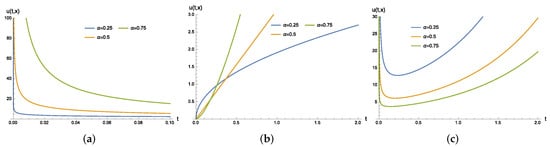
where and whereafter and are arbitrary constants. It is worth noting that, when , solution (49) is dispersive as , and blows up at . Figure 1 shows the behaviors of solutions (49) and (50) with respect to time variable t.
4.2. Reduction by Generator X
When and , the optimal symmetry generator describes a scaling transformation. It has invariants
Thus, the invariant solution has the form
Let and ; then, Equation (53) is transformed to
where , and , and is the Erdélyi–Kober fractional integral operator, defined by (9). In view of , the expression in (54) becomes
where and whereafter is the Erdélyi–Kober fractional differential operator, defined by (8). Thus, the transformed expression of the right hand side to Equation (1) under transformations (51) and (52) associated with (55) leads to the reduced fractional ODE for invariant function , given by
4.3. Reduction by Generator X
When , and , the optimal symmetry generator has invariants
Hence,
yields the corresponding group-invariant solution. Inserting (57) and (58) into Equation (1), we know that the invariant function satisfies a fractional ODE
which has solutions
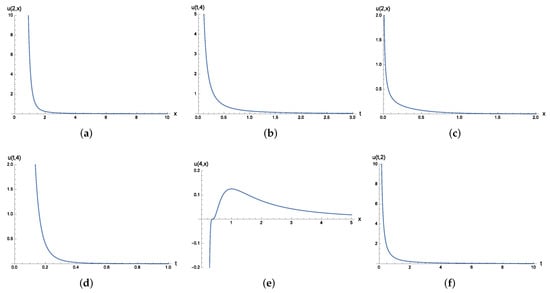
Note that solutions (62) and (63) are separable solutions. When , solution (62) is singular at and dispersive as , possessing a blow-up at . For solution (63), u is singular at . It also displays dispersion for a long time as and blows up at . Figure 2 exhibits the behaviors of solutions (62) and (63).
4.4. Reduction by Generator X
When , , and , the optimal symmetry generator has invariants
Then, the invariant solution is given by
where the invariant function satisfies Equation (46) with solutions (47) and (48). Thus, when , , and , Equation (1) possesses solutions
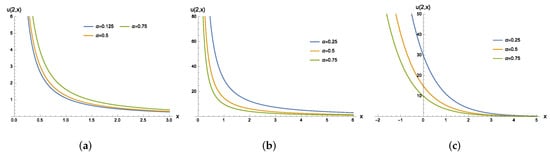
Solutions (66) and (67) are separable solutions. It is easily seen that solutions (66) and (67) are singular at . Observe that, for a fixed value of x, solutions (66) and (67) are, respectively, the same as solutions (49) and (50) up to a constant. For such a reason, the behaviors of solutions (66) and (67) on time variable t are exhibited by Figure 1. The behaviors of solutions (66) and (67) on space variable x are depicted in Figure 3a,b.
4.5. Reduction by Generator X
When , and , the optimal symmetry generator has invariants
Hence, the invariant solution has the form
where the invariant function satisfies a fractional ODE
Observe that Equation (70) has solution (48). Then, Equation (1) with , and possesses solution
which is a separable solution. Figure 3c depicts the behavior of solution (71) related to space variable x, whereas the behaviors of solution (71) related to time variable t are shown in Figure 1a,b, since, for a fixed x, solution (71) is exactly solution (49) up to a constant.
4.6. Reduction by Generator X + X
Then,
is the invariant solution, where the invariant function satisfies a fractional ODE
4.7. Reduction by Generator X + X
When , and , the optimal symmetry generator in (39) has invariants
Then,
is the invariant solution, where the invariant function satisfies a fractional ODE
4.8. Reduction by Generator X +
Thus, Equation (1) has an invariant solution
where the invariant function satisfies a fractional ODE
Here, Equation (80) is derived by a similar procedure as before.
4.9. Reduction by Generator X + X
When and , the optimal symmetry generator in (35) has invariants
Thus, the invariant solution reads as
With a similar analysis as aforementioned, we find the invariant function satisfies a fractional ODE
4.10. Reduction by Generator X +
When , , and , the optimal symmetry generator in (36) has invariants
Thus, the invariant solution takes the form
where the invariant function satisfies a fractional ODE
For the obtainment of Equation (86), we achieved this in a similar manner as earlier.
4.11. Reduction by Generator X + X
When , , and , the optimal symmetry generator in (37) has invariants
The invariant solution is of the form
Analogous to the earlier analysis, we deduce that the invariant function satisfies a fractional ODE
4.12. Reduction by Generator X + X
Then, the invariant solution is given by
where the invariant function satisfies a fractional ODE
Equation (93) is obtained in a similar manner as before.
4.13. Reduction by Generator X + X
When , and , the optimal symmetry generator in (39) has invariants
Then, the invariant solution is given by
where the invariant function satisfies a fractional ODE
5. Conservation Law
A conservation law of the Equation (1) is a space-time divergence equation
where denotes the solution space of Equation (1), is the conserved density and is the spacial flux, which are functions of t, x, u and all derivatives of u.
To begin, we introduce a formal Lagrangian of Equation (1)
where is a new dependent variable, and define a function
where is the Euler–Lagrange operator with respect to variable u, given by
In (100), is the right-sided Caputo fractional derivative operator of order , defined by (7). Then,
is the adjoint equation of Equation (1). Equation (1) is called nonlinearly self-adjoint if the adjoint Equation (99) is satisfied for all solutions of Equation (1) upon a substitution , i.e., condition
holds for a unknown coefficient . Splitting the determining Equation (102) with leads to an overdetermined system for , given by
Now, let us solve system (103)–(106). It is easy to see that from Equations (103) and (105). Thus, system (103)–(106) is reduced to Equation (106) with for . As mentioned before, the case of is out of our consideration. To proceed, we consider the following three cases. When , the reduced system is of the form
which has solution
When , the reduced system is given by
Solving this system, we immediately obtain
When , the reduced system reads as
which can be solved explicitly in terms of special elementary functions, given by
In [30,32], it is shown that the conserved density and spacial flux in (97) are determined by
where is the characteristic function of symmetry generator and integral is defined by
Now, let us use the point symmetries in Theorem 1 to construct all conservation laws of Equation (1). In view of the expressions for in (107)–(111), symmetry (28) cannot generate any conservation law.
5.1. Conservation Law Generated by Symmetry X
5.2. Conservation Laws Generated by Symmetry
The characteristic function corresponding to symmetry (25) is given by . From the expressions of , there are three cases to be considered.
5.3. Conservation Laws Generated by Symmetry
The characteristic function corresponding to symmetry (26) is given by . From the expressions of , the following five cases are needed to be considered.
5.4. Conservation Laws Generated by Symmetry
The characteristic function corresponding to symmetry (27) is given by . In view of the expressions of , we need to consider the following six cases.
5.5. Conservation Laws Generated by Symmetry
The characteristic function corresponding to symmetry (29) is . From the solutions of , we have the following three cases.
5.6. Conservation Laws Generated by Symmetry
The characteristic function corresponding to symmetry (30) is given by . With the expressions of , we arrive at three cases, which are as follows.
5.7. Conservation Laws Generated by Symmetry
The characteristic function corresponding to symmetry (31) is . From the expressions of , the following three cases arise.
5.8. Conservation Laws Generated by Symmetry
The characteristic function corresponding to symmetry (32) is given by . In view of the expressions of , we need to consider the following three cases.
5.9. Conservation Laws Generated by Symmetry
6. Conclusions
In this paper, we perform a complete symmetry and conservation law analysis to the time-fractional generalized porous medium Equation (1). Equation (1) admits affluent symmetry groups. Altogether, there are ten symmetry generators shown in Theorem 1. Then, the one-dimensional optimal system of Lie subalgebra is constructed and used to reduce Equation (1) to a fractional ODE. Some solutions for Equation (1) are derived due to the reductions, such as time-dependent solutions and separable solutions. They have several interesting dynamic behaviors: they are dispersive, blow-up and singular. Furthermore, the concept of nonlinear self-adjointness is adopted to derive the conservation laws of Equation (1).
In the process of this study, we realise that Lie symmetry analysis is an effective technique for solving fractional PDEs. A challenging problem is how to solve fractional ODEs with an Erdélyi–Kober fractional differential operator.
For future work, we will still focus on the study of FDEs; for example, how to generalize the group-foliation method [38] to FDEs and whether the theories for higher-order symmetry groups in [39] and potential symmetry groups in [40] can be extended to nonlinear FDEs.
Author Contributions
T.G.: writing original draft preparation, formal analysis, validation; W.F.: methodology, editing, validation, supervision; S.Z.: investigation, validation. All authors have read and agreed to the published version of the manuscript.
Funding
This project is supported by the National Natural Science Foundation of China (No. 12071432), and the Natural Science Foundation of Zhejiang Province (No. LY18A010033).
Institutional Review Board Statement
Not applicable.
Informed Consent Statement
Not applicable.
Data Availability Statement
Not applicable.
Acknowledgments
The authors are very grateful to the reviewers for their invaluable and expert comments.
Conflicts of Interest
The authors declare no conflict of interest.
References
- Podlubny, I. Fractional Differential Equations: An Introduction to Fractional Derivatives, Fractional Differential Equations, to Methods of Their Solution and Some of Their Applications; Academic Press: New York, NY, USA, 1999. [Google Scholar]
- Miller, K.S.; Ross, B. An Introduction to the Fractional Calculus and Fractional Differential Equations; Wiley: New York, NY, USA, 1993. [Google Scholar]
- Hilfer, R. Applications of Fractional Calculus in Physics; World Scientific: Singapore, 2000. [Google Scholar]
- Kac, M. Some mathematical models in science. Science 1969, 166, 695–699. [Google Scholar] [CrossRef]
- Bennett, K.M.; Hyde, J.S.; Schmainda, K.M. Water diffusion heterogeneity index in the human brain is insensitive to the orientation of applied magnetic field gradients. Magn. Reson. Med. 2006, 56, 235–239. [Google Scholar] [CrossRef] [PubMed]
- Magin, R.L.; Abdullah, O.; Baleanu, D.; Zhou, X.J. Anomalous diffusion expressed through fractional order differential operators in the Bloch-Torrey equation. J. Magn. Reson. 2008, 190, 255–270. [Google Scholar] [CrossRef] [PubMed]
- Hashemi, M.S.; Baleanu, D. Lie Symmetry Analysis of Fractional Differential Equations; CRC Press: New York, NY, USA, 2020. [Google Scholar]
- Carpinteri, A.; Mainardi, F. Fractals and Fractional Calculus in Continuum Mechanics; Springer: New York, NY, USA, 1997. [Google Scholar]
- Kilbas, A.A.; Srivastava, H.M.; Trujilo, J.J. Theory and Application of Fractional Differential Equation; Elsevier: Amsterdam, The Netherlands, 2006. [Google Scholar]
- Hajiseyedazizi, S.N.; Samei, M.E.; Alzabut, J.; Chu, Y.M. On multi-step methods for singular fractional q-integro-differential equations. Open Math. 2021, 19, 1378–1405. [Google Scholar] [CrossRef]
- Iqbal, M.A.; Wang, Y.; Miah, M.M.; Osman, M.S. Study on date-Jimbo-Kashiwara-miwa equation with conformable derivative dependent on time parameter to find the exact dynamic wave solutions. Fractal Fract. 2022, 6, 4. [Google Scholar] [CrossRef]
- Olver, P.J. Applications of Lie Groups to Differential Equations; Springer: New York, NY, USA, 1993. [Google Scholar]
- Bluman, G.W.; Cheviakov, A.F.; Anco, S.C. Applications of Symmetry Methods to Partial Differential Equations; Springer: New York, NY, USA, 2010. [Google Scholar]
- Buckwar, E.; Luchko, Y. Invariance of a partial differential equation of fractional order under the Lie group of scaling transformations. J. Math. Anal. Appl. 1998, 227, 81–97. [Google Scholar] [CrossRef]
- Gazizov, R.K.; Kasatkin, A.A.; Lukashchuk, S.Y. Symmetry properties of fractional diffusion equations. Phys. Scr. T 2009, 136, 014016. [Google Scholar] [CrossRef]
- Huang, Q.; Zhdanov, R. Symmetries and exact solutions of the time fractional Harry-Dym equation with Riemann-Liouville derivative. Physica A 2014, 409, 110–118. [Google Scholar] [CrossRef]
- Feng, W.; Zhao, S.L. Time-fractional inhomogeneous nonlinear diffusion equation: Symmetries, conservation laws, invariant subspaces, and exact solutions. Mod. Phys. Lett. B 2018, 32, 1850401. [Google Scholar] [CrossRef]
- Feng, W. On symmetry groups and conservation laws for space-time fractional inhomogeneous nonlinear diffusion equation. Rep. Math. Phys. 2019, 84, 375–392. [Google Scholar] [CrossRef]
- Lashkarian, E.; Hejazi, S.R. Group analysis of the time fractional generalized diffusion equation. Physica A 2017, 479, 572–579. [Google Scholar] [CrossRef]
- Leo, R.A.; Sicuro, G.; Tempesta, P. A foundational approach to the Lie theory for fractional order partial differential equations. Fract. Calc. Appl. Anal. 2017, 20, 212–231. [Google Scholar] [CrossRef]
- Sahoo, S.; Saha, R.S. The conservation laws with Lie symmetry analysis for time fractional integrable coupled KdV-mKdV system. Int. J. Non-Linear Mech. 2018, 98, 114–121. [Google Scholar] [CrossRef]
- Feng, W. Exact solutions and conservation laws of time-fractional Levi equation. Symmetry 2020, 12, 1074. [Google Scholar] [CrossRef]
- Singla, K.; Gupta, R.K. On invariant analysis of space-time fractional nonlinear systems of partial differential equations. II. J. Math. Phys. 2017, 58, 051503. [Google Scholar] [CrossRef]
- Singla, K.; Gupta, R.K. Generalized Lie symmetry approach for fractional order systems of differential equations. III. J. Math. Phys. 2017, 58, 061501. [Google Scholar] [CrossRef]
- Zhang, Z.Y.; Zheng, J. Symmetry structure of multi-dimensional time fractional partial differential equations. Nonlinearity 2021, 34, 5186. [Google Scholar] [CrossRef]
- Jefferson, G.F.; Carminati, J. FracSym: Automated symbolic computation of Lie symmetries of fractional differential equations. Comput. Phys. Commun. 2014, 185, 430–441. [Google Scholar] [CrossRef]
- Anco, S.C.; Bluman, G.W. Direct construction method for conservation laws of partial differential equations Part II: General treatment. Eur. J. Appl. Math. 2002, 13, 567–585. [Google Scholar] [CrossRef]
- Kara, A.H.; Mahomed, F.M. Noether-type symmetries and conservation laws via partial Lagrangians. Nonlinear Dyn. 2006, 5, 367–383. [Google Scholar] [CrossRef]
- Anco, S.C. Generalization of Noether’s theorem in modern form to non-variational partial differential equations, In Recent Progress and Modern Challenges in Applied Mathematics, Modeling and Computational Science; Springer: New York, NY, USA, 2017; Volume 79, pp. 119–182. [Google Scholar]
- Ibragimov, N.H. A new conservation theorem. J. Math. Anal. Appl. 2007, 333, 311–328. [Google Scholar] [CrossRef]
- Frederico, G.S.F.; Torres, D.F.M. A formulation of Noether’s theorem for fractional problems of the calculus of variations. J. Math. Anal. Appl. 2007, 334, 834–846. [Google Scholar] [CrossRef]
- Lukashchuk, S.Y. Conservation laws for time-fractional subdiffusion and diffusion-wave equations. Nonlinear Dyn. 2015, 80, 791–802. [Google Scholar] [CrossRef]
- Gandarias, M.L. Classical point symmetries of a porous medium equation. J. Phys. A Math. Theor. 1996, 29, 607–635. [Google Scholar] [CrossRef]
- Chen, X.P.; Du, S.Z.H.; Guo, T.P. The Liouville theorem of a torsion system and its application to symmetry group of a porous medium type equation on symmetric spaces. J. Lie Theory 2021, 31, 393–411. [Google Scholar]
- Vázquez, J.L. The Porous Medium Equation, Mathematical Theory; Oxford University Press: Oxford, UK, 2007. [Google Scholar]
- Dávila, J.; Rossi, J.D. Self-similar solutions of the porous medium equation in a half-space with a nonlinear boundary condition: Existence and symmetry. J. Math. Anal. Appl. 2004, 296, 634–649. [Google Scholar] [CrossRef][Green Version]
- Grillo, G.; Muratori, M.; Vázquez, J.L. The porous medium equation on Riemannian manifolds with negative curvature. The large-time behaviour. Adv. Math. 2017, 314, 328–377. [Google Scholar] [CrossRef]
- Anco, S.C.; Feng, W.; Wolf, T. Exact solutions of semilinear radial Schrödinger equations by separation of group foliation variables. J. Math. Anal. Appl. 2015, 427, 759–786. [Google Scholar] [CrossRef]
- Gazizov, R.K.; Lukashchuk, S.Y. Higher-order symmetries of a time-fractional anomalous diffusion equation. Mathematics 2020, 9, 216. [Google Scholar] [CrossRef]
- Zhang, Z.Y.; Lin, Z.X. Local symmetry structure and potential symmetries of time-fractional partial differential equations. Stud. Appl. Math. 2021, 147, 363–389. [Google Scholar] [CrossRef]
Publisher’s Note: MDPI stays neutral with regard to jurisdictional claims in published maps and institutional affiliations. |
© 2022 by the authors. Licensee MDPI, Basel, Switzerland. This article is an open access article distributed under the terms and conditions of the Creative Commons Attribution (CC BY) license (https://creativecommons.org/licenses/by/4.0/).