1. Introduction
For convenience and without loss of generality, we suppose that
is a bounded and single connected region with smooth boundary
,
is the outer region of
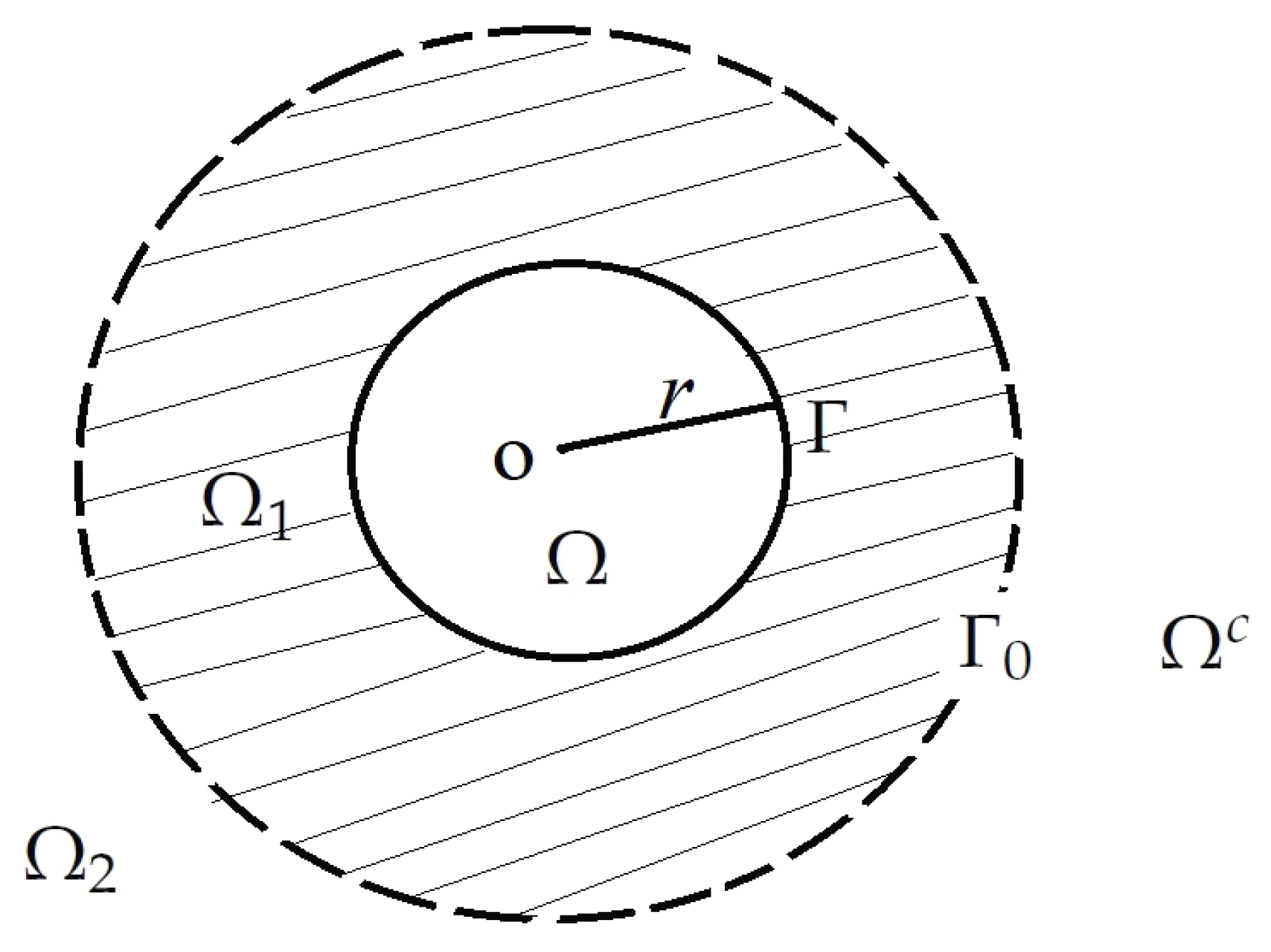
(see
Figure 1),
, and
.
For given time upper limit T, we study the following initial boundary value problem of the uniform transmission line (UTL) equation in the two-dimensional (2D) boundless outer region.
Problem 1. Find such thatwhere , , , α, γ, and β are three positive constants, and represent, respectively, the source term and the boundary value, and stand for the initial value functions, is the exterior normal derivative operation, and stands for a unit normal vector on boundary Γ from the region toward the interior of region Ω
. Additionally, we suppose that the function at infinity is bounded. The UTL equation, which is also known as the telegraph equation, has an important physical background. It can not only be used in communication engineering, but also can describe chemical diffusion, population dynamical systems, heat conduction, and other physical phenomena, even being more suitable for describing reaction diffusion problems in physics, chemistry, and biology than other diffusion equations. Thereby, it is very meaningful to research the numerical method for solving the UTL equation.
However, the UTL equation defined in the 2D boundless outer region is not easily solved by the standard finite element (FE) method or finite difference (FD) scheme since the FE and FD methods can only be used to find the numeric solutions for the inner problem defined in the bounded region. The usual boundary element (BE) method, namely the boundary integration equation method (see [
1,
2]) can only solve the inner problem on the bounded region. It basically converts the integration in the inner region
into the integration on the boundary
. Fortunately, the natural boundary element (NBE) method, which was created at the late 1970s by Feng and Yu (see [
3,
4,
5,
6,
7]) and is also referred to as the natural boundary integration equation method, is a novel type of BE method. It is not only distinguished from the FE method and the FD scheme, but is also different from the usual BE method. It can be used to solve the outer problem with the infinity region so that it is most suitable for solving the outer problem for the UTL equation in the 2D unbound region in this paper.
More specifically, the NBE method consists of the boundary value problem for the differential equation defined in the outer region
being converted into the integration equation on the boundary, and then, the integration equation on the boundary is discretized by the FE method. More precisely, by introducing an artificial boundary of a proper large finite spatial domain, the calculated region
is divided into two subregions (see
Figure 1): a bounded region
, which is a bounded annular region between boundaries
and
, and another regular boundless region
outside of circle
(see [
8,
9,
10,
11]); we build the natural integrating equation on the boundary
, as well as the Poisson integration formulation corresponding to the subproblem on the boundless region
with the natural boundary reduction such that the numerical solutions can be easily obtained. The NBE method has been successfully applied to finding the numerical solutions for the outer problems such as the Sobolev equation, the standard parabolic equation and hyperbolic equation, as well as the second-order elliptic equation defined in the 2D unbounded region (see [
5,
6,
7,
8,
10,
11,
12]).
Unfortunately, at the moment, the UTL equation has not yet been solved with the NBE method. The UTL equation is coupled by the hyperbolic and parabolic equations. It not only contains the first derivative of time, but also the second derivatives of the time and spatial variables, so that it is completely distinguished from other equations such as the standard parabolic equations, Sobolev equations, and hyperbolic equations. Hence, both the establishment of the NBE format and the theoretical analysis for the convergence and stability of the NBE solutions to the UTL equation require more skills and face more difficulties than the other equations as mentioned above, but the UTL equation defined in the 2D boundless region possesses very significant applications. Thereby, it is well worth researching the NBE method of the UTL equation defined in the 2D boundless region.
The remainder herein is arranged in the following manner. In
Section 2, we create the time semi-discretized formulation of the UTL equation defined in the 2D boundless region, as well as analyze the errors for the time semi-discretized solutions. Next, in
Section 3, we employ the natural boundary reduction principle to create the fully discretized NBE formulation based on the Poisson integration formulation and the natural integration equation for the problem and analyze the errors between the fully discretized NBE solutions and the analytical solution. Then, in
Section 4, we employ two numerical examples to verify that the numerical computing results are accordant with the theory results. Lastly, we summarize the obtained main conclusions for the study in
Section 5.
2. Semi-Discretized Formulation about Time and Error Estimate for the Time Semi-Discretized Solutions of the UTL Equation Defined in the 2D Boundless Region
The Sobolev spaces and norms herein are standard. Using the Green formula, we may create the following weak form of the UTL equation.
Problem 2. For , seek satisfyinghere, and represent the inner product in and , respectively. The existence and uniqueness of the solution to Problem 2 were proven in [
1].
Let N be the positive integer, and let be the time step. If are approximated by , are approximated by , and are approximated by , we obtain the following semi-discretized iterative scheme about time.
Problem 3. Find satisfyingherein, and . For the time semi-discretized scheme, namely Problem 3, the following result holds.
Theorem 1. If , , and , then Problem 3 has a unique set of solutions satisfyingwhere and is the positive constant in the trace theorem. Thereby, the solutions to Problem 3 are unconditionally stable and continuously dependent on the source term f, boundary value g, and initial values and . Additionally, when , the following error estimates hold:where . Proof. Because (3) in Problem 3 is a system of linear equations with respect to unknown functions , to prove the existence and uniqueness of the solutions of Problem 3, it is only needed to prove that it has only a zero solution when .
Taking
in Problem 3 and using the Cauchy–Schwarz and Hölder inequalities together with the trace theorem (see [
13]), we obtain:
where
stands for the positive constant in the trace theorem (see [
13]). Summing from 1 to
k for (
7), we obtain
Thereby, when
, by (
8), we obtain
(
). It follows that
(
). Thereupon, Problem 3 has a unique set of solutions.
Let
; from (
8), we obtain
By Taylor’s expansion, we obtain
From Problem 2, we obtain
Let
. Subtracting (
13) from (3) after taking
, we obtain
Taking
in (
14), we can obtain
Using the Cauchy–Schwarz and Hölder inequalities, we obtain
Summing for (
16) from 1 to
k, we obtain
It follows that
in which
. Theorem 1 is proven. □
3. Natural Boundary Reduction on the Outside Circle Area Together with Error Estimates of the Fully Discretized NBE Solutions
When we discretize the governing equation for Problem 1 in time, we need simultaneously to discretize its boundary condition. If we define
,
, and
, then we obtain
It follows from (
18) that the next task is to settle the elliptic boundary value problems at all time nodes
(
).
If we set
and
(
) as the first and second type of modified Bessel functions, respectively (see [
14]), and
and
as the Poisson integration operator and natural operator, respectively (see [
7,
8,
10]), then by using the NBE method (see [
3,
4,
6,
12]), we can deduce that the relationship between Neumann boundary values
with Dirichlet boundary values
is the following:
and that the relationship between the solutions
to Problem 3 with its Dirichlet boundary values
is the following:
in which
Herein, Equations (
19) and (
20) are known as the natural integration equation and the Poisson integration formula, respectively. Thereby, Equation (
19) is equivalent to the following variational problem.
Find
(
) satisfying
where
, and
.
3.1. Natural Boundary Reduction on the External Circle Area
For the sake of convenience and without loss of generality, we may suppose that the region
is a circle with radius
r and center at origin (see
Figure 1). For the convenience of discussion, we also assume that the solutions
to Problem 3 are properly smooth. By using the polar coordinates, we obtain
and
, as well as the outer normal derivative operator on
satisfying
. The solutions to Equation (
19) in the polar coordinates can be denoted as follows:
By calculation, we obtain the solutions
to Equation (
18) as follows.
in which
.
3.2. Error Estimates of NBE Solutions
In order to build the NBE formulation, it is necessary to divide the circumference into some regular arc segments. For convenient computing, we adopt the uniform subdivision and assume that the length of the longest arc is h and is an FE subspace formed with some basis functions. Thereupon, the NBE solutions for Problem 2 can be stated as the following.
Problem 4. Seek () satisfyingand In order to analyze the errors of the NBE solutions to Problem 4, it is necessary to define the following natural projection.
Definition 1. An operator is known as the natural projection; if , there is a unique that satisfies The above natural projection has the following property (see [
15,
16]).
Lemma 1. If and the subspace is formed with piecewise linear polynomials, then the natural projection has the following property:in which C is the generic positive constant independent of h and τ. For Problem 4, the following result holds.
Theorem 2. If is formed with the piecewise linear polynomial subspace and the solutions of (21) , then the error estimates between the solutions of (21) and the solutions of (21) and (26) are the following: Proof. Subtracting (
26) from (
21) and taking
, we obtain
Owing to the positive definiteness of
in
(see [
4]), by the Hölder inequality and the natural–projection, we obtain
From [
8,
11], we can immediately deduce
Therefore, we can conclude that
. Thus, we obtain
By (
31) and Lemma 1, we obtain
Summing from 1 to
k for (
32), by the Gronwall lemma (see [
16,
17]), we obtain
Thus, by Lemma 1, we obtain
Theorem 2 is proven. □
For the solutions to Equation (
27), the following result holds.
Theorem 3. If and are, respectively, the solutions of (23) and (27), then the following error estimations hold: Proof. From the literature [
14], we may conclude that
Thus,
and
. Hence, we can assume that
and
in the following discussion. Therefore, we obtain
Summing for (
35) from 1 to
k, by (
28), we gain
By the Gronwall lemma, we immediately obtain
Theorem 3 is proven. □
For Problem 4, namely the fully discretized NBE formulation, the following result holds.
Theorem 4. If , , and , Problem 4 has a unique solution satisfyingThis means that the solutions to Problem 4 are unconditionally stable and continuously dependent on the source term f and boundary value g. Furthermore, the following error estimates hold: Proof. Owing to the symmetry, continuity, and positive definiteness of
on
(see [
7,
8]), it follows by Lax–Milgram’s theorem (see [
7,
8,
16]) that Problem 4 has a unique set of solutions.
Taking
in (
29), by using the Hölder inequality, we obtain
Summing for (
41) from 1 to
k, by Gronwall’s lemma (see [
16,
17]), we obtain
Using the following triangle inequality:
and combining (
6) and (
34) with (
43), we can acquire (
39). Theorem 4 is proven. □
4. Two Numerical Examples
In this section, the effectiveness of the NBE method and the validity of the theoretical results are certified by two numerical examples for which the UTL equation has an analytical solution in the 2D boundless region, but has usually no analytical solution if the source term and initial values are complex.
In order to show the variation in the magnetic field generated around a wire with radius 2, we take
in the UTL equation, and the boundary and initial values are chosen as
,
, and
, respectively. Let
be the external region outside the circle (see
Figure 1). The source term is chosen as
where
. The analytical solution to this problem is
. Set
. We approximately replace
with
and use the numeric integration to compute
and
in the numerical simulations.
The circumference is divided into 64 regular segmental arcs with length . We chose the time step and .
4.1. The First Numerical Example, Namely the Case When
When
, we obtain the NBE solutions
and the analytical solution
at time
,
,
,
,
and
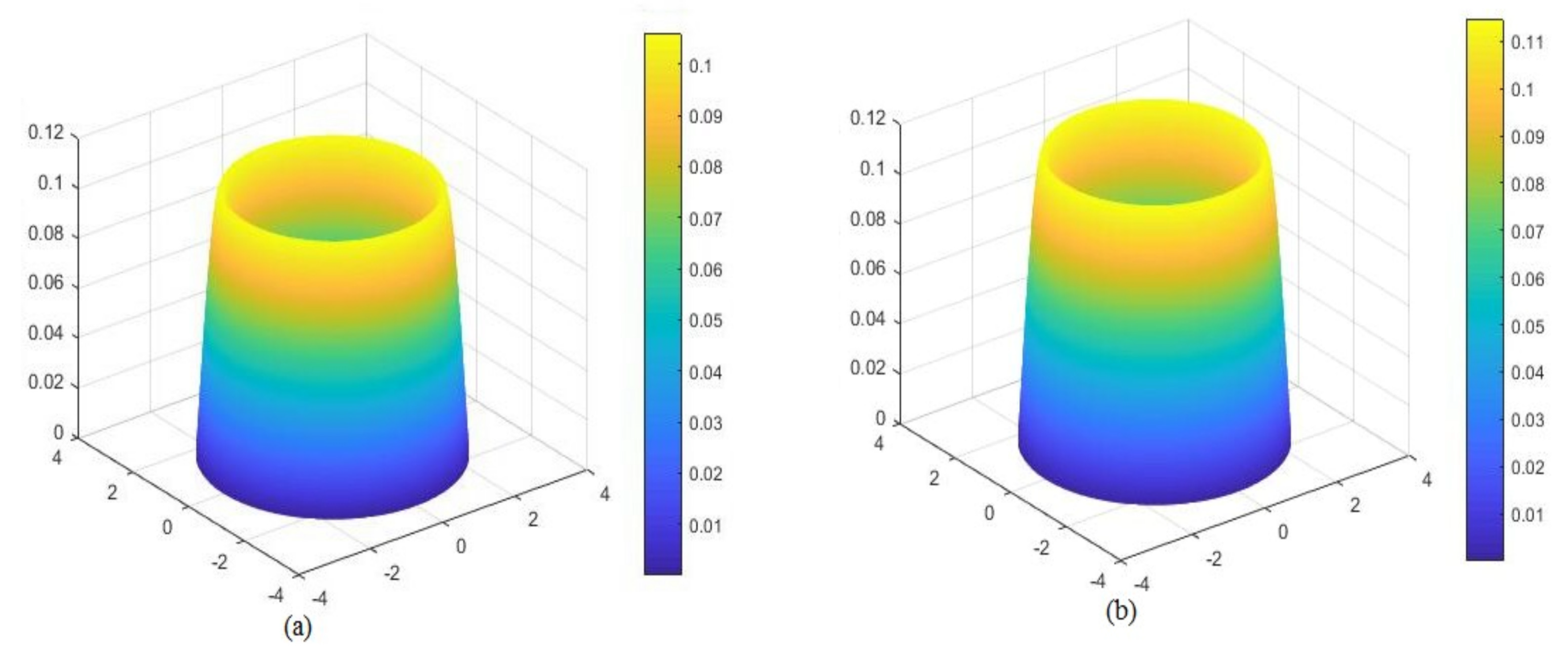
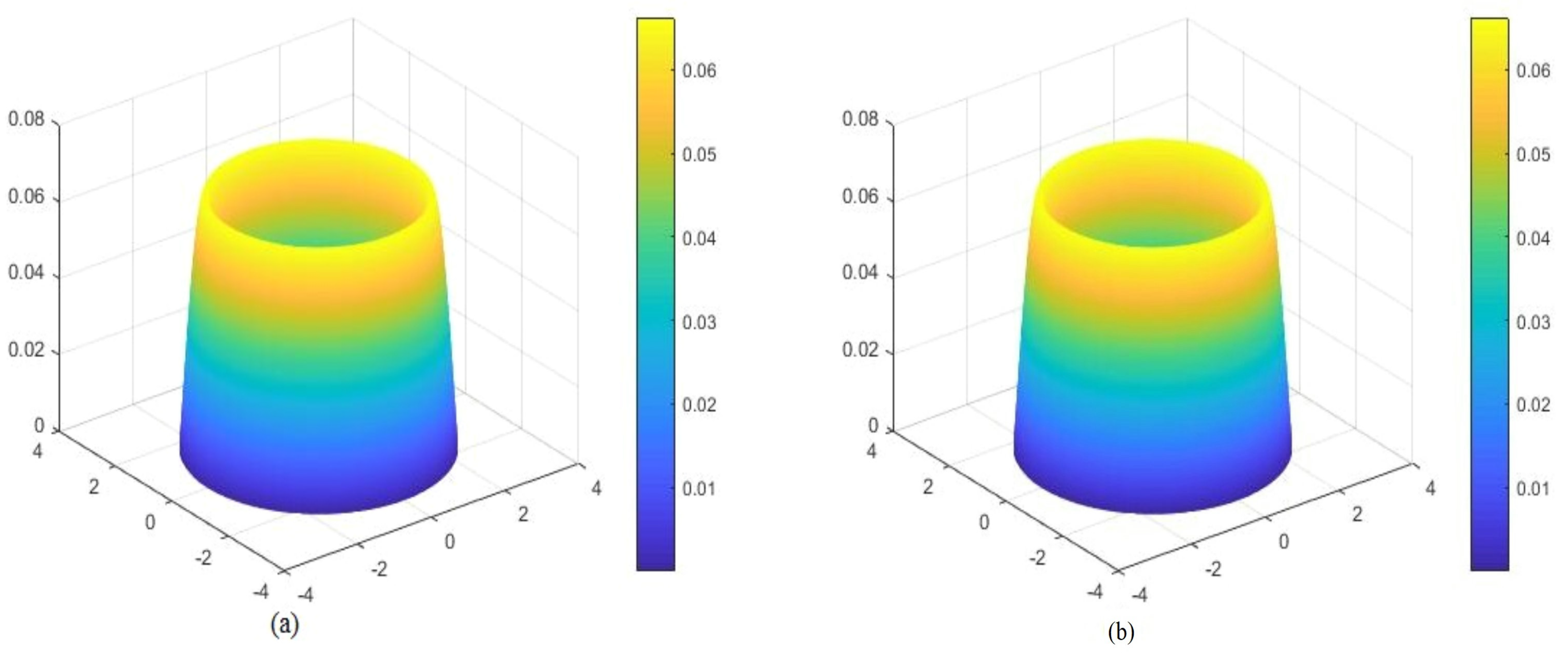
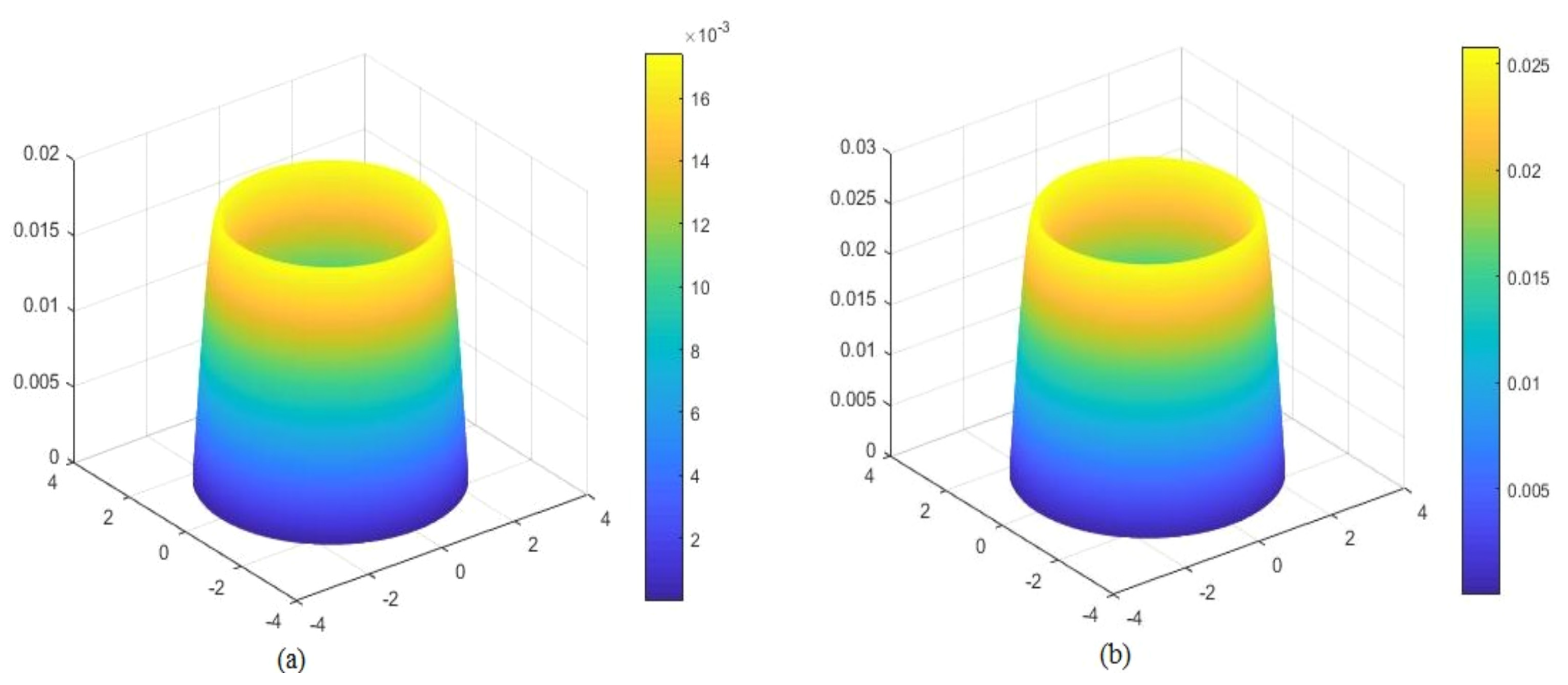
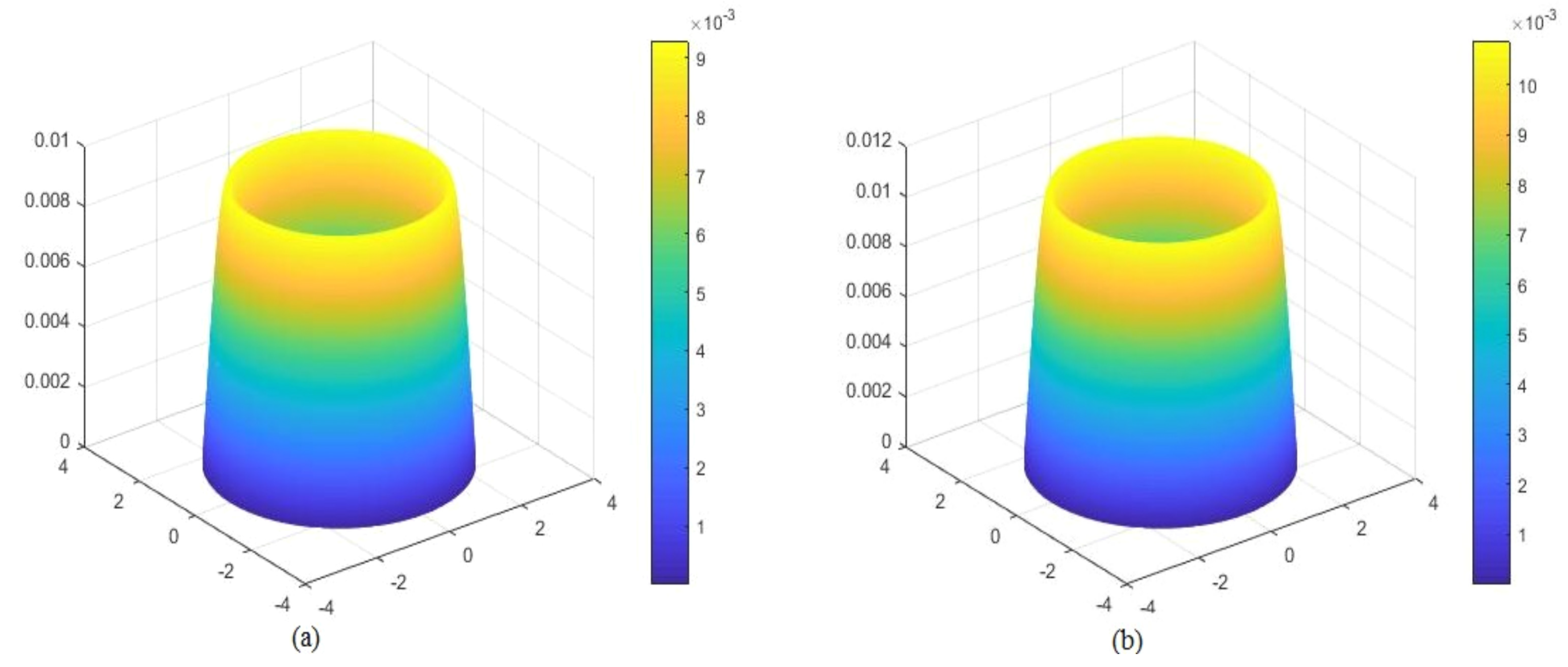
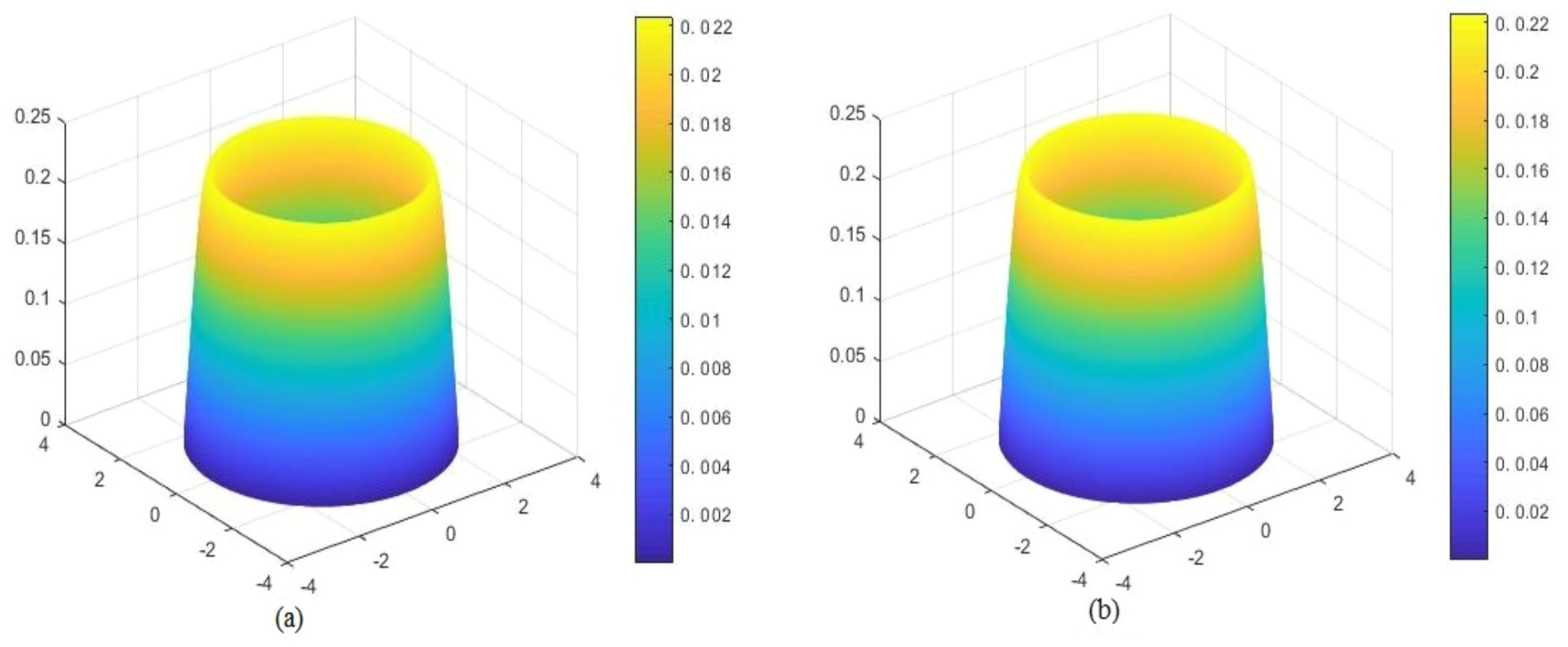
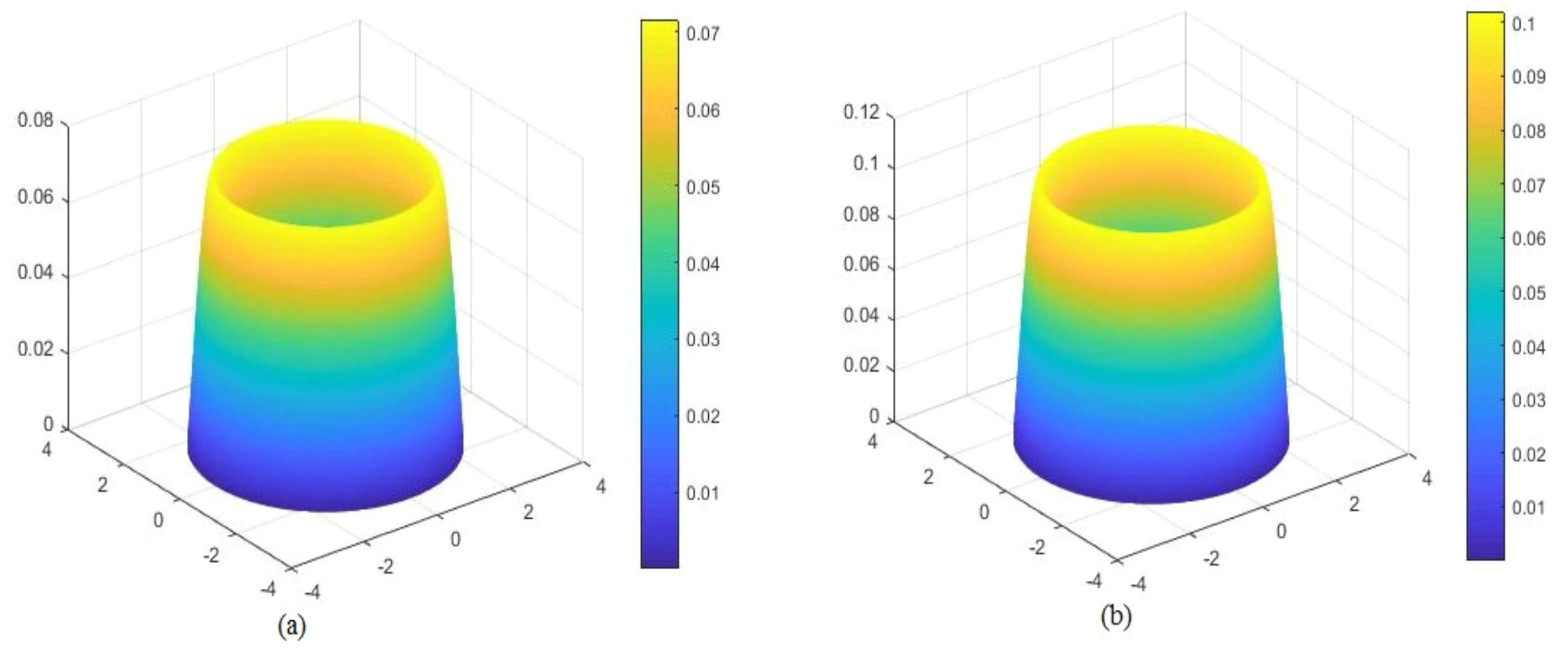
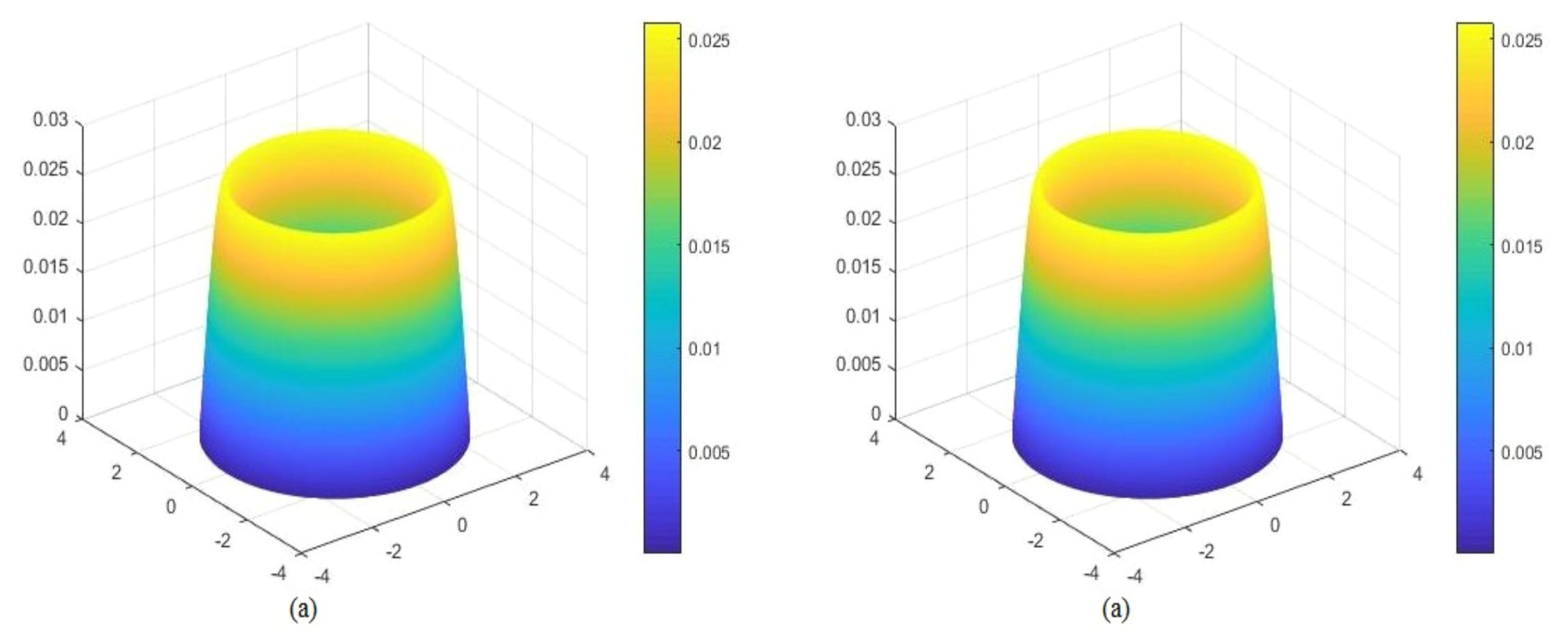
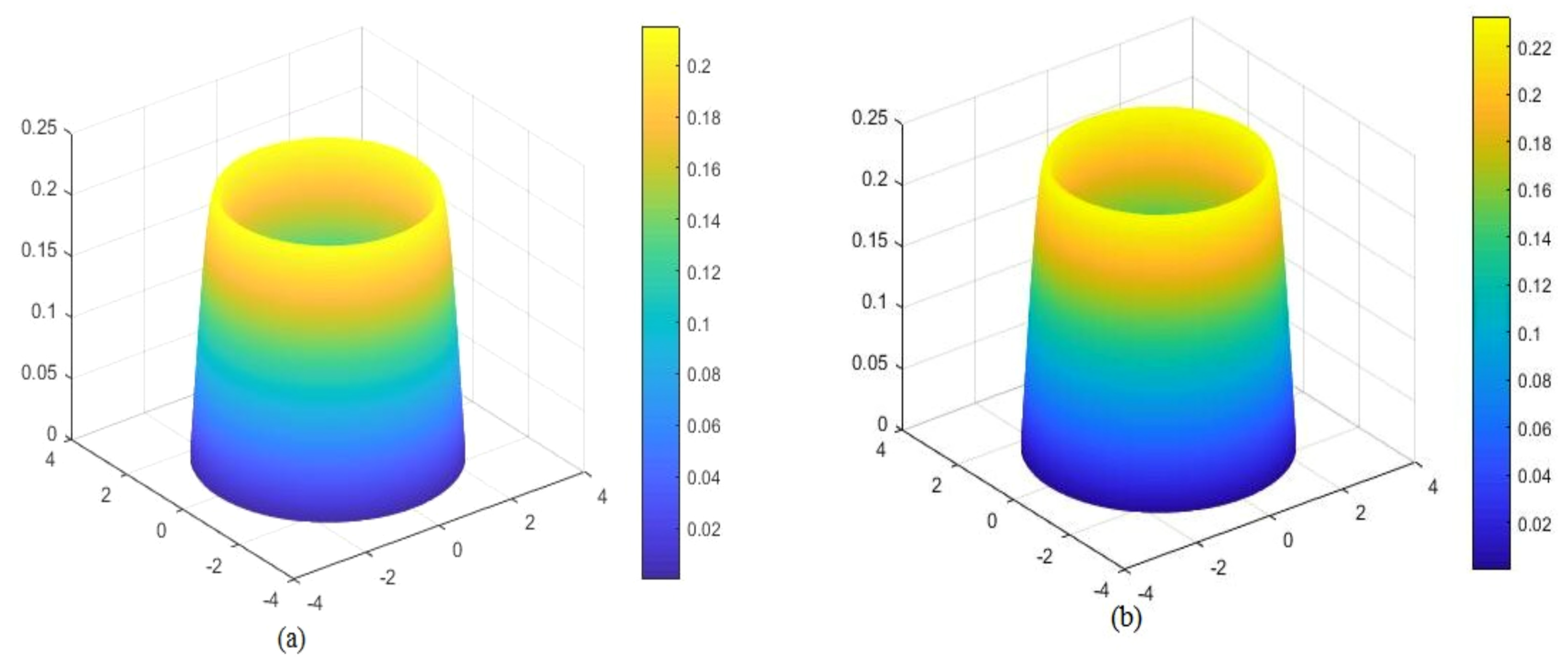
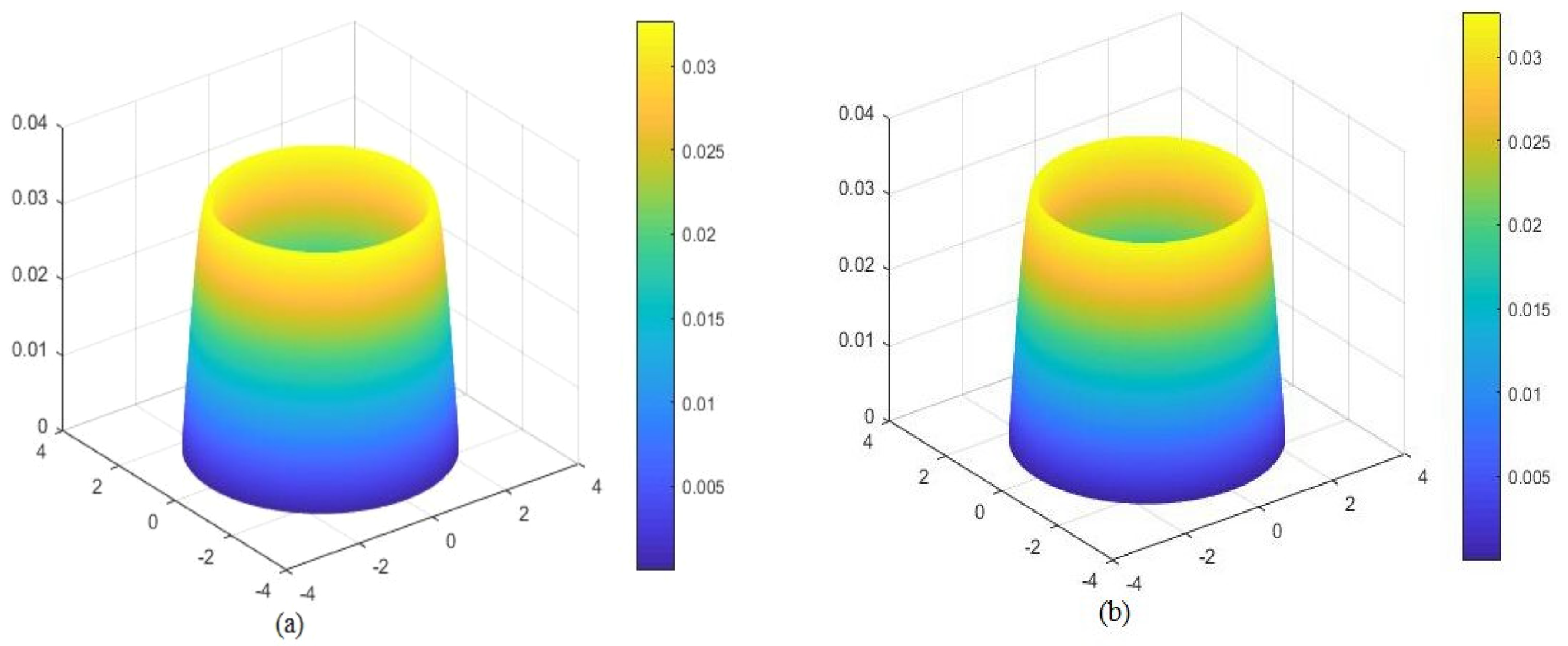
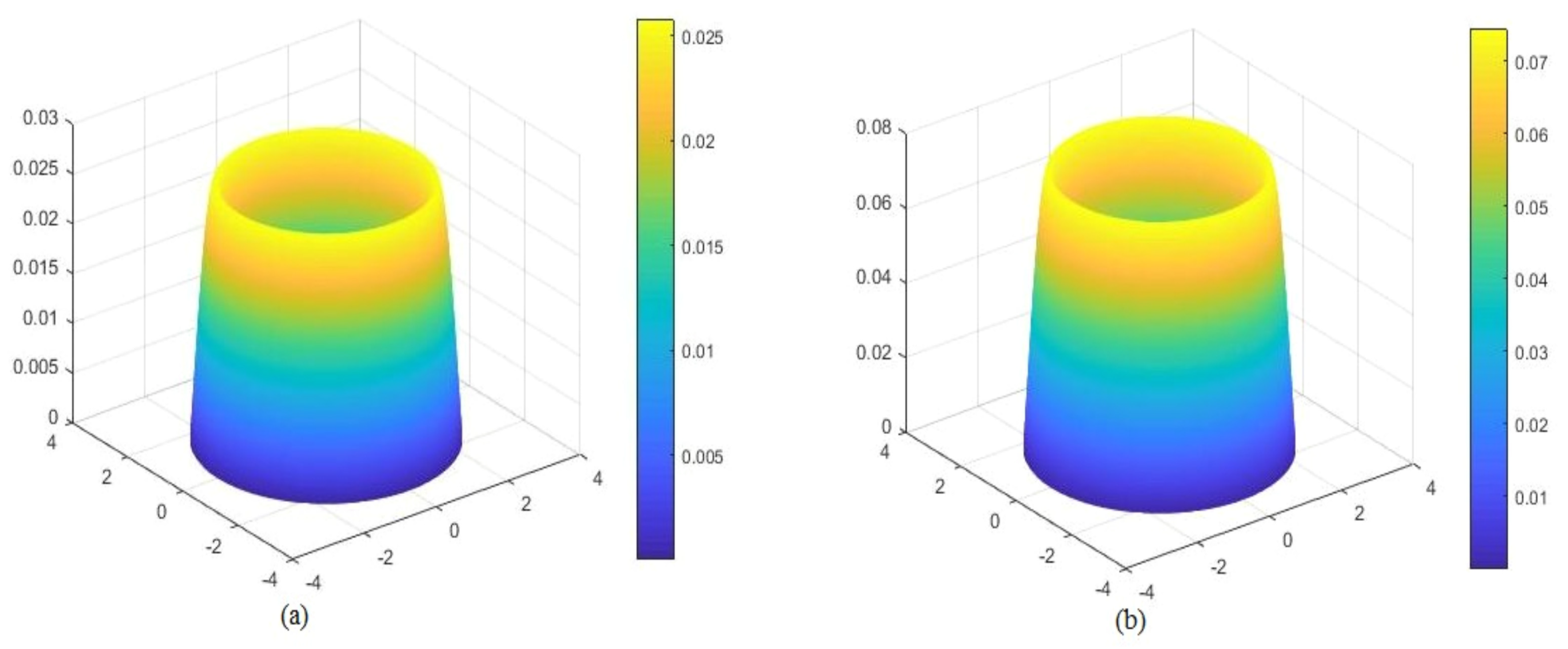
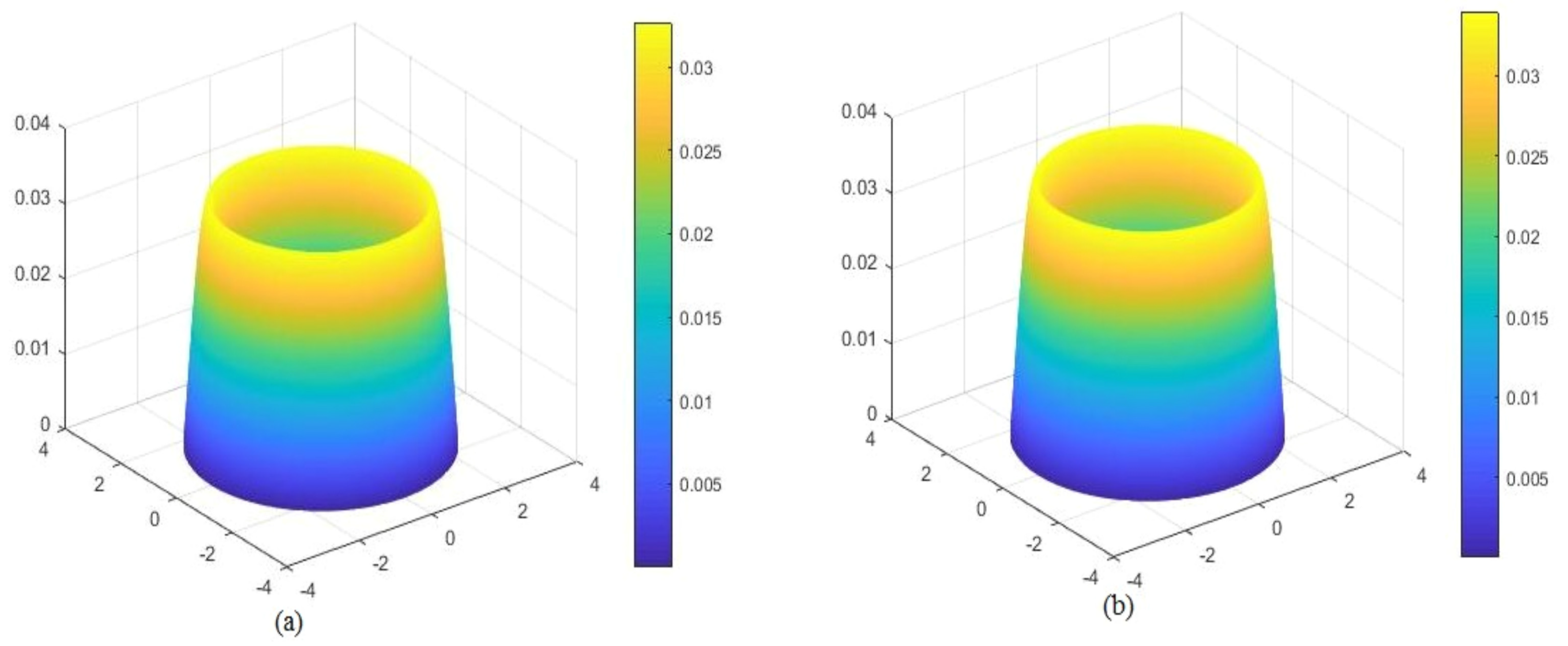
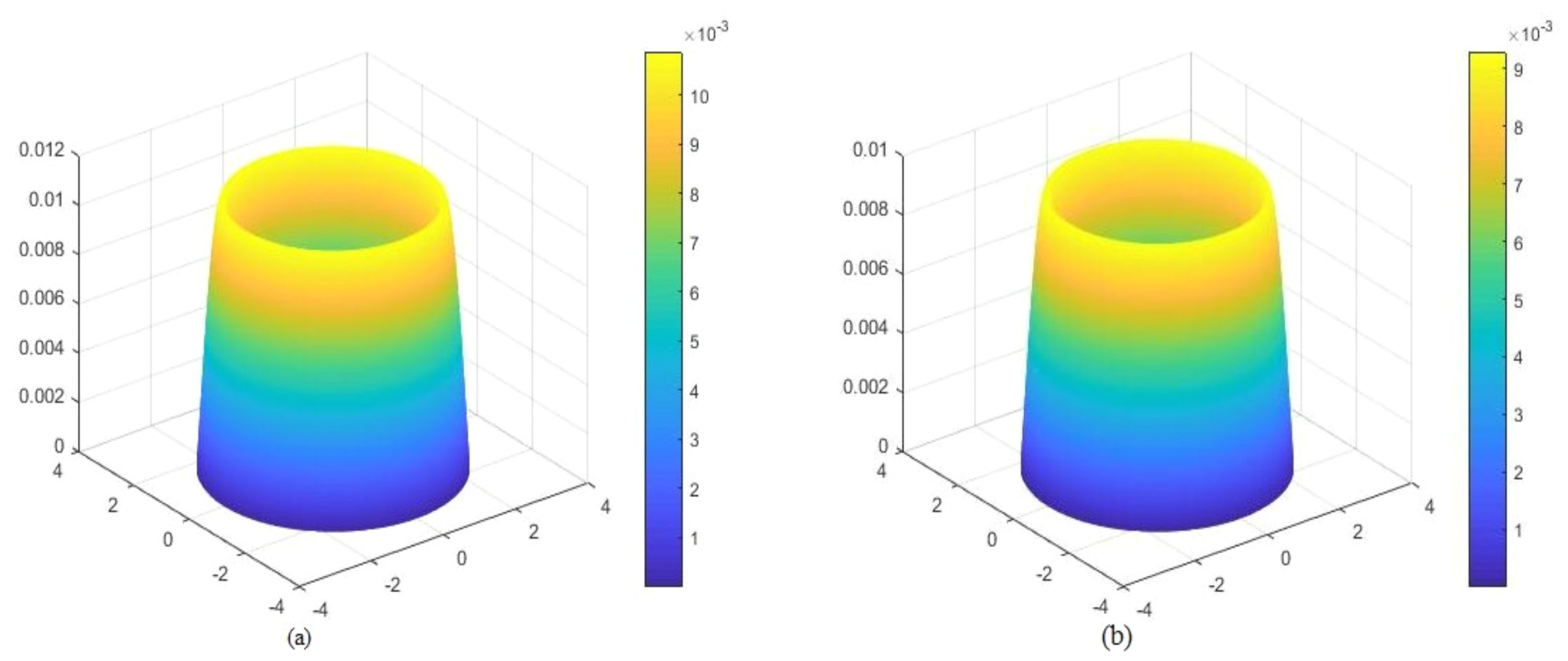
and exhibit them in (a) and (b) of
Figure 2,
Figure 3,
Figure 4,
Figure 5,
Figure 6 and
Figure 7, respectively. From each pair of images in
Figure 2,
Figure 3,
Figure 4,
Figure 5,
Figure 6 and
Figure 7, we can clearly observe that the analytical solutions are basically the same as the NBE solutions.
4.2. The Second Numerical Example, Namely the Case at
When
, we also obtain the NBE solutions
and the analytical solution
at time
,
,
,
,
and
and exhibit them in (a) and (b) of
Figure 8,
Figure 9,
Figure 10,
Figure 11,
Figure 12 and
Figure 13, respectively. Comparing each pair of images in
Figure 8,
Figure 9,
Figure 10,
Figure 11,
Figure 12 and
Figure 13, we can also clearly observe that the NBE solutions are basically the same as the analytical solutions.
The
-norm errors between the NBE solutions
and the analytical solution
at
,
,
,
,
, and
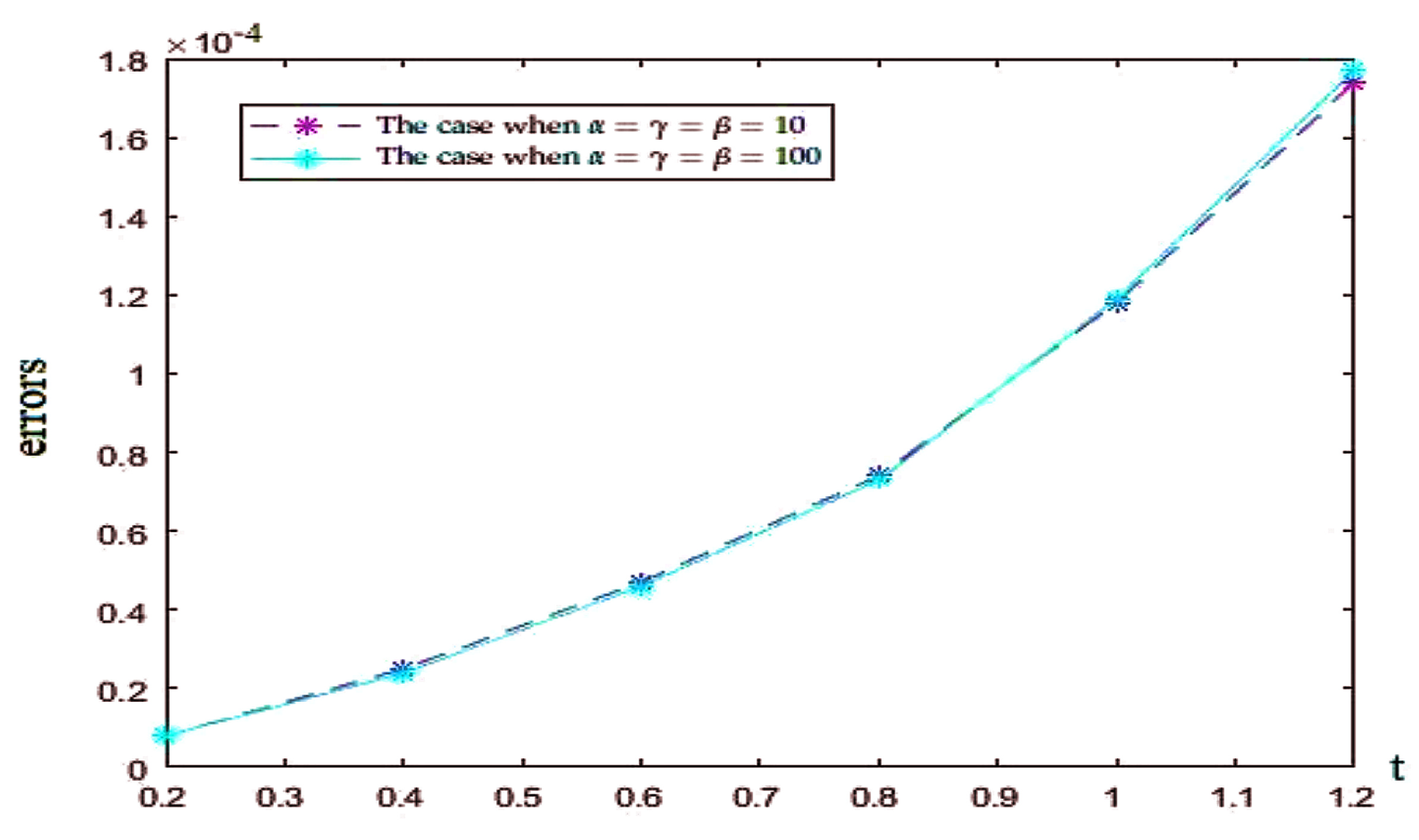
for the two cases are shown graphically in
Figure 14. It has been certified that the numerical simulation results accord with the theory results since both errors reach
. This sufficiently indicates that the NBE method is feasible and effective at finding the numerical solutions of the UTL equation defined in the 2D boundless region and is “robust”.